

Hustle
Which Passive Income Streams Are Worth Starting in 2027?
High-yield savings accounts are paying up to 4.50% APY today — 400 times more than the big-bank average of 0.01%. SCHD is up 13% in 2026 while the S&P 500 trails at 4%. The global e-learning market is heading for $450 billion by 2027. The data on passive income has never been more concrete — but most people still pursue streams that don't match their capital, timeline, or skills. This guide cuts through the noise and ranks each option by what it actually returns, how long it takes, and who it genuinely suits.

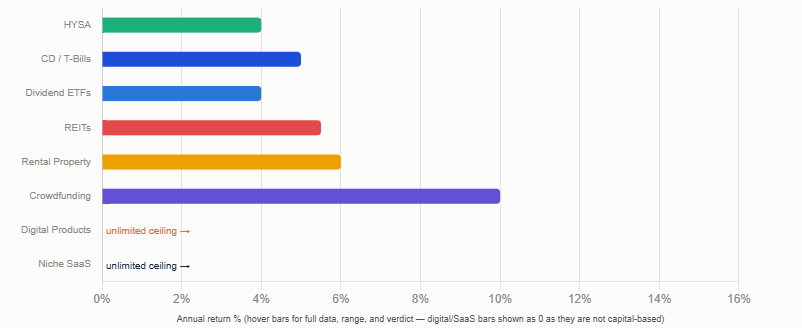
Passive income is real. The data for 2026 makes this clearer than at any point in recent memory. Top high-yield savings accounts are paying up to 4.50% APY as of this week — 400 times more than the 0.01% offered by the nation's largest brick-and-mortar banks. The Schwab US Dividend Equity ETF (SCHD) is up 13% in 2026 versus approximately 4% for the S&P 500 broadly. S&P Global projects 6.5% dividend growth for 2026. The global e-learning market hit $375 billion in 2025 and is projected to reach $450 billion by 2027. These are genuine, documented opportunities — but they serve different investors with different starting points.
The question is not 'which passive income stream is best?' The question is: 'which stream is worth starting, given my capital, my skills, my timeline, and my tolerance for the upfront work that every passive income stream requires?' This guide provides a framework for answering that question — and ranks eight specific streams using current 2026 data, with an eye on what remains viable heading into 2027.
Top HYSA APY September 14, 2026: 4.21% (NerdWallet today) to 4.50% (Fortune/Curinos Sept 11). FDIC national average: 0.38%. Big-bank standard savings: 0.01% (JPMorgan Chase, Bank of America). Gap: top HYSAs pay up to 400x more than big banks. SCHD up 13% in 2026 vs ~4% S&P 500 (moneytalkwitht.com May 2026). S&P Global: 6.5% dividend growth projected for 2026. Global e-learning market: $375B in 2025 → $450B by 2027. Real estate crowdfunding: 6–14% target returns; minimum $10–$500. Best CD rate September 2026: 5.84% (Curinos). Side hustlers need avg $94,000/year to quit full-time work; <11% hit this threshold in 2025.
Four variables determine which streams are worth starting for any given individual: Capital available — the upfront cash required to begin generating meaningful income; Effort — the ongoing time and skill investment required after setup; Timeline — how long before meaningful income flows; and Ceiling — the maximum income potential at full scale. Understanding where you sit on each axis prevents the most common passive income mistake: investing 18 months building a digital product that generates $40 per month, or putting $2,000 into a dividend portfolio and being disappointed by the $80 annual return.
The realistic passive income formula (moneytalkwitht.com May 2026): start with one investment stream (dividend ETF or HYSA) AND one digital stream (digital product or affiliate content) simultaneously. The investment stream generates immediate, real returns. The digital stream builds a scalable asset. Together they build both asset appreciation and recurring income from the earliest possible date. Less than 11% of side hustlers in 2025 reached $94,000/year — the level most say they need to replace full-time income. A 2–5 year focused horizon is realistic for most people building meaningful passive income from scratch.
The catch is that rates are variable and declining. The Fed has kept rates steady in 2026 so far, with the next meeting due later this month. But NerdWallet notes that since early June 2026, 13 accounts on their tracked list have already reduced rates. Bankrate's September 2026 analysis flags an important context: the Consumer Price Index for July 2026 was 3.4% year-over-year — meaning a HYSA paying 3.5% is barely generating real returns after inflation, and 4.21% produces a real pre-tax return of approximately 0.8% per year. This is not wealth-building at scale; it is the correct home for emergency funds and short-term savings while the investor builds higher-yielding positions.
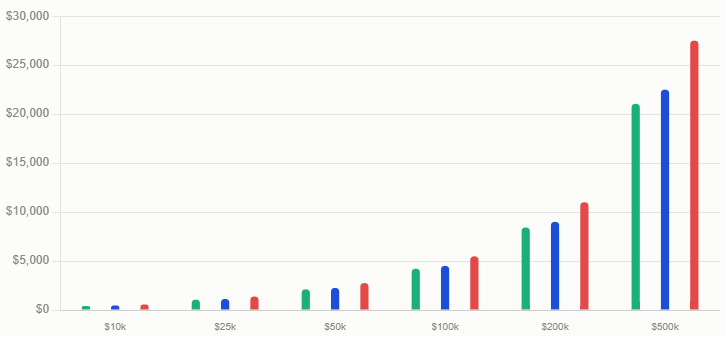
HYSA income examples at current top rates (September 2026). $10,000 at 4.21% APY: $421/year ($35/month). $25,000 at 4.21%: $1,053/year ($88/month). $50,000 at 4.21%: $2,105/year ($175/month). $100,000 at 4.21%: $4,210/year ($351/month). $300,000 at 4% (Ramsey Solutions example): $12,000/year ($1,000/month) — the level at which a HYSA alone generates meaningful passive income. Note: HYSA interest is taxed as ordinary income. CPI July 2026: 3.4% — real after-inflation, pre-tax return at 4.21%: approximately 0.8%. Not financial advice.
HYSA verdict for 2027: High priority for capital under $25,000 or capital earmarked as emergency fund. Rates will drift lower as Fed eventually cuts. Lock in current rates by also holding CDs or T-bills (see Stream 3). Do not use a HYSA as your primary wealth-building vehicle above the emergency fund level — inflation will slowly erode the real value of large static balances.
The dividend universe for 2026 and 2027 spans a wide range of yield and risk profiles. The established dividend ETFs — Schwab US Dividend Equity ETF (SCHD), Vanguard High Dividend Yield ETF (VYM), and Vanguard Dividend Appreciation ETF (VIG) — offer 3–5% yields with diversified exposure and minimal effort. The JPMorgan Equity Premium Income ETF (JEPI) adds a covered call overlay strategy to generate a higher distribution yield, at the cost of capping upside in strongly rising markets. For individual stock exposure, the Dividend Aristocrats — S&P 500 companies that have raised dividends consecutively for 25 or more years — provide the combination of income and demonstrated corporate quality.
The key variable is compounding through dividend reinvestment. A DRIP (Dividend Reinvestment Plan), offered by all major brokerages, automatically uses each dividend payment to purchase additional shares, compounding the income base without requiring any action from the investor. At a 4.5% yield with 6.5% dividend growth projected by S&P Global for 2026, a $100,000 portfolio reinvesting all dividends would produce approximately $4,500 in year one, growing each year as dividends increase and the reinvested share count rises. After ten years without adding a dollar, the same portfolio — assuming the dividend growth and reinvestment compound — would produce substantially more than $4,500 annually from the original capital alone.
Dividend portfolio income at current yields. $10,000 at 4.5% yield: $450/year. $50,000 at 4.5%: $2,250/year ($187/month, InfoDaily May 2026 example). $100,000 at 4.5%: $4,500/year ($375/month). $200,000 at 4.5%: $9,000/year ($750/month). $500,000 at 4.5%: $22,500/year ($1,875/month). Dividend growth at S&P Global's projected 6.5% for 2026: a $4,500 first-year payout grows to approximately $4,793 in year two without adding capital. Tax note: qualified dividends taxed at 0%/15%/20% (LTCG rates) — significantly more favourable than ordinary income tax rates. Contribute to Roth IRA ($7,000/year limit, 2026) to shelter dividend income entirely. Not financial advice.
Dividend ETF verdict for 2027: High priority for investors with $5,000+ capital and a 5–10 year horizon. SCHD and VYM are the lowest-effort entry points. DRIP from day one. The 2026 outperformance of dividend vs. growth is likely to persist if rates remain elevated heading into 2027. This is the single best passive income stream for most investors who are not yet ready for real estate.
T-bills — Treasury bills with maturities of 4, 8, 13, or 26 weeks — currently yield in the 4–5% range. The Fund Advisor's June 2026 guide recommends a T-bill ladder: staggering maturity dates across the four durations to maintain regular liquidity while maximising yield. Because T-bill interest is exempt from state and local income tax (though subject to federal tax), the after-tax yield for investors in high-income-tax states can exceed the after-tax yield of an equivalent HYSA rate by a meaningful margin. For a New York City resident in a combined state and city income tax bracket of 12%, a 4.5% T-bill yield effectively equals approximately 5.1% on an after-tax basis relative to a HYSA.
I-bonds — US Treasury Series I savings bonds — remain a niche but powerful tool for inflation-protected savings. The annual purchase limit is $10,000 per person, and the rate adjusts to CPI every six months. At a July 2026 CPI of 3.4%, I-bonds offer a real hedge against the primary risk to HYSA investors: rising inflation eroding the purchasing power of savings. The trade-off is a one-year minimum holding period and a three-month interest penalty for redemption within five years.
The 2027 rate-lock strategy: lock in 5.84% on a 12-month CD now for any cash you will not need for a year. Simultaneously build a T-bill ladder with 4, 8, 13, and 26-week bills. Allocate up to $10,000 per person per year to I-bonds as an inflation hedge. If the Fed cuts rates in late 2026 or early 2027, the CD and T-bill positions will have preserved the current rate environment for the duration of their terms — while HYSA rates drift down in real time. This is the correct positioning for the cash/fixed-income portion of any passive income portfolio heading into 2027.
The yield landscape for REITs in 2026 spans a wide range. Realty Income Corporation (ticker: O) — one of the most widely held REITs among income investors — pays a 5.5% dividend yield as of 2026 and has raised its dividend 133 times since going public 32 years ago, according to Primior Group's analysis. High-dividend REITs more broadly can push yields above 8%, though higher yields typically reflect either higher-risk property sectors or specific corporate balance sheet dynamics. NerdWallet's June 2026 analysis notes that the five-year return of the best-performing mutual fund REIT on their tracked list is approximately 4% — a reminder that total return (capital appreciation plus income) is the correct metric, not yield alone.
For investors who want REIT exposure without picking individual companies, REIT ETFs and mutual funds provide instant diversification across sectors: industrial REITs, retail REITs, healthcare REITs, residential REITs, office REITs, and data centre REITs. The sector mix matters: data centre REITs have been among the strongest performers given AI infrastructure demand, while office REITs have faced structural headwinds from hybrid working. A broad REIT index fund eliminates the need to make sector bets.
REIT verdict for 2027: Medium-high priority for investors who want real estate exposure with stock market liquidity. Realty Income (O) and REIT ETFs (VNQ, SCHH) are the lowest-effort entry points. Yields of 5–8% with monthly or quarterly dividend payments make REITs a natural complement to dividend equity ETFs. Hold REITs in tax-advantaged accounts (Roth IRA, 401k) where possible — REIT dividends are mostly ordinary income, not qualified dividends, making tax sheltering particularly valuable.
The yield data for 2026 is concrete. Direct rental property in the US yields 4–8% cash-on-cash returns, according to ideaproof.io's August 2026 analysis. Ramsey Solutions' June 2026 guide sets the benchmark: one rental property netting $1,000 per month after expenses — taxes, insurance, and maintenance — is realistic in most markets, particularly if the property is paid for in cash. The illustrative example from ideaproof.io is instructive: a $200,000 property generating $1,800 per month in rent minus $1,200 per month in expenses (mortgage, taxes, insurance, maintenance reserve, management) produces $600 per month, or $7,200 per year — a 3.6% cash yield on the purchase price, with equity and appreciation building in parallel.
The critical input that changes everything is the mortgage rate. At 6.76% on a 30-year fixed mortgage (the national average as of September 10, 2026, per Freddie Mac), a $160,000 mortgage on a $200,000 purchase costs approximately $1,043 per month in principal and interest alone — before taxes, insurance, maintenance, or management. The property must generate sufficient rent to cover all of these and still produce a positive cash yield. In many high-cost-of-living markets in 2026, this arithmetic is difficult to achieve for new investors without a large down payment. The markets where rental yield remains attractive are generally secondary cities with lower purchase prices relative to rents.
Rental property is not a passive income stream at entry level. It requires substantial capital for the down payment (typically 20–25% for investment properties), carries illiquidity risk (you cannot sell a rental in seconds the way you can sell a REIT), demands management time or management fees, and exposes the owner to vacancy risk, major unexpected repairs, and tenant disputes. The path to truly passive rental income — outsourcing all management to a property manager — typically requires either a portfolio large enough to absorb the 8–12% management fee or properties with yields high enough to sustain it. For most people entering passive income for the first time, REITs and real estate crowdfunding are the correct step before direct property ownership.
The return profile is more attractive than public REITs but comes with important caveats. Realistic earnings from real estate crowdfunding in 2026 are 6–14% annually, depending on the platform and risk tier, according to The Fund Advisor's June 2026 analysis. The higher end of that range typically reflects value-add or development projects with higher risk profiles; core and core-plus strategies targeting stabilised assets sit in the 6–9% range. The critical restriction is liquidity: these investments are typically locked for three to seven years. Early redemption windows exist on some platforms but are not guaranteed. Investors should treat crowdfunding allocations as illiquid commitments from day one.
The Fund Advisor's June 2026 guide highlights a notable 2026 development: AI-driven property valuation tools are now embedded in most major platforms, making due diligence faster and more accurate than it was even two years ago. This reduces (but does not eliminate) the information asymmetry that historically disadvantaged retail investors in private real estate markets. For investors who want real estate exposure above what public REITs provide without taking on direct property management, crowdfunding platforms offer a practical middle path — provided the investor is comfortable with multi-year illiquidity.
Crowdfunding verdict for 2027: Medium priority; suitable only if you can commit the capital for 3–7 years. A 6–14% target return range with a 3–7 year lock-up competes well against dividend ETFs for risk-adjusted return, but the illiquidity and platform risk (regulatory, solvency) require careful due diligence. Limit to 10–20% of a passive income portfolio. Fundrise's eREIT structure is generally the most accessible and transparent starting point.
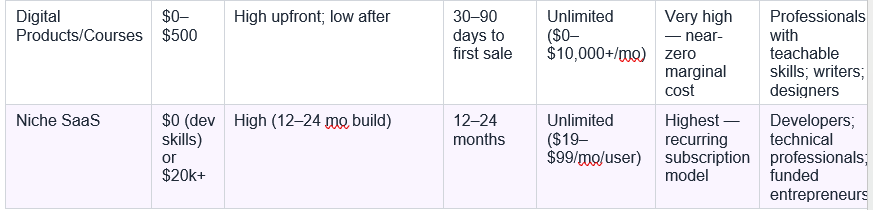
The market for digital products is large and growing. The global e-learning market hit $375 billion in 2025 and is projected to reach $450 billion by 2027, according to ideaproof.io's August 2026 analysis. Digital templates and downloads on platforms like Gumroad and Etsy sell for $5 to $50 each. Self-paced online courses command $200 to $2,000 per seat. The income ceiling for successful course creators is genuinely high — a course sold at $500 per seat to 200 students per year generates $100,000 in annual revenue with minimal ongoing effort after initial creation.
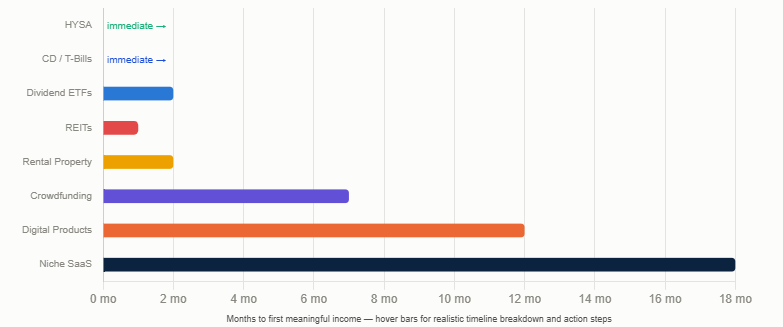
The timeline reality is important to set correctly. Content-based income — including courses, digital products, blogging, and affiliate marketing — typically takes 6 to 18 months to become meaningful, according to multiple sources in the 2026 data. The process requires building an audience or marketing capability, which is itself a form of work that looks nothing like passive. The standard benchmark cited across sources is approximately 12 months of consistent effort to reach $500 per month in passive income from digital products — a realistic but not rapid outcome. The moneytalkwitht.com May 2026 analysis adds the critical context that digital products 'scale better' than investment-based streams, meaning that the $500/month at 12 months can become $5,000/month at 36 months if the initial product and marketing approach are validated.
Digital product starting point for 2027: identify one professional skill or body of knowledge you can teach or template. Create one product (Canva template pack, Notion template, short PDF guide, or 5-module video course). Sell it on Gumroad ($0 setup cost) or Etsy. Spend the first 90 days marketing it through existing networks, Reddit communities, LinkedIn, or a simple newsletter. Expect first revenue within 30–90 days; meaningful passive income (above $500/month) within 12 months of consistent iteration. Build the investment streams in parallel — the two compound together faster than either alone.
The catch — and it is a significant one — is the entry barrier. Niche SaaS requires either software development skills (to build the product) or the capital to hire developers. It requires a validated problem and a market willing to pay. And it typically requires 12 to 24 months of development, customer discovery, and iteration before reaching the level of reliability and polish that supports a paying subscriber base. The ideaproof.io August 2026 guide notes that the best digital passive income options in 2026 include niche SaaS, but frames the timeline to $1,000 per month in monthly recurring revenue (MRR) as 6 to 12 months — achievable, but only with strong execution and prior market validation.
For 2027, the most accessible niche SaaS opportunities lie in AI-augmented tools: products that wrap existing AI APIs to solve a specific, repetitive professional problem in a domain where the builder has subject matter expertise. A lawyer building a contract clause checker, an accountant building an expense categorisation tool, a fitness trainer building a workout plan generator — these are the archetypes of viable 2027 micro-SaaS products. The AI infrastructure exists; the gap is domain-specific application.
Niche SaaS verdict for 2027: Low priority for anyone without software development skills or a willing developer partner, regardless of capital. Highest priority for developers, technical professionals, or those with budget to hire. Do not start this stream expecting passive income within six months. The 12–24 month build timeline and the requirement for ongoing customer support and product updates in the early phase mean this is an active business that becomes increasingly passive over time. The long-run ceiling — $10,000 to $50,000+ per month in MRR — justifies the investment for the right person.
The sequencing matters as much as the selection. For a beginner with $5,000 in available capital and professional skills to monetise, the correct 2027 order is: first, open a HYSA with the full $5,000 (immediate income, zero risk, FDIC-insured); second, open a brokerage account and begin a monthly contribution to SCHD or VYM with whatever can be set aside from income (DRIP from day one); third, create one digital product from existing professional skills (12–18 month build-and-market cycle). The HYSA and dividend portfolio provide an income floor and growing asset base. The digital product provides the scalable ceiling.
Qualified dividends — paid by most US corporations and eligible ETFs — are taxed at 0% (income below $48,350 single/$96,700 married filing jointly), 15%, or 20% long-term capital gains rates. This is dramatically more favourable than ordinary income tax rates for most investors. REIT dividends, by contrast, are mostly classified as ordinary income (non-qualified), making them the highest-priority candidates for tax sheltering inside a Roth IRA or traditional 401k.
HYSA and CD interest is taxed as ordinary income — the least favourable tax treatment of any income stream discussed here. T-bill interest is exempt from state and local tax but subject to federal income tax. I-bond interest is deferred until redemption, providing a form of interest compounding that is tax-advantaged relative to annual HYSA interest taxation. Digital product income is taxed as self-employment income for sole proprietors, subject to both income tax and self-employment tax (15.3% on the first $168,600 in 2026) — making the effective marginal rate higher than it appears on gross revenue.
For 2027, the most important tax development to monitor is the sunset of provisions from the 2017 Tax Cuts and Jobs Act, which was extended by the One Big Beautiful Bill Act signed July 4, 2025. The current standard deduction, income tax brackets, and LTCG thresholds are now extended indefinitely under that legislation, providing certainty for the dividend and REIT tax treatment that defines the return profile of the investment streams in this guide. Always consult a qualified tax professional for your specific circumstances.
For anyone with capital but no skills to monetise yet: open a top-rate HYSA immediately (earning up to 4.21–4.50% today, versus 0.01% at your current big bank), lock in the best available CD rate for a 12-month horizon (5.84% as of September 1, 2026), and begin monthly contributions to SCHD or VYM inside a Roth IRA with DRIP enabled. These three actions require perhaps two hours to set up and generate income from day one, compounding automatically from that point forward.
For anyone with professional skills and time to invest: the digital product path is the most rational 2027 starting point for building income that is not capital-constrained. The e-learning market heading toward $450 billion by 2027 is real. The near-zero marginal cost of a digital product after creation is real. The 6–18 month timeline to meaningful income is also real — the correct expectation is a 12-month commitment before conclusions about viability are drawn.
For anyone with substantial capital ($100,000+) and a long horizon: the combination of a dividend ETF portfolio inside a Roth IRA, a REIT allocation sheltered from ordinary income tax, and a T-bill ladder preserving liquidity and rate-locking is the institutional-grade passive income playbook at the individual investor scale. Rental property and real estate crowdfunding add to this stack, not replace it. The streams are not competing alternatives — they are complementary layers of a portfolio that produces income through multiple mechanisms simultaneously.
For most beginners, the correct first passive income stream is a combination of two: a high-yield savings account (HYSA) and a dividend ETF. The HYSA is opened immediately at an FDIC-insured online bank — top rates as of September 14, 2026 are up to 4.21% (NerdWallet) to 4.50% (Fortune/Curinos September 11, 2026), versus 0.38% national average and 0.01% at big banks like Chase and Bank of America. The dividend ETF is opened simultaneously in a brokerage account or Roth IRA, with DRIP (dividend reinvestment) enabled from day one. SCHD or VYM are the most common starting choices. Both streams require minimal ongoing effort, generate income from the first month, and compound automatically. The beginner's mistake is starting with rental property or niche SaaS — streams that require large capital or long build times — before establishing these two foundations.
How much money do I need to start generating meaningful passive income?
The threshold for 'meaningful' passive income varies by context, but $500 per month is a common benchmark. At 4.21% HYSA yield, $500/month requires approximately $1.43 million in cash savings — clearly not a beginner starting point. At a 4.5% dividend yield, the same $500/month requires approximately $133,000 invested. With rental property at $600/month net cash flow, one well-priced rental property provides it — but requires $40,000 to $60,000 in down payment. Digital products are the exception: $500/month in digital product income requires near-zero capital but approximately 12 months of consistent effort to build and market the product. The honest answer is that meaningful investment-based passive income requires either significant capital or significant time — and most people building from scratch need to begin with both a small investment stream and a skill-based digital stream to reach $500/month within a realistic timeframe.
Are dividend stocks better than high-yield savings accounts for passive income?
For any time horizon beyond 3–5 years, dividend stocks (particularly ETFs like SCHD and VYM) generate significantly more total return than HYSAs. The 2026 data makes this vivid: SCHD is up 13% year-to-date versus approximately 4% for the broader S&P 500, and S&P Global projects 6.5% dividend growth for 2026. A $50,000 HYSA at 4.21% generates $2,105/year. The same $50,000 in a dividend ETF at 4.5% yield generates $2,250/year — and that $2,250 grows each year as dividends increase and reinvested shares compound. HYSA rates are variable and will decline when the Fed cuts rates. Dividend income from quality companies tends to grow year on year. The correct allocation is both: the HYSA for emergency funds and short-term cash (0–2 year horizon), dividend ETFs for 3–10+ year capital. HYSA interest is taxed as ordinary income; qualified dividends enjoy 0%/15%/20% LTCG rates — a meaningful advantage for most investors.
How long does it take to build a real passive income from digital products?
The honest benchmark from 2026 data is 12 months of consistent effort to reach $500/month in passive income from digital products (viewstorys.com/ideaproof.io May/August 2026). Content-based income — including courses, digital downloads, blogs, and affiliate marketing — typically takes 6–18 months to become meaningful. The first 90 days produce little revenue in most cases; the 6–12 month mark is where consistent marketing and product iteration begins to generate compounding traffic and repeat sales. The ceiling is genuinely high: the global e-learning market is projected to reach $450 billion by 2027 (ideaproof.io August 2026). But the path from zero to $500/month is an active one — requiring consistent content creation, audience building, and product refinement — before it becomes genuinely passive. The streams that scale most reliably are those built on validated professional expertise (an accountant's tax guide, a designer's template pack, a lawyer's contract library) rather than generic 'how to make money online' content.
Is real estate crowdfunding safe for passive income in 2026–2027?
Real estate crowdfunding platforms like Fundrise and RealtyMogul offer 6–14% target annual returns with minimum investments of $10–$500 (ideaproof.io August 2026; The Fund Advisor June 2026). The returns are genuinely higher than public REITs in many scenarios, but they come with two risks that public REITs do not carry: illiquidity (3–7 year commitment in most cases, with no guarantee of early redemption) and platform risk (the platform itself must remain solvent and well-managed for the investment to return as projected). The AI-driven property valuation tools now embedded in major platforms (thefundadvisor.com June 2026) have reduced due diligence complexity, but do not eliminate investment risk. For 2026–2027, crowdfunding is appropriate as a 10–20% allocation within a broader passive income portfolio — not as a primary or sole income strategy. Treat the minimum stated holding period as the realistic expectation, not a worst case.
What passive income stream has the highest ceiling in 2027?
Niche SaaS (software as a service) has the highest income ceiling of any passive income stream in 2027, followed by digital products and online courses. A successful niche SaaS product charging $49/month to 500 subscribers generates $24,500/month in monthly recurring revenue — with the same infrastructure costs as 50 subscribers. Once built and stabilised, a SaaS product with low churn can sustain that income with minimal ongoing effort beyond customer support and occasional feature updates. However, the entry barrier is high: building a viable SaaS product requires either software development skills (typically 12–24 months of development) or capital to hire developers ($20,000+ for a minimal viable product), plus market validation and customer acquisition. For most people, the correct approach to the highest ceiling is to use investment streams (HYSA, dividend ETFs, REITs) to build capital while using professional skills to create digital products — and to consider SaaS only if the skills and validated market are both present.
Table of Contents
- Why Most Passive Income Advice Misses the Point
- The Master Framework: Effort, Capital, Timeline, and Ceiling
- Stream 1 — High-Yield Savings Accounts: The Honest Starting Point
- Stream 2 — Dividend ETFs and Stocks: The Compounding Engine
- Stream 3 — Treasury Bills, CDs, and Bonds: The Rate-Lock Opportunity
- Stream 4 — REITs: Real Estate Returns Without Property Management
- Stream 5 — Rental Property: The Real Numbers Behind the Dream
- Stream 6 — Real Estate Crowdfunding: The Middle Path
- Stream 7 — Digital Products and Online Courses: The Scalable Option
- Stream 8 — Niche SaaS and Software: The Highest Ceiling
- The Master Comparison: All 8 Streams Ranked Side by Side
- How to Stack Passive Income Streams Without Overextending
- Tax Considerations: What Changes in 2027
- Conclusion: Which Stream Should You Actually Start?
- Frequently Asked Questions
Return Rate By Stream (Annual %)
Annual Income By Capital Invested
Time To First Meaningfull Income
Why Most Passive Income Advice Misses the Point
Search for 'passive income ideas' and you'll find articles recommending everything from renting out your parking space to building a dropshipping empire. The advice is rarely wrong — it is simply untethered from reality. A parking space in rural Kansas and a parking space in downtown Chicago are not the same opportunity. A dividend portfolio that took twenty years and $400,000 to build is not something a 28-year-old with $3,000 can replicate by next spring. And a SaaS product that generates $10,000 per month in recurring revenue required someone with software engineering skills, 18 months of development, and a viable market idea.Passive income is real. The data for 2026 makes this clearer than at any point in recent memory. Top high-yield savings accounts are paying up to 4.50% APY as of this week — 400 times more than the 0.01% offered by the nation's largest brick-and-mortar banks. The Schwab US Dividend Equity ETF (SCHD) is up 13% in 2026 versus approximately 4% for the S&P 500 broadly. S&P Global projects 6.5% dividend growth for 2026. The global e-learning market hit $375 billion in 2025 and is projected to reach $450 billion by 2027. These are genuine, documented opportunities — but they serve different investors with different starting points.
The question is not 'which passive income stream is best?' The question is: 'which stream is worth starting, given my capital, my skills, my timeline, and my tolerance for the upfront work that every passive income stream requires?' This guide provides a framework for answering that question — and ranks eight specific streams using current 2026 data, with an eye on what remains viable heading into 2027.
Top HYSA APY September 14, 2026: 4.21% (NerdWallet today) to 4.50% (Fortune/Curinos Sept 11). FDIC national average: 0.38%. Big-bank standard savings: 0.01% (JPMorgan Chase, Bank of America). Gap: top HYSAs pay up to 400x more than big banks. SCHD up 13% in 2026 vs ~4% S&P 500 (moneytalkwitht.com May 2026). S&P Global: 6.5% dividend growth projected for 2026. Global e-learning market: $375B in 2025 → $450B by 2027. Real estate crowdfunding: 6–14% target returns; minimum $10–$500. Best CD rate September 2026: 5.84% (Curinos). Side hustlers need avg $94,000/year to quit full-time work; <11% hit this threshold in 2025.
The Master Framework: Effort, Capital, Timeline, and Ceiling
Every passive income stream sits somewhere on two axes: how much capital it requires upfront versus how much time and skill it demands. The streams that require large capital tend to be accessible from day one — open a HYSA, buy a dividend ETF, purchase REITs. The streams that require large time/skill investments tend to have no ceiling — a successful SaaS product, online course library, or digital product store can scale indefinitely without proportional cost increases.Four variables determine which streams are worth starting for any given individual: Capital available — the upfront cash required to begin generating meaningful income; Effort — the ongoing time and skill investment required after setup; Timeline — how long before meaningful income flows; and Ceiling — the maximum income potential at full scale. Understanding where you sit on each axis prevents the most common passive income mistake: investing 18 months building a digital product that generates $40 per month, or putting $2,000 into a dividend portfolio and being disappointed by the $80 annual return.
The realistic passive income formula (moneytalkwitht.com May 2026): start with one investment stream (dividend ETF or HYSA) AND one digital stream (digital product or affiliate content) simultaneously. The investment stream generates immediate, real returns. The digital stream builds a scalable asset. Together they build both asset appreciation and recurring income from the earliest possible date. Less than 11% of side hustlers in 2025 reached $94,000/year — the level most say they need to replace full-time income. A 2–5 year focused horizon is realistic for most people building meaningful passive income from scratch.
Stream 1 — High-Yield Savings Accounts: The Honest Starting Point
The most unglamorous passive income stream on this list is also the most honest starting point for anyone building from zero. A high-yield savings account at an FDIC-insured online bank requires zero investment skill, carries zero risk of capital loss, can be opened with any amount, and starts earning from the first day. As of September 14, 2026, the best available rates are up to 4.21% APY per NerdWallet's daily-updated list and up to 4.50% per Fortune's Curinos data published September 11 — against a national average of 0.38% (FDIC data as of August 17, 2026) and 0.01% at the largest brick-and-mortar banks.The catch is that rates are variable and declining. The Fed has kept rates steady in 2026 so far, with the next meeting due later this month. But NerdWallet notes that since early June 2026, 13 accounts on their tracked list have already reduced rates. Bankrate's September 2026 analysis flags an important context: the Consumer Price Index for July 2026 was 3.4% year-over-year — meaning a HYSA paying 3.5% is barely generating real returns after inflation, and 4.21% produces a real pre-tax return of approximately 0.8% per year. This is not wealth-building at scale; it is the correct home for emergency funds and short-term savings while the investor builds higher-yielding positions.
HYSA income examples at current top rates (September 2026). $10,000 at 4.21% APY: $421/year ($35/month). $25,000 at 4.21%: $1,053/year ($88/month). $50,000 at 4.21%: $2,105/year ($175/month). $100,000 at 4.21%: $4,210/year ($351/month). $300,000 at 4% (Ramsey Solutions example): $12,000/year ($1,000/month) — the level at which a HYSA alone generates meaningful passive income. Note: HYSA interest is taxed as ordinary income. CPI July 2026: 3.4% — real after-inflation, pre-tax return at 4.21%: approximately 0.8%. Not financial advice.
HYSA verdict for 2027: High priority for capital under $25,000 or capital earmarked as emergency fund. Rates will drift lower as Fed eventually cuts. Lock in current rates by also holding CDs or T-bills (see Stream 3). Do not use a HYSA as your primary wealth-building vehicle above the emergency fund level — inflation will slowly erode the real value of large static balances.
Stream 2 — Dividend ETFs and Stocks: The Compounding Engine
Dividend investing entered 2026 with a rare combination of tailwinds: elevated interest rates making dividend yields more competitive with bonds than in a decade; institutional rotation away from growth stocks toward defensive dividend payers; and the mathematical power of dividend reinvestment compounding at scale over time. The result has been visible in the 2026 performance data: SCHD is up 13% year-to-date versus approximately 4% for the broader S&P 500, according to moneytalkwitht.com's May 2026 analysis.The dividend universe for 2026 and 2027 spans a wide range of yield and risk profiles. The established dividend ETFs — Schwab US Dividend Equity ETF (SCHD), Vanguard High Dividend Yield ETF (VYM), and Vanguard Dividend Appreciation ETF (VIG) — offer 3–5% yields with diversified exposure and minimal effort. The JPMorgan Equity Premium Income ETF (JEPI) adds a covered call overlay strategy to generate a higher distribution yield, at the cost of capping upside in strongly rising markets. For individual stock exposure, the Dividend Aristocrats — S&P 500 companies that have raised dividends consecutively for 25 or more years — provide the combination of income and demonstrated corporate quality.
The key variable is compounding through dividend reinvestment. A DRIP (Dividend Reinvestment Plan), offered by all major brokerages, automatically uses each dividend payment to purchase additional shares, compounding the income base without requiring any action from the investor. At a 4.5% yield with 6.5% dividend growth projected by S&P Global for 2026, a $100,000 portfolio reinvesting all dividends would produce approximately $4,500 in year one, growing each year as dividends increase and the reinvested share count rises. After ten years without adding a dollar, the same portfolio — assuming the dividend growth and reinvestment compound — would produce substantially more than $4,500 annually from the original capital alone.
Dividend portfolio income at current yields. $10,000 at 4.5% yield: $450/year. $50,000 at 4.5%: $2,250/year ($187/month, InfoDaily May 2026 example). $100,000 at 4.5%: $4,500/year ($375/month). $200,000 at 4.5%: $9,000/year ($750/month). $500,000 at 4.5%: $22,500/year ($1,875/month). Dividend growth at S&P Global's projected 6.5% for 2026: a $4,500 first-year payout grows to approximately $4,793 in year two without adding capital. Tax note: qualified dividends taxed at 0%/15%/20% (LTCG rates) — significantly more favourable than ordinary income tax rates. Contribute to Roth IRA ($7,000/year limit, 2026) to shelter dividend income entirely. Not financial advice.
Dividend ETF verdict for 2027: High priority for investors with $5,000+ capital and a 5–10 year horizon. SCHD and VYM are the lowest-effort entry points. DRIP from day one. The 2026 outperformance of dividend vs. growth is likely to persist if rates remain elevated heading into 2027. This is the single best passive income stream for most investors who are not yet ready for real estate.
Stream 3 — Treasury Bills, CDs, and Bonds: The Rate-Lock Opportunity
While HYSA rates are variable and trending downward, Treasury bills and certificates of deposit offer the ability to lock in current rates for a defined period — a meaningful advantage if the Federal Reserve begins cutting rates in late 2026 or early 2027. The best CD rate available as of September 1, 2026, per Curinos data published on MSN, is 5.84% on accounts with a $2,500 minimum deposit. That is the highest guaranteed, risk-free return available anywhere in mainstream personal finance today.T-bills — Treasury bills with maturities of 4, 8, 13, or 26 weeks — currently yield in the 4–5% range. The Fund Advisor's June 2026 guide recommends a T-bill ladder: staggering maturity dates across the four durations to maintain regular liquidity while maximising yield. Because T-bill interest is exempt from state and local income tax (though subject to federal tax), the after-tax yield for investors in high-income-tax states can exceed the after-tax yield of an equivalent HYSA rate by a meaningful margin. For a New York City resident in a combined state and city income tax bracket of 12%, a 4.5% T-bill yield effectively equals approximately 5.1% on an after-tax basis relative to a HYSA.
I-bonds — US Treasury Series I savings bonds — remain a niche but powerful tool for inflation-protected savings. The annual purchase limit is $10,000 per person, and the rate adjusts to CPI every six months. At a July 2026 CPI of 3.4%, I-bonds offer a real hedge against the primary risk to HYSA investors: rising inflation eroding the purchasing power of savings. The trade-off is a one-year minimum holding period and a three-month interest penalty for redemption within five years.
The 2027 rate-lock strategy: lock in 5.84% on a 12-month CD now for any cash you will not need for a year. Simultaneously build a T-bill ladder with 4, 8, 13, and 26-week bills. Allocate up to $10,000 per person per year to I-bonds as an inflation hedge. If the Fed cuts rates in late 2026 or early 2027, the CD and T-bill positions will have preserved the current rate environment for the duration of their terms — while HYSA rates drift down in real time. This is the correct positioning for the cash/fixed-income portion of any passive income portfolio heading into 2027.
Stream 4 — REITs: Real Estate Returns Without Property Management
Real Estate Investment Trusts are corporations required by law to distribute at least 90% of their taxable income to shareholders as dividends — which is why they typically offer higher yields than ordinary stocks. Publicly traded REITs trade like stocks, offering full liquidity: you can buy or sell in seconds through any brokerage account. And unlike direct property ownership, they require zero property management, zero maintenance calls, and zero dealing with tenants.The yield landscape for REITs in 2026 spans a wide range. Realty Income Corporation (ticker: O) — one of the most widely held REITs among income investors — pays a 5.5% dividend yield as of 2026 and has raised its dividend 133 times since going public 32 years ago, according to Primior Group's analysis. High-dividend REITs more broadly can push yields above 8%, though higher yields typically reflect either higher-risk property sectors or specific corporate balance sheet dynamics. NerdWallet's June 2026 analysis notes that the five-year return of the best-performing mutual fund REIT on their tracked list is approximately 4% — a reminder that total return (capital appreciation plus income) is the correct metric, not yield alone.
For investors who want REIT exposure without picking individual companies, REIT ETFs and mutual funds provide instant diversification across sectors: industrial REITs, retail REITs, healthcare REITs, residential REITs, office REITs, and data centre REITs. The sector mix matters: data centre REITs have been among the strongest performers given AI infrastructure demand, while office REITs have faced structural headwinds from hybrid working. A broad REIT index fund eliminates the need to make sector bets.
REIT verdict for 2027: Medium-high priority for investors who want real estate exposure with stock market liquidity. Realty Income (O) and REIT ETFs (VNQ, SCHH) are the lowest-effort entry points. Yields of 5–8% with monthly or quarterly dividend payments make REITs a natural complement to dividend equity ETFs. Hold REITs in tax-advantaged accounts (Roth IRA, 401k) where possible — REIT dividends are mostly ordinary income, not qualified dividends, making tax sheltering particularly valuable.
Stream 5 — Rental Property: The Real Numbers Behind the Dream
Rental property is the passive income stream most people dream about and the one that is least passive in practice. It is also, properly structured, one of the most powerful wealth-building vehicles available — combining cash-on-cash yield, mortgage paydown (a form of forced savings), depreciation tax advantages, and long-run capital appreciation. The word 'passive' requires heavy qualification: managing tenants, maintenance, vacancies, and compliance is a part-time job for most landlords who self-manage, and professional property management typically costs 8–12% of gross rents.The yield data for 2026 is concrete. Direct rental property in the US yields 4–8% cash-on-cash returns, according to ideaproof.io's August 2026 analysis. Ramsey Solutions' June 2026 guide sets the benchmark: one rental property netting $1,000 per month after expenses — taxes, insurance, and maintenance — is realistic in most markets, particularly if the property is paid for in cash. The illustrative example from ideaproof.io is instructive: a $200,000 property generating $1,800 per month in rent minus $1,200 per month in expenses (mortgage, taxes, insurance, maintenance reserve, management) produces $600 per month, or $7,200 per year — a 3.6% cash yield on the purchase price, with equity and appreciation building in parallel.
The critical input that changes everything is the mortgage rate. At 6.76% on a 30-year fixed mortgage (the national average as of September 10, 2026, per Freddie Mac), a $160,000 mortgage on a $200,000 purchase costs approximately $1,043 per month in principal and interest alone — before taxes, insurance, maintenance, or management. The property must generate sufficient rent to cover all of these and still produce a positive cash yield. In many high-cost-of-living markets in 2026, this arithmetic is difficult to achieve for new investors without a large down payment. The markets where rental yield remains attractive are generally secondary cities with lower purchase prices relative to rents.
Rental property is not a passive income stream at entry level. It requires substantial capital for the down payment (typically 20–25% for investment properties), carries illiquidity risk (you cannot sell a rental in seconds the way you can sell a REIT), demands management time or management fees, and exposes the owner to vacancy risk, major unexpected repairs, and tenant disputes. The path to truly passive rental income — outsourcing all management to a property manager — typically requires either a portfolio large enough to absorb the 8–12% management fee or properties with yields high enough to sustain it. For most people entering passive income for the first time, REITs and real estate crowdfunding are the correct step before direct property ownership.
Stream 6 — Real Estate Crowdfunding: The Middle Path
Real estate crowdfunding platforms — Fundrise and RealtyMogul being the most prominent — occupy the space between public REITs (fully liquid, stock-market correlated) and direct rental property (fully illiquid, directly managed). They allow investors to pool capital with others to fund commercial or residential real estate projects, earning a share of rental income and any appreciation in the property value. The minimum investment is accessible: $10 to $500 depending on platform and tier.The return profile is more attractive than public REITs but comes with important caveats. Realistic earnings from real estate crowdfunding in 2026 are 6–14% annually, depending on the platform and risk tier, according to The Fund Advisor's June 2026 analysis. The higher end of that range typically reflects value-add or development projects with higher risk profiles; core and core-plus strategies targeting stabilised assets sit in the 6–9% range. The critical restriction is liquidity: these investments are typically locked for three to seven years. Early redemption windows exist on some platforms but are not guaranteed. Investors should treat crowdfunding allocations as illiquid commitments from day one.
The Fund Advisor's June 2026 guide highlights a notable 2026 development: AI-driven property valuation tools are now embedded in most major platforms, making due diligence faster and more accurate than it was even two years ago. This reduces (but does not eliminate) the information asymmetry that historically disadvantaged retail investors in private real estate markets. For investors who want real estate exposure above what public REITs provide without taking on direct property management, crowdfunding platforms offer a practical middle path — provided the investor is comfortable with multi-year illiquidity.
Crowdfunding verdict for 2027: Medium priority; suitable only if you can commit the capital for 3–7 years. A 6–14% target return range with a 3–7 year lock-up competes well against dividend ETFs for risk-adjusted return, but the illiquidity and platform risk (regulatory, solvency) require careful due diligence. Limit to 10–20% of a passive income portfolio. Fundrise's eREIT structure is generally the most accessible and transparent starting point.
Stream 7 — Digital Products and Online Courses: The Scalable Option
Every passive income stream discussed so far requires capital to generate returns. Digital products and online courses are the exception: they require time and skill rather than money, and once built, carry near-zero marginal cost per additional sale. A PDF template sold on Gumroad for $19 costs nothing more to deliver to the 10,000th buyer than to the first. An online course hosted on Teachable or Kajabi generates the same revenue whether 50 or 5,000 students enrol in a given month, with no corresponding increase in the creator's workload after the initial build.The market for digital products is large and growing. The global e-learning market hit $375 billion in 2025 and is projected to reach $450 billion by 2027, according to ideaproof.io's August 2026 analysis. Digital templates and downloads on platforms like Gumroad and Etsy sell for $5 to $50 each. Self-paced online courses command $200 to $2,000 per seat. The income ceiling for successful course creators is genuinely high — a course sold at $500 per seat to 200 students per year generates $100,000 in annual revenue with minimal ongoing effort after initial creation.
The timeline reality is important to set correctly. Content-based income — including courses, digital products, blogging, and affiliate marketing — typically takes 6 to 18 months to become meaningful, according to multiple sources in the 2026 data. The process requires building an audience or marketing capability, which is itself a form of work that looks nothing like passive. The standard benchmark cited across sources is approximately 12 months of consistent effort to reach $500 per month in passive income from digital products — a realistic but not rapid outcome. The moneytalkwitht.com May 2026 analysis adds the critical context that digital products 'scale better' than investment-based streams, meaning that the $500/month at 12 months can become $5,000/month at 36 months if the initial product and marketing approach are validated.
Digital product starting point for 2027: identify one professional skill or body of knowledge you can teach or template. Create one product (Canva template pack, Notion template, short PDF guide, or 5-module video course). Sell it on Gumroad ($0 setup cost) or Etsy. Spend the first 90 days marketing it through existing networks, Reddit communities, LinkedIn, or a simple newsletter. Expect first revenue within 30–90 days; meaningful passive income (above $500/month) within 12 months of consistent iteration. Build the investment streams in parallel — the two compound together faster than either alone.
Stream 8 — Niche SaaS and Software: The Highest Ceiling
Niche SaaS — software as a service targeted at a specific, underserved professional or consumer problem — represents the highest ceiling passive income stream available in 2026 and 2027. A successful niche SaaS product charges $19 to $99 per month in recurring subscription fees, requires the same development and server infrastructure whether it has 10 or 1,000 users, and can generate $10,000+ in monthly recurring revenue from a small, loyal customer base. The recurring revenue model is inherently passive once the product is built and bug-free: customers pay monthly automatically, churn is measurable, and growth comes from word-of-mouth and SEO rather than constant sales effort.The catch — and it is a significant one — is the entry barrier. Niche SaaS requires either software development skills (to build the product) or the capital to hire developers. It requires a validated problem and a market willing to pay. And it typically requires 12 to 24 months of development, customer discovery, and iteration before reaching the level of reliability and polish that supports a paying subscriber base. The ideaproof.io August 2026 guide notes that the best digital passive income options in 2026 include niche SaaS, but frames the timeline to $1,000 per month in monthly recurring revenue (MRR) as 6 to 12 months — achievable, but only with strong execution and prior market validation.
For 2027, the most accessible niche SaaS opportunities lie in AI-augmented tools: products that wrap existing AI APIs to solve a specific, repetitive professional problem in a domain where the builder has subject matter expertise. A lawyer building a contract clause checker, an accountant building an expense categorisation tool, a fitness trainer building a workout plan generator — these are the archetypes of viable 2027 micro-SaaS products. The AI infrastructure exists; the gap is domain-specific application.
Niche SaaS verdict for 2027: Low priority for anyone without software development skills or a willing developer partner, regardless of capital. Highest priority for developers, technical professionals, or those with budget to hire. Do not start this stream expecting passive income within six months. The 12–24 month build timeline and the requirement for ongoing customer support and product updates in the early phase mean this is an active business that becomes increasingly passive over time. The long-run ceiling — $10,000 to $50,000+ per month in MRR — justifies the investment for the right person.
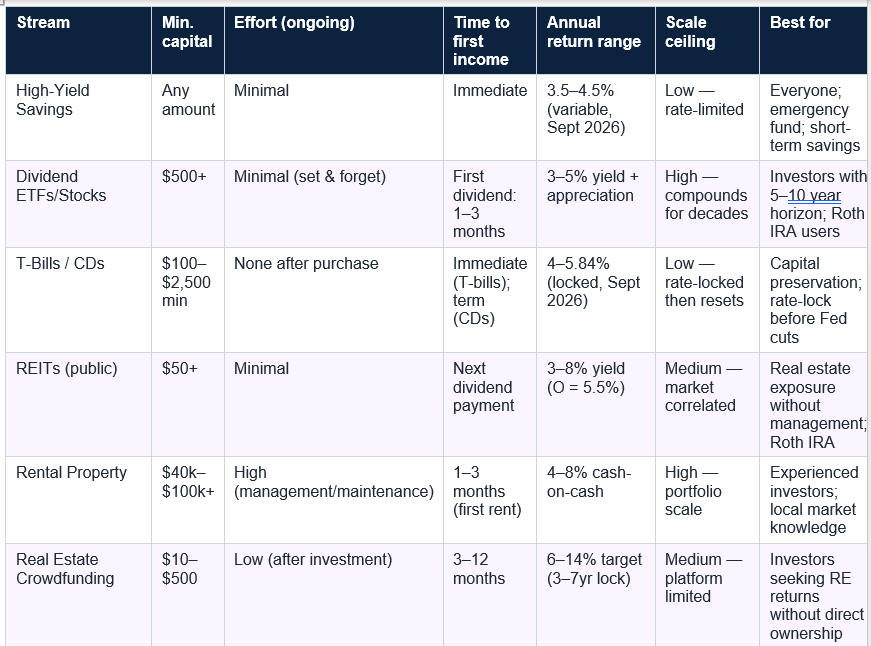
The Master Comparison: All 8 Streams Ranked Side by Side
The following table applies the framework from Section 2 to all eight streams, using current 2026 data and a 2027 forward outlook. Ratings are on a 5-point scale for each criterion.
How to Stack Passive Income Streams Without Overextending
The data from moneytalkwitht.com May 2026 is explicit: passive income works best as a stack, not a single stream. The recommended combination is one investment stream and one digital stream operating simultaneously. The investment stream (HYSA + dividend ETF + T-bill ladder) generates immediate returns and compounds steadily. The digital stream (a product or course) builds a scalable asset whose revenue is not capital-constrained.The sequencing matters as much as the selection. For a beginner with $5,000 in available capital and professional skills to monetise, the correct 2027 order is: first, open a HYSA with the full $5,000 (immediate income, zero risk, FDIC-insured); second, open a brokerage account and begin a monthly contribution to SCHD or VYM with whatever can be set aside from income (DRIP from day one); third, create one digital product from existing professional skills (12–18 month build-and-market cycle). The HYSA and dividend portfolio provide an income floor and growing asset base. The digital product provides the scalable ceiling.
- Do not start rental property without at least $50,000 in available capital and a thorough understanding of the local rental market and landlord-tenant law.
- Do not start niche SaaS without either software development skills or a budget to hire a developer, plus a validated problem and customer discovery.
- Do not put more than 10–20% of your passive income portfolio into real estate crowdfunding until you have established the investment stream (HYSA + dividend ETF) as a stable foundation.
- Maximise tax-advantaged accounts first: Roth IRA ($7,000/year, 2026 limit) is the single best vehicle for dividend and REIT income — the tax-free compounding significantly outperforms the same investments in a taxable brokerage account over a 20-year horizon.
- The moneytalkwitht.com framework: start with two streams, not eight. Two well-executed streams produce more income than eight poorly executed ones. Add a third stream only after the first two are generating consistent, documented income.
Tax Considerations: What Changes in 2027
The tax treatment of passive income varies significantly by stream, and optimising the tax layer can substantially increase after-tax returns without changing the underlying investments at all.Qualified dividends — paid by most US corporations and eligible ETFs — are taxed at 0% (income below $48,350 single/$96,700 married filing jointly), 15%, or 20% long-term capital gains rates. This is dramatically more favourable than ordinary income tax rates for most investors. REIT dividends, by contrast, are mostly classified as ordinary income (non-qualified), making them the highest-priority candidates for tax sheltering inside a Roth IRA or traditional 401k.
HYSA and CD interest is taxed as ordinary income — the least favourable tax treatment of any income stream discussed here. T-bill interest is exempt from state and local tax but subject to federal income tax. I-bond interest is deferred until redemption, providing a form of interest compounding that is tax-advantaged relative to annual HYSA interest taxation. Digital product income is taxed as self-employment income for sole proprietors, subject to both income tax and self-employment tax (15.3% on the first $168,600 in 2026) — making the effective marginal rate higher than it appears on gross revenue.
For 2027, the most important tax development to monitor is the sunset of provisions from the 2017 Tax Cuts and Jobs Act, which was extended by the One Big Beautiful Bill Act signed July 4, 2025. The current standard deduction, income tax brackets, and LTCG thresholds are now extended indefinitely under that legislation, providing certainty for the dividend and REIT tax treatment that defines the return profile of the investment streams in this guide. Always consult a qualified tax professional for your specific circumstances.
Conclusion
The answer to 'which passive income stream is worth starting in 2027?' depends entirely on the investor's starting position — but the data from 2026 points clearly to a short list of priority actions for most people.For anyone with capital but no skills to monetise yet: open a top-rate HYSA immediately (earning up to 4.21–4.50% today, versus 0.01% at your current big bank), lock in the best available CD rate for a 12-month horizon (5.84% as of September 1, 2026), and begin monthly contributions to SCHD or VYM inside a Roth IRA with DRIP enabled. These three actions require perhaps two hours to set up and generate income from day one, compounding automatically from that point forward.
For anyone with professional skills and time to invest: the digital product path is the most rational 2027 starting point for building income that is not capital-constrained. The e-learning market heading toward $450 billion by 2027 is real. The near-zero marginal cost of a digital product after creation is real. The 6–18 month timeline to meaningful income is also real — the correct expectation is a 12-month commitment before conclusions about viability are drawn.
For anyone with substantial capital ($100,000+) and a long horizon: the combination of a dividend ETF portfolio inside a Roth IRA, a REIT allocation sheltered from ordinary income tax, and a T-bill ladder preserving liquidity and rate-locking is the institutional-grade passive income playbook at the individual investor scale. Rental property and real estate crowdfunding add to this stack, not replace it. The streams are not competing alternatives — they are complementary layers of a portfolio that produces income through multiple mechanisms simultaneously.
Frequently Asked Questions
What is the best passive income stream for beginners in 2027?For most beginners, the correct first passive income stream is a combination of two: a high-yield savings account (HYSA) and a dividend ETF. The HYSA is opened immediately at an FDIC-insured online bank — top rates as of September 14, 2026 are up to 4.21% (NerdWallet) to 4.50% (Fortune/Curinos September 11, 2026), versus 0.38% national average and 0.01% at big banks like Chase and Bank of America. The dividend ETF is opened simultaneously in a brokerage account or Roth IRA, with DRIP (dividend reinvestment) enabled from day one. SCHD or VYM are the most common starting choices. Both streams require minimal ongoing effort, generate income from the first month, and compound automatically. The beginner's mistake is starting with rental property or niche SaaS — streams that require large capital or long build times — before establishing these two foundations.
How much money do I need to start generating meaningful passive income?
The threshold for 'meaningful' passive income varies by context, but $500 per month is a common benchmark. At 4.21% HYSA yield, $500/month requires approximately $1.43 million in cash savings — clearly not a beginner starting point. At a 4.5% dividend yield, the same $500/month requires approximately $133,000 invested. With rental property at $600/month net cash flow, one well-priced rental property provides it — but requires $40,000 to $60,000 in down payment. Digital products are the exception: $500/month in digital product income requires near-zero capital but approximately 12 months of consistent effort to build and market the product. The honest answer is that meaningful investment-based passive income requires either significant capital or significant time — and most people building from scratch need to begin with both a small investment stream and a skill-based digital stream to reach $500/month within a realistic timeframe.
Are dividend stocks better than high-yield savings accounts for passive income?
For any time horizon beyond 3–5 years, dividend stocks (particularly ETFs like SCHD and VYM) generate significantly more total return than HYSAs. The 2026 data makes this vivid: SCHD is up 13% year-to-date versus approximately 4% for the broader S&P 500, and S&P Global projects 6.5% dividend growth for 2026. A $50,000 HYSA at 4.21% generates $2,105/year. The same $50,000 in a dividend ETF at 4.5% yield generates $2,250/year — and that $2,250 grows each year as dividends increase and reinvested shares compound. HYSA rates are variable and will decline when the Fed cuts rates. Dividend income from quality companies tends to grow year on year. The correct allocation is both: the HYSA for emergency funds and short-term cash (0–2 year horizon), dividend ETFs for 3–10+ year capital. HYSA interest is taxed as ordinary income; qualified dividends enjoy 0%/15%/20% LTCG rates — a meaningful advantage for most investors.
How long does it take to build a real passive income from digital products?
The honest benchmark from 2026 data is 12 months of consistent effort to reach $500/month in passive income from digital products (viewstorys.com/ideaproof.io May/August 2026). Content-based income — including courses, digital downloads, blogs, and affiliate marketing — typically takes 6–18 months to become meaningful. The first 90 days produce little revenue in most cases; the 6–12 month mark is where consistent marketing and product iteration begins to generate compounding traffic and repeat sales. The ceiling is genuinely high: the global e-learning market is projected to reach $450 billion by 2027 (ideaproof.io August 2026). But the path from zero to $500/month is an active one — requiring consistent content creation, audience building, and product refinement — before it becomes genuinely passive. The streams that scale most reliably are those built on validated professional expertise (an accountant's tax guide, a designer's template pack, a lawyer's contract library) rather than generic 'how to make money online' content.
Is real estate crowdfunding safe for passive income in 2026–2027?
Real estate crowdfunding platforms like Fundrise and RealtyMogul offer 6–14% target annual returns with minimum investments of $10–$500 (ideaproof.io August 2026; The Fund Advisor June 2026). The returns are genuinely higher than public REITs in many scenarios, but they come with two risks that public REITs do not carry: illiquidity (3–7 year commitment in most cases, with no guarantee of early redemption) and platform risk (the platform itself must remain solvent and well-managed for the investment to return as projected). The AI-driven property valuation tools now embedded in major platforms (thefundadvisor.com June 2026) have reduced due diligence complexity, but do not eliminate investment risk. For 2026–2027, crowdfunding is appropriate as a 10–20% allocation within a broader passive income portfolio — not as a primary or sole income strategy. Treat the minimum stated holding period as the realistic expectation, not a worst case.
What passive income stream has the highest ceiling in 2027?
Niche SaaS (software as a service) has the highest income ceiling of any passive income stream in 2027, followed by digital products and online courses. A successful niche SaaS product charging $49/month to 500 subscribers generates $24,500/month in monthly recurring revenue — with the same infrastructure costs as 50 subscribers. Once built and stabilised, a SaaS product with low churn can sustain that income with minimal ongoing effort beyond customer support and occasional feature updates. However, the entry barrier is high: building a viable SaaS product requires either software development skills (typically 12–24 months of development) or capital to hire developers ($20,000+ for a minimal viable product), plus market validation and customer acquisition. For most people, the correct approach to the highest ceiling is to use investment streams (HYSA, dividend ETFs, REITs) to build capital while using professional skills to create digital products — and to consider SaaS only if the skills and validated market are both present.

0 Comments Comments