

Hustle
Income Stacking: Why Gen Z Is Juggling Multiple Jobs

Sixty-seven per cent of Gen Z now say multiple income streams are essential for financial security. They are not being greedy — they are being rational. This is what income stacking means, why a whole generation has adopted it, and what it reveals about the future of work.
Income stacking is the deliberate practice of building multiple streams of income simultaneously rather than relying on a single employer for all of your earnings. An income stacker might have a full-time job, a freelance client base, a content channel, and a small online shop — all running at the same time. The term captures something more intentional than a 'side hustle': income stacking is not just about earning extra money on the side. It is a financial strategy built on the belief that diversification is as important for income as it is for investments.
The concept is not new — many people have always had second jobs or passive income streams. What is new is the scale, the cultural normalisation, and the explicit framing of income diversification as a non-negotiable financial necessity rather than a luxury or a stopgap. For a significant portion of Gen Z — broadly defined as those born between 1997 and 2012, now aged between roughly 14 and 29 — income stacking is not a plan B. It is the plan.
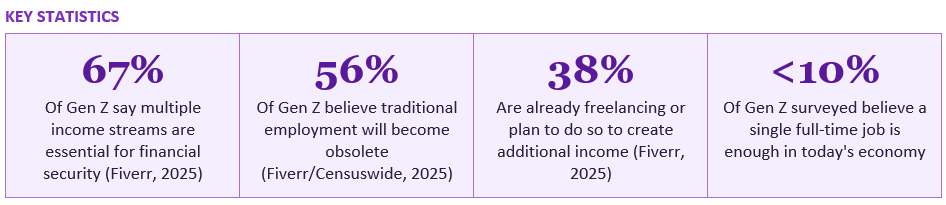
The term gained mainstream currency in late 2025, when Fiverr and Censuswide published the most comprehensive survey of Gen Z work attitudes to date, covering over 12,000 respondents across the UK, USA, France, and Germany. The findings were stark: 67% of Gen Z said that having multiple ways to earn money was essential for achieving financial security. Fewer than one in ten believed that a single, full-time job was enough in today's economy. Those two data points together are a seismic shift in how a generation views the employment contract — and they deserve serious examination.
Sixty-seven per cent of Gen Z respondents said multiple income streams are essential for financial security. This is a remarkable number. It is not 67% who are already running multiple income streams — it is 67% who believe it is essential. When asked about the future of traditional employment, 56% said they believe it will become obsolete for their generation. Thirty-eight per cent are already freelancing or plan to begin. And in the starkest finding of all, fewer than 10% believe a single full-time job is sufficient in today's economy.
A separate but complementary picture emerges from US-specific data. A survey cited by CNBC in May 2026 found that 64% of US Gen Z respondents said having multiple ways to earn money is essential for financial security — broadly consistent with the global Fiverr figure. Among all age groups, a Bankrate 2025 survey found that approximately 39% of American adults had some form of side income alongside their primary job, with the figure notably higher among younger respondents.
The YPulse data adds another layer: 46% of Gen Z say their biggest career fear is not making enough money to live comfortably. Gen Z is, on average, starting their working life at 19 — younger than previous generations — and 60 to 61% of those aged 18 to 34 have $1,000 or less in savings. These are the conditions under which income stacking has become not a trend but a survival strategy.
Gen Z isn't rejecting work — they're redefining it. Faced with economic uncertainty, Gen Z is experiencing what we're calling 'single-paycheck panic' — they're diversifying income streams because relying on one job feels too risky.
— MICHELLE BALTRUSITIS, ASSOCIATE DIRECTOR, FIVERR (OCTOBER 2025)
The panic is grounded in lived experience. Many Gen Z workers have watched older siblings, parents, or mentors lose jobs with little warning, face extended periods of unemployment, or be forced to take significant pay cuts to re-enter the workforce after redundancy. They have seen the financial devastation that a single income disruption can cause — mortgage defaults, depleted savings, deteriorating mental health. And they have decided, collectively and independently, that they will not take that risk if they can help it.
The resulting behaviour is not reckless — it is the opposite. Income stackers are typically more financially disciplined, more savings-oriented, and more risk-aware than the average young worker. They are managing career risk in exactly the way a sophisticated investor manages portfolio risk: by diversifying, by not putting all their eggs in one basket, and by building resilience against shocks that they cannot predict but can plan for.
Income stacking describes a more deliberate, strategic, and permanent approach to income. An income stacker is not just earning extra money on the side — they are constructing an intentional portfolio of income sources, none of which they regard as inherently more legitimate or permanent than another. A 25-year-old who has a contract role in marketing, earns from a YouTube channel, takes freelance design clients, and generates passive income from a print-on-demand shop is not running four side hustles — they are operating an income portfolio where each stream complements and protects the others.
The philosophical difference is significant. A side hustle mindset maintains the primacy of traditional employment and treats secondary income as supplementary. An income stacking mindset treats all income streams as equivalently valid, often explicitly distrusting the traditional employment relationship as a reliable long-term foundation. This is why 56% of Gen Z in the Fiverr survey said they believe traditional employment will become obsolete — they are not simply reporting a labour market trend, they are describing a fundamental rethinking of what a working life should look like.
Platforms including Upwork and Fiverr have created liquid global markets for freelance skills. Etsy and Amazon have democratised retail. YouTube, TikTok, Instagram, and Substack have given individuals the infrastructure to build media businesses. Stripe, PayPal, and Wise have made receiving international payments trivial. Shopify, Printful, and Redbubble have removed the inventory and logistics barriers from product businesses. Each of these platforms has individually lowered one barrier to income diversification. Together, they have created an ecosystem where a determined 22-year-old can build four income streams without raising capital, hiring staff, or renting office space.
AI tools are now adding another layer. Content creators use AI writing assistants to produce newsletters faster. Designers use AI image generation to create print-on-demand products at scale. Programmers use AI pair-programming tools to take on more freelance work per hour. The same AI that threatens to displace traditional employment is also enabling faster, more efficient income stacking for those who know how to use it.
For employers, the implication is not that income stacking is a problem to be managed through restrictive contracts. Paul Wolfe, a former chief human resources officer and author of Human Beings First, has argued that companies can benefit from workers' income stacking if it helps build new skills and exercise talents that enhance performance in the primary role. A marketing employee who runs a social media channel develops skills directly transferable to their day job. A finance analyst who trades on the side develops market intuition that makes them a better professional. Blanket restrictive policies are likely to accelerate talent attrition — not reduce it.
For policymakers, income stacking creates urgent questions about how employment protections, tax systems, and social safety nets are designed. Systems built on the assumption that most working people have one employer, one tax code, and one set of employment rights are increasingly misaligned with how the most economically active generation actually earns its living. The UK's gig economy review, the US Department of Labor's worker classification debates, and the EU's Platform Work Directive are all attempts to catch policy up with this reality — but all of them remain incomplete.
Six principles for building a successful income stack
For individuals, income stacking offers genuine financial resilience — but it requires discipline, realistic expectations about the timeline to meaningful returns, and careful management of tax, burnout risk, and employment terms. For employers and policymakers, the income stacking trend is a signal that should not be ignored: the traditional employment contract is no longer the central organising principle of working life for the most economically active generation, and the systems, policies, and assumptions built around it need to adapt accordingly.
Yahoo Finance — Gen Zers Experiencing Paycheck Panic Are Turning to Income Stacking https://finance.yahoo.com/news/gen-zers-experiencing-paycheck-panic-000103124.html
Utah Business — Income Stacking: Gen Z's Unconventional Approach to Financial Stability (Apr 2026) https://www.utahbusiness.com/industry/2026/04/20/income-stacking-gen-z-unconventional-approach-financial-stability/
YPulse — For Gen Z, Income Stacking Is More Than Just a Side Hustle Trend (Oct 2025) https://www.ypulse.com/newsfeed/2025/10/23/for-gen-z-income-stacking-is-more-than-just-a-side-hustle-trend/
McKinsey Global Institute — The Future of Work in America (occupational transitions report) https://www.mckinsey.com/featured-insights/future-of-work
GOV.UK — Trading Allowance: Earn Up to £1,000 Tax-Free https://www.gov.uk/guidance/tax-free-allowances-on-property-and-trading-income
IRS — Self-Employment Tax: Social Security and Medicare for Self-Employed https://www.irs.gov/businesses/small-businesses-self-employed/self-employment-tax-social-security-and-medicare-taxes
Bankrate — Survey: 39% of Americans Have a Side Hustle (2025) https://www.bankrate.com/personal-finance/side-hustles/side-hustle-survey/
Fiverr — Next Gen of Work: Full Survey Data (2025) https://www.fiverr.com/resources/guides/business/next-gen-of-work
TABLE OF CONTENTS
- What Is Income Stacking?
- The Data: What the Numbers Tell Us
- Why Is This Happening? The Five Drivers
- The Single-Paycheck Panic Explained
- How Gen Z Stacks Income: The Most Common Combinations
- Income Stacking vs Side Hustles: What Is the Difference?
- The Role of Technology in Making Income Stacking Possible
- The Downsides: What Income Stackers Need to Watch
- What Employers and Policymakers Need to Understand
- How to Start Income Stacking Yourself
- Conclusion
- Frequently Asked Questions
- References
What Is Income Stacking?
Income stacking is the deliberate practice of building multiple streams of income simultaneously rather than relying on a single employer for all of your earnings. An income stacker might have a full-time job, a freelance client base, a content channel, and a small online shop — all running at the same time. The term captures something more intentional than a 'side hustle': income stacking is not just about earning extra money on the side. It is a financial strategy built on the belief that diversification is as important for income as it is for investments.The concept is not new — many people have always had second jobs or passive income streams. What is new is the scale, the cultural normalisation, and the explicit framing of income diversification as a non-negotiable financial necessity rather than a luxury or a stopgap. For a significant portion of Gen Z — broadly defined as those born between 1997 and 2012, now aged between roughly 14 and 29 — income stacking is not a plan B. It is the plan.
The term gained mainstream currency in late 2025, when Fiverr and Censuswide published the most comprehensive survey of Gen Z work attitudes to date, covering over 12,000 respondents across the UK, USA, France, and Germany. The findings were stark: 67% of Gen Z said that having multiple ways to earn money was essential for achieving financial security. Fewer than one in ten believed that a single, full-time job was enough in today's economy. Those two data points together are a seismic shift in how a generation views the employment contract — and they deserve serious examination.
The Data: What the Numbers Tell Us
The Fiverr Next Gen of Work survey, conducted in April 2025 across 12,003 Gen Z and Gen Alpha respondents in the UK, US, France, and Germany, is the most cited source for income stacking statistics. Its headline findings are worth examining in full because they reveal not just behaviour but underlying belief.Sixty-seven per cent of Gen Z respondents said multiple income streams are essential for financial security. This is a remarkable number. It is not 67% who are already running multiple income streams — it is 67% who believe it is essential. When asked about the future of traditional employment, 56% said they believe it will become obsolete for their generation. Thirty-eight per cent are already freelancing or plan to begin. And in the starkest finding of all, fewer than 10% believe a single full-time job is sufficient in today's economy.
A separate but complementary picture emerges from US-specific data. A survey cited by CNBC in May 2026 found that 64% of US Gen Z respondents said having multiple ways to earn money is essential for financial security — broadly consistent with the global Fiverr figure. Among all age groups, a Bankrate 2025 survey found that approximately 39% of American adults had some form of side income alongside their primary job, with the figure notably higher among younger respondents.
The YPulse data adds another layer: 46% of Gen Z say their biggest career fear is not making enough money to live comfortably. Gen Z is, on average, starting their working life at 19 — younger than previous generations — and 60 to 61% of those aged 18 to 34 have $1,000 or less in savings. These are the conditions under which income stacking has become not a trend but a survival strategy.
Gen Z isn't rejecting work — they're redefining it. Faced with economic uncertainty, Gen Z is experiencing what we're calling 'single-paycheck panic' — they're diversifying income streams because relying on one job feels too risky.
— MICHELLE BALTRUSITIS, ASSOCIATE DIRECTOR, FIVERR (OCTOBER 2025)
Why Is This Happening? The Five Drivers
Income stacking among Gen Z is not a lifestyle choice or a generational quirk. It is a rational response to five structural forces that have converged to make single-income reliance feel genuinely unsafe.Driver 1: The collapse of entry-level job availability
The graduate job market has deteriorated significantly in the early 2020s. Automation, AI, and cost-cutting have eliminated many traditional entry-level positions, while mass layoffs at technology companies and financial institutions have created a surplus of experienced candidates competing for the roles that remain. Gen Z job seekers entering the workforce have faced longer application processes, lower acceptance rates, and more companies freezing graduate hiring than any comparable post-war generation.Driver 2: Wage growth lagging inflation
Real wages for young workers have not kept pace with the cost of living over the past decade. Housing costs have risen particularly sharply relative to income — in the UK, the average house now costs approximately 8.5 times average annual earnings, compared with around 4 times in the late 1990s. In many US cities, rent now consumes 40% to 50% of the take-home pay of a median entry-level salary. When a single income is structurally insufficient to cover basic costs, diversifying income is not ambition — it is arithmetic.Driver 3: AI anxiety and job insecurity
Gen Z is the first generation to enter the workforce while genuinely uncertain whether artificial intelligence will make their chosen career path obsolete within their working lifetime. This anxiety is not irrational. McKinsey estimates that 12 million occupational transitions will be required in the US alone by 2030 as AI reshapes job categories. Building income streams in multiple areas is a hedge against the possibility that any single stream could be automated away. As Andrew Garin, assistant professor of economics at Carnegie Mellon University, told CNBC: technology has really opened up a new kind of side hustle for a lot of people — but it has also motivated the urgency to develop them.Driver 4: The normalisation of freelancing platforms
Technology has made income stacking practically feasible in a way it never was for previous generations. Upwork, Fiverr, Etsy, Substack, Patreon, YouTube, TikTok, DoorDash, and dozens of other platforms have created functioning markets for micro-scale income generation that did not exist before 2010. A 23-year-old can now earn from tutoring on one tab, from a Substack newsletter on another, from freelance design on a third, and from a print-on-demand shop running in the background — all from a laptop, without meeting any of their clients in person. The infrastructure for income stacking was not available to Millennials in 2005, let alone to Boomers in 1985.Driver 5: The 2020s job market's trust deficit
A defining feature of Gen Z's working life has been watching companies conduct mass layoffs despite record profitability, seeing contract workers dismissed without notice, and observing colleagues lose jobs to automation with minimal institutional support. The result is a deep and evidenced mistrust of the employer-as-guarantor-of-security model. Only 14% of Gen Z say they want to work for a large corporation, according to YPulse — and this is not idealism but rational risk management from a generation that watched loyalty go unrewarded during the technology sector layoffs of 2022 and 2023.The Single-Paycheck Panic Explained
Fiverr's research team coined the phrase 'single-paycheck panic' to describe the acute anxiety many Gen Z workers experience at the prospect of having only one source of income. It is distinct from general financial anxiety — it is specifically the feeling that a single employer has too much power over your financial stability, and that the risk of losing that one income with no backup is unacceptably high.The panic is grounded in lived experience. Many Gen Z workers have watched older siblings, parents, or mentors lose jobs with little warning, face extended periods of unemployment, or be forced to take significant pay cuts to re-enter the workforce after redundancy. They have seen the financial devastation that a single income disruption can cause — mortgage defaults, depleted savings, deteriorating mental health. And they have decided, collectively and independently, that they will not take that risk if they can help it.
The resulting behaviour is not reckless — it is the opposite. Income stackers are typically more financially disciplined, more savings-oriented, and more risk-aware than the average young worker. They are managing career risk in exactly the way a sophisticated investor manages portfolio risk: by diversifying, by not putting all their eggs in one basket, and by building resilience against shocks that they cannot predict but can plan for.
How Gen Z Stacks Income: The Most Common Combinations
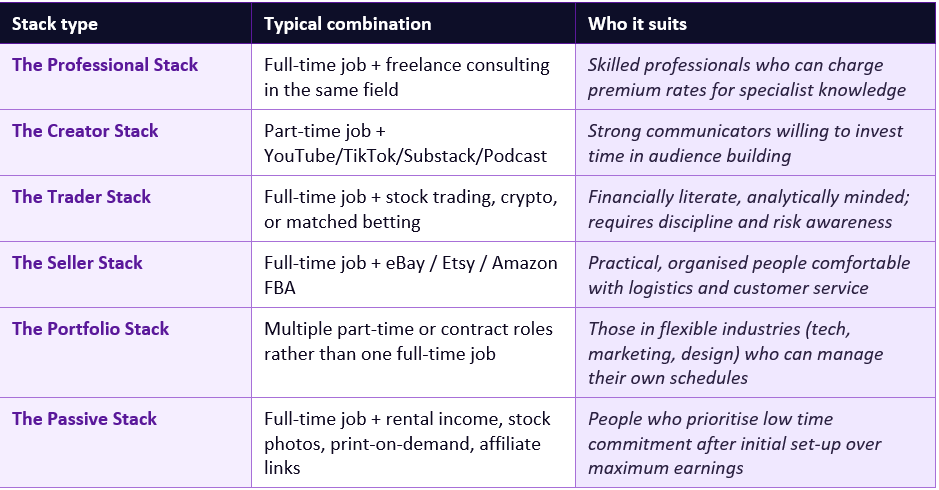
Income stacking takes many forms, and the combination that works best depends on skills, available time, and financial goals. Research and community data from platforms like Reddit, Fiverr, and YPulse point to several common configurations.Income Stacking vs Side Hustles: What Is the Difference?
Income stacking and 'having a side hustle' are related but distinct concepts, and the distinction matters for understanding the generational shift taking place. A side hustle is typically an additional income stream pursued alongside a primary job — it is supplementary, secondary, and often temporary. Someone who drives for Uber on weekends to pay off a debt has a side hustle.Income stacking describes a more deliberate, strategic, and permanent approach to income. An income stacker is not just earning extra money on the side — they are constructing an intentional portfolio of income sources, none of which they regard as inherently more legitimate or permanent than another. A 25-year-old who has a contract role in marketing, earns from a YouTube channel, takes freelance design clients, and generates passive income from a print-on-demand shop is not running four side hustles — they are operating an income portfolio where each stream complements and protects the others.
The philosophical difference is significant. A side hustle mindset maintains the primacy of traditional employment and treats secondary income as supplementary. An income stacking mindset treats all income streams as equivalently valid, often explicitly distrusting the traditional employment relationship as a reliable long-term foundation. This is why 56% of Gen Z in the Fiverr survey said they believe traditional employment will become obsolete — they are not simply reporting a labour market trend, they are describing a fundamental rethinking of what a working life should look like.
The Role of Technology in Making Income Stacking Possible
Income stacking at scale was not possible for previous generations because the infrastructure to support it did not exist. The ability to invoice clients globally, receive payments instantly, publish content to a worldwide audience, sell products without holding inventory, and manage multiple business relationships from a smartphone is a 21st century phenomenon that has fundamentally altered what is economically achievable for an individual with a laptop and an internet connection.Platforms including Upwork and Fiverr have created liquid global markets for freelance skills. Etsy and Amazon have democratised retail. YouTube, TikTok, Instagram, and Substack have given individuals the infrastructure to build media businesses. Stripe, PayPal, and Wise have made receiving international payments trivial. Shopify, Printful, and Redbubble have removed the inventory and logistics barriers from product businesses. Each of these platforms has individually lowered one barrier to income diversification. Together, they have created an ecosystem where a determined 22-year-old can build four income streams without raising capital, hiring staff, or renting office space.
AI tools are now adding another layer. Content creators use AI writing assistants to produce newsletters faster. Designers use AI image generation to create print-on-demand products at scale. Programmers use AI pair-programming tools to take on more freelance work per hour. The same AI that threatens to displace traditional employment is also enabling faster, more efficient income stacking for those who know how to use it.
The Downsides: What Income Stackers Need to Watch
Income stacking is not without real risks and costs. The picture painted by advocates of multiple income streams is not always complete, and a clear-eyed assessment requires acknowledging the genuine challenges.Real risks and challenges of income stacking
- Burnout and overwork: Running multiple income streams is genuinely demanding. The mental load of managing clients, platforms, deadlines, and finances across several streams simultaneously, on top of full-time employment, can be exhausting. Many income stackers underestimate the cumulative stress — and burnout can undermine all streams simultaneously.
- Tax complexity: Multiple income streams mean multiple reporting obligations. In the UK, income above the £1,000 Trading Allowance must be declared via Self-Assessment. In the US, self-employment income above $400 requires Schedule C filing and self-employment tax. Failure to manage tax obligations is one of the most common practical problems income stackers face.
- Risk of spreading too thin: A portfolio of six barely-functional income streams is worth less than two well-developed ones. Many income stackers underinvest in individual streams by constantly adding new ones rather than deepening and improving existing ones. Focus and consistency generate compound returns; scattering attention rarely does.
- Employer restrictions and conflicts of interest: Some employment contracts restrict outside work, particularly in similar sectors or for competing businesses. Violating these terms can result in dismissal. Income stackers should read their employment contracts carefully and take legal advice if in any doubt about what is permitted.
- Benefits and protections gap: Gig economy and freelance income typically comes with no sick pay, no holiday pay, no pension contributions, and no employer National Insurance or FICA match. Income stackers who shift toward gig work as a larger share of total income may find that their employment protections have quietly eroded.
- Income volatility: Multiple income streams can mean multiple volatile income streams. A month where clients are slow to pay, content revenue dips, and sales are quiet simultaneously can create acute short-term cash flow stress. A robust emergency fund is non-negotiable for anyone building an income stacking strategy.
What Employers and Policymakers Need to Understand
The income stacking trend is not just a personal finance story — it is a signal about the employment relationship that employers and governments would be unwise to ignore. When two-thirds of young workers believe a single employer cannot and should not be their only source of financial security, something fundamental has shifted in the social contract around work.For employers, the implication is not that income stacking is a problem to be managed through restrictive contracts. Paul Wolfe, a former chief human resources officer and author of Human Beings First, has argued that companies can benefit from workers' income stacking if it helps build new skills and exercise talents that enhance performance in the primary role. A marketing employee who runs a social media channel develops skills directly transferable to their day job. A finance analyst who trades on the side develops market intuition that makes them a better professional. Blanket restrictive policies are likely to accelerate talent attrition — not reduce it.
For policymakers, income stacking creates urgent questions about how employment protections, tax systems, and social safety nets are designed. Systems built on the assumption that most working people have one employer, one tax code, and one set of employment rights are increasingly misaligned with how the most economically active generation actually earns its living. The UK's gig economy review, the US Department of Labor's worker classification debates, and the EU's Platform Work Directive are all attempts to catch policy up with this reality — but all of them remain incomplete.
How to Start Income Stacking Yourself
Whether you are a Gen Z worker looking to build your financial resilience, or anyone who recognises that a single income is more fragile than it used to be, these are the practical principles that experienced income stackers consistently cite.Six principles for building a successful income stack
- Start with what you already know: The fastest path to a second income is to monetise skills you already have. If you write well, start freelancing. If you are an expert in a subject, start tutoring. If you have a professional skill your employer pays for, find out if clients will pay you directly for it. Familiar territory generates faster results than learning an entirely new field from scratch.
- Pick complementary streams: The best income stacks reinforce each other. A freelance writer who also runs a newsletter builds an audience that attracts freelance clients. A designer who sells print-on-demand products builds a portfolio that wins design commissions. Look for combinations where success in one stream feeds success in another.
- Automate and systematise early: Income stacking is only sustainable if it does not consume every waking hour. Automate invoicing, set up passive income streams early, use scheduling tools for content, and systematise client communication to reduce ongoing time demands per pound earned.
- Protect your emergency fund: Before investing time in income stacking as a resilience strategy, ensure you have three to six months of essential living costs in an accessible savings account. Income stacking reduces the risk of a single income loss — but it does not eliminate short-term income volatility, and cash reserves are what bridge the gap.
- Understand your tax obligations from day one: Keep a simple record of all income and associated expenses from every stream from your very first payment. Register with HMRC (UK) or track self-employment income for the IRS (US) as soon as your trading income exceeds the applicable threshold. Tax surprises are the most common avoidable problem for income stackers.
- Think in years, not months: Income stacking compounds over time. A freelance profile, a content channel, and an online shop all look underwhelming in month three. They look very different in year three. The distinguishing characteristic of successful income stackers is not talent or luck — it is sustained effort applied consistently over a timeframe that allows compounding to do its work.
CONCLUSION
The rise of income stacking is not a passing trend or a generational indulgence. It is a rational, data-backed response to a labour market that has become structurally more precarious, a cost of living that has outpaced wage growth for a decade, and a technological environment that simultaneously threatens existing jobs and enables new ones. When 67% of a generation says multiple income streams are essential for financial security, and fewer than 10% believe a single job is enough, the world of work has changed — not the generation.For individuals, income stacking offers genuine financial resilience — but it requires discipline, realistic expectations about the timeline to meaningful returns, and careful management of tax, burnout risk, and employment terms. For employers and policymakers, the income stacking trend is a signal that should not be ignored: the traditional employment contract is no longer the central organising principle of working life for the most economically active generation, and the systems, policies, and assumptions built around it need to adapt accordingly.
Frequently Asked Questions
What exactly is income stacking?
Income stacking is the deliberate practice of building multiple, simultaneous streams of income rather than relying on a single employer. It goes beyond the traditional side hustle concept by treating all income streams as equally valid — not just a primary job with extras on the side. An income stacker might combine a full-time role with freelancing, content creation, passive income from investments or digital products, and gig work, constructing a portfolio of income sources that provides financial resilience if any single stream is disrupted.Why is Gen Z specifically drawn to income stacking?
Several structural factors have converged for Gen Z: a weakened entry-level job market, wage growth that has failed to keep up with housing and living costs, anxiety about AI displacing careers, mass layoffs at major employers, and a deep-seated mistrust of the single-employer security model after watching previous generations affected by economic disruptions. Fiverr and Censuswide's 2025 survey of 12,003 Gen Z respondents found that 67% say multiple income streams are essential for financial security, and fewer than 10% believe a single full-time job is enough in today's economy.What is 'single-paycheck panic'?
Single-paycheck panic is a term coined by Fiverr to describe the anxiety Gen Z feels at the prospect of depending entirely on one employer for their financial security. It is the feeling that one redundancy, one disciplinary action, or one company failure could immediately threaten financial stability — and that this risk is too high to accept without a backup. The panic is the emotional driver behind the rational decision to build multiple income streams.Is income stacking sustainable alongside a full-time job?
Yes, for many people — but it requires careful management. The most sustainable income stacks include at least one passive or semi-passive stream (such as print-on-demand, stock photos, or rental income) that generates revenue without significant ongoing time commitment. Active income streams (freelancing, tutoring, delivery driving) require real ongoing time and can create fatigue if not managed carefully. The key is to start small, systematise early, and scale gradually rather than trying to run multiple demanding active streams simultaneously from the beginning.Do I need to declare income stacking earnings to HMRC or the IRS?
Yes, above applicable thresholds. In the UK, the Trading Allowance means the first £1,000 of trading income per tax year does not need to be declared. Above that, you must register as self-employed with HMRC and file a Self-Assessment tax return. In the US, self-employment income above $400 per year must be reported on Schedule C with your federal income tax return, and self-employment tax (15.3%) applies. In both countries, legitimate business expenses can be deducted before calculating taxable profit. Keep records from your first payment.What will income stacking mean for the future of traditional employment?
Opinions differ, but the data is clear that the workforce relationship is changing. Some economists argue that income stacking will remain a supplement to traditional employment rather than replacing it, since most income stackers still have a primary employer. Others, including the 56% of Gen Z in the Fiverr survey who believe traditional employment will become obsolete, see a more fundamental shift toward portfolio careers where no single employer holds a central place. What seems beyond dispute is that policies and employment frameworks built entirely around the assumption of a single-employer relationship need updating — for tax, benefits, pension contributions, and worker protections.References
Fiverr / Globe Newswire — Single-Paycheck Panic: 67% of Gen Z Say Income Stacking Is Essential (Oct 2025) https://investors.fiverr.com/news-releases/news-release-details/single-paycheck-panic-67-gen-z-say-income-stacking-essentialYahoo Finance — Gen Zers Experiencing Paycheck Panic Are Turning to Income Stacking https://finance.yahoo.com/news/gen-zers-experiencing-paycheck-panic-000103124.html
Utah Business — Income Stacking: Gen Z's Unconventional Approach to Financial Stability (Apr 2026) https://www.utahbusiness.com/industry/2026/04/20/income-stacking-gen-z-unconventional-approach-financial-stability/
YPulse — For Gen Z, Income Stacking Is More Than Just a Side Hustle Trend (Oct 2025) https://www.ypulse.com/newsfeed/2025/10/23/for-gen-z-income-stacking-is-more-than-just-a-side-hustle-trend/
McKinsey Global Institute — The Future of Work in America (occupational transitions report) https://www.mckinsey.com/featured-insights/future-of-work
GOV.UK — Trading Allowance: Earn Up to £1,000 Tax-Free https://www.gov.uk/guidance/tax-free-allowances-on-property-and-trading-income
IRS — Self-Employment Tax: Social Security and Medicare for Self-Employed https://www.irs.gov/businesses/small-businesses-self-employed/self-employment-tax-social-security-and-medicare-taxes
Bankrate — Survey: 39% of Americans Have a Side Hustle (2025) https://www.bankrate.com/personal-finance/side-hustles/side-hustle-survey/
Fiverr — Next Gen of Work: Full Survey Data (2025) https://www.fiverr.com/resources/guides/business/next-gen-of-work
0 Comments
Be the first to share your thoughts on this article.