

Finance
5 Unexpected Things People Fought for in Divorce
Table of Contents
- The Things Nobody Plans to Fight Over
- Battle 1: The Family Pet — ‘Who Gets the Dog?’
- Battle 2: Cryptocurrency and NFTs — The Invisible Fortune
- Battle 3: Frequent Flyer Miles and Loyalty Points
- Battle 4: Streaming Accounts and Digital Subscriptions
- Battle 5: Social Media Accounts and Online Businesses
- The Common Thread: Emotional Value vs. Legal Value
- Protecting Yourself Before It Gets Unexpected
- Conclusion: Modern Divorce for a Modern World
- Frequently Asked Questions
- External References
The Things Nobody Plans to Fight Over
Ask anyone who has been through a divorce what they expected to argue about, and the answers are fairly predictable: the house, the money, the car, the retirement accounts, the custody arrangement for the children. These are the battles everyone anticipates. They are the ones divorce attorneys have spent decades developing processes and precedents to manage.Then the actual divorce begins, and somewhere along the way, someone brings up the dog. Or the Bitcoin wallet. Or the 400,000 Delta SkyMiles accumulated on twelve years of business travel. Or the Netflix account that both people have been using for eight years. Or the Instagram account with 200,000 followers that the other spouse used to manage the photography filter settings for.
Welcome to modern divorce. The emotional weight of a marriage, it turns out, does not attach itself only to the logical, high-value assets. It attaches to the cat who was there through the miscarriage, the streaming service where someone built seven years of viewing history, the loyalty points that represent a lifetime of work travel, and the Bitcoin that seemed like a shared adventure when it was bought at $12,000. These are the battles that surprise people, the disputes that family law attorneys find themselves navigating in ways that have no clear precedent, and the stories that everyone who has heard one never quite forgets.
This article tells five of those stories — or rather, five categories of those stories — drawing on actual legal trends, real court cases, and the specific legal questions that each type of unexpected dispute raises. Some are funny in retrospect. Some are genuinely heartbreaking. All of them are instructive about the nature of marriage, divorce, and the things that matter most when a shared life comes apart.
Disclaimer: This article is for general informational and entertainment purposes only. It is not legal advice. Divorce laws vary significantly by jurisdiction. Always consult a qualified family law attorney for guidance specific to your situation.
Battle 1: The Family Pet — ‘Who Gets the Dog?’
It is, by all measures, the most emotionally charged of all the unexpected divorce wars. The family pet. And it is happening everywhere, in every income bracket, with every species. Dogs, cats, fish, horses, parrots. In 2026, it is one of the fastest-growing categories of divorce dispute, and court systems across the United States are only beginning to develop the legal frameworks to handle it.The fundamental legal tension is stark. About half of all US households have at least one pet. Most of those households treat their pets as family members. They buy them birthday presents. They take them to therapy. They refer to themselves as their ‘parents.’ Family courts, however, have for most of legal history treated pets as property — roughly equivalent, under the law, to a toaster or a television set. Courts assign them to one owner. They do not, in most jurisdictions, grant shared custody or visitation the way they do for children.
That is slowly changing. California, Illinois, and Alaska now allow courts to take into account the best interests of the animal when deciding ownership in a dispute. A growing number of other states are working toward similar frameworks. In 2026, approximately a dozen states have some form of pet-specific language in their divorce laws, and family law attorneys report that ‘petnups’ — prenuptial or cohabitation agreements that specify what happens to pets in the event of separation — are increasingly being requested.
The Delaware auction case: A Delaware judge, faced with a bitterly contested dispute over a dog between a divorcing couple, ordered them to resolve it through a private auction — each bidding against the other, with the dog going to the highest bidder. The approach was characterised by legal observers as underscoring just how emotionally and financially charged pet custody disputes had become.
The practical implications are significant. A family with children will often find that the family pet follows the primary custodial parent, since courts do consider the best interests of children and the pet’s role in their wellbeing. For couples without children, the question of who bought the pet, who provides primary care, who pays the vet bills, and who the pet appears most bonded to all become relevant.
If you are entering a marriage — or a long-term relationship — with a pet, or adopting one during the relationship, the legal advice from family attorneys is now consistent: document ownership clearly, maintain vet records in your name if the pet is yours, and consider a petnup if the emotional stakes would be high in a separation. The stories of protracted, expensive pet custody litigation are numerous, and almost none of the people involved expected to be there.
Battle 2: Cryptocurrency and NFTs — The Invisible Fortune
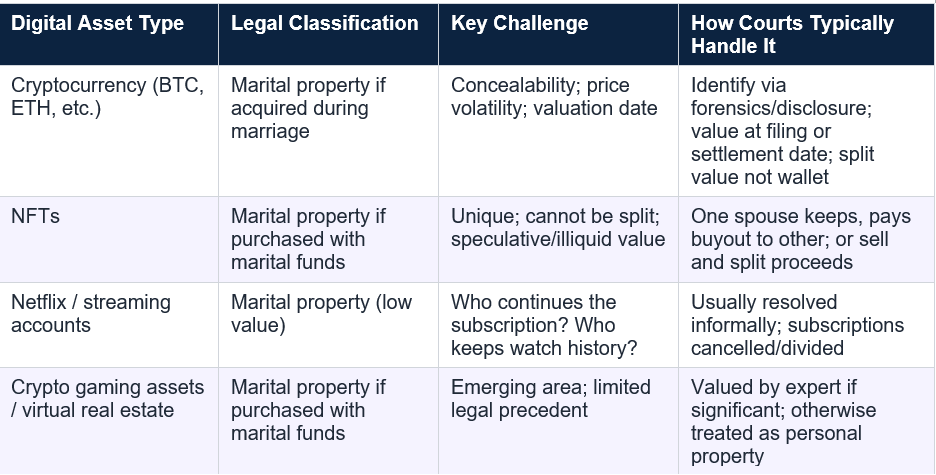
It is the divorce battle of the decade, and it is only beginning. As cryptocurrencies have moved from a niche investment to a mainstream asset class — with Bitcoin at various points exceeding $100,000 and millions of Americans holding crypto portfolios — the intersection of digital assets and family law has become one of the most complex and contested areas of divorce practice.The fundamental legal principle is clear enough: cryptocurrency and NFTs acquired during a marriage are generally treated as marital property, subject to division just like a brokerage account or a piece of real estate. In community property states, they would typically be split 50/50. In equitable distribution states, the division depends on what is ‘fair’ given all circumstances. The principle is simple. The execution is not.
Cryptocurrency can be hidden in ways that bank accounts simply cannot. There is no central institution to subpoena. A Bitcoin wallet is, at its most basic, a string of characters — a private key that can be memorised, written on paper, or stored on a hardware device in a drawer. One spouse can transfer assets into a new wallet before or during divorce proceedings with relative ease, leaving the other with no visible evidence of the transfer without forensic investigation.
CNBC, December 2025: The forensic investigation firms that trace hidden cryptocurrency in divorce cases charge retainer fees starting at $9,000, with full investigations reaching $50,000. Their services are typically only justified when there is good suspicion of significant hidden assets — but the cases are increasing in volume as crypto ownership becomes more widespread among divorcing couples.
The other dimension of crypto divorce warfare is valuation. Bitcoin’s price can move 20 percent in a week. A wallet worth $100,000 when divorce proceedings begin might be worth $70,000 when the settlement is finalised, or $150,000. Courts must decide at which point in time to fix the value for division, and that single decision can have enormous financial consequences for both parties.
NFTs introduced a further layer of complexity. Non-fungible tokens — unique digital items representing ownership of artwork, collectibles, or other digital content — cannot be split. You cannot give each spouse half of a CryptoPunk. The options are: one spouse keeps the NFT and compensates the other with cash or other assets of equivalent value, or the NFT is sold and the proceeds divided. Either approach requires agreeing on a valuation of an asset that may have a very limited secondary market and a value that is essentially whatever someone is willing to pay on a given day.
Battle 3: Frequent Flyer Miles and Loyalty Points
They feel like free money. They accumulate invisibly, recorded on a loyalty programme’s servers and redeemable for upgrades, flights, hotel stays, and gift cards. For couples where one or both partners travel extensively for work, the balance can be substantial: 400,000 American Airlines miles, 800,000 Marriott Bonvoy points, 200,000 Chase Ultimate Rewards. At typical redemption values of 1 to 2 cents per point, that portfolio is worth real money — $4,000 to $16,000 in the scenarios above. The question nobody thinks to ask until the divorce papers are filed is: whose money is it?The legal answer is that airline miles and loyalty points earned during the marriage are generally marital property, regardless of whose name is on the account. If the miles were earned through travel paid for with marital funds, through joint credit cards, or through a salary earned during the marriage, courts in most jurisdictions will treat them as part of the marital estate subject to division.
The practical answer is considerably messier. Airlines do not design their loyalty programmes with divorce in mind. Delta SkyMiles cannot be transferred at all — though the account holder can book flights for another person using them. American Airlines does not allow transfers upon divorce except through a buy-or-gift programme that charges a fee. Marriott Bonvoy allows up to 100,000 points annually to transfer to another member via a simple form. Chase and Amex allow authorised users to redeem points, but direct transfers can be complicated.
The valuation question: Airline miles do not have a simple cash value. Attorneys and divorce mediators typically use an industry benchmark of 1 to 2 cents per point to estimate value for division purposes. At the lower end, a 500,000-mile account is worth approximately $5,000. At the higher end, it could be $10,000 — enough to justify a conversation, though many mediators note that the cost of professional time to divide miles often exceeds their value.
The most common resolution is offsetting: one spouse keeps all the miles, and the other receives a cash payment or other asset of equivalent value as part of the overall settlement. This avoids the headache of programme-specific transfer rules and avoids triggering any fees or restrictions. The critical action for anyone approaching divorce is to disclose loyalty points fully in the financial disclosure process — failing to do so, whether intentionally or through oversight, can complicate or unwind a settlement if discovered later.
Battle 4: Streaming Accounts and Digital Subscriptions
At the lower end of the unexpected divorce battleground in terms of financial value, but sometimes among the highest in terms of sheer absurdity and symbolic weight, is the streaming account. Who keeps the Netflix? Who gets the Spotify playlist history? What happens to the Disney+ account that has seven years of kids’ watch history and a carefully curated list of family favourites?Legally, streaming subscriptions are generally classified as marital property in the broad sense — an asset (or ongoing expense) created during the marriage. In most divorces, however, they barely register as a financial concern. The ongoing cost of a Netflix subscription is trivial, and the account has no inherent saleable value. Most couples simply agree informally on who keeps the primary account, who creates a new one, and whether the children’s profiles travel with the custodial parent.
Where it gets genuinely contentious is in the detail. A shared Amazon Prime account is both a streaming service and a shopping account with purchase history, address book, Alexa routines, saved payment methods, and a library of purchased digital content — e-books, digital films, music — that cannot be split. A shared iTunes or Apple ID library contains decades of digital purchases. The ‘digital content library’ attached to a couple’s shared account may have accumulated thousands of dollars of purchased content that one party cannot simply replicate by starting a new account.
King Law’s analysis of digital assets in divorce notes that some practitioners define digital assets in the broadest terms — including ‘iTunes libraries, downloaded video games, Facebook photos, saved messages, Instagram reels, and more.’ The line between what is a sentimental digital archive and what is a valuable digital asset with financial implications is genuinely blurry, and navigating it requires both legal clarity and a willingness to separate the emotionally loaded from the economically significant.
The practical reality: Most streaming account disputes are resolved informally, often in a single conversation or text message. The real battleground is when digital accounts contain significant purchased content (digital film libraries, e-book collections, gaming libraries) or are linked to children’s profiles that both parents want access to. The wisest approach is to separate accounts as early as possible and maintain separate subscriptions, minimising the shared digital footprint before formal proceedings begin.
Battle 5: Social Media Accounts and Online Businesses
This is where the unexpected becomes genuinely significant. For many people, a social media account with a large following is not just a vanity metric — it is an income-generating business asset. An Instagram account with 200,000 engaged followers in a profitable niche, a YouTube channel with 500,000 subscribers and a consistent ad revenue stream, a TikTok account used to promote products through affiliate marketing: these are businesses. And businesses built during a marriage are marital property.The legal treatment of monetised social media accounts and online businesses in divorce is an emerging area that has moved remarkably quickly in recent years. Courts are now routinely asked to value Instagram accounts, YouTube channels, Etsy shops, and personal brand businesses, and to determine whether the value is marital (built during the marriage) or separate (existing before it).
The valuation challenge is substantial. A social media account or online business has no fixed market value — its worth depends on its audience engagement rate, monetisation history, the platform’s algorithm, the individual’s personal brand (which is, by definition, non-transferable), and what a buyer would actually pay for it. Unlike a restaurant or retail business, an influencer’s audience is attached to the person, not a transferable asset. Courts are increasingly engaging digital media valuation experts to assess these businesses, but the methodology is far from standardised.
The intellectual property angle adds another layer. Content creators own the copyright to their original content. If a spouse contributed meaningfully to creating content — running the camera, writing captions, managing the editing process — they may have a legitimate claim to a share of that intellectual property, separate from the platform’s commercial value. Recall that when singer Christina Milian divorced, she demanded one-tenth of the publishing rights to the hit song ‘Baby’ because she and her husband had co-written it with Justin Bieber during the marriage. The principle is the same for digital content.
For professional influencers, content creators, and anyone with a monetised online presence, the practical advice from family law attorneys is now consistent: maintain clear records of which content was created before the marriage, which was created during, and what revenue each generated. If a spouse contributes meaningfully to the creative or business process, document that contribution too — even if only informally. The account may feel personal, but if it earns money, the law treats it as a business.
The Common Thread: Emotional Value vs. Legal Value
What connects these five unexpected divorce battlegrounds is a fundamental mismatch between emotional value and legal value. The family pet has enormous emotional value and, legally, the status of personal property. The Bitcoin wallet may have extraordinary financial value that its anonymous, decentralised nature allows one spouse to obscure. The frequent flyer miles have genuine financial value that nobody thought to put in the prenuptial agreement. The streaming account has almost no financial value but may feel, to one or both parties, like a contested piece of the shared life they built together.Family law has always had to navigate this mismatch — the contested piece of furniture that is worth $200 at auction but represents a deceased grandmother to one spouse. What is different in 2026 is the volume, variety, and genuine financial complexity of the new categories of disputed assets. Cryptocurrency wallets, loyalty point portfolios, social media businesses, and digital content libraries are not hypothetical edge cases. They are present in millions of marriages, and they are present in the divorces of those marriages in proportionally increasing numbers.
The most consistent advice from family law attorneys across all five of these categories is to treat unexpected assets with the same seriousness as expected ones: disclose fully, document thoroughly, get expert valuation where the numbers justify it, and choose mediation over litigation wherever the asset type makes compromise more achievable than courtroom adjudication.
Protecting Yourself Before It Gets Unexpected
The cleanest way to handle unexpected divorce disputes is to prevent them from being unexpected in the first place. None of the five categories above are impossible to address in advance, and addressing them before a relationship ends is dramatically cheaper, faster, and less emotionally damaging than addressing them during one.- Prenuptial and postnuptial agreements: The 2026 trend in family law practice, documented by Lasher Law and others, is toward more comprehensive prenuptial agreements that address not just traditional assets but digital assets, loyalty point portfolios, pet ownership, and online business interests. These are no longer signs of pessimism about a marriage — they are legal acknowledgements of the complexity of modern shared lives.
- Petnups specifically for pets: If the emotional stakes around a pet would be high in a separation, a petnup is a simple and inexpensive document that establishes ownership and care arrangements in advance. Increasingly, family law attorneys offer these as straightforward add-ons to standard prenuptial agreements.
- Cryptocurrency disclosure and documentation: Keep records of when cryptocurrency was purchased, with which funds, and current wallet values. This is required by law in divorce financial disclosures, and having contemporaneous records of your holdings makes compliance much easier and disputes much rarer.
- Separate digital accounts from the start: Maintaining separate streaming, gaming, and digital content accounts from the beginning of a relationship avoids the dispute over who ‘owns’ the shared account when the relationship ends. Where financial assets (like Amazon Prime’s purchase library) are genuinely shared, keep records.
- Document loyalty point balances regularly: Take annual screenshots of your airline, hotel, and credit card loyalty account balances. This creates a contemporaneous record of what existed during the marriage, which significantly simplifies the disclosure and division process if it ever becomes necessary.
Conclusion
The five battles described in this article share a common origin story: assets and relationships that did not exist, or did not carry legal weight, in the marriages of previous generations. The family pet as a full emotional family member — not a working animal or livestock. The cryptocurrency portfolio as a parallel financial universe that one spouse may not even know about. The loyalty point empire built on a decade of business travel. The streaming account as a shared cultural archive. The Instagram account as a business, a personal brand, and a source of real income.Family law, like all law, follows society rather than leading it. The legal frameworks for all five of these battle categories are still developing, still producing inconsistent outcomes in different jurisdictions, and still leaving many people surprised by how contested, expensive, and emotionally painful these disputes can become. The people who are best protected against that surprise are the ones who anticipated it: who had the conversation about the dog before they got the dog, who disclosed the Bitcoin to their spouse, who signed a prenup that included digital assets, who maintained separate streaming accounts throughout.
The rest of us have stories. And some of those stories, told at dinner parties years later, are genuinely hilarious. A Delaware couple bidding on their dog in a private court auction. A couple fighting over a catfish named Pinky that ended up having a fatal heart attack in a smaller tank. A man negotiating the exclusive rights to his own nickname. These are real. They are also, in their way, perfectly human — evidence that the things we care about most are rarely the ones we expected to care about at all.
Frequently Asked Questions
Who legally gets the pet in a divorce?
Under most US and UK law, pets are classified as personal property and awarded to one owner rather than shared under a custody arrangement as children are. However, a growing number of US states — including California, Illinois, and Alaska — now allow courts to consider the pet’s best interests when deciding ownership. Factors courts may consider include who provided primary care, who paid for vet expenses, and (where children are involved) which household the pet is most bonded to.Is cryptocurrency marital property in a divorce?
Yes, in most jurisdictions. Cryptocurrency acquired during the marriage with marital funds is generally treated as marital property subject to division, just like a brokerage account. The legal principle is straightforward; the complications arise from disclosure (crypto can be hidden), valuation (prices fluctuate), and division (you cannot split a wallet; courts instead split the value). Failing to disclose crypto holdings in divorce financial disclosures can result in severe legal consequences.Are airline miles and loyalty points divided in a divorce?
Generally yes, if earned during the marriage. Miles accrued through travel paid for with marital funds, or via joint credit cards, are typically considered marital property. The practical challenge is that airlines have varying transfer rules — some programs do not allow splits. Common solutions include one spouse keeping the miles while the other receives an equivalent offset in other assets, or cashing out points where possible. Loyalty points should be disclosed in divorce financial proceedings.What happens to Netflix and streaming accounts in divorce?
For the subscription itself (Netflix, Spotify, Disney+), the monthly fee is typically an insignificant consideration in divorce. However, shared accounts that contain significant purchased digital content — Amazon Prime’s digital film library, a shared iTunes library, gaming accounts with years of purchases — can represent real asset value. Purchased digital content that cannot be split may need to be valued and offset. Most streaming disputes are resolved informally; the more complex disputes involve digital content libraries and children’s profiles.Can a social media account be considered marital property in a divorce?
If the account is monetised and was built during the marriage, it is generally treated as a marital business asset subject to division. Courts and attorneys increasingly engage digital media valuation experts to assess the commercial value of Instagram accounts, YouTube channels, and other income-generating online presences. The personal and non-transferable nature of an influencer’s audience complicates valuation, but the income history and commercial value of the business are clearly assessable. Pre-marriage accounts, or those built entirely from pre-marital effort, may be treated as separate property.What is a petnup?
A petnup (also called a pet prenup or pup nup) is a written agreement, typically part of a prenuptial or cohabitation agreement, that specifies what will happen to a pet in the event of separation or divorce. It can cover ownership, living arrangements, care responsibilities, veterinary decisions, and, in some agreements, visitation arrangements. As courts increasingly encounter emotionally charged pet custody disputes, family law attorneys recommend petnups as a cost-effective way to prevent expensive litigation over a deeply valued family member.How is cryptocurrency divided in divorce if it’s been hidden?
If one spouse suspects the other of hiding cryptocurrency, options include forensic accounting, blockchain analysis by specialist firms, subpoenas to cryptocurrency exchanges, and review of tax returns (crypto gains and losses are now subject to reporting requirements). Courts have significant powers to order disclosure of digital assets. California’s 2025 Digital Financial Assets Law specifically expanded courts’ powers to compel disclosure and imposes penalties for hiding crypto assets, including adverse financial judgments. Intentional concealment can result in the honest spouse receiving a greater share of other marital assets.Who should I contact if I think my spouse is hiding digital assets?
Contact a family law attorney immediately. If significant digital assets are suspected, the attorney may recommend engaging a forensic accountant or digital asset specialist who can trace cryptocurrency transactions, identify hidden wallets, and analyse patterns in financial records. Most jurisdictions require full financial disclosure of all assets in divorce proceedings, and concealing digital assets carries serious legal consequences. The cost of investigation is generally justified when the suspected hidden assets are substantial.External References
CNBC — Married Millennials, Here Comes the Crypto Divorce Cliff (December 2025), ClickOrlando / Dollars & Sense — As Divorcing Couples Ask ‘Who Gets the Dog,’ Pet Prenups Are on the Rise (April 2026), Consilia Legal (UK) — Dividing Digital Assets in Divorce: How Are Crypto and NFTs Treated? (2025), Lass Law — Crypto, NFTs & Divorce: Splitting Digital Assets Under California’s 2025 Digital Financial Assets Law, Super Lawyers — What Happens to Pets in a Divorce? (Updated September 2025), Hello Divorce — What Happens to Airline Miles and Hotel Points in Divorce? (November 2025), Wakefield Legal — Divorce & Digital Assets: Managing Crypto, NFTs and More (September 2025), Weinberger Law Group — Digital Assets in Divorce: How to Divide Cryptocurrency, NFTs & Online Businesses (September 2025), Lasher Law — What’s In — and What’s Out — in Divorce Trends for 2026 (January 2026), McKinley Irvin Family Law — 8 Weird Things People Fought for in Their Divorce (Notable Cases)

0 Comments Comments