
Financial Literacy
Why Are UK Prices Rising More Quickly?

Table of Contents
- Progress Interrupted
- The Numbers: What UK Inflation Looks Like Right Now
- Driver 1: The Iran War Energy Shock
- Why the UK Is More Exposed Than Other Countries
- Driver 2: Food Prices Accelerating Again
- Driver 3: Domestic Cost Pressures
- Driver 4: The July Energy Price Cap Risk
- What the Bank of England Is Doing
- How Rising Prices Hit Ordinary Households
- What the Government Has Done and What It Costs
- When Might Prices Come Down?
- Conclusion: An External Shock on Domestic Foundations
- Frequently Asked Questions
- External References
Progress Interrupted
A year ago, the trajectory of UK prices was finally moving in the right direction. Consumer Price Index (CPI) inflation had fallen from its peak of 11.1 percent in October 2022 — the highest since 1981 — to approximately 2 percent by mid-2024. The Bank of England had begun cutting interest rates. The cost of living crisis appeared to be easing, if not fully resolved.Then, in early 2026, progress was interrupted. The UK-Iranian conflict that began on 28 February 2026 sent global energy prices sharply higher. UK wholesale natural gas prices surged approximately 75 percent in the weeks that followed. Petrol prices at the pump rose faster than at any point since June 2022. Food businesses began revising their inflation forecasts upward. And the ONS March 2026 CPI data, published on 22 April 2026, showed headline inflation at 3.3 percent — up from 3.0 percent in February and moving away from the Bank of England's 2 percent target.
This article explains, in plain terms, why UK prices are rising more quickly: the external shocks, the structural domestic factors, the specific categories where households are feeling it most, and what is likely to happen next.
The Numbers: What UK Inflation Looks Like Right Now
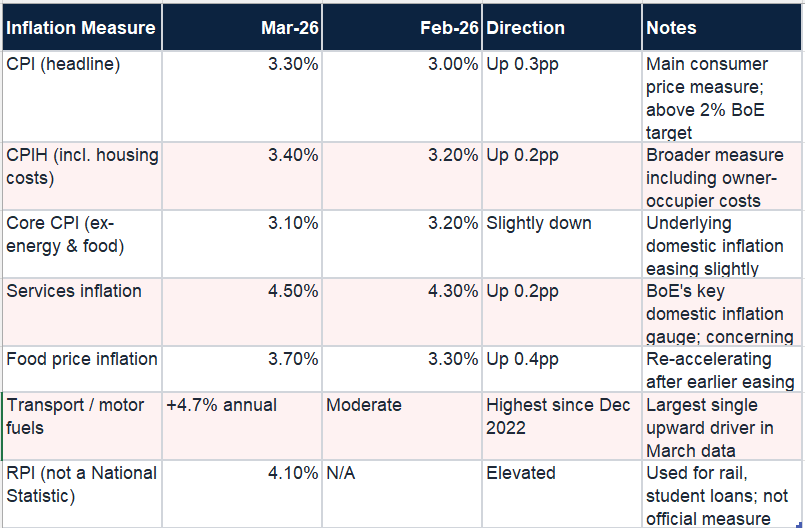
The most striking feature of the March 2026 data is the dominance of transport and motor fuels. The ONS identified these as making the largest upward contribution to the monthly change in both CPI and CPIH. On a monthly basis, transport prices rose 2.4 percent in March alone — the largest monthly increase since April 2025 and the highest 12-month rate since December 2022. This directly reflects the fuel price spike that followed the Iran conflict outbreak.
ONS, March 2026 CPI bulletin (22 April 2026): Motor fuels made the largest upward contribution to the monthly change in both CPIH and CPI annual rates in March 2026. Transport division prices rose overall by 4.7% in the 12 months to March 2026, up from 2.4% in the 12 months to February. The latest annual rate was the highest recorded since December 2022.
Driver 1: The Iran War Energy Shock
The primary cause of the renewed acceleration in UK prices is the disruption to global energy markets caused by the US-Iran conflict that began on 28 February 2026. US and Israeli military strikes against Iran, and Iran's responses, disrupted shipping through the Strait of Hormuz — the narrow waterway through which approximately 20 percent of global oil and gas supplies transit.The immediate market effect was dramatic. The House of Commons Library documents that UK wholesale natural gas prices rose by roughly 75 percent between late February and 23 March 2026. Average weekly petrol prices rose 20 percent above their pre-war levels. Diesel prices jumped by 36 percent. By late March, forecasts for the July 2026 Ofgem energy price cap had risen to approximately £1,973 for a typical household — approximately 20 percent above the April 2026 cap of £1,641.
The Resolution Foundation's Q2 2026 macroeconomic outlook calculated that a sustained return to these price peaks would see British households spending an extra £11 billion on fuel and energy in 2026 compared to if prices had remained at early-2026 levels. This represents a hit equivalent to 0.5 percent of aggregate household income.
Why the UK Is More Exposed Than Other Countries
The Iran conflict’s impact is not uniform across countries. The UK has been identified by multiple analysts as one of the most exposed G7 economies to this specific type of energy price shock, for two structural reasons.First, the UK’s energy mix is unusually gas-dependent. The Resolution Foundation documents that gas accounts for more than three-fifths (62 percent) of final household energy consumption in the UK — comfortably the highest share in the G7. When gas prices spike, UK household energy bills spike proportionally more than in countries with a more diversified energy mix, such as France (with its nuclear base) or Germany (which, post-Ukraine-war, has diversified its gas sources).
Second, UK electricity prices are set by wholesale gas prices approximately 85 percent of the time — a consequence of how the UK electricity market is structured. This means that even households with solar panels, heat pumps, or other non-gas heating still pay electricity prices that are heavily influenced by gas market conditions. The gas price shock propagates across the entire energy system, not just for those who heat their homes with gas directly.
The IMF has upgraded the UK's near-term inflation outlook by more than any other G7 economy following the conflict: by a cumulative 1.5 percentage points over the two years to end-2027, according to the Resolution Foundation. UK government bond yields have risen by more than all G7 countries except Italy since the conflict began, reflecting markets pricing in higher interest rates to address a larger-than-average inflation shock.
Resolution Foundation, Q2 2026: Gas accounts for more than three-fifths (62%) of final household energy consumption in the UK — comfortably the highest share in the G7. Britain's electricity prices are set by wholesale gas prices around 85% of the time. This means the hit to household incomes from higher gas prices will be particularly large in the UK compared to peers.
Driver 2: Food Prices Accelerating Again
Before the Iran conflict, food price inflation had been on a declining trajectory. It peaked at 19.2 percent in March 2023 — the highest since 1977 — and had fallen to approximately 2 percent by the end of 2024. The Iran war has interrupted this progress.Food price inflation was 3.7 percent in March 2026, up from 3.3 percent in February, according to ONS data. The Bank of England's Decision Maker Panel survey, published in April 2026, showed businesses now expect food inflation to climb as high as 6 to 7 percent over the coming year. Around 64 percent of firms surveyed indicated they would respond to recent energy price shocks by raising prices over the year ahead.
The mechanisms are multiple and cumulative:
- Higher diesel prices increase the cost of every lorry delivering food to every supermarket.
- Higher wholesale gas prices increase the cost of food manufacturing and processing (many food production processes are energy-intensive).
- Higher fertiliser prices — fertiliser production is energy-intensive and Middle East producers are disrupted — raise agricultural input costs.
- Domestic labour costs: the House of Commons Library documents the Bank of England noting that the 6.7 percent rise in the National Living Wage in April 2025 has contributed to food sector pay cost pressures that are feeding into prices.
- Regulatory costs: the introduction of Extended Producer Responsibility regulations for packaging has added costs that food manufacturers are passing through to consumers.
6. Driver 3: Domestic Cost Pressures
The energy and food story from the Iran war is overlaid on pre-existing domestic cost pressures that were already keeping UK inflation above the Bank of England's 2 percent target before the conflict began.Services inflation — which the Bank of England watches most closely when setting interest rates, because it reflects domestic wage and operating costs rather than global commodity prices — rose to 4.5 percent in March 2026, up from 4.3 percent in February. This is the category that the Bank describes as more persistent and more difficult to bring down than goods inflation driven by energy prices.
Key domestic cost drivers include:
- Wage growth: average earnings growth has remained above pre-pandemic norms, particularly in labour-intensive service sectors, contributing to services inflation persistence.
- The April 2025 National Insurance contributions increase for employers: this raised business employment costs and businesses have partially passed these through to prices in retail, hospitality, and food service.
- Business rates: though the government has adjusted business rates relief, the overall rates burden on retailers and hospitality businesses contributes to cost-push pressure.
Driver 4: The July Energy Price Cap Risk
The single most significant near-term risk for UK household budgets is the July 2026 Ofgem energy price cap review. The price cap — which sets the maximum unit rate suppliers can charge domestic customers — is reviewed quarterly. Based on wholesale energy prices in the period leading up to the March announcement, forecasts for the July cap were approximately £1,973 for a typical household. This would represent a 20 percent increase from the April 2026 cap of £1,641.If realised, a July cap of £1,973 would add approximately £332 per year to the typical household's energy bill. This in turn would add directly to CPI inflation in July, when the new cap takes effect. The Bank of England, in its 19 March 2026 statement, indicated it expected CPI to remain between 3 and 3.5 percent in the second and third quarters of 2026 — a projection that assumes some level of sustained energy cost elevation.
What the Bank of England Is Doing
The Bank of England held its base rate at 3.75 percent at the March 2026 Monetary Policy Committee meeting, widely expected given the inflation shock from the Iran conflict. Prior to the conflict, the Bank had been on a rate-cutting path, with three cuts in the second half of 2025 taking the rate from 5.25 percent to 3.75 percent.The inflation acceleration has complicated the rate-cutting trajectory. Financial markets, as of late April 2026, are pricing in significantly fewer cuts in 2026 than were expected in January. Some market participants have priced in the possibility of a rate rise if energy prices remain elevated and core and services inflation prove more persistent than the Bank projects.
The Bank faces a genuinely difficult policy dilemma. The inflation causing prices to rise is primarily supply-driven (the energy shock) rather than demand-driven (excess spending). Higher interest rates reduce demand but cannot increase global oil and gas supply. Raising rates aggressively to hit the 2 percent target would depress economic growth without resolving the root cause. The most likely path, in the Bank's current framing, is to hold rates until the external shock passes and the domestic inflation components moderate on their own.
How Rising Prices Hit Ordinary Households
Price data expressed as percentages can obscure the concrete impact on household finances. BritClock’s analysis of ONS data summarises the cumulative picture: UK inflation costs have added over £1,900 per average household annually since the cost of living crisis began, with cumulative prices approximately 20 to 25 percent above their pre-crisis levels even after inflation has moderated.For the average household, the specific April-to-July 2026 price pressures are concentrated in three categories:
- Fuel at the pump: petrol prices are 20 percent above pre-war levels; diesel 36 percent. For the typical driver filling a 50-litre tank, the weekly fuel cost is meaningfully higher.
- Food shopping: the forecast 6 to 7 percent food inflation over the coming year from the Bank's Decision Maker Panel translates to approximately £350 to £490 more per year for the average household on food alone.
- Energy bills: the July cap increase of approximately £332 per year (if confirmed) is a direct deduction from household disposable income, concentrated among those who heat their homes with gas.
What the Government Has Done and What It Costs
In the 2025 Autumn Budget, the government announced measures to take approximately £150 off the average household energy bill from April 2026 through changes to how policy costs are structured within bills. The ONS confirmed this had a modest reducing effect on April prices. The OBR forecast that government policy as a whole would reduce CPI inflation by approximately 0.4 percentage points in 2026/27.However, the Iran conflict has materially changed the inflation picture since that Budget. The Resolution Foundation estimates that offsetting the roughly 1.5 percentage point increase in the Bank's Q3 2026 inflation outlook through an Energy Price Guarantee-style intervention would cost approximately £20 billion if sustained for a year — which it characterises as a very high cost for a temporary reduction in inflation. As of April 2026, the government has not announced an equivalent to the 2022 Energy Price Guarantee.
When Might Prices Come Down?
The outlook depends overwhelmingly on the trajectory of the Iran conflict. The House of Commons Library notes that before the conflict, CPI was expected to fall to around 2 percent from April 2026 and remain around 2 percent for the rest of the year. The Bank's revised forecast of 3 to 3.5 percent through Q2 and Q3 assumes the energy shock persists at something close to its current level.If the conflict de-escalates, energy prices normalise, and food cost pressures ease, the Bank of England's analytical framework suggests inflation could return toward target relatively quickly — given that core inflation (3.1 percent) is already on a modest downward trend, and services inflation, while elevated, is not showing the aggressive acceleration seen in 2022.
If the conflict escalates, or if a prolonged energy price elevation feeds through into broader wage demands and services inflation expectations, the return to 2 percent will take considerably longer. CNBC noted in April 2026 that the stock market was hitting records despite the Iran war, reflecting market expectations of eventual resolution — but the inflation impact of even a temporary energy shock can persist for 12 to 18 months in the supply chain, particularly in food.
Conclusion
UK prices are rising more quickly in spring 2026 because an external shock — the Iran war's impact on global energy markets — has landed on a domestic economy that was already experiencing above-target inflation from persistent services cost pressures, elevated food sector costs, and the cumulative legacy of the 2021 to 2023 price surge.The UK's specific vulnerability — its high dependence on gas for both heating and electricity generation — means it absorbs energy price shocks more severely than most peer economies. The IMF's assessment that the UK faces the largest inflation upgrade among G7 nations from this shock confirms that this is not just a shared global experience but one with a particular UK dimension.
For households, the practical consequence is a renewed squeeze on disposable income that was already tighter than pre-pandemic norms even before 2026 began. The July energy price cap review is the single most consequential near-term event. If the cap rises as forecast, it will add to an already elevated inflation reading at exactly the point when some hoped for the Bank of England to resume cutting interest rates.
Frequently Asked Questions
What is UK inflation in April 2026?
The ONS published CPI data for March 2026 on 22 April 2026 showing headline CPI at 3.3%, up from 3.0% in February. CPIH (which includes owner-occupiers' housing costs) was 3.4%. Core CPI (excluding energy and food) was 3.1%, and services inflation was 4.5%. The RPI, used for rail fares and student loans, was 4.1% in March. All measures remain above the Bank of England's 2% inflation target.Why did UK inflation rise in March 2026?
The ONS identified motor fuels as the largest single upward driver of the March 2026 increase. Transport division prices rose 4.7% in the 12 months to March 2026, the highest rate since December 2022, and rose 2.4% on a monthly basis in March alone. This directly reflects the fuel price spike following the US-Iran conflict outbreak on 28 February 2026. Food price inflation also re-accelerated to 3.7% in March, up from 3.3% in February.Why is the UK more affected by energy price rises than other countries?
Two structural factors make the UK more vulnerable. First, gas accounts for approximately 62% of final household energy consumption in the UK, the highest share in the G7. Second, UK electricity prices are set by wholesale gas prices around 85% of the time, meaning gas market shocks propagate across all energy use, not just direct gas heating. The Resolution Foundation and the IMF have both documented that the UK faces a larger inflation impact from this type of energy shock than other G7 economies.What is the Bank of England's inflation forecast for 2026?
On 19 March 2026, the Bank of England said it expected CPI to be between 3% and 3.5% in the second and third quarters of 2026, based on preliminary estimates reflecting the energy price rises caused by the Iran conflict. This was a significant upward revision from its pre-conflict forecast, which had expected CPI to fall to around 2% from April 2026. The IMF has upgraded the UK's near-term inflation outlook by a cumulative 1.5 percentage points over the two years to end-2027 — more than any other G7 economy.Will UK food prices keep rising in 2026?
The Bank of England's Decision Maker Panel survey, published in April 2026, shows UK businesses expect food inflation to reach 6 to 7% over the coming year, driven by rising energy costs affecting food manufacturing, distribution, and agriculture. Around 64% of firms surveyed indicated they would pass higher costs on to consumers. Food price inflation was 3.7% in March 2026 — already above the headline CPI rate. Higher fertiliser, energy, and transport costs, combined with domestic wage pressures, make sustained food price acceleration the most likely near-term scenario.What will the July 2026 energy price cap be?
Based on wholesale gas prices in March and early April 2026, forecasts for the July 2026 Ofgem energy price cap rose to approximately £1,973 for a typical household — around 20% above the April 2026 cap of £1,641. If confirmed, this would add approximately £332 per year to the average household energy bill and add directly to CPI inflation in July. The final cap will be announced by Ofgem approximately six weeks before July, based on prevailing wholesale market prices.What can households do to protect themselves from rising UK prices?
Practical steps include: comparing energy tariffs before the July price cap review, as some suppliers offer fixed-rate tariffs at or near the current cap; switching to own-brand groceries and meal planning to reduce food waste; using price comparison tools for fuel to find cheaper forecourts; and ensuring all household savings are in high-interest accounts. Free debt advice is available through StepChange (0800 138 1111) and Citizens Advice. MoneyHelper (0800 138 7777) provides free guidance on managing energy bills and household budgets.External References and Further Reading
ONS — Consumer Price Inflation, UK: March 2026 (Published 22 April 2026), House of Commons Library — Inflation in the UK: Economic Indicators (Updated April 2026), House of Commons Library — The Impact of Food Inflation on the Cost of Living (January 2026), Resolution Foundation — The Macroeconomic Policy Outlook Q2 2026 (April 2026), The British Eye — Food Prices Set to Rise as Energy Bills Climb (April 2026), Bank of England — Monetary Policy Committee Decision, March 2026, Ofgem — Energy Price Cap (Current and Historical), BritClock — UK Cost of Living 2026: Inflation, Energy Bills and Rising Prices, MoneyHelper (UK) — Energy Bills: Help and Advice, StepChange Debt Charity — Free Debt and Financial Advice
0 Comments
Be the first to share your thoughts on this article.