

Men
Why Most Men Fail Financially — And How to Avoid It
42% of men describe their finances as dire. 57% carry debt. 35% say financial worries hurt their mental health every day. Men are more likely to take risky investment bets, less likely to seek financial advice, and more likely to confuse speculation with wealth-building. This is not a personal failing — it is a pattern driven by psychology, culture, and identifiable habits. Here is what the research says, and how to break the pattern.

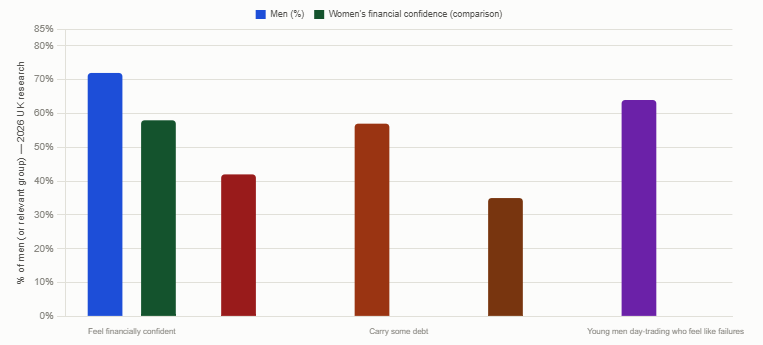
These figures sit alongside a striking paradox. Seventy-two percent of men feel confident making financial decisions, compared with 58 percent of women (Pepper Money, February 2026). Men score higher than women on formal financial literacy tests. Men know more and feel more confident — and yet the outcomes tell a different story. The explanation is not a lack of intelligence. It is a specific set of behavioural patterns, each well-documented in research and each with identifiable financial costs.
The Numbers: 42% of men describe their finances as 'dire' (Beyond Finance/Talker Research, May 2026, n=2,000). 57% carry debt. 35% report daily mental health impact from financial worries. Yet 72% of men feel confident making financial decisions vs 58% of women (Pepper Money, Feb 2026).
The LSE research found that men less secure in their masculinity took the risky side of financial bets 50.2 percent of the time, compared with 47.9 percent for other men. For most people, higher financial stakes led to greater conservatism. For men with something to prove, higher stakes led to greater risk-seeking. The mechanism makes this self-reinforcing: when bets pay off, the win is attributed to skill; when they do not, market conditions are blamed. The overconfidence survives every outcome.
The Numbers: LSE Business Review, March 2026: men less secure in their masculinity took the risky side of financial bets 50.2% of the time vs 47.9% for others. For most people, higher stakes increased conservatism. For men with 'something to prove', higher stakes increased risk-seeking.
Financial overconfidence is not primarily about money. It is about identity. Men take risky financial bets not because the expected value is better but because taking the risk signals something about who they are. Understanding this reframes the question from 'is this a good bet?' to 'am I doing this to build wealth, or to prove something?'
Stiles Financial (April 2026) identifies this directly: men 'can tend to be overconfident and overestimate their investing abilities and then take unnecessary risks.' The problem is not that trading is inherently wrong — it is that real investing is disciplined and, by social-media standards, boring. Platforms make risky behaviour look intelligent and exciting. Most people chasing fast money are chasing dopamine, not returns. Eventually, the market humbles them.
Watch out: Social media trading content is disproportionately composed of winners sharing wins. The losers are quieter. This survivorship bias distorts what investment activity looks like online. When an investment thesis comes from a social media creator rather than from your own research into fundamentals, hold that position to a higher standard of justification before committing capital.
The fix: Separate speculative activity from investment activity by holding them in different accounts. Your pension, ISA, or SIPP is for regular, disciplined contributions to diversified low-cost index funds. If you want to trade individual stocks, do it in a separate account with money explicitly earmarked as acceptable to lose entirely. This separation prevents speculative losses from compromising the disciplined saving that actually builds long-term wealth.
This is the pride trap in its most direct financial expression. The FinCap research found that men also avoided discussing debt even informally within their own family, meaning that the information gap compounds: not only do they not seek professional advice, they do not seek informal peer input that might surface problems early. The FCA data makes the cost explicit: among people who did seek debt advice, 61 percent said their debts became more manageable as a result. The barrier is not efficacy — advice works — it is the identity cost of seeking it.
The fix: Book one appointment with a regulated financial adviser this year — not because something is wrong, but as annual maintenance, the same way healthy people see a GP for a check-up. A whole-of-market IFA can be found via Unbiased.co.uk or VouchedFor.co.uk at no upfront cost for an initial consultation. The question is not whether you can manage without advice; it is whether the outcome is better with it.
The FinCap research found that men actively avoid discussing debt — with partners, with family, and with financial professionals — because acknowledging debt feels like acknowledging failure. The silence is expensive in two ways. First, it delays corrective action, and every month of delay compounds the interest. Second, it maintains financial arrangements that would not be chosen if examined honestly: minimum payment habits, missed balance transfer opportunities, continued use of credit for routine spending while the outstanding balance grows.
The fix: Write down every debt, its balance, and its interest rate on one page. Rank them by interest rate, highest first. Concentrate additional payments on the highest-rate debt while maintaining minimums on all others. Before adding to any savings, check whether any debt is costing more in interest than the savings account generates. At 23.1% APR, eliminating the debt is the higher-return action.
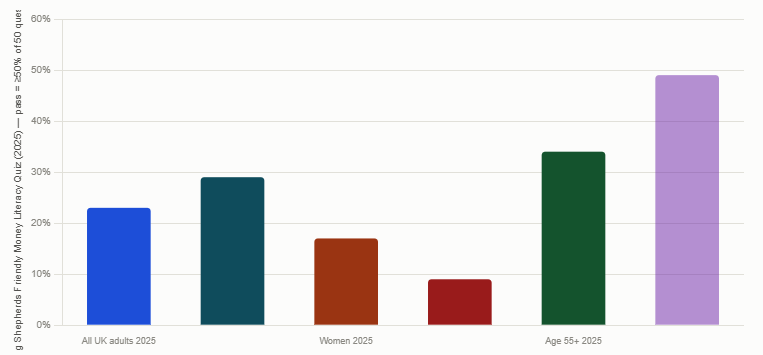
The Shepherds Friendly Money Literacy research (2025) captures this directly: men are significantly more confident than women about investing, ISA saving, and pension planning — and yet, when tested on actual knowledge, only 29 percent pass the financial literacy quiz. This is confident ignorance: knowing enough to feel secure, not enough to be secure. The median pension pot for men aged 55 to 59 is £156,000 — materially below the approximately £517,000 required to generate a moderate PLSA lifestyle in drawdown alongside the State Pension.
The fix: Check your actual pension balance and the projected retirement income from it today — not the balance, the income. Log into your pension provider's app or website and find the retirement income forecast. Compare it to the PLSA moderate lifestyle standard (approximately £32,700 per year for a single person). If the gap is significant, increase pension contributions by 1 percentage point at the next pay review and repeat annually.
For men in their 30s and 40s who are primary earners, the financial exposure from being unable to work for six months is substantial: mortgage payments, child costs, the cascade effect on long-term saving and pension contributions. Statutory sick pay in 2026/27 is £118.75 per week for 28 weeks — a fraction of what is needed to cover these obligations. For a healthy 35-year-old male, income protection covering 60 percent of salary typically costs £30 to £50 per month.
The fix: Get a protection review. A qualified protection adviser — often at no upfront cost, as they earn commission — can assess your current cover and compare available income protection, life insurance, and critical illness policies. The cost comparison is straightforward: if your monthly income is £4,000 and you are uninsured, six months of illness costs £24,000 in lost income. Three years of income protection premiums at £40 per month costs £1,440.
The Richmond Project Number Nation report (May 2026, n=8,021) establishes the link between financial literacy and financial security with one striking statistic: only 38 percent of those with very poor financial literacy could come up with £1,500 in a month for an unexpected need, versus 81 percent of those with very good financial literacy. Knowledge converts to resilience not through intention but through the implementation of knowledge into a concrete financial structure. Men who score above average on literacy tests but below average on outcomes are typically failing not because they lack knowledge but because it is not connected to a system.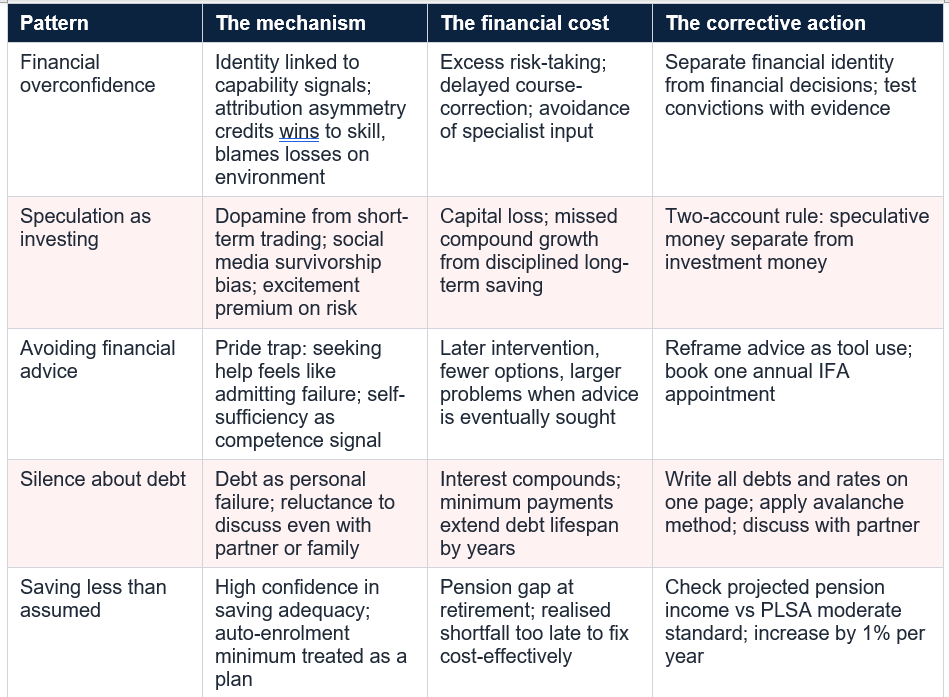
The LSE Business Review's March 2026 analysis offers the most useful framing: men are not taking excessive financial risks because they know more, or because they are genetically inclined to it. They are doing so as a way of performing a version of competence that culture has taught them to value. When that performance is recognised for what it is, its hold over financial decision-making weakens significantly.
The practical way out is systematic, not complex. Write the list. Eliminate the expensive debt. Check the pension projection. Automate the savings. Get the protection review. Book the annual check. Seek advice when decisions are significant. None of these requires exceptional knowledge or ongoing motivation. They require one decision per step, a calendar reminder, and the willingness to separate financial identity from financial strategy.
Forty-two percent of men describe their finances as dire. That number does not have to include you. The patterns that created it are identifiable. So is the way out.
Research reveals a specific paradox: 72% of men feel confident making financial decisions but also exhibit higher rates of overconfident risk-taking, lower rates of advice-seeking, and greater silence around debt. The LSE Business Review (March 2026) identifies a key mechanism: for some men, financial risk-taking is identity performance rather than a rational economic decision. When a decision is measured by how it positions the decision-maker rather than by expected financial outcome, the process is distorted. Attribution asymmetry then protects the overconfidence: wins are credited to skill, losses blamed on circumstance.
Is it true that men take more financial risks than women?
Yes, consistently across research. Men take more speculative investment positions, trade more frequently, and are more likely to use leveraged products. However, the LSE Business Review's March 2026 research challenges the assumption that this reflects a genetic or rational basis for risk tolerance. Men who are secure in their identity do not show the same elevated risk preference. The research conclusion: men are not inherently more risk-seeking, but masculinity norms create risk-seeking behaviour in financial contexts, particularly for men who feel their identity is less secure.
Why do men avoid seeking financial advice?
The FinCap qualitative research identifies the primary reason as a feeling that they should be able to sort out their problems themselves. This is consistent with broader research on men's help-seeking behaviour. The FCA data makes the cost concrete: among people who sought debt advice, 61% said their debts became more manageable. The barrier is not the efficacy of advice — it works — but the identity cost of seeking it. Reframing advice as tool use rather than competence admission changes the calculus: competent people use accountants and pension specialists not because they cannot manage without them but because specialist input produces better outcomes.
How do I know if I'm confusing speculation with investing?
Ask three questions: What is my time horizon? Real investing is characterised by years-long horizons. Am I diversified? Real investing uses broad, low-cost funds. Why do I believe this will go up? Evidence-based conviction is investing; narrative-based conviction is speculation. If your activity involves frequent position changes, single-company concentration, short time horizons, or recommendations from social media creators, it is closer to speculation. The practical fix: a pension or ISA for disciplined investment, a separate smaller account for speculative positions, with money explicitly earmarked as acceptable to lose.
What is the most important financial habit for men to build?
Automation. The single most impactful change is to automate the behaviours that willpower and motivation cannot reliably sustain: a standing order to savings on payday; pension contributions set to auto-escalate by 1% per year; debt repayment set above the minimum by a fixed automated amount. Automated systems generate wealth without requiring motivation — because motivation is unreliable but automatic payments are not. The UK pension auto-enrolment experience illustrates this at scale: changing the default from opt-in to opt-out raised participation from under 50% to over 80% in many schemes. The same principle applied to personal finance is equally powerful.
How serious is the link between financial stress and men's mental health?
The Beyond Finance survey (May 2026, 2,000 men) found that 35% of men say financial worries negatively affect their mental health every day. Among Gen Z men, this rises to nearly half. Men are less likely than women to seek mental health support when experiencing financial difficulty, less likely to discuss financial stress with partners, and more likely to internalise financial failure as personal failure. This creates a compounding dynamic: financial stress produces mental health strain that impairs decision-making, which produces worse financial outcomes, which increases stress. The most effective intervention is addressing the financial problem directly, which is why the seven practical steps in this guide are not just financial advice but, indirectly, mental health support.
Table of Contents
- The Numbers Behind the Pattern
- Reason #1: Financial Overconfidence — Knowing More, Doing Worse
- Reason #2: Treating Speculation as Investing
- Reason #3: Refusing to Seek Financial Advice
- Reason #4: Silence About Debt — The Pride Trap
- Reason #5: Saving Less Than They Think
- Reason #6: Underinsuring Against Risk
- Reason #7: No Plan — Only Intentions
- The Psychology Behind the Pattern: A Summary Table
- What Financial Success Actually Looks Like
- The 7-Step Practical Reset
- Conclusion
- Frequently Asked Questions
The Confidence - Outcome Paradox
Financial Literacy- Pass By Group
The Numbers Behind the Pattern
A survey of 2,000 men conducted by Talker Research for Beyond Finance in May 2026 found that 42 percent of men described their finances as dire: 17 percent could not make ends meet and 25 percent were barely getting by. Fifty-seven percent carried some form of debt. Thirty-five percent reported that financial worries negatively affected their mental health every day.These figures sit alongside a striking paradox. Seventy-two percent of men feel confident making financial decisions, compared with 58 percent of women (Pepper Money, February 2026). Men score higher than women on formal financial literacy tests. Men know more and feel more confident — and yet the outcomes tell a different story. The explanation is not a lack of intelligence. It is a specific set of behavioural patterns, each well-documented in research and each with identifiable financial costs.
The Numbers: 42% of men describe their finances as 'dire' (Beyond Finance/Talker Research, May 2026, n=2,000). 57% carry debt. 35% report daily mental health impact from financial worries. Yet 72% of men feel confident making financial decisions vs 58% of women (Pepper Money, Feb 2026).
Reason #1: Financial Overconfidence — Knowing More, Doing Worse
The most structurally significant financial mistake that men make is not a specific product decision or debt choice. It is the overconfidence that prevents those decisions from being recognised as mistakes. Research from the LSE Business Review (March 2026) identifies the mechanism: men do not take more financial risks because they know more or are genetically risk-inclined. They do so because financial risk-taking has become culturally associated with competence and masculinity — and the men most likely to take excess risk are those who feel their masculinity is least secure.The LSE research found that men less secure in their masculinity took the risky side of financial bets 50.2 percent of the time, compared with 47.9 percent for other men. For most people, higher financial stakes led to greater conservatism. For men with something to prove, higher stakes led to greater risk-seeking. The mechanism makes this self-reinforcing: when bets pay off, the win is attributed to skill; when they do not, market conditions are blamed. The overconfidence survives every outcome.
The Numbers: LSE Business Review, March 2026: men less secure in their masculinity took the risky side of financial bets 50.2% of the time vs 47.9% for others. For most people, higher stakes increased conservatism. For men with 'something to prove', higher stakes increased risk-seeking.
Financial overconfidence is not primarily about money. It is about identity. Men take risky financial bets not because the expected value is better but because taking the risk signals something about who they are. Understanding this reframes the question from 'is this a good bet?' to 'am I doing this to build wealth, or to prove something?'
Reason #2: Treating Speculation as Investing
Financial Advisor Magazine reported in August 2026 that 64 percent of young men who day-trade stocks feel like financial failures. The line between investing and speculation has been blurred by social media, gamified trading apps, and a culture in which investment commentary is content and risk is entertainment. A significant proportion of men who believe they are investing are in practice speculating: taking concentrated, short-term positions with outcomes closer to gambling than to wealth-building.Stiles Financial (April 2026) identifies this directly: men 'can tend to be overconfident and overestimate their investing abilities and then take unnecessary risks.' The problem is not that trading is inherently wrong — it is that real investing is disciplined and, by social-media standards, boring. Platforms make risky behaviour look intelligent and exciting. Most people chasing fast money are chasing dopamine, not returns. Eventually, the market humbles them.
Watch out: Social media trading content is disproportionately composed of winners sharing wins. The losers are quieter. This survivorship bias distorts what investment activity looks like online. When an investment thesis comes from a social media creator rather than from your own research into fundamentals, hold that position to a higher standard of justification before committing capital.
The fix: Separate speculative activity from investment activity by holding them in different accounts. Your pension, ISA, or SIPP is for regular, disciplined contributions to diversified low-cost index funds. If you want to trade individual stocks, do it in a separate account with money explicitly earmarked as acceptable to lose entirely. This separation prevents speculative losses from compromising the disciplined saving that actually builds long-term wealth.
Reason #3: Refusing to Seek Financial Advice
Less than 9 percent of UK adults sought financial advice in the past 12 months (FCA Financial Lives Survey 2024). Within that low figure, men are disproportionately underrepresented among advice-seekers relative to their financial decision-making activity. The FinCap qualitative study on men and debt identified the primary reason men did not seek advice as a feeling that they should be able to sort out their problems themselves.This is the pride trap in its most direct financial expression. The FinCap research found that men also avoided discussing debt even informally within their own family, meaning that the information gap compounds: not only do they not seek professional advice, they do not seek informal peer input that might surface problems early. The FCA data makes the cost explicit: among people who did seek debt advice, 61 percent said their debts became more manageable as a result. The barrier is not efficacy — advice works — it is the identity cost of seeking it.
The fix: Book one appointment with a regulated financial adviser this year — not because something is wrong, but as annual maintenance, the same way healthy people see a GP for a check-up. A whole-of-market IFA can be found via Unbiased.co.uk or VouchedFor.co.uk at no upfront cost for an initial consultation. The question is not whether you can manage without advice; it is whether the outcome is better with it.
Reason #4: Silence About Debt — The Pride Trap
Average UK household debt excluding mortgages stands at £4,120 in 2026 (Money Charity). The average credit card APR is 23.1 percent — the highest on record (Bank of England/Moneyfacts 2026). At this rate, a £3,000 balance paying only the minimum takes 27 years to clear and generates £5,600 in interest charges. Fifty-seven percent of men carry some form of debt (Beyond Finance, May 2026), and 18 percent of UK adults do not know which debts to prioritise (Pepper Money, February 2026).The FinCap research found that men actively avoid discussing debt — with partners, with family, and with financial professionals — because acknowledging debt feels like acknowledging failure. The silence is expensive in two ways. First, it delays corrective action, and every month of delay compounds the interest. Second, it maintains financial arrangements that would not be chosen if examined honestly: minimum payment habits, missed balance transfer opportunities, continued use of credit for routine spending while the outstanding balance grows.
The fix: Write down every debt, its balance, and its interest rate on one page. Rank them by interest rate, highest first. Concentrate additional payments on the highest-rate debt while maintaining minimums on all others. Before adding to any savings, check whether any debt is costing more in interest than the savings account generates. At 23.1% APR, eliminating the debt is the higher-return action.
Reason #5: Saving Less Than They Think
Men hold an average of £23,912 in savings compared with £14,464 for women (Finder, April 2026). This appears to be a men-save-more story. It is not. The aggregate savings advantage reflects a small number of men with very large balances pulling up the average. Only 23 percent of Brits actively save for retirement (Raisin, April 2026), and the pattern of high financial confidence paired with low financial action means that many men believe they are saving adequately when they are not.The Shepherds Friendly Money Literacy research (2025) captures this directly: men are significantly more confident than women about investing, ISA saving, and pension planning — and yet, when tested on actual knowledge, only 29 percent pass the financial literacy quiz. This is confident ignorance: knowing enough to feel secure, not enough to be secure. The median pension pot for men aged 55 to 59 is £156,000 — materially below the approximately £517,000 required to generate a moderate PLSA lifestyle in drawdown alongside the State Pension.
The fix: Check your actual pension balance and the projected retirement income from it today — not the balance, the income. Log into your pension provider's app or website and find the retirement income forecast. Compare it to the PLSA moderate lifestyle standard (approximately £32,700 per year for a single person). If the gap is significant, increase pension contributions by 1 percentage point at the next pay review and repeat annually.
Reason #6: Underinsuring Against Risk
The Drewberry Individual Protection Survey (September 2025) found that only 1 in 11 Brits has income protection insurance and more than one in three has no personal protection of any kind. Men, despite having higher average incomes and therefore greater financial exposure to income loss, are not significantly better protected than women. The attitude that insurance is an unnecessary cost, or that competent people manage risk themselves rather than outsourcing to an insurer, is particularly prevalent among men who see financial self-sufficiency as a competence signal.For men in their 30s and 40s who are primary earners, the financial exposure from being unable to work for six months is substantial: mortgage payments, child costs, the cascade effect on long-term saving and pension contributions. Statutory sick pay in 2026/27 is £118.75 per week for 28 weeks — a fraction of what is needed to cover these obligations. For a healthy 35-year-old male, income protection covering 60 percent of salary typically costs £30 to £50 per month.
The fix: Get a protection review. A qualified protection adviser — often at no upfront cost, as they earn commission — can assess your current cover and compare available income protection, life insurance, and critical illness policies. The cost comparison is straightforward: if your monthly income is £4,000 and you are uninsured, six months of illness costs £24,000 in lost income. Three years of income protection premiums at £40 per month costs £1,440.
Reason #7: No Plan — Only Intentions
The final and most structural failure is the gap between intention and plan. Financial intentions are nearly universal: almost all adults intend to save more, sort the pension, get a will, review insurance. Financial plans are far rarer: specific, written commitments with dates, amounts, and accountability structures that operate automatically regardless of motivation.The Richmond Project Number Nation report (May 2026, n=8,021) establishes the link between financial literacy and financial security with one striking statistic: only 38 percent of those with very poor financial literacy could come up with £1,500 in a month for an unexpected need, versus 81 percent of those with very good financial literacy. Knowledge converts to resilience not through intention but through the implementation of knowledge into a concrete financial structure. Men who score above average on literacy tests but below average on outcomes are typically failing not because they lack knowledge but because it is not connected to a system.
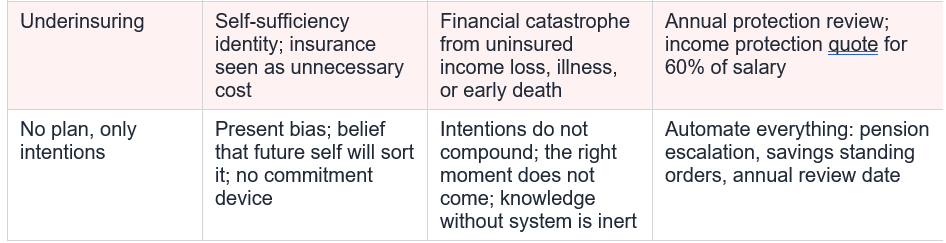
The Psychology Behind the Pattern: A Summary Table
What Financial Success Actually Looks Like
The popular culture image of male financial success is dramatic: the bold investment, the business sold at a significant multiple, the portfolio that beats the market. The research evidence is far more mundane. The financial behaviours that produce consistently better outcomes across income levels and age groups are:- Consistent automated saving: a percentage of income moved to pension or savings on payday, before discretionary spending.
- Low-cost diversification: broad global equity exposure through index funds, held for years not weeks, contributions maintained through downturns.
- Appropriate insurance: income protection in place before it is needed, not sought after a health event when it is expensive or unavailable.
- An annually updated plan: a document that records current position, targets, and specific next steps, reviewed once a year.
- Advice when needed: a relationship with a qualified adviser consulted when major financial decisions are being made, not after they go wrong.
The 7-Step Practical Reset
If you recognise the patterns in this guide, the following seven steps address the most common failure points. Each requires one decision, not ongoing effort.- Step 1: Write your full financial picture on one page — income, every debt with its balance and interest rate, all savings, current pension value, monthly outgoings. You cannot navigate from a position you have not clearly seen.
- Step 2: Eliminate high-interest debt first. Rank by interest rate. Direct every pound above the minimum to the highest-rate debt. At 23.1% APR, debt elimination is the highest guaranteed return available.
- Step 3: Check your pension income projection. Log into every pension you hold. Find the retirement income forecast. Compare it to the PLSA moderate standard of approximately £32,700 per year for a single person.
- Step 4: Set pension contributions to increase automatically. Most workplace pension providers allow auto-escalation. Set it now: 1 percent per year, activated each April, brings a 5 percent contribution to 15 percent over 10 years without a single future decision.
- Step 5: Automate savings before you see the money. A standing order from your current account to savings on the day after payday. What you do not see, you do not spend.
- Step 6: Get a protection review this year. One appointment, no upfront cost, via a qualified protection adviser at Unbiased.co.uk. The outcome: clarity on whether your income, life, and critical illness cover is adequate.
- Step 7: Book an annual financial review. Same week each year. One hour of honest review prevents the compounding of inertia that produced the problems in this guide.
Conclusion
The research on men and financial failure consistently points to the same cluster: overconfidence that substitutes for strategy, speculative risk-taking that substitutes for disciplined investing, pride that prevents advice-seeking, and silence about debt that allows it to compound. These are not character flaws. They are culturally transmitted patterns with identifiable psychological roots and identifiable financial costs.The LSE Business Review's March 2026 analysis offers the most useful framing: men are not taking excessive financial risks because they know more, or because they are genetically inclined to it. They are doing so as a way of performing a version of competence that culture has taught them to value. When that performance is recognised for what it is, its hold over financial decision-making weakens significantly.
The practical way out is systematic, not complex. Write the list. Eliminate the expensive debt. Check the pension projection. Automate the savings. Get the protection review. Book the annual check. Seek advice when decisions are significant. None of these requires exceptional knowledge or ongoing motivation. They require one decision per step, a calendar reminder, and the willingness to separate financial identity from financial strategy.
Forty-two percent of men describe their finances as dire. That number does not have to include you. The patterns that created it are identifiable. So is the way out.
Frequently Asked Questions
Why do so many men struggle financially despite feeling confident about money?Research reveals a specific paradox: 72% of men feel confident making financial decisions but also exhibit higher rates of overconfident risk-taking, lower rates of advice-seeking, and greater silence around debt. The LSE Business Review (March 2026) identifies a key mechanism: for some men, financial risk-taking is identity performance rather than a rational economic decision. When a decision is measured by how it positions the decision-maker rather than by expected financial outcome, the process is distorted. Attribution asymmetry then protects the overconfidence: wins are credited to skill, losses blamed on circumstance.
Is it true that men take more financial risks than women?
Yes, consistently across research. Men take more speculative investment positions, trade more frequently, and are more likely to use leveraged products. However, the LSE Business Review's March 2026 research challenges the assumption that this reflects a genetic or rational basis for risk tolerance. Men who are secure in their identity do not show the same elevated risk preference. The research conclusion: men are not inherently more risk-seeking, but masculinity norms create risk-seeking behaviour in financial contexts, particularly for men who feel their identity is less secure.
Why do men avoid seeking financial advice?
The FinCap qualitative research identifies the primary reason as a feeling that they should be able to sort out their problems themselves. This is consistent with broader research on men's help-seeking behaviour. The FCA data makes the cost concrete: among people who sought debt advice, 61% said their debts became more manageable. The barrier is not the efficacy of advice — it works — but the identity cost of seeking it. Reframing advice as tool use rather than competence admission changes the calculus: competent people use accountants and pension specialists not because they cannot manage without them but because specialist input produces better outcomes.
How do I know if I'm confusing speculation with investing?
Ask three questions: What is my time horizon? Real investing is characterised by years-long horizons. Am I diversified? Real investing uses broad, low-cost funds. Why do I believe this will go up? Evidence-based conviction is investing; narrative-based conviction is speculation. If your activity involves frequent position changes, single-company concentration, short time horizons, or recommendations from social media creators, it is closer to speculation. The practical fix: a pension or ISA for disciplined investment, a separate smaller account for speculative positions, with money explicitly earmarked as acceptable to lose.
What is the most important financial habit for men to build?
Automation. The single most impactful change is to automate the behaviours that willpower and motivation cannot reliably sustain: a standing order to savings on payday; pension contributions set to auto-escalate by 1% per year; debt repayment set above the minimum by a fixed automated amount. Automated systems generate wealth without requiring motivation — because motivation is unreliable but automatic payments are not. The UK pension auto-enrolment experience illustrates this at scale: changing the default from opt-in to opt-out raised participation from under 50% to over 80% in many schemes. The same principle applied to personal finance is equally powerful.
How serious is the link between financial stress and men's mental health?
The Beyond Finance survey (May 2026, 2,000 men) found that 35% of men say financial worries negatively affect their mental health every day. Among Gen Z men, this rises to nearly half. Men are less likely than women to seek mental health support when experiencing financial difficulty, less likely to discuss financial stress with partners, and more likely to internalise financial failure as personal failure. This creates a compounding dynamic: financial stress produces mental health strain that impairs decision-making, which produces worse financial outcomes, which increases stress. The most effective intervention is addressing the financial problem directly, which is why the seven practical steps in this guide are not just financial advice but, indirectly, mental health support.

0 Comments Comments