

Savings
Best 1-Year Fixed Savings Accounts UK – Up to 4.85%

The best one-year fixed savings account pays 4.85% AER. The average one-year rate has risen from 3.79% in March 2026 to 4.26% in August. The Bank of England base rate is 3.75%. Locking in for twelve months at current rates gives a guaranteed return that easy-access accounts cannot match. Here’s exactly where the top rates are and what you need to know before you commit.

The reason for the recovery is as much geopolitical as economic. MoneyfactsCompare’s savings overview notes that average rates have risen steadily since the beginning of March 2026, shortly after the US and Israel joined forces against Iran, which revised market expectations around future Bank of England base rate cuts. The MPC held the base rate at 3.75 percent at its August 2026 meeting (MoneyWeek; money.co.uk). With fewer cuts expected, providers have repriced their fixed products upward — creating a window in which locking in for twelve months offers a guaranteed return that easy-access accounts, with their variable rates, cannot match.
This guide identifies the best rates currently available, explains how the accounts work, covers the tax position precisely, and provides the worked examples that comparison tables typically omit. All rates are sourced from MoneyfactsCompare, MoneyWeek, Forbes Advisor UK, and specialist tools and are correct as at 27–28 August 2026. Rates change frequently; always verify directly with the provider before applying.
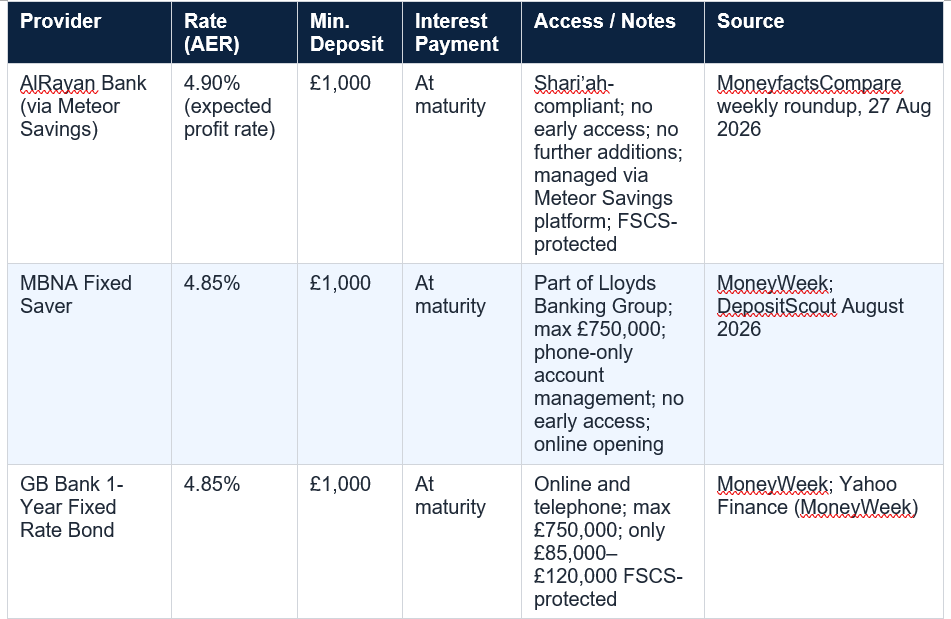
The distinction between AlRayan Bank’s ‘expected profit rate’ and the standard ‘AER’ on other accounts is worth understanding. AlRayan Bank is Shari’ah-compliant and does not pay interest (which is prohibited under Islamic finance principles). Instead, it pays an ‘expected profit rate,’ which functions identically to a fixed interest rate for the saver: AlRayan Bank states that since its founding in 2004, it has always met the expected profit rate quoted to customers. The account sits within the standard UK savings framework, carries FSCS protection in the same way as any other regulated bank, and is taxed identically to interest — as savings income.
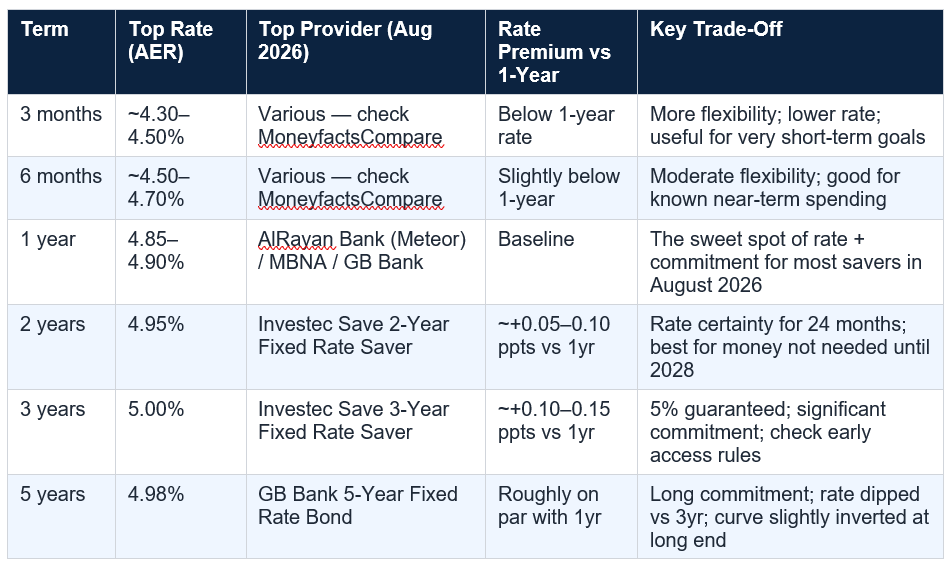
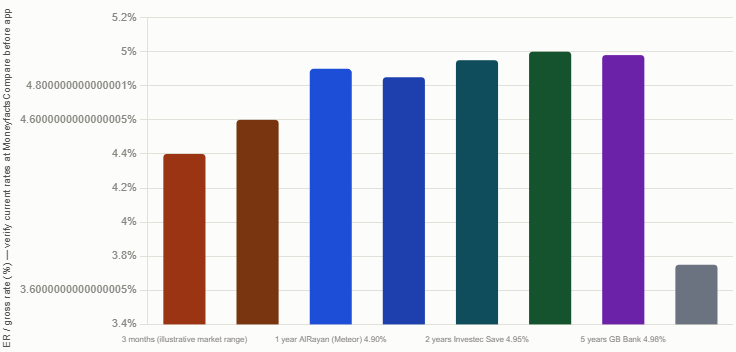
The rate pattern in August 2026 shows a relatively flat and slightly inverted yield curve at the long end: the five-year rate (4.98 percent) is slightly below the three-year rate (5.00 percent), while the two-year and three-year rates command only a small premium over the one-year rate. This makes the one-year bond particularly attractive relative to longer fixes — the rate difference between locking in for one year versus three years is approximately 0.10 to 0.15 percentage points, while the additional commitment is 24 months. For most savers, the one-year fix offers the best balance of return and flexibility in the current market.
The Bank of England cut its base rate five times between August 2024 and August 2025, reducing it from 5.25 percent to 3.75 percent. Each cut put downward pressure on savings rates, and the average one-year fixed rate fell from well above 5 percent in 2023 to approximately 3.79 percent by the start of March 2026. For savers who locked in at peak rates in 2023 and early 2024 and whose bonds have now matured, the rates currently available at maturity are materially lower than the rates they were receiving.
However, since early March 2026, the picture changed. MoneyfactsCompare’s savings overview notes that average rates rose steadily from March 2026 following geopolitical developments that revised market expectations for future base rate cuts. The MPC held the base rate at 3.75 percent at its August 2026 meeting. MoneyWeek notes that ‘with the Bank of England holding interest rates at 3.75% in its August meeting, fewer fixed-term bonds can now beat inflation’ — but those that do beat inflation, at 4.85 percent or above, represent genuinely real returns for savers.
The key implication for savers: the base rate is currently held. If it is cut again, fixed savings rates will likely fall. If it rises, fixed rates will also rise. By locking in a one-year fixed bond at 4.85 percent now, a saver captures that rate regardless of what the MPC does next. A saver who waits for base rate clarity may find the top rate has moved — in either direction — before they act.
The PSA for 2026/27:
MoneyfactsCompare’s weekly savings roundup of 27 August 2026 notes that savers earning above their PSA ‘are being reminded that higher returns could see them shoulder a bigger tax burden,’ as the number of people expected to pay tax on savings interest is projected to grow by 3.29 million (269 percent) in four years, according to HMRC data analysed by savings app Spring.
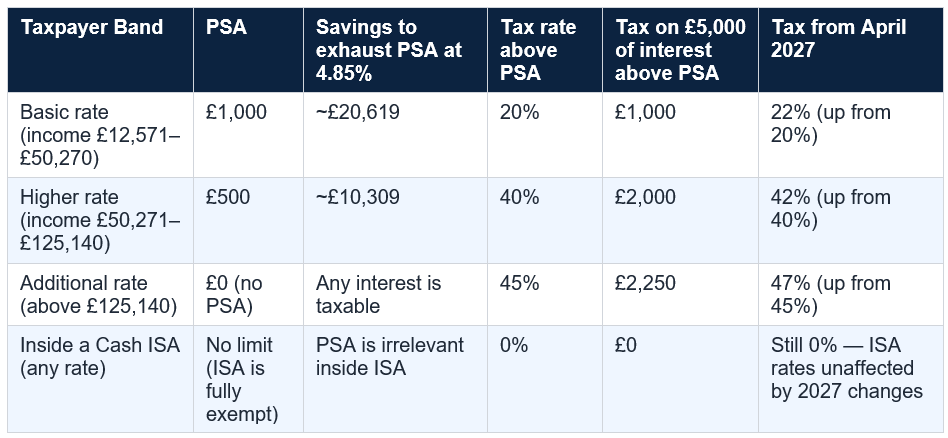
If your savings outside an ISA are above approximately £20,000 (basic rate) or £10,000 (higher rate), you will likely have a savings interest tax liability in 2026/27 from a one-year fixed bond at 4.85%. Consider whether placing some or all of the savings in a one-year fixed ISA (currently up to 4.72% AER from AlRayan Bank via Meteor Savings) would be more tax-efficient overall. The ISA rate is lower, but the post-tax return may be higher depending on your tax position. Run the comparison for your specific savings balance and tax rate before committing.
Interest from a fixed bond is taxable in the tax year in which it is received, not in the year in which it accrues. For a bond that opens in August 2026 and pays interest at maturity in August 2027, the full year’s interest is received in the 2027–28 tax year (which runs from 6 April 2027 to 5 April 2028). This means:
In August 2026:
The maturity action plan:
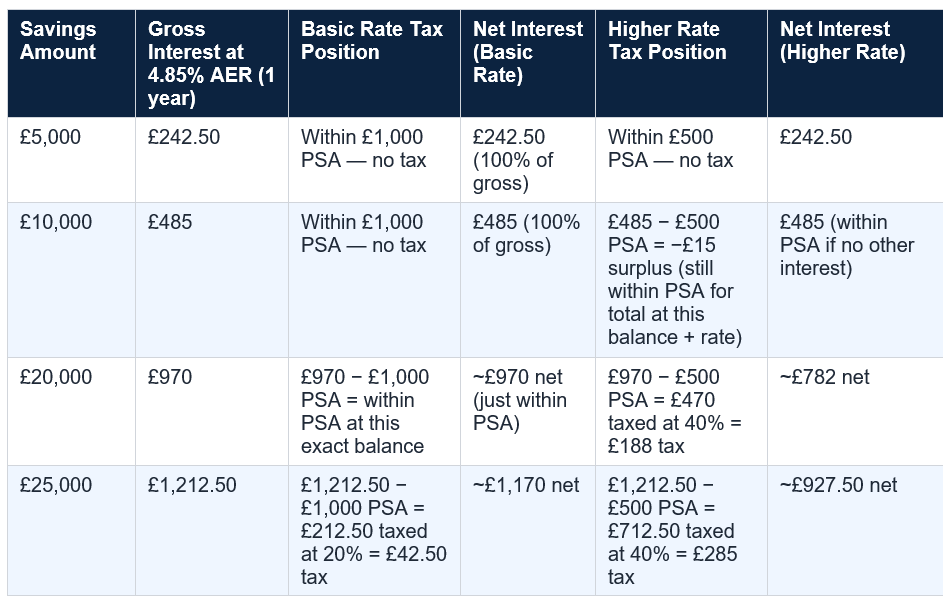
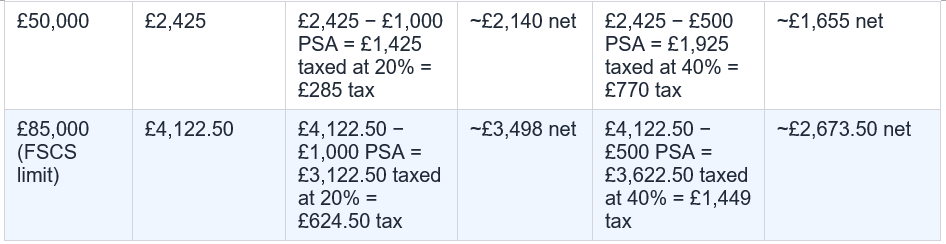
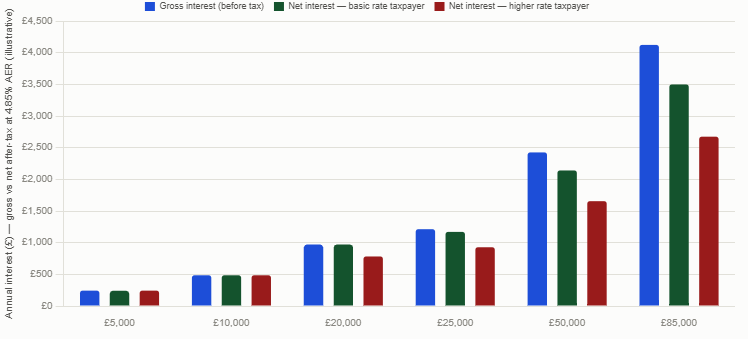
These examples illustrate why the tax position matters significantly at higher savings balances and higher income bands. A higher-rate taxpayer with £85,000 in a fixed bond earns approximately £2,673 net in one year — equivalent to an effective post-tax yield of approximately 3.14 percent — compared to a basic-rate taxpayer’s £3,498 net (effective 4.11 percent). For higher-rate taxpayers, the comparison with an ISA-wrapped bond at 4.72 percent AER (no tax at any savings level) becomes clearly more attractive at these balances.
For savers with money they know they will not need for twelve months, the case for a one-year fixed bond in August 2026 rests on three straightforward arguments. First, the guaranteed rate is materially higher than most easy-access accounts on a clean, unrestricted basis. Second, fixing now protects against a fall in rates if the MPC cuts again in the next twelve months. Third, at current levels, the fixed bond outperforms inflation (though not all accounts do — MoneyWeek notes that ‘fewer fixed-term bonds can now beat inflation’ at the base rate level, though the best accounts at 4.85 percent remain above most current inflation measures).
The two main caveats: tax and access. Savers with balances above their PSA threshold should run the post-tax comparison against a one-year fixed ISA before committing to a non-ISA bond — the effective yield advantage can reverse quickly for higher-rate taxpayers. And savers should only lock money away that is genuinely surplus to their emergency fund. A one-year fixed bond that cannot be accessed without penalty is not the right home for money that may be needed urgently.
Act before rates move. The best rates listed here were correct at 27–28 August 2026 and may change within days. Fixed rate tables are updated hourly on MoneyfactsCompare. If the account that looks right for your situation is still offering the rate you have seen, verify it and apply promptly. The rate advantage that makes these accounts compelling today is not guaranteed to persist.
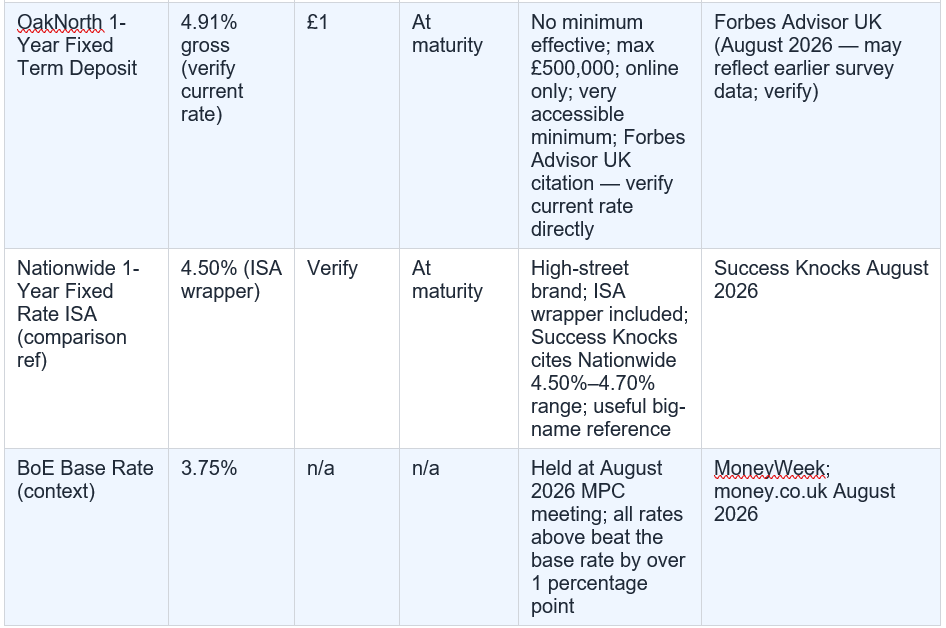
As at 27–28 August 2026, the leading rates are: AlRayan Bank's 1 Year Fixed Term Deposit via Meteor Savings at 4.90% AER (expected profit rate; Shari'ah-compliant; £1,000 minimum; MoneyfactsCompare weekly roundup, 27 August 2026); MBNA Fixed Saver and GB Bank both at 4.85% AER (MoneyWeek; DepositScout August 2026; £1,000 minimum each); and OakNorth at a rate cited by Forbes Advisor UK as 4.91% gross (minimum £1; verify current rate directly, as Forbes data may be from an earlier survey). Always verify the current rate directly with the provider before applying, as fixed rate tables change frequently.
Can I access money in a one-year fixed savings bond before maturity?
In almost all cases, no. One-year fixed savings accounts typically prohibit early withdrawals, or allow them only with a significant penalty equivalent to several months of interest. AlRayan Bank via Meteor Savings explicitly prohibits early access. MBNA Fixed Saver similarly does not allow early withdrawal. OakNorth's account terms should be verified directly. The only reliable guarantee of access at any time is an easy-access savings account — which typically pays a lower rate. Before opening a fixed bond, be confident you will not need the deposited sum for at least twelve months.
Do I pay tax on interest from a one-year fixed savings account?
Yes, unless the interest is earned inside an ISA wrapper. Interest from standard (non-ISA) fixed savings accounts is taxable income, subject to the Personal Savings Allowance (PSA). In 2026/27, basic-rate taxpayers can receive up to £1,000 in savings interest tax-free; higher-rate taxpayers £500; additional-rate taxpayers have no PSA. At 4.85% AER, basic-rate taxpayers exhaust the £1,000 PSA with approximately £20,619 in savings; higher-rate taxpayers exhaust the £500 PSA with approximately £10,309. Interest above the PSA is taxed at 20% (basic), 40% (higher), or 45% (additional rate). From April 2027, these rates rise to 22%, 42%, and 47% respectively. Interest on one-year bonds is typically paid gross — you are responsible for declaring and paying any tax due.
How does FSCS protection work for fixed savings accounts?
The Financial Services Compensation Scheme (FSCS) protects up to £85,000 per person per UK-authorised institution (£170,000 for joint accounts). A temporary higher limit of up to £120,000 applies in certain qualifying circumstances for up to 6 months (e.g. following a property sale or insurance payout). The protection is per institution, not per account — if you hold a current account and a fixed bond at the same bank, both balances count together toward the £85,000 limit. Some banks share FSCS coverage because they belong to the same banking group (e.g. MBNA and Lloyds Bank share the same FSCS limit). Check the FSCS website or MoneySavingExpert's 'which banks are linked' tool for linked institutions before depositing large sums.
Should I choose a one-year fixed bond or a one-year fixed cash ISA?
The answer depends on your tax position. In August 2026, the best one-year fixed bond pays approximately 4.85–4.90% AER, while the best one-year fixed ISA pays 4.72% AER (AlRayan Bank via Meteor Savings) — a gap of approximately 0.13–0.18 percentage points. For a basic-rate taxpayer with savings well within the £1,000 PSA, the non-ISA bond pays more on a post-tax basis. For a higher-rate taxpayer whose savings balance exceeds approximately £10,000 (exhausting the £500 PSA at 4.85%), or for any additional-rate taxpayer, the cash ISA's lower rate often produces a better post-tax return than the bond, because ISA interest is tax-free at any amount. As savings interest tax rates rise from April 2027, the ISA advantage increases further.
What happens when my one-year fixed bond matures?
At maturity, the principal and interest are typically moved to a low-rate maturity or notice account with the provider. You then have a window (often 14 to 30 days) to decide what to do with the proceeds. Action: set a calendar reminder 30 days before maturity; compare the live best-buy tables at that point (rates will have changed); consider whether to fix again, switch to easy-access, or put the proceeds into a cash ISA if you have unused ISA allowance. Do not leave the money sitting in a maturity account paying minimal interest — this is one of the most common and most costly passive mistakes for fixed-bond savers.
Table of Contents
- Why One-Year Fixed Bonds Are Worth Considering Right Now
- How One-Year Fixed Savings Accounts Work
- The Best One-Year Fixed Savings Accounts: August 2026 Rates
- The Broader Fixed-Rate Market: What Longer Terms Are Paying
- The Bank of England Base Rate Context: Why Rates Recovered in 2026
- Tax on Fixed Savings Accounts: The Personal Savings Allowance Explained
- Interest Paid at Maturity vs Annually: What the Difference Means for Tax
- FSCS Protection: Is Your Money Safe in a Fixed Bond?
- One-Year Fixed vs Easy-Access: When Each One Wins
- One-Year Fixed vs Cash ISA: Which Should You Choose?
- What to Do When Your Fixed Bond Matures
- How to Open a One-Year Fixed Savings Account
- Worked Examples: What Your Money Actually Earns
- Conclusion: Lock In Now While the Rate Advantage Holds
- Frequently Asked Questions
Best Rates By term
Net Interest After Tax By Saving Balance
Why One-Year Fixed Bonds Are Worth Considering Right Now
The UK one-year fixed savings market is paying more in August 2026 than it has for much of the past two years. The top rate sits at 4.85 percent AER, well above the Bank of England base rate of 3.75 percent, and the average one-year fixed rate has risen from 3.79 percent at the start of March 2026 to 4.26 percent at the start of August — a meaningful improvement of 0.47 percentage points in approximately five months (MoneyfactsCompare, 27 August 2026).The reason for the recovery is as much geopolitical as economic. MoneyfactsCompare’s savings overview notes that average rates have risen steadily since the beginning of March 2026, shortly after the US and Israel joined forces against Iran, which revised market expectations around future Bank of England base rate cuts. The MPC held the base rate at 3.75 percent at its August 2026 meeting (MoneyWeek; money.co.uk). With fewer cuts expected, providers have repriced their fixed products upward — creating a window in which locking in for twelve months offers a guaranteed return that easy-access accounts, with their variable rates, cannot match.
This guide identifies the best rates currently available, explains how the accounts work, covers the tax position precisely, and provides the worked examples that comparison tables typically omit. All rates are sourced from MoneyfactsCompare, MoneyWeek, Forbes Advisor UK, and specialist tools and are correct as at 27–28 August 2026. Rates change frequently; always verify directly with the provider before applying.
How One-Year Fixed Savings Accounts Work
A one-year fixed-rate savings account — also called a one-year fixed-rate bond or one-year fixed-term deposit — offers a guaranteed interest rate in exchange for locking your money away for twelve months. The key features:- Fixed rate for the term: the interest rate is guaranteed from the day you open the account to the day it matures. It does not change if the Bank of England cuts or raises the base rate during the year.
- No access during the term: in almost all cases, money deposited in a one-year fixed bond cannot be withdrawn before maturity. Some providers explicitly prohibit early access; others may allow it with a significant penalty (typically equivalent to several months’ interest). Read the terms before committing.
- No further additions: most one-year fixed bonds do not allow additional deposits after the initial opening period (typically the first 14 to 30 days). Check the account terms if you plan to add money in stages.
- Interest paid at maturity or annually: most one-year bonds pay interest at maturity (i.e. at the end of the twelve months). Some longer-term bonds pay annually; for one-year products, maturity and annually are the same. Interest is typically paid gross — without tax deducted — so savers are responsible for any tax due.
- Minimum and maximum deposits: minimum deposits range from £1 (OakNorth) to £1,000 (MBNA, AlRayan via Meteor) or £5,000 (some specialist accounts). Maximum limits range from £250,000 to £750,000 or more, though only the first £85,000 (£120,000 in qualifying circumstances) is FSCS-protected.
- Online, app, or telephone management: many of the best rates come from challenger banks and specialist providers that manage accounts online or via app. MBNA’s Fixed Saver is telephone-only for account management — a genuine trade-off for some savers (DepositScout, August 2026).
3. The Best One-Year Fixed Savings Accounts: August 2026 Rates
The following table shows the best one-year fixed savings rates available as at 27–28 August 2026, sourced from MoneyfactsCompare, MoneyWeek, Forbes Advisor UK, and DepositScout. Rates are listed for standard (non-ISA) savings accounts. Always verify the current rate directly with the provider before applying — fixed rate tables move quickly.The distinction between AlRayan Bank’s ‘expected profit rate’ and the standard ‘AER’ on other accounts is worth understanding. AlRayan Bank is Shari’ah-compliant and does not pay interest (which is prohibited under Islamic finance principles). Instead, it pays an ‘expected profit rate,’ which functions identically to a fixed interest rate for the saver: AlRayan Bank states that since its founding in 2004, it has always met the expected profit rate quoted to customers. The account sits within the standard UK savings framework, carries FSCS protection in the same way as any other regulated bank, and is taxed identically to interest — as savings income.
The Broader Fixed-Rate Market: What Longer Terms Are Paying
One-year fixed bonds sit in a broader fixed-rate market that offers progressively higher rates for longer commitments. Understanding where the one-year rate sits within this spectrum is useful for deciding whether to fix short or long:The rate pattern in August 2026 shows a relatively flat and slightly inverted yield curve at the long end: the five-year rate (4.98 percent) is slightly below the three-year rate (5.00 percent), while the two-year and three-year rates command only a small premium over the one-year rate. This makes the one-year bond particularly attractive relative to longer fixes — the rate difference between locking in for one year versus three years is approximately 0.10 to 0.15 percentage points, while the additional commitment is 24 months. For most savers, the one-year fix offers the best balance of return and flexibility in the current market.
5. The Bank of England Base Rate Context: Why Rates Recovered in 2026
Understanding why one-year fixed rates have recovered from their March 2026 lows helps savers calibrate how long the current rate environment might persist and whether locking in now makes sense.The Bank of England cut its base rate five times between August 2024 and August 2025, reducing it from 5.25 percent to 3.75 percent. Each cut put downward pressure on savings rates, and the average one-year fixed rate fell from well above 5 percent in 2023 to approximately 3.79 percent by the start of March 2026. For savers who locked in at peak rates in 2023 and early 2024 and whose bonds have now matured, the rates currently available at maturity are materially lower than the rates they were receiving.
However, since early March 2026, the picture changed. MoneyfactsCompare’s savings overview notes that average rates rose steadily from March 2026 following geopolitical developments that revised market expectations for future base rate cuts. The MPC held the base rate at 3.75 percent at its August 2026 meeting. MoneyWeek notes that ‘with the Bank of England holding interest rates at 3.75% in its August meeting, fewer fixed-term bonds can now beat inflation’ — but those that do beat inflation, at 4.85 percent or above, represent genuinely real returns for savers.
The key implication for savers: the base rate is currently held. If it is cut again, fixed savings rates will likely fall. If it rises, fixed rates will also rise. By locking in a one-year fixed bond at 4.85 percent now, a saver captures that rate regardless of what the MPC does next. A saver who waits for base rate clarity may find the top rate has moved — in either direction — before they act.
Tax on Fixed Savings Accounts: The Personal Savings Allowance Explained
Interest earned on fixed savings accounts is taxable income. Unlike ISA interest, which is permanently tax-free, interest from standard fixed bonds is subject to income tax above the Personal Savings Allowance (PSA). Understanding the tax position before opening a fixed bond is essential — especially at current rates, where the PSA is exhausted relatively quickly.The PSA for 2026/27:
- Basic-rate taxpayers: £1,000 per year tax-free on savings interest. Above £1,000, interest is taxed at 20 percent.
- Higher-rate taxpayers: £500 per year tax-free on savings interest. Above £500, interest is taxed at 40 percent.
- Additional-rate taxpayers: £0 — no PSA. All savings interest is taxed at 45 percent.
- A basic-rate taxpayer exhausts their £1,000 PSA with just £20,619 in a fixed savings account.
- A higher-rate taxpayer exhausts their £500 PSA with just £10,309 in a fixed savings account.
MoneyfactsCompare’s weekly savings roundup of 27 August 2026 notes that savers earning above their PSA ‘are being reminded that higher returns could see them shoulder a bigger tax burden,’ as the number of people expected to pay tax on savings interest is projected to grow by 3.29 million (269 percent) in four years, according to HMRC data analysed by savings app Spring.
If your savings outside an ISA are above approximately £20,000 (basic rate) or £10,000 (higher rate), you will likely have a savings interest tax liability in 2026/27 from a one-year fixed bond at 4.85%. Consider whether placing some or all of the savings in a one-year fixed ISA (currently up to 4.72% AER from AlRayan Bank via Meteor Savings) would be more tax-efficient overall. The ISA rate is lower, but the post-tax return may be higher depending on your tax position. Run the comparison for your specific savings balance and tax rate before committing.
Interest Paid at Maturity vs Annually: What the Difference Means for Tax
Most one-year fixed savings accounts pay interest at maturity — meaning the interest is credited to the account at the end of the twelve-month term. This has a specific tax implication that many savers overlook.Interest from a fixed bond is taxable in the tax year in which it is received, not in the year in which it accrues. For a bond that opens in August 2026 and pays interest at maturity in August 2027, the full year’s interest is received in the 2027–28 tax year (which runs from 6 April 2027 to 5 April 2028). This means:
- The interest does not count toward your 2026–27 PSA. It counts toward your 2027–28 PSA.
- If you already have other savings interest, a salary increase, or other income changes planned for 2027–28, the maturity payment could affect your total tax position for that year.
- From April 2027, savings interest tax rates are rising (basic 22 percent, higher 42 percent). If your bond matures after 6 April 2027, the interest will be taxed at the new, higher rates if it exceeds your PSA.
- HMRC is informed of interest paid by banks and building societies. For most PAYE employees, HMRC will adjust the tax code in the following year to collect any savings tax due, or issue a P800 letter. Savers with more than £10,000 in savings interest in a year must file a Self Assessment return.
FSCS Protection: Is Your Money Safe in a Fixed Bond?
All the providers listed in the best-buy table are UK-regulated and carry Financial Services Compensation Scheme (FSCS) protection. If a bank or building society fails, the FSCS protects:- £85,000 per person per UK-authorised institution. Money above this threshold is at risk if the institution fails.
- £170,000 per person on joint accounts (i.e. £85,000 per person).
- Up to £120,000 under the Temporary High Balance (THB) protection scheme, which applies for 6 months following certain qualifying life events (receiving insurance payouts, property sale proceeds, redundancy payments, and similar).
- The protection limit is per institution, not per account. If you hold a current account, a savings account, and a fixed bond all at the same bank, the combined total is assessed against the £85,000 limit, not each account separately.
- Some banks share FSCS protection because they are part of the same banking group. MBNA, for example, is part of Lloyds Banking Group — meaning MBNA deposits and Lloyds Bank deposits share the same £85,000 FSCS limit per person. Check the FSCS website or MSE’s ‘which banks are linked’ tool before depositing large sums.
- Accounts such as MBNA Fixed Saver and GB Bank have maximum deposit limits of £750,000 — well above the FSCS threshold. The excess above £85,000 (or £120,000 under THB) is not protected. For large deposits, spreading across multiple FSCS-protected institutions is the prudent approach.
- Challenger banks and specialist providers such as OakNorth, AlRayan Bank, and GB Bank carry identical FSCS protection to high-street banks. FSCS status does not depend on brand recognition.
One-Year Fixed vs Easy-Access: When Each One Wins
The choice between a one-year fixed bond and an easy-access savings account depends on three factors: rate difference, access needs, and rate direction expectations.In August 2026:
- Best easy-access rate: approximately 4.38 to 5.00 percent AER depending on account type and restrictions (MoneyfactsCompare 28 August 2026 — the 5.00 percent figure includes regular savers and restricted accounts; standard easy-access rates are typically in the 4.40 to 4.70 percent range).
- Best one-year fixed: 4.85 to 4.90 percent AER.
- The rate premium for fixing for one year: approximately 0.10 to 0.50 percentage points over a clean, unrestricted easy-access account. On £20,000, a 0.25 percentage point premium generates approximately £50 of additional interest per year.
- You have money you know you will not need for at least twelve months. This includes emergency funds you have already established in an easy-access account and savings above that buffer.
- You believe the base rate may be cut in the next twelve months and want to lock in the current rate before it falls.
- Certainty of return matters more than flexibility — for example, saving toward a known goal (holiday, home improvement, tuition) with a fixed date more than a year away.
- The money is your emergency fund. An easy-access account is the correct home for money that must be accessible at short notice — job loss, unexpected repairs, medical costs.
- You believe rates may rise further in the next few months and do not want to lock in now. Fixing protects against rate falls but means missing out on rate rises.
- You expect to need the money within twelve months for a planned expenditure.
One-Year Fixed vs Cash ISA: Which Should You Choose?
The comparison between a one-year fixed bond and a one-year fixed cash ISA involves both the headline rate difference and the tax position. In August 2026:- Best one-year fixed savings bond: 4.90 percent AER (AlRayan Bank via Meteor Savings).
- Best one-year fixed cash ISA: 4.72 percent AER (AlRayan Bank via Meteor Savings — the same provider, but the ISA rate is lower).
- Rate differential: approximately 0.18 percentage points in favour of the non-ISA bond.
- If your savings balance is well within your PSA and you are confident it will remain so throughout the year. A basic-rate taxpayer with only £10,000 in savings at 4.85 percent earns approximately £485 in interest — well below the £1,000 PSA. No tax is due, and the bond outperforms the ISA by approximately 0.18 percentage points.
- If your savings balance exceeds your PSA threshold (£20,619 for basic-rate at 4.85 percent; £10,309 for higher-rate). Any interest above the PSA is taxed at 20–45 percent, making the effective post-tax yield of the non-ISA bond lower than the gross rate suggests.
- For higher-rate taxpayers: the £500 PSA is exhausted quickly. On £20,000 at 4.90 percent, a higher-rate taxpayer pays 40 percent on £480 (the £980 total interest minus the £500 PSA) = £192 in tax. The effective post-tax yield is approximately 3.94 percent, well below the ISA rate of 4.72 percent.
- For savers who want all future interest permanently shielded from the April 2027 rate rises and beyond, the ISA is the correct wrapper regardless of the headline rate differential today.
What to Do When Your Fixed Bond Matures
When a one-year fixed bond matures, the money (principal plus interest) is typically moved to a holding account or current account with the provider, where it earns either a low rate or no interest at all. Acting quickly at maturity ensures you do not lose weeks of interest on a sum that took a year to build.The maturity action plan:
- Set a calendar reminder: book a reminder for 30 days before maturity to research rates and identify the next account you want to move to. The best rates can be applied for and funded within a few days, but having 30 days gives flexibility if there are delays.
- Compare the live best-buy tables at maturity: the best rate available in August 2027 may be from a completely different provider than the best rate in August 2026. Do not assume your existing provider is still competitive at maturity.
- Consider whether to fix again or switch to easy-access: at maturity, the rate environment will have changed. Evaluate the fixed vs easy-access trade-off again with the prevailing rates and your current financial position.
- Check whether to open a cash ISA with the maturity proceeds: if you have not used your ISA allowance for the year in which your bond matures, the maturity proceeds could fund a cash ISA contribution, sheltering future interest permanently.
- Contact your current provider about reinvestment options: many providers offer a preferential reinvestment rate to existing customers for a limited window at maturity. This is worth checking — but do not assume it will beat the market.
How to Open a One-Year Fixed Savings Account
The process for opening a one-year fixed savings account is straightforward:- Step 1: identify the best rate using MoneyfactsCompare, MoneySavingExpert, MoneyWeek, or Forbes Advisor UK. Verify the current rate on the provider’s own website before proceeding — comparison tables may be hours or days behind the live rate.
- Step 2: check the account terms. Confirm the minimum and maximum deposit, whether early access is available (and at what penalty), when interest is paid, and how the account is managed (online, app, or telephone).
- Step 3: check FSCS coverage. If depositing more than £85,000 with a single institution (including all existing accounts there), be aware that the excess is not FSCS-protected.
- Step 4: open the account online (or by phone for providers like MBNA). You will need proof of identity, a UK address, and your National Insurance number. Most accounts can be opened in 10 to 20 minutes.
- Step 5: fund the account within the allowed window. Most providers require the account to be funded within 14 to 30 days of opening. After this window closes, no further additions are accepted.
- Step 6: set a maturity reminder. As described in Section 11, schedule a review 30 days before maturity to avoid the proceeds sitting in a low-rate holding account.
Worked Examples: What Your Money Actually Earns
The following examples are based on a 4.85 percent AER one-year fixed bond. Figures are gross interest (before tax); see the tax columns for net return estimates. All figures are illustrative.These examples illustrate why the tax position matters significantly at higher savings balances and higher income bands. A higher-rate taxpayer with £85,000 in a fixed bond earns approximately £2,673 net in one year — equivalent to an effective post-tax yield of approximately 3.14 percent — compared to a basic-rate taxpayer’s £3,498 net (effective 4.11 percent). For higher-rate taxpayers, the comparison with an ISA-wrapped bond at 4.72 percent AER (no tax at any savings level) becomes clearly more attractive at these balances.
Conclusion: Lock In Now While the Rate Advantage Holds
The one-year fixed savings market in August 2026 is offering the best rates seen since early 2024. The top rate of 4.85 to 4.90 percent AER is more than 1.1 percentage points above the Bank of England base rate of 3.75 percent — a wide spread that reflects providers competing for deposits in an environment where expectations for further base rate cuts have receded. The average one-year fixed rate has risen from 3.79 percent in March 2026 to 4.26 percent by August, and the leading accounts have climbed further.For savers with money they know they will not need for twelve months, the case for a one-year fixed bond in August 2026 rests on three straightforward arguments. First, the guaranteed rate is materially higher than most easy-access accounts on a clean, unrestricted basis. Second, fixing now protects against a fall in rates if the MPC cuts again in the next twelve months. Third, at current levels, the fixed bond outperforms inflation (though not all accounts do — MoneyWeek notes that ‘fewer fixed-term bonds can now beat inflation’ at the base rate level, though the best accounts at 4.85 percent remain above most current inflation measures).
The two main caveats: tax and access. Savers with balances above their PSA threshold should run the post-tax comparison against a one-year fixed ISA before committing to a non-ISA bond — the effective yield advantage can reverse quickly for higher-rate taxpayers. And savers should only lock money away that is genuinely surplus to their emergency fund. A one-year fixed bond that cannot be accessed without penalty is not the right home for money that may be needed urgently.
Act before rates move. The best rates listed here were correct at 27–28 August 2026 and may change within days. Fixed rate tables are updated hourly on MoneyfactsCompare. If the account that looks right for your situation is still offering the rate you have seen, verify it and apply promptly. The rate advantage that makes these accounts compelling today is not guaranteed to persist.
Frequently Asked Questions
What is the best one-year fixed savings rate in the UK right now?As at 27–28 August 2026, the leading rates are: AlRayan Bank's 1 Year Fixed Term Deposit via Meteor Savings at 4.90% AER (expected profit rate; Shari'ah-compliant; £1,000 minimum; MoneyfactsCompare weekly roundup, 27 August 2026); MBNA Fixed Saver and GB Bank both at 4.85% AER (MoneyWeek; DepositScout August 2026; £1,000 minimum each); and OakNorth at a rate cited by Forbes Advisor UK as 4.91% gross (minimum £1; verify current rate directly, as Forbes data may be from an earlier survey). Always verify the current rate directly with the provider before applying, as fixed rate tables change frequently.
Can I access money in a one-year fixed savings bond before maturity?
In almost all cases, no. One-year fixed savings accounts typically prohibit early withdrawals, or allow them only with a significant penalty equivalent to several months of interest. AlRayan Bank via Meteor Savings explicitly prohibits early access. MBNA Fixed Saver similarly does not allow early withdrawal. OakNorth's account terms should be verified directly. The only reliable guarantee of access at any time is an easy-access savings account — which typically pays a lower rate. Before opening a fixed bond, be confident you will not need the deposited sum for at least twelve months.
Do I pay tax on interest from a one-year fixed savings account?
Yes, unless the interest is earned inside an ISA wrapper. Interest from standard (non-ISA) fixed savings accounts is taxable income, subject to the Personal Savings Allowance (PSA). In 2026/27, basic-rate taxpayers can receive up to £1,000 in savings interest tax-free; higher-rate taxpayers £500; additional-rate taxpayers have no PSA. At 4.85% AER, basic-rate taxpayers exhaust the £1,000 PSA with approximately £20,619 in savings; higher-rate taxpayers exhaust the £500 PSA with approximately £10,309. Interest above the PSA is taxed at 20% (basic), 40% (higher), or 45% (additional rate). From April 2027, these rates rise to 22%, 42%, and 47% respectively. Interest on one-year bonds is typically paid gross — you are responsible for declaring and paying any tax due.
How does FSCS protection work for fixed savings accounts?
The Financial Services Compensation Scheme (FSCS) protects up to £85,000 per person per UK-authorised institution (£170,000 for joint accounts). A temporary higher limit of up to £120,000 applies in certain qualifying circumstances for up to 6 months (e.g. following a property sale or insurance payout). The protection is per institution, not per account — if you hold a current account and a fixed bond at the same bank, both balances count together toward the £85,000 limit. Some banks share FSCS coverage because they belong to the same banking group (e.g. MBNA and Lloyds Bank share the same FSCS limit). Check the FSCS website or MoneySavingExpert's 'which banks are linked' tool for linked institutions before depositing large sums.
Should I choose a one-year fixed bond or a one-year fixed cash ISA?
The answer depends on your tax position. In August 2026, the best one-year fixed bond pays approximately 4.85–4.90% AER, while the best one-year fixed ISA pays 4.72% AER (AlRayan Bank via Meteor Savings) — a gap of approximately 0.13–0.18 percentage points. For a basic-rate taxpayer with savings well within the £1,000 PSA, the non-ISA bond pays more on a post-tax basis. For a higher-rate taxpayer whose savings balance exceeds approximately £10,000 (exhausting the £500 PSA at 4.85%), or for any additional-rate taxpayer, the cash ISA's lower rate often produces a better post-tax return than the bond, because ISA interest is tax-free at any amount. As savings interest tax rates rise from April 2027, the ISA advantage increases further.
What happens when my one-year fixed bond matures?
At maturity, the principal and interest are typically moved to a low-rate maturity or notice account with the provider. You then have a window (often 14 to 30 days) to decide what to do with the proceeds. Action: set a calendar reminder 30 days before maturity; compare the live best-buy tables at that point (rates will have changed); consider whether to fix again, switch to easy-access, or put the proceeds into a cash ISA if you have unused ISA allowance. Do not leave the money sitting in a maturity account paying minimal interest — this is one of the most common and most costly passive mistakes for fixed-bond savers.
0 Comments
Be the first to share your thoughts on this article.