

Savings
UK Electricity VAT Scrapped: What It Means for Bills

Key Statistics & Policy Details: Announcement date: 21 July 2026 (Prime Minister Andy Burnham’s first major domestic policy). VAT cut: 5% → 0% on domestic electricity bills. Effective date: 1 October 2026. Duration: 6 months (to 31 March 2027 — end of 2026/27 financial year). Government estimated saving: ~£45 per year for a typical household (~£3.75/month, ~87p/week). Estimated real-world saving (Martin Lewis / Energy Made Easy): closer to £20, once the concurrent Ofgem price cap rise is factored in. Cost to Treasury: ~£850 million in 2026/27. Funding source: cancellation of the previous government’s £1.8 billion Digital ID programme. Applies to: electricity ONLY (not gas). Applies in: England, Scotland and Wales. Northern Ireland: receives equivalent funding via the Northern Ireland Executive. Scope: all domestic households, small businesses eligible for domestic energy VAT relief, charities, and residential care homes. Applies to fixed tariff and prepayment meter customers. CPI impact: expected to reduce CPI inflation by approximately 0.1 percentage points. Previous energy support: £150 reduction in energy bills announced in the previous Budget (Autumn 2025). Extension: any decision to continue beyond 31 March 2027 will be considered at the Autumn Budget 2026.
For millions of households who have spent the past four years battling energy bills that in some months have been double what they were in 2021, the announcement was welcome news. Any reduction in the cost of running a home is genuinely meaningful. But the headline figure — a saving of £45 per year — quickly attracted scrutiny, particularly from MoneySavingExpert’s Martin Lewis, who noted that the saving would be largely offset for most households by a concurrent rise in the Ofgem price cap.
This article explains everything you need to know about the electricity VAT cut: what it is, who benefits, what you will actually save, why the headline and reality diverge, whether it will be extended, and what action (if any) you need to take.
The 5 percent VAT on domestic electricity appears on every household electricity bill. It is applied to both the unit rate (the cost per kilowatt-hour of electricity consumed) and the standing charge (the fixed daily cost of maintaining a connection to the grid). On a typical annual electricity bill of approximately £900 to £1,000, the 5 percent VAT component represents approximately £45 to £50.
Arguments for removing it have circulated since the UK left the EU — when it became legally possible to zero-rate domestic energy without breaching EU state aid rules — but successive governments retained it as a revenue source. The 5 percent rate was also applied to gas, business energy (where standard VAT rules apply differently), and certain charitable organisations and care homes at reduced rates. The July 2026 announcement cuts the rate to zero on electricity only, leaving gas at 5 percent.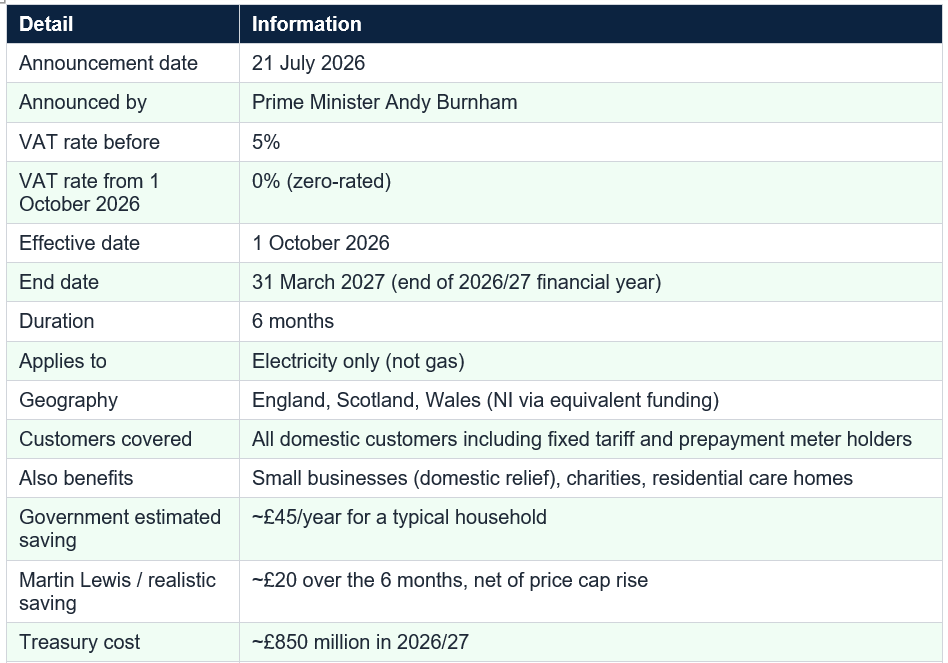

MoneyMagpie’s August 2026 analysis confirms: the £45 annual figure works out at approximately £3.75 per month or 87 pence per week for a household receiving the average saving. For heavy electricity users — those on all-electric heating, with electric vehicles, or running energy-intensive appliances — the saving will be proportionally higher.
The mechanism by which this undermines the VAT saving:
Martin Lewis, MoneySavingExpert (22 July 2026): I’ve just got the latest energy bill predictions. The new Andy Burnham administration has just announced that from 1 October, for six months, it’s going to get rid of VAT on domestic electricity bills. Now, this is good news — it’s a good totemic step. But in practice most won’t feel much benefit. The expected £45 a year VAT saving will now be swallowed up for most by the Price Cap rise.
Energy Made Easy’s August 2026 analysis is more precise: the government’s £45 figure is a comparison to the same October price cap without the VAT cut, not a comparison to September bills. In other words, the VAT cut makes the October cap lower than it would otherwise have been. It does not make October bills lower than September bills. The realistic net benefit compared to the September bill is approximately £20 over the six months.
This is not a reason to dismiss the policy. A £20 real saving on energy bills over winter is a genuine reduction in cost-of-living pressure, particularly for lower-income households for whom energy bills represent a higher proportion of total spending. But it is the accurate framing of what the policy achieves.
The government has not publicly detailed the specific reasoning for the electricity-only scope. The most likely explanations are a combination of policy ambition (aligning with the transition to electric heat pumps and the net zero agenda) and fiscal constraint (cutting gas VAT as well would cost significantly more than the £850 million budgeted, and the Digital ID cancellation funded only the electricity cut).
The VATCalc analysis also notes that extending the cut to gas would involve additional complexity under the Windsor Framework, particularly around Northern Ireland’s unique VAT position. Keeping the measure to electricity avoided some of these complications.
Consumer groups and the gas industry were vocal in pointing out the asymmetry. A household on gas central heating with typical usage might save £45 per year from the electricity VAT cut but would save approximately £80 to £100 per year if the same zero-rating applied to gas as well. Any government decision to extend the policy to gas would be one of the most significant energy bill announcements in years.
Instead, the government announced that the Northern Ireland Executive will receive equivalent funding — the same per-household amount that the VAT cut delivers in Great Britain — to support Northern Ireland households in a comparable way. As of August 2026, the Northern Ireland Executive had not yet confirmed the specific mechanism through which it would deliver this support. MoneySavingExpert confirmed it was seeking further details from the Executive and would update its coverage when available.
Action: Northern Ireland households: watch for an announcement from the Northern Ireland Executive about how the equivalent funding will be delivered. It may come as a direct payment, a bill credit, or a supplier-applied rebate rather than a VAT rate change.
The political dynamics around the extension are complex. Making the zero-rating permanent would cost approximately £1.7 billion per year at current consumption levels — a significant and recurring fiscal commitment. Cancelling it would mean bills rising by the VAT component from April 2027 in a way that could be politically damaging.
The Burnham government has signalled that the decision will be made within its fiscal rules framework, which presumably means identifying a permanent funding source rather than a one-off cancellation of a specific programme. Consumer groups are already lobbying for permanent zero-rating, and several opposition parties have voiced support for making the cut permanent.
The honest assessment: the probability of the zero-rating being allowed to expire on 31 March 2027 without any replacement measure is low given the political cost. Whether it is extended as-is, made permanent, or replaced by a different form of energy support will depend on the Autumn Budget and the energy price environment at that point.
The VATCalc analysis notes a specific complication: the funding for the Digital ID programme had not yet been clearly attached to specific savings in the previous government’s spending plans. Cancelling it therefore provides the headline resource for the VAT cut, but the underlying fiscal arithmetic requires that identified savings elsewhere confirm the funding is genuinely available.
The Burnham government described the approach as redirecting resources from a large technology project with uncertain near-term consumer benefit into immediate, tangible household relief. Critics from the previous government’s supporters argued that the Digital ID programme had broader economic benefits that should not be compared directly to energy bill support. The political debate about value-for-money is separate from the policy itself, but relevant to understanding the long-term sustainability of the measure.
His core points, made via social media and MoneySavingExpert on 21 and 22 July 2026:
Beyond the VAT cut, the wider energy saving strategies that remain relevant in October 2026:
The honest caveat is Martin Lewis’s: the £45 headline saving is a comparison to a counterfactual, not to your September bill. By the time the VAT saving arrives on 1 October, the Ofgem price cap will also have risen. The net benefit to most households is closer to £20 over the six months of the policy. That is real money — particularly for the households for whom energy costs represent a significant proportion of their income. But it is not the £45 annual transformation that the headline implies.
The most important near-term question is whether the Autumn Budget extends the zero-rating beyond March 2027. If it does not, April bills will rise by the full VAT component at a time when the new government’s energy support policy will face its first major political test. If it does, the electricity VAT cut becomes a permanent feature of the UK energy landscape — a step that consumer groups have advocated for years and that would represent a meaningful, enduring reduction in the cost of an essential service. Watch the Autumn Budget.
VAT on domestic electricity bills in England, Scotland, and Wales drops from 5% to 0% from 1 October 2026. The measure runs for six months to 31 March 2027, the end of the 2026/27 financial year. Any decision to extend it beyond that date will be made at the Autumn Budget.
How much will I save on my electricity bill?
The government estimates approximately £45 per year for a typical household (around £3.75 per month or 87p per week). However, MoneySavingExpert’s Martin Lewis noted that the October Ofgem price cap rise largely offsets the VAT saving for most households. The honest net saving over the six months of the policy is closer to £20 for a typical household. Households with higher electricity use (electric heating, EVs) will save proportionally more.
Do I need to contact my supplier?
No. All suppliers are required to apply the VAT reduction automatically to eligible customers from 1 October. British Gas and other major suppliers confirmed on 21 July that they will pass the full reduction on. No tariff change, account login, or contact with your supplier is required. Check your first October or November bill to confirm the 0% VAT rate is showing.
Does the VAT cut apply to gas as well?
No. The zero-rating applies to electricity only. Gas remains at 5% VAT. This means households with gas central heating and typical usage save less proportionally than all-electric households. Consumer groups and some opposition politicians have called for the cut to be extended to gas, but no announcement has been made on this.
Why is Northern Ireland treated differently?
The Windsor Framework, which governs Northern Ireland’s relationship with EU trading rules, means Northern Ireland must comply with EU VAT minimum rates for goods — including energy. The EU minimum rate for domestic energy is 5%, so the Great Britain zero-rating cannot be applied in Northern Ireland without breaching the Framework. Instead, the Northern Ireland Executive receives equivalent funding to deliver comparable support through a mechanism of its own choosing.
Is the electricity VAT cut permanent?
Not yet. The current measure is explicitly temporary: it covers the period from 1 October 2026 to 31 March 2027 only, funded by the cancellation of the Digital ID programme for this financial year. The government has confirmed that any extension beyond March 2027 will be considered at the Autumn Budget. Making the cut permanent would cost approximately £1.7 billion per year.
Will my bill actually go down from October?
For most households, probably not — or only slightly. The October price cap review is expected to bring a rise in the unit rates for electricity and gas that partially or fully offsets the VAT saving on electricity. The VAT cut means your October bill will be lower than it would have been without the cut, but it may still be higher than your September bill. The net benefit compared to September is approximately £3 to £4 per month for a typical household.
Table of Contents
- What Just Changed and Why It Matters
- What Is VAT on Electricity and Why Was It There?
- The Full Policy: What the Government Actually Announced
- The Honest Numbers: What Will You Actually Save?
- The Price Cap Problem: Why £45 Becomes ~£20 in Reality
- Who Benefits and Who Does Not
- The Electricity-Only Question: Why Not Gas?
- Northern Ireland: How Does It Work Differently?
- Is It Permanent? The Extension Question
- How It Was Funded: The Digital ID Connection
- What Martin Lewis Said
- What to Do Right Now
- Conclusion: A Step Forward, Not a Transformation
- Frequently Asked Questions
What Just Changed and Why It Matters
On 21 July 2026, Prime Minister Andy Burnham stood in Downing Street and made his first major domestic policy announcement: VAT on household electricity bills in Great Britain would be cut from 5 percent to zero percent, effective from 1 October 2026. The measure would run for six months, to the end of the 2026/27 financial year on 31 March 2027.For millions of households who have spent the past four years battling energy bills that in some months have been double what they were in 2021, the announcement was welcome news. Any reduction in the cost of running a home is genuinely meaningful. But the headline figure — a saving of £45 per year — quickly attracted scrutiny, particularly from MoneySavingExpert’s Martin Lewis, who noted that the saving would be largely offset for most households by a concurrent rise in the Ofgem price cap.
This article explains everything you need to know about the electricity VAT cut: what it is, who benefits, what you will actually save, why the headline and reality diverge, whether it will be extended, and what action (if any) you need to take.
What Is VAT on Electricity and Why Was It There?
VAT (Value Added Tax) is a consumption tax levied by the UK government on most goods and services. The standard VAT rate in the UK is 20 percent. Domestic energy — both electricity and gas — has historically been taxed at a reduced rate of 5 percent, the lowest rate permitted under EU VAT rules when the UK was a member. The reduced rate on domestic energy has been in place since 1997, when the government lowered it from 8 percent.The 5 percent VAT on domestic electricity appears on every household electricity bill. It is applied to both the unit rate (the cost per kilowatt-hour of electricity consumed) and the standing charge (the fixed daily cost of maintaining a connection to the grid). On a typical annual electricity bill of approximately £900 to £1,000, the 5 percent VAT component represents approximately £45 to £50.
Arguments for removing it have circulated since the UK left the EU — when it became legally possible to zero-rate domestic energy without breaching EU state aid rules — but successive governments retained it as a revenue source. The 5 percent rate was also applied to gas, business energy (where standard VAT rules apply differently), and certain charitable organisations and care homes at reduced rates. The July 2026 announcement cuts the rate to zero on electricity only, leaving gas at 5 percent.
The Full Policy: What the Government Actually Announced
The announcement from the Prime Minister’s Office, HM Treasury, and the Department for Energy Security and Net Zero on 21 July 2026 contained the following confirmed details:- VAT on domestic electricity bills cut from 5% to 0% (zero rating) from 1 October 2026.
- Duration: six months, running to 31 March 2027 (the end of the 2026/27 financial year).
- Applies to: all domestic households in England, Scotland and Wales. Northern Ireland handled separately with equivalent funding to the Northern Ireland Executive.
- Scope of customers: all domestic electricity customers, including those on fixed-rate tariffs, prepayment meters, and Economy 7 or time-of-use tariffs. No customer is excluded from the benefit.
- Also includes: small businesses eligible for domestic energy VAT relief, charities, and residential care homes qualifying for reduced-rate energy supplies.
- Pass-through obligation: the government expects all electricity suppliers to pass the full VAT saving on to customers. British Gas confirmed on 21 July that it would apply the reduction automatically to all eligible customers from 1 October.
- No action required by households: the reduction will appear on bills automatically. Tenants do not need to contact their supplier, change tariff, or take any other action.
- CPI impact: estimated to reduce the CPI inflation rate by approximately 0.1 percentage points.
- Cost to Treasury: approximately £850 million in 2026/27.
- Funding: the measure is funded by cancelling the previous government’s planned Digital ID programme (estimated cost: approximately £1.8 billion over three years, or around £600 million per year).
4. The Honest Numbers: What Will You Actually Save?
The government’s estimate of £45 per year is calculated on the basis of applying the 4.76 percent effective rate reduction (removing 5 percent VAT from a bill that currently includes 5 percent) to the electricity component of the October 2026 Ofgem price cap for a typical household. The specific arithmetic:- A typical household electricity bill under the October price cap: approximately £940 per year (for a medium usage household of around 3,100 kWh annually).
- 5 percent VAT on £940 = £47. This is the government’s approximate £45 saving figure.
- Correct statement: if the price cap for electricity stayed the same on 1 October 2026 as it was immediately before, a household with typical usage would save approximately £45 over the following year.
MoneyMagpie’s August 2026 analysis confirms: the £45 annual figure works out at approximately £3.75 per month or 87 pence per week for a household receiving the average saving. For heavy electricity users — those on all-electric heating, with electric vehicles, or running energy-intensive appliances — the saving will be proportionally higher.
The Price Cap Problem: Why £45 Becomes ~£20 in Reality
The most important piece of context for the electricity VAT cut — the one that Martin Lewis raised immediately and repeatedly in July 2026 — is the timing of the Ofgem price cap change. The VAT cut takes effect on 1 October 2026. The next quarterly price cap review also takes effect on 1 October 2026. And the October cap is widely expected to rise.The mechanism by which this undermines the VAT saving:
- The VAT cut reduces electricity bills by approximately 4.8 percent.
- But the October price cap rise is expected to increase electricity bills by approximately 3 percent or more.
- On a bill that includes both changes simultaneously, the net saving is significantly smaller than the headline £45 figure.
Martin Lewis, MoneySavingExpert (22 July 2026): I’ve just got the latest energy bill predictions. The new Andy Burnham administration has just announced that from 1 October, for six months, it’s going to get rid of VAT on domestic electricity bills. Now, this is good news — it’s a good totemic step. But in practice most won’t feel much benefit. The expected £45 a year VAT saving will now be swallowed up for most by the Price Cap rise.
Energy Made Easy’s August 2026 analysis is more precise: the government’s £45 figure is a comparison to the same October price cap without the VAT cut, not a comparison to September bills. In other words, the VAT cut makes the October cap lower than it would otherwise have been. It does not make October bills lower than September bills. The realistic net benefit compared to the September bill is approximately £20 over the six months.
This is not a reason to dismiss the policy. A £20 real saving on energy bills over winter is a genuine reduction in cost-of-living pressure, particularly for lower-income households for whom energy bills represent a higher proportion of total spending. But it is the accurate framing of what the policy achieves.
Who Benefits and Who Does Not
Who benefits most
- High electricity users: households with electric heating (heat pumps, electric storage heaters), electric vehicle chargers, or large families using more than average electricity. The saving scales with usage — higher bills mean larger absolute VAT reductions.
- Prepayment meter households: specifically confirmed as included. Prepayment customers — who are disproportionately lower-income — will see the reduction applied to their meter automatically from 1 October.
- Fixed-tariff customers: British Gas confirmed these customers are included. The pass-through obligation applies to all customer types.
- Charities and residential care homes: also confirmed as within scope. These organisations have historically qualified for reduced-rate energy supplies and will benefit from the additional reduction.
Who does not benefit
- Gas-only users: the cut applies to electricity only. Households that use gas for heating and cooking and relatively little electricity save less than those on electric heating.
- Northern Ireland households (directly): the zero rating does not apply in Northern Ireland due to the Northern Ireland Protocol and Windsor Framework VAT complexities. The Northern Ireland Executive receives equivalent funding to deliver comparable support, but the specific mechanism and timing may differ.
- Business electricity users above the domestic relief threshold: standard commercial electricity remains outside the scope of this announcement.
The Electricity-Only Question: Why Not Gas?
One of the most common questions following the July 2026 announcement was why the VAT cut applied only to electricity and not to gas. Most UK households with gas central heating have bills that are split roughly 60 percent gas and 40 percent electricity by cost, meaning the majority of their energy VAT cost sits on the gas side.The government has not publicly detailed the specific reasoning for the electricity-only scope. The most likely explanations are a combination of policy ambition (aligning with the transition to electric heat pumps and the net zero agenda) and fiscal constraint (cutting gas VAT as well would cost significantly more than the £850 million budgeted, and the Digital ID cancellation funded only the electricity cut).
The VATCalc analysis also notes that extending the cut to gas would involve additional complexity under the Windsor Framework, particularly around Northern Ireland’s unique VAT position. Keeping the measure to electricity avoided some of these complications.
Consumer groups and the gas industry were vocal in pointing out the asymmetry. A household on gas central heating with typical usage might save £45 per year from the electricity VAT cut but would save approximately £80 to £100 per year if the same zero-rating applied to gas as well. Any government decision to extend the policy to gas would be one of the most significant energy bill announcements in years.
Northern Ireland: How Does It Work Differently?
Northern Ireland is not covered by the zero-rating because of the continuing operation of the Windsor Framework, under which Northern Ireland remains aligned to EU VAT rules for goods (though not services). Energy VAT is classified as a goods supply for VAT purposes, which means the EU’s minimum 5 percent reduced rate applies in Northern Ireland and the same zero-rating that applies in Great Britain cannot be implemented without breaching the Framework.Instead, the government announced that the Northern Ireland Executive will receive equivalent funding — the same per-household amount that the VAT cut delivers in Great Britain — to support Northern Ireland households in a comparable way. As of August 2026, the Northern Ireland Executive had not yet confirmed the specific mechanism through which it would deliver this support. MoneySavingExpert confirmed it was seeking further details from the Executive and would update its coverage when available.
Action: Northern Ireland households: watch for an announcement from the Northern Ireland Executive about how the equivalent funding will be delivered. It may come as a direct payment, a bill credit, or a supplier-applied rebate rather than a VAT rate change.
Is It Permanent? The Extension Question
The government has been explicit: the current measure is temporary, applying only for the 2026/27 financial year (1 October 2026 to 31 March 2027). The funding is confirmed for this period only. Any decision to extend the zero-rating beyond 31 March 2027 will be considered at the Autumn Budget, expected in autumn 2026.The political dynamics around the extension are complex. Making the zero-rating permanent would cost approximately £1.7 billion per year at current consumption levels — a significant and recurring fiscal commitment. Cancelling it would mean bills rising by the VAT component from April 2027 in a way that could be politically damaging.
The Burnham government has signalled that the decision will be made within its fiscal rules framework, which presumably means identifying a permanent funding source rather than a one-off cancellation of a specific programme. Consumer groups are already lobbying for permanent zero-rating, and several opposition parties have voiced support for making the cut permanent.
The honest assessment: the probability of the zero-rating being allowed to expire on 31 March 2027 without any replacement measure is low given the political cost. Whether it is extended as-is, made permanent, or replaced by a different form of energy support will depend on the Autumn Budget and the energy price environment at that point.
How It Was Funded: The Digital ID Connection
The £850 million cost of the electricity VAT cut in 2026/27 is funded by cancelling the Digital ID programme that was planned by the previous Starmer government. The Digital ID project was intended to create a national digital identity infrastructure and had been estimated to cost approximately £1.8 billion over three years, or roughly £600 million per year.The VATCalc analysis notes a specific complication: the funding for the Digital ID programme had not yet been clearly attached to specific savings in the previous government’s spending plans. Cancelling it therefore provides the headline resource for the VAT cut, but the underlying fiscal arithmetic requires that identified savings elsewhere confirm the funding is genuinely available.
The Burnham government described the approach as redirecting resources from a large technology project with uncertain near-term consumer benefit into immediate, tangible household relief. Critics from the previous government’s supporters argued that the Digital ID programme had broader economic benefits that should not be compared directly to energy bill support. The political debate about value-for-money is separate from the policy itself, but relevant to understanding the long-term sustainability of the measure.
11. What Martin Lewis Said
Martin Lewis’s reaction to the July 2026 announcement is the most widely referenced analysis of the policy because of its blend of political recognition and practical honesty. He described the announcement as a ‘good totemic step’ — acknowledging the symbolic importance of a new government’s first cost-of-living measure — while being characteristically direct about the limited real-world financial benefit.His core points, made via social media and MoneySavingExpert on 21 and 22 July 2026:
- The policy is genuinely positive: removing VAT from an essential utility is a logical step and sends the right signal about the government’s priorities on cost of living.
- The timing undermines the impact: the October price cap rise offsets most of the VAT saving. The net benefit is closer to £20 over six months than the £45 per year headline.
- High users benefit most: the saving scales with electricity consumption. Those who use more electricity — including those on electric heating and EV owners — receive a larger absolute saving.
- Action is not required: households do not need to contact their supplier, switch tariff, or take any other action. The reduction appears automatically on bills.
12. What to Do Right Now
Action: Nothing — but check your October bill. You do not need to contact your supplier, switch tariff, or take any action. British Gas and all other major suppliers have confirmed the reduction will be applied automatically from 1 October. Check your first bill after October to confirm the VAT rate shown is 0%.Beyond the VAT cut, the wider energy saving strategies that remain relevant in October 2026:
- Check if you are on the cheapest available tariff: while fixed tariffs were generally uncompetitive relative to the price cap in 2024 and 2025, the market may shift as cap rises make longer-term fixes more attractive. Compare at Uswitch, MoneySuperMarket, or Energy Helpline.
- Apply for the Warm Home Discount if eligible: the £150 Warm Home Discount applies to eligible low-income households and is separate from the VAT cut. Check eligibility at gov.uk.
- Consider insulation and draught-proofing before winter: every kilowatt-hour of electricity not consumed is a saving that does not depend on government policy. Home insulation grants are available through the Great British Insulation Scheme.
- Smart meter installation: a smart meter provides real-time consumption data that makes energy waste visible. Contact your supplier to request one if you do not already have one.
- Time-of-use tariffs for EV owners: smart EV charging tariffs (Octopus Go, OVO Drive Anytime, and equivalents) allow EV charging at significantly lower off-peak rates. The VAT cut will apply to these tariffs too, compounding the benefit for EV households.
Conclusion
The scrapping of VAT on domestic electricity from 1 October 2026 is a genuine, positive policy change. It is Prime Minister Andy Burnham’s first major cost-of-living measure. It removes a tax from an essential utility that no household can choose not to use. It benefits every domestic electricity customer in Great Britain automatically and immediately. And it costs the Treasury £850 million — real public money redirected toward household relief.The honest caveat is Martin Lewis’s: the £45 headline saving is a comparison to a counterfactual, not to your September bill. By the time the VAT saving arrives on 1 October, the Ofgem price cap will also have risen. The net benefit to most households is closer to £20 over the six months of the policy. That is real money — particularly for the households for whom energy costs represent a significant proportion of their income. But it is not the £45 annual transformation that the headline implies.
The most important near-term question is whether the Autumn Budget extends the zero-rating beyond March 2027. If it does not, April bills will rise by the full VAT component at a time when the new government’s energy support policy will face its first major political test. If it does, the electricity VAT cut becomes a permanent feature of the UK energy landscape — a step that consumer groups have advocated for years and that would represent a meaningful, enduring reduction in the cost of an essential service. Watch the Autumn Budget.
Frequently Asked Questions
When does the electricity VAT cut come into effect?VAT on domestic electricity bills in England, Scotland, and Wales drops from 5% to 0% from 1 October 2026. The measure runs for six months to 31 March 2027, the end of the 2026/27 financial year. Any decision to extend it beyond that date will be made at the Autumn Budget.
How much will I save on my electricity bill?
The government estimates approximately £45 per year for a typical household (around £3.75 per month or 87p per week). However, MoneySavingExpert’s Martin Lewis noted that the October Ofgem price cap rise largely offsets the VAT saving for most households. The honest net saving over the six months of the policy is closer to £20 for a typical household. Households with higher electricity use (electric heating, EVs) will save proportionally more.
Do I need to contact my supplier?
No. All suppliers are required to apply the VAT reduction automatically to eligible customers from 1 October. British Gas and other major suppliers confirmed on 21 July that they will pass the full reduction on. No tariff change, account login, or contact with your supplier is required. Check your first October or November bill to confirm the 0% VAT rate is showing.
Does the VAT cut apply to gas as well?
No. The zero-rating applies to electricity only. Gas remains at 5% VAT. This means households with gas central heating and typical usage save less proportionally than all-electric households. Consumer groups and some opposition politicians have called for the cut to be extended to gas, but no announcement has been made on this.
Why is Northern Ireland treated differently?
The Windsor Framework, which governs Northern Ireland’s relationship with EU trading rules, means Northern Ireland must comply with EU VAT minimum rates for goods — including energy. The EU minimum rate for domestic energy is 5%, so the Great Britain zero-rating cannot be applied in Northern Ireland without breaching the Framework. Instead, the Northern Ireland Executive receives equivalent funding to deliver comparable support through a mechanism of its own choosing.
Is the electricity VAT cut permanent?
Not yet. The current measure is explicitly temporary: it covers the period from 1 October 2026 to 31 March 2027 only, funded by the cancellation of the Digital ID programme for this financial year. The government has confirmed that any extension beyond March 2027 will be considered at the Autumn Budget. Making the cut permanent would cost approximately £1.7 billion per year.
Will my bill actually go down from October?
For most households, probably not — or only slightly. The October price cap review is expected to bring a rise in the unit rates for electricity and gas that partially or fully offsets the VAT saving on electricity. The VAT cut means your October bill will be lower than it would have been without the cut, but it may still be higher than your September bill. The net benefit compared to September is approximately £3 to £4 per month for a typical household.
0 Comments
Be the first to share your thoughts on this article.