

Savings
The Single Penalty: Why Solo Adults Are Co-Buying & Co-Live

THE SINGLE PENALTY | Singles tax: $7,110/year nationally; $20,100/year in NYC (Zillow 2024). Lifetime penalty estimate: ~$1 million. 31.5% of US home purchases involve co-buyers. 64M Americans co-own with a non-spouse (CoBuy 2026). 29% of US households are one-person. 46% of UK under-35s open to buying with a friend. The workaround is underway.
The response to this penalty is structural and growing. CoBuy's 2026 National Report (April 24, 2026), based on data from more than 6,200 co-buyers and co-owners, found that 31.5% of US home purchases now involve co-buyers -- up from approximately one in four in recent years. Sixty-four million Americans co-own a home with someone they are not married to. The average co-buying group size reached 3.7 in 2026, the highest ever recorded. In the UK, Estate Agent Today (January 2026, citing Lloyds Bank and John Minnis data) reported that 46% of first-time buyers under 35 are now open to purchasing with a friend or sibling, and the share of joint mortgage applications rose from 49% to 53% between 2021 and 2024.
This is not a story about millennials delaying marriage. It is a story about rational economic decision-making in a housing market that has structurally disadvantaged single buyers, and an emerging ecosystem of legal frameworks, platforms, and social models -- from co-buying arrangements to the 'Golden Girls' shared rental model -- that unattached adults are using to fight back.
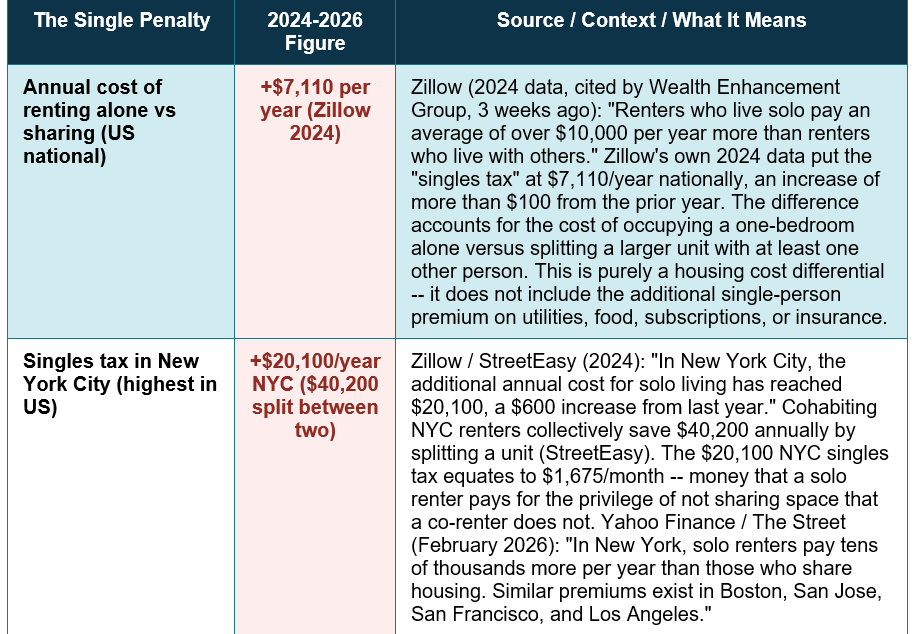
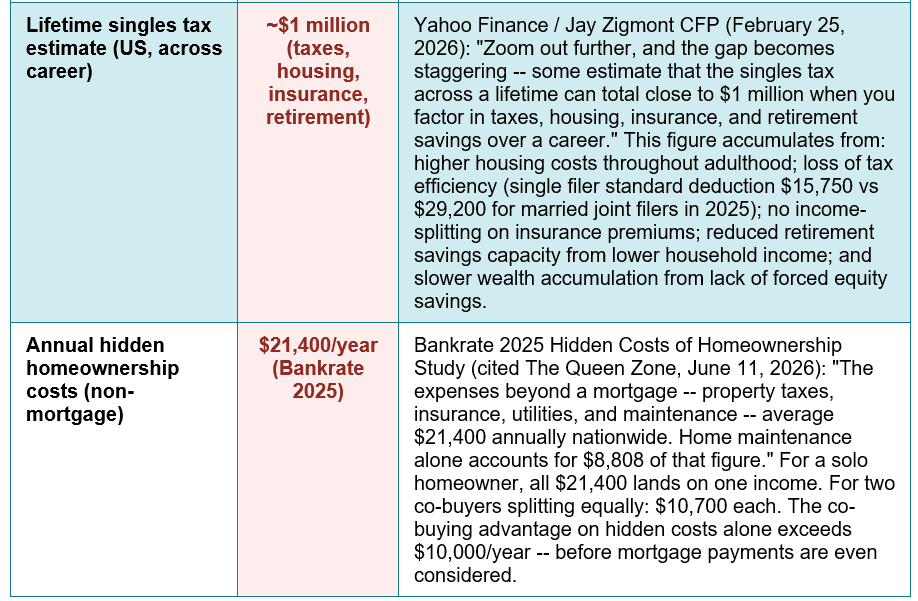
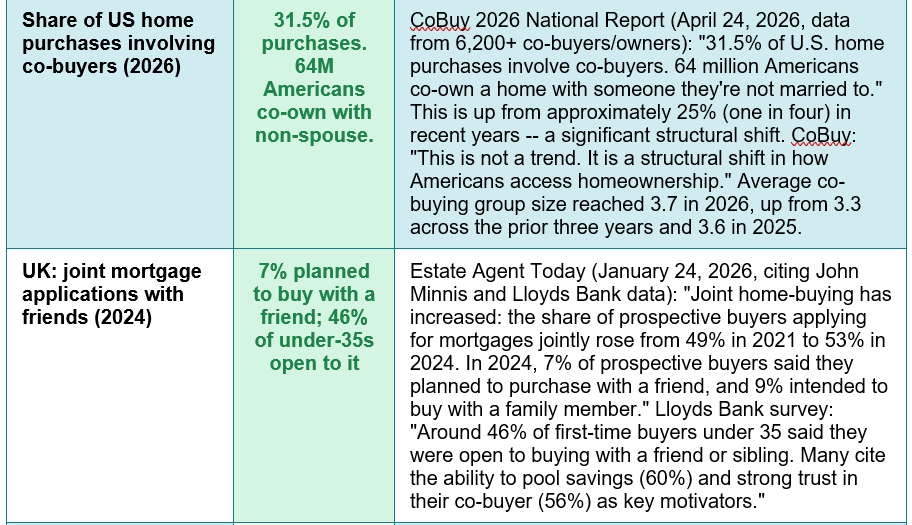
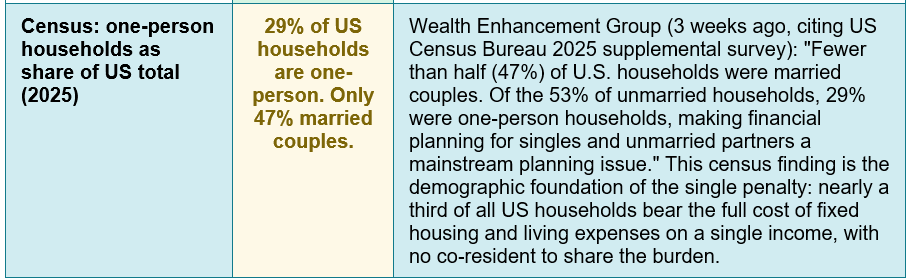
The single penalty -- key 2026 statistics: $7,110/yr national singles tax. $20,100/yr NYC. ~$1M lifetime. 31.5% of US purchases co-bought. 64M co-own with non-spouse. — Zillow 2024 (Wealth Enhancement Group, 3 weeks ago): singles tax $7,110/yr; NYC $20,100/yr; cohabiting save $14,220 collectively. Yahoo Finance/CFP Jay Zigmont (Feb 25, 2026): lifetime singles tax ~$1 million. Bankrate 2025: hidden homeownership costs $21,400/yr. CoBuy 2026 Report (Apr 24, 2026): 31.5% US purchases co-bought; 64M co-own with non-spouse; avg group 3.7. US Census 2025: 29% of households are one-person; only 47% are married couples.
In New York City, StreetEasy's 2026 Housing Market Predictions (Timeout New York, December 2025) forecast co-buying as one of the defining trends of the year. StreetEasy found that 56% of prospective buyers are planning to purchase with a co-buyer, with 9% teaming up with friends and 6% with relatives. That alternative model of co-ownership -- neither solo nor coupled -- is reshaping how homes are bought in NYC's tight market. The $20,100 annual single premium in New York creates an overwhelming economic logic for co-living: two friends splitting a larger apartment not only eliminate the singles tax individually but collectively save $40,200 per year (StreetEasy data, cited Zillow). CNBC (December 4, 2025) documented specific friend-buyer pairs in New York City and Washington DC who used co-buying to achieve homeownership that would have been impossible individually, with both pairs describing the arrangement as transformative.
In the UK, Estate Agent Today (January 24, 2026) reported that joint mortgage applications rose from 49% to 53% of all applications between 2021 and 2024. 'In Greater London and its wider regions, sky-high property prices and large deposit requirements make solo homeownership increasingly unattainable for many young professionals.' The Lloyds Bank survey found 60% of potential friend-buyers cited pooling savings as the primary motivation, and 56% cited trust in their co-buyer. National Mortgage Professional (June 3, 2026): 'According to a survey cited by the NAR, roughly 60% of renters said they would consider purchasing a home with friends, with interest particularly strong among younger generations facing affordability constraints.' NAR (2026 Generational Trends Report): 14% of all 2025 US home buyers purchased a multigenerational home -- with Gen X buyers leading at 19%.
The 15-point planning-to-ownership gap: the most important data point from CoBuy's 2026 report is not the 31.5% co-buying rate -- it is the 15-point drop between aspiration and execution. Friends are the number-one co-buying aspiration. They are not the number-one co-ownership outcome. CoBuy (April 2026): 'A 15-point drop between planning and ownership.' The primary reason: legal complexity. CoBuy found a 21-point gap in the need for legal help between co-buyers and co-owners -- the largest gap across every support category. And 96% of co-buyers said they needed help with their co-ownership agreement. The conclusion: friends who want to co-buy can do so successfully, but the execution requires proper legal structure. The aspiration-ownership gap is not a signal that friend co-buying doesn't work -- it is a signal that it requires more preparation than most people bring to it. The platforms and legal frameworks that support co-buying (CoBuy.io, co-ownership solicitors, deed of trust specialists) exist precisely to close this gap.
THE SINGLE PENALTY RESPONSE TOOLKIT -- 2026: (1) CALCULATE YOUR PERSONAL ANNUAL SINGLES TAX: current housing cost minus half of a shared comparable unit cost = your housing premium. Add utilities, food, subscriptions. National average: $7,110/year (Zillow 2024). (2) CO-RENTING (GOLDEN GIRLS MODEL): saves $7,110-$20,100/year nationally vs NYC. Requires: joint tenancy or named-on-lease arrangement, written house agreement. Free template: Citizens Advice (UK) citizensadvice.org.uk. (3) CO-BUYING (TENANTS IN COMMON): eliminates single premium permanently via shared equity. Requires: co-ownership agreement (96% of co-buyers need legal help per CoBuy 2026), solicitor/attorney ($500-3,000). Platforms: CoBuy.io. UK legal help: search Solicitors Regulation Authority sra.org.uk. (4) HOUSE HACKING: rent a room to a lodger. UK: up to £7,500 tax-free via Rent a Room scheme (HMRC gov.uk/rent-room-in-your-home). US: $800-1,500/month rental income offsets mortgage directly. (5) TAX STRATEGY: single homeowners more likely to benefit from itemising deductions. Mortgage interest may exceed the $15,750 single standard deduction. Consult a CPA or tax adviser. (6) FREE RESOURCES: US: CFPB homebuying guide consumerfinance.gov. UK: MoneyHelper mortgage guide moneyhelper.org.uk. HUD-approved housing counsellors hud.gov.
LEGAL AND FINANCIAL RISKS OF CO-BUYING: WHAT TO KNOW BEFORE YOU COMMIT: (1) JOINT LIABILITY IS 100%, NOT PROPORTIONAL. MortgageDaily (2 weeks ago): 'If one co-owner hits financial trouble, lenders can pursue the remaining owners for the complete balance while reporting the delinquency across all credit reports.' This means your co-buyer's financial hardship becomes your credit problem. Verify each co-buyer's financial stability before committing. (2) THE EXIT IS THE HARDEST PART. 'Buying a home with a friend sounds great for a few years but knowing that you need to stay in that home now for eight to ten years might make buying a little less desirable' (Amanda Pendleton, Zillow, CNBC December 2025). The exit strategy -- how one party sells their share if the arrangement ends -- must be agreed in writing before any purchase. Without it, one party can be legally blocked from selling if the other refuses. (3) 96% OF CO-BUYERS NEED LEGAL HELP BUT MOST DO NOT GET IT UNTIL IT IS TOO LATE. CoBuy (2026 Report): 'Co-buyers need far more help than co-owners with legal questions -- a 21-point gap, the largest across every support category.' Get the co-ownership agreement drafted by a qualified solicitor or attorney before exchange/closing. Not after. (4) UK: THE DECLARATION OF TRUST IS ESSENTIAL. In England and Wales, a Declaration of Trust (also called a Deed of Trust) is the legal document that records unequal ownership contributions and protects each party's share. Without it, equity disputes may default to equal-split assumptions regardless of what was actually contributed. (5) NEVER CO-BUY WITHOUT A CO-OWNERSHIP AGREEMENT. The legal cost ($500-3,000) is infinitesimal compared to the legal cost of a contested property dispute (often $20,000-100,000+).
CO-BUYING CHECKLIST -- WHAT TO DO BEFORE SIGNING ANYTHING: STEP 1 -- FINANCIAL HEALTH CHECK: All co-buyers review each other's credit scores, income stability, savings, and any existing debt. MortgageDaily (2 weeks ago): "In a market where housing starts reached 1,427.0 thousand units in June 2026 and national unemployment rests at 4.2%, planning for potential income disruption is critical." STEP 2 -- OWNERSHIP SPLIT AGREEMENT: Decide ownership percentages based on deposit contributions. Equal deposits = equal split (Tenants in Common or Joint Tenancy). Unequal deposits = Tenants in Common with percentage reflecting each party's contribution. Document in writing before any offer is made. STEP 3 -- INSTRUCT A SOLICITOR/ATTORNEY: UK: seek a conveyancer experienced in co-ownership and Declaration of Trust. SRA register: sra.org.uk. US: seek a real estate attorney in your state familiar with co-ownership agreements. CoBuy.io can facilitate the platform side. STEP 4 -- DRAFT THE CO-OWNERSHIP AGREEMENT: Must cover: ownership percentages, how monthly costs are split, process for exit/sale of one party's share, what happens if one party misses a payment, death/incapacity provisions, and dispute resolution process. STEP 5 -- MORTGAGE PRE-APPROVAL: Both/all parties apply for mortgage pre-approval together. Lender will assess joint income and joint credit. Be aware: all parties are 100% liable for the full mortgage balance. STEP 6 -- AGREE AN EXIT REVIEW DATE: Agree in advance to formally review the arrangement at a defined point (e.g. 3 years, 5 years). This normalises the conversation about eventual exit and reduces the likelihood of an acrimonious ending.
The response is structural and accelerating. CoBuy's 2026 National Report documents that 31.5% of US home purchases now involve co-buyers, up from one in four in recent years. Sixty-four million Americans co-own with a non-spouse. Average co-buying group size hit 3.7 -- the highest ever. In the UK, 46% of under-35 first-time buyers say they are open to buying with a friend. The 'Golden Girls' co-renting model, house hacking, multigenerational households, and formal Tenants in Common co-ownership agreements are all being deployed by unattached adults who have decided that the financial logic of co-living is stronger than the cultural preference for living alone.
The execution risk is real: 96% of co-buyers need legal help with their co-ownership agreement, and a 15-point gap between co-buying aspiration and ownership outcome shows that good intentions do not automatically produce successful arrangements. The answer is preparation: a written co-ownership agreement, a clear exit strategy, legal advice before signing, and an honest financial-health conversation between co-buyers before any offer is made. For those who do the preparation, the single penalty is not a life sentence -- it is a cost structure with a structural fix.
The singles tax -- or single penalty -- is the additional cost borne by someone living alone compared to someone sharing the same or equivalent accommodation with at least one other person. In housing terms, Zillow's most recent published analysis (2024 data, cited by Wealth Enhancement Group, July 2026) put the national US average at $7,110 per year. In New York City, the figure reached $20,100/year per StreetEasy data. Cohabiting renters collectively save $14,220 nationally and up to $40,200 in NYC by sharing. Beyond housing, Yahoo Finance (February 25, 2026, citing CFP Jay Zigmont of Childfree Wealth): 'You can't split the Netflix subscription, utilities, food, and more.' Bankrate's 2025 Hidden Costs of Homeownership Study found that the non-mortgage costs of owning a home (property taxes, insurance, utilities, maintenance) average $21,400/year nationally -- costs that a co-owner splits but a solo owner absorbs entirely. The tax system adds another layer: the 2025 standard deduction for single filers is $15,750, versus $29,200 for married couples filing jointly. Across a lifetime of working, housing, and retirement savings, some financial planners estimate the total singles tax at close to $1 million (Yahoo Finance, February 2026). This is the compound effect of paying more for the same housing, receiving less favourable tax treatment, and accumulating wealth more slowly than dual-income households throughout a working life.
How common is co-buying a home with friends in 2026?
Co-buying with friends is increasingly common, though friends remain more likely to aspire to co-buy than to actually complete a purchase together. CoBuy's 2026 National Report (April 24, 2026, based on 6,200+ co-buyers and co-owners): '31.5% of U.S. home purchases involve co-buyers. 64 million Americans co-own a home with someone they are not married to.' The average co-buying group size reached 3.7 in 2026, up from 3.3 for three consecutive prior years. The report notes that 'friends are the number-one co-buying aspiration' but records a 15-point drop between aspiration and actual co-ownership -- meaning many friend-buyer plans do not reach completion. In the UK, Estate Agent Today (January 2026, citing Lloyds Bank): 'Around 46% of first-time buyers under 35 said they were open to buying with a friend or sibling. Many cite the ability to pool savings (60%) and strong trust in their co-buyer (56%) as key motivators.' National Mortgage Professional (June 3, 2026): 'Roughly 60% of renters said they would consider purchasing a home with friends, with interest particularly strong among younger generations.' Zillow's Amanda Pendleton (CNBC, December 2025) notes that the rate of completed friend co-buying has moderated as mortgage rates remain elevated: 'The barrier to entry for homeownership is that much higher. You need to stay in your home a lot longer in order to make that purchase cost-effective.' The consensus: co-buying with friends is a mainstream aspiration and a significant and growing share of completions -- but it requires more legal preparation than most people bring to it.
What are the legal risks of co-buying property with friends?
The legal risks of co-buying with friends are significant and well-documented. MortgageDaily (2 weeks ago, most current): 'Joint liability ensures that a single missed payment damages every borrower's credit -- making a written agreement an absolute necessity.' If one co-owner misses a mortgage payment, the lender can pursue all co-owners for the complete balance and report the delinquency on all co-owners' credit reports. This is joint and several liability -- 100%, not proportional. CoBuy (April 2026): '96% of co-buyers need help with their co-ownership agreement' and there is a '21-point gap in need for legal help between co-buyers and co-owners -- the largest across every support category.' The most common legal disputes in co-ownership arrangements involve: disagreements over when to sell; one party wanting to exit before the others; unequal contributions to repairs or improvements; and death or incapacity of one co-owner. In England and Wales, the Declaration of Trust (Deed of Trust) is the instrument that protects each party's specific ownership share and records the terms of exit. In the US, a written co-ownership agreement under Tenants in Common title is standard. Freddie Mac: 'It is critical for anyone considering this situation to first consult an attorney in their jurisdiction.' The cost of proper legal structuring ($500-3,000) is negligible compared to the cost of a contested co-ownership dispute ($20,000-100,000+). Amanda Pendleton (Zillow, CNBC December 2025): 'Knowing that you need to stay in that home for eight to ten years' makes the exit strategy the most important part of any co-ownership agreement.
What is the "Golden Girls model" of co-living?
The 'Golden Girls model' refers to the strategy of unattached adults -- typically friends rather than romantic partners -- choosing to live together and share both housing costs and domestic responsibilities. It takes its name from the 1980s TV show in which four older women shared a home in Miami, splitting costs while maintaining independent lives under one roof. Yahoo Finance (February 25, 2026, citing Jay Zigmont, CFP and founder of Childfree Wealth): 'One strategy gaining traction: the Golden Girls model, where groups of friends choose to live together and share both costs and responsibilities.' In practice, the Golden Girls model typically means: two to four single adults sharing a rental property under a joint tenancy or individually named tenancy agreement, splitting rent and utility bills equally or proportionally to room size or income, and operating with a written house-sharing agreement covering domestic responsibilities, guests, notice periods, and exit arrangements. The financial benefit is immediate and substantial: nationally, sharing a home saves each party approximately $5,000-$7,000/year versus living alone; in New York City, up to $20,100/year per person. Unlike co-buying, the Golden Girls model requires no mortgage, no deposit, no legal co-ownership structure, and no long-term commitment -- making it accessible to anyone and reversible with appropriate notice. It is the lowest-barrier, fastest-to-implement response to the single penalty, and is gaining cultural traction as the cost of solo living has become unambiguously unaffordable for a growing share of single adults.
Does co-buying a home with friends work long-term?
Co-buying with friends can work very well long-term, but the outcomes depend heavily on the quality of legal preparation and shared expectations established before the purchase. The evidence is mixed in instructive ways. CoBuy's 2026 report (April 24, 2026): the 15-point drop between friends who aspire to co-buy and those who complete a co-purchase reflects the execution challenges -- legal complexity, mortgage qualification logistics, and the challenge of aligning two or more people's financial and lifestyle timelines. Zillow's Amanda Pendleton (CNBC, December 4, 2025): 'The idea of buying with a friend sounds great for maybe a few years but knowing that you need to stay in that home now for eight to ten years might make buying a little less desirable.' The recommended holding period to make co-buying financially worthwhile (offsetting transaction costs via appreciation) is longer now than when rates were lower. The factors that predict successful long-term co-buying arrangements are: a written co-ownership agreement with a clear exit mechanism; unambiguous records of each party's financial contribution; a dispute resolution process agreed in advance; a formal review point (3-5 years) at which all parties discuss whether to continue, buy out, or sell; and honest pre-purchase financial-health disclosure between all parties. CNBC (December 2025) documented friend-buyer pairs in New York and Washington DC who described their co-ownership as transformative -- enabling homeownership that would have been impossible alone and producing strong equity gains in both cases. The key: both pairs completed proper legal agreements before purchase and had explicit exit-strategy conversations from day one.
Table of Contents
- The Cost of Going It Alone Has Never Been Higher
- The Single Penalty by Numbers: What Living Alone Actually Costs
- Why the Single Penalty Is Getting Worse in 2026
- The Response: How Unattached Adults Are Teaming Up
- Case Studies: New York, London, and the Friend-Buyer Revolution
- Practical Steps: How to Navigate the Single Penalty in 2026
- Conclusion: The Single Penalty Is Real -- and the Workarounds Are Working
- Frequently Asked Questions (FAQ)
- What is the singles tax and how much does it cost in 2026?
- How common is co-buying a home with friends in 2026?
- What are the legal risks of co-buying property with friends?
- What is the "Golden Girls model" of co-living?
- Does co-buying a home with friends work long-term?
- External References & Further Reading
The Cost of Going It Alone Has Never Been Higher
Living alone has always cost more than living with others. But in 2026, the premium has grown large enough to fundamentally reshape how single and unattached adults think about housing and domestic life. The singles tax -- the additional annual cost borne by a person living alone versus one splitting the same or similar accommodation with another person -- stood at $7,110 nationally and $20,100 in New York City as of Zillow's 2024 analysis. Extend that across a lifetime and factor in the compounding disadvantages in tax treatment, insurance, retirement savings capacity, and home equity accumulation, and some financial planners put the total lifetime cost of singlehood at close to $1 million.The response to this penalty is structural and growing. CoBuy's 2026 National Report (April 24, 2026), based on data from more than 6,200 co-buyers and co-owners, found that 31.5% of US home purchases now involve co-buyers -- up from approximately one in four in recent years. Sixty-four million Americans co-own a home with someone they are not married to. The average co-buying group size reached 3.7 in 2026, the highest ever recorded. In the UK, Estate Agent Today (January 2026, citing Lloyds Bank and John Minnis data) reported that 46% of first-time buyers under 35 are now open to purchasing with a friend or sibling, and the share of joint mortgage applications rose from 49% to 53% between 2021 and 2024.
This is not a story about millennials delaying marriage. It is a story about rational economic decision-making in a housing market that has structurally disadvantaged single buyers, and an emerging ecosystem of legal frameworks, platforms, and social models -- from co-buying arrangements to the 'Golden Girls' shared rental model -- that unattached adults are using to fight back.
The Single Penalty by Numbers: What Living Alone Actually Costs
The following table quantifies the single penalty across housing, lifetime costs, and the emerging co-buying response:The single penalty -- key 2026 statistics: $7,110/yr national singles tax. $20,100/yr NYC. ~$1M lifetime. 31.5% of US purchases co-bought. 64M co-own with non-spouse. — Zillow 2024 (Wealth Enhancement Group, 3 weeks ago): singles tax $7,110/yr; NYC $20,100/yr; cohabiting save $14,220 collectively. Yahoo Finance/CFP Jay Zigmont (Feb 25, 2026): lifetime singles tax ~$1 million. Bankrate 2025: hidden homeownership costs $21,400/yr. CoBuy 2026 Report (Apr 24, 2026): 31.5% US purchases co-bought; 64M co-own with non-spouse; avg group 3.7. US Census 2025: 29% of households are one-person; only 47% are married couples.
Why the Single Penalty Is Getting Worse in 2026
Several converging factors have intensified the single penalty beyond what it was five or ten years ago. Understanding these drivers is essential to understanding why the co-buying and co-living response has scaled so rapidly.- The median first-time buyer is now 40: The Queen Zone (June 11, 2026): "The median first-time buyer is now 40; every delayed year is a year of missed equity." The combination of elevated mortgage rates and high median home prices (above $400,000 nationally) means the solo buyer entering the market in their 30s or 40s competes against established dual-income couples who can pool larger deposits, qualify for bigger mortgages, and absorb more financial risk (Yahoo Finance, February 2026). For a single buyer putting 3.5% down on a $400,000 median-priced home, the monthly mortgage payment alone, before taxes and insurance, would exceed $2,500 (The Street, May 11, 2026).
- Cash buyers lock out single buyers: The Queen Zone (June 11, 2026): "Nearly a third of 2025 sales were all-cash, a pool singles rarely compete in." The all-cash buyer -- typically an investor or a dual-income household with existing equity -- can bypass mortgage approval entirely and close faster. The single buyer requiring a mortgage is structurally disadvantaged not just on price but on transaction speed and certainty. This forces single buyers into lower-demand segments with slower appreciation or into indefinite renting -- which itself carries the singles tax.
- Hidden costs are borne entirely alone: Bankrate's 2025 Hidden Costs of Homeownership Study (The Queen Zone, June 2026): "The expenses beyond a mortgage -- property taxes, insurance, utilities, and maintenance -- average $21,400 annually nationwide." A couple splitting these costs pays $10,700 each. A solo owner pays the full $21,400. Home maintenance alone averages $8,808/year. This hidden cost gap is the most underappreciated component of the single penalty: it accrues regardless of whether the individual is renting or buying, because utilities, food, subscriptions, and insurance all carry implicit couple-rate assumptions.
- The tax system compounds the disadvantage: Yahoo Finance (February 25, 2026, quoting Spencer Carroll, CPA at Gelt): "For single filers, the 2025 standard deduction is $15,750... Because that threshold is lower than the $29,200 standard deduction for married couples filing jointly..." The $13,450 deduction gap between single filers and married joint filers in 2025 means single homeowners pay more federal tax on the same income, reducing the after-tax purchasing power available for housing and savings. The lifetime accumulation of this tax disadvantage -- across 30-40 working years -- is one of the largest components of the estimated $1 million lifetime singles penalty.
The Response: How Unattached Adults Are Teaming Up
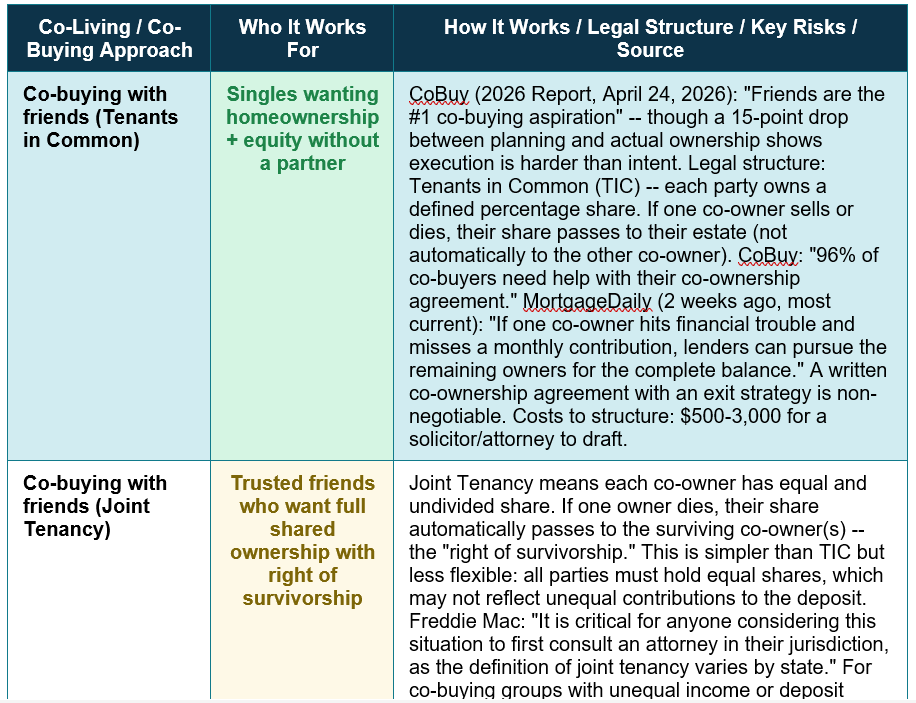
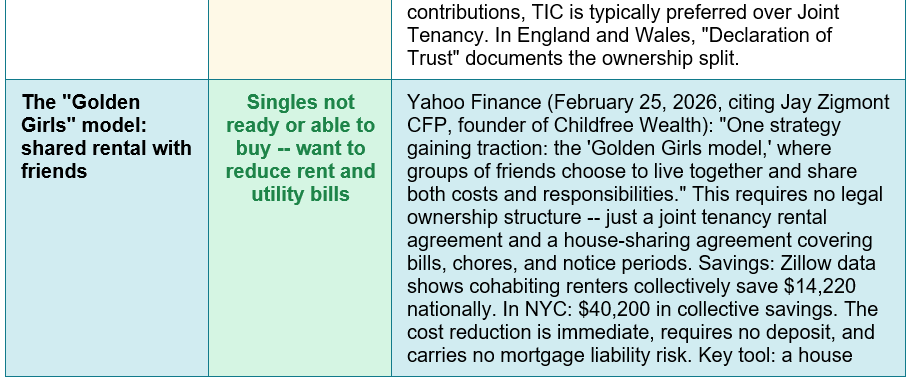
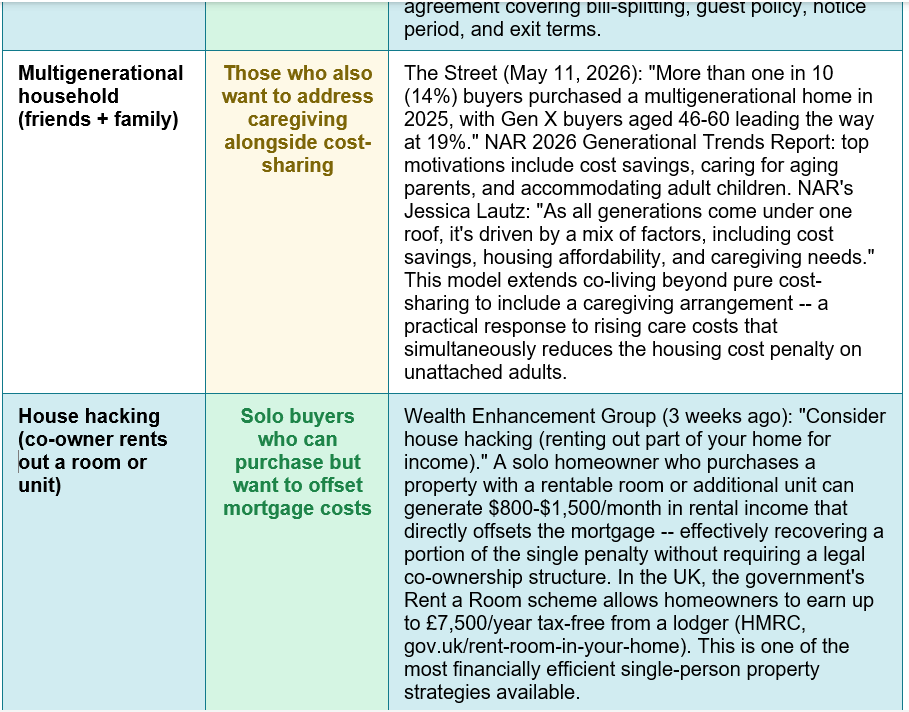
The scale of the co-buying response in 2026 suggests it has moved beyond a niche workaround to a structural feature of the housing market. CoBuy (April 2026): 'Co-buying's share of the housing market has grown from one in four to nearly one in three. The number of Americans co-owning homes has increased by 14 million. This is not a trend. It is a structural shift in how Americans access homeownership.' The following table maps the main approaches unattached adults are using:
Case Studies: New York, London, and the Friend-Buyer Revolution
The geographic epicentres of the co-buying and co-living trend are the highest-cost housing markets, where the single penalty is most acute and the incentive to find alternatives is greatest.In New York City, StreetEasy's 2026 Housing Market Predictions (Timeout New York, December 2025) forecast co-buying as one of the defining trends of the year. StreetEasy found that 56% of prospective buyers are planning to purchase with a co-buyer, with 9% teaming up with friends and 6% with relatives. That alternative model of co-ownership -- neither solo nor coupled -- is reshaping how homes are bought in NYC's tight market. The $20,100 annual single premium in New York creates an overwhelming economic logic for co-living: two friends splitting a larger apartment not only eliminate the singles tax individually but collectively save $40,200 per year (StreetEasy data, cited Zillow). CNBC (December 4, 2025) documented specific friend-buyer pairs in New York City and Washington DC who used co-buying to achieve homeownership that would have been impossible individually, with both pairs describing the arrangement as transformative.
In the UK, Estate Agent Today (January 24, 2026) reported that joint mortgage applications rose from 49% to 53% of all applications between 2021 and 2024. 'In Greater London and its wider regions, sky-high property prices and large deposit requirements make solo homeownership increasingly unattainable for many young professionals.' The Lloyds Bank survey found 60% of potential friend-buyers cited pooling savings as the primary motivation, and 56% cited trust in their co-buyer. National Mortgage Professional (June 3, 2026): 'According to a survey cited by the NAR, roughly 60% of renters said they would consider purchasing a home with friends, with interest particularly strong among younger generations facing affordability constraints.' NAR (2026 Generational Trends Report): 14% of all 2025 US home buyers purchased a multigenerational home -- with Gen X buyers leading at 19%.
The 15-point planning-to-ownership gap: the most important data point from CoBuy's 2026 report is not the 31.5% co-buying rate -- it is the 15-point drop between aspiration and execution. Friends are the number-one co-buying aspiration. They are not the number-one co-ownership outcome. CoBuy (April 2026): 'A 15-point drop between planning and ownership.' The primary reason: legal complexity. CoBuy found a 21-point gap in the need for legal help between co-buyers and co-owners -- the largest gap across every support category. And 96% of co-buyers said they needed help with their co-ownership agreement. The conclusion: friends who want to co-buy can do so successfully, but the execution requires proper legal structure. The aspiration-ownership gap is not a signal that friend co-buying doesn't work -- it is a signal that it requires more preparation than most people bring to it. The platforms and legal frameworks that support co-buying (CoBuy.io, co-ownership solicitors, deed of trust specialists) exist precisely to close this gap.
Practical Steps: How to Navigate the Single Penalty in 2026
Whether considering co-buying, co-renting, or managing the single penalty as a solo individual, the following actions address the most financially significant aspects of the penalty:- Quantify your personal single penalty: Before choosing a strategy, calculate your actual annual single penalty. List your current monthly housing cost. Find a comparable property you could share with one other person and halve the cost. The difference -- multiplied by 12 -- is your annual single housing premium. Add utilities, subscriptions, food premiums (buying in larger quantities is cheaper per unit), and insurance. The total is your personal singles tax. Zillow's data puts the national average at $7,110/year; in high-cost cities it can reach $20,100+. Knowing your specific number makes the case for co-living or co-buying concrete rather than abstract.
- If co-renting: formalise the arrangement: The "Golden Girls" model works financially (saving up to $14,220/year nationally) but requires a written house agreement covering bill-splitting method (equal split, income-proportional, or by room size), notice period to exit the arrangement, guest policy, and process for adding or removing a co-resident. A simple written agreement, even one drafted without a lawyer, prevents the most common sources of conflict in shared living. In the UK, Citizens Advice (citizensadvice.org.uk) provides free template guidance for shared rental agreements.
- If co-buying: get the legal structure right before anything else: MortgageDaily (2 weeks ago, most current): "Joint liability ensures that a single missed payment damages every borrower's credit." CoBuy (April 2026): "96% of co-buyers need help with their co-ownership agreement." The co-ownership agreement must cover: ownership percentages (equal or proportional to deposit contribution), how ongoing costs are split, the process for one party wanting to sell their share, what happens if one party cannot pay, and an exit strategy if the arrangement ends. Cost: $500-3,000 for a qualified solicitor/attorney. This is the single most important investment in a co-buying arrangement -- the cost of not having it is measured in legal disputes and credit damage. In England and Wales: use a Declaration of Trust. In the US: Tenants in Common with a co-ownership agreement is standard.
- Consider house hacking as a solo strategy: For solo buyers who can purchase independently, renting out a room or unit generates income that directly offsets the single ownership cost. In the UK, the government Rent a Room scheme (HMRC, gov.uk/rent-room-in-your-home) allows up to £7,500 tax-free annually from a lodger -- a meaningful subsidy on mortgage costs. In the US, rental income from a room or ADU (accessory dwelling unit) of $800-$1,500/month can reduce net housing costs to below what a comparable rental would cost, turning the single penalty into a single advantage.
- Address the tax disadvantage deliberately: Yahoo Finance (February 2026): single homeowners are more likely to benefit from itemising deductions because their lower standard deduction threshold ($15,750 in 2025 vs $29,200 for married joint filers) means mortgage interest is more likely to exceed the standard deduction. A solo homeowner with a $300,000 mortgage at 6.5% interest pays approximately $19,500 in interest in year 1 -- above the $15,750 standard deduction, making itemising potentially beneficial. Consult a tax professional to model whether itemising (Schedule A) beats the standard deduction for your specific mortgage and income.
THE SINGLE PENALTY RESPONSE TOOLKIT -- 2026: (1) CALCULATE YOUR PERSONAL ANNUAL SINGLES TAX: current housing cost minus half of a shared comparable unit cost = your housing premium. Add utilities, food, subscriptions. National average: $7,110/year (Zillow 2024). (2) CO-RENTING (GOLDEN GIRLS MODEL): saves $7,110-$20,100/year nationally vs NYC. Requires: joint tenancy or named-on-lease arrangement, written house agreement. Free template: Citizens Advice (UK) citizensadvice.org.uk. (3) CO-BUYING (TENANTS IN COMMON): eliminates single premium permanently via shared equity. Requires: co-ownership agreement (96% of co-buyers need legal help per CoBuy 2026), solicitor/attorney ($500-3,000). Platforms: CoBuy.io. UK legal help: search Solicitors Regulation Authority sra.org.uk. (4) HOUSE HACKING: rent a room to a lodger. UK: up to £7,500 tax-free via Rent a Room scheme (HMRC gov.uk/rent-room-in-your-home). US: $800-1,500/month rental income offsets mortgage directly. (5) TAX STRATEGY: single homeowners more likely to benefit from itemising deductions. Mortgage interest may exceed the $15,750 single standard deduction. Consult a CPA or tax adviser. (6) FREE RESOURCES: US: CFPB homebuying guide consumerfinance.gov. UK: MoneyHelper mortgage guide moneyhelper.org.uk. HUD-approved housing counsellors hud.gov.
LEGAL AND FINANCIAL RISKS OF CO-BUYING: WHAT TO KNOW BEFORE YOU COMMIT: (1) JOINT LIABILITY IS 100%, NOT PROPORTIONAL. MortgageDaily (2 weeks ago): 'If one co-owner hits financial trouble, lenders can pursue the remaining owners for the complete balance while reporting the delinquency across all credit reports.' This means your co-buyer's financial hardship becomes your credit problem. Verify each co-buyer's financial stability before committing. (2) THE EXIT IS THE HARDEST PART. 'Buying a home with a friend sounds great for a few years but knowing that you need to stay in that home now for eight to ten years might make buying a little less desirable' (Amanda Pendleton, Zillow, CNBC December 2025). The exit strategy -- how one party sells their share if the arrangement ends -- must be agreed in writing before any purchase. Without it, one party can be legally blocked from selling if the other refuses. (3) 96% OF CO-BUYERS NEED LEGAL HELP BUT MOST DO NOT GET IT UNTIL IT IS TOO LATE. CoBuy (2026 Report): 'Co-buyers need far more help than co-owners with legal questions -- a 21-point gap, the largest across every support category.' Get the co-ownership agreement drafted by a qualified solicitor or attorney before exchange/closing. Not after. (4) UK: THE DECLARATION OF TRUST IS ESSENTIAL. In England and Wales, a Declaration of Trust (also called a Deed of Trust) is the legal document that records unequal ownership contributions and protects each party's share. Without it, equity disputes may default to equal-split assumptions regardless of what was actually contributed. (5) NEVER CO-BUY WITHOUT A CO-OWNERSHIP AGREEMENT. The legal cost ($500-3,000) is infinitesimal compared to the legal cost of a contested property dispute (often $20,000-100,000+).
CO-BUYING CHECKLIST -- WHAT TO DO BEFORE SIGNING ANYTHING: STEP 1 -- FINANCIAL HEALTH CHECK: All co-buyers review each other's credit scores, income stability, savings, and any existing debt. MortgageDaily (2 weeks ago): "In a market where housing starts reached 1,427.0 thousand units in June 2026 and national unemployment rests at 4.2%, planning for potential income disruption is critical." STEP 2 -- OWNERSHIP SPLIT AGREEMENT: Decide ownership percentages based on deposit contributions. Equal deposits = equal split (Tenants in Common or Joint Tenancy). Unequal deposits = Tenants in Common with percentage reflecting each party's contribution. Document in writing before any offer is made. STEP 3 -- INSTRUCT A SOLICITOR/ATTORNEY: UK: seek a conveyancer experienced in co-ownership and Declaration of Trust. SRA register: sra.org.uk. US: seek a real estate attorney in your state familiar with co-ownership agreements. CoBuy.io can facilitate the platform side. STEP 4 -- DRAFT THE CO-OWNERSHIP AGREEMENT: Must cover: ownership percentages, how monthly costs are split, process for exit/sale of one party's share, what happens if one party misses a payment, death/incapacity provisions, and dispute resolution process. STEP 5 -- MORTGAGE PRE-APPROVAL: Both/all parties apply for mortgage pre-approval together. Lender will assess joint income and joint credit. Be aware: all parties are 100% liable for the full mortgage balance. STEP 6 -- AGREE AN EXIT REVIEW DATE: Agree in advance to formally review the arrangement at a defined point (e.g. 3 years, 5 years). This normalises the conversation about eventual exit and reduces the likelihood of an acrimonious ending.
Conclusion
The single penalty is not a myth or an exaggeration. Zillow's data puts the national singles tax at $7,110 per year in housing costs alone. In New York City, it reaches $20,100. Factoring in the tax treatment gap, insurance premiums, reduced retirement savings capacity, and missed home equity accumulation, some financial planners estimate the lifetime penalty at close to $1 million. And 29% of US households -- nearly one in three -- bear this penalty on a single income, with no co-resident to share it (US Census, 2025 supplemental survey).The response is structural and accelerating. CoBuy's 2026 National Report documents that 31.5% of US home purchases now involve co-buyers, up from one in four in recent years. Sixty-four million Americans co-own with a non-spouse. Average co-buying group size hit 3.7 -- the highest ever. In the UK, 46% of under-35 first-time buyers say they are open to buying with a friend. The 'Golden Girls' co-renting model, house hacking, multigenerational households, and formal Tenants in Common co-ownership agreements are all being deployed by unattached adults who have decided that the financial logic of co-living is stronger than the cultural preference for living alone.
The execution risk is real: 96% of co-buyers need legal help with their co-ownership agreement, and a 15-point gap between co-buying aspiration and ownership outcome shows that good intentions do not automatically produce successful arrangements. The answer is preparation: a written co-ownership agreement, a clear exit strategy, legal advice before signing, and an honest financial-health conversation between co-buyers before any offer is made. For those who do the preparation, the single penalty is not a life sentence -- it is a cost structure with a structural fix.
Frequently Asked Questions (FAQ)
What is the singles tax and how much does it cost in 2026?The singles tax -- or single penalty -- is the additional cost borne by someone living alone compared to someone sharing the same or equivalent accommodation with at least one other person. In housing terms, Zillow's most recent published analysis (2024 data, cited by Wealth Enhancement Group, July 2026) put the national US average at $7,110 per year. In New York City, the figure reached $20,100/year per StreetEasy data. Cohabiting renters collectively save $14,220 nationally and up to $40,200 in NYC by sharing. Beyond housing, Yahoo Finance (February 25, 2026, citing CFP Jay Zigmont of Childfree Wealth): 'You can't split the Netflix subscription, utilities, food, and more.' Bankrate's 2025 Hidden Costs of Homeownership Study found that the non-mortgage costs of owning a home (property taxes, insurance, utilities, maintenance) average $21,400/year nationally -- costs that a co-owner splits but a solo owner absorbs entirely. The tax system adds another layer: the 2025 standard deduction for single filers is $15,750, versus $29,200 for married couples filing jointly. Across a lifetime of working, housing, and retirement savings, some financial planners estimate the total singles tax at close to $1 million (Yahoo Finance, February 2026). This is the compound effect of paying more for the same housing, receiving less favourable tax treatment, and accumulating wealth more slowly than dual-income households throughout a working life.
How common is co-buying a home with friends in 2026?
Co-buying with friends is increasingly common, though friends remain more likely to aspire to co-buy than to actually complete a purchase together. CoBuy's 2026 National Report (April 24, 2026, based on 6,200+ co-buyers and co-owners): '31.5% of U.S. home purchases involve co-buyers. 64 million Americans co-own a home with someone they are not married to.' The average co-buying group size reached 3.7 in 2026, up from 3.3 for three consecutive prior years. The report notes that 'friends are the number-one co-buying aspiration' but records a 15-point drop between aspiration and actual co-ownership -- meaning many friend-buyer plans do not reach completion. In the UK, Estate Agent Today (January 2026, citing Lloyds Bank): 'Around 46% of first-time buyers under 35 said they were open to buying with a friend or sibling. Many cite the ability to pool savings (60%) and strong trust in their co-buyer (56%) as key motivators.' National Mortgage Professional (June 3, 2026): 'Roughly 60% of renters said they would consider purchasing a home with friends, with interest particularly strong among younger generations.' Zillow's Amanda Pendleton (CNBC, December 2025) notes that the rate of completed friend co-buying has moderated as mortgage rates remain elevated: 'The barrier to entry for homeownership is that much higher. You need to stay in your home a lot longer in order to make that purchase cost-effective.' The consensus: co-buying with friends is a mainstream aspiration and a significant and growing share of completions -- but it requires more legal preparation than most people bring to it.
What are the legal risks of co-buying property with friends?
The legal risks of co-buying with friends are significant and well-documented. MortgageDaily (2 weeks ago, most current): 'Joint liability ensures that a single missed payment damages every borrower's credit -- making a written agreement an absolute necessity.' If one co-owner misses a mortgage payment, the lender can pursue all co-owners for the complete balance and report the delinquency on all co-owners' credit reports. This is joint and several liability -- 100%, not proportional. CoBuy (April 2026): '96% of co-buyers need help with their co-ownership agreement' and there is a '21-point gap in need for legal help between co-buyers and co-owners -- the largest across every support category.' The most common legal disputes in co-ownership arrangements involve: disagreements over when to sell; one party wanting to exit before the others; unequal contributions to repairs or improvements; and death or incapacity of one co-owner. In England and Wales, the Declaration of Trust (Deed of Trust) is the instrument that protects each party's specific ownership share and records the terms of exit. In the US, a written co-ownership agreement under Tenants in Common title is standard. Freddie Mac: 'It is critical for anyone considering this situation to first consult an attorney in their jurisdiction.' The cost of proper legal structuring ($500-3,000) is negligible compared to the cost of a contested co-ownership dispute ($20,000-100,000+). Amanda Pendleton (Zillow, CNBC December 2025): 'Knowing that you need to stay in that home for eight to ten years' makes the exit strategy the most important part of any co-ownership agreement.
What is the "Golden Girls model" of co-living?
The 'Golden Girls model' refers to the strategy of unattached adults -- typically friends rather than romantic partners -- choosing to live together and share both housing costs and domestic responsibilities. It takes its name from the 1980s TV show in which four older women shared a home in Miami, splitting costs while maintaining independent lives under one roof. Yahoo Finance (February 25, 2026, citing Jay Zigmont, CFP and founder of Childfree Wealth): 'One strategy gaining traction: the Golden Girls model, where groups of friends choose to live together and share both costs and responsibilities.' In practice, the Golden Girls model typically means: two to four single adults sharing a rental property under a joint tenancy or individually named tenancy agreement, splitting rent and utility bills equally or proportionally to room size or income, and operating with a written house-sharing agreement covering domestic responsibilities, guests, notice periods, and exit arrangements. The financial benefit is immediate and substantial: nationally, sharing a home saves each party approximately $5,000-$7,000/year versus living alone; in New York City, up to $20,100/year per person. Unlike co-buying, the Golden Girls model requires no mortgage, no deposit, no legal co-ownership structure, and no long-term commitment -- making it accessible to anyone and reversible with appropriate notice. It is the lowest-barrier, fastest-to-implement response to the single penalty, and is gaining cultural traction as the cost of solo living has become unambiguously unaffordable for a growing share of single adults.
Does co-buying a home with friends work long-term?
Co-buying with friends can work very well long-term, but the outcomes depend heavily on the quality of legal preparation and shared expectations established before the purchase. The evidence is mixed in instructive ways. CoBuy's 2026 report (April 24, 2026): the 15-point drop between friends who aspire to co-buy and those who complete a co-purchase reflects the execution challenges -- legal complexity, mortgage qualification logistics, and the challenge of aligning two or more people's financial and lifestyle timelines. Zillow's Amanda Pendleton (CNBC, December 4, 2025): 'The idea of buying with a friend sounds great for maybe a few years but knowing that you need to stay in that home now for eight to ten years might make buying a little less desirable.' The recommended holding period to make co-buying financially worthwhile (offsetting transaction costs via appreciation) is longer now than when rates were lower. The factors that predict successful long-term co-buying arrangements are: a written co-ownership agreement with a clear exit mechanism; unambiguous records of each party's financial contribution; a dispute resolution process agreed in advance; a formal review point (3-5 years) at which all parties discuss whether to continue, buy out, or sell; and honest pre-purchase financial-health disclosure between all parties. CNBC (December 2025) documented friend-buyer pairs in New York and Washington DC who described their co-ownership as transformative -- enabling homeownership that would have been impossible alone and producing strong equity gains in both cases. The key: both pairs completed proper legal agreements before purchase and had explicit exit-strategy conversations from day one.
0 Comments
Be the first to share your thoughts on this article.