

Savings
How to Find Cheap Flights That Save You Money.

FLIGHT SAVINGS REALITY | Fares up 30% on popular routes vs 2022. Airlines reprice thousands of times per day. But price tracking alerts save $150/ticket on average. Travelers with the right strategies find fares 20-50% below what most people pay. This is how.
Table of Contents
- Why Finding Cheap Flights Is Harder -- and More Rewarding -- Than Ever
- Why Airfares Move: What You're Up Against in 2026
- The Timing Guide: When to Book and When to Fly for the Lowest Fares
- The Best Free Flight Tools in 2026
- 8 Proven Strategies to Find Cheap Flights That Actually Work in 2026
- Conclusion
- Frequently Asked Questions (FAQ)
- What is the cheapest day to book flights in 2026?
- Does using incognito mode help find cheaper flights?
- How far in advance should I book a flight to get the cheapest price?
- What is the best free tool for finding cheap flights in 2026?
- Are cheap flights real or do they always come with hidden costs?
- External References & Further Reading
Why Finding Cheap Flights Is Harder -- and More Rewarding -- Than Ever
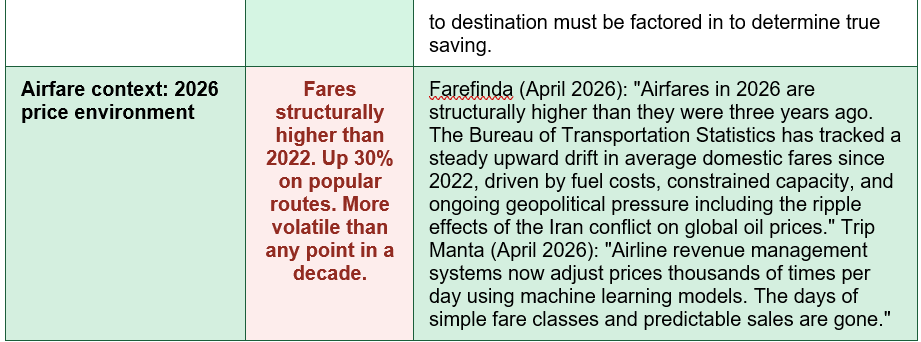
Booking a flight in 2026 is not what it was five years ago. Farefinda (April 2026): 'Airfares in 2026 are structurally higher than they were three years ago. The Bureau of Transportation Statistics has tracked a steady upward drift in average domestic fares since 2022, driven by a combination of fuel costs, constrained capacity, and ongoing geopolitical pressure on fuel supply chains, including the ripple effects of the Iran conflict on global oil prices.' Trip Manta (April 2026): 'Airline revenue management systems now adjust prices thousands of times per day using machine learning models that factor in demand forecasts, competitor pricing, fuel costs, historical booking curves, and even weather patterns. The days of simple fare classes and predictable sales are gone.'Average domestic fares now fluctuate by up to 30% depending on the day of the week you purchase and fly, according to US Bureau of Transportation Statistics data verified in 2026. A New York to London fare can swing from $380 to $950 within a single week -- not because of any change in seats available, but because airline algorithms are continuously adjusting to demand signals. Most travellers search once, see a price, and book. This is the single most expensive habit in travel. Trip Manta: 'Travelers who use the right tools and strategies can consistently find fares 20-50% below what most people pay. The key isn't luck -- it's having a systematic approach.'
This guide gives you that systematic approach. It covers the exact booking windows that research has verified produce the lowest fares, the free tools that track prices for you automatically and alert you when fares drop, the eight strategies that consistently work, and the common mistakes that cost most travellers hundreds of dollars on every trip. SDNU Daily (3 weeks ago -- most current): 'Utilizing free price tracking alerts can save an average of $150 per ticket by notifying you the moment a fare drops.' The tools are free. The strategies are learnable. And the savings are consistent, not lucky.
Why Airfares Move: What You're Up Against in 2026
Understanding why fares change is the foundation of finding cheap flights. Airline pricing is not random -- it follows predictable patterns driven by demand, time to departure, and competitive dynamics. But it is also genuinely volatile in a way that rewards active tracking over one-time searches.Dollar Flight Club (Nov 2025): 'Airfares in 2026 are influenced by factors like fuel costs, seasonal demand, and global events like the FIFA World Cup.' The FIFA World Cup 2026, hosted across the US, Canada, and Mexico, is already affecting pricing on routes to host cities around match dates -- routes that are normally competitively priced have seen significant fare increases for the June-July 2026 window. Skysonar (April 2026): 'Low-cost carriers like Ryanair and Wizz Air change fares in real-time based on demand. Traditional carriers (United, Delta, American, Lufthansa) typically update Tuesday and Wednesday mornings with weekly deals.' This Tuesday/Wednesday airline pricing update cycle -- where major carriers release discounted inventory mid-week -- is one of the few remaining structural pricing patterns, though it has weakened compared to previous years.
The key insight: fare volatility is not your enemy if you use tracking tools. Trip Manta: 'Prices drop as unpredictably as they rise, and travelers who use the right tools and strategies can consistently find fares 20-50% below what most people pay.' The strategies in this guide are designed to capture those price drops systematically -- not through luck, but through setting up the right alerts, searching the right way, and booking at the right time.
2026 cheap flight facts: $150 avg saving from price alerts. Fares fluctuate up to 30% by day. Domestic: book 21-115 days ahead. International: 2-8 months. 20-50% below average fares achievable. — SDNU Daily (3 weeks ago -- most current): 'Free price tracking alerts save an average of $150 per ticket.' SDNU Daily citing Consumer Reports 2026: 'Optimal booking window: 21-115 days for domestic, 4-10 months for international.' SDNU Daily citing US BTS: 'Average domestic airfares fluctuate by up to 30% depending on day of week.' Trip Manta (April 2026): 'Travelers with the right tools find fares 20-50% below what most people pay.' Farefinda (April 2026): 'A New York to London fare might swing from $380 to $950 within a single week.'
The Timing Guide: When to Book and When to Fly for the Lowest Fares
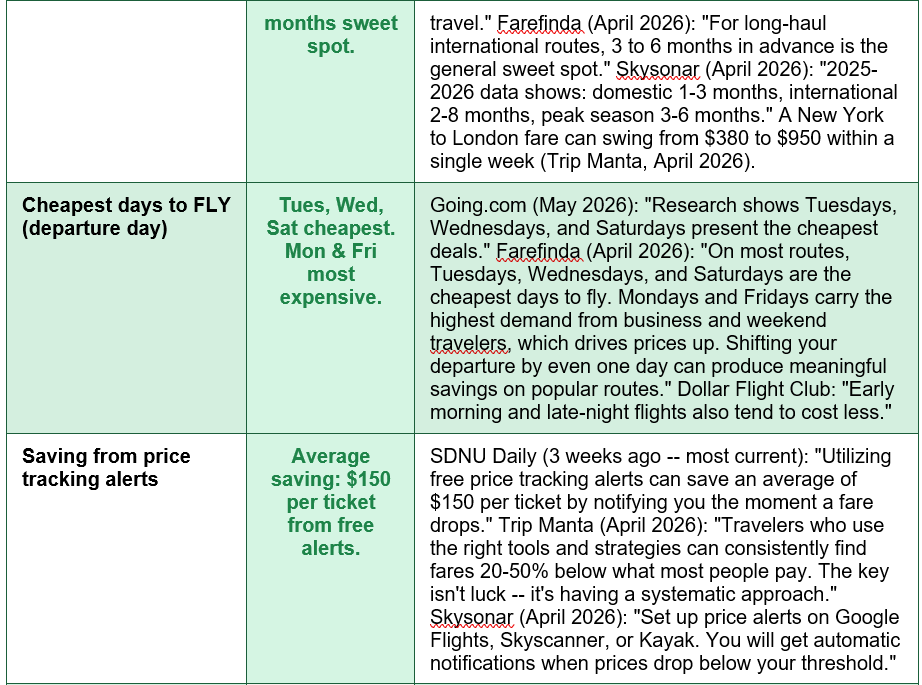
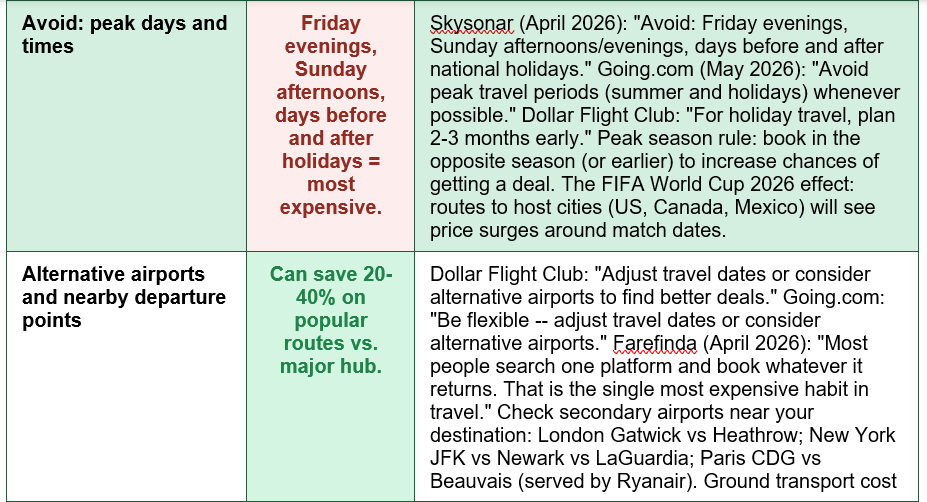
The following table maps the most current 2026 data on booking windows, departure day patterns, and the costs of poor timing: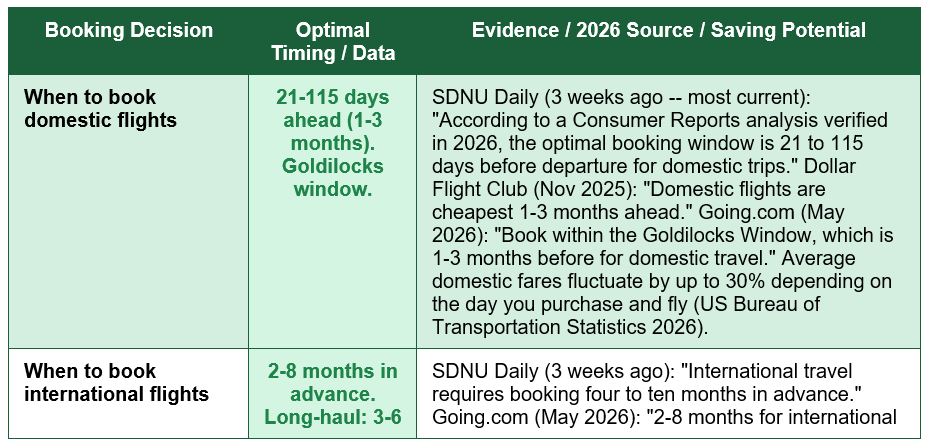
The Best Free Flight Tools in 2026
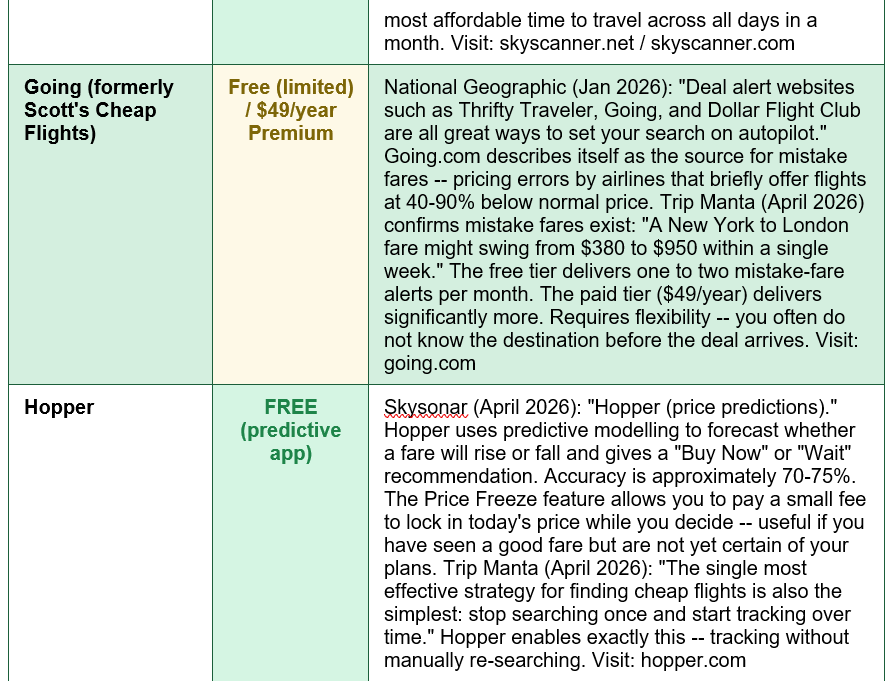
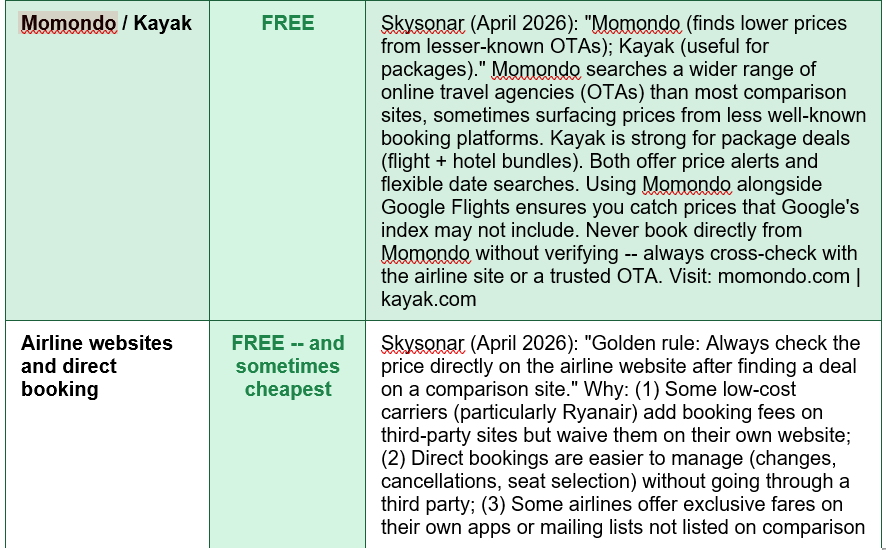
Skysonar (April 2026): 'In 2026, the best free tools for finding cheap flights are Google Flights (most complete), Skyscanner (great for low-cost carriers), Kayak (useful for packages), Momondo (finds lower prices from lesser-known OTAs), and Hopper (price predictions).' Here is what each one does and when to use it: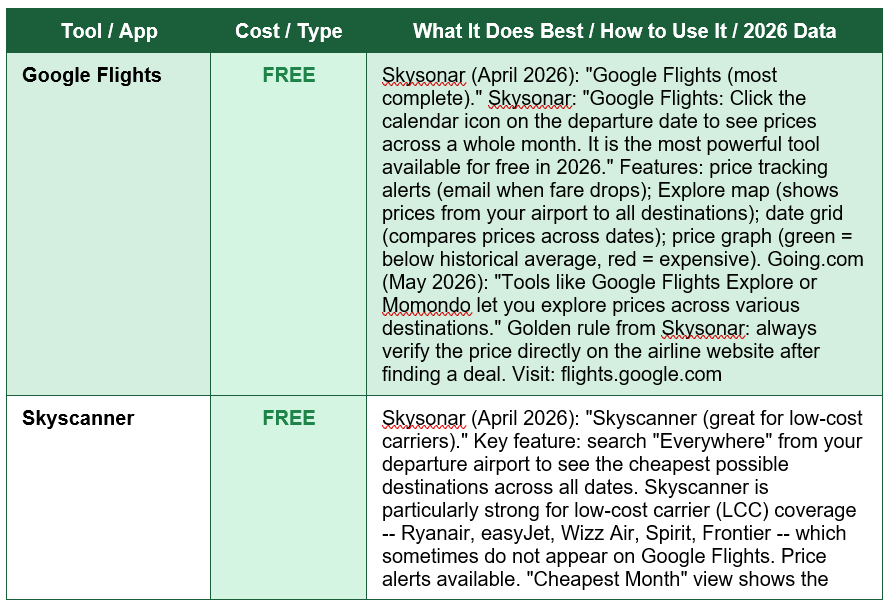

8 Proven Strategies to Find Cheap Flights That Actually Work in 2026
STRATEGY #1: SEARCH BY PRICE FIRST -- CHOOSE DESTINATION BASED ON DEALS | The mindset shift that unlocks the deepest savings
Going.com (May 2026): 'One of the most common mistakes people make when booking flights is choosing their destination and travel dates first, then checking the prices. If getting a cheap flight is your priority, you should flip that approach. Instead of choosing your destination and dates, start by seeing what flights are available based on the lowest prices. Tools like Google Flights Explore or Momondo let you explore prices across various destinations. You'll be able to see where you can go for the least amount of money during a given period. Once you've found the destination that fits your budget, you can then choose the travel dates with the best fares.' How to do this: go to flights.google.com/explore, select your departure airport, and set a rough travel window. The map view shows fares to destinations worldwide -- coloured from cheap (green) to expensive. Click any destination to see the cheapest available dates. This approach is the reverse of how most people book, and consistently produces lower fares because you are letting price dictate destination rather than letting destination dictate price.STRATEGY #2: SET PRICE ALERTS AND TRACK -- NEVER BOOK ON ONE SEARCH | The $150-per-ticket habit that costs nothing to build
SDNU Daily (3 weeks ago): 'Utilizing free price tracking alerts can save an average of $150 per ticket by notifying you the moment a fare drops.' Trip Manta (April 2026): 'The single most effective strategy for finding cheap flights is also the simplest: stop searching once and start tracking over time. Most travelers search for flights, see a price, and either book immediately or wait and hope it drops.' The correct approach: when you identify a route and rough travel window, immediately set a price alert on Google Flights (click the bell icon), Skyscanner (alert button on any search result), or Kayak. These alerts are free and automated -- they send an email when the fare for your specific route drops below the current price. You do not need to keep checking. When an alert arrives showing a significant drop, cross-check the price on the airline's own website, then book. Trip Manta: 'The cheapest approach combines two strategies: track prices over time using a tool that monitors fares frequently, and maintain date and airport flexibility.'STRATEGY #3: USE THE BOOKING WINDOW -- NOT TOO EARLY, NOT TOO LATE | The Goldilocks zone where airlines price to fill seats
Going.com (May 2026): 'Book within the Goldilocks Window, which is 1-3 months before for domestic travel and 2-8 for international travel.' SDNU Daily (3 weeks ago, citing Consumer Reports 2026): 'The optimal booking window is 21 to 115 days before departure for domestic trips, and four to ten months for international flights.' Why: airlines typically release tickets very far in advance at relatively high prices. As the departure date approaches and seats remain unsold, prices often drop in the 1-3 month domestic / 2-8 month international window. Then, as the flight fills up, prices rise again in the final weeks. The exceptions: holiday travel (Thanksgiving, Christmas, Easter, school holidays) and major events (World Cup 2026 host cities) -- for these, book at the early end of the window or earlier. Dollar Flight Club: 'For holiday travel, plan 2-3 months early.' If a fare is already marked green on Google Flights (below historical average for that route) before you hit the optimal window, book it -- waiting for the window to improve a price that is already at the historical low rarely works.STRATEGY #4: FLY ON THE CHEAPEST DAYS -- SHIFTING BY ONE DAY SAVES REAL MONEY | Tuesday, Wednesday, Saturday vs Monday, Friday, Sunday
Farefinda (April 2026): 'On most routes, Tuesdays, Wednesdays, and Saturdays are the cheapest days to fly. Mondays and Fridays carry the highest demand from business and weekend travelers respectively, which drives prices up. Shifting your departure by even one day can produce meaningful savings on popular routes.' Dollar Flight Club: 'Travel mid-week: flights on Tuesdays and Wednesdays are often less expensive than weekends. Early morning and late-night flights also tend to cost less.' Going.com (May 2026): 'Research shows Tuesdays, Wednesdays, and Saturdays present the cheapest deals.' The practical calculation: use Google Flights' date grid (click the calendar icon on the dates field) to see prices across a full week around your preferred departure. On popular domestic routes, the difference between a Tuesday and a Sunday departure can be $50-$150 per person -- for a family of four, this is $200-$600 in savings purely from choosing the right day. Skysonar (April 2026): 'Avoid Friday evenings, Sunday afternoons/evenings, days before and after national holidays.'STRATEGY #5: USE MULTIPLE TOOLS AND ALWAYS CROSS-CHECK WITH THE AIRLINE | One tool is never enough -- and the airline is always the final check
Farefinda (April 2026): 'Most people search one platform and book whatever it returns. That is the single most expensive habit in travel.' The correct workflow: search Google Flights first for the most comprehensive airline coverage and price graph comparison; search Skyscanner second to capture low-cost carrier prices that may not appear on Google; check Momondo for prices from smaller OTAs that the first two may miss; and then -- critically -- check the price directly on the airline's own website. Skysonar (April 2026): 'Golden rule: Always check the price directly on the airline website after finding a deal on a comparison site.' Why direct booking matters: (1) some carriers (particularly Ryanair) charge booking fees on third-party sites that are waived direct; (2) direct bookings simplify changes and cancellations; (3) some airlines reserve exclusive fares for their own website or app. National Geographic (Jan 2026): 'Deal alert websites such as Thrifty Traveler, Going, and Dollar Flight Club are all great ways to set your search on autopilot.' Combining passive alerts with active multi-tool searching captures both opportunistic deals and systematically lower fares.STRATEGY #6: BE FLEXIBLE: DATES, AIRPORTS, AND ROUTING ALL AFFECT PRICE | A 90-minute drive to an alternative airport can save hundreds
Dollar Flight Club: 'Adjust travel dates or consider alternative airports to find better deals. Stopovers and multi-city bookings can save money too.' Going.com (May 2026): 'Be flexible -- adjust travel dates or consider alternative airports to find better deals.' Date flexibility: use Google Flights' calendar view to see the cheapest day across an entire month for your route. Price differences within a month on the same route can be 30-50%. Airport flexibility: check flights from nearby secondary airports. London Stansted (Ryanair hub) vs Heathrow (legacy carriers); New York Newark vs JFK vs LaGuardia; Chicago Midway vs O'Hare. Ground transport to the secondary airport must be added to determine the true saving. Routing flexibility: a non-stop fare is usually higher than a connecting fare on the same route. If time permits, a one-stop itinerary on a competitive connection hub (Reykjavik via Icelandair, Dublin via Aer Lingus, Abu Dhabi via Etihad) can save $150-$400 on transatlantic routes. Going.com: 'Stopovers and multi-city bookings can save money too' -- and a free or cheap stopover can effectively add a second destination to a trip.STRATEGY #7: SIGN UP FOR AIRLINE NEWSLETTERS AND MISTAKE-FARE ALERTS | The highest-value low-effort strategy for flexible travellers
National Geographic (Jan 2026): 'Deal alert websites such as Thrifty Traveler, Going, and Dollar Flight Club are all great ways to set your search on autopilot. Flight alerts can even be useful if you've already purchased airfare.' Going.com describes the mistake-fare opportunity: airlines occasionally publish fares at a fraction of their intended price -- a pricing error rather than a deliberate sale. These are typically corrected within hours, but anyone who books before the correction can fly at prices of 40-90% below normal. Going (formerly Scott's Cheap Flights): free tier delivers occasional mistake-fare alerts; paid tier ($49/year) delivers significantly more, across more routes. Dollar Flight Club offers a similar service. For airline-direct deals: subscribe to email lists for every airline you regularly use. British Airways, Ryanair, EasyJet, Delta, Southwest, and American all run flash sales and exclusive email-only offers that do not appear on comparison sites. The volume of emails is manageable if you use a dedicated email folder for travel deals -- and a single booked mistake fare or flash sale pays for the inbox organisation many times over.STRATEGY #8: KNOW THE MYTHS -- AVOID STRATEGIES THAT DON'T WORK IN 2026 | Incognito mode, magic booking days, and last-minute luck
Trip Manta (April 2026) and Going.com (May 2026) both emphasise myth-busting as a key part of the 2026 flight-saving strategy. Going.com: 'True, there are lots of myths, like flights being cheaper on Tuesdays to BOOK (as opposed to fly), but it's important to remember that many of these are false.' National Geographic (Jan 2026): 'Experts caution that many suggestions don't amount to more than myth.' The specific myths to stop following: (1) Incognito mode lowers prices: SDNU Daily (3 weeks ago): 'While many travelers swear by this method, search engines do not actively raise prices based on your cookies alone.' While using private browsing ensures clean results, it does not lower prices. (2) There is a single magic day to book: there is no universally cheapest day to book a flight in 2026. Tuesday/Wednesday pricing patterns for departure days are more consistent than for booking days. (3) Last-minute deals: last-minute hotel deals are real and often excellent; last-minute flight deals are rare in 2026 because airlines know how to fill seats and rarely discount unsold capacity in the final days. (4) Always booking far in advance: booking 12+ months ahead is rarely cheaper than the 1-3 month domestic / 2-8 month international sweet spot, and locks you in to fares that may drop. Stick to evidence-based strategies from the sections above.The FIFA World Cup 2026 effect on flights: what travellers need to know. Dollar Flight Club: 'Global events like the FIFA World Cup' are listed as a major 2026 airfare influence factor. The World Cup is being hosted across the US, Canada, and Mexico from June to July 2026, with matches in cities including New York, Los Angeles, Miami, Dallas, Seattle, Atlanta, Boston, Kansas City, Philadelphia, San Francisco Bay Area, Toronto, Vancouver, and Mexico City. Flights to these cities during match dates -- particularly knockout stage and final matches -- have already seen significant price surges. The practical advice: if you are travelling to or through any of these cities between June and July 2026, book as far in advance as possible rather than waiting for the booking-window sweet spot. Outside of match dates, the surrounding weeks and cities not hosting matches may see lower-than-normal prices as demand concentrates on the event. Use Google Flights to check specific dates against the match schedule.
FIVE FLIGHT BOOKING MISTAKES THAT COST MOST TRAVELLERS MONEY IN 2026: (1) SEARCHING ONCE AND BOOKING IMMEDIATELY. Farefinda (April 2026): 'Most people search one platform and book whatever it returns. That is the single most expensive habit in travel.' Set a price alert. Track. Book when the price is green on Google Flights, not when you first look. (2) USING ONLY ONE SEARCH TOOL. Google Flights misses some low-cost carriers. Skyscanner misses some OTAs. Momondo catches prices others miss. No single tool is complete. Use at least two, then check the airline direct. (3) BOOKING WITHOUT CHECKING BAGGAGE FEES. SDNU Daily (3 weeks ago): 'Budget airlines often advertise low ticket prices but charge fees for baggage, seat selection, and other add-ons.' A $99 budget airline fare with $35 checked bag + $25 seat selection + $15 carry-on is $174 -- potentially more than a legacy carrier's all-inclusive fare. Always calculate the total cost including bags before choosing. (4) FLYING ON FRIDAY OR SUNDAY WITHOUT CHECKING ALTERNATIVES. Farefinda: Mondays and Fridays carry the highest demand. Skysonar: Sunday afternoons are the most expensive. Shifting by a single day to Tuesday or Saturday on the same route frequently saves $50-$150 per person. (5) IGNORING TRAVEL CREDIT CARD POINTS. Booking all travel on a travel rewards card and redeeming points for flights is one of the most consistent ways to reduce the effective cost of airfare. A sign-up bonus on a premium travel card (often 50,000-100,000 points) can cover a round-trip international flight. Do not pay with a non-rewards card for any travel purchase.
YOUR 2026 CHEAP FLIGHT CHECKLIST: STEP 1 -- SET UP YOUR TRACKING INFRASTRUCTURE (do this once): (a) Create a Google account if you do not have one (needed for Google Flights alerts). (b) Install Hopper on your phone (free). (c) Sign up to Going free tier at going.com. (d) Subscribe to airline email newsletters for carriers you use regularly. STEP 2 -- WHEN YOU HAVE A TRIP IN MIND: (a) Go to flights.google.com and search your route. (b) Check the price colour -- green = below historical average (good); red = above average (wait or be flexible). (c) Set a price alert using the bell icon. (d) Search the same route on Skyscanner. (e) Check Momondo. (f) Note the current price. Do NOT book yet unless price is already green and at the lower end of the booking window. STEP 3 -- CHOOSE YOUR DATES STRATEGICALLY: (a) Use the Google Flights date grid to compare prices across a full month. (b) Choose Tuesday, Wednesday, or Saturday departure if at all possible. (c) Check both your local airport and any secondary airports within 60-90 minutes drive. (d) Consider non-stop vs one-stop -- the cheaper routing is worth it if layover time is reasonable. STEP 4 -- WHEN TO BOOK: Domestic: when price is green and you are 3-8 weeks from departure. International: when price is green and you are 2-6 months from departure. Holiday or major event travel: as soon as you see a green price -- do not wait for the window. STEP 5 -- BEFORE CLICKING BUY: (a) Cross-check the fare directly on the airline website. (b) Calculate the total cost including all baggage fees and seat selection. (c) Confirm the full cancellation/change policy. (d) Pay with a travel rewards credit card. TOOLS: flights.google.com | skyscanner.com | going.com | hopper.com | momondo.com | kayak.com
Conclusion
Finding cheap flights in 2026 is not about luck, and it is not about following recycled travel blog myths. It is about having a systematic approach that uses the right tools, books within the right windows, searches on the right days, and tracks prices actively rather than searching once and hoping. SDNU Daily (3 weeks ago, most current): free price tracking alerts save an average of $150 per ticket. Trip Manta (April 2026): travellers who use the right tools and strategies consistently find fares 20-50% below what most people pay.The eight strategies in this guide -- searching by price first, setting tracking alerts, using the booking window, flying on the cheapest days, using multiple tools and checking direct, being flexible on dates and airports, subscribing to deal alerts, and avoiding the myths -- work together as a system. None is complicated. All are free. And the result, applied consistently, is a materially lower annual travel spend without any reduction in the quality or frequency of trips.
Farefinda (April 2026): 'Finding cheap flights in 2026 takes a combination of the right tools, well-timed searches, and genuine flexibility on dates or routing. The strategies in this guide work, but they only pay off if you apply them consistently rather than searching once and booking on impulse.' Set up Google Flights alerts today. Download Hopper. Subscribe to Going. The infrastructure takes 20 minutes to build and then works for you automatically on every trip you plan from this point forward.
Frequently Asked Questions (FAQ)
What is the cheapest day to book flights in 2026?The question of the cheapest day to book (as opposed to fly) is one of the most persistent travel myths -- and experts in 2026 are clear that there is no single magic booking day. Going.com (May 2026): 'True, there are lots of myths, like flights being cheaper on Tuesdays to book, but it's important to remember that many of these are false.' National Geographic (Jan 2026): 'Experts caution that many suggestions don't amount to more than myth.' What matters far more than the day you book is being within the optimal booking window (1-3 months ahead for domestic, 2-8 months for international) and booking when the price is at or below the historical average for that route -- shown as green on Google Flights' price graph. That said, Skysonar (April 2026) notes that traditional carriers (United, Delta, American, Lufthansa) 'typically update Tuesday and Wednesday mornings with weekly deals.' This means checking prices on Tuesday and Wednesday afternoons may capture newly released discounted inventory before it sells. The most reliable booking strategy: set a Google Flights price alert and book when the alert triggers a significant price drop, regardless of which day of the week that happens to fall on.
Does using incognito mode help find cheaper flights?
No -- and this is one of the most persistent myths in flight booking. SDNU Daily (3 weeks ago -- most current): 'While many travelers swear by this method, search engines do not actively raise prices based on your cookies alone. However, using private browsing is still a smart way to ensure clean search results without past search history influencing the displayed routes.' Airline and flight search websites do not raise prices specifically in response to your browsing history. If you searched a route yesterday and search it again today, any price increase is because the fare genuinely rose -- not because the website detected your interest. However, there are two legitimate reasons to use private/incognito mode when searching for flights: (1) it gives you a clean search session without cached results or stored preferences potentially affecting route suggestions; and (2) it means cookies from previous searches do not pre-filter results in ways you might not notice. Use it as a hygiene measure, but do not expect it to show you lower prices than a regular browser session on the same date.
How far in advance should I book a flight to get the cheapest price?
The optimal booking window depends on whether you are flying domestically or internationally. For domestic flights: SDNU Daily (3 weeks ago, citing Consumer Reports analysis verified in 2026): the optimal booking window is 21 to 115 days before departure -- roughly 3 weeks to 4 months. Dollar Flight Club (Nov 2025): 'Domestic flights are cheapest 1-3 months ahead.' Going.com (May 2026): '1-3 months before for domestic travel.' For international flights: SDNU Daily: 'International travel requires booking four to ten months in advance.' Going.com: '2-8 months for international travel.' Farefinda (April 2026): 'For long-haul international routes, 3 to 6 months in advance is the general sweet spot.' The key caveat: for peak holiday travel (Thanksgiving, Christmas, Easter, school holidays) and major events (the 2026 FIFA World Cup host cities in June-July), the appropriate window is at the earlier end -- book as soon as you see a good price, regardless of where you are in the standard window. Dollar Flight Club: 'For holiday travel, plan 2-3 months early.' Outside of peak dates and events, the general principle holds: use Google Flights price alerts to monitor and book when the price turns green (below the historical average), ideally within the windows above.
What is the best free tool for finding cheap flights in 2026?
Google Flights is the single most comprehensive free flight search tool available in 2026. Skysonar (April 2026): 'Google Flights (most complete).' Its key features: price tracking alerts (email notification when fare changes); date grid (see prices across an entire month on a calendar); price graph (green = below historical average, red = above -- the most useful single indicator for whether to book or wait); Explore map (search from your airport to all destinations to find the cheapest place to go on given dates). Access it at flights.google.com. However, Google Flights does not cover all low-cost carriers consistently -- particularly Ryanair and some budget carriers. Skysonar: 'Skyscanner (great for low-cost carriers).' Always search Skyscanner in addition to Google Flights for any route where a low-cost carrier might operate. Skysonar also recommends Momondo for finding prices from smaller OTAs that other tools miss. For deal alerts: Going.com (free tier for occasional alerts, $49/year for full access) and Dollar Flight Club are recommended by National Geographic (Jan 2026): 'Deal alert websites such as Thrifty Traveler, Going, and Dollar Flight Club are all great ways to set your search on autopilot.' For price predictions: Hopper (free) uses predictive modelling to recommend whether to buy or wait. The optimal workflow: use Google Flights + Skyscanner to search, set price alerts on both, add Hopper for a buy/wait prediction, and verify any deal found on the airline's direct website.
Are cheap flights real or do they always come with hidden costs?
Cheap flights are real -- but advertised low fares often exclude costs that bring the total closer to what a slightly more expensive fare includes. SDNU Daily (3 weeks ago): 'Budget airlines often advertise low ticket prices but charge fees for baggage, seat selection, and other add-ons. Staying informed about airline policies ensures that your cheap flight remains cheap when you arrive at the airport.' The specific costs to check before booking: checked baggage fees (can range from $25-$75 per bag per flight on budget carriers); carry-on baggage fees (Ryanair, Spirit, and others charge for cabin bags above a small personal item); seat selection fees (ranging from $5 for a basic seat to $50+ for extra legroom); payment/booking fees on third-party sites (some budget carriers add these when booking via comparison sites vs direct); credit card surcharges. The correct approach: when comparing a $79 budget airline fare with a $149 legacy carrier fare, calculate the total cost including at least one checked bag and a seat assignment for each. Frequently the legacy carrier's all-inclusive fare is actually cheaper when all costs are included, particularly for families checking bags. Skysonar (April 2026): 'Golden rule: Always check the price directly on the airline website after finding a deal on a comparison site' -- this also allows you to see the full fee schedule before committing.
0 Comments
Be the first to share your thoughts on this article.