

Savings
What Is Flight Delay Compensation? Accountant Explains


Table of Contents
- The Money Millions of Passengers Leave Unclaimed Every Year
- What Is Flight Delay Compensation?
- UK261 and EU261 Compensation Amounts: The Complete 2026 Reference
- Which Regulation Applies to Your Flight? UK261 vs EU261
- UK261 — The UK Regulation
- EU261 — The European Regulation
- The June 2026 EU261 Reform — What Changes and When
- What Qualifies vs What Does Not: The Extraordinary Circumstances Test
- Duty of Care: What the Airline Must Provide Even Without Compensation
- How to Claim Flight Delay Compensation: The Step-by-Step Process
- The US Position: Why American Passenger Rights Are Very Different
- Conclusion
- Frequently Asked Questions (FAQ)
The Money Millions of Passengers Leave Unclaimed Every Year
Every year, millions of UK and European passengers arrive at their destination three, four, or five hours late — then walk out of the arrivals hall without ever knowing they were legally entitled to between £220 and £520 in cash compensation per person. The money is not voluntary. It does not depend on goodwill from the airline. It is a statutory right, enshrined in UK law (UK261) and European law (EU261/EC261), that has been enforceable since 2004 — and which most passengers never claim because they either do not know it exists or believe the process is too complicated to be worth attempting.The scale of flight disruption makes this unclaimed compensation significant. A GBTA (Global Business Travel Association) 2025 survey found that 43% of business travellers experienced a flight delay of two or more hours in the past year, with an average productivity loss of 3.5 hours per incident. For UK passengers specifically, the UK Civil Aviation Authority (UK CAA) — updated just three days ago on July 17, 2026 — provides the definitive current guidance: compensation amounts under UK261 range from £220 per person on short-haul routes to £520 per person on long-haul routes delayed by more than four hours. These are not partial contributions or goodwill gestures. They are the full amounts you are legally owed.
This guide explains everything a passenger needs to know about flight delay compensation in 2026: the difference between UK261 and EU261 and which applies to you, the exact compensation amounts by flight distance and delay length, the critical distinction between delays that qualify and those that do not (the 'extraordinary circumstances' exemption), what duty of care means and why it applies even when compensation does not, the EU261 reform agreed on June 15, 2026 and what it means for passengers, the step-by-step process for making a claim, and the US position (which is very different from the UK and EU approach). Everything you need to understand and act on your rights.
What Is Flight Delay Compensation?
Flight delay compensation is a statutory cash payment that airlines are legally required to make to passengers when their flight is significantly delayed, cancelled, or overbooked — provided the cause of the disruption was within the airline's control. It is not a customer service gesture, a travel insurance claim, or a goodwill payment. It is a legal obligation created by EU Regulation 261/2004 (EC261/EU261) and its UK equivalent, retained in UK law as UK Regulation 261/2004 (UK261) following Brexit.AirHelp (May 25, 2026): 'Under the European legislation known as EC261, passengers may be entitled to receive up to €600 ($650) flight delay compensation.' The UK equivalent, UK261, provides up to £520 per person — the same protection under UK law. AirAdvisor (January 2026): 'Under UK Regulation 261 (UK261), eligible passengers can receive up to £520 in compensation for flight delays, cancellations, missed connections, or denied boarding.' The key phrase in both regulations is 'eligible' — not every delay qualifies. The eligibility assessment turns on three questions: was the delay long enough (3+ hours at the final destination)? Was it covered by the regulation (the right flight, the right airline, the right departure/arrival country)? And was the cause within the airline's control, rather than an extraordinary circumstance beyond it?
UK CAA (3 days ago, July 17, 2026) provides the authoritative current statement: 'Compensation is not paid automatically and you will need to claim this directly from your airline in the first instance.' This is perhaps the single most important piece of information in this entire guide. Airlines do not proactively inform passengers of their compensation rights, and they certainly do not proactively pay out. Every passenger who is owed compensation must initiate the claim themselves — by contacting the airline, and if necessary escalating to the UK CAA's Alternative Dispute Resolution (ADR) schemes or the courts.
Flight delay compensation — the 2026 figures: Up to £520 per person under UK261. 43% of business travellers faced 2+ hour delays in 2025. Compensation is not automatic — you must claim. — UK CAA (3 days ago, July 17, 2026): 'Compensation is not paid automatically and you will need to claim this directly from your airline in the first instance.' AirHelp (May 25, 2026): 'Under EC261, passengers may be entitled to receive up to €600 ($650) flight delay compensation.' GBTA 2025 Survey (Travel Code, April 2026): 43% of business travellers experienced a 2+ hour delay in the past year; average productivity loss 3.5 hours per incident. SkyRefund (1 month ago): on June 15, 2026, EU Parliament and Council reached provisional agreement to reform EU261 — €250-€600 amounts kept intact
UK261 and EU261 Compensation Amounts: The Complete 2026 Reference
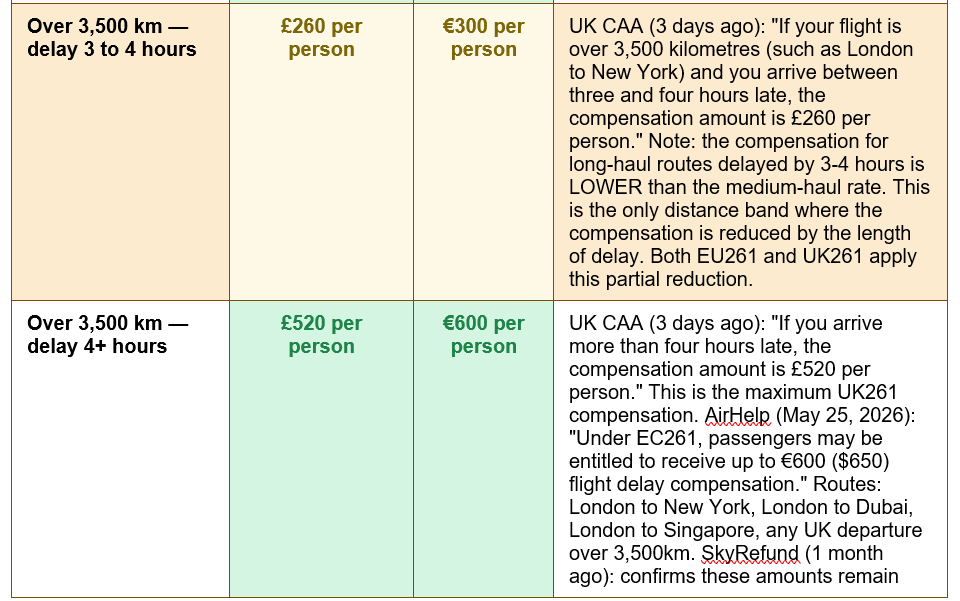
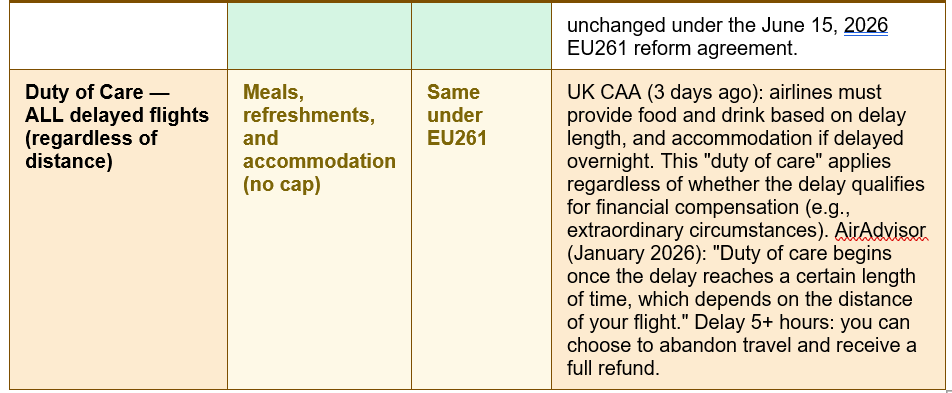
The compensation amount you are owed depends on two factors: the distance of your flight (measured in a straight line using the Great Circle Route method) and the length of the delay at your final destination. The following table sets out every tier, with current UK CAA figures (updated July 17, 2026):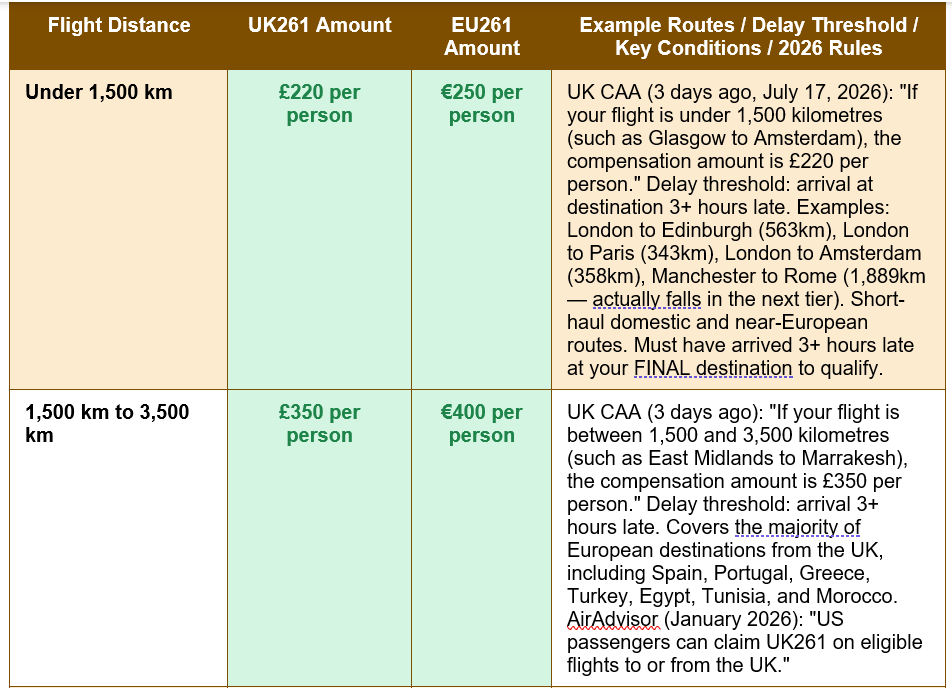
Which Regulation Applies to Your Flight? UK261 vs EU261
The Brexit created two parallel flight compensation regimes for UK passengers — UK261 and EU261 — that broadly mirror each other but apply to different flights. Understanding which one applies to your situation is the first step of any claim:UK261 — The UK Regulation
AirHelp UK (updated): 'UK261 applies on all flights departing from any UK airport, no matter which airline you are flying with or where you are from. International arrivals into the UK are also covered when operated by a UK or EU airline.' In practical terms, UK261 covers: all flights departing from any UK airport (regardless of airline or destination); and flights arriving into the UK operated by a UK airline or an EU airline. UK261 does NOT cover flights arriving into the UK on non-UK, non-EU airlines (for example, a US airline flying from New York to London Heathrow). AirAdvisor (January 2026): 'US passengers can claim UK261 on eligible flights to or from the UK' — meaning if an American passenger's British Airways flight from New York to London is delayed, UK261 applies to that BA flight because BA is a UK carrier.EU261 — The European Regulation
EU261 covers: all flights departing from any EU airport (regardless of airline); and flights arriving into an EU country operated by an EU airline. Post-Brexit, UK airlines are no longer automatically covered by EU261 for flights departing from EU airports — however, EU airlines flying from EU airports to the UK are still covered by EU261 from the EU end, and by UK261 from the UK end. For most UK passengers on European holiday routes, the practical difference between UK261 and EU261 is minimal — the compensation amounts are equivalent (£220 = €250, £350 = €400, £520 = €600 approximately) and the rules are nearly identical.The June 2026 EU261 Reform — What Changes and When
SkyRefund (1 month ago): 'On 15 June 2026, the European Parliament and Council reached a provisional agreement to reform EU261 for the first time since 2004. The deal keeps the 3-hour delay threshold and the €250-€600 (£220-£520) compensation amounts intact, after earlier proposals to raise the threshold to 4 or 6 hours were dropped. The reform still needs a final Parliament vote, expected in July 2026, and is not due to take effect until the second half of 2027, so today's rules apply in full.' The reforms add passenger-friendly measures including a free cabin bag in the base fare and a clearer, codified list of extraordinary circumstances. For passengers claiming today: nothing changes. The current rules — 3-hour threshold, £220-£520 under UK261, €250-€600 under EU261 — remain in full force throughout 2026 and into 2027.What Qualifies vs What Does Not: The Extraordinary Circumstances Test
The most important — and most frequently misunderstood — aspect of flight delay compensation is the extraordinary circumstances exemption. Airlines are not liable to pay compensation when a delay or cancellation is caused by circumstances that are extraordinary, unavoidable even if all reasonable measures had been taken, and beyond the airline's control. The following table maps the most common causes with their compensation eligibility: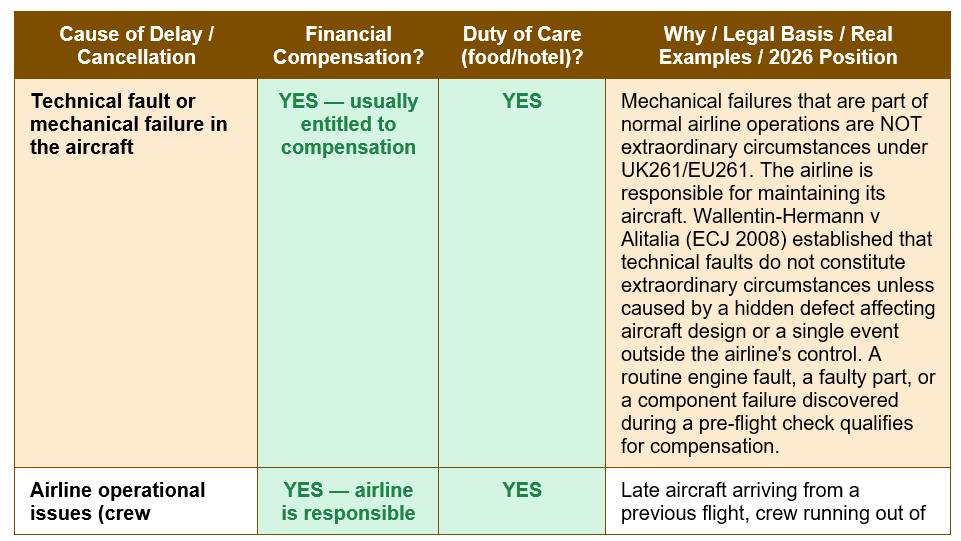
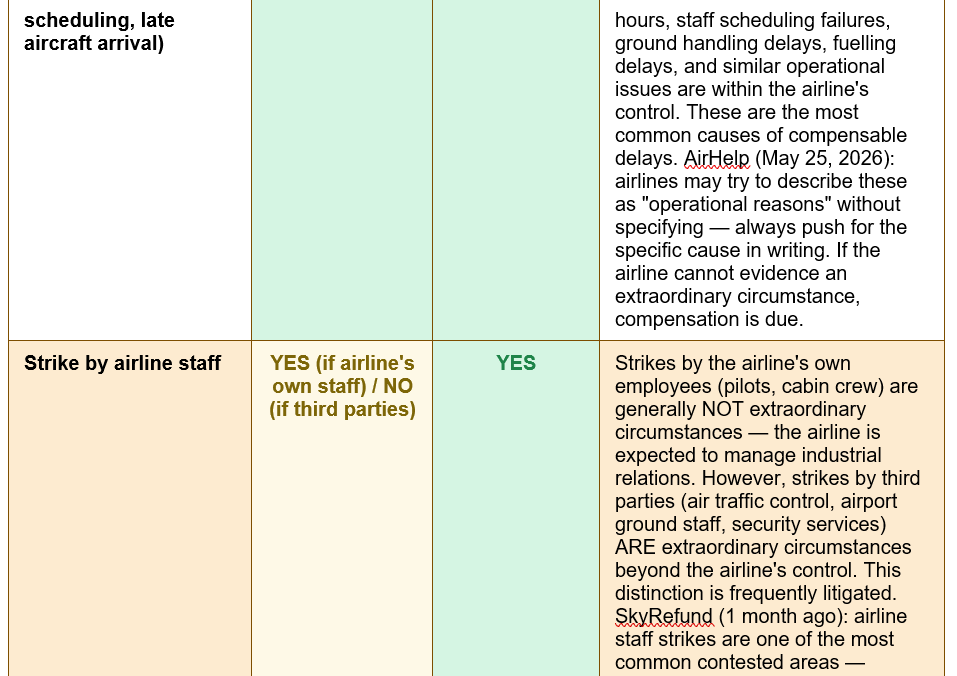
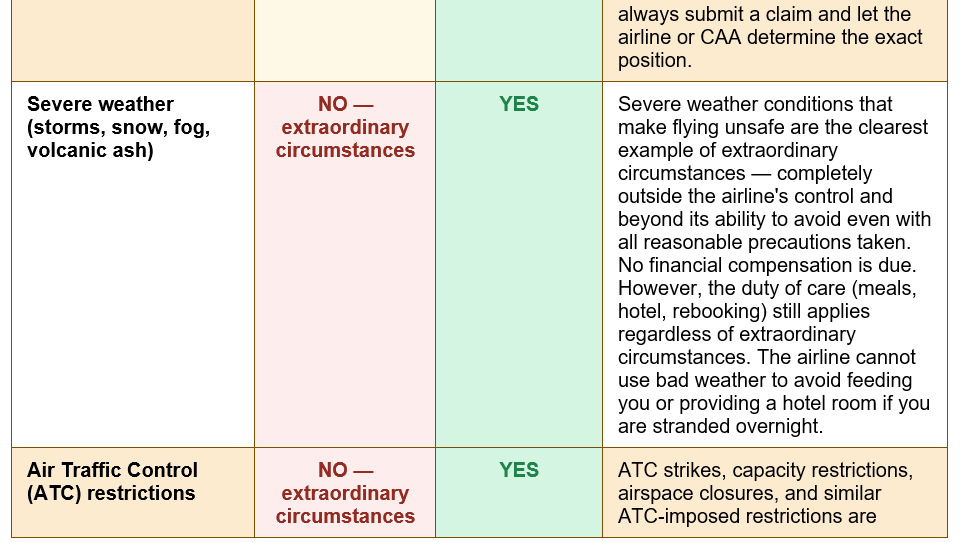
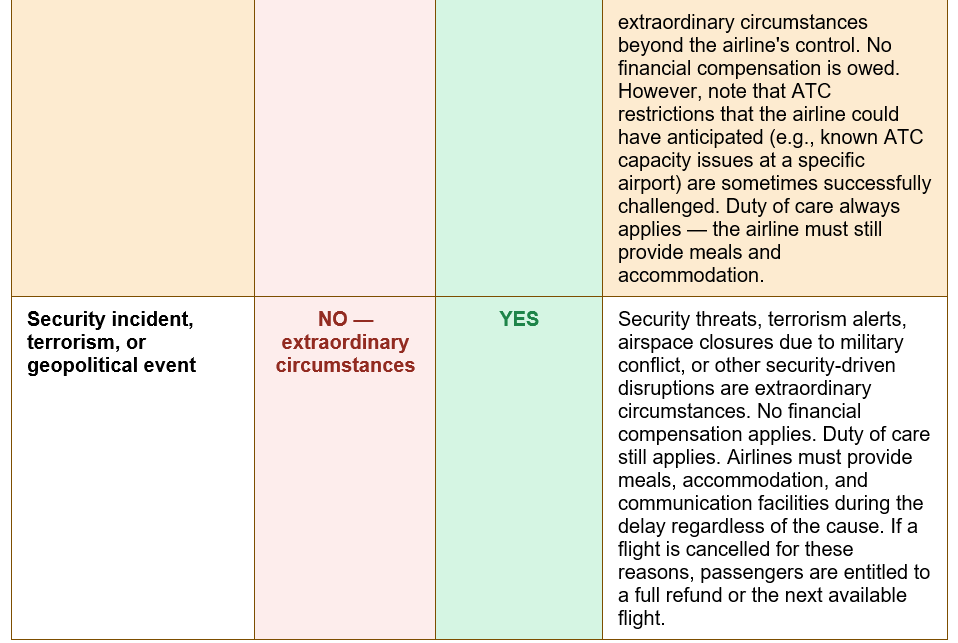
The 'extraordinary circumstances' dispute is where most compensation claims are lost — and it is where airlines most frequently provide misleading information. Airlines have a financial incentive to describe as many delays as possible as 'extraordinary circumstances' — because this exempts them from paying compensation. However, courts and the UK CAA have consistently found that many airline-described 'operational reasons' or 'technical issues' do not actually qualify as extraordinary circumstances. If an airline rejects your claim citing extraordinary circumstances, do not accept the rejection without challenge. Ask the airline for the specific cause of the delay in writing. If the cause appears to be within normal airline operations — late aircraft, crew issues, routine technical faults — escalate your claim to an approved Alternative Dispute Resolution (ADR) body or to the UK CAA. SkyRefund (1 month ago): 'Submit your claim. We handle the airline, the paperwork and, if needed, the court case.' You do not need a legal background to challenge an airline's extraordinary circumstances claim — the CAA and ADR bodies are specifically equipped to adjudicate these disputes.
Duty of Care: What the Airline Must Provide Even Without Compensation
Separate from — and independent of — the financial compensation right is the duty of care obligation. Duty of care requires airlines to look after passengers during delays regardless of whether the delay qualifies for financial compensation. This means that even if your delay is caused by extraordinary circumstances (severe weather, ATC strike, volcanic ash cloud) and no financial compensation is owed, the airline is still legally required to provide:- Meals and refreshments: Appropriate to the waiting time. For a 2-hour delay on a short-haul flight, this typically means a meal voucher to use at the airport. For longer delays, it should cover full meals. The CAA (3 days ago) confirms airlines must provide 'food and drink based on how long your delay is.' If the airline fails to provide vouchers, buy your own food and keep all receipts — you can claim these costs back.
- Communication facilities: Two free telephone calls, emails, or fax messages to allow passengers to inform contacts about the delay. In practice this is increasingly handled through airline apps and SMS messages.
- Accommodation if delayed overnight: If the delay causes an overnight stay, the airline must provide hotel accommodation and transport to and from the airport hotel. UK CAA (3 days ago): airlines must provide 'accommodation if you are delayed overnight.' If the airline fails to arrange accommodation, book a reasonable hotel yourself and claim the cost back — keep all receipts and correspondence showing the airline failed to provide it.
- Refund if delay exceeds 5 hours: UK CAA (3 days ago): 'If the delay is more than five hours, you can choose not to travel and receive a refund.' This is a valuable right that many passengers do not know about. If your flight is delayed by 5 or more hours and you decide not to travel (for example, because the purpose of the trip has been defeated), you are entitled to a full refund of your ticket cost, plus transport back to your original point of departure if you have already reached a transfer point.
How to Claim Flight Delay Compensation: The Step-by-Step Process
STEP 1 Establish Eligibility — Check the Four Conditions
Before making a claim, verify all four eligibility criteria: (1) Was the delay 3+ hours at your FINAL destination? SkyRefund confirms the delay threshold is measured at the point of doors opening at the final destination — not departure. (2) Does UK261 or EU261 apply? Use the rules above to confirm coverage. (3) Was the cause within the airline's control (not extraordinary circumstances)? Check what the airline tells you — then verify independently. (4) Is the claim within time? UK CAA rules allow 6 years to claim in England and Wales; 5 years in Scotland. Most missed claims are within this window. SkyRefund (1 month ago): 'Did it happen within the last 6 years (5 years in Scotland)? If no, the claim is time-barred.'STEP 2 Gather Your Evidence
Before contacting the airline, collect: boarding pass or booking confirmation (proof you were on the flight), any correspondence from the airline about the delay (texts, emails, app notifications), receipts for expenses incurred during the delay (meals, accommodation, transport — for duty of care claims), and the delay notification from the airline or airport. SkyRefund (1 month ago): 'Gather your documents. Have your boarding pass, booking confirmation, any messages from the airline, and receipts for extra costs (meals, hotel, transport) ready.' The more evidence you have, the stronger your claim.STEP 3 Contact the Airline Directly
UK CAA (3 days ago): 'Compensation is not paid automatically and you will need to claim this directly from your airline in the first instance.' Find the airline's compensation claim form on their website (search '[airline name] EU261 claim' or 'UK261 claim'). Submit your claim in writing — include: your flight number, date, departure and destination airports, the delay you experienced, the compensation amount you are requesting (using the table in this guide), and any supporting evidence. Airlines are required to respond within a reasonable period. Many settle straightforward claims quickly.STEP 4 Escalate to ADR or CAA if the Airline Refuses
If the airline rejects your claim, disputes the extraordinary circumstances defence, or does not respond within 8 weeks, you can escalate — for free — to an approved Alternative Dispute Resolution (ADR) scheme. The UK CAA approves several ADR schemes for aviation disputes including Aviation ADR and CEDR. These are free to passengers and binding on airlines that participate. If the airline is not a member of an ADR scheme, you can refer the complaint directly to the UK CAA or take the airline to the Small Claims Court (for amounts up to £10,000). The court route is available without a solicitor and is specifically designed to be accessible for individual claimants.STEP 5 Consider a No-Win-No-Fee Claims Service (Optional)
For those who do not want to handle the process themselves, services like SkyRefund, AirHelp, AirAdvisor, and Skycop handle the entire claim on a no-win-no-fee basis — typically taking 25-35% of the compensation as their fee if successful. AirHelp (May 2026): 'Under EC261, passengers may be entitled to receive up to €600. AirHelp handles your claim.' The trade-off: you retain more money by claiming directly (100% of the compensation) but a claims service removes all the administrative burden. For straightforward claims where the airline is likely to pay quickly, doing it yourself is clearly better value. For contested claims involving extraordinary circumstances disputes or unresponsive airlines, a claims service may be worth the fee.The US Position: Why American Passenger Rights Are Very Different
For US-based passengers or those flying domestically within the United States, the compensation framework is dramatically weaker than the UK or European system. AirHelp (May 25, 2026) states this directly: 'US law does not mandate monetary compensation for delayed flights. However, many airlines offer types of compensation such as meal vouchers, hotel accommodations, ground transportation to and from the hotel, and in some cases, travel vouchers. Additionally, if your flight has experienced a significant delay, you might be entitled to a ticket refund.'The US Department of Transportation (DOT) rules as of 2026 do not require airlines to pay passengers cash compensation for delays — regardless of how long the delay is or whether it was within the airline's control. This is the fundamental difference from the UK and EU approach: in the UK and EU, compensation is a statutory right for qualifying delays; in the US, it is discretionary goodwill from the airline. US DOT rules do require: a refund of the full ticket price if the passenger chooses not to travel on a significantly delayed or cancelled flight; prompt notification of delays and cancellations; and rebooking on the next available flight at no additional charge. For baggage-related compensation and denied boarding (bumping), US rules are more specific — but for simple delays, the law requires no cash payment.
For UK passengers who fly to or from the US on a UK or EU airline: UK261 or EU261 may still apply to the transatlantic flight, depending on the airline and direction of travel — giving significantly stronger rights than US domestic rules. A British Airways flight from New York to London delayed by 4 hours qualifies for UK261 compensation of £520 per person because BA is a UK carrier. An American Airlines flight on the same route does not trigger UK261 on the US-departing leg (it is not a UK departure), though it may be covered for the return direction if departing from London.
YOUR FLIGHT DELAY RIGHTS — QUICK REFERENCE GUIDE FOR 2026: UK261 / EU261 APPLY IF: your flight departed from a UK or EU airport (any airline); OR your flight arrived in the UK/EU on a UK or EU airline. COMPENSATION AMOUNTS (UK261 July 2026): Under 1,500km = £220 | 1,500-3,500km = £350 | Over 3,500km 3-4hr delay = £260 | Over 3,500km 4+ hour delay = £520. DELAY THRESHOLD: 3 hours at final destination (not departure point). NO COMPENSATION IF: delay caused by extraordinary circumstances (severe weather, ATC strike, security incident). DUTY OF CARE ALWAYS APPLIES: meals, accommodation, communication regardless of cause. IF DELAY EXCEEDS 5 HOURS: choose a full refund instead of travel. TIME LIMIT: 6 years to claim in England/Wales; 5 years in Scotland. HOW TO CLAIM: contact airline first; escalate to ADR scheme or UK CAA if rejected; or use a no-win-no-fee service. US FLIGHTS: no mandatory cash compensation under US law — UK261/EU261 still applies to UK/EU carrier-operated transatlantic routes.
Conclusion
Flight delay compensation under UK261 and EU261 is one of the strongest and most consistently underused sets of consumer rights available to UK and European travellers. The amounts are substantial — up to £520 per person for long-haul delays — the six-year claim window is generous, the process is free to initiate directly with the airline, and the UK CAA and ADR scheme provide free escalation routes if the airline refuses. The system is designed to be accessible to ordinary passengers without legal expertise.The critical facts to remember: compensation of £220-£520 per person is owed when a qualifying flight is delayed by 3 or more hours at the final destination for a reason within the airline's control. Extraordinary circumstances (severe weather, ATC strikes, security events) exempt the airline from financial compensation but NOT from the duty of care obligation to provide meals, accommodation, and a refund if the delay exceeds five hours. The EU261 reform agreed on June 15, 2026 keeps the current amounts and 3-hour threshold intact — the reform does not take effect until the second half of 2027 at the earliest, so all passengers flying in 2026 are covered by the current rules in full.
The most important action point from this guide: never assume you are not entitled to compensation after a delay. Check the eligibility criteria using the table in this article, gather your evidence, and contact the airline. If they refuse, escalate to the ADR scheme or the UK CAA for free. If you prefer not to handle the process yourself, a no-win-no-fee claims service takes the administrative burden at the cost of 25-35% of the compensation. Given that 43% of business travellers experienced a qualifying delay in 2025 alone, and that most of those claims were never submitted, the unclaimed compensation across UK passengers runs to many millions of pounds annually. Yours does not have to be among it.
0 Comments
Be the first to share your thoughts on this article.