
Savings
Compare Broadband Deals UK: Accountant's Guide.


Table of Contents
- The UK Broadband Market in 2026
- Types of UK Broadband: What Is Available and What You Should Choose
- Major UK Broadband Providers Compared: July 2026
- How Much Speed Do You Actually Need?
- Speed Requirements by Household Activity
- Mid-Contract Price Rises: The Hidden Cost of the Wrong Deal
- How to Compare Broadband Deals: A Step-by-Step Process
- Social Tariffs: Discounted Broadband for Those on Benefits
- Bundles: Broadband, TV, and Phone Packages
- Conclusion
- Frequently Asked Questions (FAQ)
The UK Broadband Market in 2026
The UK broadband market in July 2026 is at a structural turning point. Ofcom's Spring 2026 Connected Nations report confirms that 82% of UK homes can now access full-fibre broadband (FTTP — Fibre to the Premises), up from under 50% just three years ago. Gigabit-capable broadband (speeds of 1Gbps or more) is now available to 89% of UK homes. And the copper telephone network — the technology that has underpinned UK broadband for decades — is being retired by Openreach on 31 January 2027, making the switch to fibre a matter of when rather than whether for the majority of UK households.What makes this market particularly interesting for consumers in 2026 is the price dynamic. Switchity's analysis of real deal selections by UK broadband users over 12 months found that deals from 51Mbps right through to 1Gbps gigabit sit in a surprisingly tight average monthly cost band of £24 to £30. A gigabit deal averages just £27 per month — less than a 500Mbps to 1000Mbps package at £30 on average. In other words, the UK market is not charging significantly more for faster speeds across the mainstream range. Two forces are driving this: independent alternative network providers (altnets) competing directly, and alternative wholesale infrastructure from providers like CityFibre giving major providers cheaper network access and passing the savings on.
The average UK household's monthly broadband bill stands at £34.50 according to MoneySuperMarket (2026 nationally representative sample of 1,000 households). Many households are paying above this — particularly those who have been with their provider for several years without switching, who may be on out-of-contract rates significantly above the best new-customer deals. This guide explains how to compare broadband deals effectively, what the types of broadband are, what the best providers and deals look like in July 2026, how to avoid the most expensive contractual traps, and how to switch without downtime or difficulty.
Types of UK Broadband: What Is Available and What You Should Choose
The type of broadband connection you have or can access is the foundation of any comparison — different technologies deliver different speeds, reliability, and future-proofing. The table below maps every major UK broadband type to its typical speed, technology, availability, and what it is best suited for: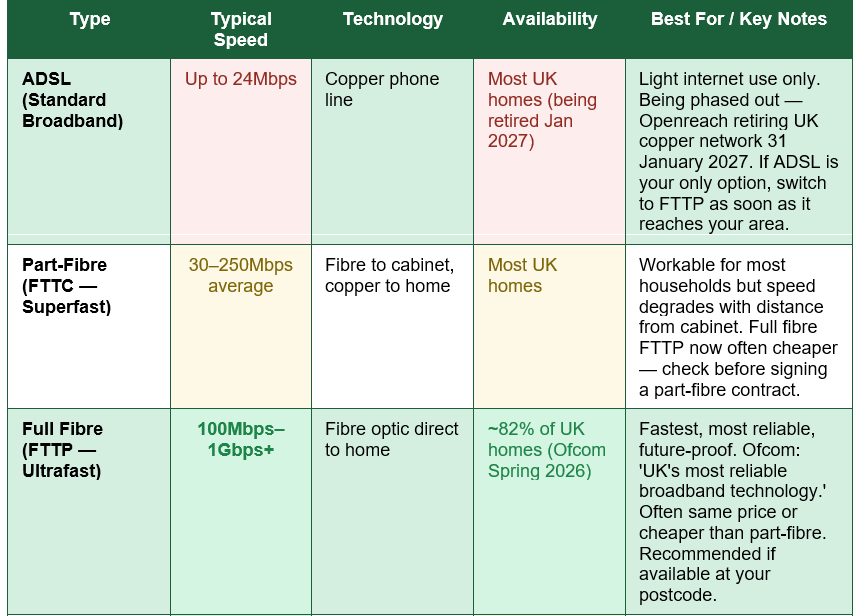
.
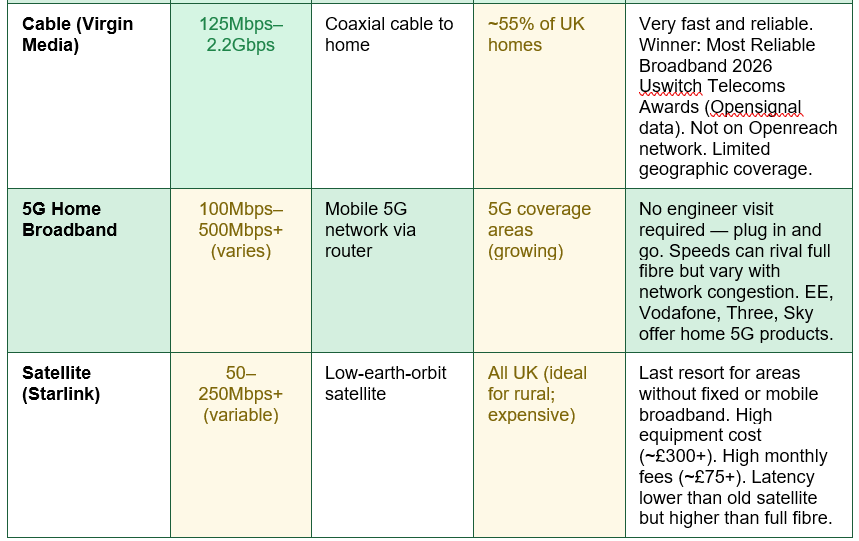
The full-fibre tipping point: 82% of UK homes can now access FTTP full fibre — and it is often cheaper than part-fibre (FTTC) — Ofcom's Spring 2026 Connected Nations report confirms 82% residential FTTP availability, up dramatically in three years. Uswitch (July 2026) specifically notes that many full fibre deals now cost the same as or less than equivalent part-fibre packages. If full fibre is available at your postcode, there is rarely a financial or performance reason to choose anything less.
Major UK Broadband Providers Compared: July 2026
The table below compares the major UK broadband providers across price, speed, network, and the most relevant awards and ratings from July 2026, sourced from Which? (July 2026), MoneySavingExpert YouGov survey (April 2026, approximately 10,000 respondents), Uswitch Telecoms Awards 2026, and Switchity (data correct 29 June 2026). Deals are highly postcode-dependent — always enter your postcode on a comparison site for the accurate offers available at your address: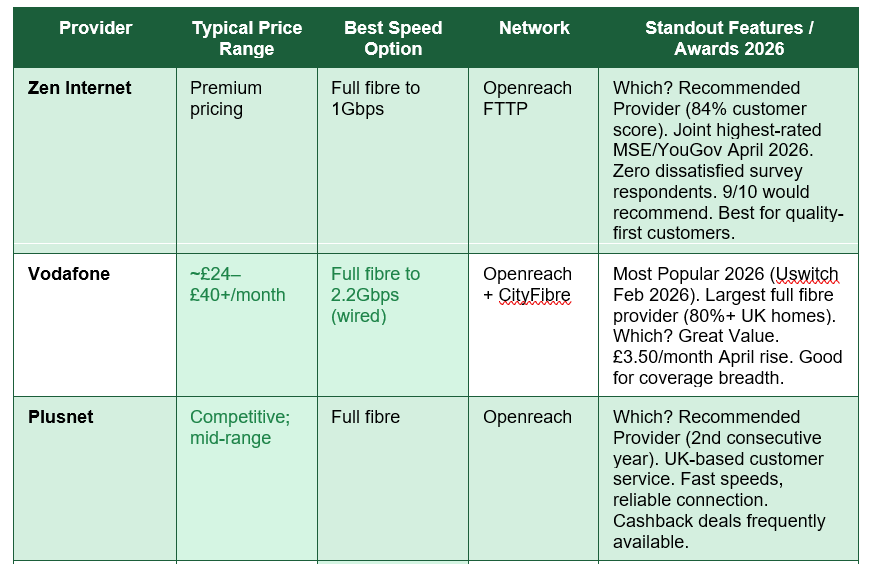
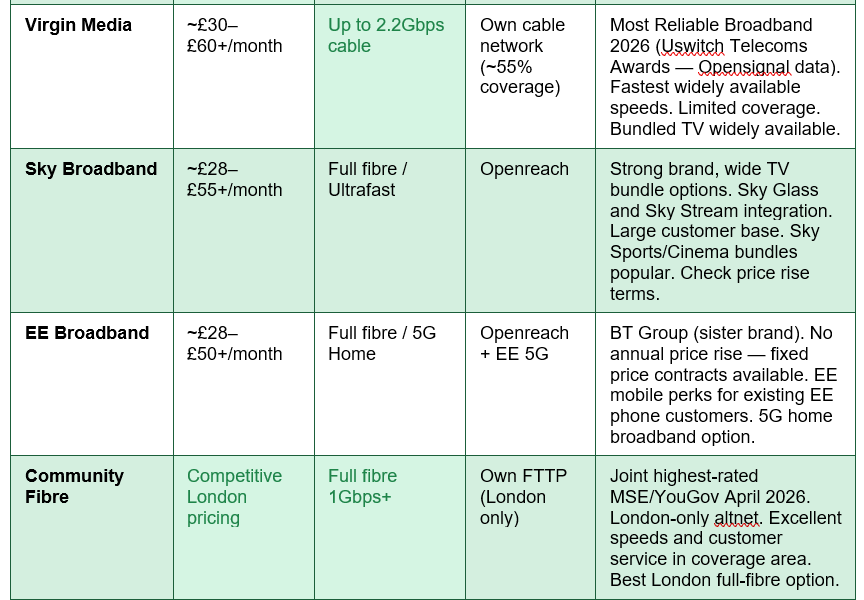

The altnet revolution: Community Fibre, Hyperoptic, Toob, and the regional specialists: The UK broadband market has been transformed by alternative network providers (altnets) — smaller, often regionally-focused providers that build and run their own full-fibre networks rather than renting capacity from Openreach or Virgin Media. Community Fibre (London), Hyperoptic (apartment buildings and city developments), Toob (South England), KCOM (Hull), Ogi (Wales), and dozens of others provide full-fibre at competitive prices with notably higher customer service scores than most major providers. MSE/YouGov's April 2026 survey placed Zen, Community Fibre, and Toob as the joint highest-rated providers for customer service. If your postcode is served by an altnet, it deserves serious consideration alongside the national providers.
How Much Speed Do You Actually Need?
One of the most common broadband buying mistakes is paying for significantly more speed than your household actually uses. The average UK download speed is now 223Mbps according to Ofcom — and most households with this level of connection report no performance issues even during peak evening usage. Understanding what activities require what speeds helps you choose the right tier without overpaying.Speed Requirements by Household Activity
- Basic browsing, email, social media: 5–10Mbps per user. Any modern broadband connection handles this comfortably.
- HD video streaming (Netflix, Disney+, iPlayer): 5–15Mbps per stream. A household streaming simultaneously on two screens while browsing needs 30–40Mbps to avoid buffering.
- 4K Ultra HD streaming: 25–40Mbps per stream. A family streaming 4K on two screens simultaneously benefits from 100Mbps+ to provide headroom for other connected devices.
- Video calls (Zoom, Teams, FaceTime): 5–25Mbps per call depending on quality. Upload speed matters here — check both download and upload figures, particularly for home workers.
- Online gaming: 10–50Mbps download, but latency (ping) is more important than speed for gaming performance. Full fibre FTTP typically offers the lowest latency.
- Working from home (multiple simultaneous activities): 50–150Mbps recommended for comfortable working alongside household internet use. Upload speed is particularly important for video calls and cloud uploads.
- Large household (5+ devices, multiple simultaneous 4K streams, gaming, WFH): 300Mbps–1Gbps. At this level, gigabit broadband provides genuine performance headroom. Switchity data shows gigabit deals average £27/month — close to mid-tier pricing.
The practical starting point recommended by Choose.co.uk (July 2026) is 100Mbps for most households — comfortably supporting HD and Ultra HD streaming, online gaming, and working from home, with capacity for multiple simultaneous connected devices. Where full fibre is available, a 150Mbps or 500Mbps deal frequently costs no more than a 36Mbps FTTC package and provides significantly better performance and future-proofing.
Mid-Contract Price Rises: The Hidden Cost of the Wrong Deal
One of the most significant and most poorly understood features of UK broadband contracts is the mid-contract price rise. Most major UK broadband providers include a clause allowing them to increase prices annually during the contract term — typically tied to the Consumer Price Index (CPI) measured in January, plus a fixed percentage, or a specified fixed annual rise. Which? explicitly warns about this in its July 2026 guide: 'Watch out for providers with mid-contract price rises. A number of providers will increase their prices each April, and over a two-year contract this could have a big impact on your monthly bill.'The practical impact is significant. TalkTalk's current Fibre 150 deal starts at £24 per month, rising to £28 in April 2027 and £32 in April 2028 on a 24-month contract — a 33% increase over the contract term. Vodafone raises monthly prices by £3.50 each April. Virgin Media, Sky, and BT all have mid-contract rise mechanisms. Where Switchity's effective monthly cost tool averages mid-contract rises into the displayed price, the 'cheapest' deal by headline price may not be the cheapest over the full contract.
Several providers offer alternatives. EE broadband offers fixed-price contracts on selected plans — no mid-contract price rise for the duration of the deal. Some smaller providers and altnets fix their contract prices. When comparing deals, Switchity's effective monthly cost calculation (which factors in mid-contract rises) is the most accurate tool for total-contract-cost comparison.
THE MID-CONTRACT RISE TRAP: A deal advertised at £24.99/month may be £29.99/month by the end of a 24-month contract. When comparing deals, always check: (1) Does the deal include mid-contract price rises? (2) What is the mechanism (CPI+3.9%, fixed £amount, or a specific schedule)? (3) What is the effective average monthly cost across the full contract? Compare on total first-year cost or effective monthly cost — not just the headline monthly price. Comparison sites including Switchity and MoneySuperMarket now display effective monthly costs that incorporate anticipated price rises, making accurate comparison possible.
How to Compare Broadband Deals: A Step-by-Step Process
Comparing broadband effectively in 2026 requires a structured approach that goes beyond headline monthly price. The following process produces the most accurate like-for-like comparison:- Enter your postcode on multiple comparison sites: Deals are postcode-specific — not all providers are available at all addresses. Use MoneySavingExpert (which includes 37+ providers plus special deals), MoneySuperMarket, Uswitch, and Switchity to generate the broadest possible view of what is available at your address. Some providers do not appear on all comparison sites.
- Sort by effective monthly cost, not headline price: Set comparison results to sort by total first-year cost or effective monthly cost to account for mid-contract price rises and setup fees. A deal with a slightly higher headline price but no annual rise may be cheaper over two years than a lower-headline deal with a CPI+3.9% rise.
- Identify the right speed tier: Use the household speed guide above to determine the minimum speed you need. Do not pay for gigabit if your household's realistic peak usage is 150Mbps — and do not choose 35Mbps FTTC when full fibre at 150Mbps is available at the same price.
- Check contract length: UK broadband contracts are typically 12 or 24 months. A 24-month deal usually offers a lower monthly price but a larger early termination fee if you leave before the end. Switchity's ETF calculator (based on 530 verified users, May 2026) shows that the average remaining contract at exit is 13 months — the earlier you are in a contract, the more you pay to leave.
- Factor in the extras: Welcome bonuses (cashback, prepaid cards, gift cards) can significantly reduce the effective cost of a deal. Plusnet regularly offers £120 cashback deals on MSE. Router quality, included security software, and the customer service rating of the provider should all factor into a decision where prices are close.
- Use One Touch Switch for a seamless change: One Touch Switch (OTS) is Ofcom's streamlined switching system, now in operation across UK broadband providers. When you sign up with a new provider, the switch is managed end-to-end — your new provider contacts your old one and coordinates the changeover. Most customers experience no downtime during the switch. You do not need to separately cancel your old provider.
BEST TIME TO COMPARE: The best time to start comparing broadband is 30 days before the end of your current contract. Most providers allow you to switch without paying early termination fees once you are within 30 days of your contract end (some allow earlier). Out-of-contract customers are typically paying the highest prices — MoneySavingExpert recommends comparing immediately if you do not know when your contract ends, as many out-of-contract customers are paying £10–£20/month more than new-customer deals.
Social Tariffs: Discounted Broadband for Those on Benefits
Social tariffs are discounted broadband deals offered by major UK providers specifically for households receiving certain means-tested benefits — primarily Universal Credit, Pension Credit, Employment and Support Allowance, and some others. If you or anyone in your household receives one of these benefits, you may be eligible for significantly cheaper broadband than any standard deal available on comparison sites.Vodafone was awarded Best Social Tariff by Broadband Genie in June 2025 for its Vodafone Essential offer. BT offers its BT Home Essentials plan (available to Universal Credit and other qualifying benefit recipients). Sky, TalkTalk, Virgin Media, and several other major providers also operate social tariffs. Social tariff prices are typically £15 to £22 per month for speeds sufficient for most households' needs — often 30 to 150Mbps. These deals are not advertised on mainstream comparison sites and must be applied for directly with the provider.
Ofcom actively monitors the availability and accessibility of social tariffs and publishes quarterly reports on uptake. If you are currently on Universal Credit or Pension Credit and paying a standard broadband rate, checking with your current provider about their social tariff — and with other providers whose social tariffs you may be eligible for — should be the first step before comparing any commercial deal.
Bundles: Broadband, TV, and Phone Packages
Many UK households consider bundled deals — broadband combined with a home phone line and/or a TV package — as a convenience and potential cost saving. The reality in 2026 is more nuanced. Switchity's analysis (data from 12 months of real deal selections, June 2025 to May 2026) found that adding TV to a broadband package typically costs an extra £16 to £47 per month above the broadband-only price, depending on the content tier. At the lower end, broadband plus a Freeview box is a modest step up. At the top end, a full Sky bundle with Sky Sports and TNT Sports can push the monthly bill above £80.The practical test recommended by Switchity is to compare the bundle price against the cost of broadband-only plus standalone streaming services. In 2026, Netflix, Disney+, Amazon Prime Video, and Apple TV+ together cost approximately £30 to £40 per month combined — often comparable to or cheaper than the TV addition cost in a broadband bundle, with the flexibility advantage that streaming services can be cancelled without a contractual penalty. For sports specifically, the economics may shift: Sky Sports and TNT Sports at standalone subscription prices are expensive, and a bundle that includes them can sometimes represent better value.
Home phone lines are included in most traditional broadband packages but are genuinely used by a declining proportion of households. If you do not use a home phone line, choosing a broadband-only deal (available from most providers) avoids paying the line rental component that is embedded in many bundle prices.
Conclusion
Comparing broadband deals in July 2026 is both more important and more rewarding than it has been at any previous point. With 82% of UK homes now able to access full-fibre broadband, the technology choice for most households is straightforward — full fibre (FTTP) delivers faster speeds, better reliability, and longer-term future-proofing, and often costs the same as or less than the part-fibre deals it replaces. The copper network is being switched off in January 2027, making this the last window to be passively on ADSL or early FTTC before the retirement forces a change.The price market is genuinely competitive. Gigabit deals average £27 per month according to Switchity's 12-month real-user data. The average UK household bill stands at £34.50, meaning out-of-contract customers — particularly those with TV bundles — are likely paying significantly above what the market offers for comparable speeds. Out-of-contract customers should compare immediately rather than continuing on renewal prices that are rarely competitive.
The five things that matter most when comparing: speed tier matched to actual household needs, effective monthly cost (not headline price) including mid-contract rises, contract length relative to your flexibility requirements, customer service quality using Which?, MSE, and Uswitch survey data rather than marketing claims, and any switching bonus. Which?'s Recommended Providers — Zen Internet (84% customer score, zero dissatisfied respondents) and Plusnet — represent the highest quality end of the market. Vodafone and Virgin Media lead on coverage breadth and speed respectively. Community Fibre and Hyperoptic lead for London and apartment-focused households. One Touch Switch means changing provider is seamless and typically involves no downtime. The comparison takes 10 minutes. The saving — over a two-year contract — can easily exceed £200.
0 Comments
Be the first to share your thoughts on this article.