
Savings
UK Housing & Energy Government Grants 2026 Guide

Table of Contents
- The Warm Homes Plan: The New Framework Behind Everything
- Every Current UK Grant at a Glance: The Master Table
- The Boiler Upgrade Scheme (BUS): Up to £9,000 for Heat Pumps
- Grant Amounts from July 2026
- Key 2026 Eligibility Change
- The Warm Homes Local Grant: Up to £30,000 for Low-Income Households
- 0% VAT and Other Support: What Every Household Qualifies For
- Zero-Rated VAT on Energy-Saving Installations
- Warm Home Discount
- Smart Export Guarantee (SEG)
- Stacking Multiple Grants: How to Maximise What You Claim
- How to Apply: A Practical Step-by-Step Guide
- Conclusion
- Frequently Asked Questions (FAQ)
- External References

The UK government committed £15 billion to home energy improvements in the Warm Homes Plan published in January 2026 — the largest single investment in housing energy efficiency in modern British history. This funding is not a future aspiration; significant portions of it are available right now, through schemes that most eligible households have either never heard of or have incorrectly assumed they do not qualify for. The Boiler Upgrade Scheme is offering up to £9,000 toward a heat pump for oil-heated homes with no means testing. The Warm Homes Local Grant is funding up to £30,000 in free home upgrades for eligible low-income households. And until March 2027, zero-rated VAT on solar panels, heat pumps, insulation, and battery storage means every household — not just low-income ones — can save the 5% VAT on qualifying energy-saving installations.
The challenge is that the grant landscape in 2026 has changed substantially since previous guides were written. ECO4 — the scheme that funded free boilers and insulation for households on qualifying benefits since 2022 — is no longer processing new installations; it has been extended only for remediation of defective existing work and closes entirely in December 2026. The Great British Insulation Scheme closed to new applications in March 2026. The successor programmes — the Warm Homes Local Grant, the expanded Boiler Upgrade Scheme, and the forthcoming Warm Homes Fund consumer loan scheme — are either live or imminent, but finding accurate information about exactly which scheme applies to which household, for which measures, has become significantly more complex.
This guide cuts through that complexity. It covers every active scheme in plain English: what it funds, how much it pays, who qualifies, whether there is a deadline to be aware of, and where to apply. The guide includes the scam warning that belongs in any honest grant article, the stacking rules that apply when you qualify for multiple schemes simultaneously, and a practical step-by-step application framework that any UK household can follow regardless of their income or existing home setup.
The Warm Homes Plan: The New Framework Behind Everything
The January 2026 Warm Homes Plan is the overarching policy framework replacing the previous Energy Company Obligation (ECO) system. The most important structural change is how the funding flows: ECO4 was funded by levies on energy bills, paid by energy suppliers who were obligated to deliver a certain volume of installations. The Warm Homes Plan is funded through general taxation — a shift the government explicitly used to justify removing approximately £150 per year of levies from household energy bills from April 2026.The £15 billion total commitment breaks down into four primary components:
- £5 billion for low-income and fuel-poverty schemes: Funding the Warm Homes Local Grant (free upgrades for low-income households), the Social Housing Fund Wave 3 (upgrades to social housing), and the successor to ECO4 for remediation and transition.
- £2.7 billion for the expanded Boiler Upgrade Scheme: Extending the BUS heat pump grant through to 2029/30, with expanded eligibility including air-to-air heat pumps and the £9,000 uplift for off-gas (oil and LPG) properties from July 2026.
- £2 billion for consumer loans (Warm Homes Fund): Low or zero interest loans for households above the income threshold for free grants, specifically for solar panels, battery storage, and heat pumps. Terms and application process expected later in 2026.
- Supporting funding for Scotland, Wales, and Northern Ireland: Separate but parallel schemes operate in Scotland (Home Energy Scotland), Wales (Nest scheme), and through devolved budget allocations across all four nations.
Scale of the Warm Homes Plan ambition: 5 million homes targeted for upgrades — the government's stated aim under the £15 billion Warm Homes Plan is to deliver energy efficiency improvements to up to 5 million homes, reducing bills and carbon emissions on a scale that would represent approximately 18% of all UK housing stock (GOV.UK, January 2026).
Every Current UK Grant at a Glance: The Master Table
The table below summarises every major active housing and energy grant scheme in the UK as of July 2026, with key eligibility and deadline information: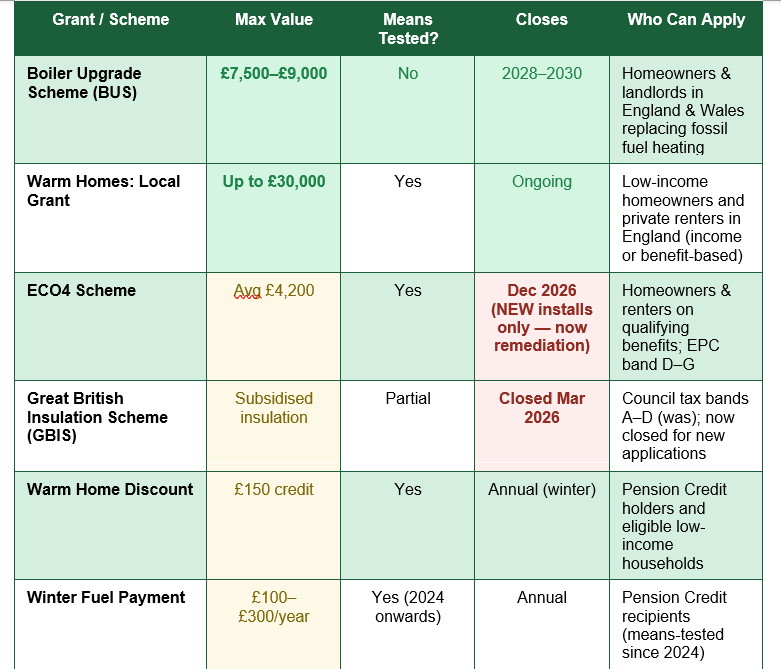
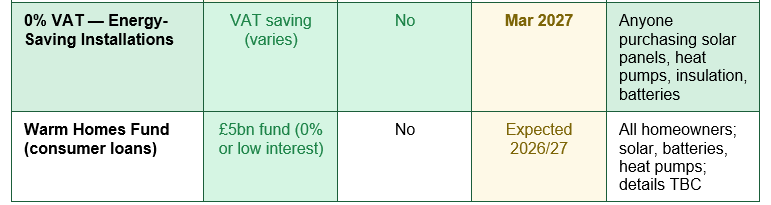
TIME-SENSITIVE DEADLINES: ECO4 closes to all activity on 31 December 2026. The 0% VAT rate on energy-saving installations reverts to 5% from April 2027. If you are eligible for ECO4 or planning a solar, heat pump, insulation, or battery installation, acting in 2026 secures both of these benefits before they change.
The Boiler Upgrade Scheme (BUS): Up to £9,000 for Heat Pumps
The Boiler Upgrade Scheme is the most widely available heat pump grant in England and Wales, and uniquely among the major schemes, it is not means-tested. There is no income requirement; any homeowner or private landlord with an eligible property replacing a fossil-fuel heating system qualifies, subject to the property and installation criteria.Grant Amounts from July 2026
- £7,500: Standard grant for air source heat pumps (air-to-water systems that heat the home and hot water through radiators or underfloor heating) — the most common heat pump type for replacing gas boilers.
- £9,000: Enhanced grant for homes currently using oil or LPG heating, available from July 2026 to March 2027. Off-grid properties face higher installation complexity and costs, and this uplift reflects both the greater technical challenge and the carbon reduction benefit of moving these properties away from higher-emission fuels.
- £2,500: Grant for air-to-air heat pumps, newly added to the scheme in 2026. These systems provide heating and cooling but do not heat water, making them typically a secondary system rather than a full boiler replacement.
Key 2026 Eligibility Change
The most significant eligibility change in 2026 is the removal of the EPC insulation condition. Previously, households had to demonstrate they had no outstanding insulation recommendations on their EPC before the grant could be accessed. This requirement was removed in April 2026, opening the scheme to a substantially wider group of homeowners whose properties have insulation gaps but who still want to proceed with a heat pump installation. The government's rationale is that practical improvement is better than blocking progress on heating while insulation is retrofitted separately.The process is straightforward: your installer applies for the BUS voucher on your behalf. You do not receive a cash payment — the grant is applied as a discount on your installation invoice, reducing what you actually pay. Installers must be MCS (Microgeneration Certification Scheme) certified, which provides a quality assurance layer for the installation itself. Since BUS first launched in 2022, over 80,000 BUS grant vouchers have been issued totalling more than £563 million (as of February 2026, Ofgem).
Scotland has a parallel scheme: The Home Energy Scotland (HES) Grant and Loan Scheme offers grants of up to £7,500 and interest-free loans of up to £7,500 for heat pump installations north of the border. Scotland's scheme is administered through Energy Saving Trust rather than Ofgem, and Scottish households should check eligibility at homeenergyscotland.org rather than gov.uk.
The Warm Homes Local Grant: Up to £30,000 for Low-Income Households
The Warm Homes Local Grant (WHLG) is the largest free home energy grant available in England right now, and the direct successor to ECO4 for new installations targeting low-income households. Delivered through local councils rather than energy suppliers, it can fund up to £30,000 in energy upgrades per household — insulation, heat pumps, solar panels, smart heating controls, and more — with no upfront cost and no repayment obligation.Eligibility is determined at local authority level, which means the specific income thresholds, qualifying benefits, and available measures vary by council. The general framework is:
- Homeowners or private renters in England (not social housing, which has its own Social Housing Fund).
- Household income at or below a threshold typically around £36,000 per year — check your local authority's specific criteria.
- Receiving certain qualifying benefits such as Universal Credit, Pension Credit, Child Tax Credit, or similar.
- Living in a property with an EPC band of D, E, F, or G — the less energy efficient the property, the more measures typically available.
The application route is through your local council or a local authority-approved installer working in your area. Energy Saving Trust's Simple Energy Advice service (www.simpleenergyadvice.org.uk) provides a postcode-based checker that can identify the specific Warm Homes schemes available from your council, alongside contact information for applications.
Unlike the BUS, which requires an MCS-certified installer and a specific product list, the Warm Homes Local Grant can fund a wider range of measures in a single installation because it takes a 'whole house' approach — assessing what the property needs rather than prescribing specific measures. This means a single application can potentially fund insulation, a new heating system, solar panels, and smart controls simultaneously, which is why the maximum value reaches £30,000.
0% VAT and Other Support: What Every Household Qualifies For
Zero-Rated VAT on Energy-Saving Installations
Since April 2022, solar panels, heat pumps, insulation, battery storage, and certain other energy-saving measures have been subject to 0% VAT rather than the standard 20% or even the reduced 5% rate. This applies to any household commissioning these installations — there is no income or means test. On a £10,000 solar panel installation, the saving at 0% vs 5% is £500; on a heat pump installation costing £12,000 before the BUS grant, the saving is £600. The zero rate is confirmed to remain in place until March 2027, after which it is expected to return to the 5% reduced rate. For anyone planning solar, heat pump, insulation, or battery installation out of pocket, scheduling the work before March 2027 locks in this saving.Warm Home Discount
The Warm Home Discount provides a £150 credit directly applied to your electricity bill each winter. It is automatically applied for households where someone receives the Guarantee Credit element of Pension Credit, and available via a broader eligibility route for other low-income households. It is not a grant for physical home improvements but a direct bill reduction that compounds the benefit of other scheme participation. Energy suppliers participate in the scheme and apply the credit automatically for qualifying customers — check your energy supplier's website to confirm whether you qualify under the broader group eligibility.Smart Export Guarantee (SEG)
The Smart Export Guarantee requires energy suppliers with more than 150,000 customers to offer a tariff that pays households for any excess electricity they generate from solar panels and export back to the grid. Rates vary by supplier but are typically between 3p and 24p per kilowatt hour, depending on the tariff and supplier. For households installing solar panels, registering for the best available SEG tariff after installation provides an ongoing revenue stream that further improves the financial case for the installation.0% VAT saving on a typical solar installation: £500–£1,000 depending on system size — on a standard 4kWp domestic solar panel system costing £8,000–£10,000, the saving from 0% rather than 5% VAT is £400–£500 — a meaningful reduction available to any household commissioning qualifying energy-saving work before March 2027 (UKEM Group / gov.uk, 2026).
Stacking Multiple Grants: How to Maximise What You Claim
Multiple UK housing and energy grants can be combined on the same property, provided each measure is only funded once and all scheme-specific eligibility criteria are met independently. This stacking potential is what makes the UK grant landscape substantially more valuable than any single scheme suggests in isolation.For example: a household receiving Universal Credit with an EPC D-rated home could potentially claim Warm Homes Local Grant funding for insulation, the Boiler Upgrade Scheme £7,500 grant for a heat pump to replace their gas boiler, and benefit from 0% VAT on the entire installation cost — all simultaneously. An eligible pensioner receiving Pension Credit could access the Warm Homes Local Grant for free home upgrades, the Warm Home Discount for £150 off their electricity bill, and the Winter Fuel Payment for winter heating support, with the 0% VAT saving additionally available on any self-funded improvements.
The practical stacking rule to know: Each individual measure — for example, cavity wall insulation — can only be funded once under a single scheme. You cannot claim both ECO4 and the Warm Homes Local Grant for the same insulation installation. But you can claim ECO4 for insulation and BUS for a heat pump on the same property in the same year, since these are different measures. The key is ensuring you are not double-claiming the same physical improvement from multiple schemes, and that the specific measures each scheme covers do not overlap for your particular property.
How to Apply: A Practical Step-by-Step Guide
- Get a current EPC for your property: An Energy Performance Certificate tells you your property's current energy efficiency rating and lists the recommended improvements. It costs £60–£120 from an accredited assessor, is valid for 10 years, and is a prerequisite for most grant applications. The EPC recommendation list effectively gives you a priority order for improvements and helps determine which grants apply to your property.
- Use the gov.uk eligibility checker and Simple Energy Advice: Start at www.gov.uk/improve-energy-efficiency and www.simpleenergyadvice.org.uk, entering your postcode and household details to identify which specific schemes are available in your area and for which you are likely eligible. Both tools are free, do not require any personal information beyond postcode and basic property details, and can be completed in under five minutes.
- For the Boiler Upgrade Scheme, contact an MCS-certified installer: BUS applications are handled by your installer. Find MCS-certified heat pump installers at mcscertified.com, and ask at least two installers to quote and confirm BUS eligibility for your specific property before committing. The installer will apply for the voucher, and the grant is deducted from your invoice rather than paid to you directly.
- For the Warm Homes Local Grant, contact your local council: Local authority contact details are available at your council's website or through the Simple Energy Advice postcode checker. Some councils run their own portal; others work through approved local installers. Ask specifically about the Warm Homes Local Grant by name, as council helplines may use slightly different scheme branding locally.
- Register for the Warm Home Discount and Winter Fuel Payment: The Warm Home Discount core group (Pension Credit holders) is applied automatically. The broader group eligibility requires action — check with your energy supplier or at gov.uk/the-warm-home-discount-scheme for the current application window and requirements.
- Beware of scam 'grant checking' services: There are companies cold-calling, door-knocking, and running social media adverts claiming to offer free government grant checks and installations. Legitimate government schemes do not operate through unsolicited contact. All genuine grant applications go through gov.uk, your local council, or MCS-certified installers. Any company asking for upfront payment for a 'free government grant' is not legitimate.
Conclusion
The UK housing and energy grant landscape in 2026 is both more generous and more complex than it has ever been. The £15 billion Warm Homes Plan represents a generational shift in the scale of government investment in housing energy efficiency, and it has been designed to reach households across the income spectrum — from the Warm Homes Local Grant offering up to £30,000 completely free to eligible low-income households, to the means-test-free Boiler Upgrade Scheme offering £7,500 to £9,000 for any homeowner replacing a fossil fuel boiler with a heat pump, to the 0% VAT saving available to any household installing solar panels, insulation, batteries, or a heat pump before March 2027.The transition away from ECO4 toward the Warm Homes Local Grant changes where many households should now be directing their applications. ECO4 is closed for new installations and active only for remediation until December 2026; anyone who was waiting for ECO4 funding for new home upgrades should now apply through the Warm Homes Local Grant route via their local council. The forthcoming Warm Homes Fund consumer loan scheme — providing low or zero interest finance for solar, batteries, and heat pumps for households above the income threshold for free grants — is expected to launch in late 2026 or early 2027, adding a further option for the significant share of UK households who earn too much for means-tested grants but cannot easily afford the upfront cost of major energy improvements.
The most important practical message is: act in 2026 rather than waiting. ECO4 remediation closes in December. 0% VAT reverts in March 2027. The £9,000 BUS uplift for oil and LPG homes runs from July 2026 to March 2027. All of these time-limited opportunities are available right now to eligible households who take the ten minutes needed to check eligibility at gov.uk and contact the relevant scheme or installer.
Frequently Asked Questions (FAQ)
What is the biggest UK government grant for home energy in 2026?
The single largest available grant is the Warm Homes Local Grant, which can provide up to £30,000 per eligible household for insulation, heat pumps, solar panels, and other energy efficiency measures, with no upfront cost and no repayment. It is means-tested and delivered through local councils in England for low-income homeowners and private renters. For households that do not meet the income threshold for the Warm Homes Local Grant, the Boiler Upgrade Scheme offers up to £9,000 toward an air source heat pump for off-gas properties, with no income requirement.Is ECO4 still running and can I apply for it?
ECO4 is no longer accepting new home improvement applications. As of 2026, ECO4 has been extended only for remediation of defective existing installations, and it closes entirely on 31 December 2026. If you were waiting for ECO4 funding for new insulation, a boiler replacement, or other home upgrades, the correct application route is now the Warm Homes Local Grant through your local council. Contact your council directly or use the Simple Energy Advice service at simpleenergyadvice.org.uk to find the specific schemes and contacts available in your postcode area.Do I need to be on benefits to qualify for government home energy grants?
Not for all schemes. The Boiler Upgrade Scheme (£7,500–£9,000 for heat pumps) and the 0% VAT saving on energy-saving installations are both available to all homeowners regardless of income or benefit status. The Warm Homes Local Grant and Warm Home Discount are means-tested and require either receipt of qualifying benefits or a household income below a specified threshold. The forthcoming Warm Homes Fund consumer loan scheme is expected to be available to all homeowners regardless of income for solar, battery, and heat pump financing.Can I claim more than one grant on the same property?
Yes, in most cases. Multiple schemes can be combined on the same property provided each measure is only funded once. A household could, for example, claim the Boiler Upgrade Scheme for a heat pump, benefit from the Warm Homes Local Grant for insulation, and apply the 0% VAT saving to the entire installation cost simultaneously. The key constraint is that a single physical measure — for example, loft insulation — cannot be claimed under more than one scheme at the same time. Always check the specific terms of each scheme and inform your local authority or installer of any other schemes you are applying for simultaneously.How do I apply for a Boiler Upgrade Scheme grant?
The BUS application is handled by your MCS-certified heat pump installer, not by you directly. Find registered installers at mcscertified.com, get at least two quotes, and ask each installer to confirm BUS eligibility for your specific property and heating system. Once you have selected an installer and agreed to proceed, they will apply for the BUS voucher through Ofgem, and the grant value is deducted directly from your installation invoice — you pay the net cost after the grant, not the full amount upfront. You do not need to apply separately to any government portal.
External References
The following authoritative sources were used in researching this article and are recommended for further reading:1. GOV.UK — Find Ways to Save Energy in Your Home (Eligibility Checker)
https://www.gov.uk/improve-energy-efficiency
2. GOV.UK — Boiler Upgrade Scheme: Apply for a Grant
https://www.gov.uk/guidance/boiler-upgrade-scheme
3. GOV.UK — The Warm Home Discount Scheme
https://www.gov.uk/the-warm-home-discount-scheme
4. Simple Energy Advice (Energy Saving Trust) — Find Grants by Postcode
https://www.simpleenergyadvice.org.uk/
5. MCS — Find a Certified Installer for BUS Heat Pumps
https://mcscertified.com/find-an-installer/
6. Ofgem — Boiler Upgrade Scheme Statistics (over 80,000 vouchers issued)
https://www.ofgem.gov.uk/check-if-energy-supplier-is-ofgem-registered/boiler-upgrade-scheme
7. UKEM Group — UK Energy Grants 2026: Every Scheme to Claim
https://www.ukem.co.uk/grants/guides/uk-energy-grants-2026/
8. Home Energy Scotland — HES Grant and Loan Scheme (Scotland)
https://www.homeenergyscotland.org/
0 Comments
Be the first to share your thoughts on this article.