

Savings
How to Save Money on Transport in the UK: Accountants' Guide
UK TRANSPORT SAVINGS | Average UK driver: £3,484/year (£290/month). Petrol: 157p/litre. Insurance: £559 average. Rail fares frozen for 2026 -- first freeze in 30 years. Bus cap: £3 until March 2027. The tips that can save you £500-£2,000+ per year on transport costs.
But 2026 has also brought some genuinely good news for UK transport costs. For the first time in 30 years, regulated rail fares in England -- including season tickets and off-peak returns -- are frozen through March 2027. The £3 bus fare cap on single journeys in England outside London has been extended to the same date. Petrol prices, after spiking sharply in early 2026 following Middle East conflict disruption, have begun to fall back. And the Cycle to Work scheme continues to offer up to 40% off the cost of a new bike for eligible employees.
This guide covers every practical way to cut your UK transport bill in 2026 -- by car, by train, by bus, by bike, and by rethinking the overall transport mix. The combined savings from applying the strategies in this guide can realistically reach £500-£2,000 per year for the average UK household, without any significant lifestyle compromise.
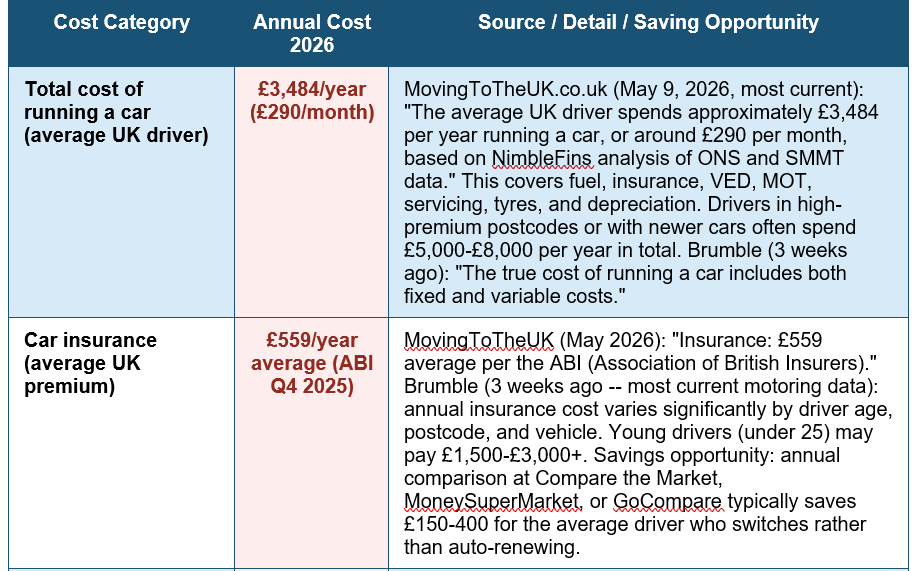
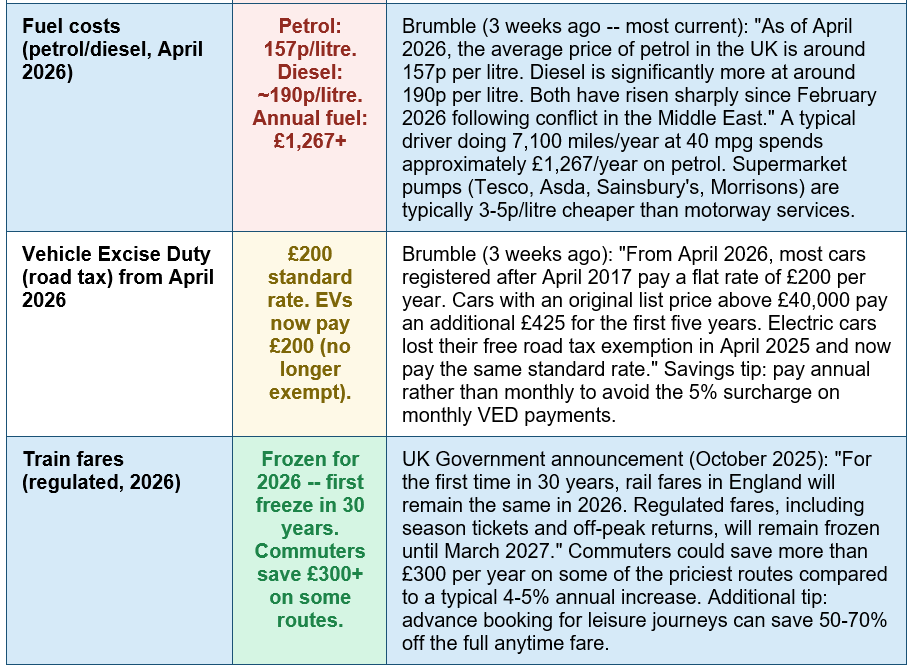
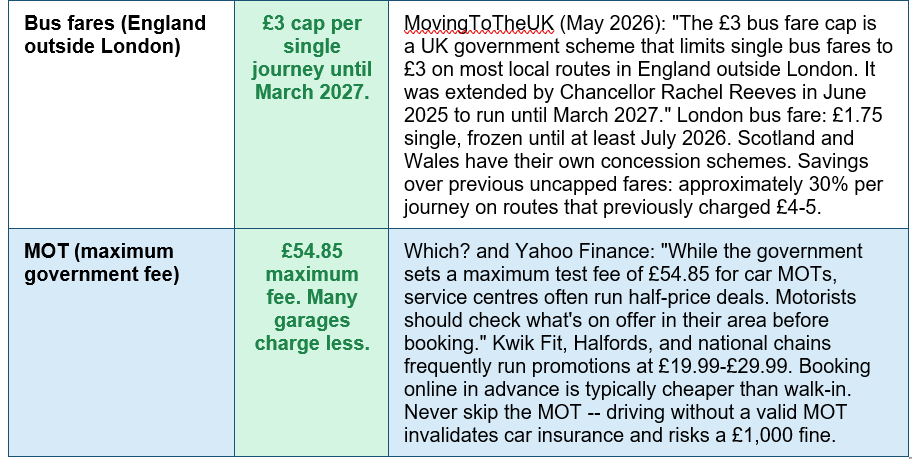
UK transport in 2026 -- the defining numbers: £3,484/year average car cost. 157p/litre petrol. £559 insurance. Rail fares frozen. £3 bus cap. MOT max £54.85. — MovingToTheUK.co.uk (May 9, 2026, most current): 'Average UK driver spends £3,484/year (£290/month) running a car (NimbleFins, ONS, SMMT data). Insurance £559 ABI average.' Brumble (3 weeks ago, most current motoring data): 'Petrol 157p/litre April 2026. Diesel ~190p/litre. VED £200 standard from April 2026.' Gov.uk: 'Rail fares frozen 2026 -- first freeze in 30 years. £3 bus cap extended to March 2027.' MOT max fee £54.85 (DVSA).
TOP TIP: Go to comparethemarket.com, moneysupermarket.com, and gocompare.com 3-4 weeks before your renewal date. Run the full comparison. If you find a better rate, call your current insurer and ask them to match it. If they won't: switch. The average saving from switching rather than auto-renewing is £150-£400 for most drivers.
TOP TIP: If you are under 60: buy the railcard that matches your demographic today at railcard.co.uk (£30, pays back in 2-3 journeys). For your next leisure train journey: check TrainSplit.com first, then nationalrail.co.uk for advance fares. Book directly with the operator (not Trainline) to avoid the booking fee.
TOP TIP: Download PetrolPrices.com (or check the app) before any fill-up. Fill at a supermarket forecourt rather than a motorway service station. Check tyre pressures monthly -- under-inflated tyres add up to 3% to fuel consumption. Remove roof boxes and excess weight when not in use.
TOP TIP: Check the gov.uk bus pass eligibility page if you are 66+ or have a qualifying disability -- a free bus pass in England replaces a significant transport cost. If under 22 in Scotland, apply for the free bus travel scheme at mygov.scot. For regular bus commuters: ask your operator about weekly, monthly, or annual passes -- typically 20-30% cheaper than daily singles.
TOP TIP: Check with your HR department whether your employer participates in a Cycle to Work scheme (cyclescheme.co.uk or the employer's own scheme). Calculate the tax savings on a bike at your income level. If cycling is realistic for even 2-3 days of your weekly commute, the fuel and parking saving over a year typically exceeds £500. Electric bikes (e-bikes) now qualify for the scheme and make longer cycling commutes practical.
TOP TIP: Register on Liftshare.com today (free) to find colleagues or neighbours who share your commute route. For city centre journeys: check your local authority's park-and-ride website before paying for city centre parking. Park-and-ride is consistently cheaper than urban parking and often faster in peak hours.
The biggest transport saving most people miss: the true cost of car ownership. Brumble (3 weeks ago, most current motoring data) and MovingToTheUK.co.uk (May 2026) both use NimbleFins data to estimate the average UK driver's annual motoring cost at £3,484/year -- not including the purchase, finance, or depreciation of the vehicle itself. When depreciation is included, the true annual cost of a typical UK car rises to £5,000-£8,000 for many drivers. The comparison question that most households never ask: could I cover my journey needs with a combination of bus, train, cycling, and occasional car hire for the same or lower total cost as owning a car? In cities with good public transport (London, Manchester, Edinburgh, Bristol), the answer is often yes -- particularly for households with only one car or whose second car is primarily used for leisure. Costofthings.co.uk (March 2026): 'The average transport costs in the UK per month range from £100 to £300 depending on whether you drive, commute, or use public transport.' The low end of that range -- £100-£150/month -- is entirely achievable for urban households relying on the £3 bus cap, the frozen rail fares, and occasional cycling. The high end (£250-£300+/month) describes the typical car-owning commuter. The gap between these two positions represents £1,200-£2,400/year in household savings.
FIVE TRANSPORT COST MISTAKES THAT COST UK HOUSEHOLDS HUNDREDS PER YEAR: (1) AUTO-RENEWING CAR INSURANCE WITHOUT COMPARING. The loyalty penalty means most auto-renewals cost 20-40% more than a comparable policy from a new insurer. Set a calendar reminder 4 weeks before renewal. Never renew without checking at least Compare the Market and MoneySuperMarket. Cost of mistake: £150-£400/year. (2) BUYING TRAIN TICKETS ON THE DAY OR AT THE STATION. Same-day and on-the-day tickets are typically 50-100% more expensive than advance fares booked online. For any leisure rail journey, check advance availability 8-12 weeks ahead. Use TrainSplit.com to test ticket splitting before booking. Cost of mistake: £100-£500+/year for regular travellers. (3) NOT HAVING A RAILCARD IF YOU TAKE MORE THAN 3 TRAIN JOURNEYS PER YEAR. A £30 railcard pays for itself in 2-3 journeys for most users. Nine types are available to cover virtually every demographic. There is no reason not to have one if you travel by train more than occasionally. Cost of mistake: £80-£500+/year depending on journey frequency. (4) FILLING UP AT MOTORWAY SERVICES. Motorway service station fuel typically costs 15-25p/litre more than supermarket forecourts. On a 50-litre fill, this is £7.50-£12.50 per fill-up. Plan journeys to fill up before joining the motorway or at the next supermarket junction. Annual cost of this habit: £100-£300 for motorway-heavy drivers. (5) IGNORING THE CYCLE TO WORK SCHEME IF YOUR EMPLOYER OFFERS IT. A £1,000 e-bike purchased through salary sacrifice saves a basic rate taxpayer £320 in tax and NI. The bike then eliminates fuel costs on routes it covers. Most employees who qualify never check whether their employer participates.
YOUR TRANSPORT SAVING QUICK-WIN LIST -- ACTIONS FOR THIS WEEK: (1) CAR INSURANCE: Set a calendar reminder 4 weeks before your renewal date. On that date: compare at comparethemarket.com and moneysupermarket.com. Switch or negotiate. (2) RAILCARD: If you take any train journeys: buy the railcard that matches your age or circumstances today at railcard.co.uk (£30, 1/3 off most fares, pays back in 2-3 journeys). (3) FUEL APP: Download PetrolPrices.com. Before your next fill-up: check the cheapest forecourt within 1-2 miles. Target supermarket pumps. (4) BUS PASS ELIGIBILITY: If you are 66+, have a qualifying disability, or are under 22 in Scotland -- check your eligibility for a free or discounted bus pass. (5) NEXT LEISURE TRAIN JOURNEY: Check TrainSplit.com before booking any train ticket. Book directly with the operator (not Trainline) to avoid the booking fee. Choose an advance fare if the date is flexible. (6) CYCLE TO WORK: Email your HR department today and ask whether your employer participates in a Cycle to Work scheme. If yes: the scheme is available for bikes and cycling equipment up to the approved limit with 32-42% tax saving. FREE RESOURCES: MoneyHelper transport costs guidance moneyhelper.org.uk | MoneySavingExpert transport hub moneysavingexpert.com/transport | National Rail nationalrail.co.uk | Railcard railcard.co.uk | PetrolPrices petrolprices.com.
YOUR ANNUAL TRANSPORT SAVINGS AUDIT -- COMPLETE IN 30 MINUTES: STEP 1 -- CALCULATE WHAT YOU ARE SPENDING: Add up your monthly transport spend: car insurance (monthly or annual premium ÷ 12), fuel (estimate from bank statement), VED (£200 for most cars ÷ 12 = £16.67/month), train/bus season tickets or regular fares, parking, and any other transport costs. Total it. Compare to the £100-£300/month national average range. STEP 2 -- IDENTIFY YOUR SINGLE BIGGEST COST: For most car owners, this is insurance or fuel. For regular commuters, it may be a season ticket. For occasional travellers, it may be one-off expensive journeys. Focus saving efforts on the largest cost first. STEP 3 -- CAR INSURANCE ACTION: When does your insurance renew? Set a calendar reminder for 4 weeks before. On that date: comparethemarket.com and moneysupermarket.com. Switch or negotiate. STEP 4 -- TRAIN TICKET AUDIT: Do you have a railcard? If eligible and not yet obtained: railcard.co.uk. £30. Done in 10 minutes online. Do you always book in advance for leisure journeys? If not: set the habit. STEP 5 -- FUEL AUDIT: What was your last fuel cost? Where did you fill up? Was it the cheapest local option? Download PetrolPrices.com. STEP 6 -- CONSIDER THE ALTERNATIVES: For at least one regular journey, could bus, cycling, or car-sharing reduce the cost? The £3 bus cap makes bus competitive with driving for many short journeys in England. TOTAL POTENTIAL SAVING FROM ALL STEPS: £500-£2,000/year depending on your starting position and how many changes you make.
The combined saving from applying the strategies most relevant to your situation -- which varies by car ownership, commute type, and journey frequency -- can realistically reach £500-£2,000 per year. That is the difference between the average household's actual transport spending and the minimum achievable with consistent application of the tips in this guide. The 2026 context makes the moment particularly good: the first rail fare freeze in 30 years, the extended bus cap, and insurance comparison tools that are more comprehensive than ever.
Start with the single highest-impact action for your situation: car insurance comparison, railcard purchase, or fuel price checking. Each of these takes less than 30 minutes and saves money immediately. The longer-term changes -- cycling to work, car-sharing, or reconsidering car ownership entirely -- take more planning but produce proportionally larger savings. MoneySavingExpert (moneysavingexpert.com/transport): 'We've got 50+ quick tips to cut driving costs, potentially saving £1,000s.' Start with one. Then the next. The savings accumulate.
MovingToTheUK.co.uk (May 9, 2026 -- most current): 'The average UK driver spends approximately £3,484 per year running a car, or around £290 per month, according to NimbleFins analysis based on ONS and SMMT data.' This figure covers fuel (£1,500-£2,500 depending on mileage and car efficiency), insurance (£559 average per the ABI), Vehicle Excise Duty (£200 standard rate from April 2026), MOT (maximum £54.85), servicing, tyres, and depreciation. It does not include the purchase cost or finance payments on the vehicle itself. Brumble (3 weeks ago -- most current motoring data): petrol prices in April 2026 are approximately 157p per litre, with diesel at approximately 190p per litre, following a price spike in February 2026 due to geopolitical disruption. A driver covering 7,100 miles per year in a car achieving 40 mpg would spend approximately £1,267 on petrol annually. Drivers in high-premium postcodes (certain urban areas, high-crime postcodes) or with newer or higher-value vehicles often spend £5,000-£8,000 per year in total running costs. Costofthings.co.uk (March 2026): 'The average transport costs in the UK per month range from £100 to £300, depending on whether you drive, commute, or use public transport.' The lower end of this range applies to public transport users; the higher end to car-owning commuters.
Are rail fares going up in 2026?
No -- rail fares in England are frozen for 2026 in a historically significant decision. The UK government announcement (October 2025): 'For the first time in 30 years, rail fares in England will remain the same in 2026. Regulated fares, including season tickets and off-peak returns, will remain frozen until March 2027.' This means that commuters who hold annual season tickets will see no increase in 2026, whereas in a typical year regulated fares rise by a percentage linked to the prior July's RPI inflation figure. In recent years, this has produced increases of 3.8% (2023) and similar amounts in prior years. Commuters could save more than £300 per year on some of the priciest routes compared to what a typical fare increase would have cost. The freeze applies to regulated fares in England -- typically those with a fare cap set by the government, including most season tickets and many off-peak return fares. Unregulated fares (typically Advance and Open Return tickets on long-distance routes set by the operators themselves) are not subject to the freeze and may still vary. In Scotland and Wales, rail fares are devolved and their own pricing decisions apply. For 2026: the frozen regulated fares mean that now is an especially good time to buy or renew a season ticket, and that the fare comparison tools remain particularly valuable for unregulated Advance fares.
What is the £3 bus fare cap and does it apply to me?
The £3 bus fare cap is a UK government scheme that limits single bus journeys on most local bus routes in England outside London to a maximum of £3 per single fare. MovingToTheUK.co.uk (May 9, 2026): 'The £3 bus fare cap is a UK government scheme that limits single bus fares to £3 on most local routes in England outside London. It was extended by Chancellor Rachel Reeves in June 2025 to run until March 2027.' The cap applies to: passengers on most local bus routes in England outside London. On routes where the fare was previously above £3, the cap represents a saving of approximately 30-40% per journey. The cap does not apply to: London (which has its own separate fare system, with a single bus fare of £1.75 frozen until at least July 2026); Scotland (which has its own bus concession schemes, including the free under-22 travel scheme and free travel for those over 60); Wales (which has its own separate bus concession arrangements). In practical terms: if you travel regularly by bus in England outside London, you are already benefiting from the cap if fares on your route were previously above £3. The cap removes the need to calculate exact fares -- any local English bus journey (outside London) will not cost more than £3 for a single. For those who travel frequently: monthly or annual bus passes from your local operator are typically more cost-effective than paying individual capped fares for high-frequency journeys.
How do I save money on car insurance in the UK?
The single most effective way to save on UK car insurance is to compare prices annually rather than auto-renewing. The FCA's 2022 pricing reform requires insurers to offer the same rate to renewing customers as to new customers for the same policy -- but switching to a different insurer still consistently produces savings. The proven approach: run a comparison 3-4 weeks before your renewal date (not on the renewal date, when you are under time pressure) using Compare the Market, MoneySuperMarket, GoCompare, and Confused.com. Also check insurers not always on the comparison sites directly: Aviva, Direct Line, and NFU Mutual. If a lower price is found: call your current insurer and ask them to match it. If they do not: switch. MovingToTheUK (May 2026): average UK car insurance premium is £559 per the ABI. Additional factors that reduce premiums: keeping the car in a garage overnight (lower theft risk); increasing the voluntary excess (the amount you pay first in any claim); adding an experienced named driver to the policy; installing a telematics or black box device (particularly effective for young drivers); paying annually rather than monthly (monthly payment adds approximately 20-30% APR interest). Young drivers (under 25) pay the highest premiums -- often £1,500-£3,000+ per year -- and benefit most from telematics policies, named driver arrangements, and the highest mileage accuracy in their comparison (overestimating mileage increases premiums; underestimating is insurance fraud and invalidates the policy).
What is the Cycle to Work scheme and how much can I save?
The Cycle to Work scheme is a government-backed salary sacrifice arrangement that allows employees to purchase a bike and cycling equipment using pre-tax earnings, saving income tax and National Insurance on the purchase cost. Yahoo Finance (citing Which?): 'The Cycle to Work scheme can save cyclists up to 40% on the value of the bike. Using the scheme to purchase a bike worth £400 could save up to £168.' The precise saving depends on your income tax rate: a basic rate taxpayer (20% income tax + 12% National Insurance) saves 32% of the purchase cost. A higher rate taxpayer (40% income tax + 12% NI in the relevant band) saves 52% on the qualifying portion. Example: a £1,000 e-bike purchased through the scheme by a basic rate taxpayer costs the employee approximately £680 after tax and NI savings -- a saving of £320. The scheme covers: bicycles of all types (road, mountain, hybrid, folding, and e-bikes up to 15.5 mph), helmets, locks, lights, panniers, waterproof clothing, and other safety equipment up to the approved scheme limit (typically £3,000 for most schemes, though some are higher). The scheme is available to employees of participating employers -- check with your HR department or at cyclescheme.co.uk. Not all employers participate. Self-employed individuals cannot use the employer scheme but may be able to claim cycling equipment as a business expense. Beyond the purchase saving: cycling eliminates ongoing fuel, parking, and transport fare costs on routes it covers. A commuter switching from a 5-mile daily car commute to cycling could save £500-£1,000 per year in fuel and parking costs, in addition to the purchase saving.
Table of Contents
- The Second-Biggest Household Cost in the UK Is Preventably Expensive
- The True Cost of UK Transport in 2026: What You Are Actually Spending
- The Saving Actions: Annual Estimates for Each Strategy
- Category Deep Dives: The Detail Behind Each Saving
- Conclusion: The £290/Month Average Is Not Fixed -- It Is Negotiable
- Frequently Asked Questions (FAQ)
- How much does it cost to run a car in the UK in 2026?
- Are rail fares going up in 2026?
- What is the £3 bus fare cap and does it apply to me?
- How do I save money on car insurance in the UK?
- What is the Cycle to Work scheme and how much can I save?
- External References & Further Reading
The Second-Biggest Household Cost in the UK Is Preventably Expensive
Transport is the second-largest category of UK household expenditure, accounting for approximately 14% of the average household budget according to ONS Family Spending data (released June 11, 2026). For car owners, the numbers are stark: the average UK driver spends approximately £3,484 per year running a car -- around £290 per month -- before the purchase or finance cost of the vehicle itself is counted. For those in high-premium postcodes or driving newer cars, the total can reach £5,000-£8,000 per year.But 2026 has also brought some genuinely good news for UK transport costs. For the first time in 30 years, regulated rail fares in England -- including season tickets and off-peak returns -- are frozen through March 2027. The £3 bus fare cap on single journeys in England outside London has been extended to the same date. Petrol prices, after spiking sharply in early 2026 following Middle East conflict disruption, have begun to fall back. And the Cycle to Work scheme continues to offer up to 40% off the cost of a new bike for eligible employees.
This guide covers every practical way to cut your UK transport bill in 2026 -- by car, by train, by bus, by bike, and by rethinking the overall transport mix. The combined savings from applying the strategies in this guide can realistically reach £500-£2,000 per year for the average UK household, without any significant lifestyle compromise.
The True Cost of UK Transport in 2026: What You Are Actually Spending
Before you can save, you need to know what you are spending. The following table maps the true cost of each major UK transport category:UK transport in 2026 -- the defining numbers: £3,484/year average car cost. 157p/litre petrol. £559 insurance. Rail fares frozen. £3 bus cap. MOT max £54.85. — MovingToTheUK.co.uk (May 9, 2026, most current): 'Average UK driver spends £3,484/year (£290/month) running a car (NimbleFins, ONS, SMMT data). Insurance £559 ABI average.' Brumble (3 weeks ago, most current motoring data): 'Petrol 157p/litre April 2026. Diesel ~190p/litre. VED £200 standard from April 2026.' Gov.uk: 'Rail fares frozen 2026 -- first freeze in 30 years. £3 bus cap extended to March 2027.' MOT max fee £54.85 (DVSA).
The Saving Actions: Annual Estimates for Each Strategy
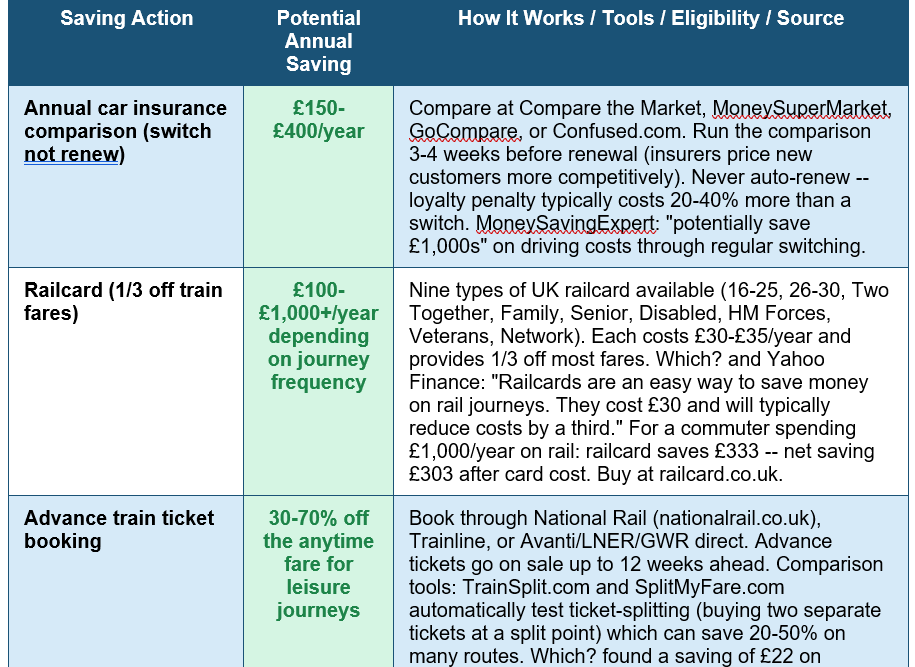
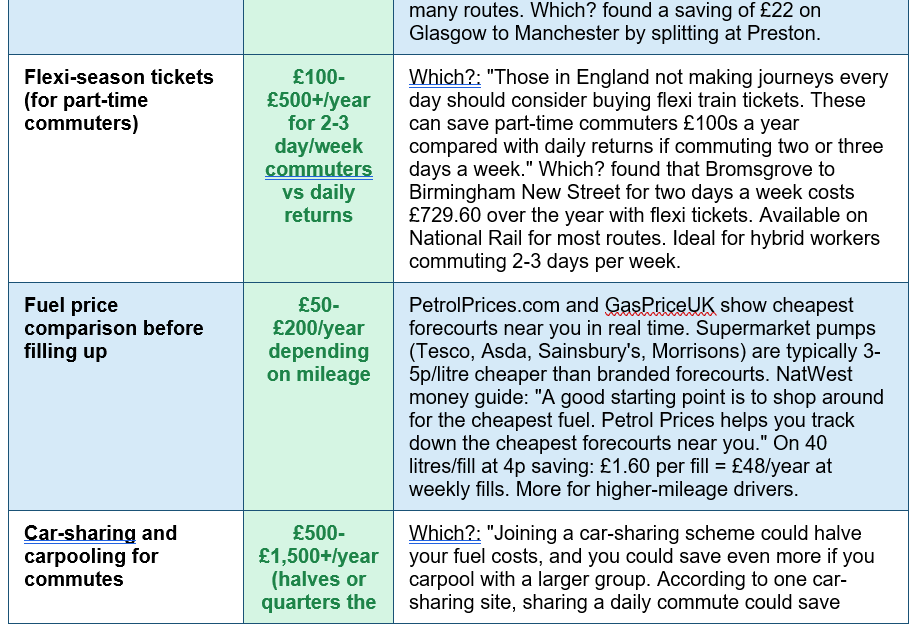
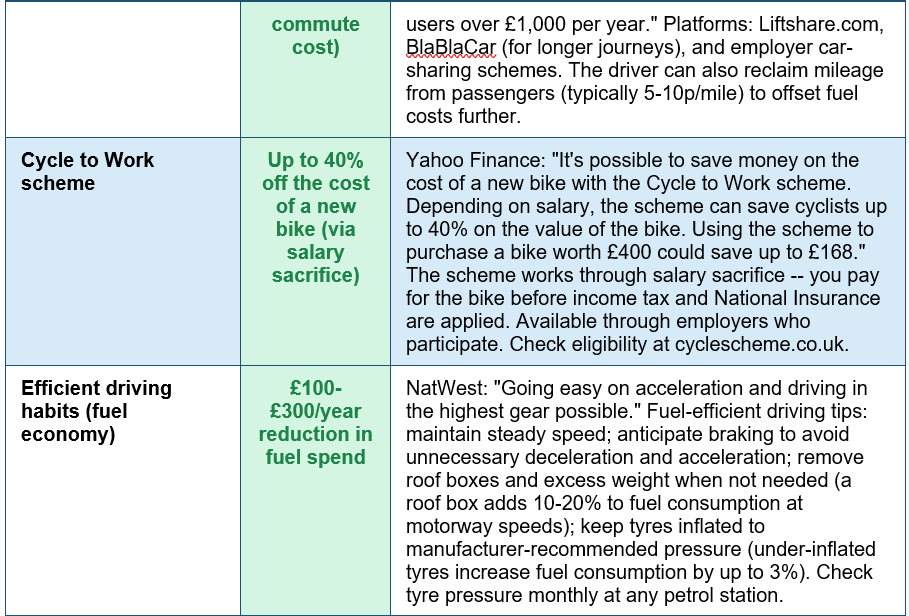
The following table maps the eight highest-impact transport saving actions to realistic annual saving estimates with specific tools and sources:Category Deep Dives: The Detail Behind Each Saving
1 CAR INSURANCE -- YOUR BIGGEST ANNUAL QUICK WIN | Save: £150-£400 from a 20-minute comparison
Car insurance is the single largest controllable annual cost for most UK drivers, and it is also the most consistently over-paid. The loyalty penalty -- the systematic overcharging of auto-renewing customers compared to new customers -- was partially addressed by FCA rules introduced in 2022, but the gap between the best available rate and the auto-renewal rate remains significant. MovingToTheUK.co.uk (May 2026): average UK car insurance premium is £559 per the ABI (Association of British Insurers). This is the average -- young drivers and those in high-risk postcodes pay far more. The FCA 2022 rules require insurers to offer the same rate to new and renewing customers for the same policy. In practice, switching to a new insurer still consistently produces better rates than staying with the same provider. The strategy: run a full comparison at Compare the Market, MoneySuperMarket, GoCompare, and Confused.com three to four weeks before your renewal date (not on the renewal date, when insurers know you have no time to shop). Then check your own insurer's website directly for their new-customer quote. If it is lower than your renewal offer, call them and ask them to match it. MoneySavingExpert recommends also checking directly with Aviva, Direct Line, and NFU Mutual (not always on comparison sites) for a complete market picture. Adding a named second driver (parent or partner with a clean record) can reduce young driver premiums. Installing a telematics or black box policy can reduce premiums for safe drivers. Annual review: set a calendar reminder 4 weeks before renewal every year. Never let it auto-renew without checking.TOP TIP: Go to comparethemarket.com, moneysupermarket.com, and gocompare.com 3-4 weeks before your renewal date. Run the full comparison. If you find a better rate, call your current insurer and ask them to match it. If they won't: switch. The average saving from switching rather than auto-renewing is £150-£400 for most drivers.
2 TRAIN TRAVEL -- RAILCARDS, ADVANCE BOOKING, AND SPLITTING | Save: 1/3 off with a £30 railcard. 50-70% off with advance booking.
The rail fare freeze for 2026 is the best news for UK train users in a decade. But even with frozen fares, the difference between a well-bought train ticket and a poorly-bought one can be hundreds of pounds. Railcards: there are nine types of railcard available in 2026, each costing £30-£35 per year and giving 1/3 off most fares. The 16-25 Railcard and 26-30 Railcard cover younger travellers. The Two Together Railcard (£30/year) gives 1/3 off for two named adults travelling together. The Family and Friends Railcard covers up to four adults and four children. The Senior Railcard covers those aged 60+. For any regular rail user: the railcard pays for itself in 2-3 journeys. Buy at railcard.co.uk. Advance tickets: for leisure journeys, booking 8-12 weeks ahead unlocks Advance fares that can be 50-70% cheaper than the Anytime fare. Advance tickets are fixed to a specific train. They are not refundable but can be changed (for a fee). Book via nationalrail.co.uk or direct with the operator to avoid Trainline's booking fee of up to £1.99 per booking. Ticket splitting: the technique of buying two separate tickets for a journey (e.g., London to Edinburgh bought as London to Newcastle plus Newcastle to Edinburgh) often produces significant savings. TrainSplit.com and SplitMyFare.com automate this calculation. Which? found a saving of £22 on a Glasgow to Manchester journey by splitting at Preston. Flexi season tickets: for hybrid workers commuting 2-3 days per week rather than 5, the flexi season ticket avoids paying for travel on non-commuting days.TOP TIP: If you are under 60: buy the railcard that matches your demographic today at railcard.co.uk (£30, pays back in 2-3 journeys). For your next leisure train journey: check TrainSplit.com first, then nationalrail.co.uk for advance fares. Book directly with the operator (not Trainline) to avoid the booking fee.
3 FUEL -- SUPERMARKET PUMPS, DRIVING HABITS, AND ROUTE PLANNING | Save: 3-5p/litre cheaper at supermarkets. Up to 25% saving from efficient driving habits.
Petrol prices rose sharply in early 2026 following geopolitical disruption, with Brumble (3 weeks ago) reporting 157p/litre for petrol and approximately 190p/litre for diesel in April 2026. Prices have been falling back but remain above late-2025 levels. The three-part fuel saving strategy: (1) Where you fill up: Supermarket forecourts (Tesco, Asda, Sainsbury's, Morrisons) are consistently 3-5p/litre cheaper than branded forecourts and typically 10-15p/litre cheaper than motorway services. PetrolPrices.com shows real-time cheapest prices near your location. Plan long journeys to fill up before the motorway, not on it. (2) How much you fill: keep the tank above a quarter full -- running low forces you to fill wherever is nearest, often the most expensive option. (3) How you drive: NatWest and fuel efficiency research consistently show that gentle acceleration, anticipating stops to avoid unnecessary braking and acceleration, and maintaining appropriate tyre pressure can reduce fuel consumption by 10-25%. Removing a roof box or bike rack when not in use reduces drag and fuel consumption by 5-10% at motorway speeds. These habits are the ones that make the biggest consistent fuel cost difference -- not the occasional supermarket fill-up.TOP TIP: Download PetrolPrices.com (or check the app) before any fill-up. Fill at a supermarket forecourt rather than a motorway service station. Check tyre pressures monthly -- under-inflated tyres add up to 3% to fuel consumption. Remove roof boxes and excess weight when not in use.
4 BUS AND PUBLIC TRANSPORT -- THE £3 CAP AND LOCAL CONCESSIONS | Save: £3 cap per journey in England outside London until March 2027
The £3 bus fare cap on single journeys in England outside London, extended to March 2027 by Chancellor Rachel Reeves in June 2025, is one of the most direct cost-of-living interventions for regular bus users. MovingToTheUK (May 2026): routes that previously charged £4-5 per single journey are now capped at £3, representing approximately 30-40% savings on affected routes. In London: the single bus fare remains £1.75, frozen until at least July 2026. The daily cap applies (once you have paid for two bus journeys in London, subsequent journeys are free for the day using a contactless card or Oyster). Beyond the fare cap: free bus passes are available to everyone in England aged 66 or over (state pension age) and to those with qualifying disabilities. In Scotland: the under-22 free bus travel scheme allows anyone under 22 to travel free on most bus services. In Wales: the 60+ free bus travel pass applies. Employer schemes: some employers provide subsidised bus passes as a salary sacrifice benefit -- worth checking with HR. For regular bus commuters: monthly or annual bus passes are significantly cheaper than daily singles on most operators. Check with your local operator.TOP TIP: Check the gov.uk bus pass eligibility page if you are 66+ or have a qualifying disability -- a free bus pass in England replaces a significant transport cost. If under 22 in Scotland, apply for the free bus travel scheme at mygov.scot. For regular bus commuters: ask your operator about weekly, monthly, or annual passes -- typically 20-30% cheaper than daily singles.
5 CYCLING AND WALKING -- THE CYCLE TO WORK SCHEME | Save: Up to 40% off a new bike for eligible employees. Zero ongoing fuel or fare cost.
For journeys under 5-10 miles, cycling is the transport option that removes the fuel and fare cost entirely. The Cycle to Work scheme makes the transition more affordable. Yahoo Finance (citing Which?): 'It's possible to save money on the cost of a new bike with the Cycle to Work scheme. Depending on salary, the scheme can save cyclists up to 40% on the value of the bike. Using the scheme to purchase a bike worth £400 could save up to £168.' The scheme works through employer salary sacrifice -- the bike and cycling equipment are purchased from your pre-tax pay over 12-18 months, saving income tax and National Insurance on the purchase cost. A basic rate taxpayer saves 32% (20% income tax + 12% NI). A higher rate taxpayer saves 42% (40% + 12%). The scheme includes helmets, locks, panniers, and cycling clothing up to the approved value. Check employer participation at cyclescheme.co.uk. Beyond the purchase: cycling eliminates ongoing fuel and fare costs entirely. A commuter switching from a 5-mile daily car commute to cycling could save £500-£1,500 per year in fuel, parking, and wear costs. Walking: for journeys under 2 miles, walking eliminates the transport cost entirely and adds physical activity benefits. The real barrier is weather and carrying capacity -- both addressable with the right kit, some of which qualifies under the Cycle to Work scheme.TOP TIP: Check with your HR department whether your employer participates in a Cycle to Work scheme (cyclescheme.co.uk or the employer's own scheme). Calculate the tax savings on a bike at your income level. If cycling is realistic for even 2-3 days of your weekly commute, the fuel and parking saving over a year typically exceeds £500. Electric bikes (e-bikes) now qualify for the scheme and make longer cycling commutes practical.
6 CAR-SHARING AND PARK-AND-RIDE -- HALVING THE COST OF DRIVING | Save: £500-£1,500/year from sharing a daily commute. Park-and-ride saves city centre parking.
Car-sharing for commuting is the most under-used transport saving in the UK. Which?: 'Joining a car-sharing scheme could halve your fuel costs, and you could save even more if you carpool with a larger group. According to one car-sharing site, sharing a daily commute could save users over £1,000 per year.' The mechanism: when two people share a journey, each pays approximately half the fuel cost. When four people share, each pays a quarter. The driver also saves on parking in many cases (sharing the cost with passengers). Platforms: Liftshare.com (UK's largest car-sharing network, free to use); BlaBlaCar (more for longer journeys); and many employers and universities operate their own internal car-sharing schemes. Drivers can claim the HMRC-approved mileage rate (45p per mile for the first 10,000 miles, 25p thereafter) from employers or can charge passengers a proportional contribution. Park-and-ride: for urban journeys where city centre parking is expensive (£10-£20 per day), parking at a suburban park-and-ride site (typically free or £1-3 per day) and taking the bus or tram into the centre saves significant money. Most major UK cities operate park-and-ride schemes.TOP TIP: Register on Liftshare.com today (free) to find colleagues or neighbours who share your commute route. For city centre journeys: check your local authority's park-and-ride website before paying for city centre parking. Park-and-ride is consistently cheaper than urban parking and often faster in peak hours.
The biggest transport saving most people miss: the true cost of car ownership. Brumble (3 weeks ago, most current motoring data) and MovingToTheUK.co.uk (May 2026) both use NimbleFins data to estimate the average UK driver's annual motoring cost at £3,484/year -- not including the purchase, finance, or depreciation of the vehicle itself. When depreciation is included, the true annual cost of a typical UK car rises to £5,000-£8,000 for many drivers. The comparison question that most households never ask: could I cover my journey needs with a combination of bus, train, cycling, and occasional car hire for the same or lower total cost as owning a car? In cities with good public transport (London, Manchester, Edinburgh, Bristol), the answer is often yes -- particularly for households with only one car or whose second car is primarily used for leisure. Costofthings.co.uk (March 2026): 'The average transport costs in the UK per month range from £100 to £300 depending on whether you drive, commute, or use public transport.' The low end of that range -- £100-£150/month -- is entirely achievable for urban households relying on the £3 bus cap, the frozen rail fares, and occasional cycling. The high end (£250-£300+/month) describes the typical car-owning commuter. The gap between these two positions represents £1,200-£2,400/year in household savings.
FIVE TRANSPORT COST MISTAKES THAT COST UK HOUSEHOLDS HUNDREDS PER YEAR: (1) AUTO-RENEWING CAR INSURANCE WITHOUT COMPARING. The loyalty penalty means most auto-renewals cost 20-40% more than a comparable policy from a new insurer. Set a calendar reminder 4 weeks before renewal. Never renew without checking at least Compare the Market and MoneySuperMarket. Cost of mistake: £150-£400/year. (2) BUYING TRAIN TICKETS ON THE DAY OR AT THE STATION. Same-day and on-the-day tickets are typically 50-100% more expensive than advance fares booked online. For any leisure rail journey, check advance availability 8-12 weeks ahead. Use TrainSplit.com to test ticket splitting before booking. Cost of mistake: £100-£500+/year for regular travellers. (3) NOT HAVING A RAILCARD IF YOU TAKE MORE THAN 3 TRAIN JOURNEYS PER YEAR. A £30 railcard pays for itself in 2-3 journeys for most users. Nine types are available to cover virtually every demographic. There is no reason not to have one if you travel by train more than occasionally. Cost of mistake: £80-£500+/year depending on journey frequency. (4) FILLING UP AT MOTORWAY SERVICES. Motorway service station fuel typically costs 15-25p/litre more than supermarket forecourts. On a 50-litre fill, this is £7.50-£12.50 per fill-up. Plan journeys to fill up before joining the motorway or at the next supermarket junction. Annual cost of this habit: £100-£300 for motorway-heavy drivers. (5) IGNORING THE CYCLE TO WORK SCHEME IF YOUR EMPLOYER OFFERS IT. A £1,000 e-bike purchased through salary sacrifice saves a basic rate taxpayer £320 in tax and NI. The bike then eliminates fuel costs on routes it covers. Most employees who qualify never check whether their employer participates.
YOUR TRANSPORT SAVING QUICK-WIN LIST -- ACTIONS FOR THIS WEEK: (1) CAR INSURANCE: Set a calendar reminder 4 weeks before your renewal date. On that date: compare at comparethemarket.com and moneysupermarket.com. Switch or negotiate. (2) RAILCARD: If you take any train journeys: buy the railcard that matches your age or circumstances today at railcard.co.uk (£30, 1/3 off most fares, pays back in 2-3 journeys). (3) FUEL APP: Download PetrolPrices.com. Before your next fill-up: check the cheapest forecourt within 1-2 miles. Target supermarket pumps. (4) BUS PASS ELIGIBILITY: If you are 66+, have a qualifying disability, or are under 22 in Scotland -- check your eligibility for a free or discounted bus pass. (5) NEXT LEISURE TRAIN JOURNEY: Check TrainSplit.com before booking any train ticket. Book directly with the operator (not Trainline) to avoid the booking fee. Choose an advance fare if the date is flexible. (6) CYCLE TO WORK: Email your HR department today and ask whether your employer participates in a Cycle to Work scheme. If yes: the scheme is available for bikes and cycling equipment up to the approved limit with 32-42% tax saving. FREE RESOURCES: MoneyHelper transport costs guidance moneyhelper.org.uk | MoneySavingExpert transport hub moneysavingexpert.com/transport | National Rail nationalrail.co.uk | Railcard railcard.co.uk | PetrolPrices petrolprices.com.
YOUR ANNUAL TRANSPORT SAVINGS AUDIT -- COMPLETE IN 30 MINUTES: STEP 1 -- CALCULATE WHAT YOU ARE SPENDING: Add up your monthly transport spend: car insurance (monthly or annual premium ÷ 12), fuel (estimate from bank statement), VED (£200 for most cars ÷ 12 = £16.67/month), train/bus season tickets or regular fares, parking, and any other transport costs. Total it. Compare to the £100-£300/month national average range. STEP 2 -- IDENTIFY YOUR SINGLE BIGGEST COST: For most car owners, this is insurance or fuel. For regular commuters, it may be a season ticket. For occasional travellers, it may be one-off expensive journeys. Focus saving efforts on the largest cost first. STEP 3 -- CAR INSURANCE ACTION: When does your insurance renew? Set a calendar reminder for 4 weeks before. On that date: comparethemarket.com and moneysupermarket.com. Switch or negotiate. STEP 4 -- TRAIN TICKET AUDIT: Do you have a railcard? If eligible and not yet obtained: railcard.co.uk. £30. Done in 10 minutes online. Do you always book in advance for leisure journeys? If not: set the habit. STEP 5 -- FUEL AUDIT: What was your last fuel cost? Where did you fill up? Was it the cheapest local option? Download PetrolPrices.com. STEP 6 -- CONSIDER THE ALTERNATIVES: For at least one regular journey, could bus, cycling, or car-sharing reduce the cost? The £3 bus cap makes bus competitive with driving for many short journeys in England. TOTAL POTENTIAL SAVING FROM ALL STEPS: £500-£2,000/year depending on your starting position and how many changes you make.
Conclusion
The average UK driver spends £3,484 per year -- £290 per month -- running a car, according to MovingToTheUK.co.uk (May 2026) analysis of NimbleFins, ONS, and SMMT data. That figure is the average for people who have not applied the strategies in this guide. Car insurance comparison alone typically saves £150-£400. A railcard saves £100-£500+ per year for regular train users. Advance booking saves 50-70% on leisure rail journeys. The £3 bus cap in England has cut the cost of bus travel by up to 40%. The Cycle to Work scheme makes bikes up to 40% cheaper. Car-sharing can halve a commuting fuel bill.The combined saving from applying the strategies most relevant to your situation -- which varies by car ownership, commute type, and journey frequency -- can realistically reach £500-£2,000 per year. That is the difference between the average household's actual transport spending and the minimum achievable with consistent application of the tips in this guide. The 2026 context makes the moment particularly good: the first rail fare freeze in 30 years, the extended bus cap, and insurance comparison tools that are more comprehensive than ever.
Start with the single highest-impact action for your situation: car insurance comparison, railcard purchase, or fuel price checking. Each of these takes less than 30 minutes and saves money immediately. The longer-term changes -- cycling to work, car-sharing, or reconsidering car ownership entirely -- take more planning but produce proportionally larger savings. MoneySavingExpert (moneysavingexpert.com/transport): 'We've got 50+ quick tips to cut driving costs, potentially saving £1,000s.' Start with one. Then the next. The savings accumulate.
Frequently Asked Questions (FAQ)
How much does it cost to run a car in the UK in 2026?MovingToTheUK.co.uk (May 9, 2026 -- most current): 'The average UK driver spends approximately £3,484 per year running a car, or around £290 per month, according to NimbleFins analysis based on ONS and SMMT data.' This figure covers fuel (£1,500-£2,500 depending on mileage and car efficiency), insurance (£559 average per the ABI), Vehicle Excise Duty (£200 standard rate from April 2026), MOT (maximum £54.85), servicing, tyres, and depreciation. It does not include the purchase cost or finance payments on the vehicle itself. Brumble (3 weeks ago -- most current motoring data): petrol prices in April 2026 are approximately 157p per litre, with diesel at approximately 190p per litre, following a price spike in February 2026 due to geopolitical disruption. A driver covering 7,100 miles per year in a car achieving 40 mpg would spend approximately £1,267 on petrol annually. Drivers in high-premium postcodes (certain urban areas, high-crime postcodes) or with newer or higher-value vehicles often spend £5,000-£8,000 per year in total running costs. Costofthings.co.uk (March 2026): 'The average transport costs in the UK per month range from £100 to £300, depending on whether you drive, commute, or use public transport.' The lower end of this range applies to public transport users; the higher end to car-owning commuters.
Are rail fares going up in 2026?
No -- rail fares in England are frozen for 2026 in a historically significant decision. The UK government announcement (October 2025): 'For the first time in 30 years, rail fares in England will remain the same in 2026. Regulated fares, including season tickets and off-peak returns, will remain frozen until March 2027.' This means that commuters who hold annual season tickets will see no increase in 2026, whereas in a typical year regulated fares rise by a percentage linked to the prior July's RPI inflation figure. In recent years, this has produced increases of 3.8% (2023) and similar amounts in prior years. Commuters could save more than £300 per year on some of the priciest routes compared to what a typical fare increase would have cost. The freeze applies to regulated fares in England -- typically those with a fare cap set by the government, including most season tickets and many off-peak return fares. Unregulated fares (typically Advance and Open Return tickets on long-distance routes set by the operators themselves) are not subject to the freeze and may still vary. In Scotland and Wales, rail fares are devolved and their own pricing decisions apply. For 2026: the frozen regulated fares mean that now is an especially good time to buy or renew a season ticket, and that the fare comparison tools remain particularly valuable for unregulated Advance fares.
What is the £3 bus fare cap and does it apply to me?
The £3 bus fare cap is a UK government scheme that limits single bus journeys on most local bus routes in England outside London to a maximum of £3 per single fare. MovingToTheUK.co.uk (May 9, 2026): 'The £3 bus fare cap is a UK government scheme that limits single bus fares to £3 on most local routes in England outside London. It was extended by Chancellor Rachel Reeves in June 2025 to run until March 2027.' The cap applies to: passengers on most local bus routes in England outside London. On routes where the fare was previously above £3, the cap represents a saving of approximately 30-40% per journey. The cap does not apply to: London (which has its own separate fare system, with a single bus fare of £1.75 frozen until at least July 2026); Scotland (which has its own bus concession schemes, including the free under-22 travel scheme and free travel for those over 60); Wales (which has its own separate bus concession arrangements). In practical terms: if you travel regularly by bus in England outside London, you are already benefiting from the cap if fares on your route were previously above £3. The cap removes the need to calculate exact fares -- any local English bus journey (outside London) will not cost more than £3 for a single. For those who travel frequently: monthly or annual bus passes from your local operator are typically more cost-effective than paying individual capped fares for high-frequency journeys.
How do I save money on car insurance in the UK?
The single most effective way to save on UK car insurance is to compare prices annually rather than auto-renewing. The FCA's 2022 pricing reform requires insurers to offer the same rate to renewing customers as to new customers for the same policy -- but switching to a different insurer still consistently produces savings. The proven approach: run a comparison 3-4 weeks before your renewal date (not on the renewal date, when you are under time pressure) using Compare the Market, MoneySuperMarket, GoCompare, and Confused.com. Also check insurers not always on the comparison sites directly: Aviva, Direct Line, and NFU Mutual. If a lower price is found: call your current insurer and ask them to match it. If they do not: switch. MovingToTheUK (May 2026): average UK car insurance premium is £559 per the ABI. Additional factors that reduce premiums: keeping the car in a garage overnight (lower theft risk); increasing the voluntary excess (the amount you pay first in any claim); adding an experienced named driver to the policy; installing a telematics or black box device (particularly effective for young drivers); paying annually rather than monthly (monthly payment adds approximately 20-30% APR interest). Young drivers (under 25) pay the highest premiums -- often £1,500-£3,000+ per year -- and benefit most from telematics policies, named driver arrangements, and the highest mileage accuracy in their comparison (overestimating mileage increases premiums; underestimating is insurance fraud and invalidates the policy).
What is the Cycle to Work scheme and how much can I save?
The Cycle to Work scheme is a government-backed salary sacrifice arrangement that allows employees to purchase a bike and cycling equipment using pre-tax earnings, saving income tax and National Insurance on the purchase cost. Yahoo Finance (citing Which?): 'The Cycle to Work scheme can save cyclists up to 40% on the value of the bike. Using the scheme to purchase a bike worth £400 could save up to £168.' The precise saving depends on your income tax rate: a basic rate taxpayer (20% income tax + 12% National Insurance) saves 32% of the purchase cost. A higher rate taxpayer (40% income tax + 12% NI in the relevant band) saves 52% on the qualifying portion. Example: a £1,000 e-bike purchased through the scheme by a basic rate taxpayer costs the employee approximately £680 after tax and NI savings -- a saving of £320. The scheme covers: bicycles of all types (road, mountain, hybrid, folding, and e-bikes up to 15.5 mph), helmets, locks, lights, panniers, waterproof clothing, and other safety equipment up to the approved scheme limit (typically £3,000 for most schemes, though some are higher). The scheme is available to employees of participating employers -- check with your HR department or at cyclescheme.co.uk. Not all employers participate. Self-employed individuals cannot use the employer scheme but may be able to claim cycling equipment as a business expense. Beyond the purchase saving: cycling eliminates ongoing fuel, parking, and transport fare costs on routes it covers. A commuter switching from a 5-mile daily car commute to cycling could save £500-£1,000 per year in fuel and parking costs, in addition to the purchase saving.

0 Comments Comments