
Savings
Emergency Savings Shortfall: A Danger for Working Families

43% of Americans can’t cover a $1,000 emergency from savings. The median emergency fund has been cut in half in one year. Suze Orman and every data source agree: the danger signs are flashing. Here is what the research shows — and what to do about it.

It is not an overstatement. The convergence of findings from the Federal Reserve, Bankrate, U.S. News, Investopedia, the National Endowment for Financial Education, and multiple independent surveys in 2025 and 2026 paint a consistent picture of a working-family emergency savings crisis that is not improving. The median emergency fund has halved in a single year. The share of Americans who cannot cover a $1,000 emergency has ticked up again. The rate of 401(k) hardship withdrawals is three times the pre-pandemic level. Credit card debt now exceeds emergency savings for nearly three in ten Americans.
This article examines what the 2026 research reveals, who is most at risk, why the problem is structural rather than behavioural, and what working families can do right now to begin reversing the shortfall — even in a tight budget environment.
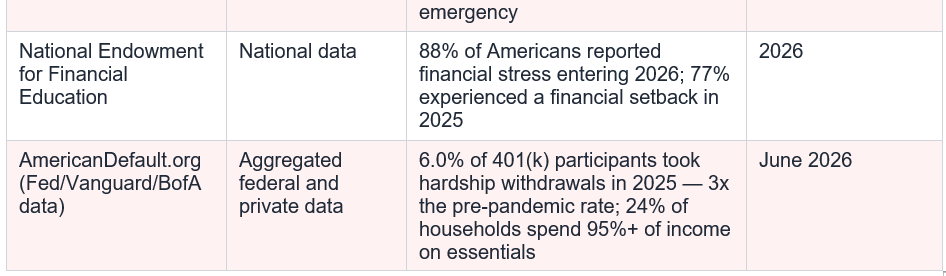
The Data: 43% of Americans cannot cover a $1,000 emergency from savings (U.S. News, January 2026). The median emergency fund fell from $10,000 to $5,000 in one year. 88% of Americans report financial stress entering 2026 (National Endowment for Financial Education). Workers without emergency savings are 13 times more likely to take a 401(k) hardship withdrawal.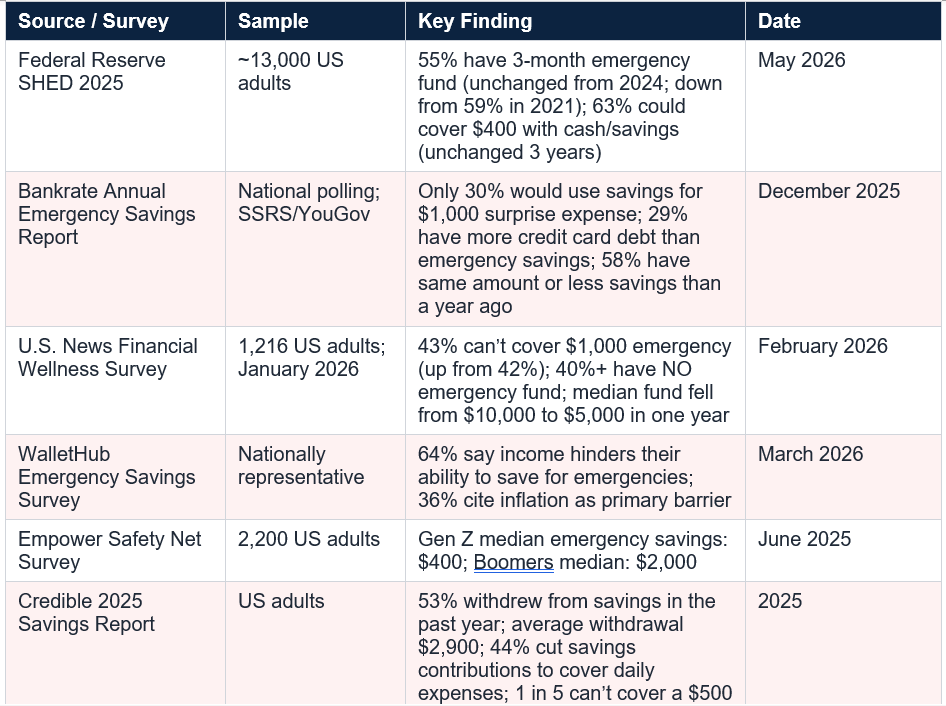
The cascade looks like this: a $500 car repair arrives. The family has no emergency fund. They cover it with a credit card. The credit card carries a 21 percent APR. The balance grows while minimum payments eat the cash flow that might have gone toward savings. The next month’s cash flow is tighter. The $500 repair has created a $600 problem, then a $700 problem. Meanwhile, the retirement contribution is paused — or the 401(k) hardship withdrawal is filed, which adds taxes and penalties on top of the principal lost to compounding.
Suze Orman (CNBC, August 22, 2026): A new survey shows even a $500 unexpected expense may throw households off track when it comes to big life goals like saving for retirement. This emergency savings shortfall signals ‘danger’ for working households.
The CNBC survey also noted that 6.0 percent of 401(k) plan participants took hardship withdrawals in 2025 — three times the pre-pandemic rate, according to AmericanDefault.org’s analysis of data from the Federal Reserve, Vanguard, and Bank of America. This is the mechanical confirmation of Orman’s danger signal: when emergency funds are depleted or absent, retirement savings become the de facto emergency fund, with all the associated costs.
Danger Signal: Workers without emergency savings are 13 times more likely to take a hardship withdrawal from their 401(k) than those with adequate emergency funds (Fortunly 2026). A 10% early withdrawal penalty plus income tax on the withdrawal can cost 30–40% of the withdrawn amount in combined penalties and taxes.
A halving of the median emergency fund balance in twelve months is not explained by people failing to save. It is explained primarily by people actively depleting their funds. Credible’s 2025 Savings Report found that 53 percent of Americans withdrew money from savings in the past year, with the average withdrawal totalling $2,900. The reasons:
The Data: Median emergency fund balance: $10,000 in 2025 → $5,000 in 2026 (U.S. News, February 2026). 53% of Americans withdrew from savings in the past year; average withdrawal $2,900 (Credible 2025). 44% cut back on savings contributions to keep up with daily expenses (Credible).
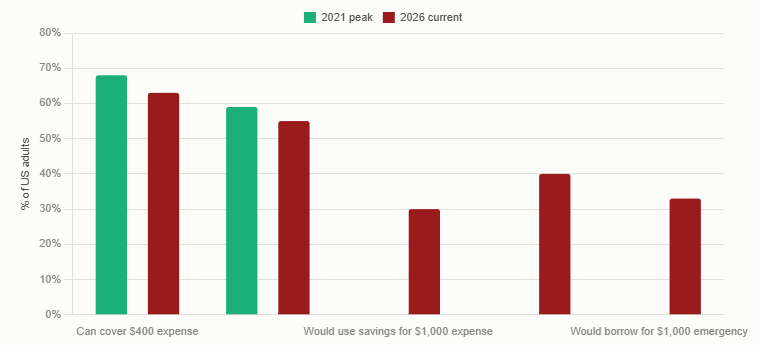
That 37 percent figure has been essentially unchanged for three consecutive years. It compares to a high of 68 percent who could cover $400 in 2021 — meaning the share of Americans financially capable of absorbing a $400 expense has declined by 5 percentage points since the post-pandemic peak and has not recovered. The Fed data also shows that 55 percent of adults have set aside money for three months of expenses in an emergency or ‘rainy day’ fund, unchanged from 2024 and down from 59 percent in 2021.
The granularity within the Fed data is particularly sobering. Among adults who could not cover a $400 expense using savings:
This is the concretisation of the danger signal that Suze Orman described. A 401(k) hardship withdrawal is costly in multiple ways simultaneously: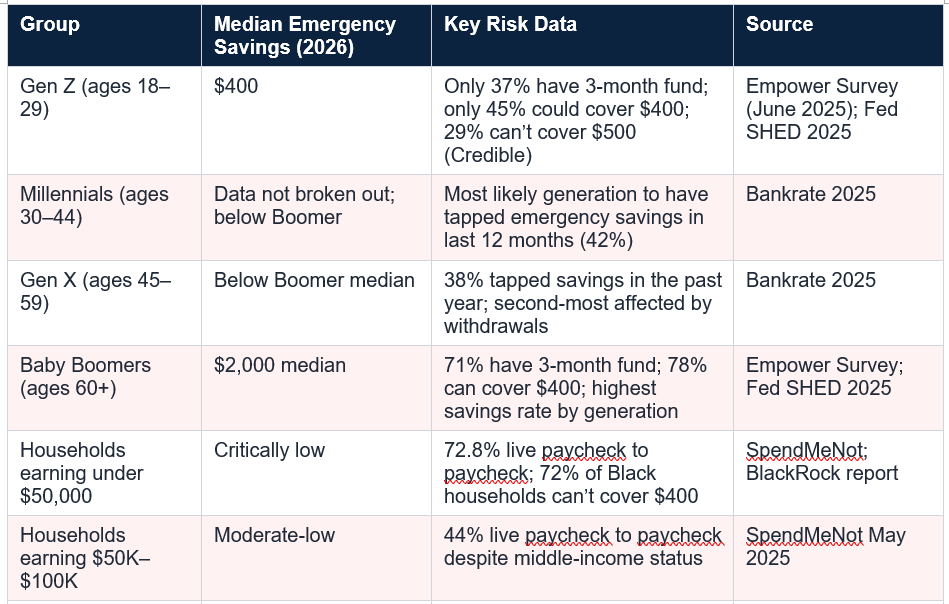

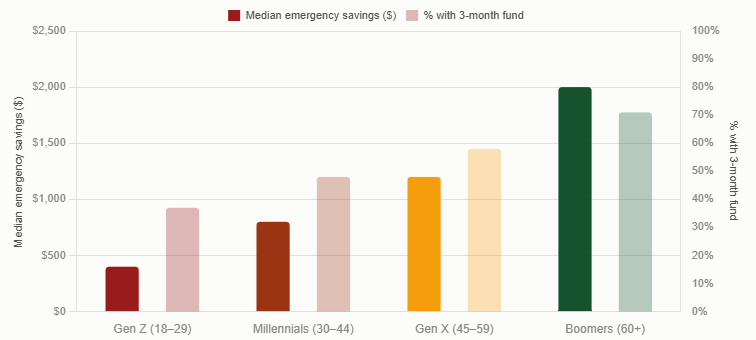
The generational data from Empower’s Safety Net Survey and the Federal Reserve SHED shows a stark divide: Gen Z with a median emergency savings balance of $400 versus Boomers with a median of $2,000. But the income data is equally significant. Even among households earning over $100,000 annually, nearly one-third are living paycheck to paycheck. The shortfall is not only a low-income phenomenon.
The 101Financial May 2026 analysis of the debt picture shows why this is structurally reinforcing the savings deficit. Total US credit card debt reached $1.28 trillion in Q4 2025, up 5.5 percent annually. The average cardholder carrying a balance now owes $7,886. With the average credit card APR at 21 percent in Q1 2026, that balance is generating approximately $1,655 in annual interest charges. That is $1,655 per year that could be going into an emergency fund but is instead going to a credit card company.
The spiral is self-reinforcing: the absence of an emergency fund forces the use of a credit card for unexpected expenses, the credit card balance accrues interest, the interest cost reduces the monthly cash available for savings, the reduced savings makes the household more vulnerable to the next expense, and the cycle continues. ECIKS’ May 2026 analysis describes it precisely: the crisis of inadequate emergency savings reflects a systemic disconnection between American household income and the real cost of living.
The Data: 29% of Americans have more credit card debt than emergency savings (Bankrate 2026). Total US credit card debt: $1.28 trillion in Q4 2025 (101Financial). Average balance on revolving debt: $7,886, generating ~$1,655/year in interest at 21% APR. 33% would need to borrow to handle a $1,000 emergency (Fortunly 2026).
The structural causes, identified across multiple 2026 research sources:
For households just beginning to build an emergency fund, the standard guidance is to start with a $1,000 initial target — enough to absorb the most common small financial shocks without resorting to debt — and then build toward the full three-to-six month target from there. The median target reported by U.S. News survey respondents is a more modest $10,000 in desired emergency savings, which is still twice the current median balance of $5,000.
The disparity is not only about income levels. As SpendMeNot’s analysis notes, Black Americans are more likely to be unbanked, denied credit, and pressured to tap into retirement savings early due to persistent financial stress. These structural barriers compound the income-level disparities, creating a gap in emergency savings that is significantly wider than the income gap alone would predict.
For military families, the Military Family Advisory Network’s 2025 survey (released June 2026, with more than 10,000 respondents) found that more than 34 percent of actively serving families reported less than $500 in emergency savings. For veterans and military retirees, the figure was slightly higher at 37 percent. These findings exist within a survey period that coincided with a federal government shutdown and emergency response activities, which may have exacerbated financial strain.
Post-pandemic excess savings, which provided a buffer for many households in 2021 and 2022, have been almost entirely depleted. The Federal Reserve’s inflation-fighting interest rate hikes made carrying debt more expensive. Tariff-driven cost increases are adding hundreds to thousands of dollars of annual household costs. The result is a financial squeeze that 101Financial describes as ‘getting tighter every quarter.’
The 78 percent of respondents who told the ECIKS survey they believed inflation would continue to negatively impact their finances in 2026 are not being pessimistic without evidence. They are responding to a structural tightening that the macroeconomic data confirms and that the savings data measures directly.
Suze Orman is right to use the word ‘danger.’ An emergency savings shortfall is not a minor inconvenience — it is a structural vulnerability that converts ordinary life events (car repairs, medical bills, a month of reduced hours) into financial crises that can take months or years to recover from. For working families already managing thin margins between income and essential expenses, the absence of an emergency fund is the missing firebreak that allows a small financial fire to become a catastrophic one.
The shortfall is the warning. The savings is the response. Not the retirement contribution, not the investment account, not the student loan extra payment — the emergency fund. It is the first financial safety net, the one that protects everything else, and the one that the 2026 data shows is most urgently missing for the working families who need it most.
More than 40% of Americans say they have no emergency fund at all, according to the U.S. News 2026 Financial Wellness Survey (n=1,216 adults, January 2026). One-third say they could not cover even one month of living expenses with their savings. The Federal Reserve’s 2025 SHED survey (n=~13,000, published May 2026) found that 55% have set aside money for three months of expenses — meaning 45% have not. The 37% who could not cover a $400 unexpected expense with cash or savings is a figure that has been essentially unchanged for three consecutive years after improving to 32% in 2021.
Why is the emergency savings shortfall dangerous for working families?
Suze Orman, responding to SecureSave survey data published by CNBC on August 22, 2026, described the emergency savings shortfall as a ‘danger’ signal for working households because even a $500 unexpected expense can throw families off track on big life goals like retirement savings. Workers without emergency savings are 13 times more likely to take a hardship withdrawal from their 401(k) (Fortunly 2026). A 401(k) hardship withdrawal typically costs 30–40% in combined early withdrawal penalties and income taxes, and permanently removes the withdrawn amount from compounding. The compound effect of using retirement savings for emergencies can cost hundreds of thousands of dollars in retirement wealth.
What happened to the median emergency fund balance in 2026?
The median emergency fund balance reported by U.S. News’ 2026 Financial Wellness Survey respondents fell from $10,000 in 2025 to $5,000 in 2026 — a 50% decline in one year. This collapse was driven primarily by withdrawals: Credible’s 2025 savings report found that 53% of Americans withdrew from their savings in the past year, with an average withdrawal of $2,900. The most common reasons were unplanned emergency expenses (51%), covering monthly bills (38%), and food or daily necessities (32%).
How much should I have in an emergency fund?
Financial experts generally recommend three to six months of essential living expenses. Investopedia’s 2025 analysis put the cost of six months of emergency expenses for a typical American household at $35,218, up 5% from $33,000 in 2024. For those just starting, a $1,000 initial emergency fund is the most commonly recommended first milestone — enough to cover the most common small financial shocks without resorting to debt. The median desired emergency fund balance reported by U.S. News survey respondents was $10,000. The current median actual balance is $5,000.
Are there new tools available to build an emergency fund in 2026?
Yes. The SECURE 2.0 Act introduced pension-linked emergency savings accounts (PLESAs), which allow annual contributions of up to $2,600 in 2026, withdrawable without taxes or penalties. T. Rowe Price launched the first PLESAs in April 2025. Additionally, just 4% of 401(k) plans currently offer the $1,000 emergency 401(k) withdrawal provision allowed under SECURE 2.0, according to a Vanguard analysis cited by CNBC. High-yield savings accounts (HYSAs) currently offer up to 4.10% interest (U.S. News, August 2026) and represent the most accessible tool for building an emergency fund with returns that meaningfully outpace traditional savings accounts.
Which generation is most affected by the emergency savings shortfall?
Gen Z is the most severely affected, with a median emergency savings balance of just $400, according to Empower’s Safety Net Survey (June 2025, n=2,200). Only 37% of adults aged 18–29 have enough emergency savings to cover three months of expenses (Fed SHED 2025), and only 45% can cover a $400 unexpected expense. Millennials are the most likely generation to have tapped their emergency savings in the last 12 months (42%), followed by Gen X at 38% (Bankrate 2025). Boomers, by contrast, have a median emergency savings balance of $2,000 and 71% have a three-month emergency fund (Fed SHED 2025).
Emergency Coverage Rate
Savings By Generation
Table of Contents
- The $500 That Can Derail a Retirement
- The Core Data: What 2026’s Research Actually Shows
- Suze Orman’s Warning: Why This Is a ‘Danger’ Signal
- The 50% Collapse: How the Median Emergency Fund Halved in One Year
- The $400 Problem: Three Years Without Progress
- 401(k) Hardship Withdrawals Are Surging — And That Is a Red Flag
- Who Is Most at Risk: Emergency Savings by Generation and Income
- The Debt Trap: Credit Card Balances Exceeding Emergency Funds
- Why Working Families Are Falling Behind
- The Real Target: How Much Emergency Savings Do You Actually Need?
- The Racial and Income Gaps Are Getting Wider
- What the Personal Savings Rate Is Telling Us
- How to Start Building Your Emergency Fund Right Now
- Conclusion: The Shortfall Is the Warning. The Savings Is the Response.
- Frequently Asked Questions
The $500 That Can Derail a Retirement
A new survey published on August 22, 2026 brings the emergency savings crisis into sharp focus. According to data cited by CNBC from a SecureSave survey, even a $500 unexpected expense may throw households off track when it comes to big life goals like saving for retirement. Personal finance expert Suze Orman, commenting on the findings, used the word that the data demands: the emergency savings shortfall is a signal of ‘danger’ for working households.It is not an overstatement. The convergence of findings from the Federal Reserve, Bankrate, U.S. News, Investopedia, the National Endowment for Financial Education, and multiple independent surveys in 2025 and 2026 paint a consistent picture of a working-family emergency savings crisis that is not improving. The median emergency fund has halved in a single year. The share of Americans who cannot cover a $1,000 emergency has ticked up again. The rate of 401(k) hardship withdrawals is three times the pre-pandemic level. Credit card debt now exceeds emergency savings for nearly three in ten Americans.
This article examines what the 2026 research reveals, who is most at risk, why the problem is structural rather than behavioural, and what working families can do right now to begin reversing the shortfall — even in a tight budget environment.
The Data: 43% of Americans cannot cover a $1,000 emergency from savings (U.S. News, January 2026). The median emergency fund fell from $10,000 to $5,000 in one year. 88% of Americans report financial stress entering 2026 (National Endowment for Financial Education). Workers without emergency savings are 13 times more likely to take a 401(k) hardship withdrawal.
The Core Data: What 2026’s Research Actually Shows
Suze Orman’s Warning: Why This Is a ‘Danger’ Signal
Suze Orman, one of the most widely recognised personal finance voices in America, responded to the SecureSave survey data by describing the emergency savings shortfall as a signal of ‘danger’ for working households. The specific mechanism she highlighted is the cascading effect: when a family lacks an emergency fund, a single unexpected expense does not merely cause temporary financial discomfort. It triggers a sequence of decisions that can permanently damage long-term financial health.The cascade looks like this: a $500 car repair arrives. The family has no emergency fund. They cover it with a credit card. The credit card carries a 21 percent APR. The balance grows while minimum payments eat the cash flow that might have gone toward savings. The next month’s cash flow is tighter. The $500 repair has created a $600 problem, then a $700 problem. Meanwhile, the retirement contribution is paused — or the 401(k) hardship withdrawal is filed, which adds taxes and penalties on top of the principal lost to compounding.
Suze Orman (CNBC, August 22, 2026): A new survey shows even a $500 unexpected expense may throw households off track when it comes to big life goals like saving for retirement. This emergency savings shortfall signals ‘danger’ for working households.
The CNBC survey also noted that 6.0 percent of 401(k) plan participants took hardship withdrawals in 2025 — three times the pre-pandemic rate, according to AmericanDefault.org’s analysis of data from the Federal Reserve, Vanguard, and Bank of America. This is the mechanical confirmation of Orman’s danger signal: when emergency funds are depleted or absent, retirement savings become the de facto emergency fund, with all the associated costs.
Danger Signal: Workers without emergency savings are 13 times more likely to take a hardship withdrawal from their 401(k) than those with adequate emergency funds (Fortunly 2026). A 10% early withdrawal penalty plus income tax on the withdrawal can cost 30–40% of the withdrawn amount in combined penalties and taxes.
The 50% Collapse: How the Median Emergency Fund Halved in One Year
The most alarming single data point in U.S. News’ 2026 Financial Wellness Survey is not the percentage of Americans who lack an emergency fund — it is the speed and magnitude of the median balance decline. The median emergency fund balance reported by survey respondents fell from $10,000 in 2025 to $5,000 in 2026. That is a 50 percent reduction in the median reported balance in a single year.A halving of the median emergency fund balance in twelve months is not explained by people failing to save. It is explained primarily by people actively depleting their funds. Credible’s 2025 Savings Report found that 53 percent of Americans withdrew money from savings in the past year, with the average withdrawal totalling $2,900. The reasons:
- 51% of those who withdrew from savings did so for unplanned emergency expenses such as medical bills or car repairs.
- 38% used savings to cover monthly bills they could not otherwise afford.
- 32% withdrew savings to pay for food or other daily necessities.
- Only 19% of withdrawals were for non-essential or discretionary purposes.
The Data: Median emergency fund balance: $10,000 in 2025 → $5,000 in 2026 (U.S. News, February 2026). 53% of Americans withdrew from savings in the past year; average withdrawal $2,900 (Credible 2025). 44% cut back on savings contributions to keep up with daily expenses (Credible).
The $400 Problem: Three Years Without Progress
The Federal Reserve’s Survey of Household Economics and Decisionmaking (SHED) has asked the same question for over a decade: could you cover a $400 unexpected expense with cash, savings, or a credit card paid in full at the next statement? The 2025 SHED results, published in May 2026 from a sample of approximately 13,000 adults surveyed in October 2025, show that 63 percent of adults could do so — meaning 37 percent could not.That 37 percent figure has been essentially unchanged for three consecutive years. It compares to a high of 68 percent who could cover $400 in 2021 — meaning the share of Americans financially capable of absorbing a $400 expense has declined by 5 percentage points since the post-pandemic peak and has not recovered. The Fed data also shows that 55 percent of adults have set aside money for three months of expenses in an emergency or ‘rainy day’ fund, unchanged from 2024 and down from 59 percent in 2021.
The granularity within the Fed data is particularly sobering. Among adults who could not cover a $400 expense using savings:
- 18% said the maximum emergency expense they could handle from savings alone was under $100.
- 13% said they could handle $100 to $499.
- This means that 31% of all adults — nearly one in three — could not handle even a $500 emergency from their own savings. A single car tyre, a broken phone, or a 24-hour urgent care visit puts nearly one-third of the adult population into debt.
401(k) Hardship Withdrawals Are Surging — And That Is a Red Flag
When emergency funds are empty and credit is maxed, the next available source of cash for many working families is their retirement account. The data shows this is happening at an alarming rate. AmericanDefault.org’s June 2026 analysis of data from the Federal Reserve, Vanguard, and Bank of America found that 6.0 percent of 401(k) participants took hardship withdrawals in 2025 — three times the pre-pandemic rate.This is the concretisation of the danger signal that Suze Orman described. A 401(k) hardship withdrawal is costly in multiple ways simultaneously:
- The 10 percent early withdrawal penalty applies if the account holder is under 59½, immediately costing 10 percent of the withdrawn amount.
- Income tax on the withdrawal reduces it further — a combined tax-and-penalty burden of 30 to 40 percent is common for middle-income earners.
- The withdrawn amount is permanently removed from the compounding cycle. A $5,000 hardship withdrawal at age 35, invested at 7 percent average annual returns, would have grown to approximately $38,000 by age 65 in the account. The actual cost of the withdrawal is $38,000 in retirement wealth, not $5,000 in current dollars.
- Workers without emergency savings are 13 times more likely to take a hardship withdrawal, according to Fortunly’s 2026 emergency fund statistics. This is the multiplier effect of the savings shortfall: one missing financial safety net triggers a chain of decisions that destroys another.
Who Is Most at Risk: Emergency Savings by Generation and Income
The generational data from Empower’s Safety Net Survey and the Federal Reserve SHED shows a stark divide: Gen Z with a median emergency savings balance of $400 versus Boomers with a median of $2,000. But the income data is equally significant. Even among households earning over $100,000 annually, nearly one-third are living paycheck to paycheck. The shortfall is not only a low-income phenomenon.
The Debt Trap: Credit Card Balances Exceeding Emergency Funds
Perhaps the clearest indicator of the emergency savings crisis is the credit card versus savings comparison. Bankrate’s 2026 Annual Emergency Savings Report found that 29 percent of Americans have more credit card debt than emergency savings — compared to 44 percent who have more in savings than on credit cards. Nearly one in five (19 percent) have neither credit card debt nor savings.The 101Financial May 2026 analysis of the debt picture shows why this is structurally reinforcing the savings deficit. Total US credit card debt reached $1.28 trillion in Q4 2025, up 5.5 percent annually. The average cardholder carrying a balance now owes $7,886. With the average credit card APR at 21 percent in Q1 2026, that balance is generating approximately $1,655 in annual interest charges. That is $1,655 per year that could be going into an emergency fund but is instead going to a credit card company.
The spiral is self-reinforcing: the absence of an emergency fund forces the use of a credit card for unexpected expenses, the credit card balance accrues interest, the interest cost reduces the monthly cash available for savings, the reduced savings makes the household more vulnerable to the next expense, and the cycle continues. ECIKS’ May 2026 analysis describes it precisely: the crisis of inadequate emergency savings reflects a systemic disconnection between American household income and the real cost of living.
The Data: 29% of Americans have more credit card debt than emergency savings (Bankrate 2026). Total US credit card debt: $1.28 trillion in Q4 2025 (101Financial). Average balance on revolving debt: $7,886, generating ~$1,655/year in interest at 21% APR. 33% would need to borrow to handle a $1,000 emergency (Fortunly 2026).
Why Working Families Are Falling Behind
The inadequacy of emergency savings is not primarily a result of poor financial decisions. The ECIKS May 2026 analysis is clear: these are workers facing a compound problem — stagnant wages, elevated inflation, and the relentless pressure of fixed housing costs that consume 25 to 40 percent of monthly income in many regions. This is not a fringe issue affecting a small underbanked population; it is a mainstream problem touching middle-class families earning $60,000 to $150,000 annually who have been priced out of savings through no failure of their own budget allocation.The structural causes, identified across multiple 2026 research sources:
- Wage stagnation relative to living costs: 64% of Americans say their income directly hinders their ability to save (WalletHub 2026). 54% cite inflation and rising prices as the primary obstacle (ECIKS 2026). Wages have risen but not at the pace of housing, healthcare, and grocery costs.
- Housing costs consuming the savings margin: in many US metro areas, housing costs have risen to consume 30 to 40 percent of gross income for working families. When the standard financial benchmark allows 25 to 28 percent of gross income for housing, families above that level have a structurally smaller savings margin regardless of their income discipline.
- Tariff-driven cost increases: the Yale Budget Lab and Congressional analyses estimate that 2026 tariffs are adding $570 to $2,500 to the average household’s annual costs, according to 101Financial’s May 2026 analysis. These costs flow directly through to household budgets with no offsetting income increase.
- Depletion without replacement: as the Credible and Bankrate data show, the emergency fund is being used but not replenished. The gap between the frequency of financial shocks and the capacity to rebuild after each one is widening.
The Real Target: How Much Emergency Savings Do You Actually Need?
Financial experts have long recommended three to six months of essential living expenses as the appropriate emergency fund target. Investopedia’s 2025 analysis put a specific dollar figure on six months of emergency expenses for a typical American household: $35,218. This figure — up 5 percent from $33,000 in 2024 — breaks down as follows:- $11,635 for medical care: the average cost of six months of single-coverage COBRA premiums multiplied by average household size.
- $10,621 for transportation: the average cost to own two vehicles for six months and operate one.
- $9,785 for housing and utilities: average costs for six months of housing and utilities across renters and homeowners.
- $3,176 for food: average costs for six months of groceries.
For households just beginning to build an emergency fund, the standard guidance is to start with a $1,000 initial target — enough to absorb the most common small financial shocks without resorting to debt — and then build toward the full three-to-six month target from there. The median target reported by U.S. News survey respondents is a more modest $10,000 in desired emergency savings, which is still twice the current median balance of $5,000.
The Racial and Income Gaps Are Getting Wider
The aggregate data on emergency savings understates the severity of the crisis for specific demographic groups. SpendMeNot’s May 2025 analysis, citing a BlackRock report, found that 72 percent of Black households cannot cover a $400 emergency — nearly double the national rate of 37 percent. Only 42 percent of Black adults have three months’ worth of savings, compared to 59 percent of white adults.The disparity is not only about income levels. As SpendMeNot’s analysis notes, Black Americans are more likely to be unbanked, denied credit, and pressured to tap into retirement savings early due to persistent financial stress. These structural barriers compound the income-level disparities, creating a gap in emergency savings that is significantly wider than the income gap alone would predict.
For military families, the Military Family Advisory Network’s 2025 survey (released June 2026, with more than 10,000 respondents) found that more than 34 percent of actively serving families reported less than $500 in emergency savings. For veterans and military retirees, the figure was slightly higher at 37 percent. These findings exist within a survey period that coincided with a federal government shutdown and emergency response activities, which may have exacerbated financial strain.
What the Personal Savings Rate Is Telling Us
The US personal savings rate data from the Federal Reserve Bank of St. Louis (FRED) provides a macroeconomic confirmation of the household-level survey findings. According to 101Financial’s May 2026 analysis of FRED data, the personal savings rate declined in three consecutive months through March 2026: from 4.5 percent in January to 4.0 percent in February to 3.6 percent in March. Income continued to grow during this period. The divergence — income rising while the savings rate falls — indicates that households are spending an increasing proportion of growing income rather than saving it.Post-pandemic excess savings, which provided a buffer for many households in 2021 and 2022, have been almost entirely depleted. The Federal Reserve’s inflation-fighting interest rate hikes made carrying debt more expensive. Tariff-driven cost increases are adding hundreds to thousands of dollars of annual household costs. The result is a financial squeeze that 101Financial describes as ‘getting tighter every quarter.’
The 78 percent of respondents who told the ECIKS survey they believed inflation would continue to negatively impact their finances in 2026 are not being pessimistic without evidence. They are responding to a structural tightening that the macroeconomic data confirms and that the savings data measures directly.
How to Start Building Your Emergency Fund Right Now
The research is clear about the problem. It is also clear about the direction, if not the speed, of the solution. For working families in 2026, the priority sequence for emergency savings:- Step 1 — Open a dedicated, separate high-yield savings account (HYSA): the current HYSA environment offers 3.5 to 4.1 percent interest. Keeping emergency funds separate from the checking account reduces the risk of spending them accidentally and ensures they earn meaningful interest while waiting to be needed. U.S. News’s August 2026 survey lists HYSAs paying up to 4.10% as the leading emergency savings vehicle.
- Step 2 — Start with $1,000 as an initial target: a $1,000 emergency fund is achievable for most working families within three to six months of consistent saving and covers the most common small financial shocks (car tyre, utility bill, minor medical expense) without resorting to credit. Set up an automatic transfer of a fixed amount on payday.
- Step 3 — Contribute to a PLESA if your employer offers one: the pension-linked emergency savings account introduced under SECURE 2.0 allows up to $2,600 per year in contributions that are withdrawable without taxes or penalties. T. Rowe Price launched the first PLESAs in April 2025. This is the most tax-efficient way to build the first tranche of an emergency fund.
- Step 4 — Treat the emergency fund as the highest financial priority above additional retirement contributions (above the employer match): the math is clear. Workers without emergency savings are 13 times more likely to take a 401(k) hardship withdrawal, which costs 30 to 40 percent in combined penalties and taxes. Building the emergency fund first protects the retirement account from being pillaged.
- Step 5 — Rebuild after every withdrawal: the Credible and Bankrate data show that the biggest structural problem is the inability to replenish the emergency fund after it is used. Setting up an automatic post-withdrawal replenishment plan — a fixed monthly transfer specifically to rebuild the depleted fund — closes the gap that the depletion cycle exploits.
Conclusion
Forty-three percent of Americans cannot cover a $1,000 emergency from savings. The median emergency fund has halved in a single year. Thirty-seven percent cannot cover a $400 expense with cash or savings — a figure that has been stuck for three consecutive years. Six percent of 401(k) participants took hardship withdrawals in 2025, three times the pre-pandemic rate. These are not the outputs of a single pessimistic survey. They are the convergent findings of the Federal Reserve, Bankrate, U.S. News, Credible, the National Endowment for Financial Education, and over a dozen independent research sources.Suze Orman is right to use the word ‘danger.’ An emergency savings shortfall is not a minor inconvenience — it is a structural vulnerability that converts ordinary life events (car repairs, medical bills, a month of reduced hours) into financial crises that can take months or years to recover from. For working families already managing thin margins between income and essential expenses, the absence of an emergency fund is the missing firebreak that allows a small financial fire to become a catastrophic one.
The shortfall is the warning. The savings is the response. Not the retirement contribution, not the investment account, not the student loan extra payment — the emergency fund. It is the first financial safety net, the one that protects everything else, and the one that the 2026 data shows is most urgently missing for the working families who need it most.
Frequently Asked Questions
How many Americans have no emergency fund in 2026?More than 40% of Americans say they have no emergency fund at all, according to the U.S. News 2026 Financial Wellness Survey (n=1,216 adults, January 2026). One-third say they could not cover even one month of living expenses with their savings. The Federal Reserve’s 2025 SHED survey (n=~13,000, published May 2026) found that 55% have set aside money for three months of expenses — meaning 45% have not. The 37% who could not cover a $400 unexpected expense with cash or savings is a figure that has been essentially unchanged for three consecutive years after improving to 32% in 2021.
Why is the emergency savings shortfall dangerous for working families?
Suze Orman, responding to SecureSave survey data published by CNBC on August 22, 2026, described the emergency savings shortfall as a ‘danger’ signal for working households because even a $500 unexpected expense can throw families off track on big life goals like retirement savings. Workers without emergency savings are 13 times more likely to take a hardship withdrawal from their 401(k) (Fortunly 2026). A 401(k) hardship withdrawal typically costs 30–40% in combined early withdrawal penalties and income taxes, and permanently removes the withdrawn amount from compounding. The compound effect of using retirement savings for emergencies can cost hundreds of thousands of dollars in retirement wealth.
What happened to the median emergency fund balance in 2026?
The median emergency fund balance reported by U.S. News’ 2026 Financial Wellness Survey respondents fell from $10,000 in 2025 to $5,000 in 2026 — a 50% decline in one year. This collapse was driven primarily by withdrawals: Credible’s 2025 savings report found that 53% of Americans withdrew from their savings in the past year, with an average withdrawal of $2,900. The most common reasons were unplanned emergency expenses (51%), covering monthly bills (38%), and food or daily necessities (32%).
How much should I have in an emergency fund?
Financial experts generally recommend three to six months of essential living expenses. Investopedia’s 2025 analysis put the cost of six months of emergency expenses for a typical American household at $35,218, up 5% from $33,000 in 2024. For those just starting, a $1,000 initial emergency fund is the most commonly recommended first milestone — enough to cover the most common small financial shocks without resorting to debt. The median desired emergency fund balance reported by U.S. News survey respondents was $10,000. The current median actual balance is $5,000.
Are there new tools available to build an emergency fund in 2026?
Yes. The SECURE 2.0 Act introduced pension-linked emergency savings accounts (PLESAs), which allow annual contributions of up to $2,600 in 2026, withdrawable without taxes or penalties. T. Rowe Price launched the first PLESAs in April 2025. Additionally, just 4% of 401(k) plans currently offer the $1,000 emergency 401(k) withdrawal provision allowed under SECURE 2.0, according to a Vanguard analysis cited by CNBC. High-yield savings accounts (HYSAs) currently offer up to 4.10% interest (U.S. News, August 2026) and represent the most accessible tool for building an emergency fund with returns that meaningfully outpace traditional savings accounts.
Which generation is most affected by the emergency savings shortfall?
Gen Z is the most severely affected, with a median emergency savings balance of just $400, according to Empower’s Safety Net Survey (June 2025, n=2,200). Only 37% of adults aged 18–29 have enough emergency savings to cover three months of expenses (Fed SHED 2025), and only 45% can cover a $400 unexpected expense. Millennials are the most likely generation to have tapped their emergency savings in the last 12 months (42%), followed by Gen X at 38% (Bankrate 2025). Boomers, by contrast, have a median emergency savings balance of $2,000 and 71% have a three-month emergency fund (Fed SHED 2025).
0 Comments
Be the first to share your thoughts on this article.