

Savings
6 Ways I Saved More on My Entry-Level Salary in 2026

Key Statistics (2026): 69% of Americans lived paycheck to paycheck in 2025 despite 86% claiming to have a budget (Debt.com annual survey, PFCU 2026). Only 38% of Gen Zers have emergency cash savings (CreditOne Bank 2025 report, BECU August 2025). US personal savings rate: 4.0% in September 2025 (Federal Reserve FRED). Financial experts recommend saving 20% of monthly take-home pay; starting with 10% if 20% is too challenging (Discover / Joy Liu, head trainer). US 401(k) contribution limit 2026: $24,500. Roth IRA 2026 annual limit: $7,500. 401(k) employer match is described as ‘essentially free money’ and the highest-return financial action available to new employees (Prudential).
Three months into my first real job, I could not account for where my money went. I was earning more than I ever had in my life — and spending more than I ever had. The direct deposit would land on Monday. By Thursday, the number in my checking account was the same figure I would have been embarrassed to admit to anyone. I had no meaningful savings, no emergency fund, and a vague sense that this was somehow normal for someone at my stage.
It is normal, but normal is not the same as inevitable. According to Debt.com’s annual survey, 69 percent of Americans lived paycheck to paycheck in 2025 — and 86 percent of them claimed to have a budget. The math was not the problem. The habits were. Only 38 percent of Gen Zers have any emergency cash savings, according to a 2025 CreditOne Bank report. The US personal savings rate was 4.0 percent as of September 2025 — a figure that represents what most entry-level earners are experiencing: nearly nothing left after the month is done.
What follows are the six specific things I did to move my personal savings rate from near zero to over 20 percent of take-home pay — without a promotion, without a side income that consumed my life, and without living on rice and misery. Plus a bonus that turned out to be more important than all of them combined.
The Data: 69% of Americans live paycheck to paycheck (Debt.com 2025). Only 38% of Gen Zers have emergency savings (CreditOne Bank 2025). US personal savings rate: 4.0% (Federal Reserve FRED, September 2025). Financial experts recommend saving 20% of take-home pay — starting with 10% if 20% feels impossible (Discover).
Joy Liu, head trainer at a personal finance company, described her own entry-level experience to Discover: ‘When I got my first job, I made $35,000 a year. It was easy to just throw my hands up and say, “I can’t save right now on this salary.”’ She urges young savers to reconsider: ‘Looking back, with the knowledge that I have now, I could have made it work if I knew that saving was something I needed to do.’
The insight that unlocked it for me was simpler: the lifestyle I was living at the start of my first job was not the lifestyle I actually needed. It was the lifestyle I defaulted into when spending was as frictionless as not thinking about it. Removing the friction of spending — or adding friction back in — was the foundation of everything that followed.
Discover / Joy Liu: Saving money at your first job will put you in a better place when you’re a seasoned professional, even if the dollar amounts you start with are small. The earlier in your career you start to save, the more time you’ll have for your money to grow exponentially.
The key discovery: I rarely missed the money that moved automatically. What I had been spending it on was not thoughtful spending — it was default spending, which is spending that happens when there is no structure to prevent it. Having a lower number in my spending account was not deprivation. It was clarity. Knowing exactly how much I had to spend in any given week made every purchase feel more intentional rather than less enjoyable.
What I Actually Did: Set up the automatic savings transfer to trigger the same day as your paycheck deposits. If the money sits in your checking account for even 48 hours before moving, the probability of spending some of it rises significantly. Make the savings transfer the first thing that happens, not the last.
The average two-person US household spends approximately $800 per month on food — $504 at home and $328 dining out, according to BLS Consumer Expenditure Survey data. Cooking at home saves approximately 60 to 75 percent per meal versus dining out or delivery. The Discover guide and multiple financial advisers interviewed by personal finance outlets make the same point: Sarah, a young professional used as a case study by Andrea Ward CPA in a March 2025 guide, discovered that her frequent dining out was draining her savings. By tracking her expenses, she found that cooking at home even three nights a week made a significant difference.
My specific changes:
The practical version: I audited who I was following on every platform and unfollowed anything that existed primarily to showcase products, brands, fashion hauls, tech reviews, or ‘this is what my life looks like’ content that made my current circumstances feel insufficient. I replaced it with accounts that showed skills I wanted to build, places I wanted to learn about, and people creating things I found genuinely interesting.
The PFCU’s January 2026 money management guide describes the same mechanism from the other side: tracking spending makes you think about whether each expense is worth it. Removing the content that generates the desire in the first place is the upstream version of the same intervention. It is significantly more effective to not want the thing than to want it and resist it.
The secondary effect surprised me: I became genuinely less interested in shopping as a leisure activity. The urge to scroll through an online store to see what was new, to add items to a cart and revisit them, to look at reviews for products I had no particular need for — all of this decreased substantially when the content feeding it was removed from my daily scroll.
What I Actually Did: Do not just mute accounts. Unfollow them. Muted content still exists in your feed algorithm’s understanding of your interests. Unfollowing changes what the algorithm recommends next. This is not about deprivation — it is about curating an information environment that aligns with your actual priorities.
The change I made was defining a clear personal replacement rule: a device is replaced when it can no longer perform the tasks I actually need it to perform, or when repair is more expensive than replacement. Not when a new version exists. Not when the battery could be replaced with 30 minutes at a repair shop. Not when the screen has a small scratch that does not affect function.
Extending a smartphone replacement from every 2.5 years to every 4 years saves approximately $200 to $400 per year at current device prices, depending on the tier. The same logic applies to laptops, tablets, earbuds, smartwatches, and the entire ecosystem of tech accessories that tends to expand in the early working years of anyone who is paid in money and surrounded by product marketing. A three-year-old laptop that runs slowly often needs a RAM upgrade or a fresh OS install, not replacement. A phone with a degraded battery needs a new battery, not a new phone.
The framing that actually worked: what can I do that uses skills I already have, fits around my schedule without disrupting my primary job, and generates income without creating a second job I resent? Navy Federal Credit Union’s guide on saving on an entry-level salary explicitly notes the importance of balance: ‘Carefully consider the time demands of your side hustle. You want to fulfil your duties to your full-time employer as you manage your new venture. Extra cash is one thing, but extra stress is another.’
The manageable sources I found:
What I Actually Did: The key to manageable additional income is keeping the barrier to entry low. One irregular freelance project per month is sustainable. A fixed commitment of fifteen hours per week is not. Start with what requires no new infrastructure, uses existing skills, and can be paused without consequence.
The version of ‘quality over quantity’ that I apply is not about buying luxury goods. It is about identifying the specific categories where durability matters and the cost-per-use calculation favours a higher upfront purchase. These categories for me:
The 52-week savings challenge is the most widely cited version of this approach: save $1 in week one, $2 in week two, gradually increasing to $52 in week 52. The total is $1,378 — in a single year, from an exercise that feels like nothing in the early months. PFCU’s January 2026 guide describes the equivalent approach through a different mechanism: round up every purchase to the nearest dollar and save the difference. Skip one habitual expense per week and transfer that amount. ‘These micro-deposits may feel painless individually, but they compound into meaningful protection over time.’
My version was simpler than a structured challenge. I tracked my savings rate each month and tried to beat the prior month by at least one percentage point. Some months I succeeded, some I did not, but the game aspect meant I was thinking about savings as something I was pursuing rather than something I was enduring. Behavioural economics research has consistently shown that framing a behaviour as a challenge or game increases completion rates significantly — because the emotional reward shifts from the purchase to the saving.
Gamify It: Try the No-Spend Day challenge: designate one day per week (typically a Tuesday or Wednesday when spend temptation is lowest) as a no-spend day. No purchases of any kind. Transfer the amount you would typically spend on incidentals that day to your savings account. Over a year, this adds up to 52 no-spend days and a meaningful supplementary savings deposit.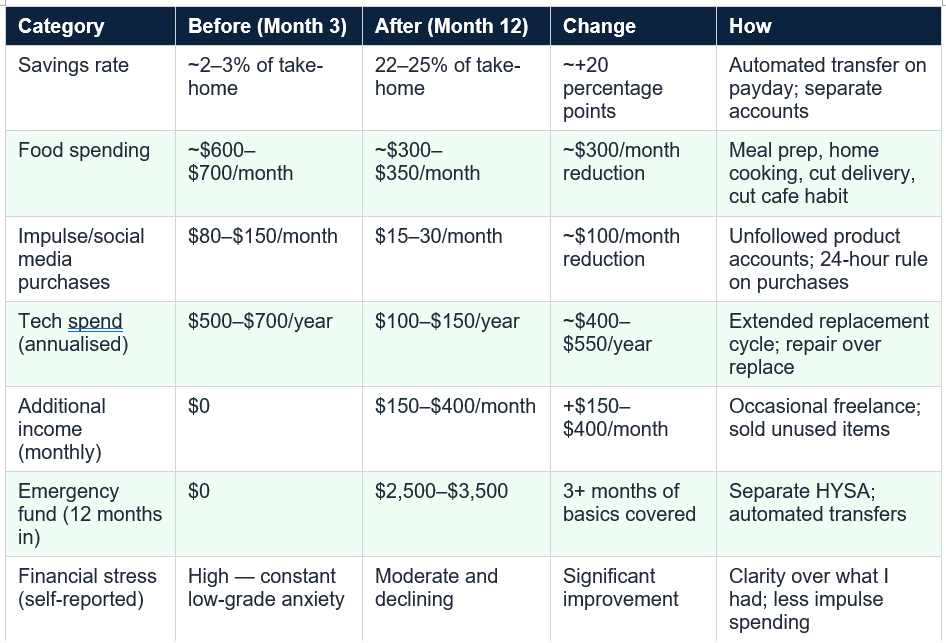
These figures represent my personal experience and are illustrative of the types of changes these habits can produce. Individual results will vary significantly based on income level, location, cost of living, existing debts, and how consistently each strategy is applied. They are not a guarantee of any specific financial outcome.
Financial experts recommend saving 20 percent of take-home pay. On an entry-level salary, that feels impossible until you have actually done it for a month and discovered that the lifestyle impact is smaller than the anxiety about attempting it. The habits in this article moved my savings rate by 20 percentage points without a promotion. The same 20 percentage points, invested consistently for 20 years, produce a meaningfully different financial life than the one that starts from 4 percent and waits for a salary increase that may or may not arrive on the timeline assumed.
The salary was not the problem. It never really was.
Financial experts including Joy Liu at Discover and advisers cited by Golden 1 Credit Union recommend saving at least 20% of monthly take-home pay. If 20% is too challenging at first, start with 10% and increase by 1 to 2 percentage points every time you receive a pay rise. Even saving $20 per week on a very limited income is worthwhile: at 7% average annual returns over 43 years (starting age 22), $20/week grows to approximately $176,000. The most important thing is to start, not to start perfectly.
What is the best bank account structure for saving on a first job salary?
Most financial advisers recommend separating your money into at least three accounts: a fixed expenses account (bills, rent, subscriptions), a day-to-day spending account (your debit card draws from here), and a high-yield savings account (your emergency fund and longer-term savings live here). An automatic transfer to the savings account should trigger on the same day as your paycheck. This structure makes saving automatic and makes your available-to-spend balance visible and honest.
How much should I have in an emergency fund as a young professional?
The standard guidance is three to six months of essential living expenses. BECU’s financial educator Stacey Black recommends three to six months’ worth. Johnson Financial Group suggests starting with a $1,000 emergency fund as an immediate goal before building toward the full three-to-six month target. Golden 1 Credit Union adds that ideally you should have at least 1x your annual salary saved for retirement by age 30. For most entry-level earners, the immediate priority is three months of essential expenses before anything else.
Is it worth starting a side income on an entry-level salary?
Yes, but with a critical caveat: the side income must be manageable without compromising your primary job or your health. Navy Federal Credit Union’s guide explicitly states: ‘Extra cash is one thing, but extra stress is another.’ Start with skills you already have from your primary job that have freelance market value, or with assets you already own that can be sold. Avoid committing to a fixed schedule of secondary work until you understand the time demands of your full-time role.
Does the quality-over-quantity buying principle actually save money?
Yes, when applied to durable goods where function is the primary purpose. A $120 item replaced every four years costs $30/year. A $40 item replaced every six months costs $80/year. The principle does NOT apply to trendy, seasonal, or purely aesthetic purchases where the value is in the novelty rather than the function. It also does not apply to consumables. The categories where quality-over-quantity consistently wins: footwear, kitchen tools, clothing basics (plain items used daily), and tech accessories.
How can I stop spending money on things I see on social media?
Unfollow accounts that exist primarily to showcase products, brands, fashion, or aspirational lifestyle content. The American Psychological Association has documented that exposure to aspirational social media content systematically drives consumer desire for products. Removing the content that generates the desire is more effective than trying to resist the desire after it has been created. Replace unfollowed accounts with content related to skills, knowledge, or interests that do not primarily manifest as purchasing decisions.
Table of Contents
- The Paycheck That Was Gone Before Friday
- The Starting Point: What Changed My Mindset First
- Thing #1: I Opened Separate Bank Accounts and Rewrote My Allocation Rule
- Thing #2: I Cut My Food Expenses (Without Eating Worse)
- Thing #3: I Removed Tempting Content From Social Media
- Thing #4: I Only Replace Tech Devices When Necessary
- Thing #5: I Earn Additional Income From Manageable Sources
- Thing #6: I Buy Quality Items That Actually Last
- BONUS: I Turned Saving Into a Personal Challenge
- My Actual Numbers: Before and After
- The Habits That Didn’t Make the List (But Also Helped)
- Conclusion: The Salary Was Never the Problem
- Frequently Asked Questions
The Paycheck That Was Gone Before Friday
Three months into my first real job, I could not account for where my money went. I was earning more than I ever had in my life — and spending more than I ever had. The direct deposit would land on Monday. By Thursday, the number in my checking account was the same figure I would have been embarrassed to admit to anyone. I had no meaningful savings, no emergency fund, and a vague sense that this was somehow normal for someone at my stage.It is normal, but normal is not the same as inevitable. According to Debt.com’s annual survey, 69 percent of Americans lived paycheck to paycheck in 2025 — and 86 percent of them claimed to have a budget. The math was not the problem. The habits were. Only 38 percent of Gen Zers have any emergency cash savings, according to a 2025 CreditOne Bank report. The US personal savings rate was 4.0 percent as of September 2025 — a figure that represents what most entry-level earners are experiencing: nearly nothing left after the month is done.
What follows are the six specific things I did to move my personal savings rate from near zero to over 20 percent of take-home pay — without a promotion, without a side income that consumed my life, and without living on rice and misery. Plus a bonus that turned out to be more important than all of them combined.
The Data: 69% of Americans live paycheck to paycheck (Debt.com 2025). Only 38% of Gen Zers have emergency savings (CreditOne Bank 2025). US personal savings rate: 4.0% (Federal Reserve FRED, September 2025). Financial experts recommend saving 20% of take-home pay — starting with 10% if 20% feels impossible (Discover).
The Starting Point: What Changed My Mindset First
Before any of the tactical changes happened, one shift in perspective made all of them possible. I stopped thinking about saving as what was left at the end of the month and started treating it as the first bill I paid.Joy Liu, head trainer at a personal finance company, described her own entry-level experience to Discover: ‘When I got my first job, I made $35,000 a year. It was easy to just throw my hands up and say, “I can’t save right now on this salary.”’ She urges young savers to reconsider: ‘Looking back, with the knowledge that I have now, I could have made it work if I knew that saving was something I needed to do.’
The insight that unlocked it for me was simpler: the lifestyle I was living at the start of my first job was not the lifestyle I actually needed. It was the lifestyle I defaulted into when spending was as frictionless as not thinking about it. Removing the friction of spending — or adding friction back in — was the foundation of everything that followed.
Discover / Joy Liu: Saving money at your first job will put you in a better place when you’re a seasoned professional, even if the dollar amounts you start with are small. The earlier in your career you start to save, the more time you’ll have for your money to grow exponentially.
Thing #1: I Opened Separate Bank Accounts and Rewrote My Allocation Rule
The single most structurally impactful change I made was moving from one bank account (where spending and saving shared the same space) to three separate accounts with a specific allocation rule applied on every payday:- Account 1: Fixed expenses account. Rent, utilities, subscriptions, phone, and any other committed monthly costs are paid from here. This account has no debit card attached.
- Account 2: Spending account. This is what my day-to-day debit card draws from. Groceries, social spending, transport, personal care. The balance here is what I have to spend.
- Account 3: High-yield savings account. An automatic transfer from Account 1 on payday moves money here before I have the opportunity to rationalise spending it.
The key discovery: I rarely missed the money that moved automatically. What I had been spending it on was not thoughtful spending — it was default spending, which is spending that happens when there is no structure to prevent it. Having a lower number in my spending account was not deprivation. It was clarity. Knowing exactly how much I had to spend in any given week made every purchase feel more intentional rather than less enjoyable.
What I Actually Did: Set up the automatic savings transfer to trigger the same day as your paycheck deposits. If the money sits in your checking account for even 48 hours before moving, the probability of spending some of it rises significantly. Make the savings transfer the first thing that happens, not the last.
Thing #2: I Cut My Food Expenses (Without Eating Worse)
Food was the first category where I found meaningful discretionary slack. Not because I was eating extravagantly — I genuinely thought my food spending was reasonable. Tracking it for a single month was one of the more uncomfortable revelations of my financial adult life. The combination of work lunches, weekend dining out, delivery fees with tip and surge pricing, and coffee purchases was substantially higher than I had estimated.The average two-person US household spends approximately $800 per month on food — $504 at home and $328 dining out, according to BLS Consumer Expenditure Survey data. Cooking at home saves approximately 60 to 75 percent per meal versus dining out or delivery. The Discover guide and multiple financial advisers interviewed by personal finance outlets make the same point: Sarah, a young professional used as a case study by Andrea Ward CPA in a March 2025 guide, discovered that her frequent dining out was draining her savings. By tracking her expenses, she found that cooking at home even three nights a week made a significant difference.
My specific changes:
- • Meal prepped on Sundays for at least three weekday lunches, eliminating the daily ‘what am I going to do for lunch’ decision that reliably resulted in buying something.
- • Set a monthly dining-out budget and treated it as a hard limit rather than a guideline. Having $120 for the month in the dining-out category made each restaurant trip feel like a deliberate choice rather than a habit.
- • Made coffee at home five days a week and treated a coffee shop visit as an activity rather than a routine. This alone saved approximately $60 to $80 per month.
- • Used up what was already in the fridge before buying new groceries. The USDA estimates the average American wastes approximately $1,500 per year in food. Reducing waste to near zero was effectively a raise I gave myself.
Thing #3: I Removed Tempting Content From Social Media
This one sounds small. It had a disproportionate impact. I had been following accounts that consistently showed products, brands, aesthetics, and lifestyles that I did not need but began to want simply from exposure. The American Psychological Association has documented that social media exposure to aspirational content systematically increases consumer desire for products and experiences that people would not have considered necessary before seeing them. It is not a character flaw. It is how the platforms are designed.The practical version: I audited who I was following on every platform and unfollowed anything that existed primarily to showcase products, brands, fashion hauls, tech reviews, or ‘this is what my life looks like’ content that made my current circumstances feel insufficient. I replaced it with accounts that showed skills I wanted to build, places I wanted to learn about, and people creating things I found genuinely interesting.
The PFCU’s January 2026 money management guide describes the same mechanism from the other side: tracking spending makes you think about whether each expense is worth it. Removing the content that generates the desire in the first place is the upstream version of the same intervention. It is significantly more effective to not want the thing than to want it and resist it.
The secondary effect surprised me: I became genuinely less interested in shopping as a leisure activity. The urge to scroll through an online store to see what was new, to add items to a cart and revisit them, to look at reviews for products I had no particular need for — all of this decreased substantially when the content feeding it was removed from my daily scroll.
What I Actually Did: Do not just mute accounts. Unfollow them. Muted content still exists in your feed algorithm’s understanding of your interests. Unfollowing changes what the algorithm recommends next. This is not about deprivation — it is about curating an information environment that aligns with your actual priorities.
Thing #4: I Replace Tech Devices Only When Necessary
Before I made this change, I was operating with what I can only describe as a consumer’s definition of ‘necessary.’ A new phone model was reason enough to consider replacement. An older laptop’s slight slowness was interpreted as a hardware problem rather than a software one. I was, without consciously deciding to be, participating in the average American replacement cycle of a new smartphone every 2.5 years, according to CIRP data.The change I made was defining a clear personal replacement rule: a device is replaced when it can no longer perform the tasks I actually need it to perform, or when repair is more expensive than replacement. Not when a new version exists. Not when the battery could be replaced with 30 minutes at a repair shop. Not when the screen has a small scratch that does not affect function.
Extending a smartphone replacement from every 2.5 years to every 4 years saves approximately $200 to $400 per year at current device prices, depending on the tier. The same logic applies to laptops, tablets, earbuds, smartwatches, and the entire ecosystem of tech accessories that tends to expand in the early working years of anyone who is paid in money and surrounded by product marketing. A three-year-old laptop that runs slowly often needs a RAM upgrade or a fresh OS install, not replacement. A phone with a degraded battery needs a new battery, not a new phone.
- Before any tech purchase, I ask: what can this do that my current device cannot? If the honest answer is ‘not much,’ the purchase is deferred.
- I keep a simple device maintenance log: screen protecter applied, case used, battery status checked every six months. Physical care alone extends useful device life by one to two years.
- For accessories and peripherals, I buy once at a quality tier that lasts — which leads directly into Thing #6.
Thing #5: I Earn Additional Income From Manageable Sources
The conventional side-hustle advice for entry-level earners tends toward two extremes: either ‘start a business’ (overwhelming) or ‘drive for a rideshare’ (trading time for dollars at minimum-wage-equivalent returns while adding stress to what is already a demanding season of career establishment). Neither appealed to me.The framing that actually worked: what can I do that uses skills I already have, fits around my schedule without disrupting my primary job, and generates income without creating a second job I resent? Navy Federal Credit Union’s guide on saving on an entry-level salary explicitly notes the importance of balance: ‘Carefully consider the time demands of your side hustle. You want to fulfil your duties to your full-time employer as you manage your new venture. Extra cash is one thing, but extra stress is another.’
The manageable sources I found:
- Freelance skills from my primary job: the skills I was building at work — writing, research, data analysis — had market value for occasional freelance projects. One or two small projects per month generated supplementary income without the scheduling intensity of a committed part-time role.
- Selling things I owned but no longer used: clothes, books, electronics, furniture. This is not recurring income, but it converts accumulated clutter into savings capital and funds the replacement rule from Thing #4 in a circular way: old device sold funds the eventual (delayed) replacement.
- High-yield savings account interest: once the savings account had a meaningful balance, moving it to a high-yield savings account earning 4 to 5 percent annually generated passive interest income. Not transformative at an entry-level salary, but genuinely something rather than nothing.
What I Actually Did: The key to manageable additional income is keeping the barrier to entry low. One irregular freelance project per month is sustainable. A fixed commitment of fifteen hours per week is not. Start with what requires no new infrastructure, uses existing skills, and can be paused without consequence.
Thing #6: I Buy Quality Items That Actually Last
This sounds like the opposite of a savings strategy. Spending more on individual items to spend less overall is counterintuitive enough that most entry-level earners dismiss it. The data is straightforward: a $120 pair of boots replaced every four years costs $30 per year. A $45 pair replaced every six months costs $90 per year — and uses three times the packaging, three times the delivery trips, and three times the decision-making energy. The cheaper option is more expensive over time.The version of ‘quality over quantity’ that I apply is not about buying luxury goods. It is about identifying the specific categories where durability matters and the cost-per-use calculation favours a higher upfront purchase. These categories for me:
- • Clothing basics: plain T-shirts, underwear, socks, and work trousers. Cheap versions of these items look dated and wear out quickly. Quality basics last three to five years with proper care. The wardrobe becomes smaller, simpler, and cheaper over any multi-year horizon.
- • Kitchen tools: a $20 knife sharpens and lasts fifteen years. A $6 knife rusts and dulls within six months. A good pan cooks better food and replaces nothing for a decade. Cooking more at home (Thing #2) makes quality kitchen tools genuinely valuable.
- • Footwear: the category where the cost-per-use calculation is clearest and where quality is most immediately apparent in day-to-day wear.
- • What I explicitly excluded from this principle: anything trendy, seasonal, or experiential. A concert ticket does not benefit from being more expensive. A fashionable jacket from last year is still a jacket. The quality-over-quantity rule applies to durable goods where the use case is functional, not aesthetic.
BONUS: I Turned Saving Into a Personal Challenge
Every tactical change described above became significantly easier after I made this shift: I stopped treating saving money as a sacrifice and started treating it as a game I was playing against my previous month’s self.The 52-week savings challenge is the most widely cited version of this approach: save $1 in week one, $2 in week two, gradually increasing to $52 in week 52. The total is $1,378 — in a single year, from an exercise that feels like nothing in the early months. PFCU’s January 2026 guide describes the equivalent approach through a different mechanism: round up every purchase to the nearest dollar and save the difference. Skip one habitual expense per week and transfer that amount. ‘These micro-deposits may feel painless individually, but they compound into meaningful protection over time.’
My version was simpler than a structured challenge. I tracked my savings rate each month and tried to beat the prior month by at least one percentage point. Some months I succeeded, some I did not, but the game aspect meant I was thinking about savings as something I was pursuing rather than something I was enduring. Behavioural economics research has consistently shown that framing a behaviour as a challenge or game increases completion rates significantly — because the emotional reward shifts from the purchase to the saving.
Gamify It: Try the No-Spend Day challenge: designate one day per week (typically a Tuesday or Wednesday when spend temptation is lowest) as a no-spend day. No purchases of any kind. Transfer the amount you would typically spend on incidentals that day to your savings account. Over a year, this adds up to 52 no-spend days and a meaningful supplementary savings deposit.
My Actual Numbers: Before and After
These figures represent my personal experience and are illustrative of the types of changes these habits can produce. Individual results will vary significantly based on income level, location, cost of living, existing debts, and how consistently each strategy is applied. They are not a guarantee of any specific financial outcome.
The Habits That Didn’t Make the List (But Also Helped)
The six things above were the primary levers. Several smaller habits compounded their effect:- Contributing to my employer’s 401(k) from my first paycheck: even a 3 percent contribution — enough to capture the full employer match at my company — was effectively a 6 percent contribution at no additional cost. MassMutual’s April 2026 financial checklist for first jobs notes: the annual employee 401(k) contribution limit is $24,500 for 2026. The employer match is widely described by financial advisers as ‘essentially free money.’
- Cancelling subscriptions I was not using: a single monthly audit of bank statements identified three recurring charges I had forgotten about. These were cancelled the same day.
- Delaying non-essential purchases by 24 to 48 hours: a mental rule that anything non-essential I wanted to buy had to wait 24 hours. The majority of items I wanted in the moment I no longer wanted the following morning.
- Using a high-yield savings account rather than a standard one: every dollar earning 4 to 5 percent versus 0.01 percent is a small win that requires zero ongoing effort after the initial account setup.
Conclusion
The entry-level salary felt like the constraint. Looking back, it was not. The constraint was the absence of structure — a single account that mixed spending and saving, a social media feed that continuously generated new desires, a replacement cycle for tech that treated novelty as necessity, and no clear principle governing whether to buy something cheap repeatedly or something good once. None of those constraints required more income to fix.Financial experts recommend saving 20 percent of take-home pay. On an entry-level salary, that feels impossible until you have actually done it for a month and discovered that the lifestyle impact is smaller than the anxiety about attempting it. The habits in this article moved my savings rate by 20 percentage points without a promotion. The same 20 percentage points, invested consistently for 20 years, produce a meaningfully different financial life than the one that starts from 4 percent and waits for a salary increase that may or may not arrive on the timeline assumed.
The salary was not the problem. It never really was.
Frequently Asked Questions
How much should I be saving on an entry-level salary?Financial experts including Joy Liu at Discover and advisers cited by Golden 1 Credit Union recommend saving at least 20% of monthly take-home pay. If 20% is too challenging at first, start with 10% and increase by 1 to 2 percentage points every time you receive a pay rise. Even saving $20 per week on a very limited income is worthwhile: at 7% average annual returns over 43 years (starting age 22), $20/week grows to approximately $176,000. The most important thing is to start, not to start perfectly.
What is the best bank account structure for saving on a first job salary?
Most financial advisers recommend separating your money into at least three accounts: a fixed expenses account (bills, rent, subscriptions), a day-to-day spending account (your debit card draws from here), and a high-yield savings account (your emergency fund and longer-term savings live here). An automatic transfer to the savings account should trigger on the same day as your paycheck. This structure makes saving automatic and makes your available-to-spend balance visible and honest.
How much should I have in an emergency fund as a young professional?
The standard guidance is three to six months of essential living expenses. BECU’s financial educator Stacey Black recommends three to six months’ worth. Johnson Financial Group suggests starting with a $1,000 emergency fund as an immediate goal before building toward the full three-to-six month target. Golden 1 Credit Union adds that ideally you should have at least 1x your annual salary saved for retirement by age 30. For most entry-level earners, the immediate priority is three months of essential expenses before anything else.
Is it worth starting a side income on an entry-level salary?
Yes, but with a critical caveat: the side income must be manageable without compromising your primary job or your health. Navy Federal Credit Union’s guide explicitly states: ‘Extra cash is one thing, but extra stress is another.’ Start with skills you already have from your primary job that have freelance market value, or with assets you already own that can be sold. Avoid committing to a fixed schedule of secondary work until you understand the time demands of your full-time role.
Does the quality-over-quantity buying principle actually save money?
Yes, when applied to durable goods where function is the primary purpose. A $120 item replaced every four years costs $30/year. A $40 item replaced every six months costs $80/year. The principle does NOT apply to trendy, seasonal, or purely aesthetic purchases where the value is in the novelty rather than the function. It also does not apply to consumables. The categories where quality-over-quantity consistently wins: footwear, kitchen tools, clothing basics (plain items used daily), and tech accessories.
How can I stop spending money on things I see on social media?
Unfollow accounts that exist primarily to showcase products, brands, fashion, or aspirational lifestyle content. The American Psychological Association has documented that exposure to aspirational social media content systematically drives consumer desire for products. Removing the content that generates the desire is more effective than trying to resist the desire after it has been created. Replace unfollowed accounts with content related to skills, knowledge, or interests that do not primarily manifest as purchasing decisions.
0 Comments
Be the first to share your thoughts on this article.