

Retirement
Why U.S Pensions Were on the Brink of Extinction

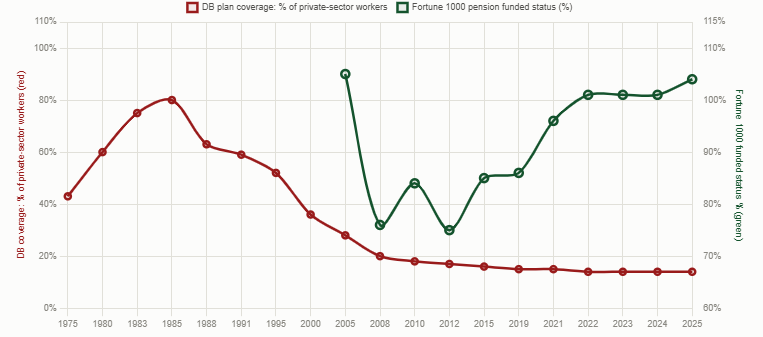
In 1985, 80% of full-time workers at medium and large US companies had a pension. By 2025, that figure had collapsed to 14%. For forty years, the defined benefit pension plan was a dying species. Then something changed: funding levels reached 104% of obligations for Fortune 1000 plans. IBM reversed its 2008 freeze and restored pensions for 300,000 employees. Half of CFOs now say their DB plans are staying permanently. The rebirth is real — here is what is driving it, who benefits, and what it means for your retirement.

The trend seemed irreversible. Major corporations — IBM, General Electric, Verizon, Lockheed Martin, Motorola — had frozen their plans and stopped accruing new benefits. The 401(k) had replaced the pension as the dominant retirement vehicle. Workers carried their own investment risk. Employers capped their exposure. The pension, many concluded, was a relic of the mid-twentieth century labour compact, unsuited to the mobile, flexible, individualistic economy that followed.
Then three things happened almost simultaneously. Corporate pension plans reached their best funded status in decades — 104 percent of obligations for Fortune 1000 plans at the end of 2025, the fourth consecutive year at or above full funding (WTW, January 2026). IBM reversed its 2008 freeze and restored a defined benefit pension for approximately 300,000 employees. And Mercer’s 2025 CFO survey found that 50 percent of plan sponsors now intend to keep their DB plans permanently — up from just 36 percent two years earlier. The pension’s obituary may have been premature.
Fortune 1000 pension funded status (year-end 2025): 104% — 4th consecutive year fully/over-funded (WTW, Jan 2026). Private-sector workers with DB pension: 14% (BLS, Mar 2025). Public-sector: 86%. Public pension aggregate funded ratio: 77.77% — highest in 15+ years. CFOs planning to keep DB plans long-term: 50% (up from 36% in 2023; Mercer 2025). Goldman Sachs: 'By several measures, the overall system has never been in better shape.'
The pension’s original function was clear: in exchange for decades of service, a worker received a guaranteed monthly income in retirement, calculated based on years of service and final salary, funded by the employer, and paid for life. The employer bore the investment risk. The worker bore no risk at all beyond keeping the job.
The shift began in 1978, when Congress passed the Revenue Act, which included a provision that would eventually be interpreted to allow workers to defer part of their salary into employer-sponsored plans with pre-tax dollars. Ted Benna, a benefits consultant, built the first working 401(k) plan in 1981. The IRS confirmed the interpretation, and the employer community rapidly recognised the opportunity: a retirement benefit where the employee bore the investment risk and the employer’s obligation was capped at a defined contribution rather than a defined outcome.
A cascade of structural forces accelerated the shift:
WTW’s January 5, 2026 analysis of 349 Fortune 1000 companies with December fiscal year-ends found:
For public pension plans, the picture is more mixed but also improving. The Center for Retirement Research estimated that public DB pension plans reached an aggregate funded ratio of 77.77 percent in 2025 — the highest level in more than 15 years. CalPERS, the largest US public pension system, saw its funded status rise from 71.4 percent to 79 percent in 2025 after an 11.6 percent investment return. Total public pension assets stood at $6.85 trillion as of Q4 2025 (Federal Reserve), up 11.1 percent year-over-year. However, $1.48 trillion in unfunded liabilities remains across public plans — a structural deficit that will ultimately require some combination of higher contributions, reduced benefits, or taxpayer support.
The positive funding picture is not just good news for retirees — it is the enabling condition for the pension revival. A fully funded or over-funded plan creates options that an under-funded plan does not: sponsors can consider reopening frozen plans, offering enhanced benefits, or designing new hybrid structures, because the financial position supports it. The 104% Fortune 1000 aggregate funded status is the foundation on which the entire revival conversation rests.
The IBM case was significant for several reasons beyond the benefit itself:
“We are confident that other employers have taken notice of what IBM is doing. We are fully confident that other employers will follow suit.” — Jonathan Price, National Retirement Practice Leader, Segal (HR Executive)
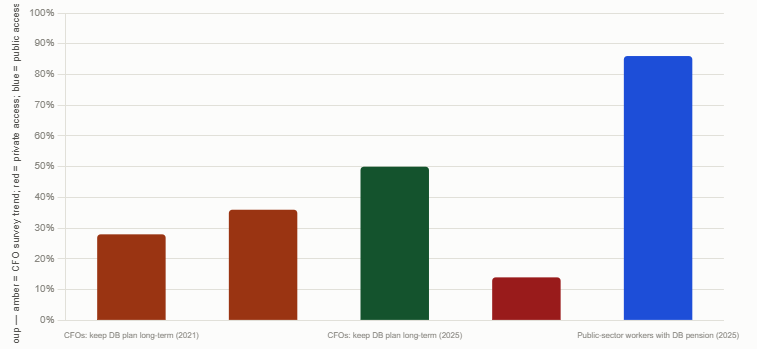
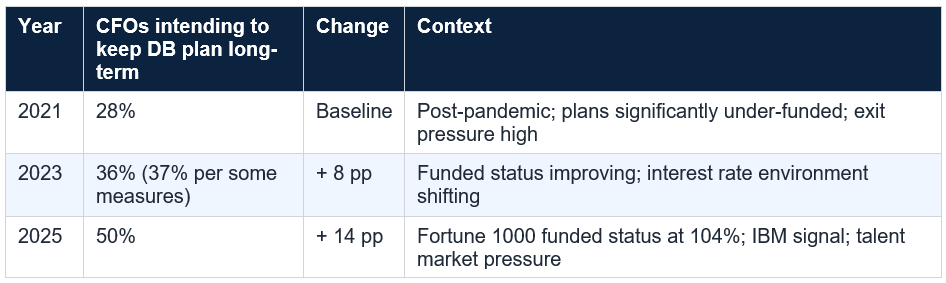
The headline finding: 50 percent of plan sponsors — CFOs of companies that currently have DB plans — now say they intend to keep those plans for the long term. Two years ago, that figure was 36 percent. In 2021, it was just 28 percent.
The Mercer survey also reveals what CFOs are doing in response to the improved funding picture:
PLANSPONSOR’s June 2026 analysis identifies recruitment and retention as the primary reason cited by employers who maintain their DB plans: ‘Recruitment and retention benefits are often cited as the reason a company or government continues to provide a pension.’ The guaranteed income of a pension, for workers who understand it, produces a qualitatively different kind of retirement security than a 401(k) plan whose value fluctuates with financial markets. In a labour market where the best candidates have multiple options, the pension is a differentiator that a simple 401(k) match cannot replicate.
Union pressure has been particularly visible. The Boeing machinist strikes of 2024, and the UAW actions that preceded them, both featured pension restoration as a prominent demand. The Workforce.com analysis of pension history notes: ‘As evident from the recent Boeing and UAW strikes, pensions are still widely valued by workers.’ When union negotiations produce pension commitments, they also set expectations in adjacent non-union workplaces where employers are competing for the same talent pool.
The demographics of the labour market add another dimension. Gen Z, as documented extensively in personal finance media, is more financially anxious and more cautious about market risk than previous generations. A benefit that provides guaranteed income regardless of market performance — which is exactly what a defined benefit pension delivers — has inherently higher appeal to a generation that watched their parents’ 401(k)s collapse in 2008 and again during the 2020 pandemic.
The pension is the ultimate counter-cyclical benefit. It becomes most attractive to workers precisely when markets are volatile and 401(k) values are falling. The combination of heightened market awareness among younger workers, continued stock market volatility driven by geopolitical and macroeconomic uncertainty, and the availability of well-funded legacy plans provides a more supportive environment for pension revival than any point in the last two decades.
A cash balance plan combines the employer-funded guarantee of a defined benefit plan with the individual account structure and portability of a defined contribution plan. The employer credits each participant’s account with a defined contribution (expressed as a percentage of salary) plus a fixed or variable interest credit, typically linked to a benchmark rate such as the 30-year Treasury yield. The benefit is expressed as an account balance — not a monthly income formula based on years of service and final pay.
The key advantages of the cash balance design over the traditional DB plan:
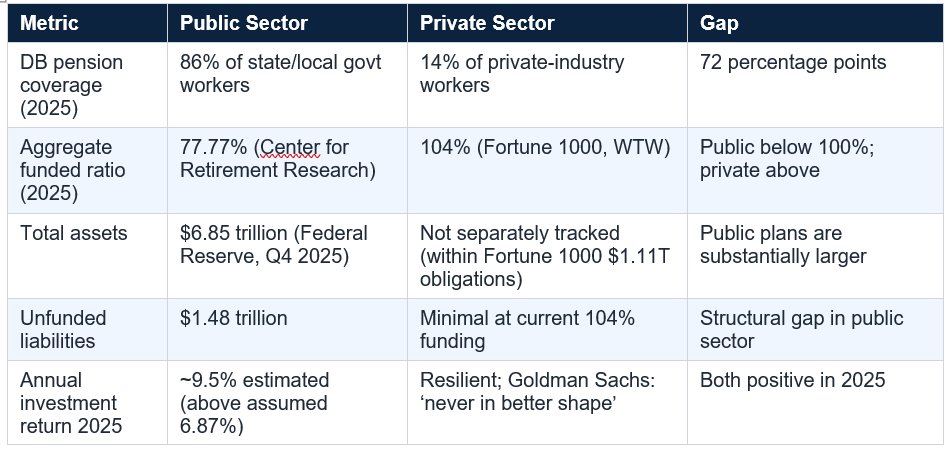

The public-sector funded ratio of 77.77 percent — despite being the highest in 15 years — still represents $1.48 trillion in unfunded liabilities that taxpayers will ultimately carry. This structural deficit means that public pension plans face ongoing political and financial pressure, even as private-sector plans are in their strongest financial position in decades. The PLANSPONSOR June 2026 analysis notes that ‘private plan funding levels, on average, are now at or near surplus’, creating a very different planning environment from their public counterparts who ‘are having very different discussions about how (and whether) to move forward with their plans.’
The pension revival narrative should not be read as a reversal of the risk transfer that occurred over 40 years. The 401(k) system — with workers bearing investment risk and decision-making responsibility — remains the dominant US retirement model. The 14% of private-sector workers with DB pension access is not projected to dramatically increase. For the 86% without access, the fundamental personal finance challenge — save enough in individual accounts to fund a decades-long retirement in uncertain markets — remains unchanged.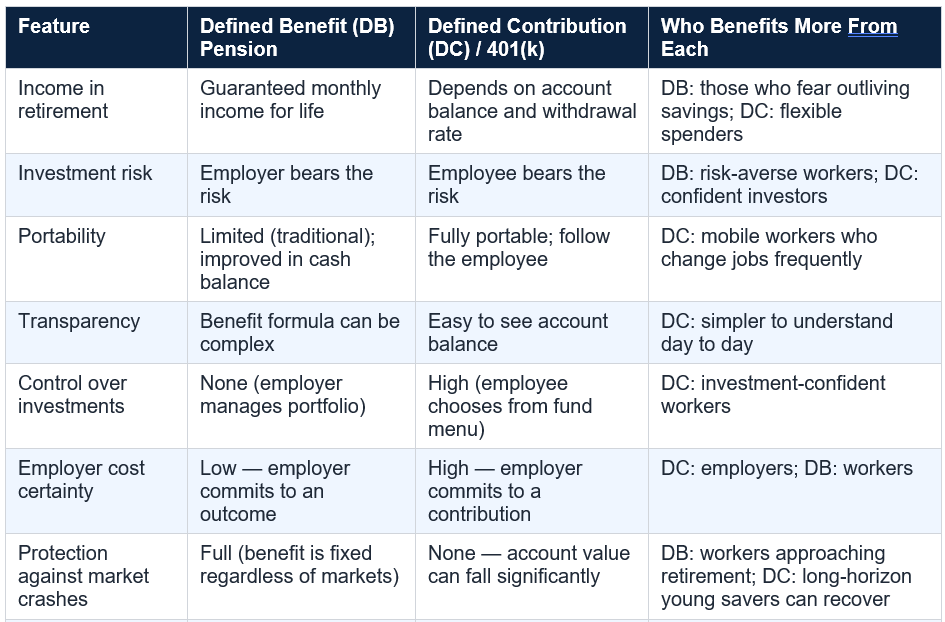
However, the revival does have some practical implications for this group:
What is reversing is the assumption that pensions are inherently unmanageable liabilities that responsible CFOs eliminate at the earliest opportunity. Fortune 1000 pension plans are at 104 percent funded status, their strongest position since before 2008. Half of CFOs now say their DB plans are permanent. Goldman Sachs says the system has never been in better shape. IBM restored pensions for 300,000 employees. The conversation has changed.
The reasons this matters extend beyond the immediate financial position. Defined benefit pensions do something that 401(k)s structurally cannot: they guarantee income for life, regardless of how long the retiree lives, regardless of what markets do, and regardless of how well the individual makes investment decisions. They pool longevity risk across a large population. They remove the existential retirement fear of outliving your money. In an era of 27 percent zero-savings rates, 59 percent inadequate emergency savings, and rising anxiety about Social Security solvency, the reappearance of a benefit that simply pays a guaranteed monthly cheque until death is not a relic. It is a solution to a problem that the DC system has spent forty years creating.
Both, in different measure. The data is real: Fortune 1000 pension plans ended 2025 at 104% funded status, the fourth consecutive year above full funding (WTW, January 2026). The share of CFOs planning to keep DB plans long-term rose from 28% in 2021 to 50% in 2025 (Mercer CFO survey). IBM restored pensions for 300,000 employees. Goldman Sachs said in March 2026 that 'by several measures, the overall system has never been in better shape.' The revival is genuine among large companies with existing over-funded plans, and among union employers where pension restoration has been a major bargaining demand. What is not happening is a broad reversal of the 40-year trend. The 14% of private-sector workers with DB pension access is not going to become 50% anytime soon. The revival is real; its scale is limited.
Why did IBM restore its pension plan?
IBM froze its defined benefit pension plan in 2008, switching employees to a 401(k) with a 5% match plus 1% automatic contribution. The January 2024 restoration was made possible because IBM's legacy pension plan was significantly over-funded — meaning the invested assets exceeded the promised obligations. By restoring the pension and ending 401(k) contributions, IBM was able to provide a 'stable and predictable' retirement benefit funded from the existing plan assets, without necessarily increasing its overall retirement spending. IBM stated the move would help employees 'diversify their retirement portfolios.' The case illustrates the broader structural opportunity: companies that froze pension plans in 2008–2012 may find those same plans are now over-funded after a decade of strong market returns, creating the option to unfreeze without significant new cash outlay.
What is a cash balance plan and how is it different from a traditional pension?
A cash balance plan is a hybrid pension that combines the employer-funded guarantee of a defined benefit plan with the individual account structure and portability of a 401(k). In a traditional DB pension, the benefit is expressed as a monthly income based on years of service and final salary — a formula that rewards long tenure and is difficult to understand. In a cash balance plan, the employer credits a defined percentage of the employee's salary into an individual account, plus a guaranteed interest credit. When the employee leaves or retires, they can take the balance as a lump sum (and roll it into an IRA) or convert it to an annuity. The key advantage: unlike a traditional pension, a cash balance plan is portable and easy to understand. The employer still bears the investment risk, but the benefit structure is far more compatible with modern, mobile careers. Cash balance plans have grown significantly in popularity among small professional firms and are a central element of the current pension revival.
Is my pension safe if my company's plan is over-funded?
A higher funding level (assets exceeding liabilities) significantly improves the security of a pension benefit. At 104% funded status for Fortune 1000 plans, plan assets exceed obligations, providing a buffer against market declines. However, pension security also depends on: the ongoing financial health of the employer (a bankrupt company may terminate a pension even if funded); the protections of the Pension Benefit Guaranty Corporation (PBGC), the federal agency that insures private-sector DB pensions up to a maximum annual benefit (approximately $75,000 per year for those retiring at 65 in 2026); and the specific terms of your plan. If your employer's DB plan is terminated, the PBGC provides coverage for vested benefits up to the annual guarantee limits. Consult your plan administrator for specific information about your plan's funded status and the coverage that applies to you.
Should I value a pension offer higher than an equivalent 401(k) match?
Generally yes, and often significantly so, because the actuarial value of a guaranteed income for life typically exceeds the nominal dollar equivalent in a 401(k). A pension that pays $2,000 per month for life provides more lifetime income the longer you live — and it is fully guaranteed regardless of market performance. A 401(k) balance provides income only until the balance runs out, and its value depends entirely on investment returns. The correct comparison: ask what lump sum would be needed in a 401(k) to generate the same guaranteed monthly income as the pension. At current annuity rates, a pension paying $2,000 per month may be equivalent to a $350,000–$500,000 lump sum in a 401(k), depending on the retirement age and interest rate environment. When evaluating job offers, ask HR for a pension benefit projection at your expected retirement age and compare it to the 401(k) equivalent. A qualified financial adviser or actuary can help you make this comparison for large financial decisions.
Who is most likely to benefit from the pension revival?
The pension revival is most likely to benefit: (1) employees at large corporations that have existing over-funded frozen DB plans — these companies have the strongest financial case for reopening plans or offering hybrid designs; (2) union members at companies where pension restoration is a collective bargaining demand, particularly in manufacturing, aerospace, and automotive sectors; (3) public-sector employees, who already have significantly better DB pension coverage (86% access vs 14% private-sector) and whose plans are at the best funding levels in 15 years; and (4) small business owners, particularly those in professional services, who may be able to establish cash balance plans with significantly higher contribution limits than 401(k) plans allow. The workers least likely to benefit in the near term: those at small and mid-sized private companies with no existing pension infrastructure, which describes the majority of the US private-sector workforce.
Table of Contents
- The Obituary That Was Written Too Early
- How the Pension Was Killed: A Forty-Year History
- The Numbers That Changed Everything: Funded Status in 2025–2026
- The IBM Moment: How One Decision Restarted the Conversation
- The CFO Reversal: Why Finance Leaders Are Changing Their Minds
- The Labour Market Factor: Unions, Strikes, and the Talent War
- What Is a Cash Balance Plan? The Hybrid Model Driving the Revival
- Public vs Private: The Two-Tier Pension World
- The Limits of the Revival: What Is Not Coming Back
- DB vs DC: A Side-by-Side Comparison for Workers
- What the Pension Revival Means If You Have One
- What the Pension Revival Means If You Don’t Have One
- Conclusion: A Partial Resurrection, and Why It Matters
- Frequently Asked Questions
40-Year Collaps And 2025 Revival: DB Coverage And Funded Status
The CFO Mindset Shift And Has Access 2026.
The Obituary That Was Written Too Early
For four decades, the American defined benefit pension plan was widely described as a dying institution. The obituaries wrote themselves: In 1983, there were 175,143 private-sector pension plans in the United States. By 2008, only 46,926 remained. In 1985, 80 percent of full-time employees at medium and large private companies participated in a defined benefit plan; by 2000, that figure was 36 percent. By March 2025, only 14 percent of private-industry workers had access to a DB pension at all (Bureau of Labor Statistics; Savvly, April 2026).The trend seemed irreversible. Major corporations — IBM, General Electric, Verizon, Lockheed Martin, Motorola — had frozen their plans and stopped accruing new benefits. The 401(k) had replaced the pension as the dominant retirement vehicle. Workers carried their own investment risk. Employers capped their exposure. The pension, many concluded, was a relic of the mid-twentieth century labour compact, unsuited to the mobile, flexible, individualistic economy that followed.
Then three things happened almost simultaneously. Corporate pension plans reached their best funded status in decades — 104 percent of obligations for Fortune 1000 plans at the end of 2025, the fourth consecutive year at or above full funding (WTW, January 2026). IBM reversed its 2008 freeze and restored a defined benefit pension for approximately 300,000 employees. And Mercer’s 2025 CFO survey found that 50 percent of plan sponsors now intend to keep their DB plans permanently — up from just 36 percent two years earlier. The pension’s obituary may have been premature.
Fortune 1000 pension funded status (year-end 2025): 104% — 4th consecutive year fully/over-funded (WTW, Jan 2026). Private-sector workers with DB pension: 14% (BLS, Mar 2025). Public-sector: 86%. Public pension aggregate funded ratio: 77.77% — highest in 15+ years. CFOs planning to keep DB plans long-term: 50% (up from 36% in 2023; Mercer 2025). Goldman Sachs: 'By several measures, the overall system has never been in better shape.'
How the Pension Was Killed: A Forty-Year History
The defined benefit pension was not simply superseded by a better product. It was systematically disadvantaged by a series of regulatory, economic, and structural shifts over four decades — and its decline tells an important story about how retirement risk was transferred from employers to workers.The pension’s original function was clear: in exchange for decades of service, a worker received a guaranteed monthly income in retirement, calculated based on years of service and final salary, funded by the employer, and paid for life. The employer bore the investment risk. The worker bore no risk at all beyond keeping the job.
The shift began in 1978, when Congress passed the Revenue Act, which included a provision that would eventually be interpreted to allow workers to defer part of their salary into employer-sponsored plans with pre-tax dollars. Ted Benna, a benefits consultant, built the first working 401(k) plan in 1981. The IRS confirmed the interpretation, and the employer community rapidly recognised the opportunity: a retirement benefit where the employee bore the investment risk and the employer’s obligation was capped at a defined contribution rather than a defined outcome.
A cascade of structural forces accelerated the shift:
- Regulatory burden: legislation passed from the 1980s onward — culminating in the Pension Protection Act of 2006 — changed funding rules for DB plans, requiring plan sponsors to address short-term funding shortfalls with immediate cash contributions. This created balance sheet volatility and financial statement complexity that made DB plans increasingly unattractive to CFOs.
- Economic and demographic shifts: the shift of the US economy from manufacturing to services and technology moved workers into sectors where DC plans were the norm. Increasing worker mobility made the traditional pension — which rewarded long tenure with the same employer — less well-suited to a workforce that changed jobs more frequently.
- Interest rate environment: pension liabilities are calculated using discount rates tied to long-term bond yields. The multi-decade decline in interest rates that began in the 1980s systematically inflated pension obligations, making plans appear less well-funded than they actually were in economic terms.
- Market shocks: the dot-com bust in 2000 and the 2008 financial crisis devastated pension plan assets, producing funding deficits that required significant employer cash contributions at the worst possible time. Many companies responded by freezing plans rather than continuing to fund them.
The Numbers That Changed Everything: Funded Status in 2025–2026
The single most important factor in the pension revival conversation is one that never generates headlines: funding levels. Pension plans that are well-funded are manageable, flexible assets. Pension plans that are poorly funded are liabilities that dominate CFO conversations and make plan termination the path of least resistance. The reason conversations about pension revival became possible is that, for the first time in a generation, the funding picture is genuinely positive.WTW’s January 5, 2026 analysis of 349 Fortune 1000 companies with December fiscal year-ends found:
- Aggregate funded status at end of 2025: 104 percent — meaning the assets held in these plans exceed the obligations they are required to meet.
- This is the fourth consecutive year in which Fortune 1000 plans collectively ended at or above full funding.
- Pension obligations fell from $1.16 trillion at end of 2024 to an estimated $1.11 trillion at end of 2025, driven by continued elevated discount rates that reduce the present value of future obligations.
For public pension plans, the picture is more mixed but also improving. The Center for Retirement Research estimated that public DB pension plans reached an aggregate funded ratio of 77.77 percent in 2025 — the highest level in more than 15 years. CalPERS, the largest US public pension system, saw its funded status rise from 71.4 percent to 79 percent in 2025 after an 11.6 percent investment return. Total public pension assets stood at $6.85 trillion as of Q4 2025 (Federal Reserve), up 11.1 percent year-over-year. However, $1.48 trillion in unfunded liabilities remains across public plans — a structural deficit that will ultimately require some combination of higher contributions, reduced benefits, or taxpayer support.
The positive funding picture is not just good news for retirees — it is the enabling condition for the pension revival. A fully funded or over-funded plan creates options that an under-funded plan does not: sponsors can consider reopening frozen plans, offering enhanced benefits, or designing new hybrid structures, because the financial position supports it. The 104% Fortune 1000 aggregate funded status is the foundation on which the entire revival conversation rests.
The IBM Moment: How One Decision Restarted the Conversation
In January 2024, IBM made an announcement that reverberated through the corporate HR and finance worlds: the company would end its 401(k) contributions for approximately 300,000 US employees and instead restore a defined benefit pension plan that it had frozen in 2008. The explanation IBM offered was notable for its directness — the pension would help employees ‘diversify their retirement portfolios’ and enjoy a ‘stable and predictable’ benefit.The IBM case was significant for several reasons beyond the benefit itself:
- Scale: with approximately 300,000 affected employees, IBM is one of the largest US employers to make such a move in decades. The signal it sends to the broader corporate community is proportional to its size.
- Financial logic: IBM’s switch was partly driven by the condition of its existing (frozen) defined benefit plan. When the plan was frozen in 2008, IBM was making 401(k) contributions of up to 6 percent of salary (5% match plus 1% automatic). Shifting to a DB model from an over-funded plan allowed IBM to provide a competitive retirement benefit without the same ongoing cash outlay, because the existing plan assets were doing the work.
- Signal to the market: Jonathan Price, national retirement practice leader at benefits consulting firm Segal, told HR Executive: ‘We are confident that other employers have taken notice of what IBM is doing. Even before that announcement, many organisations were already having conversations about whether this type of shift is right for them.’ Price predicted at least two more large companies would announce similar moves.
“We are confident that other employers have taken notice of what IBM is doing. We are fully confident that other employers will follow suit.” — Jonathan Price, National Retirement Practice Leader, Segal (HR Executive)
The CFO Reversal: Why Finance Leaders Are Changing Their Minds
The most data-rich evidence for the pension revival comes not from announcements but from surveys of the finance executives who make the decisions. Mercer’s 2025 CFO survey, reported by CFO.com in December 2025, reveals a genuine shift in attitude among the executives who had spent the previous two decades terminating, freezing, or offloading DB plans.The headline finding: 50 percent of plan sponsors — CFOs of companies that currently have DB plans — now say they intend to keep those plans for the long term. Two years ago, that figure was 36 percent. In 2021, it was just 28 percent.
The Mercer survey also reveals what CFOs are doing in response to the improved funding picture:
- 70% have adopted dynamic de-risking strategies to stabilise funding levels.
- 44% have shifted more assets into fixed income, reducing the risk of future funding shortfalls.
- 43% have reduced overall investment risk as funded status improved.
The Labour Market Factor: Unions, Strikes, and the Talent War
No analysis of the pension revival is complete without the labour market context. The extraordinary tightening of the US labour market in 2021 through 2024 produced a structural shift in the relative bargaining power of workers and employers — and pension restoration emerged as one of the most powerful competitive differentiators in that environment.PLANSPONSOR’s June 2026 analysis identifies recruitment and retention as the primary reason cited by employers who maintain their DB plans: ‘Recruitment and retention benefits are often cited as the reason a company or government continues to provide a pension.’ The guaranteed income of a pension, for workers who understand it, produces a qualitatively different kind of retirement security than a 401(k) plan whose value fluctuates with financial markets. In a labour market where the best candidates have multiple options, the pension is a differentiator that a simple 401(k) match cannot replicate.
Union pressure has been particularly visible. The Boeing machinist strikes of 2024, and the UAW actions that preceded them, both featured pension restoration as a prominent demand. The Workforce.com analysis of pension history notes: ‘As evident from the recent Boeing and UAW strikes, pensions are still widely valued by workers.’ When union negotiations produce pension commitments, they also set expectations in adjacent non-union workplaces where employers are competing for the same talent pool.
The demographics of the labour market add another dimension. Gen Z, as documented extensively in personal finance media, is more financially anxious and more cautious about market risk than previous generations. A benefit that provides guaranteed income regardless of market performance — which is exactly what a defined benefit pension delivers — has inherently higher appeal to a generation that watched their parents’ 401(k)s collapse in 2008 and again during the 2020 pandemic.
The pension is the ultimate counter-cyclical benefit. It becomes most attractive to workers precisely when markets are volatile and 401(k) values are falling. The combination of heightened market awareness among younger workers, continued stock market volatility driven by geopolitical and macroeconomic uncertainty, and the availability of well-funded legacy plans provides a more supportive environment for pension revival than any point in the last two decades.
What Is a Cash Balance Plan? The Hybrid Model Driving the Revival
The most significant structural development in the pension revival is not the restoration of traditional defined benefit plans — it is the rapid growth of cash balance plans, a hybrid pension design that addresses many of the objections that killed the traditional pension while preserving the employer-guaranteed income component that defined it.A cash balance plan combines the employer-funded guarantee of a defined benefit plan with the individual account structure and portability of a defined contribution plan. The employer credits each participant’s account with a defined contribution (expressed as a percentage of salary) plus a fixed or variable interest credit, typically linked to a benchmark rate such as the 30-year Treasury yield. The benefit is expressed as an account balance — not a monthly income formula based on years of service and final pay.
The key advantages of the cash balance design over the traditional DB plan:
- Portability: participants who leave the employer before retirement can take the cash balance with them, either as a lump sum or as a transfer to another qualified retirement account. The traditional pension’s greatest weakness for mobile workers — the benefit structure that rewards very long tenure with a single employer and penalises job-changers — is eliminated.
- Predictability and simplicity: the account balance format is easy for employees to understand and track. The traditional pension’s formula (years of service × percentage of final pay) is less intuitive to many workers.
- Reduced volatility for employers: the employer still bears the investment risk (as in all DB plans), but the liability is easier to manage with a fixed interest credit structure than with the traditional actuarial formula.
- Suitability for small businesses: cash balance plans have become increasingly popular among small professional firms (medical practices, law firms, accounting firms) as a high-contribution retirement vehicle that provides both employer and employee tax advantages. SECURE 2.0 enhanced incentives for small businesses to establish new retirement plans.
Public vs Private: The Two-Tier Pension World
One of the most striking facts in the current pension landscape is the stark divide between public-sector and private-sector pension coverage. As The World Data’s May 2026 comprehensive pension statistics report documents: 86 percent of state and local government workers have access to a DB pension, compared with just 14 percent of private-sector workers.The public-sector funded ratio of 77.77 percent — despite being the highest in 15 years — still represents $1.48 trillion in unfunded liabilities that taxpayers will ultimately carry. This structural deficit means that public pension plans face ongoing political and financial pressure, even as private-sector plans are in their strongest financial position in decades. The PLANSPONSOR June 2026 analysis notes that ‘private plan funding levels, on average, are now at or near surplus’, creating a very different planning environment from their public counterparts who ‘are having very different discussions about how (and whether) to move forward with their plans.’
The Limits of the Revival: What Is Not Coming Back
The pension revival is real, documented, and backed by credible data. It is also emphatically not a full reversal of the last four decades. Several important qualifications prevent the narrative from being oversimplified:- Scale is limited: the revival is concentrated among large corporations with existing (frozen) DB plans that are now well-funded, and among public employers and unions who maintained DB plans throughout. The 14% private-sector coverage figure is not expected to return to 1980s levels. John Lowell’s formulation is probably the most accurate: ‘more pensions in 2025 than in 2020,’ not a structural reversal of a four-decade trend.
- Backtracking continues alongside revival: 3M announced a freeze of its US pension plans for non-union employees at the end of 2028. Individual company decisions cut in both directions, and media coverage of high-profile restorations like IBM’s does not represent a universal trend. Jonathan Price’s prediction of two major companies following IBM in 2024 materialised partially but not at the pace some anticipated.
- The small-employer gap persists: while cash balance plans are growing in the small-employer market, the vast majority of the US workforce employed by small and mid-sized businesses still has no access to any DB plan. The revival is predominantly a large-employer and public-employer story.
- New plan design rather than traditional restoration: the most common form of the revival involves hybrid or cash balance designs that share characteristics of both DB and DC plans, not traditional defined benefit plans with lifetime monthly income formulas. This is a meaningful improvement but a different product.
The pension revival narrative should not be read as a reversal of the risk transfer that occurred over 40 years. The 401(k) system — with workers bearing investment risk and decision-making responsibility — remains the dominant US retirement model. The 14% of private-sector workers with DB pension access is not projected to dramatically increase. For the 86% without access, the fundamental personal finance challenge — save enough in individual accounts to fund a decades-long retirement in uncertain markets — remains unchanged.
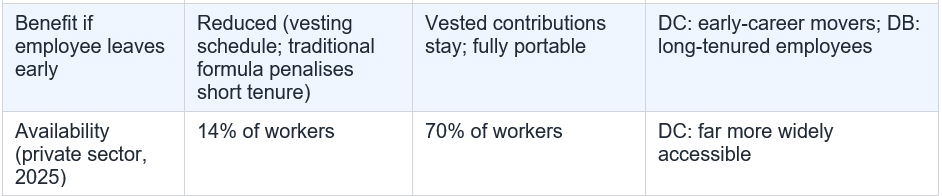
DB vs DC: A Side-by-Side Comparison for Workers
What the Pension Revival Means If You Have One
If you are one of the 14 percent of private-sector workers — or the much larger proportion of public-sector workers — who has access to a defined benefit pension, the current funding environment has specific implications:- Your plan is more secure than at any point in the last 15 years: at 104 percent funded status for Fortune 1000 plans and the highest public plan funding in over 15 years, the structural risk of your pension being cut due to under-funding is lower than it has been since before 2008.
- Understand your vesting schedule: DB pensions typically require five to seven years of service before benefits are fully vested. If you are approaching a vesting milestone, understand the financial implications of leaving before or after that date.
- Understand your benefit formula: traditional DB plans calculate benefits based on years of service and a percentage of final average salary. Know exactly what your monthly benefit will be at different retirement ages and how early retirement affects it.
- Coordinate with Social Security: DB pension income counts as income for Social Security taxation purposes (above $25,000 single / $32,000 MFJ in provisional income). If your pension produces significant income, up to 85 percent of your Social Security benefit may be taxable. Plan for the tax consequences of pension income alongside Social Security.
- Consider the survivor benefit carefully: most DB plans offer a reduced monthly benefit in exchange for a survivor annuity that continues paying a percentage of the benefit to a surviving spouse. This election, typically irrevocable once made, has significant financial consequences and should be made with professional advice.
What the Pension Revival Means If You Don’t Have One
For the 86 percent of private-sector workers without pension access, the revival is relevant primarily as a policy signal and a labour market consideration — not as an immediate change to their retirement planning. The fundamental personal finance challenge is unchanged: build sufficient assets in individual accounts to fund decades of retirement.However, the revival does have some practical implications for this group:
- If you work in a unionised industry or are considering one: the pension restoration trend is most advanced in union environments. Boeing machinists, UAW workers, and employees of large companies with existing frozen plans are most likely to see pension improvements in contract negotiations.
- If you own a small business: cash balance plans have become a highly attractive vehicle for small business owners who are approaching retirement and want to accelerate contributions above 401(k) limits. The contribution limits for a cash balance plan can be dramatically higher than the $24,500 401(k) limit, and the SECURE 2.0 Act provides enhanced tax credits for new plan establishment. This is worth exploring with a qualified pension actuary or financial adviser.
- If you are making job choices: the availability of a pension — particularly a well-funded one in a large company or government context — is a meaningful compensation element that should be valued and compared carefully against higher-salary 401(k)-only offers. The actuarial value of a defined benefit pension can significantly exceed the nominal dollar difference in salary.
Conclusion
The pension revival is real, but it should be understood with precision. The industry is not returning to 1985. The 14 percent of private-sector workers with DB pension access will not become 40 percent or 60 percent in the next decade. The 401(k) system is not being replaced. Forty years of structural, regulatory, and economic change have produced a retirement landscape in which individual accounts and individual investment risk are the norm for most American workers — and that norm is not reversing.What is reversing is the assumption that pensions are inherently unmanageable liabilities that responsible CFOs eliminate at the earliest opportunity. Fortune 1000 pension plans are at 104 percent funded status, their strongest position since before 2008. Half of CFOs now say their DB plans are permanent. Goldman Sachs says the system has never been in better shape. IBM restored pensions for 300,000 employees. The conversation has changed.
The reasons this matters extend beyond the immediate financial position. Defined benefit pensions do something that 401(k)s structurally cannot: they guarantee income for life, regardless of how long the retiree lives, regardless of what markets do, and regardless of how well the individual makes investment decisions. They pool longevity risk across a large population. They remove the existential retirement fear of outliving your money. In an era of 27 percent zero-savings rates, 59 percent inadequate emergency savings, and rising anxiety about Social Security solvency, the reappearance of a benefit that simply pays a guaranteed monthly cheque until death is not a relic. It is a solution to a problem that the DC system has spent forty years creating.
Frequently Asked Questions
Are pensions actually coming back or is this just hype?Both, in different measure. The data is real: Fortune 1000 pension plans ended 2025 at 104% funded status, the fourth consecutive year above full funding (WTW, January 2026). The share of CFOs planning to keep DB plans long-term rose from 28% in 2021 to 50% in 2025 (Mercer CFO survey). IBM restored pensions for 300,000 employees. Goldman Sachs said in March 2026 that 'by several measures, the overall system has never been in better shape.' The revival is genuine among large companies with existing over-funded plans, and among union employers where pension restoration has been a major bargaining demand. What is not happening is a broad reversal of the 40-year trend. The 14% of private-sector workers with DB pension access is not going to become 50% anytime soon. The revival is real; its scale is limited.
Why did IBM restore its pension plan?
IBM froze its defined benefit pension plan in 2008, switching employees to a 401(k) with a 5% match plus 1% automatic contribution. The January 2024 restoration was made possible because IBM's legacy pension plan was significantly over-funded — meaning the invested assets exceeded the promised obligations. By restoring the pension and ending 401(k) contributions, IBM was able to provide a 'stable and predictable' retirement benefit funded from the existing plan assets, without necessarily increasing its overall retirement spending. IBM stated the move would help employees 'diversify their retirement portfolios.' The case illustrates the broader structural opportunity: companies that froze pension plans in 2008–2012 may find those same plans are now over-funded after a decade of strong market returns, creating the option to unfreeze without significant new cash outlay.
What is a cash balance plan and how is it different from a traditional pension?
A cash balance plan is a hybrid pension that combines the employer-funded guarantee of a defined benefit plan with the individual account structure and portability of a 401(k). In a traditional DB pension, the benefit is expressed as a monthly income based on years of service and final salary — a formula that rewards long tenure and is difficult to understand. In a cash balance plan, the employer credits a defined percentage of the employee's salary into an individual account, plus a guaranteed interest credit. When the employee leaves or retires, they can take the balance as a lump sum (and roll it into an IRA) or convert it to an annuity. The key advantage: unlike a traditional pension, a cash balance plan is portable and easy to understand. The employer still bears the investment risk, but the benefit structure is far more compatible with modern, mobile careers. Cash balance plans have grown significantly in popularity among small professional firms and are a central element of the current pension revival.
Is my pension safe if my company's plan is over-funded?
A higher funding level (assets exceeding liabilities) significantly improves the security of a pension benefit. At 104% funded status for Fortune 1000 plans, plan assets exceed obligations, providing a buffer against market declines. However, pension security also depends on: the ongoing financial health of the employer (a bankrupt company may terminate a pension even if funded); the protections of the Pension Benefit Guaranty Corporation (PBGC), the federal agency that insures private-sector DB pensions up to a maximum annual benefit (approximately $75,000 per year for those retiring at 65 in 2026); and the specific terms of your plan. If your employer's DB plan is terminated, the PBGC provides coverage for vested benefits up to the annual guarantee limits. Consult your plan administrator for specific information about your plan's funded status and the coverage that applies to you.
Should I value a pension offer higher than an equivalent 401(k) match?
Generally yes, and often significantly so, because the actuarial value of a guaranteed income for life typically exceeds the nominal dollar equivalent in a 401(k). A pension that pays $2,000 per month for life provides more lifetime income the longer you live — and it is fully guaranteed regardless of market performance. A 401(k) balance provides income only until the balance runs out, and its value depends entirely on investment returns. The correct comparison: ask what lump sum would be needed in a 401(k) to generate the same guaranteed monthly income as the pension. At current annuity rates, a pension paying $2,000 per month may be equivalent to a $350,000–$500,000 lump sum in a 401(k), depending on the retirement age and interest rate environment. When evaluating job offers, ask HR for a pension benefit projection at your expected retirement age and compare it to the 401(k) equivalent. A qualified financial adviser or actuary can help you make this comparison for large financial decisions.
Who is most likely to benefit from the pension revival?
The pension revival is most likely to benefit: (1) employees at large corporations that have existing over-funded frozen DB plans — these companies have the strongest financial case for reopening plans or offering hybrid designs; (2) union members at companies where pension restoration is a collective bargaining demand, particularly in manufacturing, aerospace, and automotive sectors; (3) public-sector employees, who already have significantly better DB pension coverage (86% access vs 14% private-sector) and whose plans are at the best funding levels in 15 years; and (4) small business owners, particularly those in professional services, who may be able to establish cash balance plans with significantly higher contribution limits than 401(k) plans allow. The workers least likely to benefit in the near term: those at small and mid-sized private companies with no existing pension infrastructure, which describes the majority of the US private-sector workforce.
0 Comments
Be the first to share your thoughts on this article.