
Retirement
Can You Afford to Rent in Retirement in UK?

Renting through a 20-year retirement could cost £419,000 — more than twice the average private pension pot. The state pension alone pays just 8.5 months of rent per year. One in three pensioner households could be renting by 2044. This is the retirement planning crisis no one is talking about loudly enough.

That assumption is breaking down for the generation behind them. Rising house prices over the past two decades have locked a growing proportion of working-age people out of homeownership entirely. The Association of British Insurers (ABI), publishing research conducted by the Pensions Policy Institute (PPI) in July 2026, found that nearly two million more people are expected to retire without owning their home. The number of pensioners renting privately is projected to more than triple over the next 20 years, increasing by 1.3 million people. By 2044, one in three pensioner households could be renting.
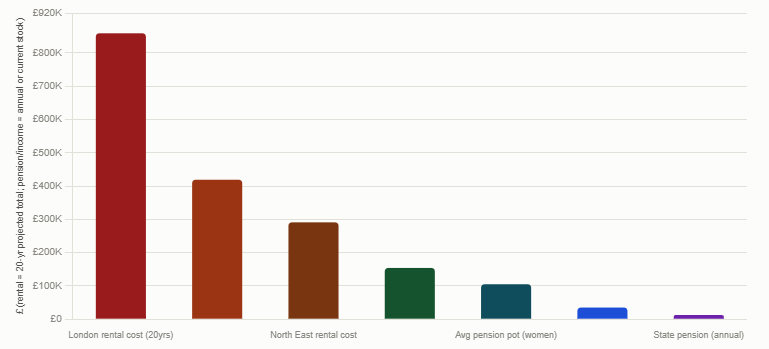
New analysis from Standard Life, published in August 2026, puts a price on what this means in practice: renting through a 20-year retirement could cost approximately £419,000. That figure is more than twice the average private pension pot of £154,000. The state pension — at £12,547.60 per year following the April 2026 triple lock increase of 4.8 percent — covers just 8.5 months of rent at average UK private rental rates. For a renting pensioner who enters retirement with only the state pension and average private savings, the arithmetic does not work.
The Numbers: Renting in retirement: £419,000 average 20-year cost (Standard Life, August 2026). Average private pension pot: £154,000 (ABI/PPI July 2026) — less than 37% of projected rental cost. State pension: £12,547.60/year (2026/27) vs average rent £15,684/year — covers just 8.5 months. 1 in 3 pensioner households could be renting by 2044 (ABI/PPI July 2026).
This figure deserves some context. The £419,000 is not a cash sum that needs to be in a pension pot at the moment of retirement — it is the present-value equivalent of a 20-year stream of rising rent payments, which could be funded through a combination of pension income, state pension, Housing Benefit, and other savings. But as a planning figure, it illustrates the scale of the additional pension saving required to maintain financial security through a renting retirement.
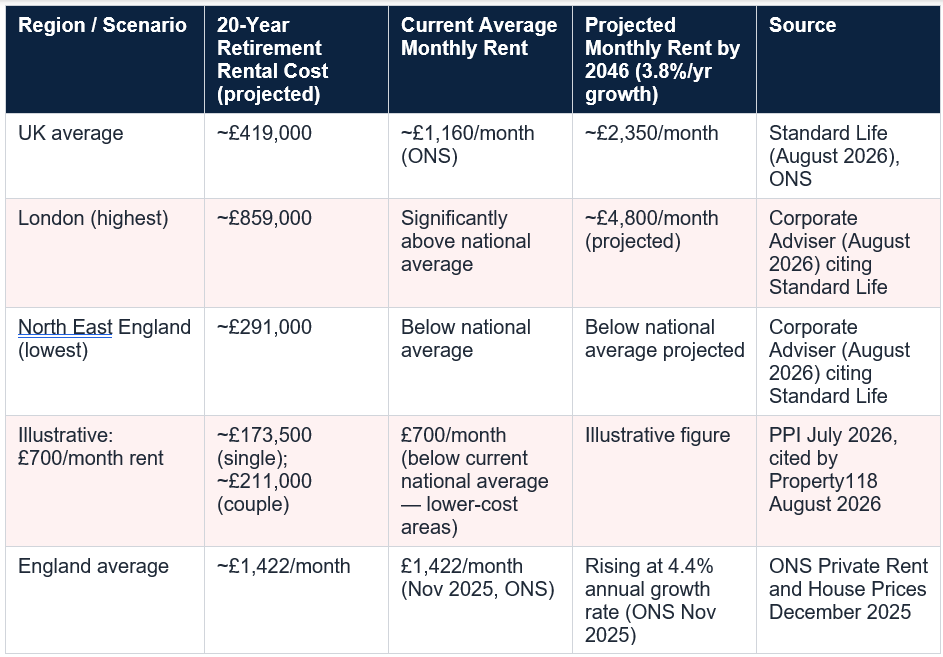
The regional variation is enormous. Corporate Adviser's August 2026 reporting of Standard Life's data identifies London as the highest-cost region, where the projected retirement rental cost reaches approximately £859,000 over 20 years. At the opposite end, the North East of England produces the lowest estimate at approximately £291,000. Even the lowest regional figure of £291,000 is nearly twice the average private pension pot.
Key Insight: The standard ABI/PPI figure of £200,000 to £400,000 to fund a two-bedroom private rental throughout retirement and the Standard Life figure of £419,000 are measuring slightly different things: the PPI range is the pension pot required (accounting for investment returns and drawdown), while the Standard Life £419,000 is the gross nominal rental outlay. Both figures dwarf the average pension pot of £154,000 and the £105,000 average for women. The policy implication is the same: the current pension system is structurally underequipped for a renting retirement.
The remaining 3.5 months of rent — approximately £4,575 per year — would need to be found from other sources: private pension income, savings, Housing Benefit, or Pension Credit. A pensioner with only the State Pension and no private savings would face an annual housing deficit of approximately £4,000 to £5,000 at current rental rates. That deficit grows each year as rents rise.
There is also an emerging issue with the relationship between the State Pension and the income tax Personal Allowance. With the full new State Pension now at £12,547.60 per year and the Personal Allowance frozen at £12,570, a pensioner receiving the full State Pension plus any additional income — including a modest private pension or savings interest — will now pay income tax on the entire additional amount above the £22.40 gap. Govtschemes.org notes that if the triple lock continues delivering increases, the State Pension itself could exceed the Personal Allowance within two to three years, meaning future retirees may pay income tax on their State Pension for the first time.
Catherine Foot, Director, Standard Life Centre for the Future of Retirement (The Intermediary, August 2026): Renting in retirement is set to become far more common in the years ahead. That exposes a fundamental flaw in our current pension system, which is built on the assumption that housing costs fall in later life. With a quarter of 60 to 65-year-olds already living in poverty, a rise in renting risks pushing even more retirees into financial difficulty.
The ONS Private Rent and House Prices data from December 2025 confirms the scale of regional divergence in current rents. England’s average monthly private rent reached £1,422 in November 2025, growing at 4.4 percent annually. Wales averaged £820 per month (growing at 6.1 percent, the fastest rate in the UK). Scotland averaged £1,012 (growing at 3.3 percent). Northern Ireland averaged £871 per month (growing at 6.4 percent).
ONS data on private rental affordability in England shows that private renters on a median household income already spend 36.3 percent of their gross income on rent — well above the traditional affordability threshold of 30 percent. For pensioners, whose income is typically lower than working-age adults’ and less flexible, the affordability ratio is likely to be significantly higher.
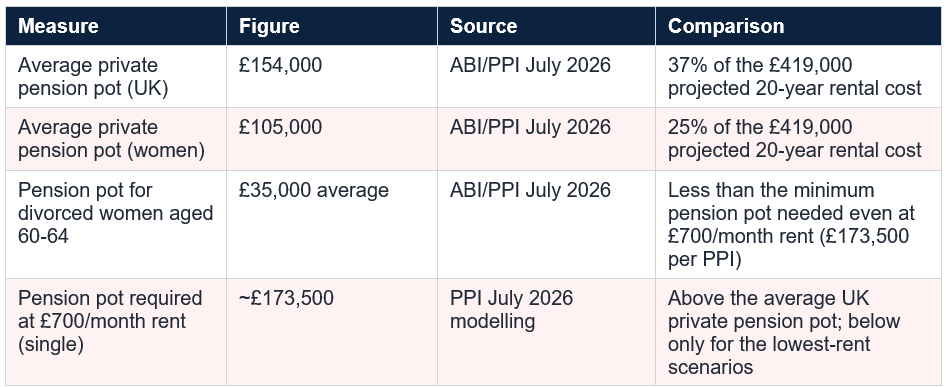
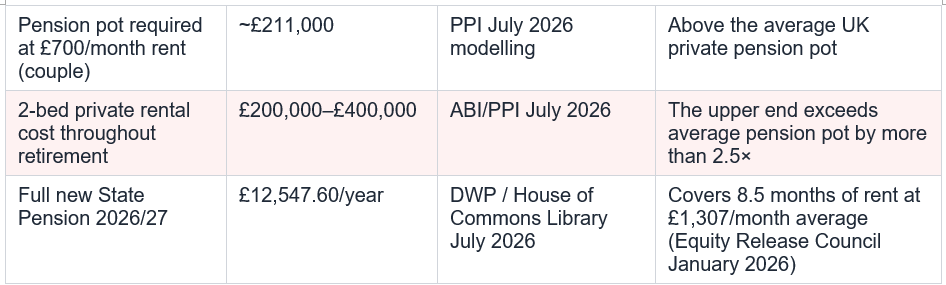
The ABI’s report includes a particularly stark commentary: rental costs threaten to swallow a person’s entire private savings, leaving the State Pension to cover all other expenses. For anyone with below-average pension savings and above-average rental costs — which describes a significant proportion of the projected future renting-pensioner population — the arithmetic of a financially comfortable renting retirement simply does not hold.
This means:
The limitations of Housing Benefit and Pension Credit as solutions to retirement rental affordability:
A realistic planning framework for a renting retirement:
The policy dimensions that need to address the renting-in-retirement problem:
The data is not abstract. One in three pensioner households could be renting by 2044. The number of private-renting pensioners is projected to more than triple over the next 20 years. A quarter of 60 to 65-year-olds are already living in poverty. Divorced women aged 60 to 64 have average pension savings of just £35,000. These are not edge cases; they are the projected mainstream of the next generation of UK retirees.
The policy response — higher auto-enrolment contribution rates, a housing-inclusive retirement income standard, more adequate Housing Benefit, and greater social housing provision for older renters — is straightforward to describe but politically and fiscally demanding to deliver. For individuals who are now in their 40s or 50s and facing a likely renting retirement, the policy response may not arrive in time. The personal response — maximising pension contributions, modelling retirement income against projected rental costs, exploring geographic flexibility, and seeking qualified financial advice — cannot wait for the commission’s recommendations.
Standard Life's analysis published in August 2026, based on ONS private rental data and projected annual rent growth of 3.8%, estimates that renting through a 20-year retirement could cost approximately £419,000. Average monthly UK private rents are currently around £1,160 (ONS), projected to rise to approximately £2,350 per month by 2046. The regional range is wide: London is projected to cost approximately £859,000 over 20 years, while the North East England estimate is approximately £291,000. Even the lowest regional figure is nearly twice the average UK private pension pot of £154,000. For a couple at a more affordable monthly rent of £700, the Pensions Policy Institute's July 2026 modelling estimates a pension pot requirement of approximately £211,000 to fund the rent through retirement.
Can the State Pension cover private rent in retirement?
Not alone. The full new State Pension in 2026/27 is £241.30 per week, or £12,547.60 per year, following the April 2026 triple lock increase of 4.8%. At average Great Britain private rents of £1,307 per month (October 2025 data, ONS), the full State Pension covers approximately 8.5 months of rent per year. The remaining 3.5 months of rent — approximately £4,500 to £5,000 per year at current rates — must come from other sources: private pension income, savings, Housing Benefit, or Pension Credit. Low-income renting pensioners who qualify for Pension Credit and Housing Benefit can significantly reduce the shortfall, but these are means-tested benefits subject to eligibility rules and application requirements. An estimated 880,000 eligible households are not claiming Pension Credit (govtschemes.org, August 2026).
How many pensioners will be renting in 2044?
According to research by the Pensions Policy Institute, commissioned by the Association of British Insurers (ABI) and published in July 2026, one in three pensioner households could be renting by 2044. The analysis finds that nearly two million more people are expected to retire without owning their home compared to the current generation, most of this growth driven by private renters. The number of pensioners privately renting is projected to more than triple over the next 20 years, an increase of approximately 1.3 million people. Currently, 82% of retirees own their home outright (Retirement Voice 2025). The demographic shift reflects the structural decline in working-age homeownership over the past two decades and the resulting cohort of long-term private renters approaching retirement age.
How much pension do I need if I will be renting in retirement?
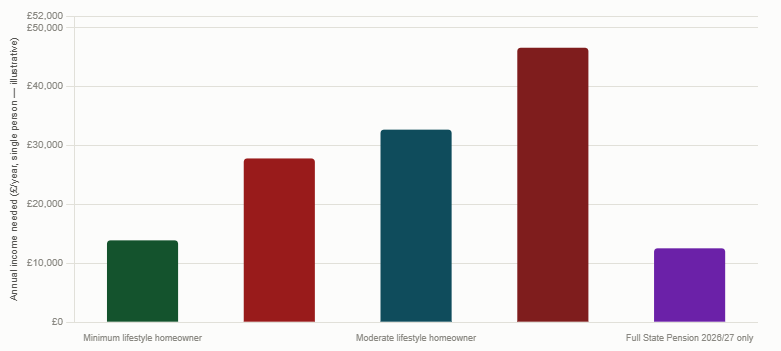
The required pension pot is substantially higher than the standard planning rule for homeowning retirees. A simple framework: take your target annual retirement lifestyle income from the PLSA Retirement Living Standards (minimum £13,900, moderate £32,700, or comfortable £43,100 per year for a single person), add your projected annual rent, subtract the State Pension (£12,547.60 per year in 2026/27), and divide the remaining annual income need by a sustainable drawdown rate of approximately 3.5%. A single renter targeting a moderate lifestyle (£32,700) at a projected annual rent of £16,000 would need approximately £36,152 per year in addition to the State Pension, implying a pension pot of approximately £1 million. This calculation illustrates why standard pension adequacy benchmarks are insufficient for renting retirees. Consult a qualified IFA for a personalised analysis.
What benefits can renting pensioners claim?
Renting pensioners with low income or savings may be eligible for: (1) Housing Benefit — helps cover private rent; eligibility and amount depend on income, savings, and the Local Housing Allowance (LHA) for the area. LHA is set at the 30th percentile of local rents, which typically falls short of average private rents. (2) Pension Credit — an income top-up for pensioners with income below the minimum guarantee level (£218.15 per week for a single person in 2026/27). Pension Credit is also a gateway to Housing Benefit, Council Tax Reduction, free TV licence (age 75+), and NHS help with dental and optical costs. An estimated 880,000 eligible households are not claiming Pension Credit. Check eligibility at gov.uk/pension-credit or via the Pension Credit helpline on 0800 99 1234. (3) Council Tax Reduction — reduces or eliminates Council Tax for eligible low-income pensioners. Note that Housing Benefit for social housing tenants is being migrated to Universal Credit for some groups; pensioners on Pension Credit are generally exempt from this change.
What if I can't save enough to cover rent in retirement?
If you are likely to be renting in retirement and cannot build a pension pot sufficient to cover projected rental costs, the practical steps are: (1) Maximise pension contributions, especially any employer match you are not already claiming. (2) Model the Housing Benefit and Pension Credit entitlement you are likely to have at your projected retirement income level — use entitledto.co.uk or Turn2Us.org.uk for estimates. (3) Consider geographic flexibility: retiring to a lower-cost region materially reduces the required pension income and may move Housing Benefit from inadequate to sufficient. (4) Explore the Rent a Room scheme: up to £7,500 per year in lodger income is tax-free and can supplement pension income significantly. (5) Consider whether delaying retirement by 1 to 3 years materially changes the pension pot available. (6) Book an appointment with a qualified independent financial adviser (IFA) to model your specific situation with current numbers.
Renting Cost vs Pension Savings Gap
Annual Income Needed To rent In retirement
Table of Contents
- The Retirement Assumption That Is Breaking Down
- The £419,000 Question: What Renting in Retirement Actually Costs
- The State Pension vs Rent: A Gap That Leaves No Room for Anything Else
- Who Will Be Renting in Retirement? The Demographics Are Shifting Fast
- Regional Reality: From £291,000 in the North East to £859,000 in London
- The Pension Pot Problem: Average Savings vs Actual Rental Costs
- The Retirement Living Standards Gap: What ‘Minimum’ Actually Costs for Renters
- Women and Renters: A Compounding Disadvantage
- Benefits in Retirement: Housing Benefit, Pension Credit, and What They Cover
- Planning If You Will Rent in Retirement: How Much Do You Actually Need?
- Alternatives and Adaptations: What Are Renters Doing?
- What Needs to Change: The Policy Dimension
- Conclusion: The Pension System Was Built for Owners, Not Renters
- Frequently Asked Questions
The Retirement Assumption That Is Breaking Down
The UK pension system was built on an assumption. That assumption is that by the time a person retires, their housing costs will have fallen significantly — specifically, that the mortgage will have been paid off and the home will be owned outright. It is an assumption that has held true for the current generation of retirees: Retirement Voice 2025 found that 82 percent of current retirees own their home outright, materially reducing their cost of living compared to when they were working and paying a mortgage.That assumption is breaking down for the generation behind them. Rising house prices over the past two decades have locked a growing proportion of working-age people out of homeownership entirely. The Association of British Insurers (ABI), publishing research conducted by the Pensions Policy Institute (PPI) in July 2026, found that nearly two million more people are expected to retire without owning their home. The number of pensioners renting privately is projected to more than triple over the next 20 years, increasing by 1.3 million people. By 2044, one in three pensioner households could be renting.
New analysis from Standard Life, published in August 2026, puts a price on what this means in practice: renting through a 20-year retirement could cost approximately £419,000. That figure is more than twice the average private pension pot of £154,000. The state pension — at £12,547.60 per year following the April 2026 triple lock increase of 4.8 percent — covers just 8.5 months of rent at average UK private rental rates. For a renting pensioner who enters retirement with only the state pension and average private savings, the arithmetic does not work.
The Numbers: Renting in retirement: £419,000 average 20-year cost (Standard Life, August 2026). Average private pension pot: £154,000 (ABI/PPI July 2026) — less than 37% of projected rental cost. State pension: £12,547.60/year (2026/27) vs average rent £15,684/year — covers just 8.5 months. 1 in 3 pensioner households could be renting by 2044 (ABI/PPI July 2026).
The £419,000 Question: What Renting in Retirement Actually Costs
Standard Life's August 2026 analysis of ONS private rental data provides the most comprehensive and most recently cited estimate of retirement rental costs. Based on current average monthly rents of £1,160 and assumed annual rent growth of 3.8 percent, average monthly rents could rise from £1,160 today to approximately £2,350 by 2046. Compounded across a 20-year retirement, the total rental outlay reaches approximately £419,000.This figure deserves some context. The £419,000 is not a cash sum that needs to be in a pension pot at the moment of retirement — it is the present-value equivalent of a 20-year stream of rising rent payments, which could be funded through a combination of pension income, state pension, Housing Benefit, and other savings. But as a planning figure, it illustrates the scale of the additional pension saving required to maintain financial security through a renting retirement.
The regional variation is enormous. Corporate Adviser's August 2026 reporting of Standard Life's data identifies London as the highest-cost region, where the projected retirement rental cost reaches approximately £859,000 over 20 years. At the opposite end, the North East of England produces the lowest estimate at approximately £291,000. Even the lowest regional figure of £291,000 is nearly twice the average private pension pot.
Key Insight: The standard ABI/PPI figure of £200,000 to £400,000 to fund a two-bedroom private rental throughout retirement and the Standard Life figure of £419,000 are measuring slightly different things: the PPI range is the pension pot required (accounting for investment returns and drawdown), while the Standard Life £419,000 is the gross nominal rental outlay. Both figures dwarf the average pension pot of £154,000 and the £105,000 average for women. The policy implication is the same: the current pension system is structurally underequipped for a renting retirement.
The State Pension vs Rent: A Gap That Leaves No Room for Anything Else
The full new State Pension in 2026/27 is £241.30 per week, or £12,547.60 per year, following the April 2026 triple lock increase of 4.8 percent (House of Commons Library, July 2026; Age UK; Moorepay March 2026). This represents a meaningful cash increase of £575 per year compared to 2025/26. But the Equity Release Council’s January 2026 analysis puts the number in housing context plainly: at average UK private rents of £1,307 per month, a retired renter receiving only the full State Pension would have enough income to cover the rent for just 8.5 months of the year.The remaining 3.5 months of rent — approximately £4,575 per year — would need to be found from other sources: private pension income, savings, Housing Benefit, or Pension Credit. A pensioner with only the State Pension and no private savings would face an annual housing deficit of approximately £4,000 to £5,000 at current rental rates. That deficit grows each year as rents rise.
There is also an emerging issue with the relationship between the State Pension and the income tax Personal Allowance. With the full new State Pension now at £12,547.60 per year and the Personal Allowance frozen at £12,570, a pensioner receiving the full State Pension plus any additional income — including a modest private pension or savings interest — will now pay income tax on the entire additional amount above the £22.40 gap. Govtschemes.org notes that if the triple lock continues delivering increases, the State Pension itself could exceed the Personal Allowance within two to three years, meaning future retirees may pay income tax on their State Pension for the first time.
Who Will Be Renting in Retirement? The Demographics Are Shifting Fast
The ABI’s July 2026 report, compiled by the Pensions Policy Institute, provides the most detailed picture of how the renting-in-retirement population is changing. The key trends:- Scale of the shift: nearly two million more people are expected to retire without owning their home compared to the current generation. Private sector pensioner renters will more than triple over the next 20 years, adding 1.3 million to the current number.
- The 1-in-3 projection: by 2044, one in three pensioner households could be renting, compared to far fewer today. This is not a fringe scenario; it is a projected outcome of current housing and savings trends.
- Flat sharers and lodgers: the ABI/PPI report notes that the proportion of flat sharers aged 65 or older has tripled in the last decade, and there has been a 38 percent increase in over-65s taking in lodgers — early evidence that some older renters are already adapting to housing cost pressure by sharing.
- Expectations of younger renters: the Equity Release Council’s January 2026 survey found that 39 percent of current renters believe they will still be renting in retirement — a strikingly high figure that reflects a realistic assessment of their homeownership prospects.
Catherine Foot, Director, Standard Life Centre for the Future of Retirement (The Intermediary, August 2026): Renting in retirement is set to become far more common in the years ahead. That exposes a fundamental flaw in our current pension system, which is built on the assumption that housing costs fall in later life. With a quarter of 60 to 65-year-olds already living in poverty, a rise in renting risks pushing even more retirees into financial difficulty.
Regional Reality: From £291,000 in the North East to £859,000 in London
The national average retirement rental cost of £419,000 over 20 years conceals extraordinary regional variation. For renting pensioners in London, the projected 20-year cost approaches £859,000 — nearly three times the national average private pension pot. Even for those in the North East, the UK’s most affordable private rental region, the projected figure of £291,000 is nearly twice the average private pension savings.The ONS Private Rent and House Prices data from December 2025 confirms the scale of regional divergence in current rents. England’s average monthly private rent reached £1,422 in November 2025, growing at 4.4 percent annually. Wales averaged £820 per month (growing at 6.1 percent, the fastest rate in the UK). Scotland averaged £1,012 (growing at 3.3 percent). Northern Ireland averaged £871 per month (growing at 6.4 percent).
ONS data on private rental affordability in England shows that private renters on a median household income already spend 36.3 percent of their gross income on rent — well above the traditional affordability threshold of 30 percent. For pensioners, whose income is typically lower than working-age adults’ and less flexible, the affordability ratio is likely to be significantly higher.
The Pension Pot Problem: Average Savings vs Actual Rental Costs
The relationship between average pension pot sizes and projected retirement rental costs is the central problem of the renting-in-retirement debate. The ABI’s July 2026 research provides both figures simultaneously, making the comparison unavoidable:The ABI’s report includes a particularly stark commentary: rental costs threaten to swallow a person’s entire private savings, leaving the State Pension to cover all other expenses. For anyone with below-average pension savings and above-average rental costs — which describes a significant proportion of the projected future renting-pensioner population — the arithmetic of a financially comfortable renting retirement simply does not hold.
The Retirement Living Standards Gap: What ‘Minimum’ Actually Costs for Renters
The Pensions UK Retirement Living Standards — produced by the Pensions and Lifetime Savings Association (PLSA) and widely used as a planning benchmark — define three levels of retirement income adequacy for UK retirees. In 2025/26:- Minimum lifestyle: £13,900 per year for a single person. Covers basic needs; limited treats; some social activity. Assumes housing costs are already covered.
- Moderate lifestyle: £32,700 per year for a single person. Covers greater financial security, more holidays, and a higher standard of living. Assumes housing costs are covered.
- Comfortable lifestyle: £43,100 per year for a single person. Covers regular holidays, cultural activities, and financial flexibility. Assumes housing costs are covered.
This means:
- A single pensioner renting at average UK rates would need approximately £27,810 per year just to achieve a minimum standard of living — a figure that the full State Pension alone (£12,547.60) covers less than half of.
- The full new State Pension covers 90 percent of the minimum retirement income standard for a homeowning retiree. For a renting retiree, it covers 45 percent.
- To achieve a moderate lifestyle while renting, a single pensioner would need approximately £46,610 per year — equivalent to a pre-tax salary of approximately £60,000 for a working-age person.
Women and Renters: A Compounding Disadvantage
The renting-in-retirement problem falls disproportionately on women. The ABI/PPI July 2026 report makes this explicit:- Average pension pot for women: £105,000, compared to £154,000 for all adults. This gap reflects the cumulative effect of lower average earnings, career breaks for caring responsibilities, part-time working, and historically lower auto-enrolment rates.
- Divorced women aged 60 to 64 have an average of just £35,000 in pension savings — just over half of married women of the same age and under a third of divorced men. The Letting Agent Today’s July 2026 analysis of the ABI/PPI report notes that ‘these figures would be eclipsed by average rental costs.’
- Women’s retirement prospects are more severely impacted by household breakdown. The ABI/PPI report identifies bereavement and divorce as events that frequently leave women with substantially weaker retirement finances than men in equivalent circumstances.
Benefits in Retirement: Housing Benefit, Pension Credit, and What They Cover
For pensioners who cannot cover rent from pension income alone, the UK benefits system provides two primary housing cost supports:Housing Benefit
Housing Benefit is available to pensioners on low incomes who rent their home. Eligibility and amount depend on income, savings, the Local Housing Allowance (LHA) rate for the area, and household composition. The LHA is set at the 30th percentile of local private rents, which means Housing Benefit does not cover the cost of renting an average-priced property in most areas. Claimants in higher-cost areas — particularly London and the South East — face a significant gap between Housing Benefit entitlement and actual rent.Pension Credit
Pension Credit is an income-related benefit for pensioners with income below a minimum guarantee level (£218.15 per week for a single person in 2026/27). Pension Credit is also a gateway benefit — claiming it opens eligibility for Housing Benefit, Council Tax Reduction, a free TV licence for those aged 75 or over, and NHS help with dental and optical costs. The financial value of the Pension Credit gateway in total is significant, but an estimated 880,000 eligible households are not claiming it (govtschemes.org, August 2026).The limitations of Housing Benefit and Pension Credit as solutions to retirement rental affordability:
- Housing Benefit is means-tested and limited by LHA rates that often fall short of actual market rents, particularly in higher-cost areas. A pensioner renting in London at £1,800 per month may have an LHA entitlement of £1,100 per month, leaving a £700 per month shortfall.
- Pension Credit requires active claiming. The 880,000 unclaimed eligible households represent a substantial population receiving less support than they are entitled to, through lack of awareness or the complexity of the application process.
- Both benefits are subject to policy change. Future governments can and do alter eligibility rules, thresholds, and LHA levels. Relying on benefit income as the primary mechanism for housing cost coverage in retirement carries significant policy uncertainty over a 20 to 30-year retirement horizon.
Planning If You Will Rent in Retirement: How Much Do You Actually Need?
If you know or suspect you will be renting in retirement, the planning calculation is materially different from the standard pension adequacy model. The standard model — targeting retirement income equivalent to roughly two-thirds of pre-retirement earnings — assumes housing costs are lower in retirement. For a renter, they are not.A realistic planning framework for a renting retirement:
- Step 1 — Estimate your retirement rent: find the current average private rent for the area you plan to retire in from Zoopla, Rightmove, or ONS regional data. Apply an annual growth rate of 3 to 4 percent for the number of years until you retire, then for each year of expected retirement. Standard Life’s projection of 3.8 percent annual growth is a reasonable central estimate.
- Step 2 — Determine your total retirement income need: take the Retirement Living Standards figure for your target lifestyle (minimum £13,900, moderate £32,700, or comfortable £43,100 per year, per PLSA) and add your projected annual rent. This is your total annual income target in retirement.
- Step 3 — Subtract guaranteed income sources: the full State Pension provides £12,547.60 per year in 2026/27, rising with the triple lock each year. Any defined benefit pension or annuity income should also be deducted. The remaining gap is the income your private pension pot must generate in drawdown.
- Step 4 — Calculate the required pot size: at a sustainable drawdown rate of approximately 3.5 percent per year, multiply the annual income gap by approximately 28.6 to estimate the pension pot needed at retirement. A renter needing £15,000 per year from private pensions (in addition to the State Pension) would need a pot of approximately £428,000.
- Step 5 — Model Housing Benefit eligibility: if your projected total retirement income is below approximately £20,000 to £25,000 per year and you will be renting, you may be eligible for Housing Benefit. Use a benefit calculator (entitledto.co.uk or Turn2Us.org.uk) with your projected retirement income and the local rent level to estimate entitlement. Do not rely on this as the primary plan; treat it as a supplementary buffer.
Alternatives and Adaptations: What Are Renters Doing?
The ABI/PPI report and the Standard Life analysis both note that some current older renters and approaching-retirement renters are already adapting to the affordability pressures. The strategies being observed:- Flat sharing and lodger income: the proportion of flat sharers aged 65 or older has tripled in the last decade. A 38 percent increase in over-65s taking in lodgers reflects a pragmatic response to housing cost pressure. Under the Rent a Room scheme, up to £7,500 per year in lodger income can be received tax-free, providing a meaningful supplement to pension income.
- Geographic relocation: retiring to a lower-cost area of the UK significantly reduces the rental burden. A pensioner paying £1,800 per month in rent in London who relocates to the North East or Wales can reduce their monthly housing cost to £600 to £800 per month, changing the retirement income calculation entirely. This requires accepting separation from established community ties and access to healthcare services in the area.
- Later retirement: continuing to work beyond State Pension age generates additional income and reduces the number of years for which retirement income must be funded. Deferring the State Pension by one year increases the weekly payment by approximately 1 percent for each nine weeks of deferral.
- Equity release for current homeowners facing retirement transition: some homeowners who purchased property but whose equity has been partially eroded by care costs, divorce settlements, or other financial events use lifetime mortgages to supplement pension income and cover rent after a house sale. This is a complex area where specialist IFA advice is essential.
12. What Needs to Change: The Policy Dimension
The Standard Life analysis and the ABI/PPI research were both published with the explicit purpose of influencing the Second Pensions Commission, which is reviewing the long-term future of pension adequacy in the UK. Catherine Foot of Standard Life’s Centre for the Future of Retirement stated directly that the commission ‘must reflect the financial realities today’s and future retirees face.’The policy dimensions that need to address the renting-in-retirement problem:
- Auto-enrolment contribution rates: the ABI has called on the Pensions Commission to set out a roadmap for increasing auto-enrolment contributions from the current combined rate toward 12 percent of qualifying earnings (ABI, July 2026). Higher contribution rates would generate larger pension pots for future retirees, closing some of the gap between average savings and projected rental costs.
- Housing-cost-inclusive retirement income standards: the Retirement Living Standards published by Pensions UK assume housing is already covered. Policy conversations about pension adequacy should incorporate a housing-inclusive standard that reflects the reality of a renting retirement.
- Local Housing Allowance uprating: if LHA rates fall further behind market rents in high-cost areas, the safety net for renting pensioners erodes. LHA uprating to better track actual market rents is a key policy lever for ensuring housing benefit provides meaningful support.
- Social housing for older renters: the ABI’s Andy Briggs and the ABI board have called for greater recognition of the relationship between housing adequacy and pension adequacy. Investment in genuinely affordable social housing stock for older renters reduces dependence on the private rental market at retirement.
13. Conclusion: The Pension System Was Built for Owners, Not Renters
The arithmetic of renting in retirement, as it currently stands, does not work for most people on average or below-average pension savings. A projected 20-year rental cost of £419,000 against an average pension pot of £154,000 and a State Pension that covers just 8.5 months of rent per year is not a tight squeeze. It is a structural mismatch between a pension system designed for a homeowning retirement and a generation for whom homeownership is increasingly not available.The data is not abstract. One in three pensioner households could be renting by 2044. The number of private-renting pensioners is projected to more than triple over the next 20 years. A quarter of 60 to 65-year-olds are already living in poverty. Divorced women aged 60 to 64 have average pension savings of just £35,000. These are not edge cases; they are the projected mainstream of the next generation of UK retirees.
The policy response — higher auto-enrolment contribution rates, a housing-inclusive retirement income standard, more adequate Housing Benefit, and greater social housing provision for older renters — is straightforward to describe but politically and fiscally demanding to deliver. For individuals who are now in their 40s or 50s and facing a likely renting retirement, the policy response may not arrive in time. The personal response — maximising pension contributions, modelling retirement income against projected rental costs, exploring geographic flexibility, and seeking qualified financial advice — cannot wait for the commission’s recommendations.
Frequently Asked Questions
How much will renting in retirement cost in the UK?Standard Life's analysis published in August 2026, based on ONS private rental data and projected annual rent growth of 3.8%, estimates that renting through a 20-year retirement could cost approximately £419,000. Average monthly UK private rents are currently around £1,160 (ONS), projected to rise to approximately £2,350 per month by 2046. The regional range is wide: London is projected to cost approximately £859,000 over 20 years, while the North East England estimate is approximately £291,000. Even the lowest regional figure is nearly twice the average UK private pension pot of £154,000. For a couple at a more affordable monthly rent of £700, the Pensions Policy Institute's July 2026 modelling estimates a pension pot requirement of approximately £211,000 to fund the rent through retirement.
Can the State Pension cover private rent in retirement?
Not alone. The full new State Pension in 2026/27 is £241.30 per week, or £12,547.60 per year, following the April 2026 triple lock increase of 4.8%. At average Great Britain private rents of £1,307 per month (October 2025 data, ONS), the full State Pension covers approximately 8.5 months of rent per year. The remaining 3.5 months of rent — approximately £4,500 to £5,000 per year at current rates — must come from other sources: private pension income, savings, Housing Benefit, or Pension Credit. Low-income renting pensioners who qualify for Pension Credit and Housing Benefit can significantly reduce the shortfall, but these are means-tested benefits subject to eligibility rules and application requirements. An estimated 880,000 eligible households are not claiming Pension Credit (govtschemes.org, August 2026).
How many pensioners will be renting in 2044?
According to research by the Pensions Policy Institute, commissioned by the Association of British Insurers (ABI) and published in July 2026, one in three pensioner households could be renting by 2044. The analysis finds that nearly two million more people are expected to retire without owning their home compared to the current generation, most of this growth driven by private renters. The number of pensioners privately renting is projected to more than triple over the next 20 years, an increase of approximately 1.3 million people. Currently, 82% of retirees own their home outright (Retirement Voice 2025). The demographic shift reflects the structural decline in working-age homeownership over the past two decades and the resulting cohort of long-term private renters approaching retirement age.
How much pension do I need if I will be renting in retirement?
The required pension pot is substantially higher than the standard planning rule for homeowning retirees. A simple framework: take your target annual retirement lifestyle income from the PLSA Retirement Living Standards (minimum £13,900, moderate £32,700, or comfortable £43,100 per year for a single person), add your projected annual rent, subtract the State Pension (£12,547.60 per year in 2026/27), and divide the remaining annual income need by a sustainable drawdown rate of approximately 3.5%. A single renter targeting a moderate lifestyle (£32,700) at a projected annual rent of £16,000 would need approximately £36,152 per year in addition to the State Pension, implying a pension pot of approximately £1 million. This calculation illustrates why standard pension adequacy benchmarks are insufficient for renting retirees. Consult a qualified IFA for a personalised analysis.
What benefits can renting pensioners claim?
Renting pensioners with low income or savings may be eligible for: (1) Housing Benefit — helps cover private rent; eligibility and amount depend on income, savings, and the Local Housing Allowance (LHA) for the area. LHA is set at the 30th percentile of local rents, which typically falls short of average private rents. (2) Pension Credit — an income top-up for pensioners with income below the minimum guarantee level (£218.15 per week for a single person in 2026/27). Pension Credit is also a gateway to Housing Benefit, Council Tax Reduction, free TV licence (age 75+), and NHS help with dental and optical costs. An estimated 880,000 eligible households are not claiming Pension Credit. Check eligibility at gov.uk/pension-credit or via the Pension Credit helpline on 0800 99 1234. (3) Council Tax Reduction — reduces or eliminates Council Tax for eligible low-income pensioners. Note that Housing Benefit for social housing tenants is being migrated to Universal Credit for some groups; pensioners on Pension Credit are generally exempt from this change.
What if I can't save enough to cover rent in retirement?
If you are likely to be renting in retirement and cannot build a pension pot sufficient to cover projected rental costs, the practical steps are: (1) Maximise pension contributions, especially any employer match you are not already claiming. (2) Model the Housing Benefit and Pension Credit entitlement you are likely to have at your projected retirement income level — use entitledto.co.uk or Turn2Us.org.uk for estimates. (3) Consider geographic flexibility: retiring to a lower-cost region materially reduces the required pension income and may move Housing Benefit from inadequate to sufficient. (4) Explore the Rent a Room scheme: up to £7,500 per year in lodger income is tax-free and can supplement pension income significantly. (5) Consider whether delaying retirement by 1 to 3 years materially changes the pension pot available. (6) Book an appointment with a qualified independent financial adviser (IFA) to model your specific situation with current numbers.
0 Comments
Be the first to share your thoughts on this article.