

Retirement
Accountant's Pension Plan for an Unprepared Generation

Table of Contents
- The Generation That Knows It Should Save -- But Hasn't
- Why Millennials and Gen Z Face a Harder Pension Challenge Than Previous Generations
- Generational Pension Preparedness: Where Each Generation Stands in 2026
- The Accountant's 7-Step Pension Plan for the Unprepared Generation
- The Accountant's Pension Action Grid: UK vs US Side by Side
- The Compound Interest Case: Why Starting Today Beats Starting Tomorrow
- Special Situations: Pension Planning for Common Millennial and Gen Z Scenarios
- Self-Employed / Gig Workers: No Employer, No Auto-Enrolment
- Career Breaks and Maternity/Paternity Leave: Protecting Pension Continuity
- Pension and Property: Both, in the Right Order
- Conclusion
- Frequently Asked Questions (FAQ)
The Generation That Knows It Should Save -- But Hasn't
There is a specific kind of financial guilt that belongs predominantly to Millennials and Gen Z: the knowledge that you should be saving more for retirement, combined with the simultaneous experience of every other financial priority -- rent, student loan repayments, childcare, the mortgage that may or may not ever happen -- consuming everything available. The retirement account sits there, underfunded or unopened, while the cost of living does not.Standard Life (May 25, 2026): 'More than any other generation, Millennials worry about the cost of living. Nearly half are homeowners (46%), and over half are raising children under the age of 18 (57%). Over a third (37%) say they've done no retirement planning at all.' The generation that grew up being told about compound interest and the importance of starting early is, in significant numbers, the generation that has not started yet. And the generation behind them faces similar barriers: Pensions Policy Institute (February 2025): UK Gen Z face annual tuition fees of £9,250 -- more than three times the £3,000 faced by early Millennials -- creating 'a more prolonged financial burden that significantly affects their disposable income and capacity to save for the long term, including for retirement.'
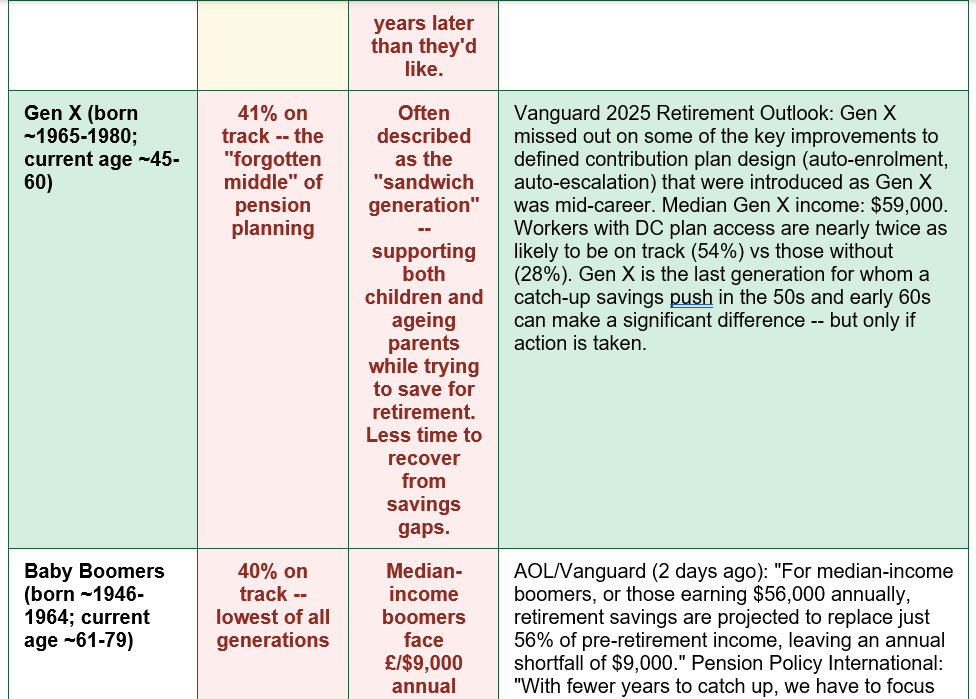
The data on retirement preparedness across generations in 2026, while not uniformly catastrophic, does reveal a significant gap between what is needed and what is happening. Vanguard's 2025 Retirement Outlook found that only 42% of all US adults are on track to maintain their standard of living in retirement. Workers without access to a defined contribution plan are less than half as likely to be on track as those with one. This guide is the accountant's answer to that gap: a practical, step-by-step pension plan designed for the generation that knows it needs to act -- and needs to know exactly what action to take.
Why Millennials and Gen Z Face a Harder Pension Challenge Than Previous Generations
The pension challenge facing younger generations is not simply a story of financial irresponsibility. The structural conditions in which Millennials and Gen Z are building their financial lives are genuinely more difficult than those their parents faced -- in ways that compound over decades.- The shift from defined benefit to defined contribution: Previous generations were more likely to benefit from defined benefit (DB) pension schemes -- the 'final salary' pensions that provided a guaranteed income in retirement linked to earnings history and service length. DB pensions were primarily employer-funded and required no investment decisions from the employee. The shift over the past three decades has moved almost all new pension provision to defined contribution (DC) schemes, where the retirement income depends entirely on contributions made, investment returns achieved, and drawdown decisions taken. The burden of adequacy has shifted from employer to employee -- and most employees are not equipped for it.
- Student debt burden compressing contribution capacity: Pensions Policy Institute (February 2025): UK Gen Z face £9,250/year tuition fees compared with £3,000 faced by Millennials and £0 faced by Boomers. 'This sharp rise in fees has resulted in higher average debt levels for Gen Z, creating a more prolonged financial burden that significantly affects their disposable income and capacity to save for the long term, including for retirement.' In the US, student loan balances have similarly increased the financial burden of the working years during which compound growth is most powerful.
- Housing costs consuming income that previous generations invested: The period during which compound growth is most powerful -- the 20s and early 30s -- is precisely the period when Millennials and Gen Z are most exposed to housing cost pressure: renting at high cost in cities where employment exists, or stretching to afford mortgages at post-2021 interest rates. IFA Magazine/Standard Life (April 9, 2026): 'Many younger adults are juggling more immediate financial pressures -- from rent and mortgage payments to day-to-day living costs -- which can push long-term retirement planning further down the priority list.'
- State pension uncertainty -- a later, less certain safety net: UK state pension age is rising: from 65 to 66 (complete for men and women), rising to 67 by 2028 for those born after April 1960, and possibly to 68 for younger generations. Millennials and Gen Z will receive the state pension later and -- given ongoing political and fiscal pressures on the system -- face more uncertainty about its future value than preceding generations. Building private pension provision is therefore more important for this generation than for those who could rely more heavily on state provision.
Generational Pension Preparedness: Where Each Generation Stands in 2026
The following table maps the retirement preparedness position of each generation, with both UK and US data, identifying the specific challenges and opportunities for each: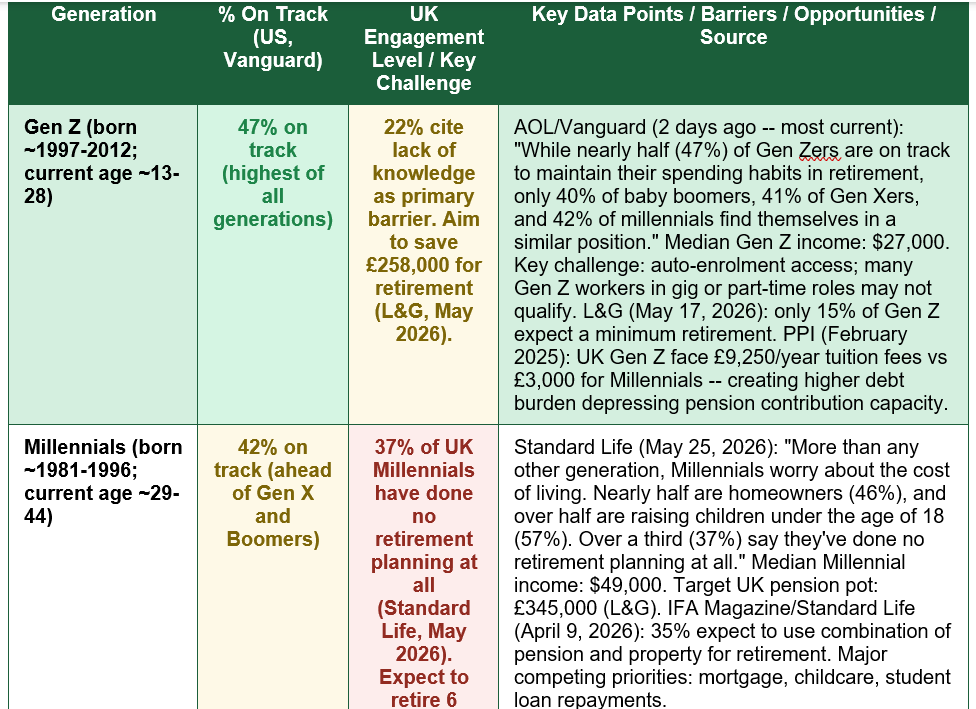

The Accountant's 7-Step Pension Plan for the Unprepared Generation
STEP 1: Know Your Number -- What You Actually Need to Save | The calculation that turns abstract anxiety into a specific plan
The first step in any pension plan is knowing what you are planning toward. Retirement savings targets feel arbitrary without a specific calculation behind them. L&G (May 17, 2026): 'Millennials aim to save £345,000. Gen Z is more cautious, aiming for £258,000.' These are self-reported ambitions -- the accountant's version requires working backward from a specific retirement income target. The calculation: (1) Estimate your desired annual retirement income -- the income you want to live on, adjusted for the fact that some costs (mortgages, commuting, childcare) will be lower in retirement, while others (healthcare, leisure) may be higher. A common starting benchmark is 60-70% of pre-retirement income. (2) Subtract any guaranteed income -- the state pension (UK: currently £221.20/week full new state pension if you have 35 qualifying NI years = approximately £11,500/year; check your personal forecast at gov.uk/check-state-pension) or Social Security (US: check your projected benefit at ssa.gov/myaccount). (3) The remainder is what your pension savings must provide annually. At a 4% annual withdrawal rate, dividing this annual income need by 0.04 gives the target pension pot (e.g. needing £/$20,000/year from savings: £/$20,000 / 0.04 = £/$500,000 target pot). UK example: target retirement income £30,000/year. State pension = approximately £11,500. Pension savings needed to provide = £18,500/year. Target pension pot at 4% withdrawal = £462,500. US example: target retirement income $50,000/year. Social Security = approximately $18,000/year. Pension savings needed = $32,000/year. Target pot at 4% withdrawal = $800,000. Once the specific number is known, the monthly saving required to reach it -- at a realistic assumed return -- can be calculated and compared to current contributions.STEP 2: Start or Increase Workplace Pension / 401(k) Contributions Today | The highest-returning single action available to most employees
The workplace pension (UK) or 401(k) (US) is the foundation of every pension plan -- and for most employees, increasing contributions to capture the full employer match is the single highest-returning financial action available. Vanguard: 'Workers with access to DC plans are nearly twice as likely to be on track for retirement (54%) compared with those without access (28%). These plans are transforming retirement outcomes, especially for younger generations, by making saving easier and more effective through features like autoenrolment, automatic escalation, and the ability to invest in target-date funds.' UK: the minimum auto-enrolment contribution rate is 8% total (5% employee + 3% employer minimum). Check your employer's matching structure: some employers match above the minimum -- for example, an employer who matches 5% employee contribution with 5% employer contribution is offering a 100% immediate return on the employee's contribution up to the match threshold. Increasing your contribution to capture the maximum employer match is free money -- the highest possible return on any contribution. UK 2026/27 pension annual allowance: £60,000 (or 100% of annual earnings if lower). Contributions receive income tax relief at your marginal rate: a basic rate taxpayer contributes £80 and the government adds £20 to make £100 in the pension; a higher rate taxpayer can claim an additional £20 back through Self Assessment. US 2026: 401(k) employee contribution limit $24,500 (up from $23,500 in 2025). Super catch-up contributions for ages 60-63: additional $11,250 (new under SECURE 2.0). The action: log into your employer's pension or 401(k) portal today. Find the maximum employer match threshold. Increase your contribution to at least that level. Set up automatic annual escalation (increase contribution percentage each April/with each pay rise).STEP 3: Open and Fund an ISA (UK) or Roth IRA (US) | The tax shelter that makes pension savings more flexible
Pension savings are tax-efficient but inflexible -- in the UK they cannot be accessed before age 57 (rising to 57 in April 2028 from the current 55); in the US, 401(k) and traditional IRA withdrawals before age 59.5 attract a 10% penalty plus income tax. For Millennials and Gen Z who may want to retire before traditional retirement age -- or who want financial flexibility before their pension becomes accessible -- a parallel tax-efficient savings vehicle is essential. UK: the Stocks and Shares ISA (up to £20,000/year; all growth and withdrawals permanently tax-free) is the most flexible and widely accessible long-term savings vehicle. Unlike a pension, ISA funds can be accessed at any age with no tax consequence. A Lifetime ISA (LISA) is additionally available for those under 40: up to £4,000/year with a 25% government bonus (worth up to £1,000/year), accessible from age 60 for retirement or at any age for first home purchase. The LISA is effectively a 25% guaranteed return on contributions -- but has a 25% withdrawal penalty for non-qualifying withdrawals that effectively erodes the bonus plus approximately 6% of principal. US: the Roth IRA ($7,500/year limit in 2026; contributions from after-tax income; all qualified withdrawals completely tax-free; contributions (not growth) can be withdrawn at any time penalty-free, providing some flexibility). Roth IRAs are particularly valuable for those currently in lower tax brackets who expect to be in higher brackets in retirement -- the tax is paid now at the lower rate, and all future growth is tax-free. The Health Savings Account (HSA), where available to those in high-deductible health plans, provides a triple tax advantage: deductible contributions, tax-free growth, and tax-free withdrawals for qualified medical expenses, making it effectively a tax-advantaged retirement healthcare fund.STEP 4: Review and Optimise Your Investment Strategy | The difference between 4% and 7% annual returns over 30 years is retirement vs poverty
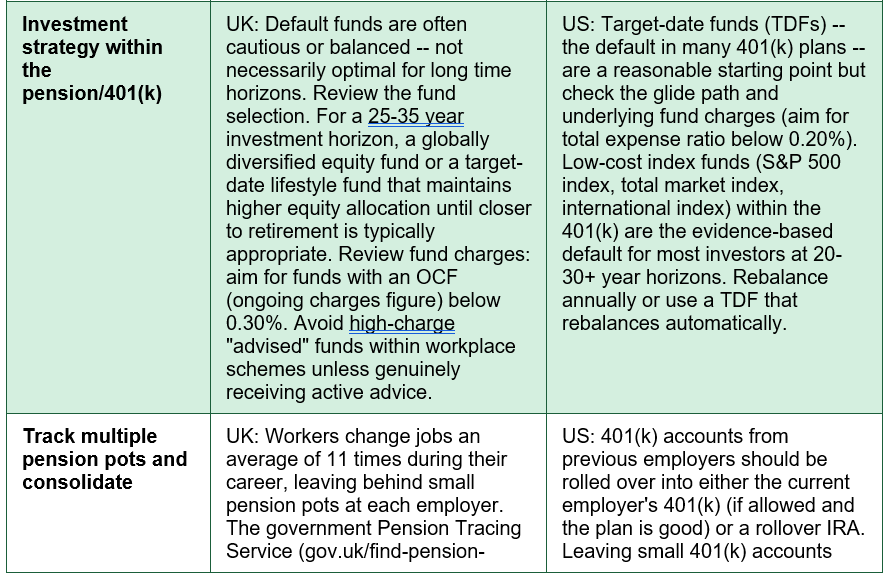
Most workplace pension default funds are designed to be acceptable for the broadest range of employees -- which means they are typically not optimal for any specific individual, particularly those with long investment horizons. A 25-year-old who allows their pension to sit in the default fund throughout their career may generate significantly lower returns than one who reviews and optimises their fund selection. The accountant's investment principles for pension savings at long horizons: (1) Equity exposure for long horizons: at 20-30+ years from retirement, the evidence overwhelmingly supports higher equity allocation. Over all historical 20-year periods in major equity markets, globally diversified equity portfolios have outperformed bonds and cash. The volatility that makes equities uncomfortable in the short term is the same volatility that generates superior long-term returns. For those more than 15 years from retirement, high equity allocation (70-100%) within the pension is typically appropriate. (2) Low costs compound in your favour: fund charges compound over decades. A fund with an annual charge of 1.5% vs one at 0.25% creates a difference of approximately 1.25% per year -- which over 30 years represents tens of thousands of pounds or dollars lost to fees rather than accumulated for retirement. Look for globally diversified index funds with an OCF/TER below 0.30% (UK) or expense ratio below 0.20% (US). (3) Diversification reduces risk without reducing long-term returns: a globally diversified portfolio (UK equities, global equities, bonds, property) reduces the risk that any single market or asset class underperformance destroys the pension pot. Concentration in UK equities alone or in the employer's company stock (particularly risky in a 401(k)) is a common and costly pension investment error. (4) Review contributions and allocation annually, not monthly: obsessive monitoring of pension values encourages the worst investment behaviour (panic selling in market downturns, chasing recent performance). Annual review is appropriate for most pension investors.STEP 5: Track and Consolidate Old Pension Pots | The pension pot you forgot about may be worth more than you think
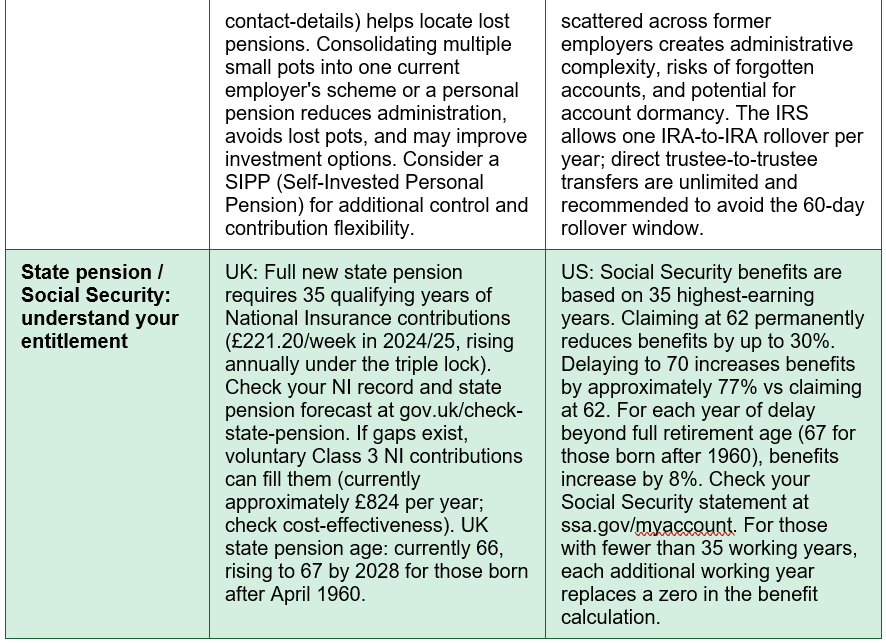
The average UK worker changes jobs 11 times during their career. Each change potentially leaves behind a small pension pot with the previous employer's scheme. These scattered pots create administrative complexity, cost in total fund charges, risk of genuinely lost pensions, and difficulty in making coherent investment decisions across the total retirement savings picture. The government Pension Tracing Service (gov.uk/find-pension-contact-details) allows anyone to find contact details for former employer pension schemes where the pension may still exist. In the UK, consolidating old pots into the current employer's scheme (if permitted) or into a SIPP (Self-Invested Personal Pension) with competitive charges and good investment options is typically beneficial -- though care must be taken not to inadvertently transfer out of any remaining defined benefit schemes without specialist advice, as these guaranteed pensions are often significantly more valuable than they appear. US: 401(k) accounts from former employers should be rolled over into either the current employer's plan (if permitted and the plan is good) or a rollover IRA. The rollover IRA provides maximum investment flexibility. Use a direct trustee-to-trustee transfer to avoid the 60-day rollover window and the 20% withholding that applies to indirect rollovers. The IRS allows one IRA-to-IRA rollover per year; direct transfers are unlimited.STEP 6: Plan for the State Pension and Understand Your Entitlement | The foundation income source most people underestimate or ignore
The state pension (UK) and Social Security (US) represent a significant guaranteed income floor in retirement that is frequently underestimated or simply not factored into retirement planning. Understanding your specific entitlement and optimising it is one of the highest-value, lowest-cost planning steps available. UK state pension: the full new state pension requires 35 qualifying years of National Insurance (NI) contributions and is currently £221.20/week (approximately £11,500/year). It rises annually under the triple lock (the higher of earnings growth, CPI inflation, or 2.5%). Check your NI record and receive a state pension forecast at gov.uk/check-state-pension. If you have gaps in your NI record, voluntary Class 3 NI contributions to fill them are typically good value: one voluntary year of NI contributions currently costs approximately £824 and generates approximately £329/year in additional state pension -- a payback period of around 2.5 years. US Social Security: benefits are calculated from the highest 35 earning years. Claiming before full retirement age (67 for those born after 1960) permanently reduces benefits; delaying beyond FRA increases benefits by 8% per year up to age 70. The difference between claiming at 62 vs 70 can represent more than $100,000 in lifetime benefit for a typical earner with normal life expectancy. Check your statement and projected benefit at ssa.gov/myaccount. The Social Security statement is now available online at any age and provides the most accurate projection of your expected benefit.STEP 7: Automate, Review Annually, and Increase With Every Pay Rise | The habit that makes the plan self-sustaining
The most effective pension plan is one that is largely automatic -- requiring minimal ongoing willpower to maintain. The behavioural evidence is unambiguous: Vanguard's research shows that auto-enrolment and automatic escalation features are the most powerful drivers of improved retirement outcomes at the population level. Workers who are auto-enrolled save; workers who need to opt in frequently do not. The automation principles for pension planning: (1) Auto-escalate contributions: set pension/401(k) contributions to increase by 1% of salary each April (UK) or annually (US) until reaching the target contribution rate. Many 401(k) plans allow this to be configured once and forgotten. (2) Direct every pay rise into the pension before it reaches spending: commit that each future pay rise will direct at least 50% of the net increase to pension contributions or ISA/Roth IRA. This prevents lifestyle inflation from consuming every income increase without any increase in retirement provision. (3) Annual review but not more: review pension pot value, contribution rate, fund allocation, and trajectory against the retirement number (Step 1) once per year. Adjust if life circumstances have changed (income, family, retirement timeline). Do not react to short-term market movements. (4) Review at every job change: a new employer may offer better matching, more contribution flexibility, or better fund options. Always compare the new employer's pension terms with the previous scheme and consider whether consolidating old pots at this point is appropriate.The Accountant's Pension Action Grid: UK vs US Side by Side
The following table maps specific pension actions for each key planning area across both UK and US systems, with current 2026 limits and mechanisms: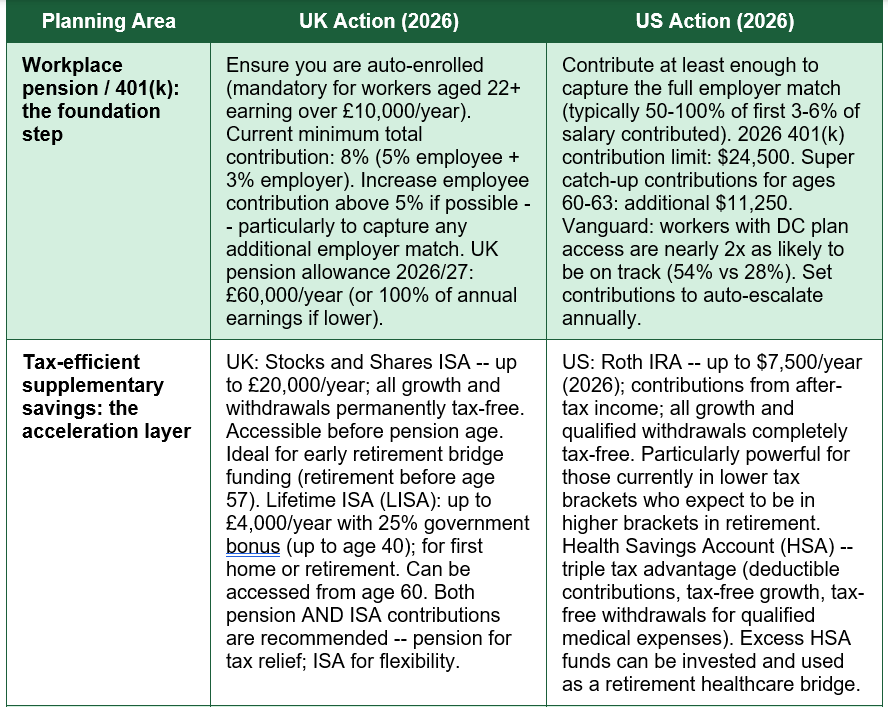
The Compound Interest Case: Why Starting Today Beats Starting Tomorrow
The accountant's most important contribution to pension planning is the mathematics of compounding. Abstract statements about 'starting early' do not convey the scale of the advantage. Specific numbers do.Scenario A -- Start at 25, contribute £/$300/month for 10 years, then stop: Total contributed: £/$36,000. At 7% annual return, value at 65: approximately £/$567,000. The 10 years of contributions from 25-35 then 30 years of compounding produces more than the scenario below.
Scenario B -- Start at 35, contribute £/$300/month for 30 years (to 65): Total contributed: £/$108,000 (3x more money contributed). At 7% annual return, value at 65: approximately £/$340,000. Three times more contributed; 40% less money at retirement. This is the compound interest advantage quantified.
Scenario C -- Start at 25 AND continue to 65 (40 years at £/$300/month): Total contributed: £/$144,000. At 7% annual return, value at 65: approximately £/$907,000. The combination of early start and consistent contribution is most powerful -- nearly £/$1 million from £/$300/month over 40 years.
The cost of one year's delay at 25: £/$300/month invested at 25 at 7% for 40 years = approximately £/$907,000. The same starting at 26 (one year's delay) for 39 years = approximately £/$844,000. One year's delay at 25 costs approximately £/$63,000 in terminal value -- from 12 months of postponement.
The accountant's pension perspective: why 8% is not enough -- and what to do about it. UK auto-enrolment minimum total contribution is 8% of qualifying earnings. This is better than nothing -- but the consensus among pension professionals is that 8% is insufficient for most people to achieve a comfortable retirement income. The Pensions and Lifetime Savings Association (PLSA) calculates that a 'comfortable' retirement (defined as £43,100/year for a couple and £31,300/year for a single person as of 2024) requires significantly more than the minimum 8% contribution for most workers. The accountant's recommended contribution target: at least 15% of gross salary (including employer contributions) for those on average incomes who want to maintain their standard of living in retirement. This means: if your employer contributes 3%, you should be contributing at least 12% personally. If your employer contributes 5%, you need at least 10%. The 15% total is a starting point -- those starting later than 30 may need to contribute more. Standard Life (May 25, 2026): 'Millennials are more likely than other generations to have a defined contribution workplace pension, meaning they make regular payments towards their retirement.' The structure is there for most Millennials. The contribution rate is the variable that most needs to increase.
Special Situations: Pension Planning for Common Millennial and Gen Z Scenarios
Self-Employed / Gig Workers: No Employer, No Auto-Enrolment
The self-employed are excluded from auto-enrolment in the UK and may not have access to an employer-sponsored 401(k) in the US. This gap is particularly significant: PPI (February 2025) notes that self-employed workers are disproportionately represented among those with the lowest pension savings. UK options: a Self-Invested Personal Pension (SIPP) or personal pension provides the same tax relief as a workplace pension (20% at source for basic rate taxpayers; additional relief claimable through Self Assessment for higher rate payers). Contributions to a SIPP can be made at any time and in any amount up to the annual allowance. Providers: Hargreaves Lansdown, Vanguard UK, AJ Bell, Nutmeg. US options: the SEP-IRA (Simplified Employee Pension): contributions up to 25% of net self-employment income or $69,000 (2026), whichever is less. The SIMPLE IRA (if the self-employed worker has employees). The Solo 401(k) (individual 401(k)): allows contributions as both employee ($24,500 in 2026) and employer (up to 25% of compensation), potentially allowing total contributions up to $69,000 in 2026. The Solo 401(k) is typically the most powerful retirement savings vehicle for self-employed workers with no employees.Career Breaks and Maternity/Paternity Leave: Protecting Pension Continuity
Career breaks, maternity leave, and periods of part-time work create gaps in pension contributions that compound over time. During statutory maternity or paternity pay in the UK, employer pension contributions typically continue, and the employee's contributions are calculated on the statutory pay amount (not pre-leave salary) -- which may create a contribution gap without the employee realising it. UK: check whether employer contributions continue at full rate or on reduced pay during maternity/paternity leave. Consider making additional personal contributions during leave if affordable, or planning to increase contributions on return to compensate. Voluntary NI contributions should also be considered during extended career breaks to protect state pension entitlement. US: if contributions to a 401(k) must be paused during a career break, prioritise making additional contributions when employment resumes -- the annual contribution limit ($24,500 in 2026) applies to the calendar year and cannot be carried forward.Pension and Property: Both, in the Right Order
IFA Magazine/Standard Life (April 9, 2026): 'More than one in three Millennials (35%) and Gen Z (39%) expect to use a combination of pension savings and property to fund their retirement.' The desire to use property as part of retirement funding is legitimate and common. The accountant's view on sequencing: pension (up to employer match limit) first; then ISA or emergency fund; then additional pension or property savings. The rationale: employer pension matching provides the highest guaranteed return. The ISA provides flexibility for the deposit. Additional property investment works alongside pension savings but should not replace it, because property lacks the tax relief, employer matching, and liquidity that pension savings provide in different proportions.THE PENSION PLAN QUICK-START CHECKLIST -- DO THESE THIS WEEK: TODAY: (1) Log into your employer's pension or 401(k) portal. Find the maximum employer match threshold. Check your current contribution rate against it. If you are not capturing the full match: increase your contribution to do so. (2) UK: visit gov.uk/check-state-pension to see your forecast and check for NI gaps. US: visit ssa.gov/myaccount to see your Social Security earnings record and benefit projection. (3) Calculate your pension number: desired annual retirement income minus state pension/Social Security = annual income from savings needed; divide by 0.04 = target pension pot. THIS WEEK: (4) If no ISA/Roth IRA is open: open one. UK: open a Stocks and Shares ISA with Vanguard UK, Hargreaves Lansdown, or equivalent. US: open a Roth IRA with Vanguard, Fidelity, or Schwab. Set up a monthly automatic contribution -- even £/$50/month to begin. (5) If self-employed: open a SIPP (UK) or SEP-IRA/Solo 401(k) (US) this week. The structure matters more than the initial contribution amount. THIS MONTH: (6) Review your pension fund allocation. If in a default fund: check the equity allocation and total annual charge (aim for below 0.30% OCF UK / 0.20% expense ratio US). (7) Locate any old pension pots from previous employers. UK: use gov.uk/find-pension-contact-details. US: contact former employers' HR departments or check the National Registry of Unclaimed Retirement Benefits. ANNUALLY: (8) Review contribution rate and increase by at least 1% of salary. (9) Compare pension trajectory against target number. Adjust if significantly behind. UK FREE GUIDANCE: MoneyHelper 0800 138 7777 | Pension Wise (for those aged 50+). US FREE GUIDANCE: CFPB consumerfinance.gov | ssa.gov.
FIVE PENSION MISTAKES THE UNPREPARED GENERATION IS MOST LIKELY TO MAKE: (1) LEAVING EMPLOYER PENSION MATCH UNCAPTURED. If your employer matches contributions up to 5% of salary and you contribute only 3%, you are leaving 2% of salary in free money on the table every year. Over a 30-year career, this uncaptured match could represent tens of thousands in lost retirement savings -- even before accounting for the lost investment growth on those contributions. Vanguard: workers with DC plan access are nearly 2x more likely to be on track. Access the plan fully. (2) LEAVING PENSION IN THE DEFAULT FUND WITHOUT REVIEWING IT. Auto-enrolment got you into the pension -- good. The default fund may not be appropriate for your time horizon, risk profile, or cost tolerance. Check the equity allocation and annual charge of your current fund. At 20+ years from retirement, a 100% equity globally diversified index fund is typically more appropriate than a 60/40 balanced fund, and usually charges less. (3) LOSING TRACK OF OLD PENSION POTS. The average UK worker changes jobs 11 times. Each job change potentially leaves behind a pension pot. Pension consolidation takes one afternoon and can significantly improve your retirement picture by giving you visibility and control over your total savings. (4) NOT INCREASING CONTRIBUTIONS WHEN INCOME INCREASES. The lifestyle inflation trap: each pay rise is absorbed by increased spending, leaving the pension contribution rate unchanged. Commit now that each future pay rise will direct at least 50% of the net increase to pension savings. (5) TREATING THE STATE PENSION AS 'NOT REAL' BECAUSE IT IS FAR AWAY. The UK state pension (£221.20/week for 2024/25) and US Social Security represent real income in retirement that reduces the private savings burden significantly. Ignoring it, or failing to check for and fill NI/Social Security record gaps, leaves guaranteed income on the table. Check your entitlement today at gov.uk/check-state-pension (UK) or ssa.gov/myaccount (US).
Conclusion
The generation that is most worried about its financial future is also the generation that has the most powerful asset available to it: time. The compound interest scenarios in this guide quantify what that asset is worth. Starting at 25 and contributing £/$300/month for just 10 years generates more retirement wealth than starting at 35 and contributing the same amount for 30 years -- because time in the market, not the quantity of money contributed, is the primary driver of long-term wealth.Standard Life (May 25, 2026): 37% of UK Millennials have done no retirement planning at all. Vanguard 2025: only 42% of US adults are on track. L&G (May 17, 2026): 22% of Gen Z cite lack of knowledge as a barrier. This guide is the accountant's response to all three statistics: a specific, step-by-step plan that converts the knowledge barrier into a checklist, converts the inaction into a series of concrete one-time and ongoing actions, and converts the anxiety about retirement into a structured approach that can begin this week with a 30-minute session on an employer's pension portal and a conversation with a MoneyHelper adviser.
The unprepared generation is not the generation that cannot save. It is the generation that has not yet been given a sufficiently clear map of what to do. Vanguard's most important finding is also its most actionable: workers with access to a defined contribution plan are nearly twice as likely to be on track. The plan is the key -- and this guide is the plan. The one remaining step is to begin.
Frequently Asked Questions (FAQ)
How much should I be saving into my pension at 30?The accountant's answer: at least 15% of gross salary in total pension contributions (including employer contributions), increasing by 1% per year until reaching 20% if you started saving in your 30s rather than your 20s. The 15% total target accounts for compound growth at a realistic long-term investment return rate over approximately 35 working years. If your employer contributes 3% (the minimum under UK auto-enrolment), you should personally contribute at least 12% to hit the 15% total. If your employer is more generous (matching up to 5% or more), your personal contribution can be proportionally lower. For a more specific target, L&G (May 17, 2026) cites UK Millennials targeting £345,000 as a pension pot -- but this figure may be below what is actually needed for a comfortable retirement. The more reliable approach is to use a pension calculator (MoneyHelper.org.uk UK; Vanguard or Fidelity retirement calculators US) to model what your current contribution rate will produce against your specific retirement income target, and identify the gap that needs to be closed. The PLSA Retirement Living Standards (UK) provide the most recent evidence-based income targets for minimum, moderate, and comfortable retirement. Standard Life (May 25, 2026) reported that 37% of UK Millennials have done no retirement planning at all -- so starting at any contribution level above zero, and increasing it, places you significantly ahead of a large proportion of your cohort.
Is it too late to start a pension at 40?
No -- and the misconception that late starters are beyond help is one of the most financially damaging beliefs in personal finance. At 40, a person typically has 27 years of contributions and compound growth ahead of them before reaching the current UK state pension age of 66 (rising to 67 by 2028). In the US, a 40-year-old has up to 30 years before reaching full Social Security retirement age of 67. In both cases, that is sufficient time for consistent contributions to compound into a meaningful retirement pot. At 40, the required contribution rate is higher than it would have been at 30 (because there are fewer years for compound growth to do the heavy lifting) but a late start at 40 on a 15-20% contribution rate is far superior to a late start at 50 on the same rate. Vanguard 2025 Retirement Outlook: workers with DC plan access are nearly twice as likely to be on track regardless of starting age -- the access to the plan and the willingness to use it are the key variables. UK-specific options for those starting later: catch-up contributions are not specifically labelled in the UK system (unlike the US), but the £60,000 annual pension allowance (2026/27) allows significant contributions in high-earning years. Pension carry-forward allows unused annual allowance from the previous three tax years to be used in the current year -- potentially allowing contributions of up to £240,000 in a single year for those with sufficient earnings and prior years of unused allowance. A financial adviser can help model the most tax-efficient catch-up strategy.
Should I prioritise my pension or paying off my student loan?
This is the most common financial priority conflict for Millennials and Gen Z -- and it depends on the specific interest rate of the student loan relative to the pension return and tax relief available. UK: English Plan 2 student loans (post-2012) carry an interest rate capped at RPI + 3% (which in recent years has been high due to inflation). More importantly, Plan 2 loans are repaid at 9% of income above the repayment threshold (currently £27,295) and are written off after 30 years. For many graduates, particularly those who will not repay the full loan in 30 years, the student loan functions more like a graduate tax than a traditional debt -- and paying extra toward it may provide no financial benefit (the write-off happens regardless). For such borrowers, prioritising pension contributions (particularly to capture the employer match) over student loan overpayments is typically the better financial decision. For those on Plan 1 (pre-2012) or Postgraduate loans with lower balances that are likely to be repaid within 10-15 years, the calculation is different. PPI (February 2025): 'The high levels of student debt faced by Gen Z reduces their disposable income, leaving less available for savings, including pension contributions.' The employer pension match should always be captured first; after that, the priority between student loan and additional pension contributions depends on the specific loan terms. US: student loan interest rates vary widely (2-8%+ on federal loans; higher on private loans). The same principle applies: capture the full employer 401(k) match first, then assess whether the student loan rate exceeds the expected return on additional pension contributions. High-rate student loans (above 6-7%) are typically worth prioritising over additional (above-match) pension contributions; lower-rate loans (below 5%) can be balanced against pension contributions based on personal preference and timeline.
What is the best pension option for self-employed people in the UK?
Self-employed workers in the UK are not eligible for auto-enrolment and do not receive employer pension contributions -- making personal pension provision both more important and less automatic than for employed workers. The primary options: (1) Self-Invested Personal Pension (SIPP): the most flexible self-employed pension option. Available from multiple providers (Hargreaves Lansdown, Vanguard UK, AJ Bell, Pension Bee, Nutmeg). Provides the same tax relief as a workplace pension: contributions receive basic rate tax relief at source (the provider claims 20% from HMRC and adds it to the pension); higher and additional rate taxpayers can claim the additional relief through Self Assessment. No employer contribution, but full tax relief on personal contributions up to the annual allowance (£60,000 or 100% of earnings). Investment options are wide: index funds, managed funds, ETFs, and other assets depending on provider. (2) Stakeholder pension: a simpler, lower-cost personal pension with capped annual charges. Less investment flexibility than a SIPP but appropriate for those who want a straightforward, low-involvement product. (3) Private pension through an IFA: if more complex financial planning is needed (particularly for higher earners navigating the tapered annual allowance or carry-forward rules), a regulated financial adviser can structure the most tax-efficient pension arrangement. The priority for self-employed: open a SIPP as early as possible and contribute regularly, even in modest amounts, to establish the pension structure before the income arrives to fund it more substantially. MoneyHelper (0800 138 7777) provides free guidance specifically for self-employed pension planning.
How do I find old pension pots I've lost track of?
Lost pension pots are a significant and underappreciated problem in the UK, where job mobility has left millions of pension accounts dormant with previous employers' pension schemes. The government estimates that billions of pounds in pension savings are sitting in lost accounts. The steps to find them: (1) Government Pension Tracing Service (gov.uk/find-pension-contact-details): free service that helps you find contact details for pension schemes you may have been a member of through previous employers. You provide the name of the employer and approximate dates of employment; the service provides contact details for the scheme or provider. (2) Contact previous employers directly: HR or payroll departments at former employers can confirm whether you were enrolled in a pension scheme and provide the scheme or provider details. (3) Check old payslips and P60 forms: evidence of pension deductions from old payslips confirms a pension existed. Old P60 forms show employment income history and sometimes pension contribution amounts. (4) Pension consolidation: once located, consider whether to consolidate old pots into the current employer's scheme or a SIPP. Benefits: improved investment oversight, potentially lower total charges, and a single coherent view of retirement savings. Caution: never transfer out of a defined benefit (final salary) pension without specialist regulated advice -- these guaranteed pensions are typically significantly more valuable than they appear and transferring out is irreversible. US: contact former employers' HR departments; check the National Registry of Unclaimed Retirement Benefits (unclaimedretirementbenefits.com); check with state unclaimed property offices. IRS form 8822-B should be filed when changing address to ensure retirement plan administrators can reach you.

0 Comments Comments