

Retirement
Retirement Plans Don't Need to Be About Leaving Money

Table of Contents
- The Inheritance Assumption That’s Holding Retirees Back
- The Statistics: What Retirees Actually Do With Their Money
- Five Myths About Leaving Money — And the Data That Debunks Them
- The Real Purpose of Retirement Savings
- The Underspending Trap: How Fear Costs More Than Spending
- Building a Retirement Plan Around Living, Not Leaving
- The Decumulation Framework: A Three-Bucket Approach
- What About the Kids? Smarter Ways to Think About Legacy
- Conclusion
- Frequently Asked Questions (FAQ)
- External References & Links
The Inheritance Assumption That’s Holding Retirees Back
There is an unspoken assumption baked into the way many Americans approach retirement planning: that a good retirement ends with money left over. That the responsible thing to do is preserve capital, live modestly, and pass on a meaningful estate to children or grandchildren. That spending down savings is something slightly uncomfortable — even slightly shameful.This assumption is costing retirees their retirement. Not financially — but experientially. Research published in June 2026 by the NAPA-Net and ASPPA found that 83% of retirees have no specific inheritance goal. They are not deliberately holding back. They are simply afraid to spend. And that fear — not any mathematical reality — is what is driving them to underspend the savings they worked decades to accumulate.
Meanwhile, the inheritance landscape itself is shifting dramatically. Only 20% of Americans now expect to receive an inheritance — down from 25% just one year ago — according to the Northwestern Mutual 2025 Planning & Progress Study. Longer lifespans, rising healthcare costs, and economic pressure are eroding the wealth transfers that the next generation had been counting on. The $84 trillion Great Wealth Transfer that financial media has been forecasting is real in aggregate but deeply unreliable at the individual level.
This guide makes a simple argument: retirement plans do not have to be built around leaving money. They should be built around living well — with appropriate safeguards, a sensible decumulation framework, and permission to actually use the savings you spent your career accumulating.
The Statistics: What Retirees Actually Do With Their Money
The data on actual retiree spending behaviour is striking — and, for many people, counterintuitive. The problem in retirement is not that people spend too much. It is that they spend too little.
According to Prudential Financial data cited by The Wall Street Journal, married couples over age 65 with at least $100,000 in savings withdraw at an average annual rate of just 2.1% — far below the commonly referenced 4% rule and well below even Morningstar’s conservative 2026 safe withdrawal rate of 3.9%. Roughly 27% of retirees over 60 with retirement accounts make no withdrawals whatsoever.
The Employee Benefit Research Institute (EBRI) found in a landmark study that three-quarters of retirees said the value of their financial assets was the same or higher than when they first retired — even after 7 to 10 years in retirement. Across income levels, from the least wealthy to the most, the pattern held: retirees are not spending down their savings. They are accumulating more of it, in many cases, while their actual quality of life suffers.
“What’s at stake for these retirees is not becoming destitute, but rather not fully enjoying the fruits of their labor.” — Christine Benz, Morningstar Director of Personal Finance & Retirement Planning, April 2026
The Schroders 2025 US Retirement Survey adds further texture: 62% of retirees admit they have no idea how long their savings will last. 45% say retirement expenses are higher than expected. 25% lose sleep worrying about their financial situation. And yet — despite all of this anxiety — the actual spending data shows they are not spending enough. The fear is disconnected from the mathematical reality for the majority of retirees with meaningful savings.
Five Myths About Leaving Money — And the Data That Debunks Them
The reluctance to spend retirement savings is driven by a cluster of beliefs that feel true but are not supported by evidence. Here are the five most common — and the data that challenges each of them.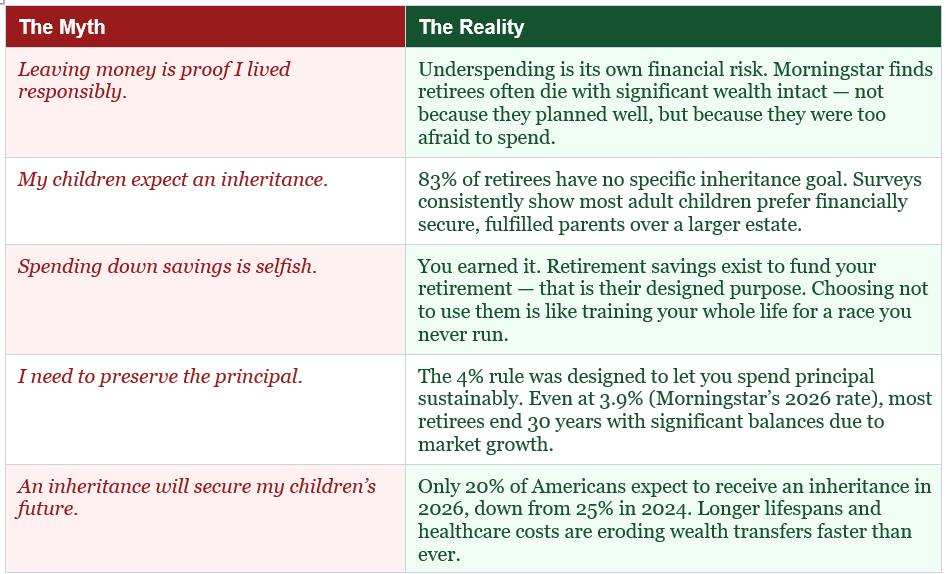
The most important line in that table is the fifth one. The inheritance landscape is changing faster than most people realise. A 20% inheritance expectation rate — and declining — means that four out of five people who might count on a wealth transfer from their parents will not receive one, or will receive far less than they expected. Longer lifespans mean parents are spending their savings on their own care. Healthcare costs in retirement average $315,000 per couple, according to Fidelity’s 2025 estimates. An inheritance that looked certain at 60 may have been largely consumed by 75.
The Real Purpose of Retirement Savings
This question sounds obvious, but it is worth asking explicitly: what is retirement savings for?The answer, at its simplest, is this: retirement savings exist to replace the income from work and fund the lifestyle you want during the years you are no longer working. That is the stated design of every 401(k), IRA, pension, and annuity product ever created. The tax advantages, the employer matches, the compound growth — all of it was structured to enable you to stop working without sacrificing your standard of living.
Retirement savings were never specifically designed to be a wealth transfer mechanism. Estate planning tools — trusts, life insurance, gifting strategies, Roth conversions — exist for that purpose. When retirees treat their retirement savings primarily as a pool of wealth to preserve and pass on, they are using the wrong tool for the job and depriving themselves of the income their own savings were designed to generate.
KEY RESEARCH FINDING
Morningstar’s Behavioral Insights Group found that even retirees who are actively trying to spend their savings responsibly — using the 4% rule or other structured withdrawal strategies — will typically end 30 years of retirement with significant remaining balances. This is because market growth during retirement continues to compound. You do not need to conserve aggressively to preserve wealth; the math tends to do it for you if you stay invested.
The Underspending Trap: How Fear Costs More Than Spending
Financial advisors name the underspending trap explicitly. Zach Teutsch, founder of Values Added Financial and a member of CNBC’s Financial Advisor Council, put it plainly in June 2026: “Overspending is risky. But underspending is risky too.”The costs of underspending are real but harder to see than the costs of overspending. They are not visible on a balance sheet. They show up in experiences not taken, relationships not deepened, health investments not made, and contributions not given while you were still alive to see their impact. They are the vacations you did not take. The grandchildren’s education you could have funded. The kitchen renovation you lived without for ten years because you were afraid.
The Psychological Cost
64% of Americans say they are more worried about outliving their savings than dying, according to a 2025 Allianz Life survey. This anxiety is real — but for most retirees with median or above-median savings, it is not mathematically justified. Research consistently shows that financial anxiety is often disconnected from actual financial capacity. Having $400,000 saved and withdrawing 2.1% is not financial caution. It is financial fear — and it has a cost.The Planning Solution
The June 2026 NAPA-Net study found a powerful antidote: a written decumulation plan. Among pre-retirees aged 55 and older who have a decumulation plan, 57% are highly confident they can manage spending throughout retirement. Without a plan, only 26% feel that confidence. Among retirees themselves, 55% with a spending plan are highly confident, versus 29% without one. Confidence is not built by having more money. It is built by having a plan for using it.Building a Retirement Plan Around Living, Not Leaving
A retirement plan built around living rather than leaving money does not mean spending recklessly or ignoring the possibility of longevity. It means inverting the default assumption: instead of starting with “how much can I preserve?”, starting with “how much do I need to live the retirement I want?” and building the plan around that answer.Here is what that looks like in practice:
- Define your retirement vision concretely. Where do you want to live? How often do you want to travel? What experiences do you want to have in your 60s, 70s, and 80s? A vague sense of “living comfortably” is not a plan. Specific goals produce specific income targets.
- Calculate your true income needs by decade. The Go-Go, Slo-Go, and No-Go year model applies here too: your spending will be highest in the early retirement years (60s to early 70s), moderate in the middle years, and lowest in the late years. A plan that treats all years equally is less accurate than one that front-loads spending during peak activity.
- Separate your retirement and legacy plans. If leaving something to heirs matters to you, address it explicitly with the right tools: life insurance, a Roth IRA designated for inheritance, a trust, or a charitable giving strategy. Do not use your retirement savings as the default legacy vehicle when better tools exist.
- Create a written decumulation plan with specific withdrawal rules. Know which accounts you draw from first, how much you take each year, and what triggers a review of the plan. The confidence data is clear: a written plan transforms anxiety into agency.
- Review annually, not reactively. A retirement income plan should be reviewed every year — not every time the market drops or a worrying headline appears. Annual reviews catch drift early; reactive reviews generate poor decisions at the worst moments.
The Decumulation Framework: A Three-Bucket Approach
The most widely recommended framework for retirement spending — and the one most effective at reducing anxiety while enabling confident spending — is the three-bucket (or segmentation) approach. It organises retirement assets by time horizon, separating money needed now from money needed later, and provides a clear mental model for when and how to spend.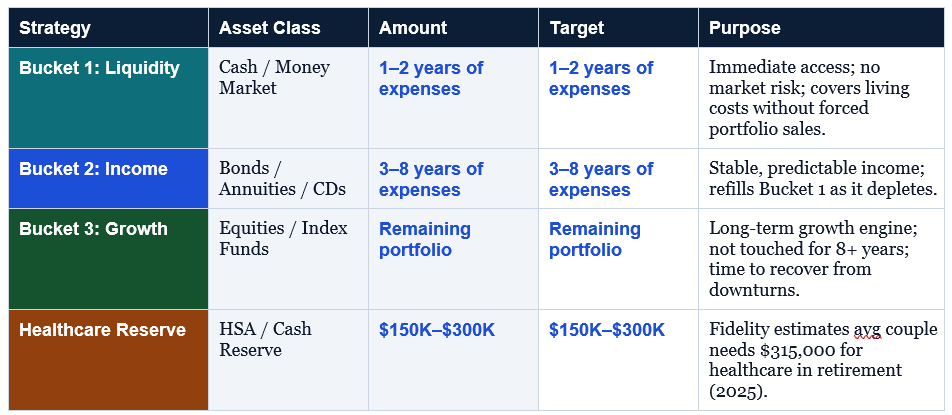
Framework based on widely used retirement income segmentation approaches. Healthcare reserve figure from Fidelity Retiree Health Care Cost Estimate 2025 ($315,000 for a 65-year-old couple). Withdrawal rates per Morningstar 2026 guidance (3.9% base case).
The bucket approach works psychologically because it gives each portion of your portfolio a specific job. The growth bucket is not “the money I might need” — it is explicitly the money you will not touch for 8+ years, giving you permission to leave it invested through downturns. The income bucket is not savings you are preserving — it is the engine generating your regular paycheck. And the liquidity bucket eliminates the panic-selling risk that most retirement income plans fear most.
What About the Kids? Smarter Ways to Think About Legacy
Choosing to build a retirement plan around your own life rather than preserving wealth for heirs is not the same as choosing not to care about your children or grandchildren. Most retirees do want to leave something behind — and that desire is entirely legitimate. The question is not whether to plan for legacy, but how to do it intelligently.
The Account Withdrawal Order Strategy
Financial advisors increasingly recommend a specific account withdrawal order that serves both the retiree’s income needs and heirs’ tax efficiency: spend the traditional IRA first, leave the Roth for heirs. According to analysis by 24/7 Wall St. (August 2026), Baby Boomers averaging $257,002 in IRA balances who spend the traditional account — paying taxes now when their income is likely lowest — and leave the Roth to heirs capture most inheritance tax benefits at essentially zero extra cost. Roth accounts pass to heirs income-tax-free; traditional accounts do not.Give While You’re Alive
The 2026 annual gift exclusion is $19,000 per recipient. Many financial planners now recommend “gifting with a warm hand” — giving money to children or grandchildren while you are alive and can witness its impact. This approach satisfies the desire to support the next generation, reduces the taxable estate, and avoids the uncertainty of a bequest that arrives after you are no longer there to see it used.Separate Legacy Tools from Retirement Income
Life insurance, charitable remainder trusts, donor-advised funds, and properly structured Roth accounts are purpose-built for transferring wealth efficiently. Using your retirement savings as the default inheritance vehicle is almost never the optimal strategy from a tax or planning perspective. If legacy is a genuine priority, build a specific legacy plan with the right tools — and let your retirement savings do the job they were designed for.CONCLUSION
You Earned It. The Plan Should Reflect That.
The most dangerous retirement plan is not one that spends too aggressively. It is one built around a fear that prevents the retiree from ever feeling permission to spend at all. The research is consistent across every major study: retirees with meaningful savings tend to underspend, not overspend. They die with more money than they needed, having declined experiences they could have afforded.83% of retirees have no specific inheritance goal. 75% end their first decade of retirement with savings equal to or greater than when they started. Couples with $100,000+ in savings withdraw at just 2.1% per year on average — less than half of what is mathematically sustainable. This is not financial prudence. It is financial paralysis.
A retirement plan built around living — with a clear decumulation framework, a written spending plan, appropriate healthcare reserves, and a separate legacy strategy if desired — is both financially sound and emotionally honest. It acknowledges what retirement savings were always for: the retirement you worked your whole life to have.
Build the plan. Give yourself permission to spend it. The life you are saving for is the one you are living right now.
10. Frequently Asked Questions (FAQ)
Is it selfish to spend my retirement savings instead of leaving it to my children?No, and the research supports this clearly. 83% of retirees have no specific inheritance goal, according to the June 2026 NAPA-Net study. More importantly, surveys consistently find that adult children prefer financially secure, fulfilled parents over larger inheritances. The money you saved was designed for your retirement. Using it that way is not selfishness — it is the plan working exactly as intended.
What does the data say about how much retirees actually withdraw?
The data is striking. Married couples over age 65 with at least $100,000 in savings withdraw at an average annual rate of just 2.1% per year, according to Prudential Financial data cited by The Wall Street Journal — far below the 4% rule and Morningstar’s 2026 safe withdrawal rate of 3.9%. Approximately 27% of retirees over 60 make no withdrawals at all from retirement accounts. EBRI found that three-quarters of retirees end their first 7–10 years of retirement with savings equal to or higher than when they started.
How do I know if I’m underspending in retirement?
Signs of underspending include: withdrawing less than 3% annually when you have no specific reason to be so conservative; consistently declining expenses or experiences you can comfortably afford; anxiety about spending that is not proportional to your actual financial position; or a growing account balance despite being in retirement. A fee-only financial advisor can run a Monte Carlo simulation or cash-flow projection to show you your realistic spending range with a high probability of success — which for most adequately-saved retirees is higher than they assumed.
What is a decumulation plan and why does it help?
A decumulation plan is a written strategy for drawing down retirement assets — specifying which accounts to withdraw from, in what order, at what rate, and under what circumstances. The NAPA-Net June 2026 study found that pre-retirees with a decumulation plan are highly confident they can manage spending (57%) vs. only 26% without a plan. For actual retirees, the confidence gap is similar: 55% with a plan vs. 29% without. A plan does not change the math of retirement; it changes the psychology of spending. That psychological shift is what enables retirees to actually use their savings.
Should I leave money to my children?
That is a values question, not a financial one — and the answer is personal. What financial planning can do is help you pursue that goal with the right tools. The Roth IRA is one of the most efficient inheritance vehicles because it passes to heirs income-tax-free. Life insurance, trusts, and annual gifting ($19,000 per recipient in 2026) are purpose-built for wealth transfer. What financial planning experts warn against is using your retirement savings as the default inheritance vehicle — that typically produces worse tax outcomes and a worse retirement than using dedicated legacy tools alongside a properly funded retirement income plan.
Is the Great Wealth Transfer still happening?
In aggregate, yes — an estimated $84 trillion or more is projected to transfer between generations over the coming decades. But at the individual level, inheritance is increasingly unreliable. Only 20% of Americans expect to receive one in 2026, down from 25% in 2024, per the Northwestern Mutual 2025 Planning Study. Longer lifespans mean parents are spending their savings on healthcare and living costs. Fidelity estimates the average couple needs $315,000 for healthcare in retirement alone. Inheritance that looks certain at 60 may be largely consumed by 80. Build your retirement plan assuming you will not receive one; treat any inheritance as a bonus.
External References & Links
1. NAPA-Net / ASPPA — Retirement Spending Anxiety Eases with a Decumulation Plan, Study Suggests — June 11, 2026. https://www.napa-net.org/news/2026/6/retirement-spending-anxiety-eases-with-a-decumulation-plan-study-suggests
2. Morningstar — Is Your Cautious Retirement Spending Doing More Harm Than Good? — April 17, 2026. https://www.morningstar.com/personal-finance/is-your-cautious-retirement-spending-doing-more-harm-than-good
3. CNBC — Retirement ‘underspending’ is risky, advisor says. Here’s why — June 8, 2026. https://www.cnbc.com/2026/06/08/retirement-risk-underspending.html
4. 247 Wall St. — Northwestern Mutual’s 2025 Planning Study: Only 20% of Americans Now Expect to Receive an Inheritance — May 20, 2026. https://247wallst.com/personal-finance/2026/05/20/northwestern-mutuals-2025-planning-study-only-20-of-americans-now-expect-to-receive-an-inheritance-down-from-25-last-year/
5. Yahoo Finance / 24/7 Wall St. — Leave the Kids the Roth, Spend the IRA Yourself: The Inheritance Order Most Families Get Backward — August 6, 2026. https://247wallst.com/personal-finance/2026/08/06/leave-the-kids-the-roth-spend-the-ira-yourself-the-inheritance-order-most-families-get-backward/
6. Boldin.com — Average Inheritance From Parents Is $46,200. Most Get Less. — April 4, 2026. https://www.boldin.com/retirement/average-inheritance-how-much-are-retirees-leaving-to-heirs/
7. AOL Finance / MoneyWise — Being Scared in Retirement Costs You Money, Time and Memories — 2026. https://www.aol.com/finance/being-scared-retirement-costs-money-123000507.html
8. Schroders — 2025 US Retirement Survey: Inflation Still Weighs Heavily on Retirees. https://secure.businesswire.com/news/home/20250520778908/en/Inflation-Still-Weighs-Heavily-on-Retirees
2. Morningstar — Is Your Cautious Retirement Spending Doing More Harm Than Good? — April 17, 2026. https://www.morningstar.com/personal-finance/is-your-cautious-retirement-spending-doing-more-harm-than-good
3. CNBC — Retirement ‘underspending’ is risky, advisor says. Here’s why — June 8, 2026. https://www.cnbc.com/2026/06/08/retirement-risk-underspending.html
4. 247 Wall St. — Northwestern Mutual’s 2025 Planning Study: Only 20% of Americans Now Expect to Receive an Inheritance — May 20, 2026. https://247wallst.com/personal-finance/2026/05/20/northwestern-mutuals-2025-planning-study-only-20-of-americans-now-expect-to-receive-an-inheritance-down-from-25-last-year/
5. Yahoo Finance / 24/7 Wall St. — Leave the Kids the Roth, Spend the IRA Yourself: The Inheritance Order Most Families Get Backward — August 6, 2026. https://247wallst.com/personal-finance/2026/08/06/leave-the-kids-the-roth-spend-the-ira-yourself-the-inheritance-order-most-families-get-backward/
6. Boldin.com — Average Inheritance From Parents Is $46,200. Most Get Less. — April 4, 2026. https://www.boldin.com/retirement/average-inheritance-how-much-are-retirees-leaving-to-heirs/
7. AOL Finance / MoneyWise — Being Scared in Retirement Costs You Money, Time and Memories — 2026. https://www.aol.com/finance/being-scared-retirement-costs-money-123000507.html
8. Schroders — 2025 US Retirement Survey: Inflation Still Weighs Heavily on Retirees. https://secure.businesswire.com/news/home/20250520778908/en/Inflation-Still-Weighs-Heavily-on-Retirees
0 Comments
Be the first to share your thoughts on this article.