

Professional & Career Development
Why Your Salary Will Never Make You Rich on Its Own

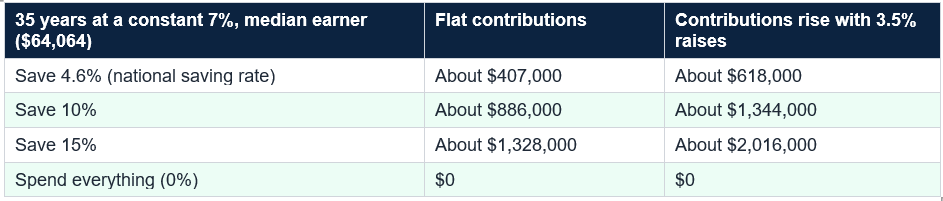
Median weekly earnings $1,232 (about $64,064 a year), up 1.5% from a year earlier vs CPI up 3.5%; real median weekly earnings $370 vs $376 a year earlier; bachelor’s degree or more $1,752 a week vs $993 for high school graduates. Wealth: top 10% hold 87.4% of corporate equities and mutual funds, bottom 50% about 1.1% (Fed, Q1 2026); 401(k) millionaires hit a record 654,000 and saved 17.3% of pay (25.8% with employer) vs 14.4% average (Fidelity); US saving rate 4.6% in 2025, about 4.1% in August 2026. My arithmetic (median earner, 35 years, 7%): saving 4.6% builds about $407,000; 10% about $886,000; 15% about $1.33 million; with 3.5% yearly raises, about $618,000, $1.34 million and $2.02 million; 10% flat takes about 37 years to reach $1 million.
It is not a character flaw; it is arithmetic. A salary is designed to fund your life, not to grow your wealth, and this year’s numbers make the gap plain. This guide walks through what the latest data show about pay and wealth, why raises rarely change the picture and what does. The goal is not to make you feel bad about your paycheck but to show you the levers that turn it into assets, which is where wealth lives.
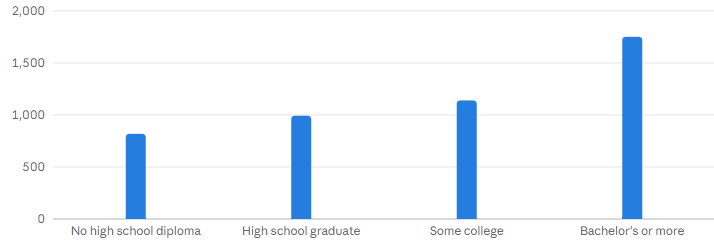
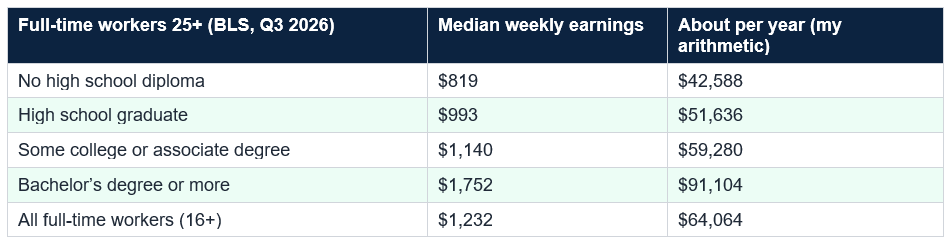
Education still matters. For full-time workers aged 25 and older, median weekly earnings were $819 without a high school diploma, $993 for high school graduates, $1,140 with some college and $1,752 with a bachelor’s degree or more, about $91,100 a year versus about $51,600 for a high school graduate. A higher income helps, but even a $91,000 salary is spent as it arrives unless something deliberate happens to it.
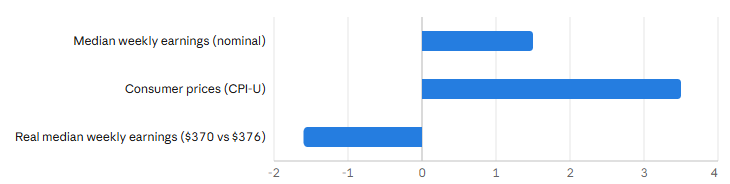
BLS, Q3 2026: median weekly earnings $1,232 (+1.5% year over year) vs CPI +3.5%; real median earnings $370 vs $376 a year earlier (about −1.6%). A $64,064 salary with no raise would buy about as much as $44,500 does today after ten years of 3.7% inflation (my arithmetic).
That is why waiting for a raise to start building wealth is a trap. A raise that matches inflation is not extra money, and extra money that is not deliberately saved is absorbed by a better apartment, a newer car or a nicer vacation. Economists call it lifestyle creep, and it is why people with high salaries can end up with the same savings as people with modest ones: the savings rate matters more than the salary.
Debt makes it worse. The average credit card rate was about 20.9% in the second quarter, so a carried balance works against you faster than most investments work for you, and Bankrate found only 46% of Americans could cover three months of expenses. A salary that is spent, partly on interest, with no cushion, cannot compound. The first job is to stop the leaks.
The ownership gap does not mean wages are unimportant. It means wages are the starting capital. Fidelity reported a record 654,000 401(k) millionaires in the second quarter of 2026, and what set them apart was saving far more than average and staying invested through market swings. The salary was the raw material; the assets built the wealth. Your paycheck is the one source of capital you control, so route a meaningful share of it into things that grow.
At a flat 10% saved, it takes about 37 years to reach $1 million at a constant 7%; start earlier, save more or let contributions grow with raises and the date moves closer. Notice what is not in the formula: a high income. A person earning $64,000 who saves 15% ends up with more than someone earning $91,000 who saves 4.6%. The market return is an assumption, not a promise, but the direction is clear.
But owning assets only helps if you do it well. DALBAR research found the average investor earned about 6.8% a year over 30 years while the S&P 500 returned about 10.2%, largely because of badly timed buying and selling. Fees matter too: $500 a month for 30 years at 7% before fees grows to about $606,000 in a 0.03% fund versus $538,000 in a 0.64% fund. And Hendrik Bessembinder found that the best 4.3% of stocks created all the market’s net wealth, an argument for owning broad index funds and holding on.
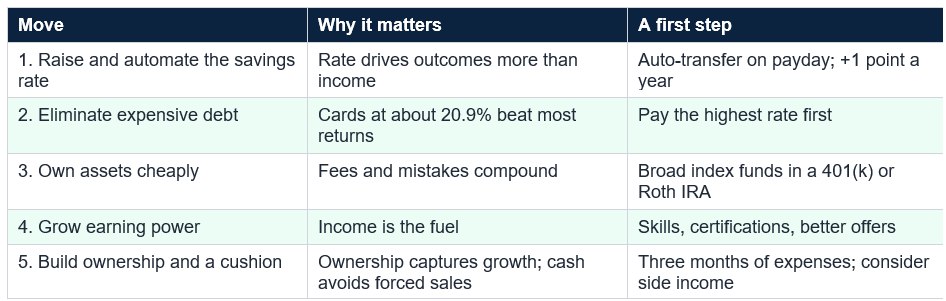
Fourth, grow your earning power, because income is the fuel. The BLS education gap, $1,752 a week for a bachelor’s degree against $993 for a high school diploma, is about $39,500 a year, and skills, certifications, job changes and negotiation can do more than a 3.5% raise. Fifth, build ownership beyond the market: a business, equity compensation, a home you can afford or a side skill, with a cushion of three to six months of expenses so a surprise never forces you to sell assets at a bad time.
Be honest about limits, too. Some people earn too little to save much, and real wages fell about 1.6% this year. If that is you, aim for the smallest consistent step and focus on income growth and debt. Nothing here guarantees returns: markets fall, and a plan needs an emergency fund and patience. The point is not certainty but putting the odds on your side.
Keep in mind: Returns of 7% are an assumption used for illustration, not a forecast. Markets can fall sharply, and past performance does not guarantee future results.
The lever is in your hands. In my illustration, a median earner saving 10% for 35 years at 7% builds about $886,000, and saving 15% with 3.5% raises builds about $2.0 million, against about $407,000 at the national saving rate. Raise your savings rate, kill expensive debt, own assets cheaply, grow your earning power and build ownership and a cushion. The salary is the fuel; the assets are the engine. A qualified adviser can help you decide what fits.
Because a salary is spent as it arrives, taxed as ordinary income and increased by small annual raises, while wealth is built by owning assets that grow. In 2026, median weekly earnings rose 1.5% while consumer prices rose 3.5%, so real pay actually fell. Federal Reserve data show the top 10% of households hold about 87.4% of corporate equities and mutual funds and the bottom 50% about 1.1%.
How much of my salary should I save to build wealth?
There is no single number, but research points to 12% to 17% of pay: Vanguard reports a 12.1% average total savings rate in its plans, and Fidelity found 401(k) millionaires saved 17.3% of pay (25.8% with employer contributions) versus a 14.4% average. The US personal saving rate was only 4.6% in 2025. Start where you can and raise it each year.
Is a higher income the answer?
It helps but does not solve it. BLS data show full-time workers with a bachelor’s degree or more earn a median $1,752 a week versus $993 for high school graduates. But if spending rises with income, wealth does not. The key is the gap between what you earn and spend, and what you do with it.
What should I invest in?
For most people, low-cost, diversified index funds in tax-advantaged accounts are a sensible core: 79% of active large-cap funds trailed the S&P 500 in 2025, and fees compound, with $500 a month for 30 years at 7% growing to about $606,000 in a 0.03% fund versus $538,000 in a 0.64% fund. This is general education, not personal advice.
How long does it take to build $1 million from a salary?
It depends on your savings rate, returns and how long you invest. In my illustration, a median full-time earner ($64,064 a year) saving 10% flat, about $6,406 a year, invested at a constant 7% reaches $1 million in about 37 years. Saving 15%, or letting contributions grow with 3.5% raises, shortens that considerably.
Table of Contents
- The Treadmill Problem
- The Short Answer
- What a Salary Is Actually Doing in 2026
- Raises Do Not Build Wealth
- Where the Paycheck Goes
- Wealth Is Owned Assets
- The Compounding Math
- Why Returns Beat Raises
- Five Moves That Turn Income Into Assets
- A 12-Month Starter Plan
- Myths That Keep People Stuck
- Conclusion
- Frequently Asked Questions
The treadmill: pay vs. prices, third quarter 2026 (% change from a year earlier)
Change (%) by BLS Usual Weekly Earnings release (Oct 21, 2026) and FRED; real earnings change is my arithmetic from $370 vs $376
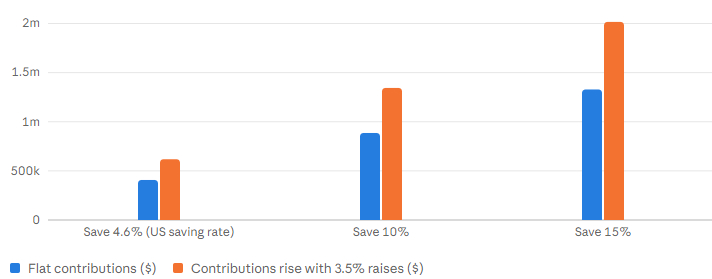
The savings rate decides the outcome: median earner after 35 years at 7% ($)
Balance after 35 years ($) by Author's illustration: $64,064 salary (BLS median), constant 7% return, end-of-year contributions, no taxes or fees; not a forecast
Earning power helps, but only if you keep the gap: median weekly earnings by education ($)
Median weekly earnings ($) by BLS Economics Daily, Q3 2026, full-time workers 25+; $1,752 is about $91,100 a year; the gap vs. high school is about $39,500 a year
The Treadmill Problem
Picture a treadmill set to a gentle pace. You run hard, you sweat, you cover real distance, and the scenery does not change. That is how a paycheck feels to many people in 2026: you earn, you pay for rent, groceries, insurance and a car, you save a little if you can and the cycle repeats. The effort is real, yet after a decade the net worth barely moves.It is not a character flaw; it is arithmetic. A salary is designed to fund your life, not to grow your wealth, and this year’s numbers make the gap plain. This guide walks through what the latest data show about pay and wealth, why raises rarely change the picture and what does. The goal is not to make you feel bad about your paycheck but to show you the levers that turn it into assets, which is where wealth lives.
The Short Answer
A salary alone rarely makes you rich because it is mostly spent, taxed as ordinary income and raised by small percentages that barely keep pace with prices. Wealth is overwhelmingly held as assets such as stocks, retirement accounts, businesses and homes. The people who build it usually save a meaningful share of income, invest it in low-cost assets for decades and increase their earning power along the way. The salary is the fuel; the assets are the engine.What a Salary Is Actually Doing in 2026
The Bureau of Labor Statistics reported on October 21 that median weekly earnings of full-time wage and salary workers were $1,232 in the third quarter of 2026, about $64,064 a year. That was 1.5% higher than a year earlier, while the Consumer Price Index rose 3.5%. In real terms, median weekly earnings were $370 in 1982-84 dollars, down from $376, about 1.6% lower. Pay went up, but prices went up faster.Education still matters. For full-time workers aged 25 and older, median weekly earnings were $819 without a high school diploma, $993 for high school graduates, $1,140 with some college and $1,752 with a bachelor’s degree or more, about $91,100 a year versus about $51,600 for a high school graduate. A higher income helps, but even a $91,000 salary is spent as it arrives unless something deliberate happens to it.
BLS, Q3 2026: median weekly earnings $1,232 (+1.5% year over year) vs CPI +3.5%; real median earnings $370 vs $376 a year earlier (about −1.6%). A $64,064 salary with no raise would buy about as much as $44,500 does today after ten years of 3.7% inflation (my arithmetic).
Raises Do Not Build Wealth
The standard hope is that a raise will fix things, but raises are small and tied to inflation. Employer surveys project 2027 salary increase budgets of about 3.4% to 3.6%, with merit increases around 3% to 3.2%. With September inflation at 3.7%, that is roughly flat in purchasing power, so a raise mostly protects what you already have. A career of 3.5% raises takes a $64,064 salary to about $179,800 in 30 years, which is the same purchasing power if prices rise 3.5% a year.That is why waiting for a raise to start building wealth is a trap. A raise that matches inflation is not extra money, and extra money that is not deliberately saved is absorbed by a better apartment, a newer car or a nicer vacation. Economists call it lifestyle creep, and it is why people with high salaries can end up with the same savings as people with modest ones: the savings rate matters more than the salary.
Where the Paycheck Goes
The US personal saving rate was 4.6% in 2025, according to the Bureau of Economic Analysis, and about 4.1% in August 2026 after revisions, according to a secondary summary. On a $64,064 salary, 4.6% is about $2,950 a year. That compares with a 12.1% average total savings rate in Vanguard’s retirement plans and 17.3% for the 401(k) millionaires Fidelity tracks. The gap between the national average and the people who build wealth is not talent. It is a different percentage of income saved.Debt makes it worse. The average credit card rate was about 20.9% in the second quarter, so a carried balance works against you faster than most investments work for you, and Bankrate found only 46% of Americans could cover three months of expenses. A salary that is spent, partly on interest, with no cushion, cannot compound. The first job is to stop the leaks.
Wealth Is Owned Assets
Now look at where wealth sits. Federal Reserve data show that in the first quarter of 2026 the top 10% of US households held about 87.4% of corporate equities and mutual funds, the top 1% about 50.2% and the bottom 50% about 1.1%, and the top 1% share of total net worth hit a record 32.5% in the second quarter. For most of the country’s wealth, the engine is not a paycheck but the ownership of assets that grow.The ownership gap does not mean wages are unimportant. It means wages are the starting capital. Fidelity reported a record 654,000 401(k) millionaires in the second quarter of 2026, and what set them apart was saving far more than average and staying invested through market swings. The salary was the raw material; the assets built the wealth. Your paycheck is the one source of capital you control, so route a meaningful share of it into things that grow.
The Compounding Math
In my illustration for a median full-time earner at $64,064, saving 4.6% of pay, about $2,950 a year, invested for 35 years at a constant 7% builds about $407,000. Saving 10% builds about $886,000, and 15% about $1.33 million. If contributions rise with 3.5% annual raises, the results climb to about $618,000, $1.34 million and $2.02 million. Same person, same job, a threefold difference from the savings rate alone.At a flat 10% saved, it takes about 37 years to reach $1 million at a constant 7%; start earlier, save more or let contributions grow with raises and the date moves closer. Notice what is not in the formula: a high income. A person earning $64,000 who saves 15% ends up with more than someone earning $91,000 who saves 4.6%. The market return is an assumption, not a promise, but the direction is clear.
Why Returns Beat Raises
Owning assets matters because their returns can outrun wages. A 3.5% raise adds a few percent to your paycheck once a year; a diversified stock portfolio has historically returned much more over long periods, though with big swings and no guarantee. Capital income is also taxed differently: long-term capital gains at 0%, 15% or 20%, plus a 3.8% surtax for higher earners, while wages face ordinary rates reaching 37% and payroll taxes. That is general knowledge, and the right account type can improve it further.But owning assets only helps if you do it well. DALBAR research found the average investor earned about 6.8% a year over 30 years while the S&P 500 returned about 10.2%, largely because of badly timed buying and selling. Fees matter too: $500 a month for 30 years at 7% before fees grows to about $606,000 in a 0.03% fund versus $538,000 in a 0.64% fund. And Hendrik Bessembinder found that the best 4.3% of stocks created all the market’s net wealth, an argument for owning broad index funds and holding on.
Five Moves That Turn Income Into Assets
First, raise the savings rate and automate it; Vanguard found automatic enrollment lifts plan participation to 94% from 64%. Start with what you can, capture any employer match, then add a point every year or with every raise. Second, kill expensive debt: paying off a card at about 20.9% is a guaranteed return few investments match. Third, own assets cheaply: diversified low-cost index funds in tax-advantaged accounts such as a 401(k) (2026 limit $24,500) and a Roth IRA ($7,500).Fourth, grow your earning power, because income is the fuel. The BLS education gap, $1,752 a week for a bachelor’s degree against $993 for a high school diploma, is about $39,500 a year, and skills, certifications, job changes and negotiation can do more than a 3.5% raise. Fifth, build ownership beyond the market: a business, equity compensation, a home you can afford or a side skill, with a cushion of three to six months of expenses so a surprise never forces you to sell assets at a bad time.
A 12-Month Starter Plan
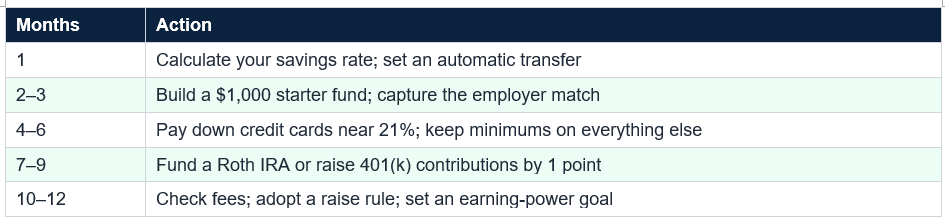
Make it concrete. In month one, find your actual savings rate by dividing what you saved last year by what you earned, and set an automatic transfer. Build a $1,000 cushion and capture any match in months two to three, pay down cards at 20% or more in months four to six, fund a Roth IRA or raise your 401(k) by a point in months seven to nine, and in months ten to twelve review fees, adopt a raise rule such as sending half of every raise to savings and set your next income goal.
Myths That Keep People Stuck
A few myths hold people back. Wealth comes from a big raise or a big break: more often it comes from years of ordinary saving. Investing is only for the rich: low-cost funds and fractional shares let people start small. You should wait until debts are gone or income is higher: the best time to start the habit is now, even at a small percentage. And a good salary guarantees wealth: spending that rises with income cancels it.Be honest about limits, too. Some people earn too little to save much, and real wages fell about 1.6% this year. If that is you, aim for the smallest consistent step and focus on income growth and debt. Nothing here guarantees returns: markets fall, and a plan needs an emergency fund and patience. The point is not certainty but putting the odds on your side.
Keep in mind: Returns of 7% are an assumption used for illustration, not a forecast. Markets can fall sharply, and past performance does not guarantee future results.
Conclusion
Your salary will probably never make you rich on its own, and the data show why. In the third quarter of 2026, median weekly earnings were $1,232, up 1.5% while prices rose 3.5%, so real pay fell, and raises of about 3.5% mostly keep pace with inflation. Meanwhile, the Federal Reserve reports the top 10% hold about 87.4% of equities and mutual funds and the bottom half about 1.1%. Wealth sits in assets, and the people who build it, like the 654,000 401(k) millionaires, save much more than average and keep investing.The lever is in your hands. In my illustration, a median earner saving 10% for 35 years at 7% builds about $886,000, and saving 15% with 3.5% raises builds about $2.0 million, against about $407,000 at the national saving rate. Raise your savings rate, kill expensive debt, own assets cheaply, grow your earning power and build ownership and a cushion. The salary is the fuel; the assets are the engine. A qualified adviser can help you decide what fits.
Frequently Asked Questions
Why can't a salary alone make you rich?Because a salary is spent as it arrives, taxed as ordinary income and increased by small annual raises, while wealth is built by owning assets that grow. In 2026, median weekly earnings rose 1.5% while consumer prices rose 3.5%, so real pay actually fell. Federal Reserve data show the top 10% of households hold about 87.4% of corporate equities and mutual funds and the bottom 50% about 1.1%.
How much of my salary should I save to build wealth?
There is no single number, but research points to 12% to 17% of pay: Vanguard reports a 12.1% average total savings rate in its plans, and Fidelity found 401(k) millionaires saved 17.3% of pay (25.8% with employer contributions) versus a 14.4% average. The US personal saving rate was only 4.6% in 2025. Start where you can and raise it each year.
Is a higher income the answer?
It helps but does not solve it. BLS data show full-time workers with a bachelor’s degree or more earn a median $1,752 a week versus $993 for high school graduates. But if spending rises with income, wealth does not. The key is the gap between what you earn and spend, and what you do with it.
What should I invest in?
For most people, low-cost, diversified index funds in tax-advantaged accounts are a sensible core: 79% of active large-cap funds trailed the S&P 500 in 2025, and fees compound, with $500 a month for 30 years at 7% growing to about $606,000 in a 0.03% fund versus $538,000 in a 0.64% fund. This is general education, not personal advice.
How long does it take to build $1 million from a salary?
It depends on your savings rate, returns and how long you invest. In my illustration, a median full-time earner ($64,064 a year) saving 10% flat, about $6,406 a year, invested at a constant 7% reaches $1 million in about 37 years. Saving 15%, or letting contributions grow with 3.5% raises, shortens that considerably.
0 Comments
Be the first to share your thoughts on this article.