
CPP Payment Dates in 2026: What You Should Know About Canada Pension Plan

This guide shows you the cpp payment dates in 2026 and the practical rules that set when your funds arrive each month. You will get a clear calendar, an explanation of the “last business day” pattern, and why December posts earlier some years. If you worked in Canada or split time across the U.S., this is for you. It also helps anyone who coordinates cross-border bills and bank posting times. Expect clear steps for checking official schedules through Service Canada tools if your bank posts later than the issuance date. In plain terms, cpp is an earnings-based social insurance plan funded by worker, employer, or self-employed contributions and run federally outside Quebec. That matters because these deposits are a steady part of retirement income and affect budgeting.
This article also covers eligibility, when to start benefits, how amounts are calculated, tax basics, rules for working while collecting, plus survivor and disability benefits so you have one place for planning.
Key Takeaways
- The full 2026 calendar and the usual last-business-day rule.
- Why December payments often arrive earlier than other months.
- How mailed checks change the timing and what you should expect.
- Where to confirm official schedules using Service Canada tools.
- Additional guidance on eligibility, benefit calculations, and tax implications.
CPP payment dates in 2026, and more to know about the Canada Pension Plan
Knowing exactly when your monthly retirement deposit will hit your account helps you avoid surprises and missed bills. You can plan rent, utilities, insurance, and card due dates without guesswork.
A predictable schedule lowers the risk of overdrafts. It also lets you keep a short cash buffer between pay cycles. Aligning autopay a day or two after the expected deposit helps when banks need extra processing time or when you cross time zones.
Remember: this regular distribution is only one piece of your retirement picture. Combine employer pensions, RRSP or RRIF withdrawals, and savings so you do not overestimate what cpp payments alone will cover. Your chosen start age permanently affects monthly amounts, so timing and benefit level both matter.
| Source | Typical timing | Cash-flow tip |
| Government benefit | Monthly, predictable | Set bills after deposit |
| Employer pension | Monthly or biweekly | Match schedule to reduce gaps |
| RRSP/RRIF withdrawals | Flexible | Plan draws for large expenses |
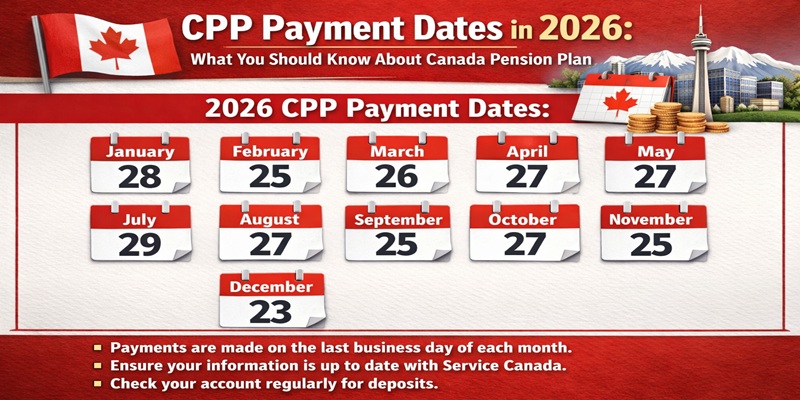
CPP payment dates in 2026 calendar
Use this quick monthly calendar to spot when your benefit arrives each month. The list below shows the official issue day for every month of the year so you can plan bills and travel.
| Month | Date | Note |
| January | January 28, 2026 | Regular issue day |
| February | February 25, 2026 | Regular issue day |
| March | March 27, 2026 | Regular issue day |
| April | April 28, 2026 | Regular issue day |
| May | May 27, 2026 | Regular issue day |
| June | June 26, 2026 | Regular issue day |
| July | July 29, 2026 | Regular issue day |
| August | August 27, 2026 | Regular issue day |
| September | September 25, 2026 | Regular issue day |
| October | October 28, 2026 | Regular issue day |
| November | November 26, 2026 | Regular issue day |
| December | December 22, 2026 | Issued earlier for holidays |
Note: the listed date is the official issuance/deposit date. Your bank may post funds earlier or later depending on its processing times.
- Tip: set recurring reminders 2–3 business days before each date so you have time to move money or schedule transfers.
- December is highlighted because it breaks the usual last-business-day pattern. This matters for holiday travel and year-end bills.
- These dates apply to retirement, disability, survivor, and children’s benefits when paid on the same schedule.
- Save or print this calendar for offline reference if you travel between the U.S. and Canada.
When CPP payments are issued each month
Most benefit releases follow a clear rule you can rely on. The usual practice is to issue funds on the last business day of each month so you can plan bills and transfers.
The typical rule: last business day
Last business day means the final weekday that banks are open. If that day falls on a weekend or holiday, the issue moves to the previous working day. This simple pattern helps you anticipate future cash flow before any new calendar posts.
Why December is different
December exceptions occur because holidays affect processing. Payments are issued earlier so you receive funds before December 25, not at month end. Plan year-end bills accordingly.
Checks versus direct deposit
Direct deposit is the fastest and most secure option; funds normally appear on the official issue date. Mailed checks are printed and sent during the last three business days of each month and can take extra days to arrive.
- Verify your bank info in your My Service Canada Account to avoid delays.
- Allow a short processing window after the issue date before reporting a missing payment.
- Contact Service Canada if the deposit doesn't show after that window.
| Method | Timing | Tip |
| Direct deposit | On issue date | Fastest |
| Mailed check | Last three business days | Allow postal delivery time |
| Confirm | My Service Canada Account | Update banking details promptly |
What the Canada Pension Plan is and who it’s designed to help
Contributions made during your career create a record that directly affects the benefit you can expect later. This program is a contributory, earnings-based social insurance system funded by workers, employers, and the self-employed.
Contributory, earnings-based coverage
It’s insurance you pay into while working. Benefits are tied to your earnings and your contribution history, not a needs test. That means your monthly amount reflects how much and how long you contributed.
Who it helps
The program is designed for workers and their families who need partial income replacement for retirement, disability, or death. You may also qualify for survivor or children’s benefits based on a contributor’s record.
How it fits Canada’s retirement framework
Think of this as one pillar of retirement income. Other pillars include Old Age Security (OAS), the Guaranteed Income Supplement (GIS), and personal savings such as employer pensions or RRSPs.
What it does not cover: it won’t replace all pre-retirement income. Use it with other sources when you plan your budget.
Quebec distinction and cross-province work
If you worked in Quebec, you may have coverage under a provincial alternative (QPP). Where you live when you apply can determine which agency administers your claim.
Practical tips: keep detailed employment records, verify contribution histories, and confirm coverage if you split work between provinces. If you need a quick primer, read this overview of the program and Quebec’s.
| Feature | What it means | Action for you |
| Contributions | Fund benefits via earnings | Keep pay stubs and records |
| Coverage | Retirement, disability, survivor | Check eligibility early |
| Provincial split | Quebec may use a different system | Confirm which record applies |
CPP eligibility rules for receiving payments
First, determine whether your age, contribution record, or spousal credits make you eligible for a retirement pension.
Minimum age to start: when you can begin at 60
You must be at least 60 years old to start early. Choosing to start at 60 is an option, but note that doing so usually reduces your monthly benefit permanently.
Contribution requirement: at least one valid contribution
To receive this pension, you need at least one valid contribution recorded. Even brief work in Canada can meet this test.
Tip: if your Canadian work history is short, confirm totals before you apply.
Eligibility via credits from a former spouse or partner
You may eligible through credits split with a former spouse or common-law partner. These credits can change your contribution record and affect your right to receive benefits.
Status and residency considerations
Citizens, permanent residents, and legal residents (landed immigrants) can be eligible. Living in the U.S. now does not automatically block your claim if you have qualifying contributions.
Quick actions:
- Check your contribution history in your My Service Canada Account before applying.
- Review any credit-splitting agreements from a former spouse to confirm how records were adjusted.
- If you have gaps, gather pay stubs or tax slips to support your request.
| Requirement | What it means | Action for you |
| Age | Minimum start at 60 | Decide if early reduction suits your plan |
| Contributions | At least one valid contribution | Confirm totals in your account |
| Spousal credits | Credits from former spouse can apply | Check records if you were married or common-law |
| Status | Citizens, PRs, legal residents eligible | Verify residency rules for cross-border claims |
Choosing when to start your CPP retirement pension
Choosing a start age for your retirement pension shapes your monthly amount for life. You can begin between ages 60 and 70. Starting earlier cuts your checks forever, while delaying raises them until age 70.
How starting before 65 permanently reduces your monthly payment
If you claim before 65, your benefit drops by about 0.6% for each month you start early. That reduction is applied for the rest of your life.
How delaying after 65 permanently increases your monthly payment (up to 70)
Delaying past 65 boosts your amount by roughly 0.7% per month up to age 70. Waiting raises your monthly payment and can help if you want stronger inflation-protected income later.
Why many people still choose to start at 65
Age 65 is common because it balances income needs with long-term value. It often aligns with other retirement milestones and simplifies taxes and benefit planning.
"The right choice depends on your life expectancy, work plans, and household cash flow."
Planning tips:
- Weigh smaller checks for a longer span against larger checks for fewer years.
- Consider whether you will keep working and what other income you have.
- Couples should coordinate start dates to stabilize household income.
- Run personalized estimates through Service Canada before you make an irreversible choice.
| Start age | Monthly change | Effect |
| 60 | -36% (approx.) | Lower monthly amount for life |
| 65 | 0% | Standard baseline amount |
| 70 | +42% (approx.) | Higher monthly amount for life |
How your CPP retirement benefit amount is calculated
A few clear levers control the size of your retirement income. Understanding them helps you spot what you can change before you file and what is fixed once you start.
Age you start collecting
Your start age directly alters the amount. Starting earlier reduces the monthly benefit permanently, while delaying raises it up to age 70.
How long you contributed and how much you paid in
Both the duration and level of your contributions matter. Consistent contributions over many years at higher earnings tend to increase your final amount.
Your average earnings across working years
This program is earnings-based, not flat. Your average annual earnings over your career are a core input to the formula that sets your benefit amount.
- Check your Statement of Contributions in your My Service Canada Account to verify reported earnings and spot gaps.
- Correct any errors early—fixes before you apply can raise your eventual benefit.
- Later sections explain how enhancements and earnings ceilings affect contribution tiers.
| Driver | What it changes | Action for you |
| Start age | Permanent reduction or boost in monthly amount | Decide based on life expectancy and cash needs |
| Contribution history | Higher total contributions raise benefit | Review records, submit corrections if needed |
| Average earnings | Determines base formula input | Confirm reported earnings on your statement |
For a quick overview of how amounts are estimated, see this benefit amount video.
CPP increases and cost-of-living adjustments in 2026
A January cost-of-living adjustment can lift your regular income without any action from you. Indexing links yearly changes to the Consumer Price Index (CPI), so benefits track inflation automatically.
How annual indexing works
Indexing in January uses CPI data from the previous period to set the new rate. That means your monthly amount can rise even though your entitlement stayed the same.
Projected COLA and what it means
Analysts project a COLA range near 3.5%–4%. A mid-single-digit increase can add real dollars to your budget each month.
| Scenario | Projected increase | Example change |
| Low | 3.5% | $1,365 → $1,414 (approx.) |
| High | 4.0% | $1,365 → $1,419 (approx.) |
| Note | Estimate | Official figures may differ |
Practical next steps
- Use the $1,365 monthly estimate as a benchmark, but check your statement for your exact amount.
- Revisit your budget each January and adjust withholding, savings, or autopays as needed.
- Watch official announcements tied to CPI and read this cpp payments increase for context and updates.
CPP contributions and recent program changes you should know
How contributions flow into the retirement system affects both your tax bill and future monthly income.
Who funds the system
Workers and employers each pay a share from payroll. If you are self-employed, you pay both shares and that extra amount appears on your tax return.
What the enhancement does
Enhancement started in 2019 and raises contribution rates gradually. The goal is higher income replacement over time for future retirees.
YMPE and the higher-earnings tier
YMPE is the annual earnings ceiling used to calculate contributions. A second tier applies extra contribution on earnings above that ceiling up to a higher limit.
| Feature | Impact | Action for you |
| Employee/employer split | Lower direct cost if employed | Confirm payroll deductions |
| Self-employed | Pay both shares via tax | Plan quarterly tax installments |
| Enhancement | Higher future pension for contributors | Consider longer contribution years |
How to apply for CPP and when to apply
The application pathway you pick affects how fast you get a decision and when funds begin. Choose an approach that fits your schedule and gives you clear tracking for your expected start month.
Applying through your My Service Canada Account versus paper forms
Online: Use your Service Canada account to apply cpp quickly. Filing online is faster, lets you upload documents, and shows status updates in your account.
Paper: A mailed form still works, but it takes longer to reach processing and you cannot track progress as easily.
Processing timeline: plan for up to 120 days
Decisions can take up to 120 days (about four months). Start the process several months before your chosen start month to avoid income gaps.
Retroactive payments and timing after age 65
If you apply after age 65, retroactive retirement benefits may cover up to 12 months (11 months plus the month you file). Retroactive pay cannot go earlier than the month after your 65th birthday.
- Roadmap: pick a start month, apply early via service canada, confirm direct deposit, and monitor your account for updates.
- Important: benefits do not begin automatically — you must apply to start receipts.
How you receive CPP payments: direct deposit, checks, and timing
Choosing the right delivery method makes a big difference in timing and peace of mind for retirees. Below you’ll find clear steps to get funds faster, what to expect if you use mailed checks, and how to confirm deposits in your online account.
Direct deposit as the fastest and most secure option
Direct deposit is the default fastest way to receive cpp payment. Funds are issued on the official payment date and typically post the same day, giving you predictable access even when you travel to the U.S.
When checks are mailed and how long delivery can take
Cheques are printed and mailed during the last three business days of each month. Postal delivery can take up to about a week and is not guaranteed.
If a check is delayed, staffing or postal disruptions are common causes, and an old address can block delivery.
How to confirm deposits and keep your banking details current
Use your My Service Canada Account to verify each deposit, update banking routing details, and download notices. Confirming in your online account reduces call wait times and speeds resolutions.
- Checklist: update bank info promptly.
- Keep your mailing address current if you receive checks.
- Watch your deposit history for any missed entries.
| Method | Typical timing | Action for you |
| Direct deposit | Issue date; usually same-day | Set up in your online account |
| Mailed check | Last three business days; delivery up to ~1 week | Allow mailing time, confirm address |
| Confirm | My Service Canada Account | Check deposits, update info |
If a deposit is missing: verify whether you receive cpp via direct deposit or check, allow the mailing window if applicable, then contact Service Canada with your account details ready to escalate.
Taxes on CPP payments and withholding options
Taxes can quietly reduce the cash you expect from monthly retirement benefits, so plan now.
Why retirement benefits are taxable income
Your retirement benefits count as taxable income under federal rules. That means the gross amount shown is not the net amount you will keep.
Plan for net cash flow rather than assuming the full deposit is spendable. This helps you avoid year-end surprises.
How to request federal tax withheld from each payment
You can set federal tax withheld online through your My Service Canada Account. That option lets you pick a withholding amount that applies to each monthly deposit.
If you prefer paper, download and submit the PDF request form to Service Canada. Without withholding, you may owe tax later or face quarterly instalments.
How taxes affect your overall retirement income plan
Withholding smooths your tax burden and protects other income sources, such as IRA or 401(k) withdrawals, from creating a large combined bill.
- Revisit withholding after major changes, like moving states, returning to work, or starting new withdrawals.
- Keep records of statements and amounts withheld to simplify annual filing and avoid mismatches.
| Option | How to set it | Tip |
| Online | My Service Canada Account | Fastest |
| Paper | PDF request form | Mail or drop off to Service Canada |
| No withholding | Default | Expect possible quarterly tax bills |
Working while receiving CPP and how it can change your benefits
Continuing to work while you receive benefits can boost near-term cash flow and alter long-term retirement income. You may choose part-time consulting, phased retirement, or full-time work and still keep receiving your monthly retirement amount.
When you may keep contributing while collecting (under 70)
If you are under age 70 and continue employment, most earnings remain subject to contributions. Those contributions stop at age 70, even if you keep working.
How post-retirement benefits can increase your income
Extra contributions while you work can create a Post‑Retirement Benefit (PRB). This adds incremental, lifelong income on top of your base retirement amount.
- Evaluate earnings: weigh today’s pay against potential PRB gains later.
- Decide by cash needs: if you need income now, collecting while working often makes sense.
- Consider delaying: if you don’t need funds immediately, compare delaying benefits versus collecting plus earning PRBs.
"Keep your tax withholding and filing in view—added earnings can raise your marginal rate and change net cash flow."
| Action | Effect | What to check |
| Keep working under 70 | Contributions continue | Confirm payroll deductions |
| Earn more | Possible PRB increases | Track contribution records |
| Work after 70 | No more contributions | Plan taxes and benefits |
For details on bridging benefits and how post‑retirement credits interact with other programs, see the bridge benefit and CPP guidance.
Other CPP benefits that can affect your household income
Your household income can change quickly if a contributor becomes disabled or dies. This section outlines key replacement supports and how they may help your spouse and children.
Disability rules and the age cutoff
Disability support applies when you have a severe, prolonged condition that prevents substantially gainful work. You must have enough contribution history andbe under age 65 to qualify.
Note: you generally cannot collect a retirement pension and disability at the same time. At age 65, disability benefits normally convert into a standard retirement pension.
Survivor’s pension and children’s benefits
A survivor pension can provide a monthly income to your spouse or common-law partner. Dependent children may receive a monthly amount if they are eligible, often noted for those under 25 while in school.
Death benefit: one-time payment
The one-time death benefit offers a lump sum for funeral or immediate costs; amounts commonly cited are up to $2,500. The estate or an authorized family
member usually applies.
- Keep documents ready: SIN, proof of relationship, and banking details ease claims.
- These benefits follow the same monthly schedule as other program payments, which helps with short-term cash flow planning.
"Having records at hand reduces stress for your spouse and family during a difficult time."
| Situation | What may apply | Action |
| Severe illness | Disability benefit | Check contribution history |
| Contributor dies | Survivor pension + children’s benefits | Gather proof and apply |
| Immediate funeral costs | One-time death benefit | Contact responsible party to claim |
Conclusion
Finish strong: use a final review to align your billing cycle, withholding choices, plus delivery method so deposits reach your account reliably.
Save the 2026 calendar, set simple reminders, and schedule key bills just after your expected month deposit. Remember most months follow the last-business-day rule; December posts earlier for holidays.
Check your My Service Canada Account to confirm your personal timeline, direct deposit routing, and tax withholding. Review what drives your monthly amount: start age, lifetime earnings, and total contributions.
Next step: pick a target start month, apply early so processing completes, then confirm direct deposit and withholding. Revisit your plan each January for indexing changes and budget updates.
0 Comments
Be the first to share your thoughts on this article.