
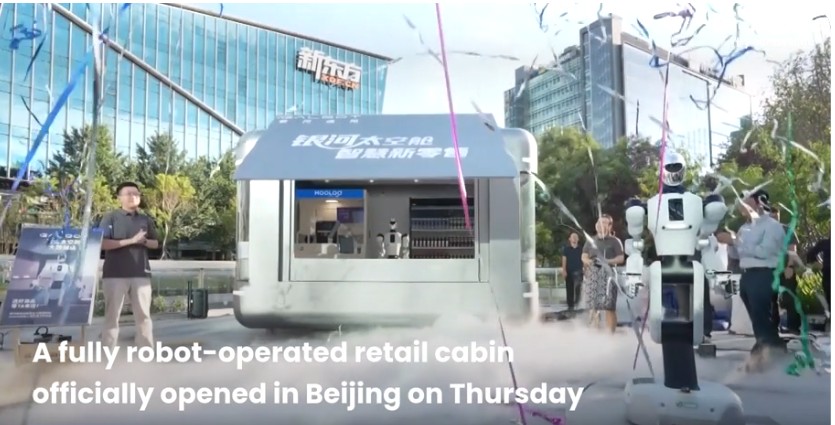
Groundbreaking Robot-Run Retail Cabin Debuts in Beijing
Beijing unveiled a 9 m² automated service kiosk featuring "Galbot," a robot clerk built by Beijing Galaxy Bot. It greets customers, takes orders, and dispenses beverages without on-site staff.
The system runs 24/7 and was projected to handle roughly 2,000 customers and about 500 orders per day. This makes it a live test for high-traffic urban spots. Galbot also supports multiple languages, a practical plus for tourists and expats.
The initial menu focuses on coffee and bottled drinks, with plans to broaden offerings as the model scales. This cabin ties into a larger city push that includes a four-story Robot Mall in E-Town selling and servicing robots from brands like Ubtech and Unitree.
Launched amid an intense robotics news cycle and major public funding, the project shows how end-to-end automated service can move beyond kiosks. This article will map the cabin’s operations, scaling plans across the city, and the market and policy forces behind the push.
?feature=shared">?feature=shared
Key Takeaways
- Galbot runs a 9 m² automated service kiosk that greets, transacts, and dispenses drinks.
- The system operates 24/7 and aimed for ~2,000 users and ~500 orders per day.
- Multilingual interaction and a simple menu make it tourist-friendly.
- It complements Beijing’s new E-Town Robot Mall and wider robotics investment.
- The launch illustrates retail automation moving beyond basic vending models.
World's first fully robot-operated retail cabin opens in Beijing
Galbot, built by Beijing Galaxy Bot, runs the compact 9 m² unit. It handles reception, orders, payments, and beverage dispensing without staff.
Inside the 9 m² setup: multilingual ordering and autonomous service
The workflow is end-to-end: Galbot greets visitors, guides them through a multilingual interface, takes payment, and dispenses coffee or bottled drinks.
Hardware and software integrate — cameras, RFID, and actuators tie to an inventory system and point-of-sale module. This keeps operations tight in a small footprint suitable for malls and transit hubs.
Always on: throughput and daily targets
The location runs 24/7 and targets about 2,000 customers and roughly 500 orders per day. This is to validate throughput and steady service quality.
Menu, rollout, and user experience
- Launch menu focuses on coffee and bottled drinks for reliability and hygiene.
- Roadmap expands products and SKUs as reliability data supports more complex items.
- Multilingual support improves accessibility for foreign travelers and consumers, while reduced labor needs boost operational efficiency.
From single cabin to “Robot Mall”: how Beijing is scaling consumer robotics
Beijing’s new four-floor complex is designed to let buyers touch, test, and take home robotics under one roof.
Sales, service, spare parts, and surveys replicate China’s auto-retail playbook for robots. This format reduces buyer friction by pairing purchase with on-site maintenance and easy parts access.
One-stop buyer journey
Visitors can find, compare, and test products all in one place. This makes it easy for both personal and business needs.
Breadth, price bands, and hands-on play
The mall has over 100 types of robots from 200 brands. Prices start at about 2,000 yuan and go up to millions. A life-size Albert Einstein robot is a highlight, priced at around $97,000.
There are zones for robot fun, like robot dogs and dancing machines. Events like robot soccer attract visitors, making the mall lively.
Market push and global buzz
E-Town offers discounts on professional robots. Logistics bots can cost about 2 million yuan. The mall's opening was tied to the 2025 World Robot Conference, showcasing hundreds of robots.
Why it matters for consumers and companies: market signals from Beijing’s robot retail push
The pilot unit is showing the market's potential for robots.
Pricing, function, and supply-chain drivers
Costs are influenced by what the robot can do and the quality of its parts.
?feature=shared">?feature=shared
Functionality varies from simple companions to heavy-duty tasks. This leads to a wide price range, with logistics bots costing about 2 million yuan and humanoid robots showing more variability.
| Use case | Typical driver | Price example |
| Logistics / transport | Heavy-duty actuators, safety systems | ~2,000,000 yuan |
| Humanoid / service | Sensors, motion control, software | Wide range; 10x variance |
| Consumer / companion | UX, content, durability | Entry to mid-market pricing |
Policy tailwinds, competition, and buyer impact
E-Town's discounts make professional robots more affordable for businesses.
China has invested over $20 billion in robotics and AI. The 2025 World Robot Conference brought together over 200 companies, boosting robotics visibility.
- U.S. firms like Tesla and Boston Dynamics urge a national strategy to keep up with commercialization.
- 4S models simplify buying and maintenance for customers.
- Hands-on zones make robots more accessible for everyone, including students.
last updated: day
Conclusion
The 9 m² pilot showed that with the right technology and strategy, growth is possible. The Galbot unit worked 24/7, meeting high demand. It also brought automated beverage service to life.
The E-Town mall expanded on this success. It offers a wide range of robots and hosts events that make robots fun for shoppers. Policy support and the World Robot Conference helped speed up progress.
Looking ahead, expect more robot options and city expansions. It's time for retailers, brands, and schools to explore robot use cases. This will help students and education programs, including remote learning.

0 Comments Comments