
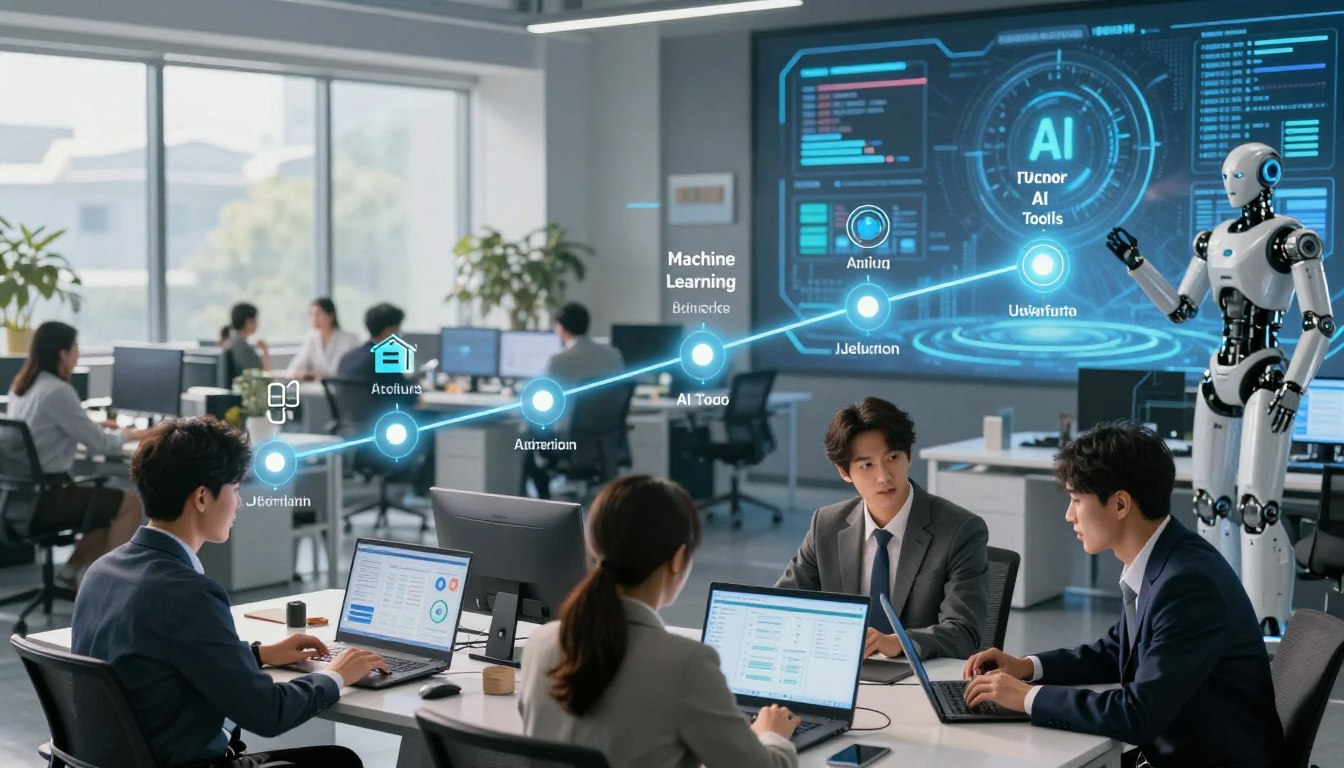
How AI and Job Market Changes Are Reshaping Workforce
You are witnessing a fundamental transformation in how technology reshapes the American workforce. This shift goes beyond simple automation, affecting your career path and economic future in profound ways. The current landscape represents one of the most significant workforce evolutions in recent history. This comprehensive analysis examines the multifaceted impact of emerging technologies on employment across diverse sectors. Rather than focusing solely on displacement concerns, we explore productivity gains, task reallocation, and new opportunities. Understanding these dynamics helps you navigate your professional journey with greater clarity. Recent research from leading institutions, including MIT Sloan's analysis, reveals that technology's influence extends differently across various occupations. High-wage information workers experience distinct effects compared to previous technological waves. This report synthesizes current data to provide actionable insights for your field.
Key Takeaways
- Technology transformation affects specific tasks within jobs rather than entire occupations
- Firms adopting advanced technologies tend to experience higher employment growth
- High-exposure roles may see nuanced outcomes depending on task composition
- Productivity gains often offset potential displacement concerns
- Legal and specialized professions show significant growth potential
- Task reallocation to technology processes enables human focus on comparative advantages
- Understanding these shifts is crucial for career planning and skill development
The Evolution of AI Integration in Modern Workplaces
The integration of intelligent systems into business operations represents the latest chapter in a long history of workplace innovation. This transformation follows established patterns rather than breaking new ground. Understanding these historical contexts helps you appreciate the current pace of change.
Historical Perspectives and Milestones
Looking back at previous technological waves provides crucial insights. Computers took nearly a decade to become commonplace in offices after their public release. This slow adoption timeline mirrors what we see today with new intelligence tools.
Research from 2010 to 2023 shows occupational mix changes during the internet era were modest. Between 1996 and 2002, the difference was only about 7 percentage points. This gradual shift demonstrates how workplace transformations unfold over extended time periods.
Current Shifts in Technology Adoption
Current data reveals we're still in early stages of this technological evolution. As of mid-2025, fewer than 10% of firms across the economy use these tools regularly. The figure rises to just over 20% in professional and scientific industries.
Most organizations are still exploring how to effectively integrate these systems. The limited implementation across diverse work environments suggests substantial time will pass before fundamental changes occur. This pattern aligns with historical technology adoption curves.
Analyzing AI and Job Market Changes in the U.S.
The relationship between technological adoption and employment outcomes demonstrates complex interdependencies rather than simple displacement. Comprehensive research reveals nuanced patterns across different economic sectors.
Sector-Wise Impact and Productivity
Different industries experience varying levels of exposure to automation capabilities. Some sectors show remarkable resilience while others undergo significant transformation.
| Sector Category | Exposure Level | Employment Trend | Productivity Gains |
| Professional Services | High | +3% growth | 9.5% increase |
| Manufacturing | Medium | Stable | 6% improvement |
| Healthcare | Low-Medium | +5% expansion | 4% enhancement |
| Retail | Medium-High | -2% adjustment | 7% boost |
Task Reallocation and Role Adaptation
Workers increasingly focus on activities where human capabilities excel. Critical thinking and creative problem-solving become more valuable.
Research analyzing millions of professional profiles shows role evolution rather than elimination. When automation handles routine tasks, employment can actually grow in specialized positions.
Companies implementing these technologies experience substantial productivity gains. This enables business expansion and workforce maintenance despite technological exposure.
Industry-Specific Impacts of AI-Driven Technologies
Today's automation wave targets a completely different segment of the labor force than previous disruptions. The impact varies dramatically across sectors, creating unique challenges for each industry.
Effects on High-Paying and Information Roles
High-wage occupations involving data analysis face the greatest exposure. Management analysts and research scientists saw employment decline by
approximately 3.5% over five years.
Business and engineering industries experienced 2-2.5% shrinkage due to task alignment with technological capabilities. Yet legal roles demonstrate positive outcomes with 6.4% growth predictions.
Tech sectors like cloud computing showed growth stagnation following recent technological releases. This suggests immediate labor demand shifts in specific work environments.
Comparisons with Traditional Automation Waves
Previous technological waves primarily affected middle-skill routine occupations. Factory automation displaced clerical positions through the 1990s.
Current transformations target cognitive tasks in information-intensive roles. This represents a fundamental shift in which workers face adaptation challenges.
The Financial Activities sector shows larger occupational mix changes than the broader labor market. Your industry's exposure level significantly influences transformation pace, as detailed in this cognitive technology research.
Generative AI and Emerging Labor Trends
Current workforce transformations driven by generative tools represent a departure from previous technological disruptions. These systems learn from fewer examples and handle broader task ranges.
Insights from Early Adoption Data
Early data reveals unique patterns in generative technology adoption. OpenAI measures exposure by whether tools reduce task time by 50%.
Scores range from 0 to 1 across different occupations. This quantifies vulnerability to automation or augmentation.
| Exposure Level | Worker Share | Trend Since Launch | Primary Impact |
| Low Exposure | 29% | Stable | Minimal change |
| Medium Exposure | 46% | Stable | Task augmentation |
| High Exposure | 18% | Stable | Automation potential |
Anthropic's Claude use data shows 70% automation in high-exposure roles. Only 11% involves augmentation currently.
Current usage patterns may not predict broader economic effects. Computer and mathematical occupations dominate early adoption.
You face uncertainty about whether these models will alter task reallocation patterns. Their advanced learning capabilities could reduce human comparative advantages.
Employer Strategies for Embracing AI
Forward-thinking organizations are developing strategic approaches to technological integration. Successful implementation requires careful planning and
employee engagement from the start.
MIT Sloan research reveals that firms adopting these technologies can expand operations without reducing staff. Productivity gains enable business growth while utilizing workers more efficiently.
Hands-On Adoption and Skill Building
Early experimentation with different tools builds essential skills and confidence. Encourage teams to test various applications before formal rollout.
This hands-on learning approach creates systematic development pathways. Employees understand not just how to operate systems but when to apply
them effectively.
Selecting the Right Tools for Growth
Choosing appropriate technologies requires evaluating which features align with specific needs. Consistent use patterns lead to measurable productivity gains.
Effective companies focus on task reallocation rather than replacement. Redirect human effort toward areas where people maintain comparative advantages.
| Strategy Approach | Primary Focus | Employee Impact | Business Outcome |
| Experimental Learning | Skill Development | Increased Confidence | Faster Adoption |
| Strategic Tool Selection | Workflow Integration | Enhanced Productivity | Sustainable Growth |
| Task Reallocation | Human Advantage | Role Evolution | Competitive Differentiation |
| Progressive Hiring | Literacy Building | Workforce Adaptation | Long-term Stability |
Your hiring strategies should emphasize technological literacy across all levels. This approach supports organic growth through capability augmentation.
Balancing Job Growth and Displacement Amid Automation
Your career trajectory now depends on balancing automation benefits with employment security considerations. December 2023 data reveals no major shifts in total employment levels.
Losses in highly exposed roles are offset by gains elsewhere. Firms using advanced technologies experience approximately 6% higher employment growth.
| Factor | Growth Impact | Displacement Risk | Key Insight |
| AI-Adopting Firms | +6% employment | Low | Higher productivity drives expansion |
| Non-Adopting Firms | Slower growth | Medium | Reduced demand affects all roles |
| High-Exposure Roles | Variable | High | Task-specific vulnerability |
| College Graduates | Challenged | Elevated | 5.8% unemployment rate |
Your security depends on employer technology adoption. Workers in low-exposure positions face challenges when companies resist innovation.
College graduate unemployment reached 5.8% in March. Majors like computer engineering and graphic design show significant increases in joblessness.
The hiring landscape concentrates opportunities at forward-thinking organizations. Your career strategy should focus on positioning within growth-oriented firms.
Economic downturns might accelerate adoption patterns. Proactive workforce planning ensures productivity gains translate into sustained employment.
Emerging Trends from Recent Research and Data Analysis
Sophisticated measurement techniques now allow for precise comparison of labor market evolution timelines. Current research reveals surprising continuity between workforce transformations and previous technological disruptions.
Comparative Analysis with Past Technological Disruptions
Your understanding of occupational mix changes benefits from historical context. Recent analysis using dissimilarity index measures shows current shifts are only about 1 percentage point faster than internet adoption patterns.
The occupational mix by 2002 differed by just 7 percentage points from 1996 levels. This provides crucial perspective for interpreting today's workforce changes.
Interpreting Key Metrics and Exposure Data
Different exposure measures yield varying insights about occupational vulnerability. Theoretical scores and actual usage data often show limited correlation.
Cross-sectional analysis of unemployment rates reveals complex patterns across college majors. Anthropology graduates face the most difficulty, but
computer engineering and graphic design also show significant increases.
Current research raises important questions about attribution. Many occupational mix trends were underway before recent technological releases, suggesting broader labor market dynamics at work.
Time-series analysis indicates that meaningful occupational composition changes typically unfold over decades. The full effects on the labor market
may not yet be observable.
Conclusion
The transformation unfolding across industries represents a redefinition of human-machine collaboration. This comprehensive report demonstrates that technological changes reshape tasks within occupations rather than eliminating entire roles. Your career path depends on developing complementary skills that enhance human advantages. Critical thinking and creative problem-solving remain valuable as automation handles routine work. Strategic adoption by forward-thinking businesses drives productivity gains and employment growth. The future of work requires understanding how intelligent systems affect professional landscapes. Your success hinges on positioning within growth-oriented organizations embracing technological augmentation.
This evolution follows historical patterns of gradual change over years. The most significant effects on the labor market may still lie ahead as diffusion accelerates across diverse sectors.

0 Comments Comments