Financial Literacy
How to Build Financial Resilience; A Step- By - Step Guide

Eighty-eight percent of Americans entered 2026 feeling some form of financial stress. Seventy-seven percent experienced a financial setback in 2025 — among the highest percentages recorded in years of tracking by the National Endowment for Financial Education. Thirty-seven percent of adults cannot cover a $400 emergency. And 34% of US adults — approximately 88 million people — describe their financial situation as struggling or in crisis. These are not outlier statistics. They are the mainstream reality of American financial life in 2026, and they point to a systemic problem: millions of people are living without financial resilience. This guide explains what financial resilience is, why so many people lack it, what specific behaviours and structural factors create financial fragility, and — most importantly — the concrete, evidence-based steps that turn fragility into stability.
Financial resilience is the capacity to withstand and recover from financial shocks without derailing your long-term stability. It is not the same as being wealthy. A household earning $150,000 a year with no savings, high debt, and no insurance is financially fragile. A household earning $55,000 a year with a six-month emergency fund, manageable debt, and a written budget is financially resilient. The difference is not income — it is structure, habits, and preparation.
FiTHMedia's April 2026 Financial Resilience Guide states it directly: 'The real differentiator today is not how much money people make, but how effectively they manage, structure, and protect what they already have.' Financial resilience means that when a car breaks down, a medical bill arrives, a job is lost, or an unexpected expense emerges — which it will — the financial shock is absorbed rather than amplified into a crisis.
The stakes of financial fragility are high and compounding. The Consumer Financial Protection Bureau's research on emergency savings shows that individuals who struggle to recover from a financial shock have less savings to protect against the next emergency — they rely on credit cards or loans, accumulate debt, and become progressively more vulnerable. The fragility deepens with each shock absorbed poorly. Conversely, building even a modest buffer breaks the cycle: JPMorgan Chase Institute research found that households with the most cash savings missed payment obligations at a rate of just 7%, compared to nearly 20% for households with the least cash savings.
For nearly a decade, our polling has explored the financial wellbeing of Americans. As we enter 2026, Americans are facing ongoing challenges and reporting some of the highest levels of financial concern we've seen in quite some time.
— BILLY HENSLEY, PHD — PRESIDENT & CEO, NATIONAL ENDOWMENT FOR FINANCIAL EDUCATION (NEFE), JANUARY 2026
Allianz Life's December 2025 New Year's Resolutions Study found that among Americans who are more financially stressed entering 2026, the top reasons are: day-to-day cost of living (54%), income too low (46%), not saving enough for an emergency fund (39%), too much debt (35%), high healthcare costs (34%), and lack of job security (33%). These are not isolated personal failures — they are systemic pressures that interact to produce fragility at scale.
The nudge Global Financial Wellbeing Report (May 2025) identified a 59% decline in financial optimism in the US — only 28% of Americans feel hopeful about their finances, down from 68% the prior year. Sixty-three percent anticipate inflation will worsen their financial situation. Fifty-four percent report increased stress from debt. This is not a temporary post-pandemic hangover — it is a sustained structural condition that financial education and deliberate habit change can address, even when macroeconomic conditions remain challenging.
The consequence of having no emergency fund is a compounding trap: the first unexpected expense (a car repair, a medical bill, a broken appliance) forces reliance on high-interest credit. The credit card balance grows. The minimum payment consumes cash flow that could have been saved. The next emergency finds the household even more vulnerable — because the credit card balance is higher, savings are still absent, and the monthly cash flow is tighter than before.
The Millions Pro Financial Wellness Checklist (March 2026) and iTHINK Financial 2026 Roadmap both cite the Federal Reserve's 2024 data showing that 31% of adults could not cover an unforeseen $500 expense using only savings. Writing down a clear definition of what constitutes an emergency — the AARP emergency fund guide (January 2026) recommends this specifically — prevents the gradual erosion of emergency funds for non-emergency spending.
Ramsey Solutions' Q4 2025 State of Personal Finance found that 34% of US adults — approximately 88 million people — describe themselves as struggling or in financial crisis. A further 38% say they spent more than they planned last month. The Financial Health Network's 2025 Pulse Report found that people who regularly assess their finances across multiple categories are 2.4 times more likely to be financially healthy — underscoring that awareness alone, applied consistently, produces measurable improvement.
The paycheck-to-paycheck trap is most acute for households where housing costs, transportation, healthcare, and debt service consume such a large proportion of income that discretionary saving is structurally impossible without an income increase. The Bank of America Institute (2025) found that 24% of households spend 95% or more of their income on essentials. For these households, the solution requires a combination of income growth strategies AND careful optimisation of fixed costs — renegotiating insurance, refinancing debt, eliminating small recurring subscriptions, and using employer benefits (matched retirement contributions, FSA accounts) that effectively increase purchasing power.
The compounding arithmetic of high-interest debt is brutal: $6,735 at 20% APR generates approximately $1,347 in annual interest. Making only minimum payments on this balance typically results in it taking over a decade to repay and costing more than double the original principal in total interest. Every month the balance is not addressed, the financial resilience gap widens.
The iTHINK Financial 2026 Roadmap makes this point directly: 'It is about intentionality. When you know exactly how much comes in and how much goes out, you gain the power to make choices aligned with your priorities rather than reacting to whatever happens next.' The Financial Health Network (2025) found that people who regularly assess their finances across multiple categories are 2.4 times more likely to be financially healthy.
Allianz Life's December 2025 study found that 27% of Americans have decreased confidence in their ability to meet retirement goals compared to the prior year. Gen X (38%) and Gen Z (32%) show the sharpest declines in retirement optimism. A 2025 Empower survey found that Gen X has median emergency savings of just $500 — meaning the generation closest to retirement in large numbers has essentially no short-term buffer, let alone long-term retirement security.
FiTHMedia's April 2026 Financial Resilience Guide recommends: 'Invest in skills that raise earning capacity 10–30 percent over five years: data literacy, AI tools, management certifications. These investments beat any ETF in risk-adjusted return.' For those behind on retirement, the Millions Pro Checklist benchmark is: one times your salary saved by 30, three times by 40, and six times by 50. If behind, increasing your savings rate by even 2% annually 'makes a significant difference' when compounded over time.
Income protection is the most underutilised tool in personal financial resilience. Many employees have employer-provided short-term disability coverage but have never reviewed whether it provides adequate income replacement. Self-employed individuals and gig workers — a growing proportion of the workforce — may have no sick pay, no disability coverage, and no employer-sponsored health plan, meaning they are one illness or injury away from zero income with full expenses continuing.
The Millions Pro Financial Wellness Checklist's six-core-area model of financial wellness explicitly includes insurance coverage as one of the six pillars — alongside cash flow management, emergency preparedness, debt management, investing and retirement, and estate planning. The checklist notes that 'most Americans have strong performance in one or two areas but significant gaps in others' — and insurance is consistently one of the most overlooked.

The iTHINK Financial 2026 Roadmap captures the shift required: 'It is about intentionality. When you know exactly how much comes in and how much goes out, you gain the power to make choices aligned with your priorities rather than reacting to whatever happens next.' The financially resilient person does not have more willpower — they have better systems. Automation removes the need for willpower. A named emergency fund account creates emotional ownership of the goal. A quarterly net worth review makes progress visible and tangible.The real differentiator today is not how much money people make, but how effectively they manage, structure, and protect what they already have.
The NEFE poll found that when asked what one word best describes their financial outlook for 2026, 32% of US adults chose 'hopeful' and 26% chose 'confident'. That is 58% of the country entering the year with some degree of positive financial orientation. The question is whether that orientation translates into the specific, consistent actions — the emergency fund, the debt plan, the automated savings, the quarterly review — that convert financial hope into financial resilience.
Financial resilience is built through systems, not willpower. Automate your savings so the decision happens before you spend. Name your emergency fund account so the goal feels real. Write down your debt plan so the payoff date is visible. Schedule a quarterly financial review so problems are caught early. These are not heroic actions — they are consistent, structural ones. As FiTHMedia's April 2026 resilience guide states, the real differentiator is not how much money you make, but how effectively you manage, structure, and protect what you already have. Start with the first $1,000. Build the emergency fund. Protect the buffer. Everything else becomes possible from that foundation.
Allianz Life — Nearly Half of Americans More Stressed Heading into 2026 (December 2025) https://www.allianzlife.com/about/newsroom/2025-Press-Releases/Nearly-Half-of-Americans-More-Stressed-Heading-into-2026
Ramsey Solutions — State of Personal Finance in America Q4 2025 (February 2026) https://www.ramseysolutions.com/budgeting/state-of-personal-finance
FiTHMedia — Financial Resilience 2026: U.S. Guide to Thriving Change (April 2026) https://fithmedia.com/timeless-finance/financial-resilience-2026-u-s-guide-to-thriving-change/
Monarch Money — Financial Resolutions for 2026: Tips to Achieve Your Money Goals (February 2026) https://www.monarch.com/blog/personal-finance/financial-resolutions
Amerant Bank — 13 Financial Health Tips for 2026: Improve Money Management (February 2026) https://www.amerantbank.com/ofinterest/financial-health-tips-for-2026/
iTHINK Financial — Your 2026 Financial Roadmap (January 2026) https://www.ithinkfi.org/blog/blog-detail/ithink-blog/2026/01/07/your-2026-financial-roadmap-ithink-financial
AARP — Tips for Building or Rebuilding Your Emergency Fund (January 2026) https://www.aarp.org/money/personal-finance/how-to-build-emergency-fund/
Millions Pro — The Complete Financial Wellness Checklist for 2026 (March 2026) https://www.millionspro.com/blog/financial-wellness-checklist-2026
nudge Global — 2025 Global Financial Wellbeing Report: Americans Doubt More Affordable Future (May 2025) https://www.prnewswire.com/news-releases/financially-stressed-americans-doubt-more-affordable-future-over-next-four-years-302464902.html
TABLE OF CONTENTS
- What Is Financial Resilience — and Why Does It Matter?
- The Real Causes of Financial Fragility in 2026
- Warning Sign 1: No Emergency Fund (or Not Enough)
- Warning Sign 2: Living Paycheck to Paycheck
- Warning Sign 3: High-Interest Debt Without a Paydown Plan
- Warning Sign 4: No Budget or Spending Awareness
- Warning Sign 5: Retirement Unpreparedness
- Warning Sign 6: No Income Protection or Insurance
- How to Build Financial Resilience: A Six-Pillar Framework
- The Financially Resilient vs Financially Fragile Mindset
- Conclusion
- Frequently Asked Questions
- References
What Is Financial Resilience — and Why Does It Matter?
Financial resilience is the capacity to withstand and recover from financial shocks without derailing your long-term stability. It is not the same as being wealthy. A household earning $150,000 a year with no savings, high debt, and no insurance is financially fragile. A household earning $55,000 a year with a six-month emergency fund, manageable debt, and a written budget is financially resilient. The difference is not income — it is structure, habits, and preparation.FiTHMedia's April 2026 Financial Resilience Guide states it directly: 'The real differentiator today is not how much money people make, but how effectively they manage, structure, and protect what they already have.' Financial resilience means that when a car breaks down, a medical bill arrives, a job is lost, or an unexpected expense emerges — which it will — the financial shock is absorbed rather than amplified into a crisis.
The stakes of financial fragility are high and compounding. The Consumer Financial Protection Bureau's research on emergency savings shows that individuals who struggle to recover from a financial shock have less savings to protect against the next emergency — they rely on credit cards or loans, accumulate debt, and become progressively more vulnerable. The fragility deepens with each shock absorbed poorly. Conversely, building even a modest buffer breaks the cycle: JPMorgan Chase Institute research found that households with the most cash savings missed payment obligations at a rate of just 7%, compared to nearly 20% for households with the least cash savings.
For nearly a decade, our polling has explored the financial wellbeing of Americans. As we enter 2026, Americans are facing ongoing challenges and reporting some of the highest levels of financial concern we've seen in quite some time.
— BILLY HENSLEY, PHD — PRESIDENT & CEO, NATIONAL ENDOWMENT FOR FINANCIAL EDUCATION (NEFE), JANUARY 2026
The Real Causes of Financial Fragility in 2026
Financial fragility does not arise simply from low income — although income constraint is real and significant. It arises from a combination of structural economic pressures, behavioural patterns, and financial system design that makes it remarkably easy to become financially vulnerable and genuinely difficult to build the buffers that provide stability.Allianz Life's December 2025 New Year's Resolutions Study found that among Americans who are more financially stressed entering 2026, the top reasons are: day-to-day cost of living (54%), income too low (46%), not saving enough for an emergency fund (39%), too much debt (35%), high healthcare costs (34%), and lack of job security (33%). These are not isolated personal failures — they are systemic pressures that interact to produce fragility at scale.
The nudge Global Financial Wellbeing Report (May 2025) identified a 59% decline in financial optimism in the US — only 28% of Americans feel hopeful about their finances, down from 68% the prior year. Sixty-three percent anticipate inflation will worsen their financial situation. Fifty-four percent report increased stress from debt. This is not a temporary post-pandemic hangover — it is a sustained structural condition that financial education and deliberate habit change can address, even when macroeconomic conditions remain challenging.
THE SIX WARNING SIGNS OF FINANCIAL FRAGILITY — 2026
- No emergency fund: 37% of adults cannot cover a $400 emergency (Fed SHED 2024); only 41% would use savings for a $1,000 emergency (Bankrate 2025).
- Living paycheck to paycheck: approximately 50% of Americans live without a meaningful financial buffer, spending most of their income before the next paycheque arrives.
- High-interest debt without a paydown plan: average credit card debt per American carrying a balance is $6,735 (Experian 2025); credit card APRs average above 20%.
- No budget or spending awareness: a 2025 Debt.com survey found 86% maintain some budget, yet 69% still report feeling financially stressed — meaning budgeting without accountability does not work.
- Retirement unpreparedness: Gen X median emergency savings are just $500 (Empower 2025). 27% of Americans say they have decreased confidence in their ability to meet retirement goals (Allianz Life Dec 2025).
- No income protection or insurance: loss of income from illness, injury, or job loss is among the top five financial setbacks experienced by households in 2025 (NEFE Jan 2026).
Warning Sign 1: No Emergency Fund (or Not Enough)
The single most powerful predictor of financial resilience is the presence of an emergency fund — liquid, accessible savings earmarked specifically for unexpected expenses. Yet Bankrate's 2025 Emergency Savings Report found that only 41% of Americans would cover a $1,000 emergency expense using savings. Forty-three percent would need to borrow through credit cards, personal loans, or family. And 73% of Americans are saving less for emergencies due to inflation, elevated interest rates, or employment changes.The consequence of having no emergency fund is a compounding trap: the first unexpected expense (a car repair, a medical bill, a broken appliance) forces reliance on high-interest credit. The credit card balance grows. The minimum payment consumes cash flow that could have been saved. The next emergency finds the household even more vulnerable — because the credit card balance is higher, savings are still absent, and the monthly cash flow is tighter than before.
The Millions Pro Financial Wellness Checklist (March 2026) and iTHINK Financial 2026 Roadmap both cite the Federal Reserve's 2024 data showing that 31% of adults could not cover an unforeseen $500 expense using only savings. Writing down a clear definition of what constitutes an emergency — the AARP emergency fund guide (January 2026) recommends this specifically — prevents the gradual erosion of emergency funds for non-emergency spending.
What to do: build the emergency fund in stages
- Stage 1 — the micro-buffer: save $500–$1,000 as fast as possible. This covers the most common single-event emergencies (car repair, appliance replacement, small medical bill) without requiring credit. Even $25 per week automated from your pay achieves this in 20–40 weeks.
- Stage 2 — the short-term buffer: build to one month of essential living expenses. This provides a bridge through short job disruptions and covers most two- or three-event emergency years without debt.
- Stage 3 — the full resilience buffer: build to three to six months of essential expenses. Monarch's February 2026 Financial Resolutions guide recommends three to nine months depending on income stability — self-employed individuals and single-income households should target the higher end.
- Where to keep it: AARP's January 2026 emergency fund guide recommends high-yield savings accounts, which pay up to 4.2% APY compared to 0.39% average for traditional savings accounts. The fund should be separate from your everyday checking account — separation prevents casual spending and makes the purpose visible.
- Automation is essential: set up an automatic transfer from your checking account to your emergency fund account on the day after payday. AARP financial coach Marc Russell: 'Automation lets the money move before you can talk yourself out of it.'
Warning Sign 2: Living Paycheck to Paycheck
Living paycheck to paycheck means arriving at the end of each pay period with nothing — or near nothing — remaining. There is no cushion. Every unexpected expense becomes a crisis. Every financial decision is made under pressure. And the probability of building any financial buffer approaches zero, because any surplus is absorbed by spending before a savings habit can form.Ramsey Solutions' Q4 2025 State of Personal Finance found that 34% of US adults — approximately 88 million people — describe themselves as struggling or in financial crisis. A further 38% say they spent more than they planned last month. The Financial Health Network's 2025 Pulse Report found that people who regularly assess their finances across multiple categories are 2.4 times more likely to be financially healthy — underscoring that awareness alone, applied consistently, produces measurable improvement.
The paycheck-to-paycheck trap is most acute for households where housing costs, transportation, healthcare, and debt service consume such a large proportion of income that discretionary saving is structurally impossible without an income increase. The Bank of America Institute (2025) found that 24% of households spend 95% or more of their income on essentials. For these households, the solution requires a combination of income growth strategies AND careful optimisation of fixed costs — renegotiating insurance, refinancing debt, eliminating small recurring subscriptions, and using employer benefits (matched retirement contributions, FSA accounts) that effectively increase purchasing power.
What to do: break the paycheck-to-paycheck cycle
- Track every outflow for 30 days with precision — not a rough estimate. The Amerant Bank 2026 Financial Health Guide notes that 86% of Americans claim to maintain a budget, yet 69% still feel financially stressed. The gap is almost always in tracking, not planning.
- Apply the 50/30/20 framework as a diagnostic tool: 50% of after-tax income to needs, 30% to wants, 20% to savings and debt repayment. For households under pressure, this ratio shifts — but the framework reveals which category is consuming the surplus that should be going to savings.
- Automate savings from every payday — even $20. The Allianz Life study (December 2025) found that 46% of Americans are likely to make and keep a resolution to manage money better or save more. Automation converts intention into action without requiring willpower each pay period.
- Treat savings as a fixed expense. Amerant Bank's 2026 Financial Health Guide: 'Many employers offer direct deposit split options, automatically sending portions of paychecks to different accounts. This invisible saving ensures money reaches savings and investment accounts before becoming available for spending.'
Warning Sign 3: High-Interest Debt Without a Paydown Plan
The average American carrying a credit card balance owed $6,735 in 2025, according to Experian data cited by Monarch's February 2026 Financial Resolutions guide. With credit card APRs averaging above 20%, this debt is actively destroying financial resilience — every dollar paid in interest is a dollar not available for saving, investing, or building the emergency buffer that would reduce future reliance on credit.The compounding arithmetic of high-interest debt is brutal: $6,735 at 20% APR generates approximately $1,347 in annual interest. Making only minimum payments on this balance typically results in it taking over a decade to repay and costing more than double the original principal in total interest. Every month the balance is not addressed, the financial resilience gap widens.
Two proven debt elimination strategies
- The Debt Avalanche: direct all extra payments to the highest-APR debt first while making minimum payments on all others. Once the highest-APR debt is cleared, roll those payments to the next-highest. This method minimises total interest paid — mathematically optimal.
- The Debt Snowball: direct extra payments to the smallest balance first, regardless of interest rate. Once cleared, roll payments to the next-smallest. Amerant Bank's 2026 Financial Health Guide notes this creates 'psychological wins that build momentum' — particularly valuable for people who have struggled to sustain debt paydown previously.
- Consolidation: for multiple high-interest accounts, a personal loan or balance transfer card with a 0% promotional APR period can significantly reduce the interest cost of paydown. Requires discipline not to accumulate new debt on cleared cards.
Warning Sign 4: No Budget or Spending Awareness
A budget is not a restriction — it is a map. The difference between a household that knows where every pound or dollar goes each month and one that does not is, over time, the difference between financial resilience and financial fragility. Yet the data on budgeting effectiveness reveals a critical insight: having a budget is not enough. Applying it with consistent tracking and regular review is what produces results.The iTHINK Financial 2026 Roadmap makes this point directly: 'It is about intentionality. When you know exactly how much comes in and how much goes out, you gain the power to make choices aligned with your priorities rather than reacting to whatever happens next.' The Financial Health Network (2025) found that people who regularly assess their finances across multiple categories are 2.4 times more likely to be financially healthy.
Building a budget that actually works
- Use zero-based budgeting or the 50/30/20 method — but track actual spending weekly, not just monthly. Monthly discovery of overspending means the damage is already done. Weekly tracking provides a course-correction window.
- Review fixed costs annually: insurance, subscriptions, phone plans, utilities. Renegotiating or switching providers on fixed costs is the highest return-per-hour activity available in personal finance — a single phone call can save $50–$200 per month with no impact on lifestyle.
- Schedule quarterly financial reviews. The Millions Pro Financial Wellness Checklist (March 2026) recommends quarterly reviews to 'assess progress, identify problems early, and adjust strategies as circumstances change.' Track net worth over time — total assets minus total liabilities — as the single most comprehensive measure of financial progress.
- The NEFE January 2026 poll found the three most common financial resolutions for 2026 are: paying down debt (42%), setting and following a budget (39%), and checking and improving credit score (36%). The overlap between these three goals is significant — a working budget is the prerequisite for all three.
Warning Sign 5: Retirement Unpreparedness and Long-Term Thinking
Short-term financial fragility and long-term financial unpreparedness are deeply connected. When a household is perpetually managing month-to-month cash flow crises, retirement contributions are the first thing paused — and the last thing restarted. The result is a retirement savings gap that compounds over decades into one of the most serious financial vulnerabilities of later life.Allianz Life's December 2025 study found that 27% of Americans have decreased confidence in their ability to meet retirement goals compared to the prior year. Gen X (38%) and Gen Z (32%) show the sharpest declines in retirement optimism. A 2025 Empower survey found that Gen X has median emergency savings of just $500 — meaning the generation closest to retirement in large numbers has essentially no short-term buffer, let alone long-term retirement security.
FiTHMedia's April 2026 Financial Resilience Guide recommends: 'Invest in skills that raise earning capacity 10–30 percent over five years: data literacy, AI tools, management certifications. These investments beat any ETF in risk-adjusted return.' For those behind on retirement, the Millions Pro Checklist benchmark is: one times your salary saved by 30, three times by 40, and six times by 50. If behind, increasing your savings rate by even 2% annually 'makes a significant difference' when compounded over time.
Warning Sign 6: No Income Protection or Insurance Coverage
The NEFE January 2026 poll found that among the most common financial setbacks experienced in 2025 were job loss, income reduction, medical expenses, and unexpected transportation costs. For households without income protection insurance, disability coverage, or adequate health insurance, any of these events can convert a manageable financial situation into a crisis within weeks.Income protection is the most underutilised tool in personal financial resilience. Many employees have employer-provided short-term disability coverage but have never reviewed whether it provides adequate income replacement. Self-employed individuals and gig workers — a growing proportion of the workforce — may have no sick pay, no disability coverage, and no employer-sponsored health plan, meaning they are one illness or injury away from zero income with full expenses continuing.
The Millions Pro Financial Wellness Checklist's six-core-area model of financial wellness explicitly includes insurance coverage as one of the six pillars — alongside cash flow management, emergency preparedness, debt management, investing and retirement, and estate planning. The checklist notes that 'most Americans have strong performance in one or two areas but significant gaps in others' — and insurance is consistently one of the most overlooked.
THE FINANCIAL RESILIENCE CHECKLIST — How to Assess Your Current Position
- Emergency fund: Do you have at least $1,000 in a dedicated, separate, liquid savings account? Target: 3–6 months of essential expenses.
- Spending awareness: Do you know, today, exactly how much you spent last month by category — and whether it was more or less than your income?
- High-interest debt: Do you have a written debt paydown plan with a specific payoff date for each account above 10% APR?
- Retirement contributions: Are you contributing at least enough to capture your full employer match? Are you on track for 1x salary saved by 30?
- Income protection: If you were unable to work for 3 months due to illness or injury, would you still be able to pay all essential bills without going into credit card debt?
- Insurance review: Have you reviewed your health, car, and home/renters insurance in the last 12 months to ensure adequate coverage at a competitive price?
- Net worth tracking: Do you calculate your net worth (total assets minus total liabilities) at least once per year and track its movement over time?
How to Build Financial Resilience: A Six-Pillar Framework
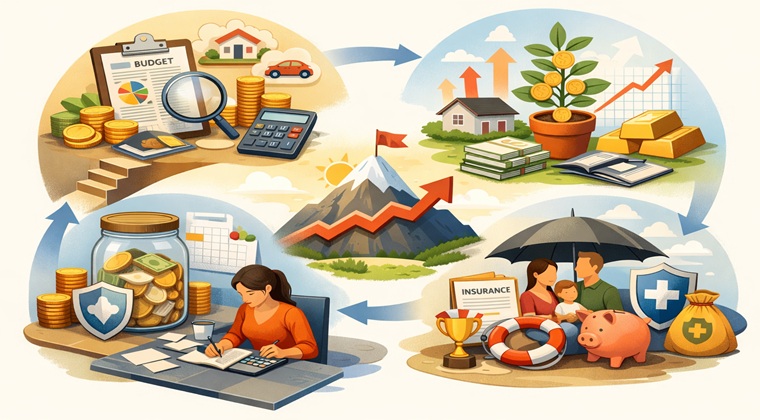
Building financial resilience is not a single action — it is a system of six interconnected practices that create compounding protection over time. The Financial Health Network's 2025 research finding that people who assess their finances across multiple categories are 2.4 times more likely to be financially healthy confirms that fragility arises from gaps in the system, not from weakness in a single area.
The Financially Resilient vs Financially Fragile Mindset
The final and most persistent factor in financial resilience is mindset — the internal relationship a person has with money, planning, and delayed gratification. The Allianz Life December 2025 study found that Americans' worst financial habits include: spending too much on things they don't need (32%), not saving as much as they could (25%), not saving any money at all (23%), and not paying down debt fast enough (22%). These are not primarily income problems — they are prioritisation and behaviour problems.The iTHINK Financial 2026 Roadmap captures the shift required: 'It is about intentionality. When you know exactly how much comes in and how much goes out, you gain the power to make choices aligned with your priorities rather than reacting to whatever happens next.' The financially resilient person does not have more willpower — they have better systems. Automation removes the need for willpower. A named emergency fund account creates emotional ownership of the goal. A quarterly net worth review makes progress visible and tangible.
The real differentiator today is not how much money people make, but how effectively they manage, structure, and protect what they already have.
— FITHMEDIA — FINANCIAL RESILIENCE 2026: U.S. GUIDE TO THRIVING CHANGE (APRIL 2026)
The NEFE poll found that when asked what one word best describes their financial outlook for 2026, 32% of US adults chose 'hopeful' and 26% chose 'confident'. That is 58% of the country entering the year with some degree of positive financial orientation. The question is whether that orientation translates into the specific, consistent actions — the emergency fund, the debt plan, the automated savings, the quarterly review — that convert financial hope into financial resilience.
CONCLUSION
The financial fragility crisis of 2026 is not a story about a few people who made poor decisions. It is a story about 88% of Americans feeling financial stress, 37% unable to cover a $400 emergency, and 34% — approximately 88 million adults — actively struggling or in financial crisis. These numbers reflect a systemic failure to equip people with the financial structures, habits, and knowledge that make resilience possible. The six warning signs — no emergency fund, paycheck-to-paycheck living, unmanaged high-interest debt, no spending awareness, retirement unpreparedness, and inadequate income protection — are each individually addressable. Together, they form the pattern of financial fragility that leaves households perpetually vulnerable to the predictable shocks of modern life.Financial resilience is built through systems, not willpower. Automate your savings so the decision happens before you spend. Name your emergency fund account so the goal feels real. Write down your debt plan so the payoff date is visible. Schedule a quarterly financial review so problems are caught early. These are not heroic actions — they are consistent, structural ones. As FiTHMedia's April 2026 resilience guide states, the real differentiator is not how much money you make, but how effectively you manage, structure, and protect what you already have. Start with the first $1,000. Build the emergency fund. Protect the buffer. Everything else becomes possible from that foundation.
Frequently Asked Questions
What does financial resilience actually mean, and how is it different from being wealthy?
Financial resilience is the capacity to absorb financial shocks — unexpected expenses, income disruption, emergencies — without those shocks permanently derailing your financial stability. It is distinct from wealth. A high-income household with no savings, high debt, and no insurance is financially fragile — one health crisis or job loss away from a cascade of missed payments and debt accumulation. A moderate-income household with a three-month emergency fund, a managed debt plan, and appropriate insurance is financially resilient — because it has the structural buffers to absorb the predictable disruptions of life without compounding their impact. FiTHMedia's April 2026 Financial Resilience Guide frames it clearly: the differentiator is not how much money you make, but how effectively you manage, structure, and protect what you already have.How much should I have in an emergency fund in 2026?
Financial guidance consistently recommends three to six months of essential living expenses as the full target, but the most important milestone is the first $1,000 — enough to cover the most common single-event emergencies without recourse to credit card debt. Monarch's February 2026 Financial Resolutions guide recommends three to nine months depending on your situation: self-employed individuals, single-income households, and those in industries with higher job insecurity should target the higher end. For the highest-yield storage, AARP's January 2026 emergency fund guide recommends high-yield savings accounts, which paid up to 4.2% APY compared to 0.39% average for traditional savings accounts. The fund must be kept separate from everyday spending accounts — separation creates both psychological protection and the habit of treating the fund as untouchable except in genuine emergencies.Why do so many people lack financial resilience even when they have decent incomes?
Income is necessary but not sufficient for financial resilience. The Allianz Life December 2025 study found that among the financially stressed, the most common reasons were: day-to-day cost of living too high (54%), income too low (46%), not saving enough for emergencies (39%), and too much debt (35%). Three of the four top reasons are behaviourally addressable — not purely income constraints. The nudge Global Financial Wellbeing Report (May 2025) identified a 59% decline in financial optimism, with 63% anticipating inflation will worsen their situation. When people feel economically hopeless, they tend toward present-focused spending rather than future-oriented saving — a rational response to perceived futility that unfortunately deepens the fragility. Breaking the cycle requires both structural changes (automation, named accounts, written plans) and a genuine belief that the actions will produce a different outcome. That belief is built incrementally, through small wins compounding over time.What is the best way to start building financial resilience if I am currently paycheck to paycheck?
Start with the smallest possible action that produces a visible result. The micro-buffer of $500–$1,000 is the most important early target — not because it is large enough to handle a major emergency, but because it exists outside your checking account and breaks the zero-balance-every-paycheque pattern. iTHINK Financial's 2026 Roadmap advises treating savings as a non-negotiable bill and setting up an automatic transfer to a separate account immediately after payday. AARP financial coach Marc Russell: 'Automation lets the money move before you can talk yourself out of it.' Simultaneously, track every outflow for 30 days with precision — not a monthly estimate, but daily recording. Most paycheck-to-paycheck households discover that 10–20% of their monthly spending is on categories that do not generate meaningful satisfaction or value. Redirecting even half of that to the emergency fund transforms the trajectory without requiring any income increase.What are the six warning signs that someone lacks financial resilience?
The six consistent warning signs identified across the major 2025–2026 financial wellness research are: (1) No emergency fund — 37% of adults cannot cover a $400 emergency (Fed SHED 2024); (2) Living paycheck to paycheck — approximately 50% of Americans arrive at the end of each pay period with no meaningful buffer; (3) High-interest debt without a paydown plan — average credit card debt of $6,735 at above 20% APR (Experian 2025; Monarch Feb 2026); (4) No budget or spending awareness — having a budget but not tracking actual spending versus the plan, which is where most budgets break down; (5) Retirement unpreparedness — Gen X median emergency savings of $500 (Empower 2025); 27% of Americans with decreased confidence in retirement goals (Allianz Life Dec 2025); and (6) No income protection — no disability insurance, inadequate health coverage, or no plan for income disruption from illness or job loss. The Financial Health Network's 2025 Pulse Report found that people assessing their finances across multiple categories are 2.4 times more likely to be financially healthy — which means addressing all six areas, not just one or two.References
NEFE — Poll: Americans Feeling Financial Stress to Begin 2026 (January 2026) https://www.nefe.org/news/2026/01/poll-americans-feeling-stressed-to-begin-2026.aspxAllianz Life — Nearly Half of Americans More Stressed Heading into 2026 (December 2025) https://www.allianzlife.com/about/newsroom/2025-Press-Releases/Nearly-Half-of-Americans-More-Stressed-Heading-into-2026
Ramsey Solutions — State of Personal Finance in America Q4 2025 (February 2026) https://www.ramseysolutions.com/budgeting/state-of-personal-finance
FiTHMedia — Financial Resilience 2026: U.S. Guide to Thriving Change (April 2026) https://fithmedia.com/timeless-finance/financial-resilience-2026-u-s-guide-to-thriving-change/
Monarch Money — Financial Resolutions for 2026: Tips to Achieve Your Money Goals (February 2026) https://www.monarch.com/blog/personal-finance/financial-resolutions
Amerant Bank — 13 Financial Health Tips for 2026: Improve Money Management (February 2026) https://www.amerantbank.com/ofinterest/financial-health-tips-for-2026/
iTHINK Financial — Your 2026 Financial Roadmap (January 2026) https://www.ithinkfi.org/blog/blog-detail/ithink-blog/2026/01/07/your-2026-financial-roadmap-ithink-financial
AARP — Tips for Building or Rebuilding Your Emergency Fund (January 2026) https://www.aarp.org/money/personal-finance/how-to-build-emergency-fund/
Millions Pro — The Complete Financial Wellness Checklist for 2026 (March 2026) https://www.millionspro.com/blog/financial-wellness-checklist-2026
nudge Global — 2025 Global Financial Wellbeing Report: Americans Doubt More Affordable Future (May 2025) https://www.prnewswire.com/news-releases/financially-stressed-americans-doubt-more-affordable-future-over-next-four-years-302464902.html
0 Comments Comments