
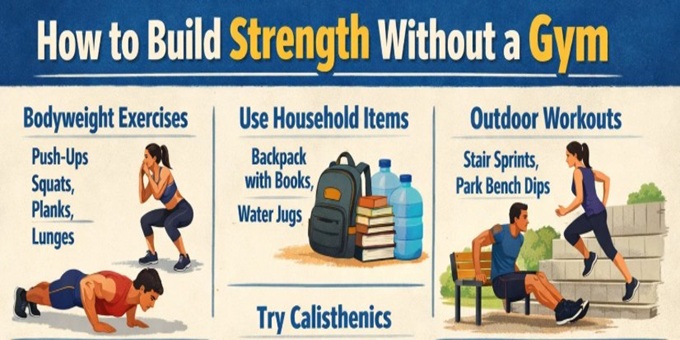
How to Build Strength Without a Gym: Effective At-Home Exercises

Ready to build muscle but stuck at home? You do not need a costly membership or a room full of gear. Your own body and perhaps a pair of dumbbells are powerful tools for getting strong. Bodyweight training is far more than a simple alternative. It builds serious muscle, enhances athleticism, and develops functional power. You can use your body and common items, like a bar for pull-ups, to create a complete routine. This approach offers unique benefits. You gain incredible convenience, save money, and enjoy complete privacy. Your schedule becomes flexible, eliminating commutes and waits for machines.
Whether you are starting out or are an experienced athlete, you can achieve impressive results. Success comes from understanding exercise selection, progressive overload, and proper recovery. This guide provides the actionable strategies you need to start immediately.
Key Takeaways
- Building significant muscle at home is entirely possible and highly effective.
- Your body is the most versatile piece of fitness equipment you own.
- Home training offers major advantages in convenience, cost, and flexibility.
- Both beginners and advanced athletes can achieve results with the right plan.
- Success hinges on proper exercise choice, progressive overload, and recovery.
- You can start a powerful routine with minimal or no special gear.
Introduction: Starting Your Fitness Journey at Home
Your personal wellness evolution begins right where you are, with no commute required. This approach eliminates common barriers that prevent many people from maintaining consistent exercise habits.
Understanding the Benefits of Home Workouts
Home training provides incredible flexibility. You can exercise whenever your schedule allows. This makes it easier to build consistent habits without disruption. Research shows that strength training at least two days weekly supports muscle growth. A balanced routine delivers optimal results.
| Day | Activity | Duration | Focus |
| Monday | Full-Body Strength | 30-45 minutes | Muscle development |
| Tuesday | Cardio | 20-30 minutes | Heart health |
| Wednesday | Rest | - | Recovery |
| Thursday | Full-Body Strength | 30-45 minutes | Progressive overload |
| Friday | Cardio | 20-30 minutes | Endurance |
| Weekend | Active Rest | Flexible | Sustainability |
Regular physical activity improves mental wellbeing, including reducing anxiety and depression symptoms.
Setting Realistic Fitness Goals
Focus on establishing consistent training habits rather than dramatic transformations. Your journey is personal and unique. Consider your current fitness level and available time. Realistic goals ensure your training plan enhances rather than complicates your life. Celebrate small victories along the way.
Benefits of Strength Training Without a Gym
Training your muscles at home unlocks numerous benefits beyond just physical gains. This approach to developing your body offers advantages that traditional gym settings cannot match. Financial savings represent a major advantage. You eliminate membership fees, personal trainer costs, and transportation expenses. The money saved can be substantial over time.
| Benefit Category | Home Training | Gym Training |
| Cost | Minimal investment | Monthly fees required |
| Convenience | Available 24/7 | Limited operating hours |
| Privacy | Complete control | Shared space with others |
| Results | Equivalent or superior | Dependent on equipment |
Your training environment becomes completely personalized. You choose the music, temperature, and timing. This control enhances comfort and consistency. Functional strength development occurs naturally. Bodyweight exercises translate directly to daily activities. Carrying groceries or climbing stairs becomes
easier. The adaptability of this approach ensures consistency during travel or schedule changes. Your routine continues uninterrupted wherever you go. Mental resilience grows alongside physical capabilities. Self-motivation and discipline develop without external pressure. This psychological strength serves you in all life areas.
How to Build Strength Without a Gym
Developing physical power is not confined to spaces filled with metal plates and machines. Your own mass provides ample resistance to stimulate significant growth. The key lies in applying the principle of progressive overload. This means gradually increasing the challenge of your bodyweight exercises. You achievethis by adding repetitions, slowing your movement tempo, or mastering more difficult variations. This constant progression is what forces your muscles to adapt and grow stronger. Creativity becomes your greatest asset. Simple changes, like adjusting hand placement during a push-up or adding a pause at the bottom of a squat, dramatically increase intensity. Your body is a complete training system capable of targeting every major muscle group effectively. Success hinges on mastering fundamental patterns: pushing, pulling, squatting, and hinging. Consistent challenge, not equipment access, determines your gains. Patience and strict attention to form are ultimately more critical than any specialized gear.
Core Bodyweight Exercises for Overall Strength
Three essential exercises provide comprehensive strength development using only your body mass. These movements form the foundation of effective home training programs.
Push-Ups and Variations
The push-up stands as a cornerstone among bodyweight exercises. Begin in a high plank position with your hands flat on the floor beneath your
shoulders. Maintain a straight line from head to heels as you lower your chest toward the floor. This fundamental movement targets multiple muscle groups
effectively. Progress to variations like close-grip or decline push-ups for continued challenge.
Burpees and Pull-Ups
Burpees combine strength and cardio in one dynamic bodyweight exercise. From a standing position, place your hands on the floor and jump back into a plank. Pull-ups develop exceptional upper body strength. Start from a dead hang position and pull until your chin clears the bar. These exercises complete a
comprehensive bodyweight exercises routine.
| Exercise | Sets/Reps | Primary Muscles | Key Focus |
| Push-up | 3-6 sets of 6-12 reps | Chest, shoulders, triceps | Upper body strength |
| Burpee | 6 per minute for 15 min | Full body engagement | Cardio and strength |
| Pull-up | 3 sets of 2-5 reps | Back, biceps, shoulders | Pulling strength |
| Overall Program | 2-3 sessions weekly | Comprehensive development | Progressive overload |
Targeted Workouts for Upper Body Strength
Strategic exercise selection enables precise targeting of your chest, arms, and shoulders for balanced upper body development. These focused routines isolate specific muscle groups to address weaknesses and create proportional growth. You can achieve comprehensive upper body development through careful movement selection. Each exercise variation emphasizes different aspects of your musculature.
Chest and Arm Focused Routines
Your chest responds well to varied pushing angles. Close-grip push-ups target your inner chest and triceps effectively. Arm-specific movements like triceps dips and plank-ups develop the often-neglected triceps muscles. These comprise two-thirds of your upper arm mass.
| Exercise | Sets/Reps | Primary Focus | Key Muscles |
| Close-grip Push-up | 3 sets of 10-12 | Inner chest development | Chest, triceps |
| Plank-up | 3 sets of 5-10 | Core stability | Shoulders, arms |
| Triceps Dip | 2 sets of 10-12 | Arm strength | Triceps, shoulders |
| Inchworm | 3 sets of 4-6 | Full-body coordination | Shoulders, core |
Enhancing Shoulder Stability
Shoulder stability exercises protect your joints during dynamic movements. They develop the supporting muscles around your shoulder girdle. These stability drills prevent injury while improving functional strength. Your shoulders support all upper body activities effectively. Balanced training requires equal attention to pushing and pulling movements. This approach ensures proportional development across all upper body muscles.
Effective Lower Body Routines to Build Leg and Glute Strength
Building leg and glute strength forms the cornerstone of functional fitness and athletic performance. These muscles power your daily movements and provide stability for all physical activities. You develop powerful legs through fundamental movements that target multiple muscle groups simultaneously. Proper form ensures maximum benefits while minimizing injury risk.
Squats, Lunges, and Step-Ups
The squat engages your entire lower body effectively. Stand with your feet slightly wider than shoulder-width, keeping your chest up and back straight. Push your hips back while bending your knees, lowering until thighs reach parallel. Drive upward through your heels to return to the starting position. Lunges address strength imbalances between your legs. Take a big step forward, lowering until your front thigh nears parallel to the floor. Your back knee should hover just above the floor. Press through your front heel to return to standing, repeating with the opposite leg. Step-ups build unilateral power using stairs or a sturdy box. Step up with your right foot, then left, before stepping back down in the same order. These best leg exercises develop comprehensive lower body capability. Consistent practice with proper positioning yields impressive results over time.
Incorporating Dumbbell Exercises Safely at Home
Adding dumbbells to your home training routine introduces precise resistance control for accelerated muscle development. This equipment enables progressive overload more accurately than bodyweight alone. You can systematically increase challenge as your capabilities grow. Safe training begins with selecting appropriate weight. Choose dumbbells that allow proper form while making the final 2-3 reps challenging. This balance prevents injury while ensuring sufficient stimulus.
Chest Press and Dumbbell Flyes
The dumbbell chest press targets your pectorals, shoulders, and triceps effectively. Lie faceup on a bench or floor with knees bent. Hold dumbbells at your chest sides, then press upward with control. Dumbbell flyes isolate chest muscles through a different movement pattern. Maintain slightly bent elbows while lowering weights in an arc to your sides. This stretches your pectorals before contracting them to return overhead.
Biceps Curls and Triceps Extensions
Biceps curls develop impressive arm strength by isolating your biceps muscles. Keep your upper arms stationary while curling the weight toward your shoulders. Control the descent for maximum benefit. Triceps extensions target the back of your arms by lowering weight behind your head. Stand with feet hip-width apart, raising the dumbbell overhead with both hands. Bend elbows to lower the weight while keeping upper arms steady. Proper breathing technique maintains stability throughout each repetition. Exhale during the exertion phase and inhale during lowering. This approach optimizes performance and blood pressurecontrol. Progressive overload involves increasing weight once you complete the upper end of your target rep range. Typically progress in 2.5-5 pound increments for continued adaptation.
Proper Form to Prevent Injury and Maximize Gains
Correct technique is the cornerstone upon which all physical progress is built. Proper positioning ensures your target muscles do the work while protecting your joints. Your lower back is particularly vulnerable. Maintaining a neutral spine during movements like squats is critical. This alignment distributes force safely.
Warm-Up and Cool Down Techniques
Always begin with a 5-10 minute warm-up. Light cardio and dynamic stretches prepare your body for action. This routine increases blood flow and reduces injury risk. Cooling down is equally important. Gentle activity and static stretching help your heart rate return to normal. This practice also aids recovery and reduces soreness.
Common Mistakes to Avoid
Rushing through repetitions is a frequent error. Move slowly and with control. Count two seconds for the lifting phase and two seconds for the lowering phase. Never hold your breath. Exhale during the effort of each exercise. Inhale as you return to the starting point. This prevents dangerous blood pressure spikes. Listen to your body. Stop immediately if you feel sharp pain or dizziness. Needing a break is a sign to rest, not push harder.
| Exercise | Common Form Error | Proper Cue |
| Push-up | Sagging lower back | Engage core, keep body straight |
| Squat | Knees moving past toes | Push hips back first |
| Plank | Dropping hips or raising back | Maintain a straight line from head to heels |
| Row Variation | Shrugging shoulders | Pull shoulders back and down, bend elbows |
Designing a Weekly Training Routine
Creating a structured weekly schedule transforms random workouts into measurable progress. Research confirms that strength training at least two days weekly effectively builds muscle. Your routine should balance activity with adequate recovery time. Begin with 2-3 full-body strength training sessions weekly. Add two cardio days and reserve two days for complete rest. This approach gives your body sufficient recovery time between sessions.
Balancing Cardio and Strength Sessions
Schedule strength training and cardio on separate days when possible. This strategy optimizes each workout's quality. When time is limited, perform strength work first while you're fresh. High-Intensity Interval Training (HIIT) offers superior muscle-building compatibility. It delivers cardiovascular benefits in shorter periods. HIIT minimizes interference with strength adaptations.
Rest and Recovery Strategies
Recovery is when muscles actually grow stronger. Your training adaptations occur during rest periods, not during the workout itself. Adequate sleep and nutrition support this process. Watch for signs of insufficient recovery like persistent fatigue or declining performance. These indicate you need more rest time. Adjust your schedule based on your recovery capacity. As you advance, increase to 3-4 weekly training sessions. Consider splitting routines between upper and lower body days. This allows higher volume
while maintaining recovery.
Adapting Workouts for Varying Fitness Levels
Whether you're just starting out or have years of experience, customized approaches maximize your results. Effective training programs must adapt to individualstarting points.
This ensures appropriate challenges for every participant. Your journey to get stronger should match your current capabilities.
Beginner and Novice Modifications
Newcomers to exercise should begin slowly and build up gradually. Consult your doctor before starting any new training program.
Beginner modifications make bodyweight exercises accessible. Use incline push-ups against walls or countertops. Try assisted squats holding onto
stable surfaces. These adaptations build foundational strength safely. Aim for 8-15 repetitions of each exercise. Focus on proper form above all else.
Progressive Challenges for Advanced Trainees
As you get stronger, systematically increase the difficulty. Add repetitions, reduce rest intervals, or try harder variations. Advanced techniques include tempo manipulation and unilateral movements. Single-leg squats and one-arm push-ups provide endless progression. Your workout should continually challenge your improved capabilities. This approach prevents plateaus and promotes ongoing adaptation.
| Fitness Level | Exercise Approach | Volume Recommendation | Progression Strategy |
| Beginner | Modified movements with support | 1-2 sets of 8-12 reps | Master basic form first |
| Intermediate | Standard bodyweight exercises | 2-3 sets of 10-15 reps | Increase repetitions gradually |
| Advanced | Challenging variations and tempo work | 3-4 sets of 8-12 reps | Introduce complex movements |
Advanced Techniques and Progressive Overload
When standard exercises become comfortable, specialized techniques provide continued growth. Advanced training methods challenge your body in new ways, ensuring you continue to get stronger. Leverage manipulation dramatically increases difficulty. Changing your position relative to resistance points makes identical movements more challenging. This approach builds exceptional strength without additional equipment. Reducing stability during movements recruits more muscle fibers. Unilateral positions or unstable surfaces increase neural demand. Your body adapts by developing better control and coordination. Tempo training extends time under tension. Controlled descent and explosive ascent phases create superior muscle adaptation. This method transforms familiar exercises into advanced challenges. Combination movements develop multiple attributes simultaneously. Flow sequences linking various positions enhance coordination and endurance. Your workout becomes more dynamic and engaging. Advanced methods like cluster sets and density training provide sophisticated progression strategies. These techniques maximize muscle stimulation within limited time frames. Tracking performance ensures systematic improvement rather than random effort.
Conclusion
Your fitness transformation begins with the powerful tools you already possess. This guide has demonstrated that significant muscular development is achievable through effective home-based strength training programs. You now understand how to create sustainable routines that deliver real results. The journey requires consistency and attention to proper form. These qualities develop mental resilience that extends beyond physical fitness. Your progress is personal and unique—focus on your own improvements rather than comparisons. Remember that every expert started as a beginner. Small, consistent efforts compound into remarkable transformations over time. For additional guidance on creating safe, effective routines, explore this resource on effective home-based strength training.
Take action today by selecting exercises from this guide. Commit to regular sessions and begin building the capable, resilient body you deserve. Your journey to better health starts now, right where you are.
0 Comments
Be the first to share your thoughts on this article.