
Travel & holidays
How to Plan a Perfect Holiday Travel in 2026

From choosing the right destination and booking flights at the best price to packing smartly, managing your budget, and handling the unexpected — this is your complete, step-by-step guide to planning a holiday that goes exactly the way you imagined it.
The first and most important decision in any holiday is where to go — and yet it is often the one that gets the least structured thought. Most people end up at the same familiar destinations partly out of habit and partly because the choice feels overwhelming. A simple framework makes it much easier.
Start by answering four questions. First, what kind of holiday do you actually want? Rest and relaxation by the sea, active adventure in the mountains, cultural immersion in a city, or something entirely different? Different people need different things, and a beach resort is not the right answer for someone who wants to explore medieval architecture any more than a city break is ideal for someone who needs to genuinely switch off. Second, who are you travelling with? A solo trip, a couple's break, a family holiday with young children, and a group of friends all call for very different destinations and styles of travel. Third, how much time do you have? A weekend city break requires a different destination shortlist to a three-week overland journey. And fourth, what is your realistic budget? Some dream destinations are surprisingly affordable; others are more expensive than they appear online once the full cost — including transport, accommodation, activities, and food — is taken into account.
Once you have answered those questions, use travel search tools like Google Explore, Skyscanner Everywhere, or Lonely Planet's destination guides to identify destinations that match your criteria. Read recent traveller reviews on TripAdvisor and travel forums, and check the UK Foreign Commonwealth and Development Office (FCDO) or US State Department travel advisories to confirm there are no current safety or entry concerns for your shortlisted destinations.
The best holiday destination is not the most popular one — it is the one that matches who you are, how much time you have, and what you genuinely need from a break.
— LONELY PLANET TRAVEL ADVICE
A complete travel budget should cover flights or transport, accommodation, travel insurance, activities and excursions, food and drink, local transport at the destination, souvenirs and shopping, visa fees and airport transfers, and a contingency reserve of at least 10% to 20% of the total for unexpected costs. Write each category down with a realistic estimate, then total it up and compare it with what you can actually afford. If the total exceeds your available funds, adjust — choose a closer destination, travel off-peak, self-cater for some meals, or reduce the trip length.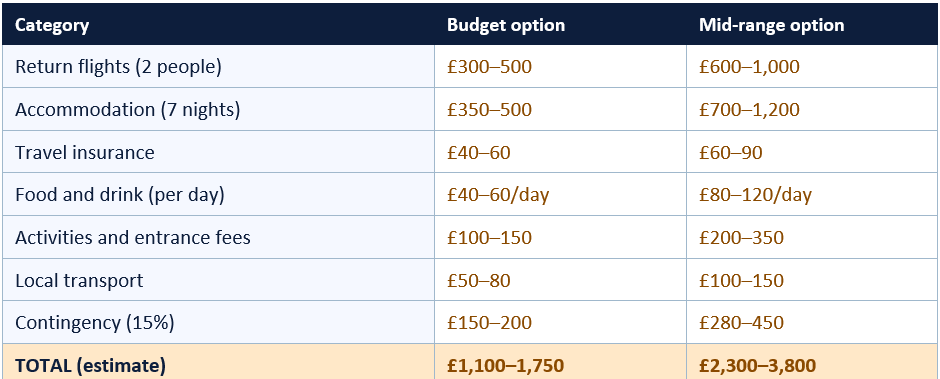
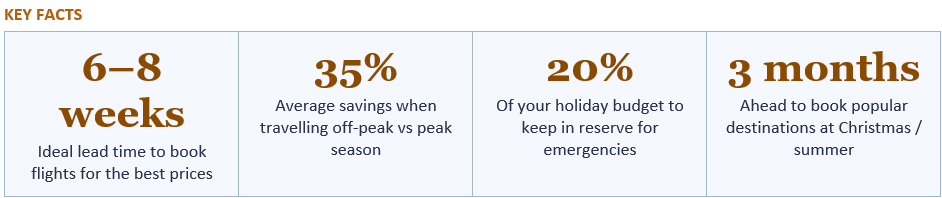
For flights, research consistently points to a booking sweet spot of six to eight weeks ahead of departure for short-haul and European routes, and three to five months ahead for long-haul flights. Booking too far in advance — particularly more than six months out — often means paying inflated early-booking prices, as airlines hold back their cheapest seats. Booking last-minute is occasionally possible for budget airlines but carries significant risk of paying premium prices or losing the dates you need.
The day of the week you search and book also matters. Multiple pricing studies have found that flight prices tend to be lower on Tuesdays and Wednesdays and higher on Fridays and Sundays, when leisure travellers are most active on booking sites. Setting up fare alerts on Google Flights, Skyscanner, or Kayak means you can track price movements on specific routes and book when prices dip rather than when you happen to think about it.
For accommodation, the dynamics are somewhat different. Popular hotels and holiday rentals in sought-after destinations can sell out months in advance, particularly during school holidays, public holidays, and local festivals. For city hotels with more flexible cancellation policies, booking six to eight weeks out and keeping an eye on prices is often sensible — prices sometimes drop closer to the date if rooms are not filling up. For villas, holiday cottages, or properties through platforms like Airbnb, book early: the best properties in popular areas are typically taken three to six months ahead for peak season.
Once you have found a good price, book directly with the airline or through a reputable online travel agent rather than through an unknown third-party site, which may charge hidden fees or have poor customer service if problems arise. Always read the fare conditions before booking — baggage allowances, change fees, and cancellation terms vary enormously between fare types and can significantly affect the true cost of the ticket.
For most holidaymakers, the choice comes down to hotels, self-catering apartments or villas, holiday parks, hostels, or private rental platforms like Airbnb and Vrbo. Each has genuine advantages depending on your situation. Hotels suit short breaks and city trips where you want service, a central location, and the flexibility of not cooking. Self-catering works well for families or groups, particularly for longer stays where eating every meal out becomes expensive — a week in a villa or apartment with a kitchen can save hundreds of pounds on food compared with eating in restaurants every day. Hostels remain excellent value for solo travellers or younger groups who prioritise budget and social experience over privacy.
When choosing and comparing accommodation, look carefully at the total price including taxes and cleaning fees (particularly for Airbnb listings, which routinely add service fees and cleaning charges that can add 20% to 40% to the headline nightly rate). Read at least ten recent reviews, paying particular attention to comments about cleanliness, accuracy of the listing description, and the responsiveness of the host or property manager when problems arose. A five-star average with only three reviews is much less reliable than a 4.6-star average from 200 guests.
Location matters enormously and is often worth paying a premium for. Staying in a central, walkable location can eliminate the need for taxis and public transport, saving money and time while improving the experience. A hotel that is slightly more expensive but within easy walking distance of the main attractions, the beach, or the town centre will usually deliver a better overall holiday than a cheaper option that requires a car or bus journey every time you want to go somewhere.
A useful rule of thumb is to plan one main activity or attraction per day and treat everything else as optional. This anchors the day without turning it into a march. Pre-book the activities and attractions that genuinely require advance booking — major museums, popular guided tours, iconic restaurants, and ticketed events typically sell out days or weeks ahead in peak season. For everything else, keep your options open and decide each morning based on how you feel, the weather, and what looks appealing.
When researching what to see and do, use a combination of guidebooks (Lonely Planet, Rough Guides, and DK Eyewitness are consistently reliable), recent travel blogs and vlogs for up-to-date practical information, and local knowledge wherever you can get it — the best recommendations often come from hotel concierges, Airbnb hosts, or local tourism information offices, who know what is currently worth visiting and what has become over-priced or overcrowded.
Build in at least one completely unscheduled day on any holiday longer than five nights. Experienced travellers consistently describe these buffer days as among the best of any trip — they allow you to revisit a place you loved, linger longer over a meal, explore an interesting neighbourhood you stumbled across, or simply rest if the trip has been busy.
Medical emergencies abroad are the most serious risk. In some countries — particularly the United States — a hospital admission can cost tens of thousands of pounds or dollars for a few days of treatment. Without insurance, those costs fall entirely on the traveller. Medical evacuation — being flown home for treatment — can cost £50,000 or more. Standard travel insurance policies cover medical expenses, usually to a minimum of £2 million, for a cost of £15 to £60 per person per trip depending on destination, age, and cover level.
Beyond medical cover, good travel insurance also covers cancellation and curtailment (if you have to cancel before travel or cut a trip short due to illness, bereavement, or other covered reasons), lost, stolen, or damaged baggage and personal possessions, flight delays and missed connections, and emergency repatriation. For winter sports or adventure activities, a specialist policy or add-on is needed.
When buying travel insurance, compare policies on a comparison site such as MoneySuperMarket, Compare the Market (UK), or InsureMyTrip (US). Do not choose purely on price — read what is and is not covered, and pay particular attention to exclusions for pre-existing medical conditions, activities, and the excess amount you would need to pay before the policy pays out. Annual multi-trip policies are excellent value for anyone who travels more than twice a year.
The worst way to access foreign currency is to exchange cash at an airport bureau de change or a hotel front desk, where exchange rates are typically 8% to 15% worse than the mid-market rate. The best approach is to use a debit card that charges no foreign transaction fees and accesses the mid-market exchange rate. In the UK, Starling Bank, Monzo, Chase, and Revolut all offer competitive rates and minimal or zero foreign transaction fees. In the US, the Charles Schwab High Yield Investor Checking account reimburses all ATM fees worldwide and charges no foreign transaction fees. These accounts effectively let you withdraw local currency from an ATM at close to the interbank rate — often the best available.
Always choose to pay in the local currency when given the option. When a payment terminal or ATM offers to convert the price to your home currency, decline — this is called Dynamic Currency Conversion and the conversion rate used is almost always significantly worse than the rate your card would apply automatically.
Keep a small amount of local currency cash for situations where cards are not accepted — some local markets, small restaurants, taxis, and tourist sites in less developed areas still operate primarily in cash. A sensible approach is to use your card for most transactions and withdraw local cash as needed from bank ATMs, rather than carrying large amounts of cash throughout the trip.
Check the FCDO (fcdo.gov.uk) or US State Department (travel.state.gov) travel advice for your destination well before you travel. These sites provide up-to-date information on safety, entry requirements, health risks, and local laws. Read the entry requirements section carefully — passport validity rules, visa requirements, electronic travel authorisations (such as ETIAS for the EU or ESTA for the USA), and vaccination requirements all need to be confirmed before you book, not on the day of travel.
Visit your GP or a travel health clinic four to six weeks before a trip to a region that may require vaccinations. Malaria prophylaxis, typhoid, hepatitis A and B, and yellow fever vaccinations have different lead times and course structures. Your GP can advise which are recommended or required for your specific destination. Pack any prescription medications in your hand luggage with a copy of the prescription, both to get through customs and to replace them if your checked baggage is delayed.
Register your trip with your government's official traveller registration service before you go. In the UK this is the FCDO's LOCATE service; in the US it is the Smart Traveler Enrollment Program (STEP). In the event of a natural disaster, civil unrest, or other emergency, registration means your embassy knows you are in the country and can help reach you.
The best defence against theft is not to carry everything in one place. Split cash, cards, and documents across different pockets or bags. Use the hotel safe for valuables and passport when you are out. A small photocopy of your passport is much safer to carry on sightseeing days than the original.
The travellers who consistently have great holidays are not lucky — they are prepared. They book flights and accommodation at the right time, they pack light and smart, they carry travel insurance, they know how to access money without losing it to poor exchange rates, and they know what to do when things go unexpectedly wrong. Follow the steps in this guide, take notes, and adapt them to your own travel style. Your perfect holiday is entirely within reach.
TABLE OF CONTENTS
- Start With the Destination: How to Choose Where to Go
- Set Your Travel Budget Before You Book Anything
- The Best Time to Book: Flights, Hotels and Packages
- Booking Flights: How to Find the Best Deals
- Choosing and Booking Accommodation
- Planning Your Itinerary: Structure Without Over-Scheduling
- What to Pack: The Smart Traveller's Checklist
- Travel Insurance: Why You Should Never Skip It
- Managing Money Abroad
- Health, Safety and Travel Documents
- Handling the Unexpected: What to Do When Things Go Wrong
- Conclusion
- Frequently Asked Questions
- References
Start With the Destination: How to Choose Where to Go
The first and most important decision in any holiday is where to go — and yet it is often the one that gets the least structured thought. Most people end up at the same familiar destinations partly out of habit and partly because the choice feels overwhelming. A simple framework makes it much easier.Start by answering four questions. First, what kind of holiday do you actually want? Rest and relaxation by the sea, active adventure in the mountains, cultural immersion in a city, or something entirely different? Different people need different things, and a beach resort is not the right answer for someone who wants to explore medieval architecture any more than a city break is ideal for someone who needs to genuinely switch off. Second, who are you travelling with? A solo trip, a couple's break, a family holiday with young children, and a group of friends all call for very different destinations and styles of travel. Third, how much time do you have? A weekend city break requires a different destination shortlist to a three-week overland journey. And fourth, what is your realistic budget? Some dream destinations are surprisingly affordable; others are more expensive than they appear online once the full cost — including transport, accommodation, activities, and food — is taken into account.
Once you have answered those questions, use travel search tools like Google Explore, Skyscanner Everywhere, or Lonely Planet's destination guides to identify destinations that match your criteria. Read recent traveller reviews on TripAdvisor and travel forums, and check the UK Foreign Commonwealth and Development Office (FCDO) or US State Department travel advisories to confirm there are no current safety or entry concerns for your shortlisted destinations.
The best holiday destination is not the most popular one — it is the one that matches who you are, how much time you have, and what you genuinely need from a break.
— LONELY PLANET TRAVEL ADVICE
Set Your Travel Budget Before You Book Anything
Before you open a single booking website, sit down and set a realistic total budget for the trip. This is the step most people skip — and it is the single biggest cause of holiday-related financial stress and post-trip regret. A holiday that stretches your finances past a comfortable point is not a perfect holiday, however beautiful the destination.A complete travel budget should cover flights or transport, accommodation, travel insurance, activities and excursions, food and drink, local transport at the destination, souvenirs and shopping, visa fees and airport transfers, and a contingency reserve of at least 10% to 20% of the total for unexpected costs. Write each category down with a realistic estimate, then total it up and compare it with what you can actually afford. If the total exceeds your available funds, adjust — choose a closer destination, travel off-peak, self-cater for some meals, or reduce the trip length.
Sample budget breakdown for a 7-night couple's trip
The Best Time to Book: Flights, Hotels and Packages
Timing your bookings is one of the most effective ways to reduce the cost of a holiday without reducing its quality. The difference between booking a flight at the optimal time and booking it at the wrong time can easily be 30% to 50% of the ticket price for the same route and dates.For flights, research consistently points to a booking sweet spot of six to eight weeks ahead of departure for short-haul and European routes, and three to five months ahead for long-haul flights. Booking too far in advance — particularly more than six months out — often means paying inflated early-booking prices, as airlines hold back their cheapest seats. Booking last-minute is occasionally possible for budget airlines but carries significant risk of paying premium prices or losing the dates you need.
The day of the week you search and book also matters. Multiple pricing studies have found that flight prices tend to be lower on Tuesdays and Wednesdays and higher on Fridays and Sundays, when leisure travellers are most active on booking sites. Setting up fare alerts on Google Flights, Skyscanner, or Kayak means you can track price movements on specific routes and book when prices dip rather than when you happen to think about it.
For accommodation, the dynamics are somewhat different. Popular hotels and holiday rentals in sought-after destinations can sell out months in advance, particularly during school holidays, public holidays, and local festivals. For city hotels with more flexible cancellation policies, booking six to eight weeks out and keeping an eye on prices is often sensible — prices sometimes drop closer to the date if rooms are not filling up. For villas, holiday cottages, or properties through platforms like Airbnb, book early: the best properties in popular areas are typically taken three to six months ahead for peak season.
Booking Flights: How to Find the Best Deals
Finding the cheapest flights requires a combination of the right tools, a little flexibility, and an understanding of how airline pricing works. Airlines use dynamic pricing algorithms that adjust fares continuously based on demand, competitor prices, remaining seat availability, and time to departure. This means that the price you see for a flight today may be different from the price you see tomorrow — sometimes higher, sometimes lower.Use comparison search engines, not airline sites alone
Start with a flight comparison search engine such as Google Flights, Skyscanner, or Kayak. These tools search across hundreds of airlines and booking sites simultaneously and display results in a clear, comparable format. Google Flights in particular offers an excellent price calendar view that shows the cheapest dates in any given month for a given route — invaluable if you have some flexibility on dates.Be flexible on dates and nearby airports
Travelling a day earlier or later than your preferred dates, or flying into or out of a nearby alternative airport, can often save significant sums. Flying on a Tuesday or Wednesday rather than a Friday or Sunday can reduce prices by 20% to 40% on many popular routes. Choosing a less convenient departure airport — for example, a secondary airport 30 to 60 minutes further from your home — can also produce meaningful savings, particularly for budget carrier routes.Consider booking one-way flights separately
For some routes, particularly when mixing budget and full-service carriers, booking two one-way tickets separately can be cheaper than a return. Be aware, however, that this reduces your protection if one flight is cancelled or delayed — missed connections across separate bookings are not the airline's responsibility to rebook.Once you have found a good price, book directly with the airline or through a reputable online travel agent rather than through an unknown third-party site, which may charge hidden fees or have poor customer service if problems arise. Always read the fare conditions before booking — baggage allowances, change fees, and cancellation terms vary enormously between fare types and can significantly affect the true cost of the ticket.
Choosing and Booking Accommodation
Where you stay shapes your holiday experience as much as any other single factor. The right accommodation is not necessarily the most expensive — it is the one that fits your style of travel, your budget, and your destination well.For most holidaymakers, the choice comes down to hotels, self-catering apartments or villas, holiday parks, hostels, or private rental platforms like Airbnb and Vrbo. Each has genuine advantages depending on your situation. Hotels suit short breaks and city trips where you want service, a central location, and the flexibility of not cooking. Self-catering works well for families or groups, particularly for longer stays where eating every meal out becomes expensive — a week in a villa or apartment with a kitchen can save hundreds of pounds on food compared with eating in restaurants every day. Hostels remain excellent value for solo travellers or younger groups who prioritise budget and social experience over privacy.
When choosing and comparing accommodation, look carefully at the total price including taxes and cleaning fees (particularly for Airbnb listings, which routinely add service fees and cleaning charges that can add 20% to 40% to the headline nightly rate). Read at least ten recent reviews, paying particular attention to comments about cleanliness, accuracy of the listing description, and the responsiveness of the host or property manager when problems arose. A five-star average with only three reviews is much less reliable than a 4.6-star average from 200 guests.
Location matters enormously and is often worth paying a premium for. Staying in a central, walkable location can eliminate the need for taxis and public transport, saving money and time while improving the experience. A hotel that is slightly more expensive but within easy walking distance of the main attractions, the beach, or the town centre will usually deliver a better overall holiday than a cheaper option that requires a car or bus journey every time you want to go somewhere.
Planning Your Itinerary: Structure Without Over-Scheduling
A well-planned itinerary strikes a balance between having enough structure to make sure you do not miss the things that matter most to you, and enough flexibility to allow for the spontaneous discoveries that make travel memorable. Over-scheduling a holiday — filling every hour with organised activities, queued attractions, and booked restaurants — often produces exhaustion rather than enjoyment. Under-scheduling can lead to aimless days and a sense that you did not make the most of where you were.A useful rule of thumb is to plan one main activity or attraction per day and treat everything else as optional. This anchors the day without turning it into a march. Pre-book the activities and attractions that genuinely require advance booking — major museums, popular guided tours, iconic restaurants, and ticketed events typically sell out days or weeks ahead in peak season. For everything else, keep your options open and decide each morning based on how you feel, the weather, and what looks appealing.
When researching what to see and do, use a combination of guidebooks (Lonely Planet, Rough Guides, and DK Eyewitness are consistently reliable), recent travel blogs and vlogs for up-to-date practical information, and local knowledge wherever you can get it — the best recommendations often come from hotel concierges, Airbnb hosts, or local tourism information offices, who know what is currently worth visiting and what has become over-priced or overcrowded.
Build in at least one completely unscheduled day on any holiday longer than five nights. Experienced travellers consistently describe these buffer days as among the best of any trip — they allow you to revisit a place you loved, linger longer over a meal, explore an interesting neighbourhood you stumbled across, or simply rest if the trip has been busy.
What to Pack: The Smart Traveller's Checklist
Packing well is both a skill and a mindset. The general principle that most experienced travellers eventually arrive at is: lay out everything you think you need, then put half of it back. Most people over-pack for holidays and spend the trip lugging around clothes they never wear, only to discover that laundry, local shopping, and the versatility of a few well-chosen basics cover most situations.The smart traveller's packing checklist
- DOCUMENTS: Passport (valid for at least 6 months beyond travel dates), visa(s) if required, travel insurance documents, booking confirmations (hotel, flights, car hire), EHIC/GHIC card (for EU/EEA travel, UK travellers), driving licence if needed.
- MONEY: Travel debit or credit card with low or no foreign transaction fees (Starling, Chase, or Revolut for UK users; Charles Schwab or Wise for US users), local currency cash for first day, backup card kept separately.
- HEALTH AND TOILETRIES: Prescription medications (with prescription copies), basic first aid kit, sun cream appropriate for destination, insect repellent if needed, any required vaccinations documented.
- TECH: Phone and charger, universal travel adaptor for the destination's plug type, portable power bank, earphones, and any cameras or devices with sufficient memory cards and batteries.
- CLOTHING: Based on weather and planned activities — check the forecast for your destination. Aim for items that mix and match easily. One smart outfit for evenings, comfortable walking shoes (worn in before you leave), swimwear if applicable.
- BAGS: A carry-on sized bag capable of fitting everything avoids checked luggage fees on budget airlines and the risk of delayed baggage. If checking a bag, weigh it at home before you travel to avoid airport weight surcharges.
Travel Insurance: Why You Should Never Skip It
Travel insurance is the single most undervalued item in most people's holiday planning. An estimated 1 in 6 travellers go abroad without any cover, often on the basis that it is an extra cost they would rather avoid. The flaw in that reasoning becomes apparent the moment something goes wrong.Medical emergencies abroad are the most serious risk. In some countries — particularly the United States — a hospital admission can cost tens of thousands of pounds or dollars for a few days of treatment. Without insurance, those costs fall entirely on the traveller. Medical evacuation — being flown home for treatment — can cost £50,000 or more. Standard travel insurance policies cover medical expenses, usually to a minimum of £2 million, for a cost of £15 to £60 per person per trip depending on destination, age, and cover level.
Beyond medical cover, good travel insurance also covers cancellation and curtailment (if you have to cancel before travel or cut a trip short due to illness, bereavement, or other covered reasons), lost, stolen, or damaged baggage and personal possessions, flight delays and missed connections, and emergency repatriation. For winter sports or adventure activities, a specialist policy or add-on is needed.
When buying travel insurance, compare policies on a comparison site such as MoneySuperMarket, Compare the Market (UK), or InsureMyTrip (US). Do not choose purely on price — read what is and is not covered, and pay particular attention to exclusions for pre-existing medical conditions, activities, and the excess amount you would need to pay before the policy pays out. Annual multi-trip policies are excellent value for anyone who travels more than twice a year.
Managing Money Abroad
Money management is one of the practical aspects of travel that most people get slightly wrong — and getting it right can save a meaningful amount and eliminate significant stress.The worst way to access foreign currency is to exchange cash at an airport bureau de change or a hotel front desk, where exchange rates are typically 8% to 15% worse than the mid-market rate. The best approach is to use a debit card that charges no foreign transaction fees and accesses the mid-market exchange rate. In the UK, Starling Bank, Monzo, Chase, and Revolut all offer competitive rates and minimal or zero foreign transaction fees. In the US, the Charles Schwab High Yield Investor Checking account reimburses all ATM fees worldwide and charges no foreign transaction fees. These accounts effectively let you withdraw local currency from an ATM at close to the interbank rate — often the best available.
Always choose to pay in the local currency when given the option. When a payment terminal or ATM offers to convert the price to your home currency, decline — this is called Dynamic Currency Conversion and the conversion rate used is almost always significantly worse than the rate your card would apply automatically.
Keep a small amount of local currency cash for situations where cards are not accepted — some local markets, small restaurants, taxis, and tourist sites in less developed areas still operate primarily in cash. A sensible approach is to use your card for most transactions and withdraw local cash as needed from bank ATMs, rather than carrying large amounts of cash throughout the trip.
Health, Safety and Travel Documents
Good preparation on health and safety turns potential crises into manageable inconveniences. The specifics depend heavily on your destination, but there are several universal steps every traveller should take.Check the FCDO (fcdo.gov.uk) or US State Department (travel.state.gov) travel advice for your destination well before you travel. These sites provide up-to-date information on safety, entry requirements, health risks, and local laws. Read the entry requirements section carefully — passport validity rules, visa requirements, electronic travel authorisations (such as ETIAS for the EU or ESTA for the USA), and vaccination requirements all need to be confirmed before you book, not on the day of travel.
Visit your GP or a travel health clinic four to six weeks before a trip to a region that may require vaccinations. Malaria prophylaxis, typhoid, hepatitis A and B, and yellow fever vaccinations have different lead times and course structures. Your GP can advise which are recommended or required for your specific destination. Pack any prescription medications in your hand luggage with a copy of the prescription, both to get through customs and to replace them if your checked baggage is delayed.
Register your trip with your government's official traveller registration service before you go. In the UK this is the FCDO's LOCATE service; in the US it is the Smart Traveler Enrollment Program (STEP). In the event of a natural disaster, civil unrest, or other emergency, registration means your embassy knows you are in the country and can help reach you.
Pre-departure document and health checklist
- Check passport expiry — valid for at least 6 months beyond your return date, with enough blank pages for stamps
- Confirm visa or electronic travel authorisation requirements for every country you will visit or transit through
- Visit a travel health clinic 4–6 weeks before departure to confirm vaccinations and medications
- Purchase comprehensive travel insurance before your trip begins (not after your flight lands)
- Make digital and physical copies of all key documents: passport photo page, insurance details, bookings, emergency contacts
- Register your trip with FCDO Locate (UK) or STEP (US) so your embassy can reach you in an emergency
- Check the FCDO or State Department travel advisory for your destination the week before you leave
Handling the Unexpected: What to Do When Things Go Wrong
Even the best-planned holidays encounter setbacks — a delayed or cancelled flight, lost luggage, an illness, a stolen wallet, or a hotel that does not match its listing. Knowing what to do in advance means you can respond calmly and effectively rather than panicking and making the situation worse.Flight delays and cancellations
Under UK261 (the retained EU regulation, now UK law) and EU261/2004, passengers on flights departing from the UK or EU are entitled to compensation and care when flights are delayed or cancelled for reasons within the airline's control. Delays of two hours or more entitle you to meals and refreshments. Delays of more than five hours entitle you to a full refund if you choose not to travel. Cancellations with less than 14 days' notice entitle you to compensation of £220 to £520 per person depending on the flight distance, unless the airline can demonstrate extraordinary circumstances. For US domestic flights, different rules apply — the DOT requires airlines to offer refunds for cancelled flights regardless of the reason.Lost or stolen belongings
If anything is lost or stolen, report it to local police as quickly as possible and obtain a written police report. This is essential for any travel insurance claim. Keep all receipts for any emergency replacement purchases, as these can usually be claimed. Report a stolen passport to the nearest British or US consulate or embassy immediately — they can issue an emergency travel document to get you home.The best defence against theft is not to carry everything in one place. Split cash, cards, and documents across different pockets or bags. Use the hotel safe for valuables and passport when you are out. A small photocopy of your passport is much safer to carry on sightseeing days than the original.
CONCLUSION
Planning a perfect holiday is not about having an unlimited budget or spending weeks researching every detail. It is about making a series of thoughtful decisions in the right order — starting with what kind of trip you actually want, setting a realistic budget before you get excited about specific destinations, booking the key elements at the right time, and preparing properly for health, safety, and the unexpected.The travellers who consistently have great holidays are not lucky — they are prepared. They book flights and accommodation at the right time, they pack light and smart, they carry travel insurance, they know how to access money without losing it to poor exchange rates, and they know what to do when things go unexpectedly wrong. Follow the steps in this guide, take notes, and adapt them to your own travel style. Your perfect holiday is entirely within reach.
0 Comments
Be the first to share your thoughts on this article.