
Financial Literacy
3 Thinking Errors That Cost You Money

Loss aversion. Present bias. The sunk cost fallacy. These are not obscure academic concepts. They are the everyday mental habits that make us hold losing investments too long, avoid transferring savings accounts, pay for subscriptions we never use, and fail to save enough for a future we cannot feel. Behavioural economics has spent decades proving these patterns exist. This guide explains exactly how each one costs you money — and what to do about it.

The field of behavioural economics — built on decades of research by Daniel Kahneman, Amos Tversky, Richard Thaler, and hundreds of researchers since — has established something more uncomfortable: most money mistakes are not random. They are systematic, predictable, and shared across income levels, education levels, and countries. They arise not from stupidity or laziness but from the fundamental architecture of the human brain, which evolved to navigate an environment of immediate threats, visible resources, and social relationships — not abstract financial instruments, compound interest, or probabilistic risk.
Simply Psychology’s March 2026 analysis of cognitive biases in financial decision-making puts it precisely: ‘Our cognitive architecture was shaped by environments where resources were immediate, visible, and social. Abstract financial instruments, compound interest, probabilistic risk, and long time horizons are recent inventions that the brain handles with the same ancient machinery.’ The result is a set of thinking errors that are not character flaws. They are predictable features of a system doing its best with tools it was not designed for.
This guide covers three of the most financially costly: loss aversion, present bias, and the sunk cost fallacy. For each, the scientific evidence is clear, the practical consequences in everyday financial life are documented, and the fixes are specific enough to implement.
The Science: Loss aversion coefficient (UK population survey, Springer Journal of Risk and Uncertainty, October 2025): average 2.41 for a £500 loss. A £500 loss feels as bad as a £1,205 gain feels good. Pension auto-enrolment: participation rose from under 50% to over 80% in many UK schemes by changing the default — design alone, no willpower required. FCA: loyalty penalties in home and motor insurance cost UK consumers £750 million per year through inertia before 2021 pricing reforms.
The key insight is not that people are irrational in a random way — that would be unhelpful. The key insight is that people are irrational in predictable ways. The same biases appear across cultures, income levels, and educational backgrounds. A representative UK population study published in the Springer Journal of Risk and Uncertainty in October 2025 measured loss aversion across thousands of participants and found it varied by demographic but was present in all groups studied. These patterns are systematic, which means they are exploitable by businesses and correctable by individuals who know what to look for.
This asymmetry was adaptive in an evolutionary environment where losing resources was genuinely more dangerous than failing to gain them. In a world of immediate scarcity, a £500 loss of food, shelter, or social standing could be catastrophic; a £500 gain was a welcome surplus. The brain’s weighting of losses over gains made biological sense. In the context of modern financial decisions — where the relevant risks are statistical, long-term, and abstract — it consistently produces the wrong answer.
The pain of a £500 loss is felt as powerfully as the joy of gaining £1,205 (UK population study, Springer Journal of Risk and Uncertainty, October 2025). The psychological impact of a loss is approximately twice that of an equivalent gain (Kahneman and Tversky, Prospect Theory, 1979; Simply Psychology, March 2026).
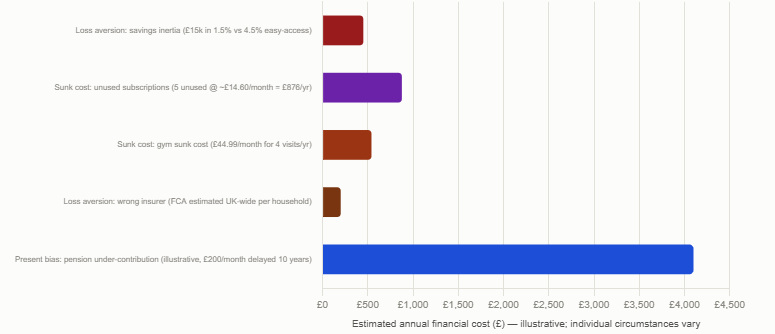
Real-world example: Marcus had £15,000 sitting in a 1.2% easy-access account for three years after the 2022 rate rises. He knew better savings rates existed but felt uncomfortable 'losing' the account he'd had for years. In the same period, a 5% easy-access account would have generated approximately £1,300 more interest. His reluctance to act cost him over £400 per year in forgone interest — more than the psychological 'security' of staying was worth.
How businesses exploit this: Insurance companies, subscription services, and banks exploit status quo bias by making switching difficult and making the default option the one that benefits them. Annual insurance auto-renewal, low-rate savings accounts with long-standing customers, and mobile contracts that roll over at the same price are all designed around the knowledge that loss aversion will keep most customers in place.
Name the loss. When you are considering whether to switch a financial product, calculate the explicit annual cost of staying: current rate vs available rate, multiplied by the balance. Making the loss concrete and specific counteracts loss aversion's tendency to make abstract inaction feel safe. Set an annual 'switching review' date — December or April — and run the comparison on savings accounts, insurance, energy, and mobile bills. The goal is not to eliminate loss aversion but to replace vague inertia with a specific number that overrides it.
This is precisely why UK pension auto-enrolment, introduced progressively from 2012, worked so dramatically. It did not change the financial product, the tax relief, or the employer match. It changed the default from ‘opt in to save’ to ‘opt out to stop saving.’ Participation rates in many schemes rose from under 50 percent to over 80 percent. Loss aversion — the fear of losing the contributions already being made — kept people enrolled. The design did what willpower could not.
The classic experimental demonstration: most people prefer £50 today over £60 next month — a 20 percent premium to receive the money immediately. But the same people are largely indifferent between £50 in 12 months and £60 in 13 months. The waiting period is the same one month in both cases, and the sum on offer is identical. The difference is whether ‘now’ is one of the options. When it is, the immediate reward is irrationally inflated. When both options are in the future, the preference largely disappears.
The behavioural economics explanation is that the brain processes immediate rewards in emotional brain systems (the limbic system) and future rewards in deliberative planning systems (the prefrontal cortex). When immediate and future options compete, the emotional system’s response is faster, louder, and harder to override. ‘Future you’ is processed almost like a stranger — someone you care about in the abstract, but not someone whose wellbeing competes effectively with what you want right now.
Present bias in pensions: auto-enrolment raised UK pension participation from under 50% to over 80% in many schemes by making saving the default — demonstrating that behavioural friction, not information or willpower, was the primary barrier. Classic experiment: people prefer £50 now over £60 in one month but are indifferent between £50 in 12 months and £60 in 13 months — present bias applies specifically to 'now', not to time generally.
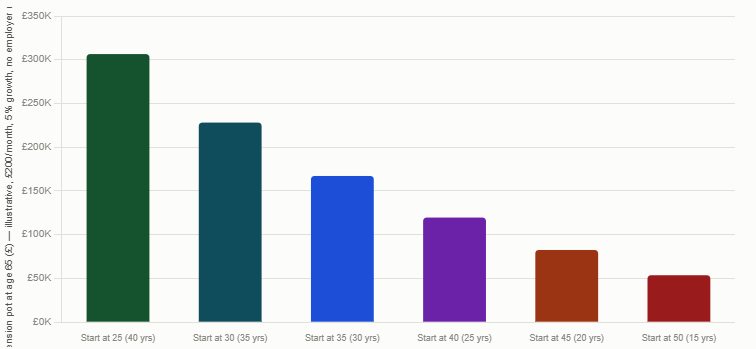
The compound interest consequence of this delay is severe. A person who starts contributing £200 per month to a pension at age 25, at 5 percent annual growth, accumulates approximately £341,000 by age 65. A person who delays ten years and starts at 35, at the same rate, accumulates approximately £197,000. The ten-year delay reduces the final pot by approximately £144,000 — from contributions that would have cost approximately £24,000 net if made at 25 to 35. Present bias cost that hypothetical person £144,000 of retirement wealth for £24,000 of immediate take-home pay.
Real-world example: Sarah pays for 11 subscriptions totalling £184 per month. She actively uses 6 of them. The other 5 cost £73 per month. Cancelling them feels like 5 separate small actions, each of which requires confronting a 'loss' (the cancelled service). The £876 annual saving is abstract. She has not cancelled them in 14 months. Present bias keeps her paying for services she does not use because the inertia of not cancelling feels costless today.
The Fix: Address present bias by front-loading your financial commitments. Automate savings on payday — before you see the money. Set pension contributions to auto-escalate by 1% each April before you have experienced the current level of take-home pay as 'normal.' Review all subscriptions on a fixed annual date and require each one to justify its cost rather than assuming continuation. Pre-commit to future behaviour: sign up for pension auto-escalation now, when 'future you's lower take-home pay feels abstract rather than immediate.
Simply Psychology’s April 2026 analysis of behavioural financial design recommends: ‘Automate savings and investments so the default is contribution rather than consumption. Set savings rate first before allocating spending, not the reverse. Pre-commit to financial behaviors through automatic escalation plans before higher income is received.’ The key is to set up the structures when future sacrifices feel abstract — now — rather than when they will feel immediate and concrete — later.
The academic articulation goes back to Arkes and Blumer (1985), who ran a classic experiment: participants who had purchased theatre season tickets were more likely to attend performances they did not enjoy, in bad weather, when unwell, than participants who had received the tickets for free. The paying participants were influenced by what they had spent. The free recipients, having nothing sunk, made decisions based only on whether attending was worth the evening. The correct answer was the same for both groups. Only one group found it.
Flyvbjerg (2021) identified the sunk cost fallacy as one of the ten most significant biases in project planning — a finding with direct financial implications for anyone running a business, managing a renovation, or making a large purchase that has started but not gone to plan.
Sunk cost fallacy is identified as one of the ten most significant biases in project planning and management (Flyvbjerg, 2021). A 2025 behavioural economics study found Netflix exploits sunk cost thinking (prior payments justify continued subscription) to sustain 'zombie subscriptions' — services people are not actively using but are reluctant to cancel because they have already paid (hbem.org, June 2025). FCA general insurance pricing reforms (2021) addressed loyalty penalties worth £750 million per year — money lost primarily through sunk cost inertia: the longer you have been a customer, the less likely you are to switch.
The sunk cost thinking at work: ‘I’ve been with this insurer for twelve years. It would be disloyal to leave.’ Or: ‘We’ve had this savings account for a decade. It would feel wrong to move it.’ The duration of the relationship is treated as a reason to continue it, when the correct analysis is based entirely on what the product offers today versus what alternatives offer today.
Tom has been paying £14.99 per month for a gym membership for 11 months. He has been three times. He keeps paying because 'I've already paid so much — quitting now would make it all wasted.' But the £164.89 already paid is sunk whether he cancels today or in six months. The relevant question is: is £14.99 per month worth what he will get from the gym going forward? Almost certainly not. The sunk cost is making him pay £89.94 more before he eventually cancels.
Loyalty pricing, rolling contracts, and the friction of cancellation are all partially designed around sunk cost thinking. The longer you have been a customer — and the harder the company makes it to cancel — the more sunk cost psychology keeps you paying. This is particularly acute in gym memberships, broadband and mobile contracts, premium bank accounts, and subscription boxes.
Ask the prospective question, not the retrospective one. When evaluating whether to continue a financial commitment, ask: 'If I were starting from scratch today, would I choose this product at this price?' The answer to that question is the correct basis for the decision. What you have already paid is not. Apply this question to subscriptions, investments, savings accounts, and insurance policies on a fixed annual schedule.
Environmental design means structuring the decision context so that the financially correct behaviour is the default and the incorrect behaviour requires active effort. The principles:
What makes these biases tractable — unlike random errors that are difficult to anticipate — is exactly their predictability. Loss aversion will cause you to undervalue switching when you should switch; you can counteract it by naming the cost of staying in concrete annual cash terms. Present bias will cause you to undersave for retirement; you can counteract it by automating pension contributions before you experience the take-home pay without them. The sunk cost fallacy will cause you to continue financial commitments that no longer serve you; you can counteract it by asking the prospective question — ‘Would I choose this today?’ — rather than the retrospective one.
The goal is not to eliminate these biases — that is neither possible nor necessary. The goal is to build decision processes that account for how the human mind actually works. Automating the financially correct behaviour, increasing friction for the financially incorrect behaviour, and running fixed annual reviews that force the prospective question are sufficient for most people to recapture thousands of pounds per year that these three thinking errors are currently costing them.
Loss aversion is the psychological tendency to feel the pain of a loss more strongly than the pleasure of an equivalent gain. Research by Kahneman and Tversky (1979) established that a loss is approximately twice as psychologically powerful as an equivalent gain. A UK population study (Springer Journal of Risk and Uncertainty, October 2025) found the average UK loss aversion coefficient for a £500 loss was 2.41. In practical personal finance, loss aversion costs money by: causing investors to hold losing investments too long rather than crystallising a loss and redeploying capital; keeping people in low-rate savings accounts because switching to a better rate feels like 'losing' a familiar provider; preventing people from starting investments because the possibility of a loss is more emotionally salient than the long-term gain; and creating inertia in insurance, utilities, and financial products that costs UK consumers hundreds of millions of pounds per year in loyalty penalties.
What is present bias and why does it matter for saving?
Present bias is the tendency to overvalue immediate rewards relative to delayed ones, specifically when one of the options involves receiving something now. It is demonstrated by the fact that people prefer £50 now over £60 next month but are indifferent between £50 in 12 months and £60 in 13 months — the one-month wait is identical in both cases, but the emotional response to waiting is different when 'now' is one of the options. In the context of saving, present bias causes chronic under-contribution to pensions because the cost (reduced take-home pay) is immediate and the benefit (retirement income) is decades away. The most powerful evidence for present bias in UK personal finance is pension auto-enrolment: simply changing the default from 'opt in to save' to 'opt out to stop saving' raised participation from under 50% to over 80% in many schemes — without changing any of the financial terms.
What is the sunk cost fallacy and what is a real-world example?
The sunk cost fallacy is the tendency to continue a course of action because of past investments of time, money, or effort, even when the correct decision based only on future costs and benefits is to stop. The 'sunk' cost cannot be recovered regardless of what you do next — it is gone either way. Example: you have paid £300 for a non-refundable holiday you no longer want to take. The correct question is: 'Given I will lose the £300 whether I go or not, is attending worth the cost of travel, time off, and the experience itself?' But most people feel compelled to go because 'not going wastes the £300' — when in fact the £300 is wasted regardless. Financial examples include: holding a losing investment because 'I can't sell below what I paid'; staying with a savings account, insurance policy, or bank for years after better alternatives are available because of how long you have been a customer; and continuing unused gym memberships or subscriptions to avoid 'wasting' prior payments.
How do businesses exploit these cognitive biases?
Businesses with sophisticated behavioural science teams design products explicitly to exploit loss aversion, present bias, and sunk cost thinking. Examples documented in a 2025 research study (hbem.org, Highlights in Business, Economics and Management): Netflix uses sunk cost thinking (prior payments justify continuation) and loss aversion (fear of losing personalised content) to sustain 'zombie subscriptions' — services people pay for but do not actively use. TikTok uses artificial scarcity and time pressure to trigger impulse purchases, exploiting the sunk cost of viewer attention and loss aversion (fear of missing a limited offer). Insurance companies and banks historically charged loyal customers more than new customers — a loyalty penalty sustained by status quo bias and sunk cost thinking — which cost UK consumers an estimated £750 million per year in the home and motor insurance sector alone before FCA pricing reforms in 2021.
What is the most effective way to overcome these three biases?
The most effective approach is environmental design rather than willpower. Research in behavioural economics consistently shows that willpower and information are insufficient to overcome systematic cognitive biases. Environmental design means making the financially correct behaviour the default. Specific actions: (1) Automate savings and pension contributions to move on payday before you see the money. (2) Pre-commit to pension auto-escalation for future pay rises. (3) Run a fixed annual financial review on the same date every year, evaluating each financial product with the prospective question: 'Would I choose this today?' (4) Calculate the explicit annual cost of staying with any financial product where a switch is available — make the loss concrete. (5) Add friction to impulse spending (remove saved card details, implement waiting periods). (6) Cancel all subscriptions you are not actively using on a fixed annual subscription audit date.
Are these biases the same for everyone?
The three biases — loss aversion, present bias, and sunk cost thinking — are present across income levels, education levels, and countries. However, their magnitude varies by individual. A UK population study (Springer Journal of Risk and Uncertainty, October 2025) found that loss aversion coefficients vary significantly by gender, age, education, financial knowledge, social class, and employment status. A cross-country study of 5,000 participants across 27 countries (Scientific Reports / Nature, June 2023) found no significant differences in bias rates between economic groups — both low-income individuals and 'positive deviants' (those who grew up disadvantaged but achieved above-average financial wellbeing) showed similar rates of cognitive bias. The biases are features of human cognition, not products of financial inexperience. This means that becoming more financially literate does not eliminate them — but it does help you design processes to work around them.
Table of Contents
- The Mind Was Not Built for Modern Money Decisions
- Why Behavioural Economics Matters for Your Wallet
- Thinking Error #1: Loss Aversion — The Fear That Costs More Than the Loss
- How Loss Aversion Costs You Money in Practice
- The Fix for Loss Aversion: Make the Status Quo Do the Work
- Thinking Error #2: Present Bias — Why Tomorrow’s You Is a Stranger
- How Present Bias Costs You Money in Practice
- The Fix for Present Bias: Design Your Future In Before You Can Spend It
- Thinking Error #3: The Sunk Cost Fallacy — Throwing Good Money After Bad
- How the Sunk Cost Fallacy Costs You Money in Practice
- The Fix for Sunk Cost Thinking: Ask the Right Question
- The Compound Effect: When All Three Errors Hit at Once
- How Businesses Use These Biases Against You
- The Master Fix: Environmental Design Over Willpower
- Conclusion: The Errors Are Predictable. So Are the Solutions.
- Frequently Asked Questions
Estimated Annual Cost Of each Biases
Present Bias: Pension Delay Compound Cost
The Mind Was Not Built for Modern Money Decisions
There is a persistent and comforting myth about money mistakes: that they result from a lack of information, a lack of discipline, or simply not being smart enough. The myth is useful because it implies a solution — read more, try harder, be smarter. It is also wrong.The field of behavioural economics — built on decades of research by Daniel Kahneman, Amos Tversky, Richard Thaler, and hundreds of researchers since — has established something more uncomfortable: most money mistakes are not random. They are systematic, predictable, and shared across income levels, education levels, and countries. They arise not from stupidity or laziness but from the fundamental architecture of the human brain, which evolved to navigate an environment of immediate threats, visible resources, and social relationships — not abstract financial instruments, compound interest, or probabilistic risk.
Simply Psychology’s March 2026 analysis of cognitive biases in financial decision-making puts it precisely: ‘Our cognitive architecture was shaped by environments where resources were immediate, visible, and social. Abstract financial instruments, compound interest, probabilistic risk, and long time horizons are recent inventions that the brain handles with the same ancient machinery.’ The result is a set of thinking errors that are not character flaws. They are predictable features of a system doing its best with tools it was not designed for.
This guide covers three of the most financially costly: loss aversion, present bias, and the sunk cost fallacy. For each, the scientific evidence is clear, the practical consequences in everyday financial life are documented, and the fixes are specific enough to implement.
The Science: Loss aversion coefficient (UK population survey, Springer Journal of Risk and Uncertainty, October 2025): average 2.41 for a £500 loss. A £500 loss feels as bad as a £1,205 gain feels good. Pension auto-enrolment: participation rose from under 50% to over 80% in many UK schemes by changing the default — design alone, no willpower required. FCA: loyalty penalties in home and motor insurance cost UK consumers £750 million per year through inertia before 2021 pricing reforms.
Why Behavioural Economics Matters for Your Wallet
Traditional economics assumed people were rational actors: they would always gather available information, weigh costs and benefits, and choose the option that maximises their long-term wellbeing. Behavioural economics, which earned Daniel Kahneman the Nobel Prize in Economics in 2002 and Richard Thaler in 2017, has comprehensively demonstrated that this is not how people actually behave.The key insight is not that people are irrational in a random way — that would be unhelpful. The key insight is that people are irrational in predictable ways. The same biases appear across cultures, income levels, and educational backgrounds. A representative UK population study published in the Springer Journal of Risk and Uncertainty in October 2025 measured loss aversion across thousands of participants and found it varied by demographic but was present in all groups studied. These patterns are systematic, which means they are exploitable by businesses and correctable by individuals who know what to look for.
Thinking Error #1: Loss Aversion — The Fear That Costs More Than the Loss
Loss aversion is the psychological tendency to feel the pain of a loss more acutely than the pleasure of an equivalent gain. The foundational research by Kahneman and Tversky (Prospect Theory, 1979) established that a loss of any given amount is psychologically approximately twice as powerful as a gain of the same amount. A UK-specific study published in the Springer Journal of Risk and Uncertainty in October 2025 quantified this for a representative UK population: the average loss aversion coefficient for a £500 loss was 2.41, meaning a £500 loss felt as painful as a £1,205 gain felt good.This asymmetry was adaptive in an evolutionary environment where losing resources was genuinely more dangerous than failing to gain them. In a world of immediate scarcity, a £500 loss of food, shelter, or social standing could be catastrophic; a £500 gain was a welcome surplus. The brain’s weighting of losses over gains made biological sense. In the context of modern financial decisions — where the relevant risks are statistical, long-term, and abstract — it consistently produces the wrong answer.
The pain of a £500 loss is felt as powerfully as the joy of gaining £1,205 (UK population study, Springer Journal of Risk and Uncertainty, October 2025). The psychological impact of a loss is approximately twice that of an equivalent gain (Kahneman and Tversky, Prospect Theory, 1979; Simply Psychology, March 2026).
How Loss Aversion Costs You Money in Practice
Loss aversion is not a theoretical curiosity. It has documented, quantifiable effects on everyday financial behaviour:The disposition effect: holding losers too long, selling winners too soon
The disposition effect (Shefrin and Statman, 1985) is one of the most robust findings in investment research. Individual investors systematically hold losing investments longer than winning investments, because selling a losing position ‘realises’ the loss psychologically, whereas continuing to hold it means the loss remains a paper loss that can still be recovered. This is loss aversion in action: the pain of crystallising the loss is greater than the rational argument for cutting it. The mathematically correct decision — sell the loser if the same money would be better deployed elsewhere — is systematically avoided.Status quo bias in savings and switching
Loss aversion drives status quo bias: the tendency to prefer the existing state of affairs over a change, even when the change would be financially beneficial. In the UK savings market, this means millions of customers leave money in low-rate savings accounts for years after better rates become available, because switching requires action and the ‘loss’ of leaving a familiar provider feels more salient than the ‘gain’ of a better interest rate. The Financial Conduct Authority (FCA) has documented this inertia extensively in its work on loyalty penalties in insurance, savings, and mortgages, finding that the financial cost to consumers of not switching runs to hundreds of millions of pounds annually.Avoiding starting
Loss aversion also prevents people from starting investments at all. The possibility of loss — even a small and temporary one in a long-term investment — is psychologically more salient than the near-certain long-term gain from consistent investment. This causes people to hold excess cash in low-yielding accounts rather than investing, particularly during periods of market uncertainty when loss salience is highest.Real-world example: Marcus had £15,000 sitting in a 1.2% easy-access account for three years after the 2022 rate rises. He knew better savings rates existed but felt uncomfortable 'losing' the account he'd had for years. In the same period, a 5% easy-access account would have generated approximately £1,300 more interest. His reluctance to act cost him over £400 per year in forgone interest — more than the psychological 'security' of staying was worth.
How businesses exploit this: Insurance companies, subscription services, and banks exploit status quo bias by making switching difficult and making the default option the one that benefits them. Annual insurance auto-renewal, low-rate savings accounts with long-standing customers, and mobile contracts that roll over at the same price are all designed around the knowledge that loss aversion will keep most customers in place.
Name the loss. When you are considering whether to switch a financial product, calculate the explicit annual cost of staying: current rate vs available rate, multiplied by the balance. Making the loss concrete and specific counteracts loss aversion's tendency to make abstract inaction feel safe. Set an annual 'switching review' date — December or April — and run the comparison on savings accounts, insurance, energy, and mobile bills. The goal is not to eliminate loss aversion but to replace vague inertia with a specific number that overrides it.
The Fix for Loss Aversion: Make the Status Quo Do the Work
The most powerful fix for loss aversion is not willpower — it is changing which option requires action. Instead of having to actively choose to switch, save, or invest, make the financially correct behaviour the default. Auto-escalation pension contributions, standing order savings that move money out of the current account on payday, and ISA subscriptions set up as direct debits all leverage loss aversion rather than fighting it: once the money has left the account, losing it back feels worse than keeping it in the investment or savings wrapper.This is precisely why UK pension auto-enrolment, introduced progressively from 2012, worked so dramatically. It did not change the financial product, the tax relief, or the employer match. It changed the default from ‘opt in to save’ to ‘opt out to stop saving.’ Participation rates in many schemes rose from under 50 percent to over 80 percent. Loss aversion — the fear of losing the contributions already being made — kept people enrolled. The design did what willpower could not.
Thinking Error #2: Present Bias — Why Tomorrow’s You Is a Stranger
Present bias is the systematic tendency to overvalue immediate rewards relative to delayed ones, even when the delayed reward is objectively larger. It is distinct from simply having a preference for the present — all rational actors prefer a pound today to a pound next year, given the time value of money. Present bias is the irrational amplification of this preference, specifically for ‘now’ versus ‘any other time.’The classic experimental demonstration: most people prefer £50 today over £60 next month — a 20 percent premium to receive the money immediately. But the same people are largely indifferent between £50 in 12 months and £60 in 13 months. The waiting period is the same one month in both cases, and the sum on offer is identical. The difference is whether ‘now’ is one of the options. When it is, the immediate reward is irrationally inflated. When both options are in the future, the preference largely disappears.
The behavioural economics explanation is that the brain processes immediate rewards in emotional brain systems (the limbic system) and future rewards in deliberative planning systems (the prefrontal cortex). When immediate and future options compete, the emotional system’s response is faster, louder, and harder to override. ‘Future you’ is processed almost like a stranger — someone you care about in the abstract, but not someone whose wellbeing competes effectively with what you want right now.
Present bias in pensions: auto-enrolment raised UK pension participation from under 50% to over 80% in many schemes by making saving the default — demonstrating that behavioural friction, not information or willpower, was the primary barrier. Classic experiment: people prefer £50 now over £60 in one month but are indifferent between £50 in 12 months and £60 in 13 months — present bias applies specifically to 'now', not to time generally.
How Present Bias Costs You Money in Practice
Under-saving for retirement
Present bias is the primary driver of chronic under-saving for retirement in the UK. The cost of pension contributions is immediate — reduced take-home pay, starting this month. The benefit is distant — retirement income in 20, 30, or 40 years. The emotional immediacy of the cost consistently overwhelms the abstract benefit. Simply Psychology’s April 2026 guide to financial decision-making psychology notes that people consistently delay pension contributions despite knowing they should contribute, because the cognitive system that processes the immediate cost is faster and more emotionally salient than the system that evaluates the distant benefit.The compound interest consequence of this delay is severe. A person who starts contributing £200 per month to a pension at age 25, at 5 percent annual growth, accumulates approximately £341,000 by age 65. A person who delays ten years and starts at 35, at the same rate, accumulates approximately £197,000. The ten-year delay reduces the final pot by approximately £144,000 — from contributions that would have cost approximately £24,000 net if made at 25 to 35. Present bias cost that hypothetical person £144,000 of retirement wealth for £24,000 of immediate take-home pay.
Impulse spending and debt accumulation
Present bias makes the immediate pleasure of a purchase overwhelm the future cost of the debt it creates. Buy Now Pay Later (BNPL) services, zero-percent credit periods, and deferred payment schemes are all designed explicitly to exploit present bias: they separate the pleasure of the purchase (now, immediate, emotionally salient) from the cost (later, deferred, emotionally abstract). When the cost arrives, it is experienced as a new loss — often at a time when emotional resources to deal with it are depleted.Subscription accumulation
Present bias drives subscription accumulation. Each individual subscription costs a small amount per month — a present sacrifice so small it barely registers emotionally. The aggregate across a household — streaming services, delivery passes, apps, gym memberships, news sites — can easily total £200 to £300 per month. The cost of each individual service is felt immediately but is small; the benefit of cancelling each service is also small individually and feels abstract. The rational action — cancel everything not being actively used and reduce the total by perhaps £100 per month — requires deliberate present-moment sacrifice for a future benefit that feels trivially small in isolation.Real-world example: Sarah pays for 11 subscriptions totalling £184 per month. She actively uses 6 of them. The other 5 cost £73 per month. Cancelling them feels like 5 separate small actions, each of which requires confronting a 'loss' (the cancelled service). The £876 annual saving is abstract. She has not cancelled them in 14 months. Present bias keeps her paying for services she does not use because the inertia of not cancelling feels costless today.
The Fix: Address present bias by front-loading your financial commitments. Automate savings on payday — before you see the money. Set pension contributions to auto-escalate by 1% each April before you have experienced the current level of take-home pay as 'normal.' Review all subscriptions on a fixed annual date and require each one to justify its cost rather than assuming continuation. Pre-commit to future behaviour: sign up for pension auto-escalation now, when 'future you's lower take-home pay feels abstract rather than immediate.
The Fix for Present Bias: Design Your Future In Before You Can Spend It
The fix for present bias is not discipline — it is commitment devices and defaults. A commitment device is an arrangement made now that constrains future choices in a way that serves long-term interests. The most powerful commitment device in personal finance is the standing order or direct debit that moves money into savings or investments on payday — before the current account registers it as spendable.Simply Psychology’s April 2026 analysis of behavioural financial design recommends: ‘Automate savings and investments so the default is contribution rather than consumption. Set savings rate first before allocating spending, not the reverse. Pre-commit to financial behaviors through automatic escalation plans before higher income is received.’ The key is to set up the structures when future sacrifices feel abstract — now — rather than when they will feel immediate and concrete — later.
Thinking Error #3: The Sunk Cost Fallacy — Throwing Good Money After Bad
The sunk cost fallacy is the tendency to continue a course of action because of prior investments of time, money, or effort — even when the rational decision, based only on future costs and benefits, is to stop. The defining characteristic is that the past investment is ‘sunk’: it has been spent and cannot be recovered. A rational decision-maker should ignore sunk costs entirely and base their decision only on prospective costs and benefits. Humans systematically fail to do this.The academic articulation goes back to Arkes and Blumer (1985), who ran a classic experiment: participants who had purchased theatre season tickets were more likely to attend performances they did not enjoy, in bad weather, when unwell, than participants who had received the tickets for free. The paying participants were influenced by what they had spent. The free recipients, having nothing sunk, made decisions based only on whether attending was worth the evening. The correct answer was the same for both groups. Only one group found it.
Flyvbjerg (2021) identified the sunk cost fallacy as one of the ten most significant biases in project planning — a finding with direct financial implications for anyone running a business, managing a renovation, or making a large purchase that has started but not gone to plan.
Sunk cost fallacy is identified as one of the ten most significant biases in project planning and management (Flyvbjerg, 2021). A 2025 behavioural economics study found Netflix exploits sunk cost thinking (prior payments justify continued subscription) to sustain 'zombie subscriptions' — services people are not actively using but are reluctant to cancel because they have already paid (hbem.org, June 2025). FCA general insurance pricing reforms (2021) addressed loyalty penalties worth £750 million per year — money lost primarily through sunk cost inertia: the longer you have been a customer, the less likely you are to switch.
10. How the Sunk Cost Fallacy Costs You Money in Practice
Staying in the wrong financial product
The most expensive consequence of sunk cost thinking in personal finance is the tendency to stay with a financial product because of how long you have held it. The longer you have been a customer of a bank, insurance company, mortgage lender, or savings provider, the less likely you are to switch — even when switching would provide a materially better return. The FCA’s research on loyalty penalties in home and motor insurance, which led to pricing reforms in January 2022, found that long-standing customers were paying materially more than new customers for identical cover. The total loyalty penalty was estimated at £750 million per year before the reforms.The sunk cost thinking at work: ‘I’ve been with this insurer for twelve years. It would be disloyal to leave.’ Or: ‘We’ve had this savings account for a decade. It would feel wrong to move it.’ The duration of the relationship is treated as a reason to continue it, when the correct analysis is based entirely on what the product offers today versus what alternatives offer today.
Holding onto bad investments
The sunk cost fallacy causes investors to hold onto underperforming investments because of what they originally paid. ‘I paid £50 per share and they are now worth £20. I can’t sell at this price.’ But the £50 paid is gone regardless of what the investor does next. The only relevant question is: given what the shares are worth today (£20), is this the best home for this money going forward? The sunk cost (the £30 per share already lost) is irrelevant to that question — but it consistently dominates thinking.Continuing uneconomic subscriptions and spending
The sunk cost fallacy is exploited extensively by subscription businesses. A 2025 case study published in Highlights in Business, Economics and Management (hbem.org) found that Netflix uses sunk cost thinking — the justification of prior payments — alongside loss aversion (fear of losing personalised content) to sustain what the paper calls ‘zombie subscriptions’: services people are paying for but not actively using. The study found this pattern across multiple subscription models where the sunk cost of previous payments creates an artificial psychological anchor for continuation.Tom has been paying £14.99 per month for a gym membership for 11 months. He has been three times. He keeps paying because 'I've already paid so much — quitting now would make it all wasted.' But the £164.89 already paid is sunk whether he cancels today or in six months. The relevant question is: is £14.99 per month worth what he will get from the gym going forward? Almost certainly not. The sunk cost is making him pay £89.94 more before he eventually cancels.
Loyalty pricing, rolling contracts, and the friction of cancellation are all partially designed around sunk cost thinking. The longer you have been a customer — and the harder the company makes it to cancel — the more sunk cost psychology keeps you paying. This is particularly acute in gym memberships, broadband and mobile contracts, premium bank accounts, and subscription boxes.
Ask the prospective question, not the retrospective one. When evaluating whether to continue a financial commitment, ask: 'If I were starting from scratch today, would I choose this product at this price?' The answer to that question is the correct basis for the decision. What you have already paid is not. Apply this question to subscriptions, investments, savings accounts, and insurance policies on a fixed annual schedule.
The Fix for Sunk Cost Thinking: Ask the Right Question
The practical antidote to the sunk cost fallacy is to separate the past decision from the present one. The past is not undone by the current decision; only the future is affected. A structured way to implement this: when evaluating whether to continue or exit any financial commitment, write down two numbers. First, what you have already spent (sunk — cannot be recovered regardless of what you do). Second, the expected future cost and expected future benefit. Make the decision based only on those two future numbers. The sunk cost is information about a past decision that has no bearing on whether the future decision is correct.The Compound Effect: When All Three Errors Hit at Once
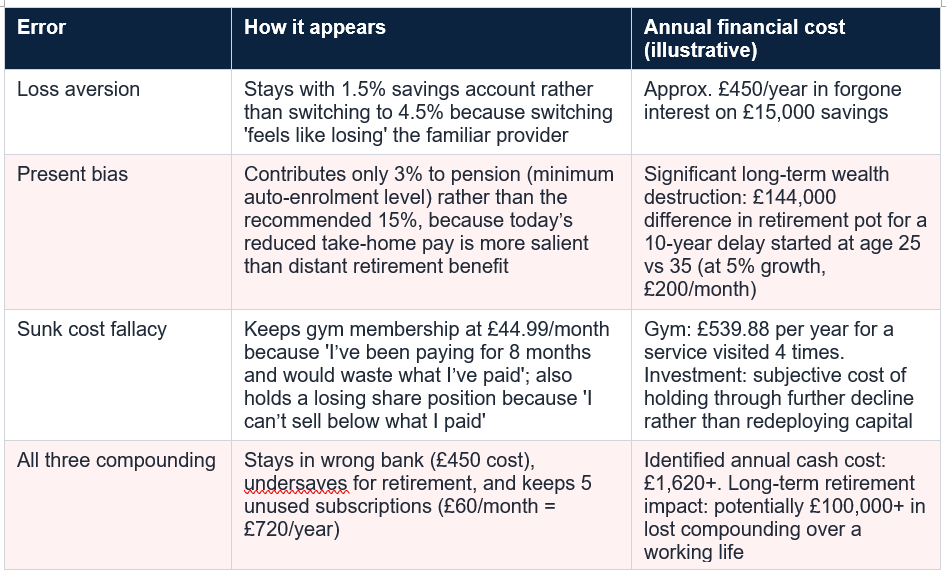
The three thinking errors rarely operate in isolation. They compound each other in ways that amplify their individual financial impact significantly. A worked example of all three operating simultaneously:
How Businesses Use These Biases Against You
Understanding these biases matters doubly because businesses — often with sophisticated behavioural science teams — deliberately design products and pricing to exploit them. The June 2025 case study from hbem.org (Highlights in Business, Economics and Management) documented three business models built explicitly around these biases:- Netflix auto-renewal: sustained by sunk cost (prior payments justify continuation) and loss aversion (fear of losing personalised content recommendations and viewing history). The combination keeps subscribers paying for months after they stop watching.
- TikTok live commerce: uses artificial scarcity and time pressure to trigger impulse purchases by exploiting sunk costs (the time already invested watching a live stream) and loss aversion (fear of missing out on a limited offer).
- Insurance, banking, and utilities: loyalty penalties — where long-standing customers pay more than new customers — are sustained by status quo bias (rooted in loss aversion) and sunk cost thinking. The FCA found these penalties cost UK consumers £750 million per year in the home and motor insurance sector alone before the 2021 pricing reforms.
The Master Fix: Environmental Design Over Willpower
The most important practical lesson from behavioural economics is that willpower and information are insufficient tools for overcoming systematic cognitive biases. Simply Psychology’s April 2026 analysis of the psychology of financial decision-making states this directly and provides the alternative: environmental design.Environmental design means structuring the decision context so that the financially correct behaviour is the default and the incorrect behaviour requires active effort. The principles:
- Automate savings before you see the money. Set up a standing order for savings, pension contributions, and ISA subscriptions to move on payday, before the current account balance registers the full take-home pay as spendable.
- Increase friction for impulse financial decisions. Remove saved card details from shopping sites. Install a delay period before large purchases (24 hours for purchases above £50, 7 days for purchases above £200). Delete shopping apps from your phone.
- Reduce friction for good financial decisions. Set pension contributions to auto-escalate annually. Set ISA allowance contributions on a standing order so the decision is made once, not monthly.
- Pre-commit to future behaviour. Set pension auto-escalation now, to take effect when you receive your next pay rise — committing to saving more when future income arrives rather than when it is already in your account and feels like ‘yours.’
- Run a fixed annual financial review. On the same date every year — December, April, or whatever you can commit to — check savings rates vs available alternatives, review subscriptions against actual use, and evaluate each financial product against the prospective question (‘Would I choose this today?’). The calendar commitment makes the review an expected event rather than a reaction to an unusually bad bank statement.
Conclusion
Loss aversion, present bias, and the sunk cost fallacy are not personality defects or signs of financial ignorance. They are features of the human cognitive system, documented across thousands of studies and millions of participants. They affect economists, financial advisers, and Kahneman himself — who has written extensively about being unable to eliminate the biases he spent his career studying in others.What makes these biases tractable — unlike random errors that are difficult to anticipate — is exactly their predictability. Loss aversion will cause you to undervalue switching when you should switch; you can counteract it by naming the cost of staying in concrete annual cash terms. Present bias will cause you to undersave for retirement; you can counteract it by automating pension contributions before you experience the take-home pay without them. The sunk cost fallacy will cause you to continue financial commitments that no longer serve you; you can counteract it by asking the prospective question — ‘Would I choose this today?’ — rather than the retrospective one.
The goal is not to eliminate these biases — that is neither possible nor necessary. The goal is to build decision processes that account for how the human mind actually works. Automating the financially correct behaviour, increasing friction for the financially incorrect behaviour, and running fixed annual reviews that force the prospective question are sufficient for most people to recapture thousands of pounds per year that these three thinking errors are currently costing them.
Frequently Asked Questions
What is loss aversion and how does it cost me money?Loss aversion is the psychological tendency to feel the pain of a loss more strongly than the pleasure of an equivalent gain. Research by Kahneman and Tversky (1979) established that a loss is approximately twice as psychologically powerful as an equivalent gain. A UK population study (Springer Journal of Risk and Uncertainty, October 2025) found the average UK loss aversion coefficient for a £500 loss was 2.41. In practical personal finance, loss aversion costs money by: causing investors to hold losing investments too long rather than crystallising a loss and redeploying capital; keeping people in low-rate savings accounts because switching to a better rate feels like 'losing' a familiar provider; preventing people from starting investments because the possibility of a loss is more emotionally salient than the long-term gain; and creating inertia in insurance, utilities, and financial products that costs UK consumers hundreds of millions of pounds per year in loyalty penalties.
What is present bias and why does it matter for saving?
Present bias is the tendency to overvalue immediate rewards relative to delayed ones, specifically when one of the options involves receiving something now. It is demonstrated by the fact that people prefer £50 now over £60 next month but are indifferent between £50 in 12 months and £60 in 13 months — the one-month wait is identical in both cases, but the emotional response to waiting is different when 'now' is one of the options. In the context of saving, present bias causes chronic under-contribution to pensions because the cost (reduced take-home pay) is immediate and the benefit (retirement income) is decades away. The most powerful evidence for present bias in UK personal finance is pension auto-enrolment: simply changing the default from 'opt in to save' to 'opt out to stop saving' raised participation from under 50% to over 80% in many schemes — without changing any of the financial terms.
What is the sunk cost fallacy and what is a real-world example?
The sunk cost fallacy is the tendency to continue a course of action because of past investments of time, money, or effort, even when the correct decision based only on future costs and benefits is to stop. The 'sunk' cost cannot be recovered regardless of what you do next — it is gone either way. Example: you have paid £300 for a non-refundable holiday you no longer want to take. The correct question is: 'Given I will lose the £300 whether I go or not, is attending worth the cost of travel, time off, and the experience itself?' But most people feel compelled to go because 'not going wastes the £300' — when in fact the £300 is wasted regardless. Financial examples include: holding a losing investment because 'I can't sell below what I paid'; staying with a savings account, insurance policy, or bank for years after better alternatives are available because of how long you have been a customer; and continuing unused gym memberships or subscriptions to avoid 'wasting' prior payments.
How do businesses exploit these cognitive biases?
Businesses with sophisticated behavioural science teams design products explicitly to exploit loss aversion, present bias, and sunk cost thinking. Examples documented in a 2025 research study (hbem.org, Highlights in Business, Economics and Management): Netflix uses sunk cost thinking (prior payments justify continuation) and loss aversion (fear of losing personalised content) to sustain 'zombie subscriptions' — services people pay for but do not actively use. TikTok uses artificial scarcity and time pressure to trigger impulse purchases, exploiting the sunk cost of viewer attention and loss aversion (fear of missing a limited offer). Insurance companies and banks historically charged loyal customers more than new customers — a loyalty penalty sustained by status quo bias and sunk cost thinking — which cost UK consumers an estimated £750 million per year in the home and motor insurance sector alone before FCA pricing reforms in 2021.
What is the most effective way to overcome these three biases?
The most effective approach is environmental design rather than willpower. Research in behavioural economics consistently shows that willpower and information are insufficient to overcome systematic cognitive biases. Environmental design means making the financially correct behaviour the default. Specific actions: (1) Automate savings and pension contributions to move on payday before you see the money. (2) Pre-commit to pension auto-escalation for future pay rises. (3) Run a fixed annual financial review on the same date every year, evaluating each financial product with the prospective question: 'Would I choose this today?' (4) Calculate the explicit annual cost of staying with any financial product where a switch is available — make the loss concrete. (5) Add friction to impulse spending (remove saved card details, implement waiting periods). (6) Cancel all subscriptions you are not actively using on a fixed annual subscription audit date.
Are these biases the same for everyone?
The three biases — loss aversion, present bias, and sunk cost thinking — are present across income levels, education levels, and countries. However, their magnitude varies by individual. A UK population study (Springer Journal of Risk and Uncertainty, October 2025) found that loss aversion coefficients vary significantly by gender, age, education, financial knowledge, social class, and employment status. A cross-country study of 5,000 participants across 27 countries (Scientific Reports / Nature, June 2023) found no significant differences in bias rates between economic groups — both low-income individuals and 'positive deviants' (those who grew up disadvantaged but achieved above-average financial wellbeing) showed similar rates of cognitive bias. The biases are features of human cognition, not products of financial inexperience. This means that becoming more financially literate does not eliminate them — but it does help you design processes to work around them.
0 Comments
Be the first to share your thoughts on this article.