

Taxes
After-Tax Retirement Numbers That Matter More Than Balance

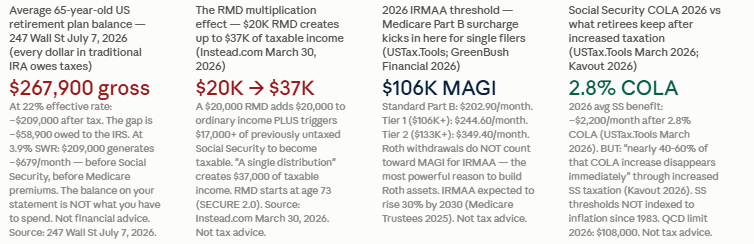
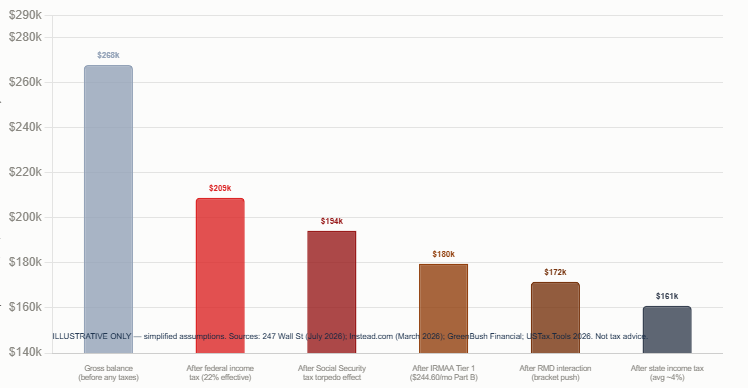
The average 65-year-old has $267,900 in retirement savings. But not a single dollar of it is free and clear. At a 22% effective tax rate, that balance becomes approximately $209,000 in spendable money — before Medicare premiums, before RMD-triggered Social Security taxation, before IRMAA surcharges. Your retirement account balance is the gross number. The after-tax, after-Medicare monthly income is the number that actually determines your retirement. This article shows you exactly which numbers to focus on, the tax traps most people discover too late, and the specific 2026 strategies that change the outcome. Not financial or tax advice.
The number that actually determines your retirement is your after-tax monthly income: what lands in your bank account each month after federal and state taxes, after Medicare Part B and Part D premiums and any IRMAA surcharges, after the interaction between your withdrawals and the taxation of your Social Security benefits. For the average 65-year-old with $267,900 in workplace retirement plans (247 Wall St, July 7, 2026), the difference between the gross balance and the after-tax equivalent can be $40,000 to $70,000 or more — a gap that reshapes the entire retirement income plan if not anticipated.
This article covers five specific tax traps that erode the gap between your balance and your spendable income, four strategies that shrink those traps, and the precise 2026 numbers that govern each of them. Not financial or tax advice.
Average 65-year-old US retirement plan balance: $267,900 (247 Wall St, July 7, 2026). At a 22% effective rate, this becomes approximately $209,000 in spendable money. 2026 average Social Security benefit: approximately $2,200/month after 2.8% COLA (USTax.Tools March 2026). Roth IRA ownership: 35.4 million households (27.8% of US households) as of mid-2025 (ICI 2025 household survey, cited Financer.com 2026). Roth IRA contribution limit 2026: $7,500 (Financer.com 2026). '2026 demands an active, informed approach to safeguard financial security' (Kavout/Market Lens 2026). QCD limit 2026: $108,000 (247 Wall St July 2026).
The practical illustration: a 73-year-old couple with $500,000 combined in pre-tax accounts plus Social Security. 247 Wall St (July 7, 2026) explains: ‘Combined RMDs and Social Security income can push a retired couple from the 12% to 22% tax bracket in a single year.’ Moving from 12% to 22% on $30,000 of additional income costs an extra $3,000 in federal tax immediately — and that does not account for the additional Social Security becoming taxable as the RMD pushes combined income higher (see Tax Trap 2). The $500,000 balance that looks like a comfortable retirement fund is generating a tax event that most people have not modelled.
The solution is not to avoid traditional accounts — they provide valuable pre-tax savings during working years. The solution is to understand that the balance and the spendable amount are different numbers, and to plan specifically for the gap between them. Not financial or tax advice.
Traditional IRA/401(k) is pre-tax deferred income: every dollar owed taxes at withdrawal as ordinary income. At 22%: $267,900 balance → ~$209,000 after tax. At 24%: $267,900 → ~$203,600. At 12%: $267,900 → ~$235,750. The tax rate at withdrawal depends on ALL income sources combined: Social Security, RMDs, investment income, part-time wages, pension. Most people discover their effective retirement tax rate is higher than expected once all sources combine. 2026 federal brackets (single filer): 12% on income $11,925-$48,475; 22% on $48,475-$103,350; 24% on $103,350-$197,300 (GoBankingRates 2026; tax-calculator.us 2026). Not financial or tax advice.
Combined income (also called provisional income) = Adjusted Gross Income + nontaxable interest + 50% of Social Security benefits. For a single filer with $34,000+ in combined income, up to 85% of their Social Security is taxable as ordinary income. For married filers, the 85% threshold is $44,000. And these thresholds have never been adjusted for inflation since they were written into law in 1983. At that time, only a small number of high-income retirees paid tax on their Social Security. By 2026, the vast majority of SS recipients with any significant other income source have some portion of their benefits taxed. This is what tax planners call the ‘tax torpedo.’
The RMD interaction makes the torpedo worse. Instead.com (March 30, 2026) documents the cascade: ‘A $20,000 increase in RMD income does not simply add $20,000 in taxable income. It adds the RMD amount to ordinary income, plus an additional $17,000 or more in now-taxable Social Security benefits, pushing total taxable income up by as much as $37,000 from a single distribution.’ A $20,000 RMD effectively creates $37,000 of taxable income. That is the Social Security torpedo in quantified form. Not financial or tax advice.
The Social Security tax torpedo (2026): Example from Instead.com (March 2026): retiree receives $30,000 Social Security + takes $25,000 RMD. Combined income = $25,000 (RMD/AGI) + $15,000 (50% of SS) = $40,000 — well above the $34,000 single-filer 85% threshold. Result: $25,500 of SS benefits become taxable. Effective taxable income from this combination: $25,000 (RMD) + $25,500 (taxable SS) = $50,500. From a $25,000 RMD. COLA impact: 2026 SS COLA 2.8% (USTax.Tools March 2026); but 'nearly 40-60% of that COLA increase disappears immediately' through increased taxation (Kavout 2026). SS taxation thresholds: single $25,000-$34,000 (50% taxable); above $34,000 (85% taxable). Married: $32,000-$44,000 / above $44,000. NOT adjusted for inflation since 1983. Sources: USTax.Tools 2026; Instead.com March 2026; GoBankingRates 2026; Kavout 2026. Not tax advice.
The problem is not just the tax on the RMD itself — it is the interaction effects. As documented above, a $20,000 RMD can push $17,000 or more of previously untaxed Social Security into taxable income. That same RMD can push MAGI above the IRMAA threshold for Medicare premiums (see Tax Trap 4). It can push a surviving spouse from the 22% bracket to the 24% bracket (Tax Trap 5). The RMD is a tax trigger that ripples through every other component of a retiree’s tax situation.
For someone who built a large traditional IRA or 401(k) over a 40-year career, the RMD in their 70s and 80s can be substantial. A $1 million traditional IRA at age 73 generates an RMD of approximately $36,496 in the first year (using the IRS Uniform Lifetime Table divisor of 27.4). Combined with Social Security, that RMD alone can push a single filer into the 22% bracket and trigger 85% SS taxation and IRMAA Tier 1. Not financial or tax advice.
RMD at age 73 from $1M traditional IRA: approximately $36,496 first-year RMD (IRS Uniform Lifetime Table, divisor 27.4). Combined with average SS ($2,200/month = $26,400/year): combined income = $36,496 + $13,200 (50% of SS) = $49,696. This is above the $34,000 single-filer 85% SS threshold, meaning $22,440 of SS becomes taxable. Total taxable income: $36,496 + $22,440 = $58,936 — pushing firmly into the 22% bracket. PLUS: MAGI = $36,496 + $22,440 + $3,960 (remaining SS treated) = approximately $62,896 (simplified) — below IRMAA threshold but growing each year as the IRA balance compounds. At a $2M traditional IRA, the first RMD is ~$72,993 — likely triggering IRMAA Tier 1 and heavy SS taxation. Sources: Instead.com March 2026; GreenBush Financial 2026; 247 Wall St July 2026. Not tax advice. Illustrative.
Two features of IRMAA make it particularly dangerous for retirement planning. First, it is a cliff rather than a gradual phase-out: crossing the threshold by $1 of MAGI triggers the full surcharge. A retiree with $105,999 in MAGI pays $202.90/month. With $106,001, they pay $244.60/month. The $41.70/month difference is not proportional to the income difference — it is a binary cliff. Second, Medicare uses a two-year lookback: the 2026 premiums are based on the 2024 tax return. This means a one-time income spike in 2024 (a Roth conversion, a home sale, a large RMD) affects 2026 Medicare premiums. The person who made that one-time decision in 2024 is still paying for it in 2026.
‘Overall Part B IRMAA charges alone are expected to increase 30% from 2026 to 2030,’ according to the 2025 Medicare Trustees Report (cited WSJ / Motley Fool discussion, 2026). This trajectory matters for retirement income planning: the IRMAA burden will grow, making MAGI management an increasingly important retirement skill. Not financial or tax advice.
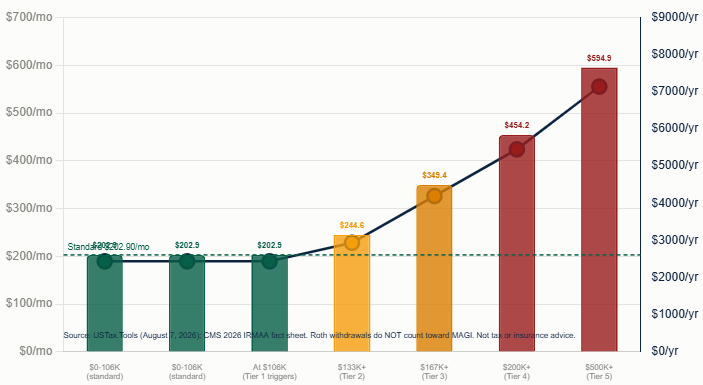
IRMAA 2026 Part B monthly premium thresholds (single filer, per CMS 2026 IRMAA fact sheet / USTax.Tools 2026): Standard: up to $106,000 MAGI → $202.90/month. Tier 1: $106,001-$133,000 → $244.60/month (+$41.70). Tier 2: $133,001-$167,000 → $349.40/month (+$146.50). Tier 3: $167,001-$200,000 → $454.20/month (+$251.30). Tier 4: $200,001-$500,000 → $559.00/month (+$356.10). Tier 5: above $500,000 → $594.90/month (+$392.00). KEY: Roth IRA withdrawals do NOT count toward MAGI for IRMAA. This is the single most powerful financial reason to build Roth assets before retirement. Two-year lookback: 2026 premiums based on 2024 tax return. One-time income event in 2024 = higher premiums in 2026. Sources: USTax.Tools August 2026; GreenBush Financial 2026; 247 Wall St July 2026; Kavout 2026. Not tax or insurance advice.
Under MFJ filing, the 12% bracket extends to approximately $89,075 in 2026. Under single filing, the 12% bracket extends to approximately $48,475. A couple with $70,000 in combined taxable income is solidly in the 12% bracket. After one spouse dies, the same income — if it has not significantly reduced — pushes the survivor into the 22% bracket. And because both spouses’ RMDs were being distributed across a larger bracket, the survivor now faces the full RMD tax burden alone within a narrower bracket.
This trap is predictable and plannable. A couple that converts a portion of their traditional IRA to Roth during the years when both are living reduces the RMD burden after one spouse dies, because Roth accounts have no RMDs during the owner’s lifetime. This is the clearest example of how after-tax planning — thinking specifically about the tax consequences of every account structure choice — produces better outcomes than simply maximising the gross balance. Not financial or tax advice.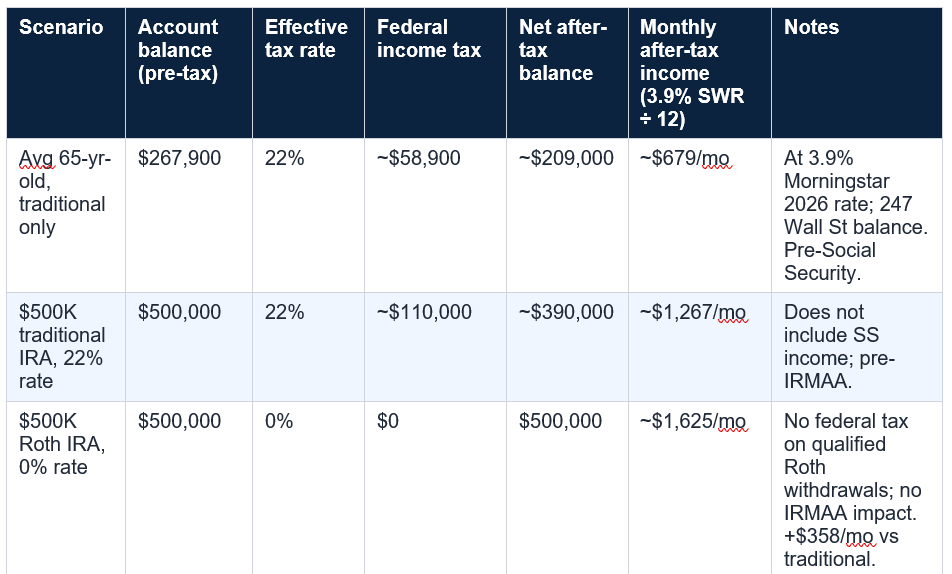
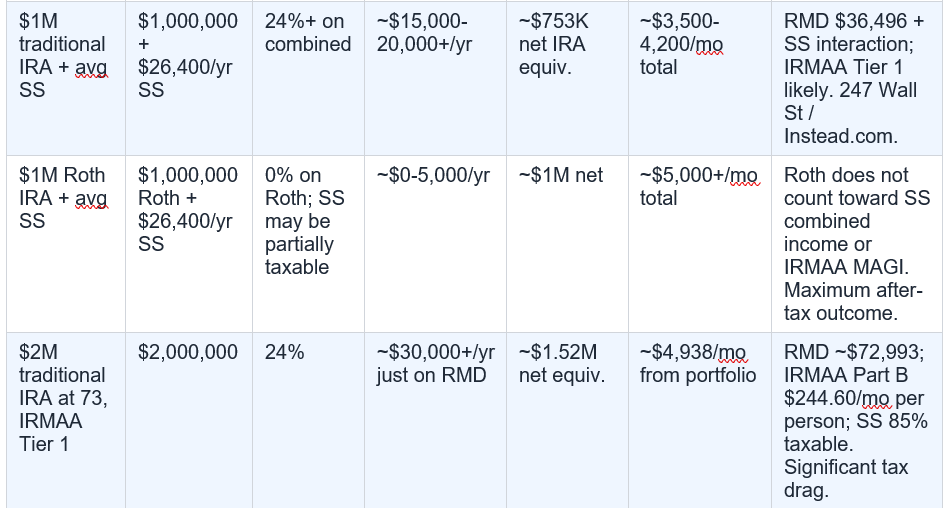
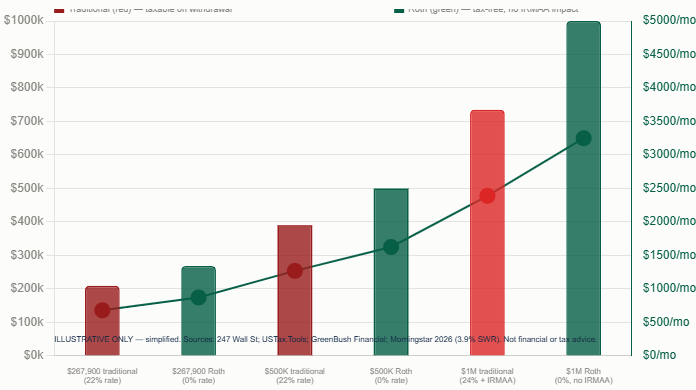
IMPORTANT: These are illustrative projections only using simplified assumptions. Actual tax depends on total income, filing status, deductions, state taxes, other income sources, and many individual factors. The Morningstar 2026 safe withdrawal rate of 3.9% is used for monthly income calculation. Sources: 247 Wall St July 7, 2026 (balance data); Instead.com March 2026 (RMD/SS interaction); GoBankingRates 2026 (brackets); USTax.Tools August 2026 (IRMAA); Morningstar 2026 (SWR). Not financial or tax advice.
But the equation changes when you factor in the IRMAA interaction, the Social Security taxation interaction, and the RMD multiplier effect. A traditional IRA dollar generates three tax burdens that a Roth dollar does not: (1) ordinary income tax on withdrawal; (2) increased MAGI that can trigger IRMAA Medicare surcharges; (3) increased combined income that makes Social Security taxable. A Roth IRA dollar generates none of the three. Kavout (2026): ‘The key benefit is that Roth withdrawals in retirement are tax-free and, crucially, do not count towards your combined income for Social Security taxation or your MAGI for Medicare IRMAA calculations.’
For 2026, the Roth IRA phase-out begins at $153,000 MAGI for single filers and is eliminated above $168,000 (Finhabits 2026). For investors above these thresholds, the backdoor Roth contribution (contribute to a non-deductible traditional IRA, then convert to Roth) provides access to tax-free growth without income restriction. Not financial or tax advice.
The strategy: each year in this window, convert enough from the traditional IRA to Roth to fill the 12% or 22% bracket without crossing into the 24% bracket. This pays tax voluntarily at today’s lower rates, removing those dollars from future RMD calculations, reducing future IRMAA exposure, and reducing the future Social Security tax torpedo. A retiree who retires at 63 and delays Social Security to 70 has a seven-year conversion window. Systematically converting $50,000–60,000 per year in that window at a 22% marginal rate pays the tax now before RMDs force much larger conversions at potentially higher effective rates.
The long-term arithmetic is compelling. Converting $350,000 from traditional to Roth during the conversion window at 22% costs approximately $77,000 in tax. But it removes $350,000+ in future RMD-triggering assets, potentially saving $80,000–$120,000 in combined RMD/SS/IRMAA tax over a 20-year retirement. Not financial or tax advice. Consult a CPA for projections specific to your situation.
Roth conversion strategy for the golden window (retirement to RMD age 73): (1) Identify your taxable income gap: the distance between your current income and the top of the 22% bracket ($103,350 single, ~$206,000 MFJ in 2026). (2) Convert that gap amount from traditional IRA to Roth each year. (3) Pay the tax from non-retirement funds if possible -- using IRA funds to pay the tax reduces the conversion benefit. (4) Consider delaying Social Security to expand the window: if SS is not yet claimed, its 50% inclusion in combined income is not yet a factor. (5) Use IRS Form 8606 to track after-tax IRA basis. (6) Consult a CPA or CFP before executing -- the optimal conversion amount depends on your full financial picture. Not financial or tax advice.
A practical example: a retiree with $400,000 in a traditional IRA and $200,000 in a Roth IRA. In a year when their RMD from the traditional IRA is $20,000, they draw $30,000 from the traditional IRA (filling the 12% bracket) and $10,000 from the Roth IRA to meet spending needs, keeping MAGI below the IRMAA threshold and limiting Social Security taxation. Without the Roth account, they would need $40,000 from the traditional IRA, triggering the bracket crossover and IRMAA exposure. The Roth is the pressure valve.
Building tax diversification requires contributing to both account types during working years. For most working Americans, the optimal approach is: contribute to the traditional 401(k) up to the employer match (maximising the guaranteed return), then contribute to a Roth IRA (building the tax-free pool), then return to the traditional 401(k) for additional contributions if budget allows. This is not a universal prescription — it depends on current and expected future tax rates — but it is the framework that most tax-efficient retirement planners use as a starting point. Not financial or tax advice.
For a retiree with a $50,000 RMD who would otherwise donate $10,000 to charity anyway, directing that $10,000 as a QCD reduces taxable income by $10,000 compared to taking the full RMD and then claiming a charitable deduction. Critically, the QCD benefit applies even to retirees who take the standard deduction (which eliminates the benefit of itemising charitable contributions). This makes the QCD superior to a standard charitable deduction for most retirees.
The mechanics: the IRA custodian writes a cheque directly to the qualifying charity or transfers the funds electronically. The taxpayer does not receive the funds. The amount reduces the RMD by the QCD amount. If the QCD exceeds the RMD, the excess can be used for future year QCDs (up to the annual limit). Not financial or tax advice. Consult a CPA before executing a QCD.
The optimal sequence in the Roth conversion window era is more nuanced. In early retirement, drawing from traditional IRA accounts (enough to fill lower tax brackets) while the balance is relatively small reduces the future RMD burden. Roth accounts can then grow tax-free throughout. In late retirement, Roth accounts become the source of flexible, IRMAA-neutral spending that does not trigger Social Security taxation.
TD Wealth (Winter 2026) adds the capital gains dimension: ‘the reduction in taxable income that accompanies retirement can make [tax-gain harvesting] a viable strategy after leaving the workforce.’ In years when taxable income is low, the 0% long-term capital gains rate applies to gains on investments in taxable accounts (up to approximately $47,025 single / $94,050 MFJ in 2026). This creates an opportunity to harvest unrealised gains at zero federal tax during the conversion window. Not financial or tax advice. The optimal sequencing depends on your specific account mix, income sources, and tax situation.
Seven numbers every retiree should know for 2026: (1) Your effective tax rate (not marginal) on all income sources combined. (2) Your combined income for SS taxation purposes (AGI + nontaxable interest + 50% of SS). (3) Your MAGI relative to the $106,000/$212,000 IRMAA threshold. (4) Your first-year RMD amount (account balance ÷ IRS Uniform Lifetime Table divisor). (5) The top of the 12% bracket: $48,475 single / $97,025 MFJ (2026). (6) The QCD limit: $108,000 per year. (7) The Roth conversion gap: how much you can convert before hitting the 22%/24% boundary. Not financial or tax advice. Run projections with a CFP and CPA.
None of these outcomes are inevitable. The Roth conversion window — the years between retirement and RMD age 73 — is the primary planning opportunity. The tax diversification strategy allows year-by-year MAGI management. The QCD turns a mandatory taxable distribution into a tax-free charitable contribution. Withdrawal sequencing controls which account gets drawn first. The tools exist. The difference between a retiree who knows these numbers and one who does not can be $40,000 to $100,000 or more in lifetime tax savings.
The after-tax retirement number is not on your quarterly statement. It requires the same calculation your payslip makes every month: gross minus taxes equals take-home. In retirement, that calculation is more complex, more consequential, and less automated. The retirees who do it in advance keep more of what they saved. Not financial or tax advice. Consult a qualified CFP and CPA for guidance specific to your situation.
Up to 85% of your Social Security benefits may be taxable depending on your 'combined income' (also called provisional income). The formula: Combined income = Adjusted Gross Income + nontaxable interest + 50% of your Social Security benefits. For single filers: if combined income is between $25,000 and $34,000, up to 50% of SS is taxable. If above $34,000, up to 85% is taxable. For married filing jointly: $32,000-$44,000 = 50% taxable; above $44,000 = 85% taxable. Crucially, these thresholds have NEVER been indexed for inflation since 1983 — so what was once a high-earner's tax is now paid by most retirees with any significant other income. Roth IRA withdrawals do NOT count toward combined income, making Roth assets particularly valuable for managing SS taxation. 2026 average SS benefit: approximately $2,200/month after 2.8% COLA (USTax.Tools March 2026). Sources: GoBankingRates 2026; USTax.Tools 2026; Instead.com March 2026; Kavout 2026.
What is the IRMAA threshold for 2026 Medicare premiums?
The 2026 IRMAA (Income-Related Monthly Adjustment Amount) surcharge on Medicare Part B begins when your Modified Adjusted Gross Income (MAGI) exceeds $106,000 for single filers or $212,000 for married filing jointly. The standard 2026 Part B premium is $202.90/month. At Tier 1 ($106,001-$133,000 single), it rises to $244.60/month. At Tier 2 ($133,001-$167,000), it rises to $349.40/month. IRMAA functions as an income cliff — crossing the threshold by $1 triggers the full surcharge. Medicare uses a two-year lookback: 2026 premiums are based on your 2024 tax return. Key planning point: Roth IRA and Roth 401(k) withdrawals do NOT count toward MAGI for IRMAA purposes — making Roth assets a direct tool for IRMAA management. 'Overall Part B IRMAA charges alone are expected to increase 30% from 2026 to 2030' (2025 Medicare Trustees Report, cited WSJ). Sources: USTax.Tools August 2026; GreenBush Financial 2026; 247 Wall St July 2026. Not tax or insurance advice.
What is the RMD starting age and how does it interact with Social Security taxes?
RMDs (Required Minimum Distributions) begin at age 73 under the SECURE 2.0 Act. At 73, you must take a minimum withdrawal from traditional IRAs and 401(k)s each year, calculated using IRS life expectancy tables. The first-year RMD on a $1 million IRA is approximately $36,496 (IRS Uniform Lifetime Table divisor 27.4). The interaction with Social Security taxation is the critical issue: Instead.com (March 30, 2026) quantifies it as follows — 'A $20,000 increase in RMD income does not simply add $20,000 in taxable income. It adds the RMD amount to ordinary income, plus an additional $17,000 or more in now-taxable Social Security benefits, pushing total taxable income up by as much as $37,000 from a single distribution.' Additionally, RMDs increase MAGI for IRMAA purposes, potentially triggering Medicare surcharges. The primary mitigation strategy is Roth conversion during the golden window (retirement to age 73) to reduce the traditional IRA balance before RMDs begin. Not tax advice. Sources: Instead.com March 2026; 247 Wall St July 2026.
What is a Qualified Charitable Distribution (QCD) and who should use it?
A Qualified Charitable Distribution (QCD) is a direct transfer from a traditional IRA to a qualifying charity. In 2026, the QCD limit is $108,000 per taxpayer per year (247 Wall St July 7, 2026). A QCD: (1) satisfies your RMD requirement for the year; (2) never appears as taxable income; (3) does not increase your AGI, combined income for Social Security taxation, or MAGI for IRMAA purposes. A QCD is superior to taking an RMD and then deducting the charitable contribution because: (a) the benefit applies even if you take the standard deduction; (b) it reduces AGI directly rather than reducing taxable income indirectly. Who should use it: any retiree over age 70½ (the QCD eligibility age) who makes regular charitable contributions and is subject to RMDs. The QCD is most powerful for retirees near the IRMAA threshold or the SS taxation threshold — a well-sized QCD can keep MAGI below the trigger point. Not tax advice. Consult a CPA before executing.
Should I have all my retirement savings in a Roth or traditional account?
The answer most retirement tax planners give is: neither. Tax diversification — holding both Roth and traditional accounts — provides the most flexibility. USTax.Tools (2026): 'Many financial advisors recommend holding both Roth and Traditional accounts. In low-income years, draw from Traditional accounts; in higher-income years, lean on Roth funds.' The mathematical equivalence argument: 'If your tax rate is the same now and in retirement, Roth and Traditional produce the same after-tax result.' But this ignores the IRMAA interaction, the Social Security taxation interaction, and the RMD multiplier — all of which make Roth dollars more valuable than traditional dollars at the same headline balance, because Roth dollars generate zero IRMAA exposure and zero SS taxation. The practical building strategy for most people: contribute to traditional 401(k) up to the employer match, then fund Roth IRA to the annual limit ($7,500 in 2026), then return to traditional 401(k) for additional contributions. Adjust based on expected future tax rates. Not financial or tax advice. Sources: USTax.Tools 2026; Kavout 2026; TD Wealth Winter 2026.
Table of Contents
- The Number Everyone Focuses On — and the One That Actually Matters
- Tax Trap 1: Your Traditional IRA Balance Is Not Your Money
- Tax Trap 2: The Social Security Tax Torpedo
- Tax Trap 3: RMDs — The Forced Distribution Time Bomb
- Tax Trap 4: IRMAA — The Medicare Surcharge That Sneaks Up
- Tax Trap 5: The Widow’s Penalty — The Bracket Shock Nobody Plans For
- The After-Tax Retirement Income Calculator: What Your Balance Really Buys
- The Roth vs Traditional Comparison: After-Tax, the True Winner
- The Golden Window: The Roth Conversion Opportunity Before RMDs
- The Tax Diversification Strategy: Why Both Accounts Beat Either Alone
- The QCD Strategy: Turn an RMD Into a Tax-Free Gift
- Withdrawal Sequencing: The Order Your Accounts Should Be Drawn Down
- Conclusion: The After-Tax Number Is the Retirement Number
- Frequently Asked Questions
The 5 tax traps — what erodes your retirement balance
Roth vs Traditional — the after-tax comparison
The IRMAA cliff — Medicare surcharge thresholds
The Number Everyone Focuses On — and the One That Actually Matters
The retirement savings industry is built around one number: your balance. Your 401(k) dashboard shows it in large font. Your quarterly statement leads with it. The financial media publishes articles about whether your balance is on track for your age. But your balance is the gross figure — the pre-tax amount sitting in your account before any interaction with the IRS, Medicare, or Social Security taxation rules. It is not the number that determines whether your retirement works.The number that actually determines your retirement is your after-tax monthly income: what lands in your bank account each month after federal and state taxes, after Medicare Part B and Part D premiums and any IRMAA surcharges, after the interaction between your withdrawals and the taxation of your Social Security benefits. For the average 65-year-old with $267,900 in workplace retirement plans (247 Wall St, July 7, 2026), the difference between the gross balance and the after-tax equivalent can be $40,000 to $70,000 or more — a gap that reshapes the entire retirement income plan if not anticipated.
This article covers five specific tax traps that erode the gap between your balance and your spendable income, four strategies that shrink those traps, and the precise 2026 numbers that govern each of them. Not financial or tax advice.
Average 65-year-old US retirement plan balance: $267,900 (247 Wall St, July 7, 2026). At a 22% effective rate, this becomes approximately $209,000 in spendable money. 2026 average Social Security benefit: approximately $2,200/month after 2.8% COLA (USTax.Tools March 2026). Roth IRA ownership: 35.4 million households (27.8% of US households) as of mid-2025 (ICI 2025 household survey, cited Financer.com 2026). Roth IRA contribution limit 2026: $7,500 (Financer.com 2026). '2026 demands an active, informed approach to safeguard financial security' (Kavout/Market Lens 2026). QCD limit 2026: $108,000 (247 Wall St July 2026).
Tax Trap 1: Your Traditional IRA Balance Is Not Your Money
The most fundamental misconception in retirement planning is treating a traditional IRA or 401(k) balance as the equivalent of money in a savings account. It is not. Every dollar in a traditional pre-tax retirement account is a deferred tax liability. The IRS is a silent partner in your retirement account, and its share depends on your tax rate at the time of withdrawal. At a 22% marginal rate, 22 cents of every dollar belongs to the IRS. At 24%, 24 cents. At 12%, 12 cents. But the rate that applies at withdrawal is the rate you face in retirement — which may be higher than you expect once Social Security income, RMDs, and investment income are combined.The practical illustration: a 73-year-old couple with $500,000 combined in pre-tax accounts plus Social Security. 247 Wall St (July 7, 2026) explains: ‘Combined RMDs and Social Security income can push a retired couple from the 12% to 22% tax bracket in a single year.’ Moving from 12% to 22% on $30,000 of additional income costs an extra $3,000 in federal tax immediately — and that does not account for the additional Social Security becoming taxable as the RMD pushes combined income higher (see Tax Trap 2). The $500,000 balance that looks like a comfortable retirement fund is generating a tax event that most people have not modelled.
The solution is not to avoid traditional accounts — they provide valuable pre-tax savings during working years. The solution is to understand that the balance and the spendable amount are different numbers, and to plan specifically for the gap between them. Not financial or tax advice.
Traditional IRA/401(k) is pre-tax deferred income: every dollar owed taxes at withdrawal as ordinary income. At 22%: $267,900 balance → ~$209,000 after tax. At 24%: $267,900 → ~$203,600. At 12%: $267,900 → ~$235,750. The tax rate at withdrawal depends on ALL income sources combined: Social Security, RMDs, investment income, part-time wages, pension. Most people discover their effective retirement tax rate is higher than expected once all sources combine. 2026 federal brackets (single filer): 12% on income $11,925-$48,475; 22% on $48,475-$103,350; 24% on $103,350-$197,300 (GoBankingRates 2026; tax-calculator.us 2026). Not financial or tax advice.
Tax Trap 2: The Social Security Tax Torpedo
Many Americans expect their Social Security benefits to be tax-free. The reality: up to 85% of Social Security benefits may be taxable depending on your combined income — a figure that is calculated by a formula virtually no one knows until they file their first retirement tax return.Combined income (also called provisional income) = Adjusted Gross Income + nontaxable interest + 50% of Social Security benefits. For a single filer with $34,000+ in combined income, up to 85% of their Social Security is taxable as ordinary income. For married filers, the 85% threshold is $44,000. And these thresholds have never been adjusted for inflation since they were written into law in 1983. At that time, only a small number of high-income retirees paid tax on their Social Security. By 2026, the vast majority of SS recipients with any significant other income source have some portion of their benefits taxed. This is what tax planners call the ‘tax torpedo.’
The RMD interaction makes the torpedo worse. Instead.com (March 30, 2026) documents the cascade: ‘A $20,000 increase in RMD income does not simply add $20,000 in taxable income. It adds the RMD amount to ordinary income, plus an additional $17,000 or more in now-taxable Social Security benefits, pushing total taxable income up by as much as $37,000 from a single distribution.’ A $20,000 RMD effectively creates $37,000 of taxable income. That is the Social Security torpedo in quantified form. Not financial or tax advice.
The Social Security tax torpedo (2026): Example from Instead.com (March 2026): retiree receives $30,000 Social Security + takes $25,000 RMD. Combined income = $25,000 (RMD/AGI) + $15,000 (50% of SS) = $40,000 — well above the $34,000 single-filer 85% threshold. Result: $25,500 of SS benefits become taxable. Effective taxable income from this combination: $25,000 (RMD) + $25,500 (taxable SS) = $50,500. From a $25,000 RMD. COLA impact: 2026 SS COLA 2.8% (USTax.Tools March 2026); but 'nearly 40-60% of that COLA increase disappears immediately' through increased taxation (Kavout 2026). SS taxation thresholds: single $25,000-$34,000 (50% taxable); above $34,000 (85% taxable). Married: $32,000-$44,000 / above $44,000. NOT adjusted for inflation since 1983. Sources: USTax.Tools 2026; Instead.com March 2026; GoBankingRates 2026; Kavout 2026. Not tax advice.
Tax Trap 3: RMDs — The Forced Distribution Time Bomb
Required Minimum Distributions (RMDs) begin at age 73 under the SECURE 2.0 Act. At that point, the IRS requires you to take a minimum withdrawal from your traditional IRA and 401(k) each year, regardless of whether you need the money. The withdrawal amount is calculated using an IRS life expectancy table, and every dollar of it appears on your tax return as ordinary income.The problem is not just the tax on the RMD itself — it is the interaction effects. As documented above, a $20,000 RMD can push $17,000 or more of previously untaxed Social Security into taxable income. That same RMD can push MAGI above the IRMAA threshold for Medicare premiums (see Tax Trap 4). It can push a surviving spouse from the 22% bracket to the 24% bracket (Tax Trap 5). The RMD is a tax trigger that ripples through every other component of a retiree’s tax situation.
For someone who built a large traditional IRA or 401(k) over a 40-year career, the RMD in their 70s and 80s can be substantial. A $1 million traditional IRA at age 73 generates an RMD of approximately $36,496 in the first year (using the IRS Uniform Lifetime Table divisor of 27.4). Combined with Social Security, that RMD alone can push a single filer into the 22% bracket and trigger 85% SS taxation and IRMAA Tier 1. Not financial or tax advice.
RMD at age 73 from $1M traditional IRA: approximately $36,496 first-year RMD (IRS Uniform Lifetime Table, divisor 27.4). Combined with average SS ($2,200/month = $26,400/year): combined income = $36,496 + $13,200 (50% of SS) = $49,696. This is above the $34,000 single-filer 85% SS threshold, meaning $22,440 of SS becomes taxable. Total taxable income: $36,496 + $22,440 = $58,936 — pushing firmly into the 22% bracket. PLUS: MAGI = $36,496 + $22,440 + $3,960 (remaining SS treated) = approximately $62,896 (simplified) — below IRMAA threshold but growing each year as the IRA balance compounds. At a $2M traditional IRA, the first RMD is ~$72,993 — likely triggering IRMAA Tier 1 and heavy SS taxation. Sources: Instead.com March 2026; GreenBush Financial 2026; 247 Wall St July 2026. Not tax advice. Illustrative.
Tax Trap 4: IRMAA — The Medicare Surcharge That Sneaks Up
The Income-Related Monthly Adjustment Amount (IRMAA) is one of the most underappreciated retirement tax traps. When your Modified Adjusted Gross Income (MAGI) exceeds certain thresholds, Medicare raises your Part B and Part D premiums above the standard rates. In 2026, the standard Part B premium is $202.90 per month. Once your MAGI exceeds $106,000 (single) or $212,000 (married), you enter IRMAA Tier 1: $244.60/month. Tier 2: $349.40/month. These amounts apply per person, so a married couple both on Medicare at Tier 2 pays $698.80/month combined — $8,385.60/year extra just for Medicare Part B.Two features of IRMAA make it particularly dangerous for retirement planning. First, it is a cliff rather than a gradual phase-out: crossing the threshold by $1 of MAGI triggers the full surcharge. A retiree with $105,999 in MAGI pays $202.90/month. With $106,001, they pay $244.60/month. The $41.70/month difference is not proportional to the income difference — it is a binary cliff. Second, Medicare uses a two-year lookback: the 2026 premiums are based on the 2024 tax return. This means a one-time income spike in 2024 (a Roth conversion, a home sale, a large RMD) affects 2026 Medicare premiums. The person who made that one-time decision in 2024 is still paying for it in 2026.
‘Overall Part B IRMAA charges alone are expected to increase 30% from 2026 to 2030,’ according to the 2025 Medicare Trustees Report (cited WSJ / Motley Fool discussion, 2026). This trajectory matters for retirement income planning: the IRMAA burden will grow, making MAGI management an increasingly important retirement skill. Not financial or tax advice.
IRMAA 2026 Part B monthly premium thresholds (single filer, per CMS 2026 IRMAA fact sheet / USTax.Tools 2026): Standard: up to $106,000 MAGI → $202.90/month. Tier 1: $106,001-$133,000 → $244.60/month (+$41.70). Tier 2: $133,001-$167,000 → $349.40/month (+$146.50). Tier 3: $167,001-$200,000 → $454.20/month (+$251.30). Tier 4: $200,001-$500,000 → $559.00/month (+$356.10). Tier 5: above $500,000 → $594.90/month (+$392.00). KEY: Roth IRA withdrawals do NOT count toward MAGI for IRMAA. This is the single most powerful financial reason to build Roth assets before retirement. Two-year lookback: 2026 premiums based on 2024 tax return. One-time income event in 2024 = higher premiums in 2026. Sources: USTax.Tools August 2026; GreenBush Financial 2026; 247 Wall St July 2026; Kavout 2026. Not tax or insurance advice.
Tax Trap 5: The Widow’s Penalty — The Bracket Shock Nobody Plans For
GreenBush Financial’s 2026 retirement tax trap analysis identifies a fifth, often-overlooked trap: the widow’s penalty. When one spouse dies, the surviving spouse transitions from married filing jointly (MFJ) to single filing status. This halves the bracket thresholds immediately, while the income often remains similar or reduces only slightly. The result is a bracket shock that can move a surviving spouse from the 12% bracket to the 22% bracket in a single year.Under MFJ filing, the 12% bracket extends to approximately $89,075 in 2026. Under single filing, the 12% bracket extends to approximately $48,475. A couple with $70,000 in combined taxable income is solidly in the 12% bracket. After one spouse dies, the same income — if it has not significantly reduced — pushes the survivor into the 22% bracket. And because both spouses’ RMDs were being distributed across a larger bracket, the survivor now faces the full RMD tax burden alone within a narrower bracket.
This trap is predictable and plannable. A couple that converts a portion of their traditional IRA to Roth during the years when both are living reduces the RMD burden after one spouse dies, because Roth accounts have no RMDs during the owner’s lifetime. This is the clearest example of how after-tax planning — thinking specifically about the tax consequences of every account structure choice — produces better outcomes than simply maximising the gross balance. Not financial or tax advice.
The After-Tax Retirement Income Calculator: What Your Balance Really Buys
IMPORTANT: These are illustrative projections only using simplified assumptions. Actual tax depends on total income, filing status, deductions, state taxes, other income sources, and many individual factors. The Morningstar 2026 safe withdrawal rate of 3.9% is used for monthly income calculation. Sources: 247 Wall St July 7, 2026 (balance data); Instead.com March 2026 (RMD/SS interaction); GoBankingRates 2026 (brackets); USTax.Tools August 2026 (IRMAA); Morningstar 2026 (SWR). Not financial or tax advice.
The Roth vs Traditional Comparison: After-Tax, the True Winner
The classic comparison between Roth and traditional accounts is often presented as a tax-rate question: if your tax rate is the same now and in retirement, both produce the same after-tax outcome. USTax.Tools (2026) makes this explicit: ‘If your tax rate is the same now and in retirement, Roth and Traditional produce the same after-tax result — mathematically, paying tax on the seed (Roth) versus paying tax on the harvest (Traditional) yields an identical outcome when rates are equal.’But the equation changes when you factor in the IRMAA interaction, the Social Security taxation interaction, and the RMD multiplier effect. A traditional IRA dollar generates three tax burdens that a Roth dollar does not: (1) ordinary income tax on withdrawal; (2) increased MAGI that can trigger IRMAA Medicare surcharges; (3) increased combined income that makes Social Security taxable. A Roth IRA dollar generates none of the three. Kavout (2026): ‘The key benefit is that Roth withdrawals in retirement are tax-free and, crucially, do not count towards your combined income for Social Security taxation or your MAGI for Medicare IRMAA calculations.’
For 2026, the Roth IRA phase-out begins at $153,000 MAGI for single filers and is eliminated above $168,000 (Finhabits 2026). For investors above these thresholds, the backdoor Roth contribution (contribute to a non-deductible traditional IRA, then convert to Roth) provides access to tax-free growth without income restriction. Not financial or tax advice.
The Golden Window: The Roth Conversion Opportunity Before RMDs
The most powerful tax planning opportunity for most pre-retirees and early retirees is the Roth conversion window: the period between retirement and age 73 (when RMDs begin), particularly if Social Security claiming is also delayed. In this window, many retirees have lower income than they will at 73, because they no longer have employment wages and are not yet receiving Social Security or taking RMDs. TD Wealth’s Winter 2026 Retirement Newsletter states: ‘Most individuals will enjoy a lower tax rate right after retirement because they will no longer have earned income from wages and may not have reached RMD age.’The strategy: each year in this window, convert enough from the traditional IRA to Roth to fill the 12% or 22% bracket without crossing into the 24% bracket. This pays tax voluntarily at today’s lower rates, removing those dollars from future RMD calculations, reducing future IRMAA exposure, and reducing the future Social Security tax torpedo. A retiree who retires at 63 and delays Social Security to 70 has a seven-year conversion window. Systematically converting $50,000–60,000 per year in that window at a 22% marginal rate pays the tax now before RMDs force much larger conversions at potentially higher effective rates.
The long-term arithmetic is compelling. Converting $350,000 from traditional to Roth during the conversion window at 22% costs approximately $77,000 in tax. But it removes $350,000+ in future RMD-triggering assets, potentially saving $80,000–$120,000 in combined RMD/SS/IRMAA tax over a 20-year retirement. Not financial or tax advice. Consult a CPA for projections specific to your situation.
Roth conversion strategy for the golden window (retirement to RMD age 73): (1) Identify your taxable income gap: the distance between your current income and the top of the 22% bracket ($103,350 single, ~$206,000 MFJ in 2026). (2) Convert that gap amount from traditional IRA to Roth each year. (3) Pay the tax from non-retirement funds if possible -- using IRA funds to pay the tax reduces the conversion benefit. (4) Consider delaying Social Security to expand the window: if SS is not yet claimed, its 50% inclusion in combined income is not yet a factor. (5) Use IRS Form 8606 to track after-tax IRA basis. (6) Consult a CPA or CFP before executing -- the optimal conversion amount depends on your full financial picture. Not financial or tax advice.
The Tax Diversification Strategy: Why Both Accounts Beat Either Alone
The answer to the Roth-versus-traditional question is not always one or the other. USTax.Tools (2026) recommends the approach that most experienced retirement planners endorse: hold both types of accounts to create tax diversification. The strategy: ‘In low-income years, draw from Traditional accounts; in higher-income years, lean on Roth funds.’ This allows a retiree to manage their taxable income year-by-year, drawing enough from traditional accounts to stay in a lower bracket and supplementing with Roth withdrawals when income is elevated.A practical example: a retiree with $400,000 in a traditional IRA and $200,000 in a Roth IRA. In a year when their RMD from the traditional IRA is $20,000, they draw $30,000 from the traditional IRA (filling the 12% bracket) and $10,000 from the Roth IRA to meet spending needs, keeping MAGI below the IRMAA threshold and limiting Social Security taxation. Without the Roth account, they would need $40,000 from the traditional IRA, triggering the bracket crossover and IRMAA exposure. The Roth is the pressure valve.
Building tax diversification requires contributing to both account types during working years. For most working Americans, the optimal approach is: contribute to the traditional 401(k) up to the employer match (maximising the guaranteed return), then contribute to a Roth IRA (building the tax-free pool), then return to the traditional 401(k) for additional contributions if budget allows. This is not a universal prescription — it depends on current and expected future tax rates — but it is the framework that most tax-efficient retirement planners use as a starting point. Not financial or tax advice.
The QCD Strategy: Turn an RMD Into a Tax-Free Gift
For retirees who are charitably inclined and subject to RMDs, the Qualified Charitable Distribution (QCD) is one of the most powerful tools in the retirement tax toolbox. In 2026, the QCD limit is $108,000 per taxpayer per year (247 Wall St, July 7, 2026). A QCD is a direct transfer from an IRA to a qualifying charity — it satisfies the RMD requirement but never appears as taxable income. It does not appear in AGI; it does not contribute to combined income for Social Security taxation; it does not increase MAGI for IRMAA purposes.For a retiree with a $50,000 RMD who would otherwise donate $10,000 to charity anyway, directing that $10,000 as a QCD reduces taxable income by $10,000 compared to taking the full RMD and then claiming a charitable deduction. Critically, the QCD benefit applies even to retirees who take the standard deduction (which eliminates the benefit of itemising charitable contributions). This makes the QCD superior to a standard charitable deduction for most retirees.
The mechanics: the IRA custodian writes a cheque directly to the qualifying charity or transfers the funds electronically. The taxpayer does not receive the funds. The amount reduces the RMD by the QCD amount. If the QCD exceeds the RMD, the excess can be used for future year QCDs (up to the annual limit). Not financial or tax advice. Consult a CPA before executing a QCD.
Withdrawal Sequencing: The Order Your Accounts Should Be Drawn Down
The order in which you draw down retirement accounts significantly affects your lifetime tax bill. Instead.com (February 2026) and TD Wealth (Winter 2026) both cover the standard withdrawal sequencing framework. The conventional wisdom: draw from taxable accounts first (to allow tax-advantaged accounts to compound longer), then traditional IRA/401(k), then Roth IRA. But this is an oversimplification.The optimal sequence in the Roth conversion window era is more nuanced. In early retirement, drawing from traditional IRA accounts (enough to fill lower tax brackets) while the balance is relatively small reduces the future RMD burden. Roth accounts can then grow tax-free throughout. In late retirement, Roth accounts become the source of flexible, IRMAA-neutral spending that does not trigger Social Security taxation.
TD Wealth (Winter 2026) adds the capital gains dimension: ‘the reduction in taxable income that accompanies retirement can make [tax-gain harvesting] a viable strategy after leaving the workforce.’ In years when taxable income is low, the 0% long-term capital gains rate applies to gains on investments in taxable accounts (up to approximately $47,025 single / $94,050 MFJ in 2026). This creates an opportunity to harvest unrealised gains at zero federal tax during the conversion window. Not financial or tax advice. The optimal sequencing depends on your specific account mix, income sources, and tax situation.
Seven numbers every retiree should know for 2026: (1) Your effective tax rate (not marginal) on all income sources combined. (2) Your combined income for SS taxation purposes (AGI + nontaxable interest + 50% of SS). (3) Your MAGI relative to the $106,000/$212,000 IRMAA threshold. (4) Your first-year RMD amount (account balance ÷ IRS Uniform Lifetime Table divisor). (5) The top of the 12% bracket: $48,475 single / $97,025 MFJ (2026). (6) The QCD limit: $108,000 per year. (7) The Roth conversion gap: how much you can convert before hitting the 22%/24% boundary. Not financial or tax advice. Run projections with a CFP and CPA.
Conclusion
Your bank balance is the number the financial industry tracks. Your after-tax monthly income is the number that determines whether your retirement works. The average 65-year-old’s $267,900 in retirement savings is approximately $209,000 after a 22% effective tax rate — before Social Security taxation, before RMD interaction effects, before IRMAA Medicare surcharges. These are not small adjustments. A $20,000 RMD can create $37,000 in taxable income when the Social Security torpedo is included. A one-time income spike crossing the $106,000 IRMAA threshold adds $41.70 to monthly Medicare premiums for the next year. The widow’s penalty can shift a surviving spouse from 12% to 22% overnight.None of these outcomes are inevitable. The Roth conversion window — the years between retirement and RMD age 73 — is the primary planning opportunity. The tax diversification strategy allows year-by-year MAGI management. The QCD turns a mandatory taxable distribution into a tax-free charitable contribution. Withdrawal sequencing controls which account gets drawn first. The tools exist. The difference between a retiree who knows these numbers and one who does not can be $40,000 to $100,000 or more in lifetime tax savings.
The after-tax retirement number is not on your quarterly statement. It requires the same calculation your payslip makes every month: gross minus taxes equals take-home. In retirement, that calculation is more complex, more consequential, and less automated. The retirees who do it in advance keep more of what they saved. Not financial or tax advice. Consult a qualified CFP and CPA for guidance specific to your situation.
Frequently Asked Questions
How much of my Social Security benefits will be taxed in 2026?Up to 85% of your Social Security benefits may be taxable depending on your 'combined income' (also called provisional income). The formula: Combined income = Adjusted Gross Income + nontaxable interest + 50% of your Social Security benefits. For single filers: if combined income is between $25,000 and $34,000, up to 50% of SS is taxable. If above $34,000, up to 85% is taxable. For married filing jointly: $32,000-$44,000 = 50% taxable; above $44,000 = 85% taxable. Crucially, these thresholds have NEVER been indexed for inflation since 1983 — so what was once a high-earner's tax is now paid by most retirees with any significant other income. Roth IRA withdrawals do NOT count toward combined income, making Roth assets particularly valuable for managing SS taxation. 2026 average SS benefit: approximately $2,200/month after 2.8% COLA (USTax.Tools March 2026). Sources: GoBankingRates 2026; USTax.Tools 2026; Instead.com March 2026; Kavout 2026.
What is the IRMAA threshold for 2026 Medicare premiums?
The 2026 IRMAA (Income-Related Monthly Adjustment Amount) surcharge on Medicare Part B begins when your Modified Adjusted Gross Income (MAGI) exceeds $106,000 for single filers or $212,000 for married filing jointly. The standard 2026 Part B premium is $202.90/month. At Tier 1 ($106,001-$133,000 single), it rises to $244.60/month. At Tier 2 ($133,001-$167,000), it rises to $349.40/month. IRMAA functions as an income cliff — crossing the threshold by $1 triggers the full surcharge. Medicare uses a two-year lookback: 2026 premiums are based on your 2024 tax return. Key planning point: Roth IRA and Roth 401(k) withdrawals do NOT count toward MAGI for IRMAA purposes — making Roth assets a direct tool for IRMAA management. 'Overall Part B IRMAA charges alone are expected to increase 30% from 2026 to 2030' (2025 Medicare Trustees Report, cited WSJ). Sources: USTax.Tools August 2026; GreenBush Financial 2026; 247 Wall St July 2026. Not tax or insurance advice.
What is the RMD starting age and how does it interact with Social Security taxes?
RMDs (Required Minimum Distributions) begin at age 73 under the SECURE 2.0 Act. At 73, you must take a minimum withdrawal from traditional IRAs and 401(k)s each year, calculated using IRS life expectancy tables. The first-year RMD on a $1 million IRA is approximately $36,496 (IRS Uniform Lifetime Table divisor 27.4). The interaction with Social Security taxation is the critical issue: Instead.com (March 30, 2026) quantifies it as follows — 'A $20,000 increase in RMD income does not simply add $20,000 in taxable income. It adds the RMD amount to ordinary income, plus an additional $17,000 or more in now-taxable Social Security benefits, pushing total taxable income up by as much as $37,000 from a single distribution.' Additionally, RMDs increase MAGI for IRMAA purposes, potentially triggering Medicare surcharges. The primary mitigation strategy is Roth conversion during the golden window (retirement to age 73) to reduce the traditional IRA balance before RMDs begin. Not tax advice. Sources: Instead.com March 2026; 247 Wall St July 2026.
What is a Qualified Charitable Distribution (QCD) and who should use it?
A Qualified Charitable Distribution (QCD) is a direct transfer from a traditional IRA to a qualifying charity. In 2026, the QCD limit is $108,000 per taxpayer per year (247 Wall St July 7, 2026). A QCD: (1) satisfies your RMD requirement for the year; (2) never appears as taxable income; (3) does not increase your AGI, combined income for Social Security taxation, or MAGI for IRMAA purposes. A QCD is superior to taking an RMD and then deducting the charitable contribution because: (a) the benefit applies even if you take the standard deduction; (b) it reduces AGI directly rather than reducing taxable income indirectly. Who should use it: any retiree over age 70½ (the QCD eligibility age) who makes regular charitable contributions and is subject to RMDs. The QCD is most powerful for retirees near the IRMAA threshold or the SS taxation threshold — a well-sized QCD can keep MAGI below the trigger point. Not tax advice. Consult a CPA before executing.
Should I have all my retirement savings in a Roth or traditional account?
The answer most retirement tax planners give is: neither. Tax diversification — holding both Roth and traditional accounts — provides the most flexibility. USTax.Tools (2026): 'Many financial advisors recommend holding both Roth and Traditional accounts. In low-income years, draw from Traditional accounts; in higher-income years, lean on Roth funds.' The mathematical equivalence argument: 'If your tax rate is the same now and in retirement, Roth and Traditional produce the same after-tax result.' But this ignores the IRMAA interaction, the Social Security taxation interaction, and the RMD multiplier — all of which make Roth dollars more valuable than traditional dollars at the same headline balance, because Roth dollars generate zero IRMAA exposure and zero SS taxation. The practical building strategy for most people: contribute to traditional 401(k) up to the employer match, then fund Roth IRA to the annual limit ($7,500 in 2026), then return to traditional 401(k) for additional contributions. Adjust based on expected future tax rates. Not financial or tax advice. Sources: USTax.Tools 2026; Kavout 2026; TD Wealth Winter 2026.
0 Comments
Be the first to share your thoughts on this article.