
Credits
$1.25 Trillion Credit Card Crisis: Who's Falling Behind?

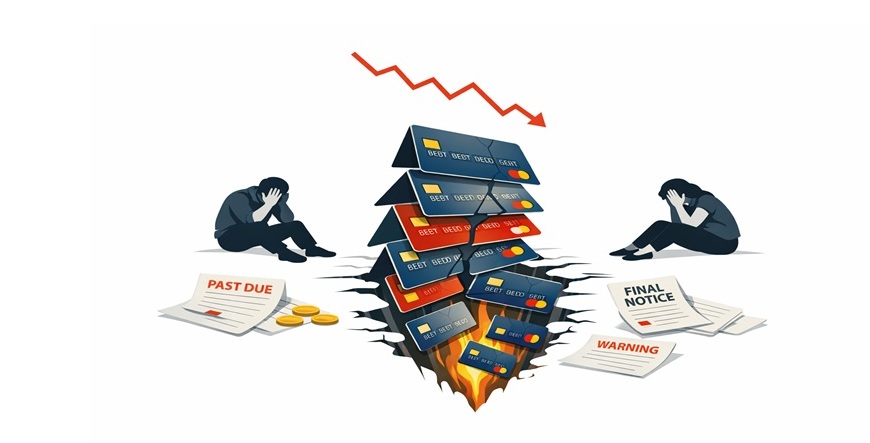
American households are now carrying a record $1.25 trillion in credit card debt, according to Federal Reserve Bank of New York data released in May 2026. That figure alone is alarming. But the more urgent number sits within it: 13.12% of all credit card accounts are now at least 90 days delinquent — the highest rate in 15 years, last seen in the immediate aftermath of the 2008 financial crisis. Average credit card interest rates have reached 21%, up from 14.6% just four years ago. Credit card debt has risen 63% in five years, from $770 billion in Q1 2021 to $1.25 trillion today. Total US household debt has hit a record $18.8 trillion. Americans, as KTLA's coverage of the New York Fed data put it this week, 'are essentially mortgaging their futures to survive the present.' This guide explains what is behind the crisis, who it is hitting hardest, and what anyone carrying credit card debt can — and should — do right now.
THE $1.25 TRILLION CREDIT CARD CRISIS — KEY FIGURES Q1 2026
Seasonal patterns provided minor relief: credit card debt typically falls in Q1 after peak holiday spending in Q4, and Q1 2026 did see a $25 billion decline from the Q4 2025 peak of $1.277 trillion — the highest balance since the New York Fed began tracking this data in 1999. But as LendingTree's 2026 credit card debt statistics report notes, 'credit card debt has risen by $482 billion since Q1 2021 — that's a 63% increase in five years.' The seasonal dip is a rounding error against a five-year surge.
Meanwhile, total US household debt reached a record $18.8 trillion in Q1 2026 — equivalent to approximately $57,000 per American household. Mortgage debt, auto loans, and home equity lines of credit were all higher alongside the credit card figure, confirming that credit card debt is not the only pressure point but the most acute one given its combination of scale, growth rate, and the 21% average interest rate attached to it.
Americans are essentially mortgaging their futures to survive the present, which is a very scary economic place to be.
— KTLA — AMERICANS FALLING BEHIND ON $1.25 TRILLION IN CREDIT CARD BILLS (JUNE 2026)
The balance number is alarming. The delinquency number is the emergency. The New York Fed's Q1 2026 data shows that 13.12% of all credit card accounts are now at least 90 days delinquent — the highest rate in 15 years. The only comparable period in recent US financial history was the aftermath of the 2008 financial crisis, when delinquencies peaked at nearly 7% in 2009 (note: this was a different measurement basis, per LendingTree). On the current measurement basis used by the New York Fed, 13.12% is the worst reading since 2008.
CardRates.com's June 2026 analysis places this figure in direct practical terms: 'A credit card balance is considered seriously delinquent when it is 90 or more days past due. It is clear more Americans are letting credit card payments slide as they struggle with inflation and affordability issues.' The Federal Reserve Bank of New York's own researchers acknowledged the divergence in their Q1 2026 press statement: 'Americans are generally on pretty stable footing, overall, but we do see some weakness in lower-income households. We do see some of this in our delinquency rates.' This 'weakness' is 13.12% of all credit card accounts — an enormous number embedded in a statement of reassurance.
Principal Asset Management market strategist Christian Floro offered the sharpest analyst reading to CNBC: 'A subset of consumers, primarily subprime borrowers, has driven most of the increase in delinquencies, while prime borrowers have experienced only a marginal deterioration in credit performance.' This is the K-shaped economy expressed in credit: the bifurcation between consumers who are managing and those who are falling behind runs directly through the delinquency data.
Applied to the average balance: at $6,595 and 21% APR, the monthly interest charge is approximately $115. Over a year, a cardholder making only minimum payments and not adding new charges will pay roughly $1,380 in interest — more than 20% of the balance in annual interest cost alone. At the pre-2022 rate of 14.6%, the same balance generated approximately $960 in annual interest. The 21% rate adds $420 per year in cost on the average balance — simply from the rate increase, with no additional borrowing.
SHTF Plan's June 2026 analysis notes that the Federal Reserve's preferred inflation measure, the Personal Consumption Expenditures index, rose to 3.8% in April 2026. Inflation at 3.8% with credit card rates at 21% means the real cost of carrying credit card debt remains approximately 17% in real terms — one of the most expensive forms of consumer borrowing available, and one that the current economic environment has made dramatically more expensive than it was just four years ago.
Sources: Experian 2025 Consumer Debt Study · WalletHub 2026 Credit Card Debt by Generation (January 2026) · CardRates.com (June 2026) · New York Fed Center for Microeconomic Data · US News (January 2026).
The New York Fed's researchers were explicit about the Gen Z delinquency risk in CNBC's May 2024 coverage of earlier data, a trend that has continued into 2026: Gen Z borrowers 'have shorter credit histories and lower credit limits, making them more likely to be maxed out on their credit cards and miss a payment.' Bobbi Rebell, certified financial planner, summarised the structural cause: 'The sad reality is that life was more affordable for Boomers and Gen X. In recent years, we have been facing high inflation, and for many Americans wages aren't getting much higher and certainly have not kept up with inflation. As a result, the younger generation has more student debt and is also facing rising credit card debt.'
A 401(k) early withdrawal (before age 59½) carries a 10% penalty plus ordinary income tax on the entire amount withdrawn. A household in the 22% tax bracket withdrawing $10,000 to pay credit card debt will receive approximately $6,800 after the penalty and taxes — and will have permanently forfeited the future compound growth on the $10,000, which at historical 7% annual returns over 20 years would have grown to approximately $38,700. The $6,800 received today costs approximately $31,900 in future wealth. This is the price of unmanaged credit card debt at 21% APR: not just monthly interest, but the systematic destruction of long-term financial security.
The Ramsey Q1 2026 State of Personal Finance data, published June 2, 2026, adds a final layer: 54% of Americans are living paycheck to paycheck in 2026. With no financial buffer, the cycle is structural: high-cost debt accrues interest, minimum payments consume available cash, no savings are possible, any shock triggers new debt, and retirement assets become the only available emergency reserve. The loop closes.
The path out requires clarity, urgency, and the correct sequence of actions: list everything, call your issuers, apply the Debt Avalanche, avoid 401(k) withdrawals, pursue balance transfers, and build the emergency fund that breaks the cycle. At 21% APR, inaction is the most expensive choice available. Every month of minimum-only payment on the average balance costs $115 in interest that goes entirely to the lender. Every month of deliberate paydown above the minimum builds equity in your own financial future. The national crisis is structural. Your response to it is personal, immediate, and entirely within your control.
CNBC — New York Fed: Credit Card Debt Stands at $1.25 Trillion (May 12, 2026) https://www.cnbc.com/2026/05/12/new-york-fed-credit-card-debt-stands-at-1point25-trillion.html
KTLA / Yahoo Finance — Americans Falling Behind on $1.25 Trillion in Credit Card Bills (June 2026) https://finance.yahoo.com/economy/articles/americans-falling-behind-1-25-233028571.html
CardRates.com — Credit Card Delinquency Rate Hits 15-Year High in 2026 (June 2026) https://www.cardrates.com/news/credit-card-delinquency-rate-hits-15-year-high-in-2026/
SHTF Plan — Credit Card Debt Hits Record $1.25 Trillion With Delinquencies at 15-Year High (June 2026) https://www.shtfplan.com/economics/credit-card-debt-hits-record-1-25-trillion-with-delinquencies-at-an-alarming-15-year-high
LendingTree — 2026 Credit Card Debt Statistics (Updated Q1 2026 NY Fed Data) https://www.lendingtree.com/credit-cards/study/credit-card-debt-statistics/
ECIKS.org — Credit Card Debt Climbs to $1.25 Trillion as US Household Debt Hits Record $18.8 Trillion (May 2026) https://eciks.org/4240-52279-credit-card-debt-climbs-to-1-25-trillion-as-us-household-debt-hits-record-18-8-t
WalletHub — Credit Card Debt by Generation and Age 2026 (January 2026) https://wallethub.com/edu/cc/credit-card-debt-by-generation/28303
US News Money — Gen Z Is Severely Delinquent on Credit Card Debt (January 2026) https://money.usnews.com/credit-cards/articles/gen-z-severely-delinquent-on-credit-card-debt
CNBC — Credit Card Delinquencies Rise as More Gen Z Cardholders Are Maxed Out (NY Fed Research, May 2024) https://www.cnbc.com/2024/05/14/credit-card-delinquencies-rise-as-more-gen-zers-are-maxed-out-ny-fed.html
THE $1.25 TRILLION CREDIT CARD CRISIS — KEY FIGURES Q1 2026
| $1.25T Total US credit card debt Q1 2026 — 5.9% above Q1 2025 (NY Fed) |
13.12% Accounts 90+ days delinquent — 15-year high since 2008 (NY Fed) |
21% Average credit card APR February 2026 — up from 14.6% in Feb 2022 |
$6,595 Average credit card debt per US consumer Q1 2026 (Capital One) |
+63% Credit card debt rise in 5 years: $770B (Q1 2021) to $1.25T |
$18.8T Record total US household debt Q1 2026 (New York Fed, May 2026) |
TABLE OF CONTENTS
- The Record $1.25 Trillion: What the New York Fed Data Actually Shows
- The Delinquency Crisis: 13.12% — Worse Than Any Point Since 2008
- The 21% APR Trap: How Interest Rates Are Compounding the Crisis
- Who Is Falling Behind — Credit Card Debt by Generation
- The Structural Drivers: Why This Is Happening Now
- Mortgaging the Future: 401(k) Withdrawals and Savings Collapse
- What You Can Do Right Now: A Six-Step Debt Action Plan
- Conclusion
- Frequently Asked Questions
- References and Further Reading
The Record $1.25 Trillion: What the New York Fed Data Actually Shows
The Federal Reserve Bank of New York's Quarterly Report on Household Debt and Credit for Q1 2026, released on May 12, 2026, revealed that American households now carry $1.252 trillion in credit card balances — a 5.9% increase from $1.18 trillion in Q1 2025. This figure is $325 billion higher than the pre-pandemic record set in Q4 2019, when balances stood at $927 billion. It is $482 billion higher than the pandemic-era low of $770 billion in Q1 2021, when stimulus payments and lockdown-reduced spending temporarily depressed balances. Credit card debt has risen in a near-unbroken line for five years.Seasonal patterns provided minor relief: credit card debt typically falls in Q1 after peak holiday spending in Q4, and Q1 2026 did see a $25 billion decline from the Q4 2025 peak of $1.277 trillion — the highest balance since the New York Fed began tracking this data in 1999. But as LendingTree's 2026 credit card debt statistics report notes, 'credit card debt has risen by $482 billion since Q1 2021 — that's a 63% increase in five years.' The seasonal dip is a rounding error against a five-year surge.
Meanwhile, total US household debt reached a record $18.8 trillion in Q1 2026 — equivalent to approximately $57,000 per American household. Mortgage debt, auto loans, and home equity lines of credit were all higher alongside the credit card figure, confirming that credit card debt is not the only pressure point but the most acute one given its combination of scale, growth rate, and the 21% average interest rate attached to it.
Americans are essentially mortgaging their futures to survive the present, which is a very scary economic place to be.
— KTLA — AMERICANS FALLING BEHIND ON $1.25 TRILLION IN CREDIT CARD BILLS (JUNE 2026)
The Delinquency Crisis: 13.12% — Worse Than Any Point Since 2008
The balance number is alarming. The delinquency number is the emergency. The New York Fed's Q1 2026 data shows that 13.12% of all credit card accounts are now at least 90 days delinquent — the highest rate in 15 years. The only comparable period in recent US financial history was the aftermath of the 2008 financial crisis, when delinquencies peaked at nearly 7% in 2009 (note: this was a different measurement basis, per LendingTree). On the current measurement basis used by the New York Fed, 13.12% is the worst reading since 2008.CardRates.com's June 2026 analysis places this figure in direct practical terms: 'A credit card balance is considered seriously delinquent when it is 90 or more days past due. It is clear more Americans are letting credit card payments slide as they struggle with inflation and affordability issues.' The Federal Reserve Bank of New York's own researchers acknowledged the divergence in their Q1 2026 press statement: 'Americans are generally on pretty stable footing, overall, but we do see some weakness in lower-income households. We do see some of this in our delinquency rates.' This 'weakness' is 13.12% of all credit card accounts — an enormous number embedded in a statement of reassurance.
Principal Asset Management market strategist Christian Floro offered the sharpest analyst reading to CNBC: 'A subset of consumers, primarily subprime borrowers, has driven most of the increase in delinquencies, while prime borrowers have experienced only a marginal deterioration in credit performance.' This is the K-shaped economy expressed in credit: the bifurcation between consumers who are managing and those who are falling behind runs directly through the delinquency data.
WARNING SIGNS THAT YOUR CREDIT CARD DEBT IS BECOMING A CRISIS
- You are making only the minimum payment each month — at 21% APR, a $6,595 balance paid at the minimum rate will take over 22 years to clear and cost more in interest than the original balance.
- You are using one credit card to pay the minimum on another — this is a debt spiral, not a management strategy.
- Your balance is growing each month despite making payments — at 21% APR, the interest accruing on $6,595 is approximately $116 per month before you spend a single additional dollar.
- You have missed one or more payments — 90+ days late triggers the 13.12% delinquency classification that the New York Fed is reporting, damages your credit score, and typically triggers default interest rates of 29%+ on the affected account.
- You are withdrawing from your 401(k) to make minimum payments — this is the pattern Fidelity is now warning about and represents the destruction of future financial security to manage present-day crisis.
The 21% APR Trap: How Interest Rates Are Compounding the Crisis
The arithmetic of 21% annual percentage rate credit card interest is merciless. Average credit card rates climbed to 21% in February 2026, according to Federal Reserve data reported by SHTF Plan — up from 14.6% in February 2022. That 44% increase in the interest rate in four years means that the cost of carrying the average balance has increased by approximately 44% on an ongoing monthly basis for every cardholder who does not pay in full.Applied to the average balance: at $6,595 and 21% APR, the monthly interest charge is approximately $115. Over a year, a cardholder making only minimum payments and not adding new charges will pay roughly $1,380 in interest — more than 20% of the balance in annual interest cost alone. At the pre-2022 rate of 14.6%, the same balance generated approximately $960 in annual interest. The 21% rate adds $420 per year in cost on the average balance — simply from the rate increase, with no additional borrowing.
SHTF Plan's June 2026 analysis notes that the Federal Reserve's preferred inflation measure, the Personal Consumption Expenditures index, rose to 3.8% in April 2026. Inflation at 3.8% with credit card rates at 21% means the real cost of carrying credit card debt remains approximately 17% in real terms — one of the most expensive forms of consumer borrowing available, and one that the current economic environment has made dramatically more expensive than it was just four years ago.
Who Is Falling Behind — Credit Card Debt by Generation
The delinquency and balance data is not evenly distributed. CardRates.com's June 2026 analysis reports that Gen X consumers have the highest average credit card debt, while Gen Z consumers have the fastest growth. WalletHub's 2026 credit card debt by generation data shows Gen X carrying an average balance of $9,600 — 175% more than the national average. The generational breakdown reflects different mechanisms of debt accumulation and delinquency risk.| Generation | Avg Credit Card Debt | Delinquency Risk | Key Driver |
| Gen Z (18–28) | $3,493 avg (Experian 2025) | HIGHEST growth rate | Low income + low credit limit = maxed out cards + missed payments |
| Millennials (29–44) | $6,232 avg (Experian 2025) | Rising sharply | Student debt + housing costs + credit reliance for daily spending |
| Gen X (45–60) | $9,600 avg (Experian 2025 / WalletHub) | Highest absolute | Peak expenses: mortgage, childcare, college tuition — highest total debt |
| Baby Boomers (61–79) | $6,245 avg (Experian 2025) | Moderate | Fixed income in retirement; higher medical costs depleting savings |
Sources: Experian 2025 Consumer Debt Study · WalletHub 2026 Credit Card Debt by Generation (January 2026) · CardRates.com (June 2026) · New York Fed Center for Microeconomic Data · US News (January 2026).
The New York Fed's researchers were explicit about the Gen Z delinquency risk in CNBC's May 2024 coverage of earlier data, a trend that has continued into 2026: Gen Z borrowers 'have shorter credit histories and lower credit limits, making them more likely to be maxed out on their credit cards and miss a payment.' Bobbi Rebell, certified financial planner, summarised the structural cause: 'The sad reality is that life was more affordable for Boomers and Gen X. In recent years, we have been facing high inflation, and for many Americans wages aren't getting much higher and certainly have not kept up with inflation. As a result, the younger generation has more student debt and is also facing rising credit card debt.'
The Structural Drivers: Why This Is Happening Now
The $1.25 trillion balance and 13.12% delinquency rate are the outcome of several converging structural forces, not a single cause or a temporary shock. Understanding the drivers is essential to understanding why this crisis is likely to deepen rather than self-correct in the near term.- Interest rate shock: the Federal Reserve's aggressive rate hiking cycle from 2022 to 2024 — which raised the federal funds rate from near-zero to over 5% — directly translated into higher credit card APRs. The average rate went from 14.6% in February 2022 to 21% in February 2026, as creditors repriced revolving debt at the new higher-rate environment. The Fed has subsequently cut rates, but credit card APRs have been slow to follow.
- Persistent inflation above wage growth: the CPI rose over 20% between 2020 and 2024. Essential expenses — food, energy, housing, healthcare, childcare — consistently outpaced wage growth, forcing many households to use credit cards to cover the gap between what they earn and what their lives now cost.
- Pandemic savings exhaustion: the stimulus payments and reduced spending of 2020–2021 temporarily reduced credit card balances to their low of $770 billion. Those reserves are now fully depleted, and households that built up emergency buffers during the pandemic have reverted to — or fallen below — their pre-pandemic financial positions.
- Tariff-driven consumer price pressure: the SHTF Plan analysis notes that the introduction of new US tariffs in 2025 has pushed up consumer goods prices, particularly in electronics, clothing, and household items — all categories frequently charged on credit cards. ECIKS.org's May 2026 analysis of the NY Fed data warns that tariffs represent 'an additional inflationary pressure on already-strained consumer budgets.'
- Student debt pressure on younger borrowers: the return of federal student loan payments in 2023–2024, after years of pandemic-era forbearance, added monthly payment obligations for millions of borrowers precisely as credit card rates were rising. For Gen Z and Millennials carrying both student debt and credit card balances, the debt service burden has reached multi-decade highs.
Mortgaging the Future: 401(k) Withdrawals and Savings Collapse
Perhaps the most alarming downstream consequence of the credit card debt crisis is the behaviour it is driving in retirement savings. The KTLA analysis of the New York Fed data, published this week, reports: 'Fidelity warns that many people are now raiding their 401(k)s just to make ends meet.' This is the compounding crisis at its most destructive: Americans are not just falling behind on today's credit card bills — they are liquidating their future financial security to manage present-day debt service.A 401(k) early withdrawal (before age 59½) carries a 10% penalty plus ordinary income tax on the entire amount withdrawn. A household in the 22% tax bracket withdrawing $10,000 to pay credit card debt will receive approximately $6,800 after the penalty and taxes — and will have permanently forfeited the future compound growth on the $10,000, which at historical 7% annual returns over 20 years would have grown to approximately $38,700. The $6,800 received today costs approximately $31,900 in future wealth. This is the price of unmanaged credit card debt at 21% APR: not just monthly interest, but the systematic destruction of long-term financial security.
The Ramsey Q1 2026 State of Personal Finance data, published June 2, 2026, adds a final layer: 54% of Americans are living paycheck to paycheck in 2026. With no financial buffer, the cycle is structural: high-cost debt accrues interest, minimum payments consume available cash, no savings are possible, any shock triggers new debt, and retirement assets become the only available emergency reserve. The loop closes.
What You Can Do Right Now: A Six-Step Debt Action Plan
The scale of the national credit card debt crisis does not diminish the importance of individual action. At 21% APR, the decision to not act on credit card debt is itself a financial decision — one that costs approximately $115 per month in interest on the average balance, every month of inaction. The following six steps, applied in sequence, are the evidence-backed path out of the credit card trap.YOUR 6-STEP CREDIT CARD DEBT ACTION PLAN — 2026
- List every card, balance, APR, and minimum payment on a single sheet. You cannot fight what you cannot see in full. Financial clarity is the prerequisite for every subsequent step. Melissa Murphy Pavone, CFP: 'Seeing everything on one page often brings immediate relief — and it reveals exactly which balances to attack first.'
- Call your card issuers immediately if you have missed any payment or are at risk of doing so. The American Bankers Association spokesperson Mike Townsend states: 'Any credit cardholder in financial stress should always contact their card issuer to make them aware of their situation. They may be eligible for some relief or assistance depending on their individual circumstances.' Hardship programmes, rate reductions, and payment deferrals are available — but only to those who ask.
- Apply the Debt Avalanche method: direct every available pound/dollar above minimum payments toward the highest-APR balance. At 21% APR, eliminating the highest-rate card first is mathematically optimal — it produces the fastest total interest savings and the fastest path to zero balance.
- Do not withdraw from your 401(k) to pay credit card debt. The 10% penalty plus income tax means you lose 32%+ of every dollar withdrawn before it reaches your credit card balance. The interest cost of the credit card debt is almost certainly less than the permanent destruction of compound growth in the retirement account. Use a balance transfer to a 0% promotional APR card, a personal loan at lower APR, or a debt management plan with a non-profit credit counsellor instead.
- Transfer high-balance cards to 0% APR promotional offers where available. Many balance transfer cards offer 12–21 months at 0% — during which every payment reduces principal rather than interest. Apply only for cards you qualify for; multiple hard credit inquiries in a short period further damage a stressed credit score.
- Build a $1,000 emergency fund before you begin aggressive debt paydown. Without a cash buffer, the next emergency (car repair, medical bill, appliance failure) goes straight back onto the credit card, resetting all progress. Cash does not charge interest. A $1,000 liquid emergency fund is the first structural break in the debt cycle.
CONCLUSION
The Federal Reserve Bank of New York's Q1 2026 data is not ambiguous: $1.25 trillion in credit card debt, 13.12% delinquency — the worst in 15 years — and an average APR of 21% that has risen 44% in four years. The 63% increase in credit card debt since 2021 tells a five-year story of households bridging the gap between stagnant wages and rising costs with revolving high-interest debt, until the bridge is straining under its own weight. KTLA's coverage this week named the consequence plainly: Americans are mortgaging their futures to survive the present.The path out requires clarity, urgency, and the correct sequence of actions: list everything, call your issuers, apply the Debt Avalanche, avoid 401(k) withdrawals, pursue balance transfers, and build the emergency fund that breaks the cycle. At 21% APR, inaction is the most expensive choice available. Every month of minimum-only payment on the average balance costs $115 in interest that goes entirely to the lender. Every month of deliberate paydown above the minimum builds equity in your own financial future. The national crisis is structural. Your response to it is personal, immediate, and entirely within your control.
Frequently Asked Questions
How much credit card debt does the average American carry in 2026?
According to Capital One data cited by CardRates.com in their June 2026 analysis, the average US credit card debt per consumer was $6,595 at the beginning of 2026. LendingTree's 2026 credit card debt statistics report provides additional context from the New York Fed: total US credit card balances stand at $1.252 trillion in Q1 2026, a 5.9% increase from $1.18 trillion in Q1 2025. The average debt per household (dividing total balances by US household count) is approximately $9,144, reflecting that many households carry multiple cards. Gen X (ages 45–60) carries the highest average by generation at $9,600 (Experian 2025 / WalletHub 2026), while Gen Z carries the lowest absolute balance at $3,493 but the fastest growth rate.What does a 13.12% credit card delinquency rate mean in practice?
A credit card balance is considered seriously delinquent when it is 90 or more days past due. The 13.12% rate reported by the Federal Reserve Bank of New York for Q1 2026 means that 13.12% of all credit card accounts in the United States — more than one in eight — have not received a payment in at least 90 days. This is the highest level since the immediate aftermath of the 2008 financial crisis, making it the worst reading in 15 years. CardRates.com's June 2026 analysis notes that the previous comparable period was the 2008 crisis, which peaked at nearly 7% delinquency in 2009 on a different measurement basis. At 90+ days delinquent, accounts typically trigger default interest rates (often 29%+), severe credit score damage, and the beginning of collections processes — creating a cascade of financial consequences that extend well beyond the missed payments themselves.Why have credit card interest rates reached 21% and will they fall?
Average credit card APRs rose from 14.6% in February 2022 to 21% in February 2026, tracking the Federal Reserve's aggressive rate hiking cycle that raised the federal funds rate from near-zero to over 5% between 2022 and 2024. The Federal Reserve has since begun cutting rates, but credit card APRs have been slow to follow — a structural feature of the revolving credit market, where issuers typically raise rates faster than they lower them. The Federal Reserve's preferred inflation measure (PCE index) rose to 3.8% in April 2026, per SHTF Plan's analysis, suggesting that further rate cuts may be limited in the near term. Analysts interviewed by CNBC (May 2026) suggest that APRs are unlikely to fall significantly without either a sharper Federal Reserve rate cutting cycle or regulatory intervention. The practical implication: plan on 21% APR persisting for the foreseeable future, and act accordingly.Should I withdraw from my 401(k) to pay credit card debt?
No — in almost every case. A 401(k) early withdrawal (before age 59½) incurs a 10% penalty plus ordinary income tax on the withdrawn amount. A household in the 22% tax bracket withdrawing $10,000 receives approximately $6,800 after penalties and taxes, while permanently forfeiting the future compound growth on the $10,000. At a historical 7% annual return, that $10,000 would have grown to approximately $38,700 over 20 years. Better alternatives include: balance transfer to a 0% promotional APR card (12–21 months at 0% gives you time to eliminate principal without interest accrual); a personal loan at a lower APR than your credit card rate (currently available at 10–15% for creditworthy borrowers, substantially below 21%); and a debt management plan through a non-profit credit counselling agency (NFCC-member agencies negotiate reduced interest rates with creditors and create structured repayment plans, often at 6–9% effective rates).What is the fastest and most cost-effective way to pay off credit card debt?
The mathematically optimal method is the Debt Avalanche: list all credit card balances and their APRs, make minimum payments on all accounts, and direct every additional available dollar to the highest-APR balance first. Once that balance reaches zero, roll those payments to the next-highest APR balance. This method minimises total interest paid across all accounts and typically produces the fastest payoff timeline. For those who need psychological momentum rather than mathematical optimisation, the Debt Snowball (pay the smallest balance first, regardless of APR) is an alternative — studies suggest it produces better completion rates for some people because of the early wins. Regardless of method, the American Bankers Association recommends contacting your card issuers if you are in financial stress: many offer hardship programmes with temporary rate reductions, deferred payments, or waived fees that can meaningfully accelerate paydown when combined with either strategy.References
Federal Reserve Bank of New York — Quarterly Report on Household Debt and Credit, Q1 2026 (May 2026) https://www.newyorkfed.org/microeconomics/hhdcCNBC — New York Fed: Credit Card Debt Stands at $1.25 Trillion (May 12, 2026) https://www.cnbc.com/2026/05/12/new-york-fed-credit-card-debt-stands-at-1point25-trillion.html
KTLA / Yahoo Finance — Americans Falling Behind on $1.25 Trillion in Credit Card Bills (June 2026) https://finance.yahoo.com/economy/articles/americans-falling-behind-1-25-233028571.html
CardRates.com — Credit Card Delinquency Rate Hits 15-Year High in 2026 (June 2026) https://www.cardrates.com/news/credit-card-delinquency-rate-hits-15-year-high-in-2026/
SHTF Plan — Credit Card Debt Hits Record $1.25 Trillion With Delinquencies at 15-Year High (June 2026) https://www.shtfplan.com/economics/credit-card-debt-hits-record-1-25-trillion-with-delinquencies-at-an-alarming-15-year-high
LendingTree — 2026 Credit Card Debt Statistics (Updated Q1 2026 NY Fed Data) https://www.lendingtree.com/credit-cards/study/credit-card-debt-statistics/
ECIKS.org — Credit Card Debt Climbs to $1.25 Trillion as US Household Debt Hits Record $18.8 Trillion (May 2026) https://eciks.org/4240-52279-credit-card-debt-climbs-to-1-25-trillion-as-us-household-debt-hits-record-18-8-t
WalletHub — Credit Card Debt by Generation and Age 2026 (January 2026) https://wallethub.com/edu/cc/credit-card-debt-by-generation/28303
US News Money — Gen Z Is Severely Delinquent on Credit Card Debt (January 2026) https://money.usnews.com/credit-cards/articles/gen-z-severely-delinquent-on-credit-card-debt
CNBC — Credit Card Delinquencies Rise as More Gen Z Cardholders Are Maxed Out (NY Fed Research, May 2024) https://www.cnbc.com/2024/05/14/credit-card-delinquencies-rise-as-more-gen-zers-are-maxed-out-ny-fed.html
0 Comments
Be the first to share your thoughts on this article.