

Financial Literacy
4 Frightening Financial Mistakes That Can Haunt Your Wallet!

Credit card balances $1.263 trillion at an average APR of about 20.9%; $5,000 at 20.9% costs about $1,045 a year in interest; paying $150 a month takes about 51 months and about $2,446 in interest, versus about 20 months and $915 at $300 a month (author’s arithmetic). Cushion: only 47% can cover a $1,000 emergency, 46% three months and 27% six months (Bankrate 2026); 19.5% of 401(k) savers have a loan and 3% took a hardship withdrawal (Fidelity, Q2 2026). Saving: US saving rate 4.6% in 2025 and about 4.1% in August 2026; average total plan savings rate 12.1%; a $60,000 earner saving 4% vs 15% for 35 years at a constant 7% builds about $332,000 vs $1.24 million. Costs and behavior: 0.64% fund vs 0.03% fund costs about $68,000 on $500 a month for 30 years; the average investor earned about 6.8% vs 10.2% for the S&P 500 over 30 years (DALBAR); 79% of active large-cap funds trailed the S&P 500 in 2025.
Mistake 3: what saving 4%, 10% or 15% of a $60,000 salary builds in 35 years ($)
The unsettling part is that these mistakes rarely feel like mistakes when you make them. Each one looks sensible in the moment. That is exactly why they haunt. This guide walks through four of the most common and costly, with 2026 numbers so you can see what each really costs, and a practical way to banish each one.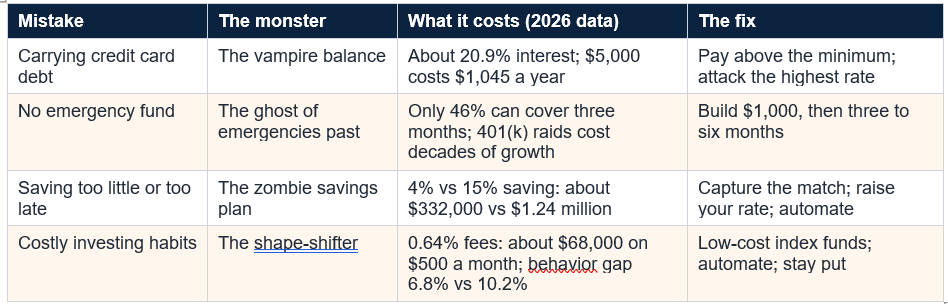
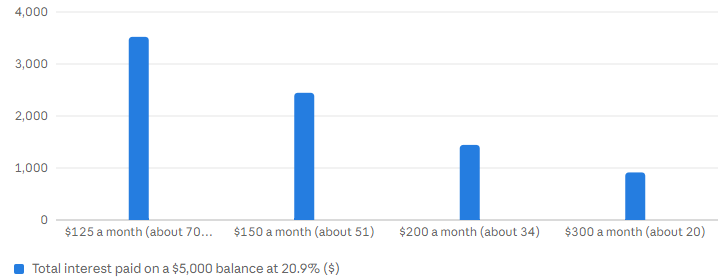
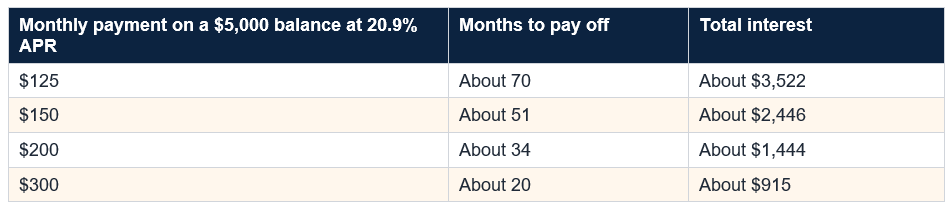
The trap is the minimum payment. It feels manageable, and the card company is happy to let it feel that way. In my illustration, a $5,000 balance at 20.9% costs about $1,045 in interest in the first year if you do not pay it down. Paying $125 a month takes about 70 months and costs about $3,522 in interest. Paying $150 takes about 51 months and $2,446. Paying $200 takes about 34 months and $1,444, and $300 clears the balance in about 20 months for $915. An extra $50 a month can save well over a thousand dollars.
The fix: List every card by interest rate, pay the minimum on all, then send every spare dollar to the highest rate. Keep a $1,000 starter fund so a surprise does not go back on the card. Paying off a 21% card is a guaranteed 21% return, which almost no investment can promise.
The raid on retirement is the hidden cost. Fidelity reported that 19.5% of 401(k) savers had an outstanding loan in the second quarter of 2026, and 3% took a hardship withdrawal. Withdrawals before 59½ generally trigger tax and often a 10% penalty. In my illustration, a $10,000 withdrawal at 40 nets only about $6,600 after 24% tax and the 10% penalty, and the lost growth is worse: at a constant 7%, that $10,000 would have become about $62,000 by 67. A $1,000 problem solved with your future self’s money can cost a lot more.
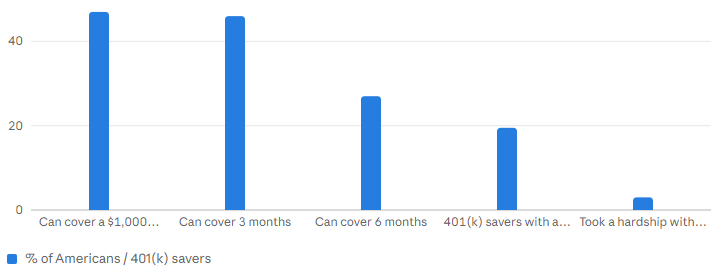
The numbers: Bankrate 2026: 47% could cover a $1,000 emergency; 46% three months; 27% six months. Fidelity Q2 2026: 19.5% of 401(k) savers have a loan; 3% took a hardship withdrawal. A $10,000 early withdrawal at 40 costs about $62,000 of growth by 67 (illustration at 7%).
The cure is boring and works. Build a starter fund of $1,000, then three to six months of essential expenses. If your essentials are $3,000 a month, that is $9,000 to $18,000. Keep it somewhere safe and earning something: top savings accounts paid about 4.34% to 4.50% in October, and a 52-week Treasury bill about 4.46%, beating the 3.7% inflation rate. Automate a transfer every payday so the cushion builds while you are busy.
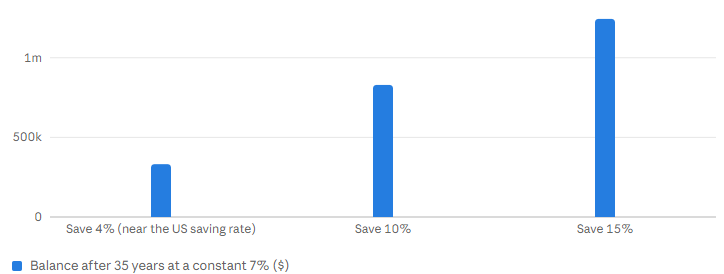
Start with the match. Vanguard’s data show 86% of its plans offer an employer match, according to one summary. In my illustration, a $60,000 earner whose employer matches 50% of the first 6% contributed receives $1,800 a year, which grows to about $170,000 over thirty years at 7%. Skipping the match is turning down free money. Then look at the rate: the same earner saving 4% for 35 years at 7% builds about $332,000, at 10% about $829,000 and at 15% about $1.24 million. Waiting five years to start saving 15% of a $59,800 salary costs about $450,000 by 67.

Contribute at least enough to get your full employer match, then raise your rate by one point every few months until you reach 12% to 15% including the match. Automate it. The 2026 401(k) limit is $24,500 and the IRA limit $7,500, but most people are nowhere near either, so the first step is simply the next point.
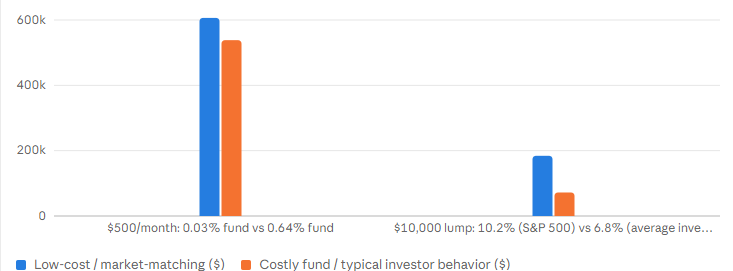
The damage compounds. In my illustration, $500 a month for thirty years at a 7% return before fees grows to about $606,000 in a 0.03% fund but about $538,000 in a 0.64% fund, a gap of roughly $68,000. And behavior costs more than fees: DALBAR research, cited by MyETFJourney, found that over 30 years the average investor earned about 6.8% a year while the S&P 500 returned about 10.2%, largely because of badly timed buying and selling. On $10,000, that is about $184,000 versus about $72,000.
The numbers: Fees: $500 a month for 30 years at 7% before fees ends at about $606,000 (0.03%) vs $538,000 (0.64%). Behavior: $10,000 grows to about $184,000 at 10.2% vs about $72,000 at 6.8%. 79% of active large-cap funds trailed the S&P 500 in 2025.
The cure is to make your investing dull: low-cost diversified funds, automatic contributions and a rule not to sell in a panic. If you cannot resist tinkering, give yourself a small, separate fun account and leave the core alone.
The third is skipping the annual review. Rules and limits change every year: the 2026 401(k) limit rose to $24,500, for example. A yearly check of your accounts, debts, insurance and goals takes an hour and catches most problems early. None of these ghosts is hard to beat, but all of them thrive when nobody is looking.
That is good news, because it means you do not have to fix everything at once. A small emergency fund stops the card from growing. Paying down the card frees cash to save. A higher savings rate and cheap funds then do the rest. Start with the mistake that costs you the most today, which for many people is the 21% card, and let the momentum build.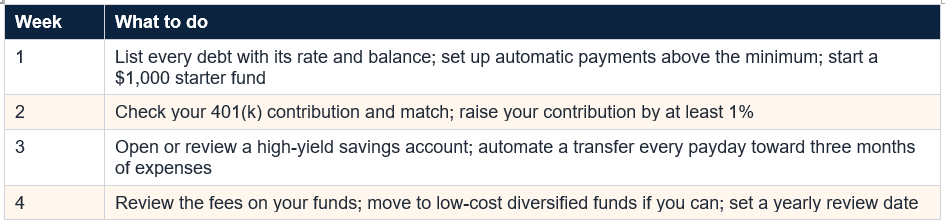
You do not need to do it perfectly. You need to do it in the right order. Pay the minimums, build a small cushion, capture the match, attack the highest-interest debt and automate everything. If you do only that, you will have banished most of the monsters before the next Halloween.
The best defense is a boring system: pay above the minimum, build a cushion, capture the match, automate your saving and keep your investing cheap and dull. Do that, and Halloween will be the only thing that frightens you in October. This is general education, not personalized advice, and a qualified adviser can help you apply it.
Four of the most costly are carrying credit card balances at rates near 21%, having no emergency fund, saving too little or missing an employer match and letting fees or emotional decisions erode investment returns. Each can cost tens of thousands of dollars over time, and they often feed one another.
How big should my emergency fund be?
A common guideline is three to six months of essential expenses, built in stages, starting with $1,000. If your essentials cost $3,000 a month, that is $9,000 to $18,000. Keep it in an insured savings account or similar, where top accounts paid about 4.34% to 4.50% in October 2026. Only 46% of Americans could cover three months of expenses, according to Bankrate.
Should I pay off credit cards or save for retirement first?
For most people, capture any employer match first, since it is an immediate return, then pay down high-interest cards, which cost about 21% a year, then raise retirement savings. A 21% interest rate is a guaranteed cost that few investments can reliably beat. Build a small cash cushion too, so a surprise does not push you back onto the card.
Is it ever okay to take money out of a 401(k) early?
Sometimes, in a true emergency, but it is expensive. Withdrawals before 59½ generally trigger income tax and often a 10% penalty, and you lose decades of growth. In my illustration, a $10,000 withdrawal at 40 nets about $6,600 after 24% tax and the 10% penalty and costs about $62,000 by age 67 at a constant 7% return. Loans and hardship withdrawals have their own rules, so ask your plan first.
How can I stop making these mistakes?
Automate the good habits: set up automatic transfers to savings and your 401(k), automate card payments above the minimum and choose low-cost diversified funds you do not need to watch. Then review once a year. This is general education, not personal advice.
Table of Contents
- The Things That Go Bump in Your Budget
- The Four Mistakes at a Glance
- Mistake 1: The Vampire Balance (Carrying Credit Card Debt)
- Mistake 2: The Ghost of Emergencies Past (No Cushion)
- Mistake 3: The Zombie Savings Plan (Saving Too Little or Too Late)
- Mistake 4: The Shape-Shifter (Fees, Hot Tips and Panic)
- Three Bonus Ghosts
- How the Mistakes Feed Each Other
- A 30-Day Exorcism Plan
- A Quick Self-Check
- Conclusion
- Frequently Asked Questions
Mistake 1: the cost of paying slowly on a $5,000 credit card balance at 20.9% ($)
Mistake 2: how thin the cushion is, and how often retirement gets raided (%)
Mistake 3: what saving 4%, 10% or 15% of a $60,000 salary builds in 35 years ($)
Mistake 4: what fees and behavior cost over 30 years ($)
Value after 30 years ($) by Author's constant-return illustrations; DALBAR returns via MyETFJourney; fee gap about $68,000The Things That Go Bump in Your Budget
Halloween is this Friday, which makes it a fine time to talk about the scariest things in personal finance. Not ghosts or witches, but the quiet mistakes that sit in the corner of your budget for years, then jump out at the worst moment. A card balance that never quite goes away. A car repair that wipes out your savings. A retirement account that never got the attention it needed.The unsettling part is that these mistakes rarely feel like mistakes when you make them. Each one looks sensible in the moment. That is exactly why they haunt. This guide walks through four of the most common and costly, with 2026 numbers so you can see what each really costs, and a practical way to banish each one.
The Four Mistakes at a Glance
Mistake 1: The Vampire Balance (Carrying Credit Card Debt)
Credit card debt is the vampire of personal finance: it drains a little at a time and is very hard to kill. Americans owed $1.263 trillion on credit cards in the second quarter of 2026, according to the New York Fed, and the average card rate was about 20.9%, according to Federal Reserve data cited by a secondary source. Experian figures put the average millennial card balance at $6,961, which at 20.9% costs about $1,455 a year in interest alone. Bankrate found that 35% of millennials have more card debt than emergency savings.The trap is the minimum payment. It feels manageable, and the card company is happy to let it feel that way. In my illustration, a $5,000 balance at 20.9% costs about $1,045 in interest in the first year if you do not pay it down. Paying $125 a month takes about 70 months and costs about $3,522 in interest. Paying $150 takes about 51 months and $2,446. Paying $200 takes about 34 months and $1,444, and $300 clears the balance in about 20 months for $915. An extra $50 a month can save well over a thousand dollars.
The fix: List every card by interest rate, pay the minimum on all, then send every spare dollar to the highest rate. Keep a $1,000 starter fund so a surprise does not go back on the card. Paying off a 21% card is a guaranteed 21% return, which almost no investment can promise.
Mistake 2: The Ghost of Emergencies Past (No Cushion)
The second mistake is invisible until it strikes. You go along fine, and then the car dies, the roof leaks or a paycheck stops. If you have no cushion, the bill lands on a credit card, which feeds the vampire, or on your retirement account, which feeds the ghost. Bankrate’s 2026 survey found that only 47% of Americans could cover a $1,000 emergency, 46% could cover three months of expenses and 27% six months.The raid on retirement is the hidden cost. Fidelity reported that 19.5% of 401(k) savers had an outstanding loan in the second quarter of 2026, and 3% took a hardship withdrawal. Withdrawals before 59½ generally trigger tax and often a 10% penalty. In my illustration, a $10,000 withdrawal at 40 nets only about $6,600 after 24% tax and the 10% penalty, and the lost growth is worse: at a constant 7%, that $10,000 would have become about $62,000 by 67. A $1,000 problem solved with your future self’s money can cost a lot more.
The numbers: Bankrate 2026: 47% could cover a $1,000 emergency; 46% three months; 27% six months. Fidelity Q2 2026: 19.5% of 401(k) savers have a loan; 3% took a hardship withdrawal. A $10,000 early withdrawal at 40 costs about $62,000 of growth by 67 (illustration at 7%).
The cure is boring and works. Build a starter fund of $1,000, then three to six months of essential expenses. If your essentials are $3,000 a month, that is $9,000 to $18,000. Keep it somewhere safe and earning something: top savings accounts paid about 4.34% to 4.50% in October, and a 52-week Treasury bill about 4.46%, beating the 3.7% inflation rate. Automate a transfer every payday so the cushion builds while you are busy.
Mistake 3: The Zombie Savings Plan (Saving Too Little or Too Late)
The third monster walks slowly, which is why people ignore it. A zombie savings plan means contributing a little, or nothing, and assuming you will catch up later. The national saving rate was 4.6% in 2025 and about 4.1% in August 2026, according to the Bureau of Economic Analysis and a secondary summary, well below the average total plan savings rate of 12.1% that Vanguard reports. And those who start late pay for it dearly.Start with the match. Vanguard’s data show 86% of its plans offer an employer match, according to one summary. In my illustration, a $60,000 earner whose employer matches 50% of the first 6% contributed receives $1,800 a year, which grows to about $170,000 over thirty years at 7%. Skipping the match is turning down free money. Then look at the rate: the same earner saving 4% for 35 years at 7% builds about $332,000, at 10% about $829,000 and at 15% about $1.24 million. Waiting five years to start saving 15% of a $59,800 salary costs about $450,000 by 67.
Contribute at least enough to get your full employer match, then raise your rate by one point every few months until you reach 12% to 15% including the match. Automate it. The 2026 401(k) limit is $24,500 and the IRA limit $7,500, but most people are nowhere near either, so the first step is simply the next point.
Mistake 4: The Shape-Shifter (Fees, Hot Tips and Panic)
The fourth mistake changes shape. Sometimes it is an expensive fund, sometimes a hot tip from a video, sometimes selling in a panic. All of them look different, and all of them cost you returns. S&P Dow Jones Indices found that 79% of active large-cap funds trailed the S&P 500 in 2025, and a Swiss Finance Institute study found that 56% of finfluencers had negative skill. Meanwhile, top S&P 500 index funds charge only 0.015% to 0.04% a year, according to Bankrate.The damage compounds. In my illustration, $500 a month for thirty years at a 7% return before fees grows to about $606,000 in a 0.03% fund but about $538,000 in a 0.64% fund, a gap of roughly $68,000. And behavior costs more than fees: DALBAR research, cited by MyETFJourney, found that over 30 years the average investor earned about 6.8% a year while the S&P 500 returned about 10.2%, largely because of badly timed buying and selling. On $10,000, that is about $184,000 versus about $72,000.
The numbers: Fees: $500 a month for 30 years at 7% before fees ends at about $606,000 (0.03%) vs $538,000 (0.64%). Behavior: $10,000 grows to about $184,000 at 10.2% vs about $72,000 at 6.8%. 79% of active large-cap funds trailed the S&P 500 in 2025.
The cure is to make your investing dull: low-cost diversified funds, automatic contributions and a rule not to sell in a panic. If you cannot resist tinkering, give yourself a small, separate fun account and leave the core alone.
Three Bonus Ghosts
A few more spirits are worth a quick mention. The first is claiming Social Security at 62 without thinking: the Social Security Administration says it permanently reduces your benefit by about 30% compared with waiting until 67. That can be the right choice for some people, but it should be a decision, not a default. The second is ignoring inflation. At 3.7% in September, cash earning less than that is quietly shrinking, which is why the average savings account at 0.38% is a mistake in itself.The third is skipping the annual review. Rules and limits change every year: the 2026 401(k) limit rose to $24,500, for example. A yearly check of your accounts, debts, insurance and goals takes an hour and catches most problems early. None of these ghosts is hard to beat, but all of them thrive when nobody is looking.
How the Mistakes Feed Each Other
These four mistakes are not independent. They form a haunted house. Card debt makes it harder to build savings. No emergency fund forces you onto the card or into your 401(k). Under-saving means retirement pressure later, which tempts people to chase hot tips and expensive products. And poor investing returns make the whole thing feel hopeless. The reverse is also true: fixing one mistake makes the next easier.That is good news, because it means you do not have to fix everything at once. A small emergency fund stops the card from growing. Paying down the card frees cash to save. A higher savings rate and cheap funds then do the rest. Start with the mistake that costs you the most today, which for many people is the 21% card, and let the momentum build.
A 30-Day Exorcism Plan
You do not need to do it perfectly. You need to do it in the right order. Pay the minimums, build a small cushion, capture the match, attack the highest-interest debt and automate everything. If you do only that, you will have banished most of the monsters before the next Halloween.
A Quick Self-Check
Ask yourself four questions. Do I carry a credit card balance from month to month? Could I cover a $1,000 surprise without borrowing? Am I getting my full employer match and saving at least 10% of income? Do I know what my funds cost and why I own them? Each “no” points to a monster to deal with. Most people have at least one, and that is normal. The goal is not a perfect score. It is knowing which ghost to chase next. Pick the one “no” that worries you most and fix only that this week. A small, specific action, such as an automatic $50 transfer or a 1% raise in your 401(k), beats a grand plan you never start.Conclusion
Four mistakes haunt many wallets: carrying credit card debt at about 21%, having no emergency fund, saving too little or too late and letting fees and emotions erode returns. Each is common, each is costly and each is fixable. The numbers in this guide show how much is at stake: a $5,000 card balance can cost $3,522 in interest if you pay slowly, a $10,000 retirement raid can cost about $62,000 of growth and the difference between saving 4% and 15% is nearly a million dollars.The best defense is a boring system: pay above the minimum, build a cushion, capture the match, automate your saving and keep your investing cheap and dull. Do that, and Halloween will be the only thing that frightens you in October. This is general education, not personalized advice, and a qualified adviser can help you apply it.
Frequently Asked Questions
What are the biggest financial mistakes people make?Four of the most costly are carrying credit card balances at rates near 21%, having no emergency fund, saving too little or missing an employer match and letting fees or emotional decisions erode investment returns. Each can cost tens of thousands of dollars over time, and they often feed one another.
How big should my emergency fund be?
A common guideline is three to six months of essential expenses, built in stages, starting with $1,000. If your essentials cost $3,000 a month, that is $9,000 to $18,000. Keep it in an insured savings account or similar, where top accounts paid about 4.34% to 4.50% in October 2026. Only 46% of Americans could cover three months of expenses, according to Bankrate.
Should I pay off credit cards or save for retirement first?
For most people, capture any employer match first, since it is an immediate return, then pay down high-interest cards, which cost about 21% a year, then raise retirement savings. A 21% interest rate is a guaranteed cost that few investments can reliably beat. Build a small cash cushion too, so a surprise does not push you back onto the card.
Is it ever okay to take money out of a 401(k) early?
Sometimes, in a true emergency, but it is expensive. Withdrawals before 59½ generally trigger income tax and often a 10% penalty, and you lose decades of growth. In my illustration, a $10,000 withdrawal at 40 nets about $6,600 after 24% tax and the 10% penalty and costs about $62,000 by age 67 at a constant 7% return. Loans and hardship withdrawals have their own rules, so ask your plan first.
How can I stop making these mistakes?
Automate the good habits: set up automatic transfers to savings and your 401(k), automate card payments above the minimum and choose low-cost diversified funds you do not need to watch. Then review once a year. This is general education, not personal advice.
0 Comments
Be the first to share your thoughts on this article.