

Financial Literacy
How to Build a Launch Fund for Your Kids or Grandkids

£2.5 billion poured into Junior ISAs in 2025-26. Some accounts now over £200,000. £1,000 invested at birth in a global tracker grew to £5,690 by age 18. The earlier you start, the more time does the heavy lifting. A launch fund is not a gift. It is a decision. When you open a Junior ISA or start contributing to a 529 plan or a custodial account for a child who cannot yet say your name properly, you are making a choice about what financial life looks like for them eighteen years from now. The compound interest does not care whether you started with £25 a month or £2,500 a month. It cares how long it has to work. AJ Bell’s analysis, published September 16, 2026, found that £1,000 invested in a global tracker fund from birth grew to £5,690 by age 18 — a return driven entirely by the length of the investment period. £2.5 billion was poured into Junior ISAs by UK parents in 2025-26 — described by AJ Bell’s Charlene Young as ‘another incredibly strong year.’ According to Freedom of Information data obtained by NFU Mutual and reported by Which.co.uk in July 2025, hundreds of Junior ISA holders have built accounts worth more than £100,000, and around 50 have passed £200,000. On the other side of the Atlantic, 529 plans and UGMA/UTMA custodial accounts provide the US architecture for the same goal: a pot of money that waits for a child to grow into it. This article explains how to build a launch fund, what accounts are available, what the numbers actually look like, and what the specific traps are for families who start with the best intentions.
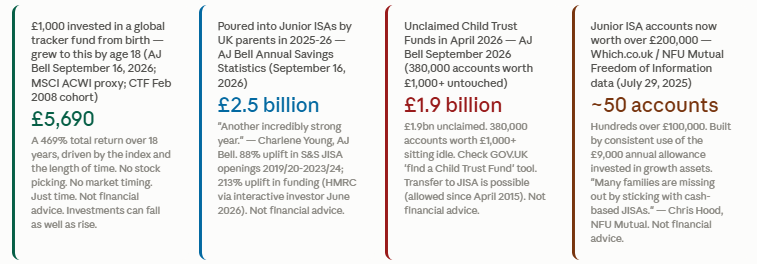
A savings account for a child is a place to put pocket money. A launch fund is a deliberate, long-term investment vehicle designed to give a young person meaningful financial agency at the moment they need it most — at 18, 21, or later. The distinction matters because the account choice, the investment approach, and the regularity of contributions look completely different depending on which you are building. A savings account optimised for access earns the FDIC or FSCS-protected interest rate at its current level. A launch fund invested in a diversified global equity index has historically delivered compound returns that a cash account cannot match over an 18-year horizon. Unbiased.co.uk’s November 2025 guide to saving for children frames the distinction precisely: ‘Whether it’s to help fund the cost of university, raise a deposit on their first home, or even start their own retirement fund, it’s worth taking full advantage of those first 18 years as any savings will benefit from compound interest.’ That time horizon is the launch fund’s most powerful asset. AJ Bell’s analysis found that £1,000 invested in a global tracker fund from birth grew to £5,690 by age 18 — a 469% return over 18 years, driven by nothing except the index return and the length of time. No stock picking. No market timing. Just time. AJ Bell September 2026: £1,000 in a global tracker from birth (CTF, Feb 2008 cohort) = £5,690 by age 18 (MSCI ACWI proxy). £2.5bn poured into Junior ISAs 2025-26. Unbiased.co.uk November 2025: 'Take full advantage of those first 18 years.
£2.5bn poured into JISAs by UK parents in 2025-26 (AJ Bell September 2026). 88% uplift in S&S JISA openings 2019/20-2023/24; 213% uplift in funding (HMRC via interactive investor June 2026). ~50 accounts now over £200,000; hundreds over £100,000 (Which.co.uk / NFU Mutual FOI July 2025).
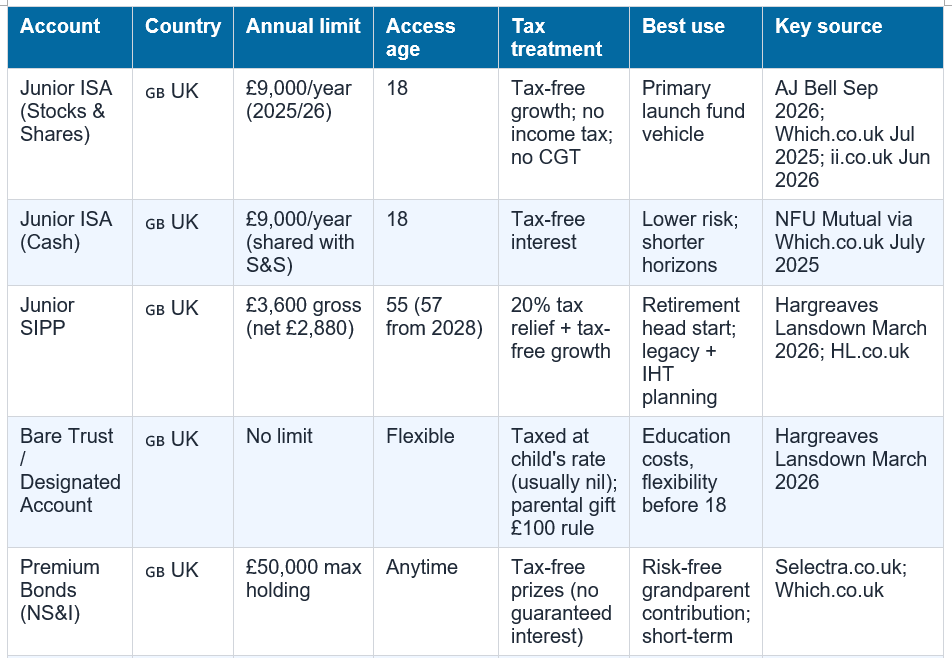
Annual limit: £9,000 per child per tax year (2025/26). Access: Age 18 (child takes control at 16 but cannot withdraw). Tax: Tax-free growth — no income tax on interest; no capital gains tax on growth. Who can open it: Parent or legal guardian; grandparents can contribute once opened. Best for: Most UK families as the primary long-term savings vehicle for a child.
Junior SIPP: £3,600 gross maximum per year (most children); net cost £2,880 after 20% tax relief (Hargreaves Lansdown, HL.co.uk). Accessible from age 55, rising to 57 from 2028. 'Most people don't start their pension until they're working' — Unbiased.co.uk November 2025.
Annual limit: £3,600 gross per year (maximum for children without earnings); net cost £2,880. Access: Age 55 (rising to 57 from 2028). Tax: 20% tax relief on contributions; tax-free growth inside the pension. Who can open it: Must be opened by a parent or legal guardian; grandparents can contribute. Best for: Families thinking decades ahead; grandparents with a long-term legacy goal.
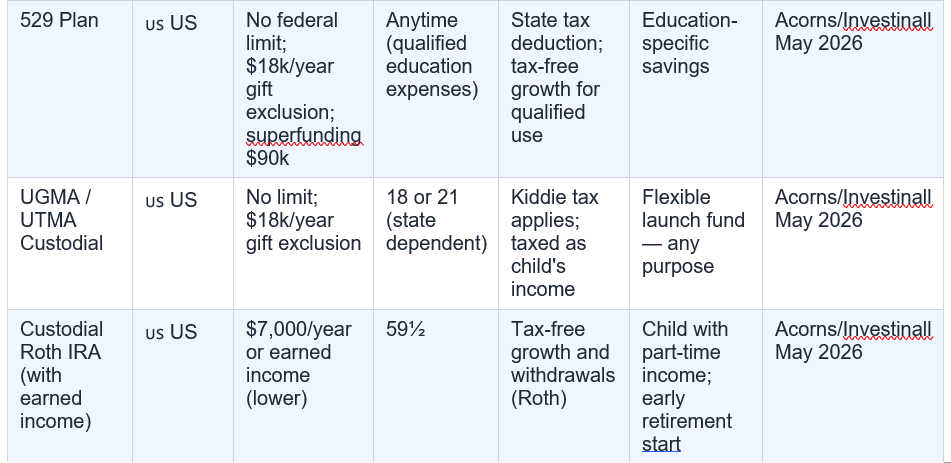
Annual limit: No federal annual contribution limit; gift tax exclusion $18,000/year per person (2026); superfunding up to $90,000 in one go (5-year election). Access: Any time for qualified educational expenses; non-educational withdrawal = income tax + 10% penalty on earnings. Tax: Tax-free growth for qualified education expenses; state tax deduction on contributions in most states. Who can open it: Anyone can open and contribute — parent, grandparent, other family. Best for: US families focused specifically on funding education costs.
UGMA/UTMA: most flexibility of all US children's investment accounts; no restriction on use after age of majority (Acorns/Investinall May 2026). Child gains full control at 18 or 21 depending on state. Kiddie tax rules apply on unearned income. Irrevocable gift — cannot be reclaimed. Annual limit: No contribution limit; gift tax exclusion $18,000/year per person (2026). Access: Child gains full control at age of majority (18 or 21 depending on state). Tax: Investment gains taxed as child's income (kiddie tax rules apply under 19 / under 24 if full-time student). Who can open it: Any adult can open and contribute. Best for: US families wanting flexibility beyond education; non-education launch fund goals.
UK: grandparents can contribute to Junior ISA after parent opens it; £9,000 annual limit 2025/26 (Hargreaves Lansdown). Junior SIPP: up to £2,880 net (£3,600 gross) per year; 20% tax relief on contributions (HL). US: 529 superfunding $90,000 per contributor in one year (5-year gift tax election).
Sources: AJ Bell September 2026; Which.co.uk/NFU Mutual July 2025; Hargreaves Lansdown March 2026; Selectra.co.uk.
There is no minimum that makes the exercise meaningful or worthless. AJ Bell's September 2026 analysis showed that £1,000 invested at birth in a global tracker grew to £5,690 by age 18 — using the MSCI ACWI as a proxy. Most Junior ISA providers (UK) accept monthly contributions from £25/month. US custodial accounts can typically be opened with as little as $1-$100. The Hargreaves Lansdown March 2026 guide specifically notes that 'the discipline of regular saving can build a solid balance.' Which.co.uk's July 2025 analysis of accounts that have grown past £100,000 and £200,000 shows what consistent use of the £9,000 annual allowance can produce. For grandparents with larger sums, the options include the full £9,000 JISA allowance per year or Junior SIPP contributions of up to £2,880 net (£3,600 gross) per year. Not financial advice — the right starting amount depends entirely on individual circumstances.
What is the difference between a cash Junior ISA and a Stocks and Shares Junior ISA?
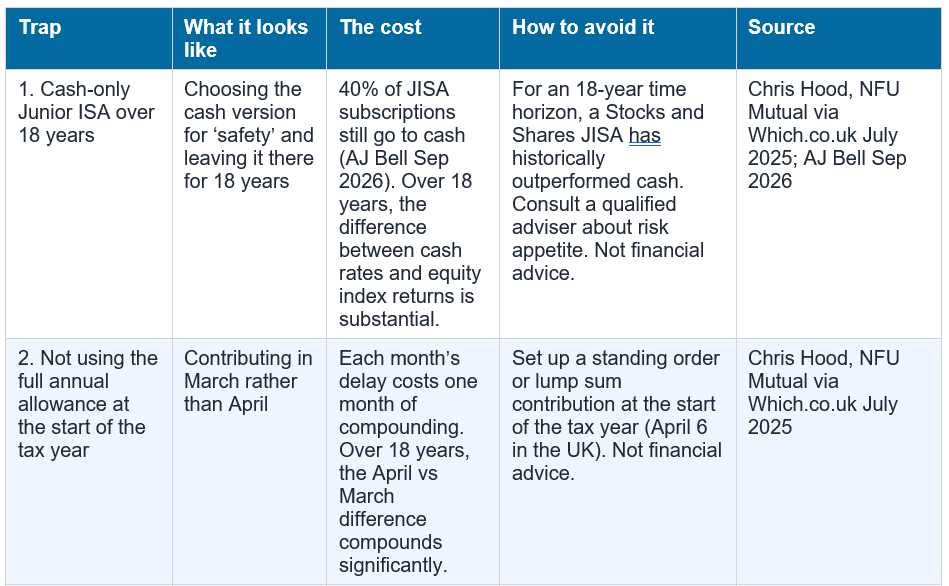
A cash Junior ISA works like a savings account inside a tax-free wrapper — it earns interest at the advertised rate and the balance does not fluctuate. A Stocks and Shares Junior ISA invests in assets like global equity index funds or ETFs, and the value can go up or down. Over the 18-year time horizon of a Junior ISA, the historical evidence is that equity investment has outperformed cash. AJ Bell's September 2026 data found that almost 40% of JISA subscriptions still go to cash versions, and NFU Mutual's Chris Hood identified this as a missed opportunity: 'Many families are missing out on potentially higher long-term returns by sticking with cash-based Junior ISAs.' The choice between cash and S&S is a personal and financial decision — consult a qualified financial adviser.
Can grandparents open a Junior ISA for a grandchild?
In the UK, most Junior ISAs must be opened by a parent or legal guardian. However, once the account is open, grandparents can make contributions within the annual £9,000 limit. Hargreaves Lansdown's investing for grandchildren guide confirms this specifically and notes that grandparents can pay into Junior ISAs 'online, by post or by telephone as a lump sum or via monthly savings.' Hargreaves Lansdown also offers a Junior SIPP that grandparents can manage directly on a child's behalf — one of three accounts their platform specifically caters for grandparent investors. In the US, anyone including grandparents can open and contribute to a UGMA/UTMA custodial account. 529 plans can also be opened directly by grandparents, though the FAFSA treatment of grandparent-owned 529 plans differs from parent-owned ones.
What is a Junior SIPP and is it worth it?
A Junior SIPP is a pension for a child. It benefits from 20% basic rate tax relief on contributions — meaning a £2,880 net contribution from a grandparent or parent generates £3,600 inside the pension. The money cannot be accessed until age 55 (rising to 57 from 2028). Hargreaves Lansdown and Unbiased.co.uk both identify the Junior SIPP's key argument: most people don't start a pension until they're working, and the compounding head start from 18 years of investment before age 18 could be very significant by retirement. Hargreaves Lansdown's HL.co.uk investing for grandchildren guide notes that for grandparents with IHT considerations, Junior SIPP contributions are a way to reduce the estate while starting a pension for a grandchild. Whether a Junior SIPP is appropriate depends on individual circumstances — consult a qualified adviser.
What should I do if I have an old unclaimed Child Trust Fund?
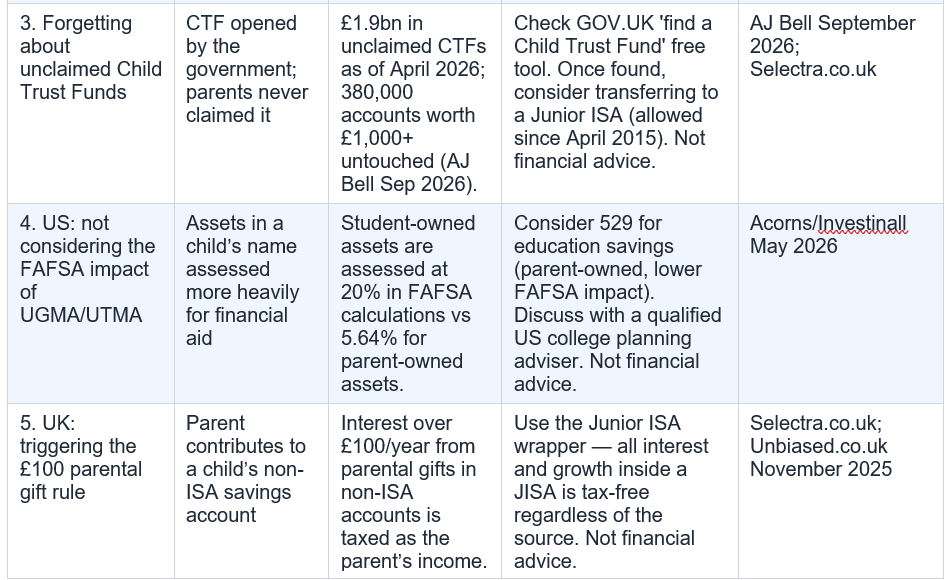
AJ Bell's September 16, 2026 analysis found that unclaimed CTFs had breached £1.9 billion, with 380,000 accounts worth £1,000 or more still untouched. The Selectra.co.uk guide confirms that as of April 2025, around 758,000 matured accounts were unclaimed, worth an average of £2,242 each. If you or a child you know had a CTF, you can find it through the free 'find a Child Trust Fund' tool on GOV.UK, which returns the name of the account provider. Once found, if the child is under 18, it is worth considering a transfer to a Junior ISA (allowed since April 2015), which may offer more investment choice and potentially lower costs. If the child has turned 18, the CTF converts to an adult account and the money is fully accessible.
Table of Contents
- What a Launch Fund Actually Is (and Why It Is Not Just a Savings Account)
- The Power of Early: What the Numbers Actually Show
- Account 1 🇬🇧: Junior ISA — The Tax-Free Foundation for Most UK Families
- Account 2 🇬🇧: Junior SIPP — The Very Long Game
- Account 3 🇺🇸: 529 Plan — The US Education-Focused Account
- Account 4 🇺🇸: UGMA / UTMA — The Flexible US Launch Fund
- The Grandparent's Playbook: How to Contribute Without Overcomplicating It
- The Complete Account Comparison: UK and US Side by Side
- The Traps: Five Mistakes That Reduce the Fund's Impact
- Conclusion: Start Small, Start Now, Let Time Do the Work
- Frequently Asked Questions
What a Launch Fund Actually Is (and Why It Is Not Just a Savings Account)
A savings account for a child is a place to put pocket money. A launch fund is a deliberate, long-term investment vehicle designed to give a young person meaningful financial agency at the moment they need it most — at 18, 21, or later. The distinction matters because the account choice, the investment approach, and the regularity of contributions look completely different depending on which you are building. A savings account optimised for access earns the FDIC or FSCS-protected interest rate at its current level. A launch fund invested in a diversified global equity index has historically delivered compound returns that a cash account cannot match over an 18-year horizon. Unbiased.co.uk’s November 2025 guide to saving for children frames the distinction precisely: ‘Whether it’s to help fund the cost of university, raise a deposit on their first home, or even start their own retirement fund, it’s worth taking full advantage of those first 18 years as any savings will benefit from compound interest.’ That time horizon is the launch fund’s most powerful asset. AJ Bell’s analysis found that £1,000 invested in a global tracker fund from birth grew to £5,690 by age 18 — a 469% return over 18 years, driven by nothing except the index return and the length of time. No stock picking. No market timing. Just time. AJ Bell September 2026: £1,000 in a global tracker from birth (CTF, Feb 2008 cohort) = £5,690 by age 18 (MSCI ACWI proxy). £2.5bn poured into Junior ISAs 2025-26. Unbiased.co.uk November 2025: 'Take full advantage of those first 18 years.
The Power of Early: What the Numbers Actually Show
The AJ Bell September 2026 data provides the cleanest illustration of what early investing does: £1,000 at birth, a global tracker fund, no additional contributions, grows to £5,690 by age 18. That is a 469% total return over 18 years using the MSCI ACWI as a proxy. But the more relevant calculation for most families is not the lump sum at birth — it is the regular contribution over time. NFU Mutual’s Chris Hood, quoted in Which.co.uk’s July 2025 analysis, identified the optimal behaviour for those using the full £9,000 Junior ISA allowance: ‘If you can, use as much of the £9,000 annual allowance as possible — and do it at the start of the tax year so the money benefits from a full year of growth.’ Interactive investor’s June 2026 analysis noted that between 2019/20 and 2023/24, the amount funded into Stocks and Shares Junior ISAs grew by 213% — showing that families are not just opening more accounts but putting significantly more into them. The Hargreaves Lansdown March 2026 guide makes the behavioural point: ‘Money in a Junior ISA is normally locked away until the child reaches 18, so there’s plenty of time to ride the ups and downs of the stock market.’ The 18-year lock is not a restriction. It is an asset. It prevents the emotional selling during market downturns that erodes returns in adult portfolios. £1,000 global tracker from birth = £5,690 at age 18 (AJ Bell September 2026; MSCI ACWI proxy; CTF Feb 2008 cohort). 213% uplift in S&S JISA funding 2019/20-2023/24; 88% uplift in account openings (HMRC via interactive investor June 2026). NFU Mutual: use £9,000 at start of tax year. HL: 18-year lock prevents emotional selling.Account 🇬🇧: Junior ISA (JISA)
The tax-free foundation for most UK families
For most UK families, the Junior ISA is where the launch fund lives. Every penny of interest or investment growth inside it is free from income tax and capital gains tax, for good. The annual allowance is £9,000 per child for the 2025/26 tax year. It cannot be touched until the child turns 18 — which AJ Bell’s Charlene Young describes as one of its key strengths: ‘A Junior ISA opened soon after birth would run for nearly 18 years before being converted into an adult version, which means parents can make the most of that time horizon.’ The interactive investor data published June 25, 2026 shows that the awareness shift toward Stocks and Shares Junior ISAs is significant: between 2019/20 and 2023/24, account openings for S&S JISAs rose 88% and the amount funded into them rose 213%. Yet as of AJ Bell’s September 2026 analysis, almost 40% of JISA subscriptions still go into cash versions. Chris Hood at NFU Mutual was direct: ‘Many families are missing out on potentially higher long-term returns by sticking with cash-based Junior ISAs rather than investing in a stocks and shares ISA.’ For a fund that will not be accessed for 18 years, the case for long-term equity investing over cash is compelling — though the choice of how to invest within the JISA is a decision for a qualified adviser. The Which.co.uk/NFU Mutual Freedom of Information data from July 2025 showed just how large some JISAs have grown: hundreds of accounts have passed £100,000 and around 50 have passed £200,000.£2.5bn poured into JISAs by UK parents in 2025-26 (AJ Bell September 2026). 88% uplift in S&S JISA openings 2019/20-2023/24; 213% uplift in funding (HMRC via interactive investor June 2026). ~50 accounts now over £200,000; hundreds over £100,000 (Which.co.uk / NFU Mutual FOI July 2025).
Annual limit: £9,000 per child per tax year (2025/26). Access: Age 18 (child takes control at 16 but cannot withdraw). Tax: Tax-free growth — no income tax on interest; no capital gains tax on growth. Who can open it: Parent or legal guardian; grandparents can contribute once opened. Best for: Most UK families as the primary long-term savings vehicle for a child.
Account 🇬🇧: Junior SIPP
The very long game — starting a pension before they start school
The Junior SIPP is the most counterintuitive entry on this list, and possibly the most powerful for the right family. You are starting a retirement fund for someone who has not started school yet. The money cannot be accessed until age 55, rising to 57 from 2028. That is not a launch fund for a first flat. It is a launch fund for the retirement of a person who is currently learning to read. The power is in the compounding. Hargreaves Lansdown’s March 2026 guide confirms the mechanism: the maximum gross contribution for a child without earnings is £3,600 per year, but thanks to 20% basic rate tax relief, the net cost to the contributor is only £2,880. The government adds back £720. Unbiased.co.uk’s November 2025 guide to saving for children makes the generational case: ‘Most people don’t start their pension until they’re working. This financial head start could have far-reaching consequences for a young person, including being able to retire with a sizeable pension pot.’ Hargreaves Lansdown offers Junior SIPPs for grandchildren to contribute to alongside a Junior ISA, specifically noting that grandparents are often motivated by both legacy and tax-efficiency goals. Not financial advice. The pension access age is subject to legislative change.Junior SIPP: £3,600 gross maximum per year (most children); net cost £2,880 after 20% tax relief (Hargreaves Lansdown, HL.co.uk). Accessible from age 55, rising to 57 from 2028. 'Most people don't start their pension until they're working' — Unbiased.co.uk November 2025.
Annual limit: £3,600 gross per year (maximum for children without earnings); net cost £2,880. Access: Age 55 (rising to 57 from 2028). Tax: 20% tax relief on contributions; tax-free growth inside the pension. Who can open it: Must be opened by a parent or legal guardian; grandparents can contribute. Best for: Families thinking decades ahead; grandparents with a long-term legacy goal.
Account 🇺🇸: 529 Education Savings Plan
The US tax-advantaged account built specifically for education costs
The 529 plan is the US equivalent of a dedicated education launch fund. It is state-sponsored, tax-advantaged, and specifically designed to cover qualified educational expenses: tuition, room and board, books, fees, and (since 2019) apprenticeship programmes and student loan repayments up to certain limits. The Acorns/Investinall guide published May 26, 2026 identifies 529 plans as offering ‘tax-free growth potential’ for educational use. The practical strategy many US financial planning guides recommend is the dual-track approach: fund a 529 for education AND a UGMA/UTMA custodial account for everything else. That way the educational costs are handled through the tax-advantaged wrapper and the non-educational launch fund — the first car, the first flat deposit, the startup capital, the emergency fund — lives in the more flexible custodial account. Grandparents specifically benefit from a 529 superfunding option: contributing up to five years’ worth of the annual gift tax exclusion in a single year ($90,000 in 2026 for a single person, $180,000 for a couple) without triggering gift tax, removing a significant sum from their estate in one transaction. Not financial advice. US tax rules are complex and vary by state. 529 plans: tax-free growth for qualified education expenses; state tax deduction in most states (Acorns May 2026). Superfunding: up to $90,000 in one year per contributor (5-year gift tax election). Strategy: fund 529 for education + UGMA/UTMA for everything else (Acorns May 2026).Annual limit: No federal annual contribution limit; gift tax exclusion $18,000/year per person (2026); superfunding up to $90,000 in one go (5-year election). Access: Any time for qualified educational expenses; non-educational withdrawal = income tax + 10% penalty on earnings. Tax: Tax-free growth for qualified education expenses; state tax deduction on contributions in most states. Who can open it: Anyone can open and contribute — parent, grandparent, other family. Best for: US families focused specifically on funding education costs.
Account US: UGMA / UTMA Custodial Account
The flexible US launch fund — any purpose, any time after majority
UGMA (Uniform Gifts to Minors Act) and UTMA (Uniform Transfers to Minors Act) custodial accounts are what the Acorns/Investinall guide calls ‘the most common ways to invest for your kids’ and ‘the most flexible.’ Unlike a 529, which penalises non-educational withdrawals, a UGMA/UTMA account places no restrictions on what the money is used for once the child reaches the age of majority. It can fund university or trade school. It can fund a gap year. It can fund a first car, a first business, a first home deposit. Or it can simply sit invested for longer. The trade-off for that flexibility is tax treatment: investment gains inside a UGMA/UTMA are taxed as the child’s income, with the ‘kiddie tax’ rules applying to children under 19 (or under 24 if a full-time student), meaning unearned income above a threshold is taxed at the parent’s marginal rate. The other significant consideration: once assets are placed in a UGMA/UTMA, they are irrevocably the child’s property. The parent manages them as custodian but cannot take them back. At the age of majority, the child gains full, unrestricted control. This irrevocability is not a problem for a well-considered launch fund. It is something to understand before funding the account.UGMA/UTMA: most flexibility of all US children's investment accounts; no restriction on use after age of majority (Acorns/Investinall May 2026). Child gains full control at 18 or 21 depending on state. Kiddie tax rules apply on unearned income. Irrevocable gift — cannot be reclaimed. Annual limit: No contribution limit; gift tax exclusion $18,000/year per person (2026). Access: Child gains full control at age of majority (18 or 21 depending on state). Tax: Investment gains taxed as child's income (kiddie tax rules apply under 19 / under 24 if full-time student). Who can open it: Any adult can open and contribute. Best for: US families wanting flexibility beyond education; non-education launch fund goals.
The Grandparent’s Playbook: How to Contribute Without Overcomplicating It
Grandparents are often the overlooked driver of launch fund growth. Hargreaves Lansdown’s guide to investing for grandchildren notes directly: ‘Grandparents are often keen to contribute to grandchildren’s savings as a way of rolling wealth down the generations and saving tax.’ There are several clear routes. For UK grandparents: once a parent or legal guardian has opened a Junior ISA, grandparents can contribute to it up to the £9,000 annual limit. They cannot open a JISA themselves, but they can fund one. Contributions count toward the child’s £9,000 annual allowance, not the grandparent’s ISA allowance. For grandparents who want more direct involvement, Hargreaves Lansdown specifically notes that their platform offers three junior accounts that ‘grandparents can pay into, one of which they can also manage on a child’s behalf’ — a Junior SIPP. The Junior SIPP option for grandparents is particularly powerful for those with IHT considerations: contributions of up to £2,880 net (£3,600 gross including 20% tax relief) per year reduce the grandparent’s estate and simultaneously start a pension for a child. For US grandparents: 529 superfunding allows up to $90,000 in a single year per contributor ($180,000 per couple) using the five-year gift tax election — removing a significant sum from the estate in one transaction. A UGMA/UTMA custodial account allows contributions without restriction on use. In the UK, premium bonds offer a no-risk, government-backed option (National Savings & Investments) where the ‘interest’ comes as tax-free prizes.UK: grandparents can contribute to Junior ISA after parent opens it; £9,000 annual limit 2025/26 (Hargreaves Lansdown). Junior SIPP: up to £2,880 net (£3,600 gross) per year; 20% tax relief on contributions (HL). US: 529 superfunding $90,000 per contributor in one year (5-year gift tax election).
The Complete Account Comparison: UK and US Side by Side
Sources: AJ Bell September 2026; Hargreaves Lansdown March 2026; Selectra.co.uk; Unbiased.co.uk November 2025; Acorns/Investinall May 2026; HL.co.uk. Always consult a qualified adviser for your specific circumstances.
The Traps: Five Mistakes That Reduce the Fund’s Impact
Sources: AJ Bell September 2026; Which.co.uk/NFU Mutual July 2025; Hargreaves Lansdown March 2026; Selectra.co.uk.
Conclusion
The most important insight from the AJ Bell September 2026 data is deceptively simple. £1,000 invested in a global tracker fund at birth grew to £5,690 by age 18. Not £1,000 invested perfectly at the market bottom. Not £1,000 in the best-performing individual stock. £1,000 in a global tracker. Over 18 years. Nothing else. The Which.co.uk/NFU Mutual Freedom of Information data from July 2025 showed the upper end of what consistent long-term investing can produce: around 50 Junior ISA accounts in the UK now hold more than £200,000. Those accounts were not funded by extraordinary wealth. They were funded by the annual £9,000 Junior ISA allowance, consistently used, invested in growth assets rather than cash, over the years since 2011. The parents and grandparents who built those accounts were not financial experts. They were people who started early and did not stop. The interactive investor June 2026 analysis confirmed that Hargreaves Lansdown’s behavioural insight is right: the launch fund’s 18-year lock is a feature, not a limitation. It prevents the panic selling that reduces returns in adult portfolios. It forces the long view. And the long view, in this context, is the whole strategy. Start small, start now, and let time do the work that no investment skill can replicate. This is not financial, tax, or investment advice. Always consult a qualified, regulated financial adviser.Frequently Asked Questions
How much do I need to start a launch fund for a child or grandchild?There is no minimum that makes the exercise meaningful or worthless. AJ Bell's September 2026 analysis showed that £1,000 invested at birth in a global tracker grew to £5,690 by age 18 — using the MSCI ACWI as a proxy. Most Junior ISA providers (UK) accept monthly contributions from £25/month. US custodial accounts can typically be opened with as little as $1-$100. The Hargreaves Lansdown March 2026 guide specifically notes that 'the discipline of regular saving can build a solid balance.' Which.co.uk's July 2025 analysis of accounts that have grown past £100,000 and £200,000 shows what consistent use of the £9,000 annual allowance can produce. For grandparents with larger sums, the options include the full £9,000 JISA allowance per year or Junior SIPP contributions of up to £2,880 net (£3,600 gross) per year. Not financial advice — the right starting amount depends entirely on individual circumstances.
What is the difference between a cash Junior ISA and a Stocks and Shares Junior ISA?
A cash Junior ISA works like a savings account inside a tax-free wrapper — it earns interest at the advertised rate and the balance does not fluctuate. A Stocks and Shares Junior ISA invests in assets like global equity index funds or ETFs, and the value can go up or down. Over the 18-year time horizon of a Junior ISA, the historical evidence is that equity investment has outperformed cash. AJ Bell's September 2026 data found that almost 40% of JISA subscriptions still go to cash versions, and NFU Mutual's Chris Hood identified this as a missed opportunity: 'Many families are missing out on potentially higher long-term returns by sticking with cash-based Junior ISAs.' The choice between cash and S&S is a personal and financial decision — consult a qualified financial adviser.
Can grandparents open a Junior ISA for a grandchild?
In the UK, most Junior ISAs must be opened by a parent or legal guardian. However, once the account is open, grandparents can make contributions within the annual £9,000 limit. Hargreaves Lansdown's investing for grandchildren guide confirms this specifically and notes that grandparents can pay into Junior ISAs 'online, by post or by telephone as a lump sum or via monthly savings.' Hargreaves Lansdown also offers a Junior SIPP that grandparents can manage directly on a child's behalf — one of three accounts their platform specifically caters for grandparent investors. In the US, anyone including grandparents can open and contribute to a UGMA/UTMA custodial account. 529 plans can also be opened directly by grandparents, though the FAFSA treatment of grandparent-owned 529 plans differs from parent-owned ones.
What is a Junior SIPP and is it worth it?
A Junior SIPP is a pension for a child. It benefits from 20% basic rate tax relief on contributions — meaning a £2,880 net contribution from a grandparent or parent generates £3,600 inside the pension. The money cannot be accessed until age 55 (rising to 57 from 2028). Hargreaves Lansdown and Unbiased.co.uk both identify the Junior SIPP's key argument: most people don't start a pension until they're working, and the compounding head start from 18 years of investment before age 18 could be very significant by retirement. Hargreaves Lansdown's HL.co.uk investing for grandchildren guide notes that for grandparents with IHT considerations, Junior SIPP contributions are a way to reduce the estate while starting a pension for a grandchild. Whether a Junior SIPP is appropriate depends on individual circumstances — consult a qualified adviser.
What should I do if I have an old unclaimed Child Trust Fund?
AJ Bell's September 16, 2026 analysis found that unclaimed CTFs had breached £1.9 billion, with 380,000 accounts worth £1,000 or more still untouched. The Selectra.co.uk guide confirms that as of April 2025, around 758,000 matured accounts were unclaimed, worth an average of £2,242 each. If you or a child you know had a CTF, you can find it through the free 'find a Child Trust Fund' tool on GOV.UK, which returns the name of the account provider. Once found, if the child is under 18, it is worth considering a transfer to a Junior ISA (allowed since April 2015), which may offer more investment choice and potentially lower costs. If the child has turned 18, the CTF converts to an adult account and the money is fully accessible.
0 Comments
Be the first to share your thoughts on this article.