

Financial Literacy
Money Worries Kept Me Awake: How I Became Financially Free

85% of Americans are worried about money. Americans spend 96 days a year consumed by financial anxiety. Nearly half lose sleep. This is the story of what the 3am money spiral really is, why it keeps going, and what finally makes it stop.
If you have ever lain awake at three in the morning running a mental inventory of everything you owe, everything that could go wrong, and every financial decision you now wish you had made differently — this article is for you. Not for you in a vague, everyone-is-included way. Specifically for you. Because the data says you are not an outlier. You are a majority. The Penny Hoarder’s 2026 Financial Anxiety Barometer found that Americans spend the equivalent of 96 days a year worried about money and lose an average of three nights of sleep per month to financial stress. YNAB’s 2026 Money Mood Report, conducted through the Harris Poll, found that 85% of Americans are worried about money — as many as worry about their health. Achieve.com’s May 2026 research called what is happening ‘a public health crisis.’ This article is a personal story, not a prescription. It is about what the 3am money spiral actually is, why shame makes it worse, what clarity does that willpower alone cannot, and what financial freedom actually feels like from the inside — not as an abstract destination but as a specific, liveable change in daily experience. It references the research not to prove a point but to make one thing clear before you read further: whatever you are carrying, you are carrying it in company.
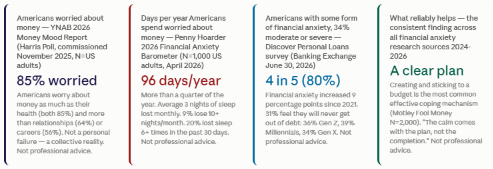
The Banking Exchange reported on June 30, 2026 that four in five Americans have financial anxiety, with 34% experiencing moderate or severe anxiety. Financial anxiety has increased by nine percentage points since 2021. The Motley Fool Money survey of 2,000 Americans found that only 40% are comfortable discussing their financial stress with family or friends. Sixty percent of people carrying this anxiety are carrying it alone. This article is for them.
85% of Americans worried about money — same as health worry (YNAB 2026 Money Mood Report, Harris Poll). 96 days/year spent worrying about money (Penny Hoarder April 2026, N=1,000). 80% have financial anxiety; 34% moderate/severe (Discover/Banking Exchange June 2026). 77% hit a financial setback in 2025 — NEFE's highest reading ever (walnutinvest.com 2026). Only 40% comfortable discussing financial stress with family/friends (Motley Fool Money N=2,000).
96 days a year worried about money (Penny Hoarder 2026). 3 nights/month average sleep lost to financial stress (Penny Hoarder April 2026). 85% of Americans worried about money (YNAB 2026 Money Mood Report, Harris Poll). 46% say money worries disturb sleep (YNAB 2026). 50% with debt feel anxious or on edge (Achieve.com May 2026).
The 3am spiral is not a sign that you are bad with money. It is a sign that you have unresolved financial uncertainty and no clear plan. Uncertainty breeds anxiety. Clarity — even about bad news — is less anxiety-producing than not knowing. The path out starts with looking at the actual numbers, however uncomfortable that first look is.
Write down the number. The real one. Total debt. Monthly outgoings. Income. The gap or the surplus. Not to fix it tonight — just to make it concrete. Anxiety thrives in the abstract. A specific number can be worked with. An unnamed dread cannot.
19% avoid social interactions due to financial stress (Penny Hoarder April 2026). 10% have hidden debt from a partner (Penny Hoarder April 2026). Only 40% comfortable discussing financial anxiety with family/friends (Motley Fool Money 2024 survey N=2,000). 31% feel they will never get out of debt (Discover/Banking Exchange June 2026): 36% Gen Z; 39% Millennials; 34% Gen X.
Shame about money is almost universal — only 40% are comfortable talking about financial stress even with family. That silence means most people are carrying this alone, assuming everyone else is fine. They are not. The public health framing from Achieve.com is deliberate: debt stress is a collective problem with systemic roots, not an individual moral failing.
Tell one person the real number. Not to be fixed — just to be witnessed. The act of speaking a financial worry aloud to a trusted person is one of the most reliably anxiety-reducing things available. Isolation amplifies financial shame. Witnessed, it begins to lose its power.
Building a budget is the most common financial anxiety coping strategy (Motley Fool Money 2024 survey N=2,000). 55% of those with debt say their main priority is paying it off quickly (Discover/Banking Exchange June 2026). 88% of survey respondents had been in debt at some point (Discover/Banking Exchange 2026). High debt linked to anxiety, depression, anger, hopelessness (TIAA survey via Motley Fool).
The anxiety is rarely about the number itself. It is about not knowing the number. Most people who have done a serious financial inventory report feeling more in control — not more distressed — after seeing the full picture. Clarity is not comfortable, but it is workable. Uncertainty is neither.
Do a 30-minute financial inventory this weekend. Total all balances. List all monthly outgoings and income. Calculate the gap or surplus. Then calculate the minimum to be solvent, the minimum to make progress, and what progress looks like at a specific monthly payment. Not a full plan — just the information that makes a plan possible.
77% of adults lose sleep over money worries at least some of the time; 41% lose sleep all or nearly all the time (National Sleep Foundation via walnutinvest.com 2026). Top bedtime financial worries: household bills 43%, inflation 32%, credit card debt 29%, job loss 29% (Northwestern Mutual via walnutinvest.com 2026). 15% say financial stress hurts workplace productivity (Penny Hoarder April 2026).
The goal is not zero debt overnight. It is direction of travel. A balance going down by $50 every month is psychologically transformative relative to a balance that stays the same. The avalanche and snowball methods both work. The one you stick with is the one that fits your psychology, not the one that looks best on a spreadsheet.
Pick one debt to focus on this month — either the highest rate (avalanche) or the smallest balance (snowball). Put every extra pound or dollar toward it above the minimums on everything else. Track it weekly. The number going down is the evidence that produces the calm.
Financial anxiety increased 9 percentage points since 2021 (Discover/Banking Exchange June 2026). 77% hit a financial setback in 2025 — among NEFE's highest readings ever (NEFE via walnutinvest.com 2026). 85% worried about money, matching health worry (YNAB 2026 Money Mood Report). Parents of kids under 18: 60% say money worries disturb sleep vs 38% without young children (YNAB 2026).
The calm that comes from a financial plan does not wait for the debt to be gone. It arrives when the uncertainty is replaced by a clear direction of travel — even if that direction is slow. The 3am brain responds to evidence of progress, not completion.
Write the version of financial freedom that is specific to you — not 'no debt' as an abstract concept but the specific feeling: sleeping through the night without an inventory, getting to the end of the month without dread, having the car repair conversation without panic. That specific image is a more powerful motivator than any number on a spreadsheet.
Yes — overwhelmingly so. YNAB's 2026 Money Mood Report (Harris Poll) found that 85% of Americans are worried about money, and 46% say those worries disturb their sleep. The Penny Hoarder's April 2026 survey found Americans lose an average of three nights of sleep per month to financial stress. The Banking Exchange reported in June 2026 that four in five Americans have some form of financial anxiety, with 34% experiencing moderate or severe levels. Financial anxiety has increased by nine percentage points since 2021. If you are experiencing financial anxiety, you are experiencing something that affects the clear majority of the adult population.
Why does money anxiety get so much worse at night?
The 3am money spiral is a well-documented psychological pattern. During the day, there are distractions, tasks, and social interactions that occupy the parts of the brain that would otherwise run the financial inventory. At night, those distractions are gone and the brain defaults to unresolved threats. Money worries represent exactly the kind of unresolved, uncertain threat that the brain processes during the low-distraction, high-rumination state of insomnia. The National Sleep Foundation (cited walnutinvest.com 2026) found that 77% of adults lose sleep over money at least some of the time. The top nighttime financial worries per Northwestern Mutual are: household bills (43%), interest rates and inflation (32%), credit card debt (29%), and job loss (29%). The practical response is not to think harder about the problem at night but to resolve the uncertainty during the day through planning, which removes the unresolved threat the brain keeps processing after midnight.
What is the first step when financial anxiety feels overwhelming?
The research consensus and the lived experience in this article converge on the same first step: replace the abstract with the specific. Write down the actual numbers — every debt, every monthly outgoing, actual income, the real gap or surplus. This is not about solving the problem in one sitting. It is about replacing the unresolved uncertainty (which the brain processes as a chronic threat) with concrete information (which the brain can actually work with). Achieve.com's May 2026 research describes the mechanism: 'Breaking this cycle requires moving past the shame of debt and into a clear, actionable plan.' Dan Nickele of Discover Personal Loans states: 'Creating and sticking with a plan for paying off debt may give consumers peace of mind.' The clarity often produces relief before a single payment is made. Not financial advice — for significant debt, consider contacting a nonprofit credit counselling service such as the NFCC (nfcc.org).
Does having a budget actually reduce financial anxiety?
Yes, consistently. The Motley Fool Money 2024 survey of 2,000 Americans found that creating and sticking to a budget is the most common effective coping mechanism for financial anxiety. The YNAB 2026 Money Mood Report (the company that makes budget software, acknowledged bias caveat) found that money worry is a year-round pattern that responds to active engagement with finances rather than avoidance. A budget does not need to be complex. The function it serves is replacing uncertainty with information and giving every pound or dollar a destination, which reduces the background anxiety of not knowing whether you are overspending. Budgeting apps, spreadsheets, or the envelope method all produce this effect when used consistently.
When should I seek professional help for financial stress?
Two distinct types of professional help may be relevant. For the financial dimension: nonprofit credit counselling through organisations like the NFCC (nfcc.org in the US) or StepChange (stepchange.org in the UK) provides free, regulated advice on debt management plans, budget review, and negotiation with creditors. For the mental health dimension: if financial anxiety is producing clinical symptoms — severe sleep disruption, depression, inability to function normally, panic attacks, relationship breakdown — these warrant support from a qualified mental health professional, not just a financial plan. Achieve.com's May 2026 research specifically frames debt stress as a public health issue with mental and physical health consequences: 'Financial strain is fueling fatigue, anxiety and difficulty concentrating for many households.' The Motley Fool Money 2024 survey found that high debt is strongly linked to symptoms of anxiety, depression, anger, and hopelessness. If you are experiencing these symptoms, please seek professional support.
If you have ever lain awake at three in the morning running a mental inventory of everything you owe, everything that could go wrong, and every financial decision you now wish you had made differently — this article is for you. Not for you in a vague, everyone-is-included way. Specifically for you. Because the data says you are not an outlier. You are a majority. The Penny Hoarder’s 2026 Financial Anxiety Barometer found that Americans spend the equivalent of 96 days a year worried about money and lose an average of three nights of sleep per month to financial stress. YNAB’s 2026 Money Mood Report, conducted through the Harris Poll, found that 85% of Americans are worried about money — as many as worry about their health. Achieve.com’s May 2026 research called what is happening ‘a public health crisis.’ This article is a personal story, not a prescription. It is about what the 3am money spiral actually is, why shame makes it worse, what clarity does that willpower alone cannot, and what financial freedom actually feels like from the inside — not as an abstract destination but as a specific, liveable change in daily experience. It references the research not to prove a point but to make one thing clear before you read further: whatever you are carrying, you are carrying it in company.
Table of Contents
- You Are Not Alone in This: The Scale of Financial Anxiety in 2026
- Stage 1: The 3am Inventory
- Stage 2: The Shame Trap That Keeps You Stuck
- Stage 3: The Clarity That Changed Everything
- Stage 4: The Avalanche Versus the Avalanche in My Head
- Stage 5: What Financial Freedom Actually Feels Like
- The Numbers That Prove Progress Is Possible
- Conclusion: The Calm Comes Before the Finish Line
- Frequently Asked Questions
You Are Not Alone in This: The Scale of Financial Anxiety in 2026
Before anything else, the number. Because the most pernicious quality of financial anxiety is the way it isolates the person inside it. The shame of money worry is partly manufactured by the belief that everyone else is managing fine. They are not. YNAB’s 2026 Money Mood Report, commissioned through the Harris Poll, found that 85% of Americans are worried about money — the same proportion that worry about their health. More than worry about their relationships (64%) or their careers (56%). The Penny Hoarder’s April 2026 Financial Anxiety Barometer, a survey of 1,000 US adults, found that Americans spend the equivalent of 96 days a year worried about money. Ninety-six days. More than a quarter of the year. Achieve.com’s May 2026 research called what is happening a public health crisis. The National Endowment for Financial Education found that 77% of adults hit a financial setback in 2025 — among the highest readings they have ever recorded. The person lying awake at 3am running a financial inventory is not exceptional. They are the statistical norm.The Banking Exchange reported on June 30, 2026 that four in five Americans have financial anxiety, with 34% experiencing moderate or severe anxiety. Financial anxiety has increased by nine percentage points since 2021. The Motley Fool Money survey of 2,000 Americans found that only 40% are comfortable discussing their financial stress with family or friends. Sixty percent of people carrying this anxiety are carrying it alone. This article is for them.
85% of Americans worried about money — same as health worry (YNAB 2026 Money Mood Report, Harris Poll). 96 days/year spent worrying about money (Penny Hoarder April 2026, N=1,000). 80% have financial anxiety; 34% moderate/severe (Discover/Banking Exchange June 2026). 77% hit a financial setback in 2025 — NEFE's highest reading ever (walnutinvest.com 2026). Only 40% comfortable discussing financial stress with family/friends (Motley Fool Money N=2,000).
Stage 1: The 3am Inventory
Let me describe a night you might recognise. It is somewhere between two and four in the morning. The room is dark and quiet. Everyone else is asleep. And your mind is running a relentless inventory: the credit card balance you have not looked at this month, the direct debit that might bounce, the car repair you have been putting off, the conversation you keep not having with your partner about how stretched things actually are. You are not doing this on purpose. You are not choosing to lie there and catalogue your financial failures by moonlight. It just starts, and it does not stop until exhaustion wins or the alarm goes off, whichever comes first. The data confirms this is not a personal character flaw. It is one of the most widespread experiences in the developed world. YNAB’s 2026 Money Mood Report, commissioned through the Harris Poll, found that 85% of Americans are worried about money — and 46% of those people say those worries disturb their sleep. The Penny Hoarder’s 2026 Financial Anxiety Barometer, a survey of 1,000 US adults conducted in April 2026, found that Americans spend the equivalent of 96 days a year worried about money and lose an average of three nights of sleep per month to financial stress. Nine percent lose ten or more nights per month. The National Sleep Foundation puts the share of adults losing sleep over money at 77% at least some of the time. These are not anxious outliers. These are the people sitting next to you on the bus. The number that stopped me in my tracks was from Achieve.com’s May 2026 research: 50% of people with debt describe feeling anxious or on edge because of it. Half. Not a small cohort of people who were already prone to anxiety. Half of all people carrying debt are living with a constant undercurrent of dread. Naming it was the first thing. Not the first step — just the first thing. Acknowledging that the 3am inventory was not a personality defect but a rational response to a real and unresolved problem. That was the beginning.96 days a year worried about money (Penny Hoarder 2026). 3 nights/month average sleep lost to financial stress (Penny Hoarder April 2026). 85% of Americans worried about money (YNAB 2026 Money Mood Report, Harris Poll). 46% say money worries disturb sleep (YNAB 2026). 50% with debt feel anxious or on edge (Achieve.com May 2026).
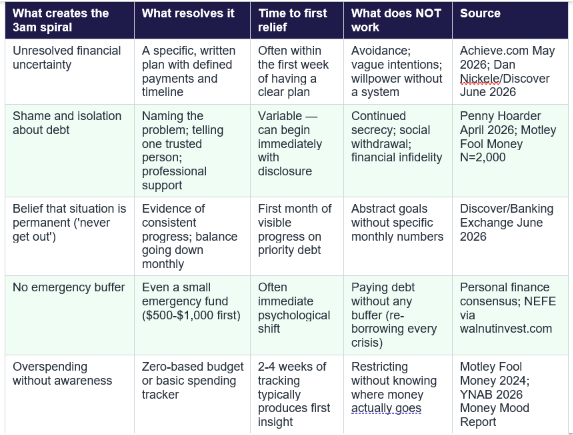
The 3am spiral is not a sign that you are bad with money. It is a sign that you have unresolved financial uncertainty and no clear plan. Uncertainty breeds anxiety. Clarity — even about bad news — is less anxiety-producing than not knowing. The path out starts with looking at the actual numbers, however uncomfortable that first look is.
Write down the number. The real one. Total debt. Monthly outgoings. Income. The gap or the surplus. Not to fix it tonight — just to make it concrete. Anxiety thrives in the abstract. A specific number can be worked with. An unnamed dread cannot.
Stage 2: The Shame Trap That Keeps You Stuck
One of the most insidious dimensions of financial stress is the silence it produces. The Penny Hoarder’s April 2026 survey found that 19% of Americans avoid friends and social interactions because of financial stress — contracting their world to avoid situations that might expose the gap between how they appear and how they actually are. Ten percent have hidden a purchase or debt from a significant other. The Motley Fool Money survey of 2,000 Americans found that only 40% are comfortable talking about their financial stress and anxiety with friends or family. The money shame cycle works like this: financial difficulty creates anxiety, anxiety creates shame, shame creates silence, and silence prevents the conversations, information, and decisions that would actually reduce the financial difficulty. Achieve.com’s May 2026 analysis, published under the title ‘The Cost of Staying Awake: Why Debt Is a Public Health Crisis,’ describes it precisely: ‘Breaking this cycle requires moving past the shame of debt and into a clear, actionable plan.’ I know this cycle from inside. There was a period where I was managing the anxiety through avoidance — not checking the bank account on Fridays, not opening certain emails, not initiating certain conversations. Every act of avoidance provided about four hours of relief and then made the underlying anxiety worse, because now there was the thing itself AND the knowledge that I had not dealt with it. Shame is not a character weakness. It is a predictable psychological response to living in a culture that treats financial difficulty as evidence of moral failure rather than a structural and circumstantial reality. The Banking Exchange’s June 2026 reporting on Discover’s survey found that 31% of Americans feel they will never get out of debt — 36% of Gen Z, 39% of Millennials. The hopelessness is not irrational given the scale of the problem. But it is also not accurate, in most cases. The first step out of the shame trap is the same one that resolves the 3am inventory: replace the abstract dread with specific information.19% avoid social interactions due to financial stress (Penny Hoarder April 2026). 10% have hidden debt from a partner (Penny Hoarder April 2026). Only 40% comfortable discussing financial anxiety with family/friends (Motley Fool Money 2024 survey N=2,000). 31% feel they will never get out of debt (Discover/Banking Exchange June 2026): 36% Gen Z; 39% Millennials; 34% Gen X.
Shame about money is almost universal — only 40% are comfortable talking about financial stress even with family. That silence means most people are carrying this alone, assuming everyone else is fine. They are not. The public health framing from Achieve.com is deliberate: debt stress is a collective problem with systemic roots, not an individual moral failing.
Tell one person the real number. Not to be fixed — just to be witnessed. The act of speaking a financial worry aloud to a trusted person is one of the most reliably anxiety-reducing things available. Isolation amplifies financial shame. Witnessed, it begins to lose its power.
Stage 3: The Clarity That Changed Everything
There is a specific moment in almost every financial recovery story that is less dramatic than you might expect. It is not usually a windfall or a promotion. It is the moment you stop estimating and start knowing. For me, it was a Sunday afternoon with a spreadsheet. Not a sophisticated spreadsheet. A four-column one: what I owed, to whom, at what interest rate, and the minimum payment. I had been living with a vague sense that things were bad. The spreadsheet replaced the vague sense with a specific number. And here is what is counterintuitive: the specific number was less frightening than the vague sense had been. Because a specific number is a problem with a potential solution. A vague sense is a cloud. You cannot work on a cloud. The TIAA survey cited by Motley Fool Money found that high debt levels are strongly linked to symptoms of anxiety, depression, anger, and hopelessness. But the research also shows that the antidote to those symptoms is not the absence of debt — it is the presence of a plan. Dan Nickele, VP of Discover Personal Loans, stated in June 2026: ‘Creating and sticking with a plan for paying off debt may give consumers peace of mind, open up new financial opportunities and could put them on a path toward a more rewarding financial future.’ Creating and sticking to a budget is also the most common coping mechanism identified in financial stress research (Motley Fool Money 2024). Not because budgets are fun. Because they replace uncertainty with information, and information is the only thing that actually reduces the 3am spiral. The clarity phase was not instant. It took about three months of consistently tracking spending before the picture was clear enough to act on. But the sleep improved well before the debt was gone — because the anxiety was never really about the numbers. It was about the not-knowing.Building a budget is the most common financial anxiety coping strategy (Motley Fool Money 2024 survey N=2,000). 55% of those with debt say their main priority is paying it off quickly (Discover/Banking Exchange June 2026). 88% of survey respondents had been in debt at some point (Discover/Banking Exchange 2026). High debt linked to anxiety, depression, anger, hopelessness (TIAA survey via Motley Fool).
The anxiety is rarely about the number itself. It is about not knowing the number. Most people who have done a serious financial inventory report feeling more in control — not more distressed — after seeing the full picture. Clarity is not comfortable, but it is workable. Uncertainty is neither.
Do a 30-minute financial inventory this weekend. Total all balances. List all monthly outgoings and income. Calculate the gap or surplus. Then calculate the minimum to be solvent, the minimum to make progress, and what progress looks like at a specific monthly payment. Not a full plan — just the information that makes a plan possible.
Stage 4: The Avalanche Versus the Avalanche in My Head
Once you have the numbers, the question is what to do with them. I spent a long time doing the financially sub-optimal thing, which is attacking debts at random — whatever felt most urgent that month, whoever sent the most alarming-looking letter. This is exhausting, demoralising, and slower than almost any deliberate strategy. The two strategies that appear most consistently in debt repayment research — the avalanche (highest interest rate first) and the snowball (smallest balance first) — both beat the random approach by years and thousands of dollars. But neither worked for me until I understood something about the psychology of progress. I started with the snowball, because I needed to see a balance go to zero. The mathematical inefficiency was real — I paid slightly more in interest than I would have with the avalanche. But the motivational return on seeing one line item disappear from the list was large enough to keep me going for the next one. By the time I switched to the avalanche for the bigger debts, the habit and confidence were there. The YNAB 2026 Money Mood Report notes that money worry is year-round rather than seasonal — the anxiety does not automatically go away between December and January. It responds to progress. The Achieve.com May 2026 research is specific about what drives the cycle: ‘Financial stress has become a constant background noise for many households.’ The only thing that reliably turns down the background noise is the evidence of consistent progress — not the elimination of debt, but the direction of travel. Watching a balance fall every month, even slowly, produces a qualitatively different mental state than watching it stay the same or rise. That direction-of-travel shift was the first time I slept through a full night without a 3am inventory. Not when the debt was gone. When the trajectory changed.77% of adults lose sleep over money worries at least some of the time; 41% lose sleep all or nearly all the time (National Sleep Foundation via walnutinvest.com 2026). Top bedtime financial worries: household bills 43%, inflation 32%, credit card debt 29%, job loss 29% (Northwestern Mutual via walnutinvest.com 2026). 15% say financial stress hurts workplace productivity (Penny Hoarder April 2026).
The goal is not zero debt overnight. It is direction of travel. A balance going down by $50 every month is psychologically transformative relative to a balance that stays the same. The avalanche and snowball methods both work. The one you stick with is the one that fits your psychology, not the one that looks best on a spreadsheet.
Pick one debt to focus on this month — either the highest rate (avalanche) or the smallest balance (snowball). Put every extra pound or dollar toward it above the minimums on everything else. Track it weekly. The number going down is the evidence that produces the calm.
Stage 5: What Financial Freedom Actually Feels Like
I want to be careful not to turn this into a triumph narrative, because that is not the full picture and it is not helpful to people who are in the middle of it. Financial freedom, in my experience, is not a destination that arrives all at once. It is a gradual accumulation of nights without the 3am inventory. It is the first month you do not dread the bank statement. It is the first time a car repair happens and you pay for it without restructuring your life. It is the experience of a setback that used to be catastrophic becoming merely annoying. The Banking Exchange’s June 2026 report on the Discover survey captures what drives the hopelessness that keeps people stuck: 31% believe they will never be free of debt. That belief is not a fact. It is the natural cognitive output of being inside a problem for long enough that the problem feels like the permanent state. For most people, with a clear plan and consistent execution, debt freedom is a matter of years rather than decades. The NEFE data cited by walnutinvest.com found that 77% of adults experienced a financial setback in 2025 — one of the highest readings ever recorded. These are not people who failed. These are people living in an expensive, volatile economy. The path out is not about moral redemption or financial genius. It is about replacing avoidance with information, replacing shame with a plan, and replacing random effort with consistent direction. The thing I did not expect about financial freedom was that the sleep came back before the debt was gone. The calm arrived with the plan, not the result. Because what the 3am brain needs is not an empty bank balance — it is evidence that the problem is being handled. That evidence does not require completion. It requires consistent progress.Financial anxiety increased 9 percentage points since 2021 (Discover/Banking Exchange June 2026). 77% hit a financial setback in 2025 — among NEFE's highest readings ever (NEFE via walnutinvest.com 2026). 85% worried about money, matching health worry (YNAB 2026 Money Mood Report). Parents of kids under 18: 60% say money worries disturb sleep vs 38% without young children (YNAB 2026).
The calm that comes from a financial plan does not wait for the debt to be gone. It arrives when the uncertainty is replaced by a clear direction of travel — even if that direction is slow. The 3am brain responds to evidence of progress, not completion.
Write the version of financial freedom that is specific to you — not 'no debt' as an abstract concept but the specific feeling: sleeping through the night without an inventory, getting to the end of the month without dread, having the car repair conversation without panic. That specific image is a more powerful motivator than any number on a spreadsheet.
The Numbers That Prove Progress Is Possible
The statistic that most people in financial anxiety need to hear is not about how many people have the problem. It is about how many people get through it. The research consistently shows that the primary driver of hopelessness — the belief held by 31% of Americans that they will never get out of debt — is not correlated with the actual difficulty of their financial situation. It is correlated with how long they have been inside the problem without a plan. The moment a plan exists, the hopelessness typically begins to recede. Dan Nickele of Discover Personal Loans stated in June 2026: ‘Creating and sticking with a plan for paying off debt may give consumers peace of mind.’ Achieve.com’s May 2026 research: ‘Breaking this cycle requires moving past the shame of debt and into a clear, actionable plan.’ The research on financial anxiety and sleep consistently identifies the same pattern: anxiety does not respond to wishful thinking or to willpower deployed without a system. It responds to the evidence of progress. A balance going down. A savings buffer going up. An emergency fund that exists, even a small one.
Conclusion
Here is the thing I most want to leave you with, drawn from both the research and the lived experience of the journey described in this article: the relief does not wait for the debt to be gone. The National Sleep Foundation found that 77% of adults lose sleep over money at least some of the time — but the research on financial recovery consistently shows that the sleep improves when the plan exists, not when the plan is complete. The 3am brain is not distressed by the size of the debt. It is distressed by the absence of a plan for the debt. A specific, written, monthly plan — even a slow one, even an imperfect one — changes the character of the problem from ‘unresolved and threatening’ to ‘in progress and manageable.’ That cognitive shift is not trivial. It is the difference between the spiral and the sleep. The Achieve.com May 2026 analysis ends with this: ‘While credit scores are often used to measure financial health, a more accurate metric may be the ability to sleep through the night.’ I agree with that. Financial freedom, in the fullest sense, is not the moment your debt hits zero. It is the first morning you wake up without having done the inventory in the dark. That morning is reachable. It does not require perfect income or perfect history or a lucky break. It requires a plan that is honest enough to face the numbers and specific enough to work with them.Frequently Asked Questions
Is financial anxiety normal?Yes — overwhelmingly so. YNAB's 2026 Money Mood Report (Harris Poll) found that 85% of Americans are worried about money, and 46% say those worries disturb their sleep. The Penny Hoarder's April 2026 survey found Americans lose an average of three nights of sleep per month to financial stress. The Banking Exchange reported in June 2026 that four in five Americans have some form of financial anxiety, with 34% experiencing moderate or severe levels. Financial anxiety has increased by nine percentage points since 2021. If you are experiencing financial anxiety, you are experiencing something that affects the clear majority of the adult population.
Why does money anxiety get so much worse at night?
The 3am money spiral is a well-documented psychological pattern. During the day, there are distractions, tasks, and social interactions that occupy the parts of the brain that would otherwise run the financial inventory. At night, those distractions are gone and the brain defaults to unresolved threats. Money worries represent exactly the kind of unresolved, uncertain threat that the brain processes during the low-distraction, high-rumination state of insomnia. The National Sleep Foundation (cited walnutinvest.com 2026) found that 77% of adults lose sleep over money at least some of the time. The top nighttime financial worries per Northwestern Mutual are: household bills (43%), interest rates and inflation (32%), credit card debt (29%), and job loss (29%). The practical response is not to think harder about the problem at night but to resolve the uncertainty during the day through planning, which removes the unresolved threat the brain keeps processing after midnight.
What is the first step when financial anxiety feels overwhelming?
The research consensus and the lived experience in this article converge on the same first step: replace the abstract with the specific. Write down the actual numbers — every debt, every monthly outgoing, actual income, the real gap or surplus. This is not about solving the problem in one sitting. It is about replacing the unresolved uncertainty (which the brain processes as a chronic threat) with concrete information (which the brain can actually work with). Achieve.com's May 2026 research describes the mechanism: 'Breaking this cycle requires moving past the shame of debt and into a clear, actionable plan.' Dan Nickele of Discover Personal Loans states: 'Creating and sticking with a plan for paying off debt may give consumers peace of mind.' The clarity often produces relief before a single payment is made. Not financial advice — for significant debt, consider contacting a nonprofit credit counselling service such as the NFCC (nfcc.org).
Does having a budget actually reduce financial anxiety?
Yes, consistently. The Motley Fool Money 2024 survey of 2,000 Americans found that creating and sticking to a budget is the most common effective coping mechanism for financial anxiety. The YNAB 2026 Money Mood Report (the company that makes budget software, acknowledged bias caveat) found that money worry is a year-round pattern that responds to active engagement with finances rather than avoidance. A budget does not need to be complex. The function it serves is replacing uncertainty with information and giving every pound or dollar a destination, which reduces the background anxiety of not knowing whether you are overspending. Budgeting apps, spreadsheets, or the envelope method all produce this effect when used consistently.
When should I seek professional help for financial stress?
Two distinct types of professional help may be relevant. For the financial dimension: nonprofit credit counselling through organisations like the NFCC (nfcc.org in the US) or StepChange (stepchange.org in the UK) provides free, regulated advice on debt management plans, budget review, and negotiation with creditors. For the mental health dimension: if financial anxiety is producing clinical symptoms — severe sleep disruption, depression, inability to function normally, panic attacks, relationship breakdown — these warrant support from a qualified mental health professional, not just a financial plan. Achieve.com's May 2026 research specifically frames debt stress as a public health issue with mental and physical health consequences: 'Financial strain is fueling fatigue, anxiety and difficulty concentrating for many households.' The Motley Fool Money 2024 survey found that high debt is strongly linked to symptoms of anxiety, depression, anger, and hopelessness. If you are experiencing these symptoms, please seek professional support.
0 Comments
Be the first to share your thoughts on this article.