

Financial Literacy
Every Dollar Milestone From $0 to $1 Million: What Changes?

Charlie Munger, the late vice-chairman of Berkshire Hathaway and one of the greatest investors who ever lived, had one piece of advice that cuts through all the noise: ‘The first $100,000 is a b****, but you gotta do it.’ He wasn’t wrong. The journey from $0 to $1 million isn’t a straight line, and it doesn’t feel the same all the way through. Each milestone changes something real — the maths shifts, the psychology shifts, the options available to you shift. Most people think in terms of how far they are from $1 million in dollars. This article reframes that: it’s about what actually changes at each marker on the map, and why the second half of the journey is fundamentally different from the first. Not financial advice.
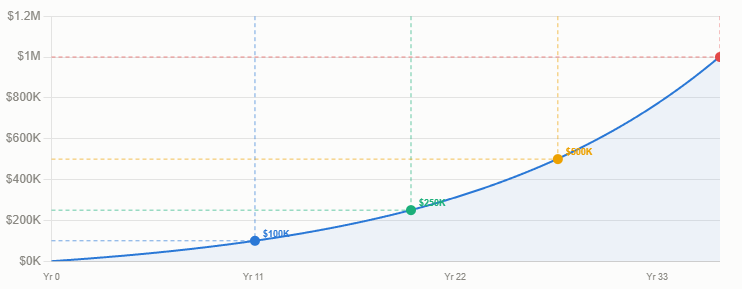
Here is the central insight this article is built around: the milestones on the path from $0 to $1 million are not equally spaced, equally hard, or equally meaningful. The first $100,000 is the hardest. The $250,000 milestone is the compounding halfway point, even though it’s only one-quarter of the dollar amount. The $500,000 milestone is when retirement stops being an abstract future concept and starts being a visible mathematical outcome. And $1 million is simultaneously the most celebrated milestone and the one that carries the most caveats.
What follows is each milestone in order — what changes in the maths, what changes in your mindset, and what moves you to the next level. Not financial advice.
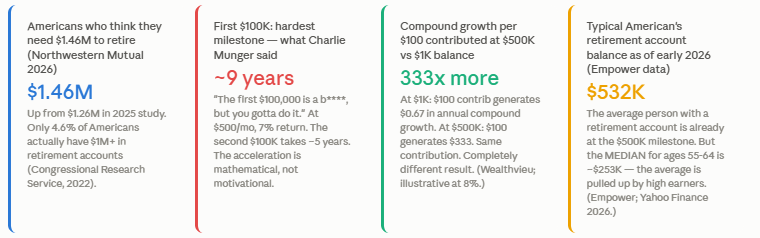
The big picture: Americans now believe they need $1.46 million to retire comfortably (Northwestern Mutual 2026 Planning & Progress Study, cited WebProNews 2026). Only 4.6% of Americans had retirement assets above $1 million (Congressional Research Service, cited Yahoo Finance 2026). The typical American has approximately $532,291 in retirement accounts as of early 2026 (Empower, cited Yahoo Finance 2026). The personal savings rate: just 3.6% as of March 2026 (Federal Reserve, cited Yahoo Finance 2026). 20% of adults over 50 had no retirement savings in 2024 (AARP). Not financial advice.
This is also the stage most psychologically vulnerable to abandonment. The numbers are small enough that they can feel insulting — you contribute $200 a month for a year and you have $2,400 to show for it. Inflation. Market noise. The sense that you’re filling a bucket with a thimble. The Vanguard 2025 financial wellbeing survey found that having at least $2,000 in an emergency fund is associated with a 21% higher level of reported financial wellbeing compared to having no emergency savings. That’s not a retirement figure — it’s the smallest meaningful financial cushion. And it moves the needle on how you feel about money.
The starting line is not about investment returns. It’s about two things: building the habit of saving automatically and eliminating high-interest consumer debt that is running at a rate no investment reliably beats. Until those two conditions are met, the milestones ahead remain unreachable. Not financial advice.
The psychological shift at $1,000 is real and measurable. As the Vanguard data shows, even $2,000 in emergency savings is associated with a 21% improvement in reported financial wellbeing. This is not about returns. It is about anxiety reduction. When you know you have something in the bank, you make better financial decisions in general. You do not raid your retirement account. You do not take payday loans. You do not make panicked choices under pressure.
$1,000 at 7% annual return generates $70 per year — or about $5.83 per month in investment growth. The compound growth at this level is genuinely invisible. This is entirely a habit and stability milestone, not a growth milestone. Every $100 contributed adds $0.67 in annual compound growth. Sources: Wealthvieu compound growth analysis. Not financial advice.
The psychology: $0 → $1K mindset: 'I have nothing saved.' → 'I have a buffer.' The shift is from pure financial anxiety to a small but real cushion. Even $1,000 represents several months of contribution effort for many people, which builds the meta-skill of delayed gratification that every subsequent milestone requires. Not financial advice.
The maths at $10,000 still feel slow. At 7% annual return, your $10,000 generates approximately $700 per year in investment growth — about $58 per month. Your monthly contributions are still doing almost all of the work. If you contribute $300 per month, compound growth adds about $20. But the ratio is beginning to shift, and for the first time you can actually see compound interest showing up on your statement as a distinct line item rather than rounding noise.
$10,000 at 7% = ~$700/year in growth (~$58/month). Every $100 you contribute generates about $6.67 in annual compound growth. Contributions still dominate growth (~80-90% of portfolio growth is from what you put in, not what returns). At this level, investing in tax-advantaged accounts (401(k), IRA, Roth IRA) matters enormously because the tax savings per dollar invested are at their maximum proportional value. Not financial advice.
At $10K: (1) Switch to automatic contributions — remove willpower from the equation. (2) Ensure you are in low-cost index funds (expense ratio under 0.15%). (3) Maximise any employer 401(k) match — this is a 50-100% instant return on your money that no investment can rival. (4) Open a Roth IRA if your income qualifies — tax-free compounding over the next 30-40 years is transformationally valuable from this early stage. Not financial advice.
At $50,000, your portfolio generates approximately $3,500 per year at 7% — roughly $292 per month in returns without any new contributions. If you’re contributing $400 per month, compound growth is now adding the equivalent of about 73% of a monthly contribution on top of your deposits. It still doesn’t dominate, but you can feel the partnership forming.
The $50,000 milestone is also where investment allocation starts to matter in a way it simply didn’t at $10,000. The fee drag from a high-cost 1% annual fee fund now costs you $500 per year. At $10,000 it cost you $100 — irritating but not catastrophic. At $50,000 it starts to represent real money compounding against you. This is the point to audit every investment you hold for its expense ratio. Not financial advice.
$50K mindset: 'The grind is working.' This is also the first milestone where looking at your investment statements stops being painful and starts being motivating. You can see growth. You can see the compound interest as a real number rather than cents. The psychological shift from 'this is pointless' to 'this is working' typically happens somewhere in the $25K-$75K range for most consistent savers. Not financial advice.
Before $100,000: you are building retirement money. After $100,000: you have retirement money. The psychological shift is reported universally among people who reach this milestone — retirement moves from being an abstract aspiration to a visible mathematical reality. Wealthvieu’s analysis of the $100K milestone puts it this way: ‘Before $100K: “Retirement is theoretical.” After $100K: “Retirement is real money.”’
The maths confirm the shift. At $100,000, your portfolio generates approximately $7,000 per year at 7% — roughly $583 per month in compound growth without any new contributions. Every $100 you contribute now generates $67 in annual compound growth alongside it. The ratio of contributions-to-compound is approaching 50/50 for the first time. And here is the killer fact: the second $100,000 takes roughly half the time of the first, even at the same monthly contribution rate. Compound growth is now pulling its weight.
Charlie Munger (Berkshire Hathaway, widely cited): 'The first $100,000 is a b****, but you gotta do it.' And Warren Buffett's corollary: 'My wealth has come from a combination of living in America, some lucky genes, and compound interest.' The $100K milestone is where compound interest stops being theory and becomes the dominant force in your financial life. Not financial advice.
$100K at 7% = ~$7,000/year in growth ($583/month). Every $100 contributed generates $67 in annual compound growth alongside it. The second $100K (from $100K to $200K) takes roughly 4-6 years vs 9 years for the first $100K — at the same monthly contribution. The portfolio is now earning what many people save in a month just by sitting there. Source: Wealthvieu; illustrative at 7% average annual return. Not financial advice.
At $100K: (1) Do not stop — this is the most dangerous milestone for 'lifestyle creep.' Keep the same contributions. (2) Review your asset allocation for the first time seriously — at $100K, being in the wrong allocation costs you thousands per year. (3) Consider Coast FIRE as a motivational tool: calculate how much you’d need today to coast to retirement without new contributions. At $100K in your 30s, you may already be Coast-FI. (4) Never borrow from your 401(k) — at $100K, every dollar removed loses compound growth and penalties that cost multiples of what you withdrew. Not financial advice.
Northwestern Mutual’s 2025 Planning & Progress Study found that the average American believes they need $1.26 million to retire comfortably (this rose to $1.46 million in the 2026 edition). At $250,000, you are between one-sixth and one-fifth of the way to those targets in raw dollars. But the acceleration is real and measurable: your portfolio at $250,000 generates approximately $17,500 per year at 7% — nearly $1,500 per month in investment returns with no new deposits required.
The psychology at $250,000 is one of the most significant shifts on the entire journey. Most people describe a move from ‘saving for retirement’ to ‘building wealth.’ The numbers feel serious. A bad market year no longer feels personal — it is now a paper variation on a real asset, not a question of whether the whole project is worth continuing. You have crossed the threshold where the math is clearly on your side. Not financial advice.
$250K at 7% = ~$17,500/year in growth (~$1,458/month) without new contributions. Under the Rule of 72 at 7% return, $250K doubles to $500K in approximately 10.3 years even with no new contributions. With ongoing contributions, significantly faster. The 'compound halfway point': at $1,000/month and 8% return, the journey from $0 to $250K takes ~13 years; $250K to $1M takes roughly 14 years — confirming $250K as the true halfway point by time and effort. Source: AOL/Yahoo Finance 2025; Northwestern Mutual 2025; Rule of 72. Not financial advice.
The maths at $500,000 are genuinely different from any previous milestone. Your portfolio is generating approximately $35,000 per year in compound growth at 7% — that’s $2,917 per month appearing in your account without any contributions from your salary. For the first time in the journey, compound growth exceeds what most people contribute monthly. The ratio has flipped: investment returns are now the primary driver of your wealth growth, and your contributions — while still valuable — are the secondary driver.
The context matters. The Empower data cited in Yahoo Finance’s 2026 reporting shows the typical American has approximately $532,291 in retirement accounts — meaning the average person with a retirement account has roughly cleared this milestone. But the median tells a different story: the median 401(k) balance for people in their 50s is approximately $253,454 (Empower, September 2025), showing the average is pulled up by high earners. Reaching $500,000 genuinely puts you well ahead of the median American of any age. Not financial advice.
$500K at 7% = ~$35,000/year in growth (~$2,917/month) without new contributions. At 7%, $500K becomes ~$983K in 10 years (almost $1M without contributions). With $1,500/month contributions: ~$1.24 million. Fee impact: 0.5% vs 0.05% fee difference = $2,250/year at $500K — now material enough to demand immediate review of every fund you hold. Source: Wealthvieu reaching $500K. Not financial advice.
At $500K: (1) Run a retirement projection — with $500K and ongoing contributions, calculate your specific retirement age across optimistic, base, and conservative return scenarios. (2) Review fees urgently — $2,250 per year in avoidable fees is real money at this level. (3) Think about tax diversification — do you have both pre-tax (traditional 401(k)) and after-tax (Roth IRA) buckets? Both give you flexibility in retirement income management. (4) Consider a fee-only CFP for the first time — the complexity of your situation now justifies it. Not financial advice.
The asterisk: Northwestern Mutual’s 2026 survey found that Americans now believe they need $1.46 million to retire comfortably. The 4% safe withdrawal rule produces $40,000 per year from $1 million in income — a decent supplement to Social Security but not a standalone income for most people’s retirement expectations. More than 95% of American retirees do not have $1 million saved (Motley Fool 2025). Getting here puts you in a genuinely rare category. But it does not mean you are done, particularly if you are retiring in an expensive city or expect a long retirement.
The identity shift at $1 million is real and different from every other milestone. Every previous milestone changed what compound interest does for you. This one changes how you think about yourself. The psychological research on this transition is consistent: people who reach $1 million do not feel as wealthy as they expected to feel. The target moves. The definition of ‘enough’ shifts. The work continues. But the maths are undeniably powerful: $1 million at 7% generates $70,000 per year in investment growth without contributions — nearly $6,000 per month. The money is genuinely working harder than most full-time jobs. Not financial advice.
$1M at 7% = ~$70,000/year in growth (~$5,833/month) without new contributions. At 4% safe withdrawal rule: $40,000/year income. Average Social Security adds ~$22,000-$30,000/year per household. Combined total: potentially $62,000-$70,000/year. Rule of 72: $1M doubles to $2M in approximately 10.3 years at 7%. The milestone changes who does the work: investment returns generate more income per year than most Americans earn from employment. Source: Yahoo Finance; Wealthvieu; Federal Reserve. Not financial advice.
$1M mindset shift: 'I made it' → 'I need more than I thought.' Almost universally, people who reach $1M discover that the number raises rather than resolves the retirement question. The target moves: they see $1.46M (Northwestern Mutual 2026) or $2M or 'number depends on where I retire.' The real shift: you stop being afraid of markets. A 10% correction is a $100K paper loss — meaningful, but not existentially threatening. You can absorb volatility in a way that would have been impossible at $50K or $100K. Not financial advice.
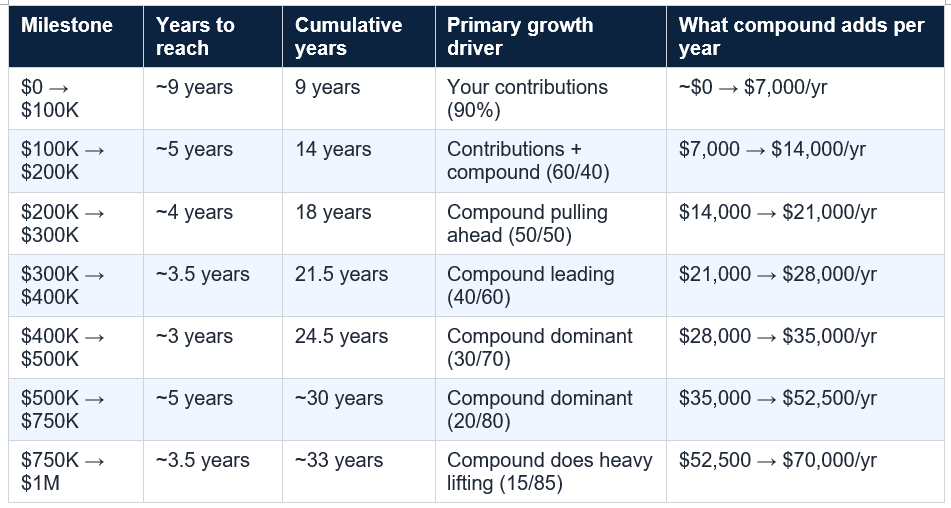
Note: illustrative estimates at $500/month contributions and 7% average annual return. Actual timelines depend on your specific savings rate, investment returns, fees, taxes, and market conditions. Source: Wealthvieu (100K hardest milestone; reaching 500K retirement); Wealthvieu analysis of compound growth acceleration. Not financial advice.
But the same data contains a genuinely hopeful finding. The typical American has approximately $532,291 in retirement accounts as of early 2026 (Empower data). The average person with a retirement account is already at the $500,000 milestone. A 40-year-old earning $80,000 with only $60,000 saved can still reach $1 million by contributing approximately $1,000 per month (MoneyLion July 2026). Saving $307 per month from age 30 at a 10% average return reaches $1 million by traditional retirement age (Yahoo Finance retirement analysis).
The people who reach $1 million are not usually people who started with unusual advantages. They are people who started early enough, kept going through the painful early years when compound growth was invisible, and did not stop when life got expensive. The milestones ahead are real. The compounding that makes the later milestones faster and easier than the early ones is mathematical certainty, not motivation-poster optimism. Not financial advice.
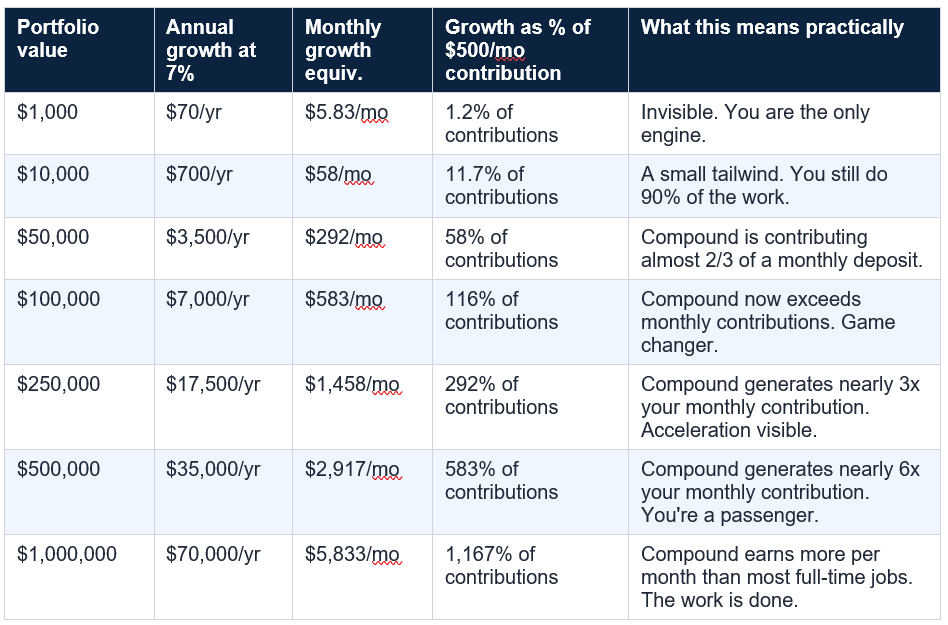
This table illustrates why Charlie Munger’s advice to get to $100,000 as fast as possible is the most practically important piece of wealth-building advice ever given in a single sentence. The shift at $100,000 is where the compound interest line on the table crosses the contribution line. Everything after that is a matter of time. Source: illustrative at 7% average annual return; Wealthvieu compound growth analysis. Not financial advice.
The $250,000 mark is where you are genuinely at the compounding halfway point, even though you are only one-quarter of the dollar distance. The $500,000 mark is where retirement stops being aspirational and becomes visible. And $1 million — reached by fewer than 5% of Americans — is both the destination most people name and the milestone that immediately reveals itself as a starting point for a different conversation about what is actually enough.
The timeline accelerates with every milestone because compound interest accelerates with every dollar. The first $100,000 takes roughly 9 years at $500 per month and 7% returns. The last $250,000 before $1 million takes roughly 3-4 years. Same contribution. Same market. Different outcome. That is the whole argument for starting early, staying consistent, and not stopping. The best time to plant the tree was 20 years ago. The second-best time is today. Not financial, investment, or tax advice. Consult a fee-only CFP for guidance specific to your situation.
The first $100,000 is the hardest because compound interest is at its weakest when your balance is smallest. At $1,000 invested at 7%, you earn about $70 per year from investment growth — $5.83 per month — meaning almost all of your progress toward $100,000 comes directly from what you contribute from your salary. There is no meaningful tailwind. Progress feels slow because it IS slow, entirely dependent on your discipline. Charlie Munger put it most memorably: 'The first $100,000 is a b****, but you gotta do it.' Once you cross $100,000, the maths change: at $100K at 7%, compound growth generates $7,000 per year ($583/month) — roughly equal to an average monthly contribution. The second $100,000 typically takes 4-6 years instead of 9. The acceleration is mathematical, not motivational. Sources: Wealthvieu (100K hardest milestone); Charlie Munger quote widely cited. Not financial advice.
Why is $250,000 considered the 'halfway point' to $1 million when it's only one-quarter of the dollar amount?
Because compound interest measures progress in time and effort, not just dollars. AOL/Yahoo Finance (2025) explained it this way: at $250,000, it took approximately 13 years (at $1,000/month at 8% return) to accumulate the first $250K. From $250K, continuing at $1,000/month and 8% return, it takes roughly 14 years to reach $1 million — meaning the remaining $750,000 takes about the same time as the first $250,000. The reason: at $250,000, both your contributions AND your portfolio's compound returns are working together at comparable scale. The second $750,000 comes primarily from compounding, whereas the first $250,000 came primarily from your contributions. In time and effort terms, $250K really is the halfway point. Sources: AOL/Yahoo Finance 2025; Northwestern Mutual 2025 Planning & Progress Study. Not financial advice.
What does $1 million in savings actually produce in retirement income?
Under the 4% safe withdrawal rule — the most widely cited guideline for sustainable retirement income — a $1 million portfolio produces $40,000 per year in retirement income ($3,333/month). This is designed to allow the portfolio to last at least 30 years. Adding average Social Security benefits (approximately $22,000-$30,000 per year for the typical household), total retirement income from $1M + Social Security would be approximately $62,000-$70,000 per year. However, Americans now believe they need $1.46 million to retire comfortably (Northwestern Mutual 2026 Planning & Progress Study, cited WebProNews 2026). $1 million may be sufficient in a low-cost area or with a paid-off home but insufficient in a high-cost city or for someone expecting a 35+ year retirement. Sources: Yahoo Finance retirement analysis; WebProNews 2026; MoneyLion July 2026. Not financial advice.
How many Americans actually reach $1 million in savings?
Very few. According to a Congressional Research Service study cited in Yahoo Finance (2026), only about 4.6% of Americans had retirement assets greater than $1 million as of 2022. A Federal Reserve survey cited by MoneyLion (July 2026) puts the figure at approximately 2.5-3% of all Americans with $1 million or more in retirement accounts. More than 95% of American retirees do not have $1 million saved (Motley Fool 2025). Reaching $1 million genuinely places you in a rare category. The path that gets most people there: starting early, maintaining consistent contributions, investing in low-cost diversified index funds, and not stopping during market downturns. A 40-year-old with only $60,000 saved can still reach $1M by contributing approximately $1,000/month (MoneyLion July 2026). Sources: Congressional Research Service (cited Yahoo Finance 2026); Federal Reserve (cited MoneyLion July 2026); Motley Fool 2025. Not financial advice.
What is the Rule of 72 and how does it help understand the milestones?
The Rule of 72 is a quick mental shortcut: divide 72 by your expected annual return, and the result tells you approximately how many years it takes your money to double. At 7% return: 72 ÷ 7 = approximately 10.3 years to double. At 8%: 9 years. At 10%: 7.2 years. Applied to the milestones: $100,000 at 7% doubles to $200,000 in approximately 10 years without any new contributions. $250,000 doubles to $500,000 in approximately 10 years. $500,000 doubles to $1,000,000 in approximately 10 years. This means a 40-year-old at $500,000 can expect to hit $1 million by age 50 at 7% returns with no new contributions at all. The Rule of 72 is an approximation — actual outcomes depend on market performance, fees, and contribution patterns — but it illustrates why the $500,000 milestone is often described as the point where retirement becomes visible and mathematical rather than aspirational. Not financial advice.
Table of Contents
- Why the Journey Feels Different at Every Stage
- The Starting Line: $0 — Building the Foundation
- Milestone #1: $1,000 — The Emergency Seed
- Milestone #2: $10,000 — Real Numbers, Invisible Growth
- Milestone #3: $50,000 — The Grind Is Working
- Milestone #4: $100,000 — The Most Important Number of All
- Milestone #5: $250,000 — The Compound Halfway Point
- Milestone #6: $500,000 — When Retirement Gets Real
- Milestone #7: $1,000,000 — The Identity Milestone
- The Timeline Table: How Long Each $100K Takes
- The Hard Truth: Most People Never Get There — But Here’s Why You Can
- The Compound Growth Shift: What Your Money Does at Each Level
- Conclusion: The Milestones Are Not Equal — and That’s the Point
- Frequently Asked Questions
Why the Journey Feels Different at Every Stage
Most personal finance articles tell you to save more, invest early, and let compound interest do the work. All of that is true. What they skip is the honest account of what the journey actually feels like from the inside — and why each milestone changes something deeper than just your bank balance. The maths of wealth-building is not linear. The psychology of it is not linear. The options available to you shift in ways that are qualitative, not just quantitative.Here is the central insight this article is built around: the milestones on the path from $0 to $1 million are not equally spaced, equally hard, or equally meaningful. The first $100,000 is the hardest. The $250,000 milestone is the compounding halfway point, even though it’s only one-quarter of the dollar amount. The $500,000 milestone is when retirement stops being an abstract future concept and starts being a visible mathematical outcome. And $1 million is simultaneously the most celebrated milestone and the one that carries the most caveats.
What follows is each milestone in order — what changes in the maths, what changes in your mindset, and what moves you to the next level. Not financial advice.
The big picture: Americans now believe they need $1.46 million to retire comfortably (Northwestern Mutual 2026 Planning & Progress Study, cited WebProNews 2026). Only 4.6% of Americans had retirement assets above $1 million (Congressional Research Service, cited Yahoo Finance 2026). The typical American has approximately $532,291 in retirement accounts as of early 2026 (Empower, cited Yahoo Finance 2026). The personal savings rate: just 3.6% as of March 2026 (Federal Reserve, cited Yahoo Finance 2026). 20% of adults over 50 had no retirement savings in 2024 (AARP). Not financial advice.
The Starting Line: $0 — Building the Foundation
Starting from zero is not the same as having nothing. It is the stage where every dollar of your savings comes entirely from your own effort. There is no compound interest helping you, because there is no principal on which interest can compound. You are in what we might call the pure labour phase of wealth-building: every single dollar in your account got there because you chose to put it there and not spend it on something else.This is also the stage most psychologically vulnerable to abandonment. The numbers are small enough that they can feel insulting — you contribute $200 a month for a year and you have $2,400 to show for it. Inflation. Market noise. The sense that you’re filling a bucket with a thimble. The Vanguard 2025 financial wellbeing survey found that having at least $2,000 in an emergency fund is associated with a 21% higher level of reported financial wellbeing compared to having no emergency savings. That’s not a retirement figure — it’s the smallest meaningful financial cushion. And it moves the needle on how you feel about money.
The starting line is not about investment returns. It’s about two things: building the habit of saving automatically and eliminating high-interest consumer debt that is running at a rate no investment reliably beats. Until those two conditions are met, the milestones ahead remain unreachable. Not financial advice.
$1,000 — what changes here
One thousand dollars does not feel like much. But it is the difference between a financial shock event — a car repair, a medical bill, an unexpected gap in income — wiping you out completely and it merely being uncomfortable. The $1,000 milestone is not an investment milestone. It is a stability milestone. It is the line between being one bad day away from debt and being one bad day away from a setback.The psychological shift at $1,000 is real and measurable. As the Vanguard data shows, even $2,000 in emergency savings is associated with a 21% improvement in reported financial wellbeing. This is not about returns. It is about anxiety reduction. When you know you have something in the bank, you make better financial decisions in general. You do not raid your retirement account. You do not take payday loans. You do not make panicked choices under pressure.
$1,000 at 7% annual return generates $70 per year — or about $5.83 per month in investment growth. The compound growth at this level is genuinely invisible. This is entirely a habit and stability milestone, not a growth milestone. Every $100 contributed adds $0.67 in annual compound growth. Sources: Wealthvieu compound growth analysis. Not financial advice.
The psychology: $0 → $1K mindset: 'I have nothing saved.' → 'I have a buffer.' The shift is from pure financial anxiety to a small but real cushion. Even $1,000 represents several months of contribution effort for many people, which builds the meta-skill of delayed gratification that every subsequent milestone requires. Not financial advice.
$10,000 — what changes here
Ten thousand dollars is your first five-figure number, and it changes something specific: it makes retirement feel potentially real rather than purely theoretical. It’s not real yet — $10,000 is nowhere near a retirement fund by itself — but it’s a number that takes more than a line on a spreadsheet to accumulate. Getting here required sustained discipline over a meaningful period of time.The maths at $10,000 still feel slow. At 7% annual return, your $10,000 generates approximately $700 per year in investment growth — about $58 per month. Your monthly contributions are still doing almost all of the work. If you contribute $300 per month, compound growth adds about $20. But the ratio is beginning to shift, and for the first time you can actually see compound interest showing up on your statement as a distinct line item rather than rounding noise.
$10,000 at 7% = ~$700/year in growth (~$58/month). Every $100 you contribute generates about $6.67 in annual compound growth. Contributions still dominate growth (~80-90% of portfolio growth is from what you put in, not what returns). At this level, investing in tax-advantaged accounts (401(k), IRA, Roth IRA) matters enormously because the tax savings per dollar invested are at their maximum proportional value. Not financial advice.
At $10K: (1) Switch to automatic contributions — remove willpower from the equation. (2) Ensure you are in low-cost index funds (expense ratio under 0.15%). (3) Maximise any employer 401(k) match — this is a 50-100% instant return on your money that no investment can rival. (4) Open a Roth IRA if your income qualifies — tax-free compounding over the next 30-40 years is transformationally valuable from this early stage. Not financial advice.
$50,000 — what changes here
Fifty thousand dollars is where the grind starts to feel like it might be worth it. You are probably 5-10 years into the savings habit by this point (unless you started with a high income or a disciplined savings rate above 20%). The compounding is still not doing the heavy lifting, but it is making a noticeable contribution for the first time.At $50,000, your portfolio generates approximately $3,500 per year at 7% — roughly $292 per month in returns without any new contributions. If you’re contributing $400 per month, compound growth is now adding the equivalent of about 73% of a monthly contribution on top of your deposits. It still doesn’t dominate, but you can feel the partnership forming.
The $50,000 milestone is also where investment allocation starts to matter in a way it simply didn’t at $10,000. The fee drag from a high-cost 1% annual fee fund now costs you $500 per year. At $10,000 it cost you $100 — irritating but not catastrophic. At $50,000 it starts to represent real money compounding against you. This is the point to audit every investment you hold for its expense ratio. Not financial advice.
$50K mindset: 'The grind is working.' This is also the first milestone where looking at your investment statements stops being painful and starts being motivating. You can see growth. You can see the compound interest as a real number rather than cents. The psychological shift from 'this is pointless' to 'this is working' typically happens somewhere in the $25K-$75K range for most consistent savers. Not financial advice.
$100,000 — what changes here
This is the milestone that changes everything. Charlie Munger said it plainly and without softening: ‘The first $100,000 is a b****, but you gotta do it.’ He was right on both counts. The first $100,000 is the hardest, slowest, most discouraging stretch of the wealth-building journey. It is also the most important, because it is the threshold at which compound interest flips from being your passive observer to your active business partner.Before $100,000: you are building retirement money. After $100,000: you have retirement money. The psychological shift is reported universally among people who reach this milestone — retirement moves from being an abstract aspiration to a visible mathematical reality. Wealthvieu’s analysis of the $100K milestone puts it this way: ‘Before $100K: “Retirement is theoretical.” After $100K: “Retirement is real money.”’
The maths confirm the shift. At $100,000, your portfolio generates approximately $7,000 per year at 7% — roughly $583 per month in compound growth without any new contributions. Every $100 you contribute now generates $67 in annual compound growth alongside it. The ratio of contributions-to-compound is approaching 50/50 for the first time. And here is the killer fact: the second $100,000 takes roughly half the time of the first, even at the same monthly contribution rate. Compound growth is now pulling its weight.
Charlie Munger (Berkshire Hathaway, widely cited): 'The first $100,000 is a b****, but you gotta do it.' And Warren Buffett's corollary: 'My wealth has come from a combination of living in America, some lucky genes, and compound interest.' The $100K milestone is where compound interest stops being theory and becomes the dominant force in your financial life. Not financial advice.
$100K at 7% = ~$7,000/year in growth ($583/month). Every $100 contributed generates $67 in annual compound growth alongside it. The second $100K (from $100K to $200K) takes roughly 4-6 years vs 9 years for the first $100K — at the same monthly contribution. The portfolio is now earning what many people save in a month just by sitting there. Source: Wealthvieu; illustrative at 7% average annual return. Not financial advice.
At $100K: (1) Do not stop — this is the most dangerous milestone for 'lifestyle creep.' Keep the same contributions. (2) Review your asset allocation for the first time seriously — at $100K, being in the wrong allocation costs you thousands per year. (3) Consider Coast FIRE as a motivational tool: calculate how much you’d need today to coast to retirement without new contributions. At $100K in your 30s, you may already be Coast-FI. (4) Never borrow from your 401(k) — at $100K, every dollar removed loses compound growth and penalties that cost multiples of what you withdrew. Not financial advice.
$250,000 — what changes here
A quarter million dollars looks like 25% of the way to $1 million. In dollar terms, it is. In compound-interest terms, it is not. This is the milestone that AOL and Yahoo Finance described in 2025 as ‘already halfway to $1 million— seriously.’ The reason is compounding arithmetic: at $250,000, both your monthly contributions AND your portfolio’s autonomous returns are working simultaneously and at comparable scale. The second $750,000 can take roughly as long as the first $250,000, depending on your contribution rate and returns.Northwestern Mutual’s 2025 Planning & Progress Study found that the average American believes they need $1.26 million to retire comfortably (this rose to $1.46 million in the 2026 edition). At $250,000, you are between one-sixth and one-fifth of the way to those targets in raw dollars. But the acceleration is real and measurable: your portfolio at $250,000 generates approximately $17,500 per year at 7% — nearly $1,500 per month in investment returns with no new deposits required.
The psychology at $250,000 is one of the most significant shifts on the entire journey. Most people describe a move from ‘saving for retirement’ to ‘building wealth.’ The numbers feel serious. A bad market year no longer feels personal — it is now a paper variation on a real asset, not a question of whether the whole project is worth continuing. You have crossed the threshold where the math is clearly on your side. Not financial advice.
$250K at 7% = ~$17,500/year in growth (~$1,458/month) without new contributions. Under the Rule of 72 at 7% return, $250K doubles to $500K in approximately 10.3 years even with no new contributions. With ongoing contributions, significantly faster. The 'compound halfway point': at $1,000/month and 8% return, the journey from $0 to $250K takes ~13 years; $250K to $1M takes roughly 14 years — confirming $250K as the true halfway point by time and effort. Source: AOL/Yahoo Finance 2025; Northwestern Mutual 2025; Rule of 72. Not financial advice.
$500,000 — what changes here
Half a million dollars is the milestone where retirement stops being theoretical or even psychological and becomes a visible, calculable outcome. Wealthvieu’s analysis of the $500K milestone uses language that rings true to anyone who has reached it: ‘Before $500K: retirement is distant. At $500K: retirement is visible.’ The reason is simple. At $500,000 invested, even without contributing a single additional dollar, your portfolio nearly doubles to $1 million in approximately 10 years at a 7% average annual return.The maths at $500,000 are genuinely different from any previous milestone. Your portfolio is generating approximately $35,000 per year in compound growth at 7% — that’s $2,917 per month appearing in your account without any contributions from your salary. For the first time in the journey, compound growth exceeds what most people contribute monthly. The ratio has flipped: investment returns are now the primary driver of your wealth growth, and your contributions — while still valuable — are the secondary driver.
The context matters. The Empower data cited in Yahoo Finance’s 2026 reporting shows the typical American has approximately $532,291 in retirement accounts — meaning the average person with a retirement account has roughly cleared this milestone. But the median tells a different story: the median 401(k) balance for people in their 50s is approximately $253,454 (Empower, September 2025), showing the average is pulled up by high earners. Reaching $500,000 genuinely puts you well ahead of the median American of any age. Not financial advice.
$500K at 7% = ~$35,000/year in growth (~$2,917/month) without new contributions. At 7%, $500K becomes ~$983K in 10 years (almost $1M without contributions). With $1,500/month contributions: ~$1.24 million. Fee impact: 0.5% vs 0.05% fee difference = $2,250/year at $500K — now material enough to demand immediate review of every fund you hold. Source: Wealthvieu reaching $500K. Not financial advice.
At $500K: (1) Run a retirement projection — with $500K and ongoing contributions, calculate your specific retirement age across optimistic, base, and conservative return scenarios. (2) Review fees urgently — $2,250 per year in avoidable fees is real money at this level. (3) Think about tax diversification — do you have both pre-tax (traditional 401(k)) and after-tax (Roth IRA) buckets? Both give you flexibility in retirement income management. (4) Consider a fee-only CFP for the first time — the complexity of your situation now justifies it. Not financial advice.
$1,000,000 — what changes here
One million dollars is the number most people name when asked what it means to be wealthy. It is the traditional retirement target, the cultural shorthand for financial security, and the milestone that only 4.6% of Americans with retirement accounts have actually reached (Congressional Research Service, cited Yahoo Finance 2026). The irony of hitting $1 million is that it simultaneously feels like everything you worked for and like a number that needs an immediate asterisk.The asterisk: Northwestern Mutual’s 2026 survey found that Americans now believe they need $1.46 million to retire comfortably. The 4% safe withdrawal rule produces $40,000 per year from $1 million in income — a decent supplement to Social Security but not a standalone income for most people’s retirement expectations. More than 95% of American retirees do not have $1 million saved (Motley Fool 2025). Getting here puts you in a genuinely rare category. But it does not mean you are done, particularly if you are retiring in an expensive city or expect a long retirement.
The identity shift at $1 million is real and different from every other milestone. Every previous milestone changed what compound interest does for you. This one changes how you think about yourself. The psychological research on this transition is consistent: people who reach $1 million do not feel as wealthy as they expected to feel. The target moves. The definition of ‘enough’ shifts. The work continues. But the maths are undeniably powerful: $1 million at 7% generates $70,000 per year in investment growth without contributions — nearly $6,000 per month. The money is genuinely working harder than most full-time jobs. Not financial advice.
$1M at 7% = ~$70,000/year in growth (~$5,833/month) without new contributions. At 4% safe withdrawal rule: $40,000/year income. Average Social Security adds ~$22,000-$30,000/year per household. Combined total: potentially $62,000-$70,000/year. Rule of 72: $1M doubles to $2M in approximately 10.3 years at 7%. The milestone changes who does the work: investment returns generate more income per year than most Americans earn from employment. Source: Yahoo Finance; Wealthvieu; Federal Reserve. Not financial advice.
$1M mindset shift: 'I made it' → 'I need more than I thought.' Almost universally, people who reach $1M discover that the number raises rather than resolves the retirement question. The target moves: they see $1.46M (Northwestern Mutual 2026) or $2M or 'number depends on where I retire.' The real shift: you stop being afraid of markets. A 10% correction is a $100K paper loss — meaningful, but not existentially threatening. You can absorb volatility in a way that would have been impossible at $50K or $100K. Not financial advice.
The Timeline Table: How Long Each $100K Takes
The table below shows the approximate years to reach each $100K increment, starting from zero, at $500 per month contributed and a 7% average annual return. The acceleration effect — the defining feature of compound interest at scale — is visible in how dramatically the time per $100K decreases.Note: illustrative estimates at $500/month contributions and 7% average annual return. Actual timelines depend on your specific savings rate, investment returns, fees, taxes, and market conditions. Source: Wealthvieu (100K hardest milestone; reaching 500K retirement); Wealthvieu analysis of compound growth acceleration. Not financial advice.
The Hard Truth: Most People Never Get There — But Here’s Why You Can
The data on American retirement savings is sobering. Only 4.6% of Americans with retirement assets have more than $1 million. The median 401(k) balance for people aged 55-64 hovers around $185,000 — a fraction of even the most conservative retirement target. Twenty percent of adults over 50 have no retirement savings at all, and 61% are worried their savings are insufficient (AARP 2024, cited Yahoo Finance 2026). The collective retirement savings gap runs into the trillions.But the same data contains a genuinely hopeful finding. The typical American has approximately $532,291 in retirement accounts as of early 2026 (Empower data). The average person with a retirement account is already at the $500,000 milestone. A 40-year-old earning $80,000 with only $60,000 saved can still reach $1 million by contributing approximately $1,000 per month (MoneyLion July 2026). Saving $307 per month from age 30 at a 10% average return reaches $1 million by traditional retirement age (Yahoo Finance retirement analysis).
The people who reach $1 million are not usually people who started with unusual advantages. They are people who started early enough, kept going through the painful early years when compound growth was invisible, and did not stop when life got expensive. The milestones ahead are real. The compounding that makes the later milestones faster and easier than the early ones is mathematical certainty, not motivation-poster optimism. Not financial advice.
The Compound Growth Shift: What Your Money Does at Each Level
The single most important concept in this article is the shift in who does the work at each milestone. In the early years, you are doing all the work. By the time you reach $500,000 and beyond, your money is doing most of the work. Here is how that shift looks in concrete annual dollar terms at 7% average annual return:This table illustrates why Charlie Munger’s advice to get to $100,000 as fast as possible is the most practically important piece of wealth-building advice ever given in a single sentence. The shift at $100,000 is where the compound interest line on the table crosses the contribution line. Everything after that is a matter of time. Source: illustrative at 7% average annual return; Wealthvieu compound growth analysis. Not financial advice.
Conclusion
The map from $0 to $1 million is not flat. The terrain changes at every milestone. The first $1,000 is a stability milestone, not a wealth milestone. The $10,000 mark is where the savings habit proves itself. The $50,000 mark is where the grind starts to look like it might actually work. The $100,000 mark is where compound interest becomes your partner, not just a promise, and where Charlie Munger says the hardest part is over.The $250,000 mark is where you are genuinely at the compounding halfway point, even though you are only one-quarter of the dollar distance. The $500,000 mark is where retirement stops being aspirational and becomes visible. And $1 million — reached by fewer than 5% of Americans — is both the destination most people name and the milestone that immediately reveals itself as a starting point for a different conversation about what is actually enough.
The timeline accelerates with every milestone because compound interest accelerates with every dollar. The first $100,000 takes roughly 9 years at $500 per month and 7% returns. The last $250,000 before $1 million takes roughly 3-4 years. Same contribution. Same market. Different outcome. That is the whole argument for starting early, staying consistent, and not stopping. The best time to plant the tree was 20 years ago. The second-best time is today. Not financial, investment, or tax advice. Consult a fee-only CFP for guidance specific to your situation.
Frequently Asked Questions
Why is the first $100,000 considered the hardest savings milestone?The first $100,000 is the hardest because compound interest is at its weakest when your balance is smallest. At $1,000 invested at 7%, you earn about $70 per year from investment growth — $5.83 per month — meaning almost all of your progress toward $100,000 comes directly from what you contribute from your salary. There is no meaningful tailwind. Progress feels slow because it IS slow, entirely dependent on your discipline. Charlie Munger put it most memorably: 'The first $100,000 is a b****, but you gotta do it.' Once you cross $100,000, the maths change: at $100K at 7%, compound growth generates $7,000 per year ($583/month) — roughly equal to an average monthly contribution. The second $100,000 typically takes 4-6 years instead of 9. The acceleration is mathematical, not motivational. Sources: Wealthvieu (100K hardest milestone); Charlie Munger quote widely cited. Not financial advice.
Why is $250,000 considered the 'halfway point' to $1 million when it's only one-quarter of the dollar amount?
Because compound interest measures progress in time and effort, not just dollars. AOL/Yahoo Finance (2025) explained it this way: at $250,000, it took approximately 13 years (at $1,000/month at 8% return) to accumulate the first $250K. From $250K, continuing at $1,000/month and 8% return, it takes roughly 14 years to reach $1 million — meaning the remaining $750,000 takes about the same time as the first $250,000. The reason: at $250,000, both your contributions AND your portfolio's compound returns are working together at comparable scale. The second $750,000 comes primarily from compounding, whereas the first $250,000 came primarily from your contributions. In time and effort terms, $250K really is the halfway point. Sources: AOL/Yahoo Finance 2025; Northwestern Mutual 2025 Planning & Progress Study. Not financial advice.
What does $1 million in savings actually produce in retirement income?
Under the 4% safe withdrawal rule — the most widely cited guideline for sustainable retirement income — a $1 million portfolio produces $40,000 per year in retirement income ($3,333/month). This is designed to allow the portfolio to last at least 30 years. Adding average Social Security benefits (approximately $22,000-$30,000 per year for the typical household), total retirement income from $1M + Social Security would be approximately $62,000-$70,000 per year. However, Americans now believe they need $1.46 million to retire comfortably (Northwestern Mutual 2026 Planning & Progress Study, cited WebProNews 2026). $1 million may be sufficient in a low-cost area or with a paid-off home but insufficient in a high-cost city or for someone expecting a 35+ year retirement. Sources: Yahoo Finance retirement analysis; WebProNews 2026; MoneyLion July 2026. Not financial advice.
How many Americans actually reach $1 million in savings?
Very few. According to a Congressional Research Service study cited in Yahoo Finance (2026), only about 4.6% of Americans had retirement assets greater than $1 million as of 2022. A Federal Reserve survey cited by MoneyLion (July 2026) puts the figure at approximately 2.5-3% of all Americans with $1 million or more in retirement accounts. More than 95% of American retirees do not have $1 million saved (Motley Fool 2025). Reaching $1 million genuinely places you in a rare category. The path that gets most people there: starting early, maintaining consistent contributions, investing in low-cost diversified index funds, and not stopping during market downturns. A 40-year-old with only $60,000 saved can still reach $1M by contributing approximately $1,000/month (MoneyLion July 2026). Sources: Congressional Research Service (cited Yahoo Finance 2026); Federal Reserve (cited MoneyLion July 2026); Motley Fool 2025. Not financial advice.
What is the Rule of 72 and how does it help understand the milestones?
The Rule of 72 is a quick mental shortcut: divide 72 by your expected annual return, and the result tells you approximately how many years it takes your money to double. At 7% return: 72 ÷ 7 = approximately 10.3 years to double. At 8%: 9 years. At 10%: 7.2 years. Applied to the milestones: $100,000 at 7% doubles to $200,000 in approximately 10 years without any new contributions. $250,000 doubles to $500,000 in approximately 10 years. $500,000 doubles to $1,000,000 in approximately 10 years. This means a 40-year-old at $500,000 can expect to hit $1 million by age 50 at 7% returns with no new contributions at all. The Rule of 72 is an approximation — actual outcomes depend on market performance, fees, and contribution patterns — but it illustrates why the $500,000 milestone is often described as the point where retirement becomes visible and mathematical rather than aspirational. Not financial advice.
0 Comments
Be the first to share your thoughts on this article.