

Financial Literacy
You Can Change Your Finances in 3 Months: The Plan

Most people fail their financial goals by February. Not because the goals are wrong but because the plan is missing. A 90-day financial reset — 12 weeks, three clear phases — is long enough to see real results and form lasting habits, but short enough that you can hold the whole thing in your head. This is the week-by-week plan. Month One: know where you stand. Month Two: protect yourself and attack debt. Month Three: build the engine that runs without you. Not financial advice.
Most people who decide to fix their finances set a goal and then set it again three months later, having achieved little in between. The problem is almost never motivation. It is the absence of a specific, sequenced plan that converts the aspiration into a series of concrete, dated actions. Without the plan, every week feels like the same shapeless ‘I should do something about my finances’ intention — and intentions without structure expire by February.
The 90-day timeframe is specific and deliberate. Research by Phillippa Lally at UCL found that new habits typically form in approximately 66 days — not the commonly cited 21 days. By the end of Week 12, the behaviours built in this plan (automated savings transfers, monthly budget reviews, debt payments above the minimum) will be genuinely habitual, not just aspirational. Three months is also long enough to see real, measurable outcomes: a net worth that is higher than it was in Week 1, a debt balance that has moved, a savings account that actually has something in it.
MarieYolaine Toms, coach and founder of Focused Fire financial coaching company, makes the principle explicit: ‘Resolutions can easily turn into unattainable goals that feel more like a dream. To avoid setting unrealistic expectations, follow a “no resolutions” mindset and instead focus on making an actionable plan.’ (NBC/AP, 2026). The ‘You Can Change Your Finances in 3 Months’ video format has accrued more than 1.7 million views across platforms by May 2026 — reflecting a genuine public appetite for structured, time-bound financial change. This article is the written, comprehensive version of that plan. Not financial advice.
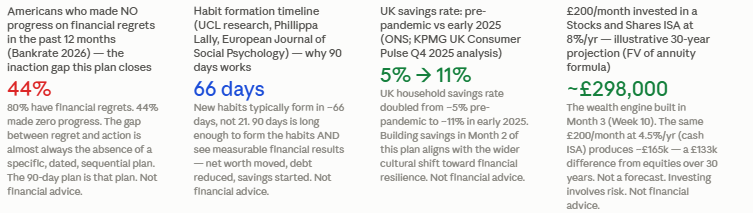
80% of Americans have financial regrets for 2025 (Omni Calculator 2026). Top single regret: overspending on non-essentials (29%). Bankrate: 44% of those with financial regrets made no progress addressing them in the past 12 months. 19% of Americans have zero savings; majority have <$500 (GOBankingRates 2025). UK savings rate rose from 5% pre-pandemic to 11% in 2025 (ONS; KPMG). 56% of UK adults intend to reduce discretionary spending in 2026 (Barclays January 2026). Sources: Omni Calculator 2026; Bankrate; GOBankingRates 2025; ONS/KPMG; Barclays. Not financial advice.
Month One is not about saving more money or paying off debt. It is about understanding your current financial reality with precision. Most people have only a vague sense of where their money goes — and the gap between vague sense and precise knowledge is typically several hundred pounds per month in untracked, unintentional spending. You cannot cut what you cannot see. Month One makes everything visible. Not financial advice.
Tools: a free spreadsheet, the Notes app, or a dedicated app such as Money Dashboard (UK) or Copilot (US). The calculation does not need to be precise — an estimate within 10% is sufficient for a planning baseline. The important thing is that you have a number on paper. That number is the one you will beat in Week 12.
Week 1 action: List every financial account (current, savings, ISA, pension, investments) with its current balance. List every debt (credit cards, loans, overdraft, buy-now-pay-later, student loan if applicable) with its balance. Subtract total debts from total assets. Write the result down. This is your Day 1 net worth. Not financial advice.
The experience of completing a spending audit for the first time is reliably surprising. BizNews (2026 financial planning guide): ‘Track your spending for 30 days. You’ll be amazed by what you learn. Even small leaks can sink your savings.’ The surprise is almost always in discretionary categories — the subscriptions that have been running since 2022, the delivery app habit that costs £300/month, the buying of coffee and lunch that collectively runs to £200/month more than the person estimated.
Brighton Journal (2025): ‘Subscriptions and direct debits have a way of quietly adding up so review each one and cancel anything non-essential like streaming services, fitness apps and magazine subscriptions.’ A monthly subscription audit typically uncovers £20–£60 in unused recurring charges (MoneyLion 2026). Not financial advice.
The spending audit hack: many UK banking apps (Monzo, Starling, HSBC Smart Banking) automatically categorise transactions. If yours does, the audit is already 80% done -- just review the categories and identify the surprises. For older-style banking: download the last 30 days as a CSV or PDF and go through it with a highlighter. One colour per category. The totals will tell you where the plan needs to focus. Not financial advice.
The simplest effective budget structure is the 50/30/20 rule: 50% of take-home income to needs (housing, bills, food, transport), 30% to wants (entertainment, dining, clothes), and 20% to savings and debt repayment. If debt is significant, the 20% becomes 30% or more by temporarily reducing the wants allocation. The specific numbers are less important than the principle: every pound is allocated before the month begins. No allocation = no plan = default overspending.
For UK households, the free Money Helper service (moneyhelper.org.uk) provides a budget planner that walks through the process. For US households, YNAB (You Need A Budget), EveryDollar (free version), or a simple spreadsheet all work. The tool matters less than the habit of using it. Not financial advice.
The most common budget failure: creating a perfect budget in Week 3 and then never reviewing it. A budget is a living document. Commit to a monthly 30-minute budget review -- what BizNews (2026) calls a 'monthly money hour.' Cheryl and Dr Ross (US podcast) suggest making these reviews enjoyable: 'over pancakes or wine, depending on the time of day.' The financial review that you actually do is better than the perfect one you skip. Not financial advice.
Cancel the unused ones today. Not next week. Today. The procrastination cost of leaving a £12.99 unused streaming service running for another six months is £78 — for nothing. The cancellation takes three minutes. This is the category where the 90-day plan pays for its time investment fastest. Beyond subscriptions, Week 4 is for other quick wins: calling your broadband/mobile provider to negotiate a better deal (many UK providers will reduce the bill for existing customers who ask, particularly at the end of a contract period), checking for unclaimed cashback, and setting up a cashback platform (TopCashback or Quidco in the UK) for future purchases.
Week 4 actions: (1) Go through bank statements and list every recurring charge. (2) For each: have you used it in the past month? If no: cancel today. (3) Check phone subscription management (Settings → Subscriptions on iPhone; Google Play Store → Subscriptions on Android). (4) Call broadband/mobile provider. Ask: 'I'm thinking of switching -- can you offer me a better rate?' (5) Sign up for TopCashback or Quidco if not already a member. (6) Total the monthly saving from cancelled subscriptions and add it to Week 3's budget under savings. Not consumer advice.
Month Two is where the plan gets structural. The spending audit and budget from Month One should already be generating some extra monthly cash — from cancelled subscriptions, identified savings, and deliberate spending decisions. Month Two directs this extra cash toward the two most important financial priorities after knowing where you stand: protection against emergencies and systematic debt reduction. Not financial advice.
The Week 5 target is not the full three-to-six month emergency fund. It is the starter emergency fund: £500–£1,000 (UK) or $500–$1,000 (US). The starter fund achieves one critical objective: the next time an emergency arrives (car repair, boiler breakdown, dental bill), it is covered from savings rather than from a credit card at 22–24% APR. This is the break-the-cycle fund. The full emergency fund is built later; the starter fund is built now, this week.
Where to put it: a separate, instantly accessible high-interest savings account. Separate from the current account to reduce the temptation to dip in; instantly accessible because emergencies do not give notice; high-interest because rates in 2026 are sufficient (approximately 4–5% for easy-access accounts in the UK) to make the account slightly productive. The mental separation of ‘this money is not available to spend’ is reinforced by the physical separation of the account. Not financial advice.
Erica Grundza, CFP at Betterment (NBC/AP, 2026): 'When building your goals for 2026, focus on an optimistic, yet realistic, vision for the future. It can be as simple as saving $10 each week in a savings account, or a bigger goal like saving to buy a house in the coming years. It's all about your own journey.' The starter emergency fund is the $10/week goal made concrete -- small enough to be achievable immediately, meaningful enough to break the borrowing cycle. Not financial advice.
List every debt: credit card balances, personal loans, overdraft, car finance, buy-now-pay-later balances, student loan if it affects cash flow. For each: note the current balance, the interest rate, and the minimum monthly payment. Two strategies for what to do next:
Unused assets: most households have items they no longer use that have resale value — electronics, furniture, clothing, books, sporting equipment. Facebook Marketplace, eBay, Vinted, or local car boot sales convert physical clutter into emergency fund cash. A realistic target for a single weekend clear-out: £100–£500 depending on what is available. Unused time: even a few hours per week of additional income — through freelancing, overtime, tutoring, or selling a skill — can accelerate the debt repayment or emergency fund building dramatically. Unclaimed entitlements: many UK households are not claiming all the benefits and tax reliefs they are entitled to. Marriage Allowance (if eligible), Child Benefit, council tax discounts, pension credit — all are worth checking via the gov.uk benefits calculator. Not financial advice.
If the starter emergency fund is complete, all extra monthly cash should now move to the debt repayment. If the debt avalanche is the strategy: every additional pound on the highest-interest debt reduces the balance on which interest compounds. A credit card at 22% APR — where every additional £100 payment saves £22 per year in interest — is the highest-returning ‘investment’ available to someone carrying that debt. Not financial advice.
Credit card acceleration maths: £3,000 at 22% APR, minimum payments only = paid off in ~25-30 years with ~£3,000-£4,500 in interest. Same debt with extra £150/month on top of minimum = paid off in approximately 18 months with approximately £500 in total interest. The extra £150/month saves approximately £2,500-£4,000 in interest and 23+ years of debt life. Illustrative only. Not financial advice. Individual rates and balances vary.
By Month Three, the financial picture is significantly clearer than it was 60 days ago. The net worth is known and has moved. The debt has a strategy. The emergency fund has been started. Now the task is to build the systems that make wealth accumulation automatic — so that by the time the 90 days are complete, the financial improvement does not require ongoing willpower to sustain. It runs on its own. Not financial advice.
Week 9 task: check your payslip, your employer’s HR portal, or your pension provider’s statement. Confirm: (a) what percentage you are currently contributing; (b) what percentage your employer matches; and (c) whether you are contributing enough to capture the full employer match. If not: submit a contribution increase request this week. This is the highest-return single financial action most employed UK workers can take. BizNews (2026): ‘Increase your retirement contributions by 10%. It might feel small now, but your future self will thank you.’ Not financial advice.
UK pension tax relief: basic-rate taxpayers receive 20% tax relief on pension contributions. That means a £100 pension contribution only costs £80 from your take-home pay. Higher-rate taxpayers (20%+ up to 45%) get proportionally more. This makes pension contributions more efficient than equivalent ISA contributions for taxpayers above the basic rate. In 2026/27: annual allowance £60,000; ISA allowance £20,000. A combination of both is the optimal tax-efficient savings approach. Not financial advice.
Week 10 task: if you do not have a Stocks and Shares ISA: open one. Providers include Vanguard UK, Fidelity UK, Hargreaves Lansdown, AJ Bell, and others. If you already have one: increase the monthly contribution. Even £50/month matters. BizNews (2026): ‘Start investing — even if it’s just R500 [or £50] a month. Consistency beats timing every time.’ For US readers: the equivalent is the Roth IRA (permanent tax-free growth on qualified withdrawals; $7,000/year limit in 2026) or the 401(k) (pre-tax contributions). Not financial advice.
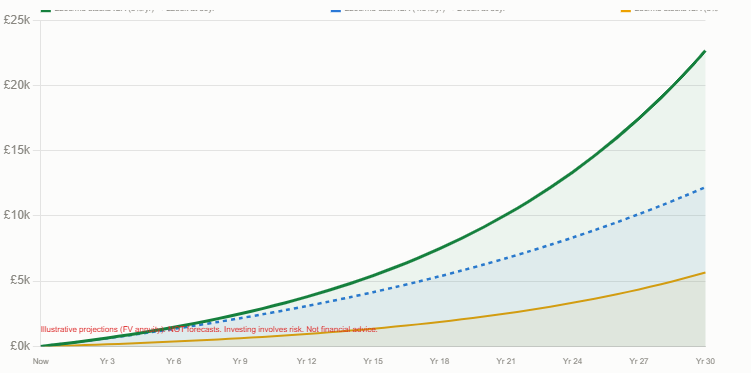
£200/month in a Stocks and Shares ISA at 8%/yr: 10 years → ~£36,000. 20 years → ~£118,000. 30 years → ~£298,000. The same money in a cash savings account at 4.5%/yr: 30 years → approximately £165,000. The difference of ~£133,000 is the risk premium from equities -- not guaranteed, but historically the dominant outcome over long horizons. Not a forecast. FV of annuity formula. Not financial advice. Past performance does not predict future results. Investing involves risk including loss of principal.
The most underused and most important protection product for working-age adults is income protection insurance. It pays a percentage of salary (typically 50–60%) if you are unable to work due to illness or injury, continuing until you return to work or reach the nominated end age. The statistical reality: you are significantly more likely to be unable to work due to illness or injury during your career than to die during your working life — yet life insurance uptake far exceeds income protection uptake among UK households. A simple comparison quote via a comparison site or an independent protection adviser takes under an hour. Not financial advice.
Week 11 is also for reviewing existing policies: are you paying for buildings and contents insurance at a price that has not been re-shopped in two or more years? Loyalty premiums are real; many insurers automatically raise renewal prices for continuing customers. A comparison site check (Comparethemarket, Confused.com, MoneySupermarket) typically takes 15 minutes and produces savings of £50–£200 per year for policyholders who have not shopped around recently. Not financial advice.
More importantly: the systems are now in place. The automated savings transfer runs on payday. The pension contribution captures the employer match. The debt payment goes out at the start of the month. The monthly budget review is in the diary. The ISA contribution is set up as a standing order. None of these requires a new decision every month; they are self-sustaining. The 90-day plan has done its job. BizNews (2026): ‘Celebrate progress, not perfection. It’s a marathon, not a sprint. Recognise the wins.’
Week 12 actions: (1) Recalculate net worth. Compare to Day 1. Write down the change. (2) Check emergency fund balance vs starter target. (3) Check debt balances vs Month 2 Week 6 baseline. (4) Confirm all automated transfers and payments are running. (5) Set 3 new 90-day goals for the next quarter: one for savings, one for debt/investment, one for financial knowledge. (6) Schedule the next 90-day review date in your calendar now. Not financial advice.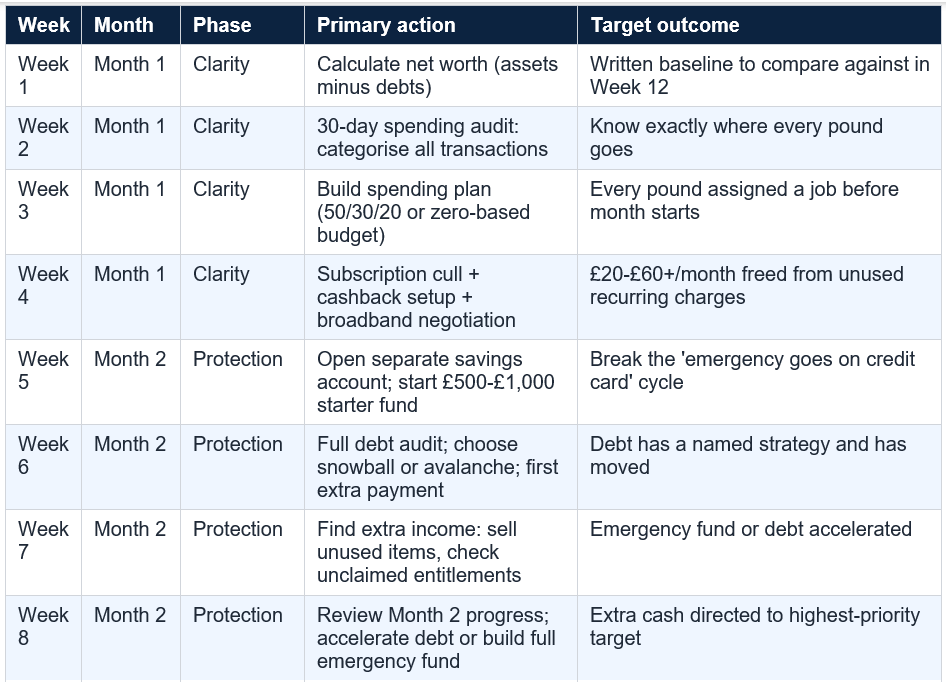
Not financial advice. All outcomes are targets and will vary based on individual income, expenses, debt, and circumstances. The plan is a framework; adapt the specific actions to your situation.
The standard progression after the 90-day plan: build the full emergency fund to three to six months of core expenses (if not already there); eliminate all high-interest consumer debt; increase pension and ISA contributions as income allows and debt reduces; start learning about investing beyond the basic index fund; consider financial protection review annually.
This is not exciting. It is, however, the compounding of small, consistent actions that produces substantial wealth over years — the process described in the 21 Money Lessons article in this series.
Schedule the next 90-day review before you leave Week 12. Set a date. Put it in the calendar. The rhythm of quarterly financial reviews — twelve weeks of doing, one week of reviewing, twelve more weeks of doing — produces an annual pattern of deliberate financial progress that compound over a decade into genuinely different financial outcomes. Not financial advice.
80% of Americans have financial regrets for 2025. 44% of those with regrets made no progress on them. The gap between having a regret and doing something about it is almost always the absence of a specific, dated, sequential plan. This is the plan. It will not work perfectly. Week 4 will probably turn up fewer savings than hoped. Week 6 will probably reveal a debt balance that feels daunting. Week 9 will require a conversation with HR that feels awkward. None of that matters, because the direction is correct, and the direction sustained over 90 days produces a Day 90 that is measurably better than Day 1.
Start with Week 1 this week. Not next month. Not after the holiday. Not when things are ‘less busy.’ The opportunity cost of one more month is the compound growth on one more month of investments not made and the interest on one more month of debt not paid. Start now. Not financial advice. Consult a qualified independent financial adviser if you need guidance specific to your circumstances.
Yes — with specific, sequential actions, three months is enough time to: calculate your net worth (Week 1), complete a spending audit (Week 2), build a budget (Week 3), cancel unused subscriptions (Week 4), start an emergency fund (Weeks 5-8), create a debt repayment plan and make meaningful early progress (Weeks 6-8), optimise your pension to capture the employer match (Week 9), open or fund a Stocks and Shares ISA (Week 10), and review protection (Week 11). None of these will produce complete financial transformation in 90 days — debt is not typically paid off in 3 months and ISA wealth is not built in 3 months. What 3 months does produce is the foundation, the systems, and the habits that compound into material change over the following years. Research by UCL's Phillippa Lally found that habits typically form in approximately 66 days, which falls within the 90-day window. The 'You Can Change Your Finances in 3 Months' video format has over 1.7 million views as of May 2026, reflecting strong public resonance with the timeframe. Not financial advice.
What order should I do things in — emergency fund or debt first?
The standard sequence used in this plan (and supported by most major financial frameworks including Dave Ramsey's Baby Steps): (1) Build a starter emergency fund (£500-£1,000 / $500-$1,000) first. (2) Then attack debt aggressively. The reason for the starter fund first: without it, the first unexpected expense goes back onto the credit card, restarting the debt cycle. The starter fund breaks this cycle. After consumer debt is eliminated: (3) Build the full emergency fund to 3-6 months of expenses. (4) Then invest aggressively. Exception: always contribute enough to your pension to capture the full employer match before building the emergency fund, because the employer match is a 100% guaranteed return — higher than any interest rate on debt. Not financial advice. Individual circumstances vary — if in serious debt difficulty, contact StepChange (UK) or NFCC (US) for free specialist advice.
How much money do I need to start this plan?
No minimum amount is needed to start. Week 1 (net worth calculation) and Week 2 (spending audit) cost nothing. Week 3 (budget) costs nothing. Week 4 (subscription cancellations) generates money. By Week 5, the goal is to find £500-£1,000 for the starter emergency fund over the course of the month — which for most households comes from a combination of subscription savings, spending reductions from the budget, and any one-off income (selling items, overtime). The plan is specifically designed to start from wherever you are, not from an assumed income or savings level. Erica Grundza, CFP at Betterment (NBC/AP 2026): 'It can be as simple as saving $10 each week.' Start at any amount. Not financial advice.
What should I do if I have very high debt levels?
If you are in serious debt (unable to meet minimum payments, receiving creditor contact, or feeling overwhelmed by debt), the 90-day plan in this article is a framework for people managing their finances, not specialist debt crisis advice. In the UK, contact StepChange (0800 138 1111, free, charity) or National Debtline (0808 808 4000, free) for specialist debt advice — these charities can help you explore options including debt management plans, individual voluntary arrangements (IVAs), and in extreme cases, bankruptcy or sequestration. In the US, the National Foundation for Credit Counseling (NFCC, 1-800-388-2227) provides free or low-cost counselling. For those with manageable but significant consumer debt: the plan in this article applies — the debt audit in Week 6 and the acceleration in Week 8 are designed to be the starting point for systematic reduction. Not financial advice.
Which budgeting method is best — 50/30/20, zero-based, or another system?
The best budgeting method is the one you will actually use. The 50/30/20 rule (50% needs, 30% wants, 20% savings and debt) is the most accessible starting point for most people because it is simple enough to apply without a spreadsheet. Zero-based budgeting (assigning every pound of income a specific category until the balance reaches zero) is more precise and produces better outcomes but requires more weekly engagement. For people in debt-payoff mode: the 50/30/20 can become 50/20/30 (reducing wants temporarily to 20% and increasing the savings/debt allocation to 30%). Dr Bruce Ross (University of Kentucky): 'Redefine a budget as a spending plan to reduce stress and remove negative connotations.' MoneyHelper (UK, free at moneyhelper.org.uk) provides a free online budget planner that is suitable for beginners. Not financial advice.
Table of Contents
- Why 3 Months? The Science of Financial Habit Change
- Before You Start: The 15-Minute Pre-Flight Check
- Month One (Weeks 1–4): Know Exactly Where You Stand
- Week 1: Calculate Your Net Worth
- Week 2: The Full Spending Audit
- Week 3: Build Your Spending Plan
- Week 4: The Subscription Cull
- Month Two (Weeks 5–8): Protect Yourself and Attack Debt
- Week 5: Start the Emergency Fund
- Week 6: The Debt Audit and Strategy
- Week 7: Find Extra Money
- Week 8: Accelerate
- Month Three (Weeks 9–12): Build the Wealth Engine
- Week 9: Optimise Your Pension
- Week 10: Open or Fund Your ISA / Investment Account
- Week 11: Review Protection and Insurance
- Week 12: The 90-Day Review
- The Complete 90-Day Week-by-Week Reference Table
- What Happens After Day 90
- Conclusion: The Plan Is the Difference
- Frequently Asked Questions
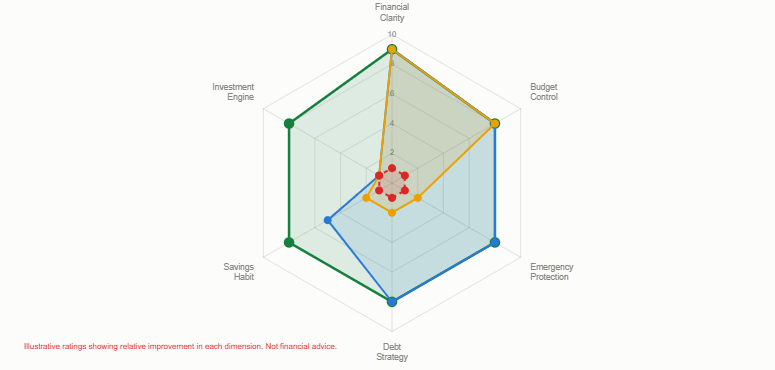
Your 90-day journey — what changes in each month
The wealth engine - - what 3 Months builds Overtime
Why 3 Months? The Science of Financial Habit Change
Most people who decide to fix their finances set a goal and then set it again three months later, having achieved little in between. The problem is almost never motivation. It is the absence of a specific, sequenced plan that converts the aspiration into a series of concrete, dated actions. Without the plan, every week feels like the same shapeless ‘I should do something about my finances’ intention — and intentions without structure expire by February.The 90-day timeframe is specific and deliberate. Research by Phillippa Lally at UCL found that new habits typically form in approximately 66 days — not the commonly cited 21 days. By the end of Week 12, the behaviours built in this plan (automated savings transfers, monthly budget reviews, debt payments above the minimum) will be genuinely habitual, not just aspirational. Three months is also long enough to see real, measurable outcomes: a net worth that is higher than it was in Week 1, a debt balance that has moved, a savings account that actually has something in it.
MarieYolaine Toms, coach and founder of Focused Fire financial coaching company, makes the principle explicit: ‘Resolutions can easily turn into unattainable goals that feel more like a dream. To avoid setting unrealistic expectations, follow a “no resolutions” mindset and instead focus on making an actionable plan.’ (NBC/AP, 2026). The ‘You Can Change Your Finances in 3 Months’ video format has accrued more than 1.7 million views across platforms by May 2026 — reflecting a genuine public appetite for structured, time-bound financial change. This article is the written, comprehensive version of that plan. Not financial advice.
80% of Americans have financial regrets for 2025 (Omni Calculator 2026). Top single regret: overspending on non-essentials (29%). Bankrate: 44% of those with financial regrets made no progress addressing them in the past 12 months. 19% of Americans have zero savings; majority have <$500 (GOBankingRates 2025). UK savings rate rose from 5% pre-pandemic to 11% in 2025 (ONS; KPMG). 56% of UK adults intend to reduce discretionary spending in 2026 (Barclays January 2026). Sources: Omni Calculator 2026; Bankrate; GOBankingRates 2025; ONS/KPMG; Barclays. Not financial advice.
Before You Start: The 15-Minute Pre-Flight Check
Before the 90 days begin, spend 15 minutes answering four questions. You do not need complete answers — estimates are fine. The purpose is to establish a baseline that Week 12 can be compared against. Without a baseline, there is no way to measure progress, and progress measurement is what sustains the motivation to continue.- What is my approximate net worth right now? (Add up everything you own — savings, investments, car value, property equity; subtract everything you owe — mortgage, loans, credit cards, student debt. If the number is negative, write it down anyway. That is your starting line.)
- What is my approximate monthly take-home income after tax?
- What is my total consumer debt (not including mortgage) and what is the average interest rate I am paying on it?
- Do I have any emergency fund at all? If yes, how many months of essential expenses does it cover?
MONTH ONE — WEEKS 1–4 — CLARITY Know exactly where every pound goes and why
Month One: Know Exactly Where You Stand
Month One is not about saving more money or paying off debt. It is about understanding your current financial reality with precision. Most people have only a vague sense of where their money goes — and the gap between vague sense and precise knowledge is typically several hundred pounds per month in untracked, unintentional spending. You cannot cut what you cannot see. Month One makes everything visible. Not financial advice.
Week 1: Calculate Your Net Worth
Net worth is the single most informative financial number you can know. It is assets minus liabilities: everything you own minus everything you owe. Many people avoid this calculation because they are afraid of the answer. But an accurate negative net worth is more useful than a vague anxiety about debt, because it gives you a specific problem to address rather than a general sense of dread.Tools: a free spreadsheet, the Notes app, or a dedicated app such as Money Dashboard (UK) or Copilot (US). The calculation does not need to be precise — an estimate within 10% is sufficient for a planning baseline. The important thing is that you have a number on paper. That number is the one you will beat in Week 12.
Week 1 action: List every financial account (current, savings, ISA, pension, investments) with its current balance. List every debt (credit cards, loans, overdraft, buy-now-pay-later, student loan if applicable) with its balance. Subtract total debts from total assets. Write the result down. This is your Day 1 net worth. Not financial advice.
Week 2: The Full Spending Audit
The spending audit is where the 90-day plan starts to pay for itself. Download or print the last 30 days of transactions across all accounts. Categorise every item: housing, transport, food (groceries separate from restaurants), subscriptions, entertainment, clothing, personal care, and everything else. Then total each category.The experience of completing a spending audit for the first time is reliably surprising. BizNews (2026 financial planning guide): ‘Track your spending for 30 days. You’ll be amazed by what you learn. Even small leaks can sink your savings.’ The surprise is almost always in discretionary categories — the subscriptions that have been running since 2022, the delivery app habit that costs £300/month, the buying of coffee and lunch that collectively runs to £200/month more than the person estimated.
Brighton Journal (2025): ‘Subscriptions and direct debits have a way of quietly adding up so review each one and cancel anything non-essential like streaming services, fitness apps and magazine subscriptions.’ A monthly subscription audit typically uncovers £20–£60 in unused recurring charges (MoneyLion 2026). Not financial advice.
The spending audit hack: many UK banking apps (Monzo, Starling, HSBC Smart Banking) automatically categorise transactions. If yours does, the audit is already 80% done -- just review the categories and identify the surprises. For older-style banking: download the last 30 days as a CSV or PDF and go through it with a highlighter. One colour per category. The totals will tell you where the plan needs to focus. Not financial advice.
Week 3: Build Your Spending Plan
The word ‘budget’ activates resistance in most people. The reframe that makes it work: a budget is not a constraint; it is a spending plan that assigns every pound a specific job before it gets spent. Dr Bruce Ross, Department of Family Sciences at the University of Kentucky: ‘Redefine a budget as a spending plan to reduce stress and remove negative connotations around budgeting. Let values inform your spending and saving habits.’The simplest effective budget structure is the 50/30/20 rule: 50% of take-home income to needs (housing, bills, food, transport), 30% to wants (entertainment, dining, clothes), and 20% to savings and debt repayment. If debt is significant, the 20% becomes 30% or more by temporarily reducing the wants allocation. The specific numbers are less important than the principle: every pound is allocated before the month begins. No allocation = no plan = default overspending.
For UK households, the free Money Helper service (moneyhelper.org.uk) provides a budget planner that walks through the process. For US households, YNAB (You Need A Budget), EveryDollar (free version), or a simple spreadsheet all work. The tool matters less than the habit of using it. Not financial advice.
The most common budget failure: creating a perfect budget in Week 3 and then never reviewing it. A budget is a living document. Commit to a monthly 30-minute budget review -- what BizNews (2026) calls a 'monthly money hour.' Cheryl and Dr Ross (US podcast) suggest making these reviews enjoyable: 'over pancakes or wine, depending on the time of day.' The financial review that you actually do is better than the perfect one you skip. Not financial advice.
Week 4: The Subscription Cull and Quick Wins
With the spending audit complete and the budget built, Week 4 is for acting on what was discovered. The primary target: every recurring charge that is not actively serving you. This includes streaming services you barely use, gym memberships attended fewer than four times per month, premium app subscriptions, unused software licences, charity direct debits set up years ago without review, and any service on autopay whose removal you have been intending to do for months.Cancel the unused ones today. Not next week. Today. The procrastination cost of leaving a £12.99 unused streaming service running for another six months is £78 — for nothing. The cancellation takes three minutes. This is the category where the 90-day plan pays for its time investment fastest. Beyond subscriptions, Week 4 is for other quick wins: calling your broadband/mobile provider to negotiate a better deal (many UK providers will reduce the bill for existing customers who ask, particularly at the end of a contract period), checking for unclaimed cashback, and setting up a cashback platform (TopCashback or Quidco in the UK) for future purchases.
Week 4 actions: (1) Go through bank statements and list every recurring charge. (2) For each: have you used it in the past month? If no: cancel today. (3) Check phone subscription management (Settings → Subscriptions on iPhone; Google Play Store → Subscriptions on Android). (4) Call broadband/mobile provider. Ask: 'I'm thinking of switching -- can you offer me a better rate?' (5) Sign up for TopCashback or Quidco if not already a member. (6) Total the monthly saving from cancelled subscriptions and add it to Week 3's budget under savings. Not consumer advice.
MONTH TWO — WEEKS 5–8 — PROTECTION Build your buffer and take back control of debt
Month Two: Protect Yourself and Attack Debt
Month Two is where the plan gets structural. The spending audit and budget from Month One should already be generating some extra monthly cash — from cancelled subscriptions, identified savings, and deliberate spending decisions. Month Two directs this extra cash toward the two most important financial priorities after knowing where you stand: protection against emergencies and systematic debt reduction. Not financial advice.
Week 5: Start the Emergency Fund
The emergency fund is the most important financial structure most people do not have. 19% of Americans have zero savings; the majority have less than $500 (GOBankingRates 2025). In the UK, the pandemic and subsequent cost-of-living crisis exposed the same vulnerability: households without savings buffers had to use credit cards or high-interest borrowing when unexpected costs hit — turning a manageable problem into a compound one.The Week 5 target is not the full three-to-six month emergency fund. It is the starter emergency fund: £500–£1,000 (UK) or $500–$1,000 (US). The starter fund achieves one critical objective: the next time an emergency arrives (car repair, boiler breakdown, dental bill), it is covered from savings rather than from a credit card at 22–24% APR. This is the break-the-cycle fund. The full emergency fund is built later; the starter fund is built now, this week.
Where to put it: a separate, instantly accessible high-interest savings account. Separate from the current account to reduce the temptation to dip in; instantly accessible because emergencies do not give notice; high-interest because rates in 2026 are sufficient (approximately 4–5% for easy-access accounts in the UK) to make the account slightly productive. The mental separation of ‘this money is not available to spend’ is reinforced by the physical separation of the account. Not financial advice.
Erica Grundza, CFP at Betterment (NBC/AP, 2026): 'When building your goals for 2026, focus on an optimistic, yet realistic, vision for the future. It can be as simple as saving $10 each week in a savings account, or a bigger goal like saving to buy a house in the coming years. It's all about your own journey.' The starter emergency fund is the $10/week goal made concrete -- small enough to be achievable immediately, meaningful enough to break the borrowing cycle. Not financial advice.
Week 6: The Debt Audit and Repayment Strategy
Week 6 is for looking at the full picture of consumer debt — all of it, clearly — and choosing a repayment strategy. This is the week that most people avoid indefinitely, which is why Bankrate (2026) found that 44% of those with financial regrets made no progress on them in the past 12 months. The avoidance of the uncomfortable total is itself the biggest obstacle to clearing it.List every debt: credit card balances, personal loans, overdraft, car finance, buy-now-pay-later balances, student loan if it affects cash flow. For each: note the current balance, the interest rate, and the minimum monthly payment. Two strategies for what to do next:
- Debt Snowball (Dave Ramsey method, adapted for UK by Frugal Family): make minimum payments on all debts; direct all extra cash to the smallest balance. When that debt is cleared, redirect its payment to the next smallest. The psychological advantage: quick wins feel motivating and sustain momentum. Academically, the debt snowball has been shown to improve debt completion rates because motivation matters more than optimisation for most people.
- Debt Avalanche / Waterfall (mathematically optimal): make minimum payments on all debts; direct all extra cash to the highest interest rate debt. This saves the most in interest charges over the life of the debt. Dr Bruce Ross (University of Kentucky): 'Use the avalanche debt pay-off method by making all minimum payments, allocate extra cash to the debt with the highest-interest rate -- work down from there.' Best for those who trust the process and do not need the psychological win of small-balance elimination.
Week 7: Find Extra Money
Week 7 is for expanding the income side of the equation. The budget and subscriptions have already worked on the outgoings side. Now the question is: is there any additional income available that is not currently being captured? For many households, the answer is yes — often in three categories: unused assets, unused time, and unclaimed entitlements.Unused assets: most households have items they no longer use that have resale value — electronics, furniture, clothing, books, sporting equipment. Facebook Marketplace, eBay, Vinted, or local car boot sales convert physical clutter into emergency fund cash. A realistic target for a single weekend clear-out: £100–£500 depending on what is available. Unused time: even a few hours per week of additional income — through freelancing, overtime, tutoring, or selling a skill — can accelerate the debt repayment or emergency fund building dramatically. Unclaimed entitlements: many UK households are not claiming all the benefits and tax reliefs they are entitled to. Marriage Allowance (if eligible), Child Benefit, council tax discounts, pension credit — all are worth checking via the gov.uk benefits calculator. Not financial advice.
Week 8: Accelerate
By Week 8, three things should be true: the starter emergency fund target is either reached or close; the debt repayment plan is running; and the monthly budget is no longer a new idea but an established structure. Week 8 is for reviewing what has been achieved and accelerating where possible.If the starter emergency fund is complete, all extra monthly cash should now move to the debt repayment. If the debt avalanche is the strategy: every additional pound on the highest-interest debt reduces the balance on which interest compounds. A credit card at 22% APR — where every additional £100 payment saves £22 per year in interest — is the highest-returning ‘investment’ available to someone carrying that debt. Not financial advice.
Credit card acceleration maths: £3,000 at 22% APR, minimum payments only = paid off in ~25-30 years with ~£3,000-£4,500 in interest. Same debt with extra £150/month on top of minimum = paid off in approximately 18 months with approximately £500 in total interest. The extra £150/month saves approximately £2,500-£4,000 in interest and 23+ years of debt life. Illustrative only. Not financial advice. Individual rates and balances vary.
MONTH THREE — WEEKS 9–12 — MOMENTUM Automate the wealth-building engine so it runs without you
Month Three: Build the Wealth Engine
By Month Three, the financial picture is significantly clearer than it was 60 days ago. The net worth is known and has moved. The debt has a strategy. The emergency fund has been started. Now the task is to build the systems that make wealth accumulation automatic — so that by the time the 90 days are complete, the financial improvement does not require ongoing willpower to sustain. It runs on its own. Not financial advice.
Week 9: Optimise Your Pension
The pension is the single most financially powerful vehicle available to employed workers in the UK, yet it is the most misunderstood and the most under-used. UK auto-enrolment requires a minimum total contribution of 8% of qualifying earnings (5% employee, 3% employer). Many employers will match additional contributions beyond the minimum — some up to 5%, 7%, or even 10% of salary — making an increase in pension contribution one of the few financial decisions that provides a guaranteed, immediate 100% return on the matched element.Week 9 task: check your payslip, your employer’s HR portal, or your pension provider’s statement. Confirm: (a) what percentage you are currently contributing; (b) what percentage your employer matches; and (c) whether you are contributing enough to capture the full employer match. If not: submit a contribution increase request this week. This is the highest-return single financial action most employed UK workers can take. BizNews (2026): ‘Increase your retirement contributions by 10%. It might feel small now, but your future self will thank you.’ Not financial advice.
UK pension tax relief: basic-rate taxpayers receive 20% tax relief on pension contributions. That means a £100 pension contribution only costs £80 from your take-home pay. Higher-rate taxpayers (20%+ up to 45%) get proportionally more. This makes pension contributions more efficient than equivalent ISA contributions for taxpayers above the basic rate. In 2026/27: annual allowance £60,000; ISA allowance £20,000. A combination of both is the optimal tax-efficient savings approach. Not financial advice.
Week 10: Open or Fund Your ISA or Investment Account
An ISA (Individual Savings Account) in the UK is the second most powerful wealth-building vehicle after the pension. Up to £20,000 per year (2026/27 allowance) can be contributed, and all interest, dividends, and capital gains within the ISA are permanently free from tax — no annual tax return, no capital gains calculation, no dividend tax. A Stocks and Shares ISA invested in a low-cost index fund (such as a Vanguard Lifestrategy or iShares Core fund) provides long-term equity growth in a tax-free wrapper.Week 10 task: if you do not have a Stocks and Shares ISA: open one. Providers include Vanguard UK, Fidelity UK, Hargreaves Lansdown, AJ Bell, and others. If you already have one: increase the monthly contribution. Even £50/month matters. BizNews (2026): ‘Start investing — even if it’s just R500 [or £50] a month. Consistency beats timing every time.’ For US readers: the equivalent is the Roth IRA (permanent tax-free growth on qualified withdrawals; $7,000/year limit in 2026) or the 401(k) (pre-tax contributions). Not financial advice.
£200/month in a Stocks and Shares ISA at 8%/yr: 10 years → ~£36,000. 20 years → ~£118,000. 30 years → ~£298,000. The same money in a cash savings account at 4.5%/yr: 30 years → approximately £165,000. The difference of ~£133,000 is the risk premium from equities -- not guaranteed, but historically the dominant outcome over long horizons. Not a forecast. FV of annuity formula. Not financial advice. Past performance does not predict future results. Investing involves risk including loss of principal.
Week 11: Review Protection and Insurance
Financial resilience is not only about accumulating assets; it is also about protecting against the risks that could destroy years of wealth building in a single event. Week 11 is for reviewing protection — specifically life insurance (if you have dependants), income protection insurance, and contents/buildings cover.The most underused and most important protection product for working-age adults is income protection insurance. It pays a percentage of salary (typically 50–60%) if you are unable to work due to illness or injury, continuing until you return to work or reach the nominated end age. The statistical reality: you are significantly more likely to be unable to work due to illness or injury during your career than to die during your working life — yet life insurance uptake far exceeds income protection uptake among UK households. A simple comparison quote via a comparison site or an independent protection adviser takes under an hour. Not financial advice.
Week 11 is also for reviewing existing policies: are you paying for buildings and contents insurance at a price that has not been re-shopped in two or more years? Loyalty premiums are real; many insurers automatically raise renewal prices for continuing customers. A comparison site check (Comparethemarket, Confused.com, MoneySupermarket) typically takes 15 minutes and produces savings of £50–£200 per year for policyholders who have not shopped around recently. Not financial advice.
Week 12: The 90-Day Review
Week 12 is not a week of action — it is a week of measurement. Pull out the answers you wrote down in the pre-flight check. Calculate your net worth again. Compare it to Day 1. For most people who have followed the plan with reasonable consistency, the change will be measurable: a net worth that is higher (or a negative net worth that is less negative), a debt balance that has moved, a savings account with a starter fund in it, an ISA or investment account that has been opened.More importantly: the systems are now in place. The automated savings transfer runs on payday. The pension contribution captures the employer match. The debt payment goes out at the start of the month. The monthly budget review is in the diary. The ISA contribution is set up as a standing order. None of these requires a new decision every month; they are self-sustaining. The 90-day plan has done its job. BizNews (2026): ‘Celebrate progress, not perfection. It’s a marathon, not a sprint. Recognise the wins.’
Week 12 actions: (1) Recalculate net worth. Compare to Day 1. Write down the change. (2) Check emergency fund balance vs starter target. (3) Check debt balances vs Month 2 Week 6 baseline. (4) Confirm all automated transfers and payments are running. (5) Set 3 new 90-day goals for the next quarter: one for savings, one for debt/investment, one for financial knowledge. (6) Schedule the next 90-day review date in your calendar now. Not financial advice.
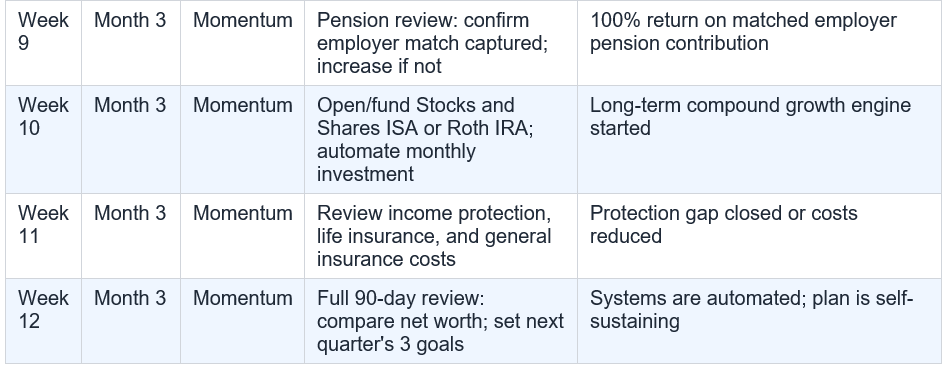
The Complete 90-Day Week-by-Week Reference Table
Not financial advice. All outcomes are targets and will vary based on individual income, expenses, debt, and circumstances. The plan is a framework; adapt the specific actions to your situation.
What Happens After Day 90
The 90-day plan is a reset, not a destination. By Day 90, the financial infrastructure should be in place: the budget, the emergency fund, the debt strategy, the automated investment. What happens next is the repetition of Month Three’s systems with progressively improving inputs: a higher savings rate, a lower debt balance, a larger investment portfolio.The standard progression after the 90-day plan: build the full emergency fund to three to six months of core expenses (if not already there); eliminate all high-interest consumer debt; increase pension and ISA contributions as income allows and debt reduces; start learning about investing beyond the basic index fund; consider financial protection review annually.
This is not exciting. It is, however, the compounding of small, consistent actions that produces substantial wealth over years — the process described in the 21 Money Lessons article in this series.
Schedule the next 90-day review before you leave Week 12. Set a date. Put it in the calendar. The rhythm of quarterly financial reviews — twelve weeks of doing, one week of reviewing, twelve more weeks of doing — produces an annual pattern of deliberate financial progress that compound over a decade into genuinely different financial outcomes. Not financial advice.
Conclusion
The most financially successful people are not, in most cases, the ones with the highest incomes or the most financial sophistication. They are the ones who had a plan and executed it with imperfect but consistent effort. The 90-day plan in this article is available to anyone with any income level at any stage of their financial life — because it starts where you are (the net worth calculation) and builds systematically from there.80% of Americans have financial regrets for 2025. 44% of those with regrets made no progress on them. The gap between having a regret and doing something about it is almost always the absence of a specific, dated, sequential plan. This is the plan. It will not work perfectly. Week 4 will probably turn up fewer savings than hoped. Week 6 will probably reveal a debt balance that feels daunting. Week 9 will require a conversation with HR that feels awkward. None of that matters, because the direction is correct, and the direction sustained over 90 days produces a Day 90 that is measurably better than Day 1.
Start with Week 1 this week. Not next month. Not after the holiday. Not when things are ‘less busy.’ The opportunity cost of one more month is the compound growth on one more month of investments not made and the interest on one more month of debt not paid. Start now. Not financial advice. Consult a qualified independent financial adviser if you need guidance specific to your circumstances.
Frequently Asked Questions
Can I really change my finances in 3 months?Yes — with specific, sequential actions, three months is enough time to: calculate your net worth (Week 1), complete a spending audit (Week 2), build a budget (Week 3), cancel unused subscriptions (Week 4), start an emergency fund (Weeks 5-8), create a debt repayment plan and make meaningful early progress (Weeks 6-8), optimise your pension to capture the employer match (Week 9), open or fund a Stocks and Shares ISA (Week 10), and review protection (Week 11). None of these will produce complete financial transformation in 90 days — debt is not typically paid off in 3 months and ISA wealth is not built in 3 months. What 3 months does produce is the foundation, the systems, and the habits that compound into material change over the following years. Research by UCL's Phillippa Lally found that habits typically form in approximately 66 days, which falls within the 90-day window. The 'You Can Change Your Finances in 3 Months' video format has over 1.7 million views as of May 2026, reflecting strong public resonance with the timeframe. Not financial advice.
What order should I do things in — emergency fund or debt first?
The standard sequence used in this plan (and supported by most major financial frameworks including Dave Ramsey's Baby Steps): (1) Build a starter emergency fund (£500-£1,000 / $500-$1,000) first. (2) Then attack debt aggressively. The reason for the starter fund first: without it, the first unexpected expense goes back onto the credit card, restarting the debt cycle. The starter fund breaks this cycle. After consumer debt is eliminated: (3) Build the full emergency fund to 3-6 months of expenses. (4) Then invest aggressively. Exception: always contribute enough to your pension to capture the full employer match before building the emergency fund, because the employer match is a 100% guaranteed return — higher than any interest rate on debt. Not financial advice. Individual circumstances vary — if in serious debt difficulty, contact StepChange (UK) or NFCC (US) for free specialist advice.
How much money do I need to start this plan?
No minimum amount is needed to start. Week 1 (net worth calculation) and Week 2 (spending audit) cost nothing. Week 3 (budget) costs nothing. Week 4 (subscription cancellations) generates money. By Week 5, the goal is to find £500-£1,000 for the starter emergency fund over the course of the month — which for most households comes from a combination of subscription savings, spending reductions from the budget, and any one-off income (selling items, overtime). The plan is specifically designed to start from wherever you are, not from an assumed income or savings level. Erica Grundza, CFP at Betterment (NBC/AP 2026): 'It can be as simple as saving $10 each week.' Start at any amount. Not financial advice.
What should I do if I have very high debt levels?
If you are in serious debt (unable to meet minimum payments, receiving creditor contact, or feeling overwhelmed by debt), the 90-day plan in this article is a framework for people managing their finances, not specialist debt crisis advice. In the UK, contact StepChange (0800 138 1111, free, charity) or National Debtline (0808 808 4000, free) for specialist debt advice — these charities can help you explore options including debt management plans, individual voluntary arrangements (IVAs), and in extreme cases, bankruptcy or sequestration. In the US, the National Foundation for Credit Counseling (NFCC, 1-800-388-2227) provides free or low-cost counselling. For those with manageable but significant consumer debt: the plan in this article applies — the debt audit in Week 6 and the acceleration in Week 8 are designed to be the starting point for systematic reduction. Not financial advice.
Which budgeting method is best — 50/30/20, zero-based, or another system?
The best budgeting method is the one you will actually use. The 50/30/20 rule (50% needs, 30% wants, 20% savings and debt) is the most accessible starting point for most people because it is simple enough to apply without a spreadsheet. Zero-based budgeting (assigning every pound of income a specific category until the balance reaches zero) is more precise and produces better outcomes but requires more weekly engagement. For people in debt-payoff mode: the 50/30/20 can become 50/20/30 (reducing wants temporarily to 20% and increasing the savings/debt allocation to 30%). Dr Bruce Ross (University of Kentucky): 'Redefine a budget as a spending plan to reduce stress and remove negative connotations.' MoneyHelper (UK, free at moneyhelper.org.uk) provides a free online budget planner that is suitable for beginners. Not financial advice.
0 Comments
Be the first to share your thoughts on this article.