

Financial Literacy
Can Your Family Live on One Income? 7 First Money Moves
Two-thirds of US households with children now have both parents working. Even six-figure earners say one income feels nearly impossible to live on. But 15 to 18 million married-couple households are doing it — by choice or circumstance. Whether a growing family, a job loss, a health issue, or a deliberate lifestyle decision is behind the question, the answer is the same: survivability on one income is a preparation problem, not an income problem. These seven money moves, made before the transition, change the outcome entirely.
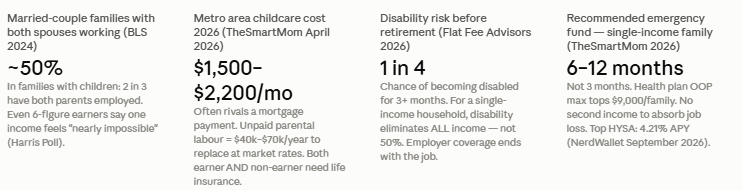
Mark Hamrick, Bankrate's senior economic analyst, is direct about the scale of the shift: 'Where there was a time in the US when a married couple with children could get by with a single-wage earner in the house, those days are mostly vestiges of the past.' The data from the Bureau of Labor Statistics confirms it: about half of all married-couple families in the US now have both spouses employed. In families with children, two-thirds of all households have both parents working outside the home (CNBC December 2025). The Harris Poll found that even six-figure earners say one income feels 'nearly impossible' to live on.
And yet 15 to 18 million married-couple households are doing it. Some are doing it because of childcare costs that make work economically irrational for a lower-earning partner. Some are doing it because of a health event, a job loss, or a family member who needs full-time care. Some are doing it by deliberate choice — prioritising time over income at a specific life stage. The circumstances differ. The financial preparation required does not. These seven money moves, executed before the single-income life begins, are what separate the families who make it work from those who spend the first year in crisis.
Two-thirds of US households with children have both parents working (BLS 2024, cited CNBC December 2025). 25-30% of married-couple families live on a single income — 15-18 million households (US Census/BLS). 5 million stay-at-home parents rely on one working spouse. Even six-figure earners say one income feels 'nearly impossible' (Harris Poll). A dual-to-single income shift can happen overnight: divorce, job loss, death of a spouse, a new baby, a health crisis (Hometap/ABC17 News August 2026). US median household income 2026: approximately $83,000. Childcare in metro areas 2026: $1,500-$2,200/month (TheSmartMom April 2026). Health plan OOP maximum 2026: regularly tops $9,000 per family.
The deliberate choice group includes families where the childcare calculation does not work out. In metro areas, childcare runs $1,500 to $2,200 per month in 2026, according to TheSmartMom's April 2026 family financial guide. For a family where the lower-earning parent would bring home $2,800 per month after tax, the net benefit of that second income is $600 to $1,300 per month — before accounting for work-related costs (second car, professional wardrobe, convenience food, commuting). Many families discover the net gain from dual income is smaller than it appears, and opt for the arrangement where one partner manages the household full-time.
The involuntary group includes families navigating a disability, a redundancy, a family health crisis, or a bereavement. The Hometap report, published in August 2026 and cited across multiple news outlets, identifies the overnight nature of this transition: 'A change in circumstances — a divorce, the death of a spouse, a job loss, a growing family — can turn a two-income household into a one-income household overnight.' For this group, the preparation described in this guide was not completed before the transition — and the financial reality they face is substantially harder.
The hybrid group includes households that have always been single-income — solo earners supporting a family without a partner — as well as gig and freelance households where income is irregular rather than absent. The creditgenius Substack analysis of US Census and BLS data notes that gig and hybrid income has replaced stable W-2 checks for roughly a third of working parents in 2026, creating a category of household that is technically dual-income on paper but effectively single-income in cash flow predictability.
The critical distinction for financial planning purposes is not whether a household is single-income by choice or necessity — it is whether the financial preparation for single-income living was completed before the transition. The seven money moves in this guide are designed to be made in advance. They do not solve the problem once the crisis has arrived. They prevent the crisis from arriving in the first place.
Housing is the largest variable. The Hometap August 2026 analysis notes that housing affordability is often measured against the mortgage alone — but property taxes, insurance, utilities, maintenance, and unplanned repairs can add hundreds or thousands per month. Industry guidance suggests budgeting 1% to 4% of the home's value annually for maintenance. On a $400,000 home, that is $4,000 to $16,000 per year — $333 to $1,333 per month that does not appear in the mortgage payment but must come from somewhere. A household whose mortgage payment is affordable on one income may still be unable to sustain the full cost of homeownership on one income once these costs are included.
The second largest variable, for families with young children, is childcare. At $1,500 to $2,200 per month in metro areas, childcare often rivals the mortgage payment. Families transitioning to single income because one parent is stopping work are eliminating childcare as a cost — but adding the full economic value of that parent's time to the household equation. TheSmartMom's April 2026 guide quantifies it: replacing the unpaid labour of childcare, household management, and transportation at market rates would cost $40,000 to $70,000 per year.
The true cost test is best conducted as a cash flow simulation rather than a budget exercise. Identify the sole earner's current net take-home pay. Subtract every actual monthly expenditure — not the budget, the actuals — for the last three months. The result is either a surplus (the transition is viable with adjustments) or a deficit (the transition requires structural changes to housing, debt, or spending before it becomes viable). Most households find a gap. The purpose of the seven money moves is to close it before the transition happens.
The simulation answers the questions that no spreadsheet can: not 'can we afford it in theory?' but 'what does it feel like when the month-end balance reflects one income?' It reveals which spending categories are genuinely flexible and which ones are not. It surfaces the irregular costs — car repairs, dental bills, school fees, home maintenance — that monthly budget projections systematically omit. And it generates the data needed to make honest decisions about housing, debt, and lifestyle adjustments before those decisions are made under financial pressure.
The savings accumulation from the simulation is also the beginning of the emergency fund described in Money Move #2. Three months of diverting the second income to savings while the household operates on one income produces both the trial and the financial cushion simultaneously. A household with a net take-home of $8,000 per month (dual income) and a sole earner's take-home of $5,500 per month accumulates $7,500 in diverted savings over three months — a meaningful contribution to the six-month emergency fund target.
How to run the one-income simulation. Month 1: identify the sole earner's exact net take-home pay (after all deductions). Open a separate savings account. Set up an automatic transfer on payday that sends the second earner's take-home equivalent to that savings account. Live exclusively on the sole earner's income. Month 2: track every actual expenditure against the sole earner's income. Identify where the month runs short and by how much. Month 3: evaluate without making any other changes. At the end of Month 3: the gap between what the household needs and what one income provides is the precise figure the remaining six money moves must address. The simulation savings become the seed of the emergency fund.
The standard advice of three to six months of expenses was calibrated for dual-income households where partial income replacement provides a buffer. For single-income households, the Due.com financial checklist (July 2026) recommends six months or more. TheSmartMom's April 2026 comprehensive guide goes further: 'Three months no longer cuts it' for families with children, particularly in the context of health plan out-of-pocket maximums that 'regularly top $9,000 per family.' The ARQ Wealth February 2026 new parent financial planning guide makes the point numerically: if monthly expenses were $4,000 before children and are now $5,500, the emergency fund target based on the new post-transition budget is $33,000 to $66,000 — not the pre-child figure.
Critically, the emergency fund must be sized to the post-transition budget — not the current dual-income budget. A family whose monthly expenses are $7,500 on dual income but will be $5,800 on single income (after childcare is eliminated and other adjustments are made) has an emergency fund target of $34,800 to $69,600. This is the amount that should be in accessible, FDIC-insured savings before the transition begins.
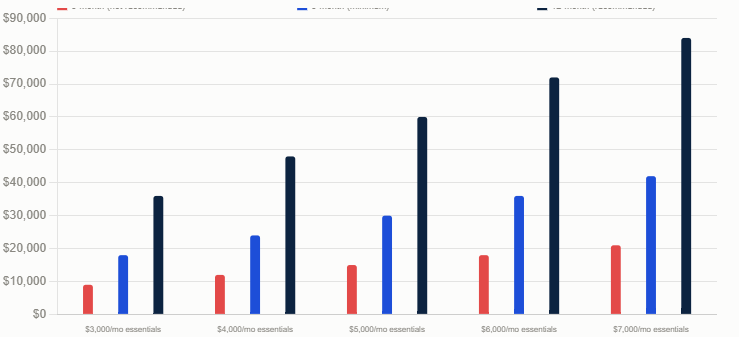
Emergency fund sizing for single-income transition. Monthly essential expenses after transition (sole earner net take-home minus surplus): $5,800/month. 6-month target: $34,800. 9-month target: $52,200. 12-month target: $69,600. Current top HYSA rate (NerdWallet September 2026): 4.21% APY. Annual interest on $34,800 at 4.21%: approximately $1,465/year while the fund is held. The fund earns meaningful income rather than sitting idle. Hold in a dedicated HYSA at a separate bank from the daily checking account — psychological separation prevents casual spending and same-day liquidity is maintained for genuine emergencies. Not financial advice.
Emergency fund building strategy. Step 1: calculate the post-transition monthly essential expenses (sole earner budget from Money Move #1 simulation). Step 2: multiply by 6 (minimum) to 12 (recommended for single-income). Step 3: open a dedicated HYSA at a separate bank from your current accounts. Use the three-month simulation period (Money Move #1) to direct the second income to this account. Step 4: continue directing any surplus income to this fund until the target is reached before the transition date. Step 5: document what constitutes a genuine emergency — job loss, major medical expense, major home repair, car replacement — and commit that the fund is not available for discretionary use.
The life insurance target for the earner is typically 10 to 15 times annual income — the rule of thumb that Flat Fee Advisors' September 2026 comprehensive checklist for families with young children cites. On a $90,000 annual income, that is $900,000 to $1,350,000 in death benefit. A 20-year term policy at these coverage levels is more affordable than most families expect: the Flat Fee Advisors analysis notes that a $1.5 million 20-year term policy for a healthy 35-year-old non-smoking male in the preferred underwriting class costs approximately $62 per month. Term life insurance is the appropriate product for most working-age families — pure protection for the income-dependent years, at the lowest cost per dollar of coverage available.
Disability insurance is the more neglected half of the income protection pair — and statistically the more likely claim. The Flat Fee Advisors 2026 guide states the probability directly: the chance of becoming disabled for at least three months before retirement is 1 in 4. For a single-income household where disability means $0 in monthly income rather than a 50% reduction, this risk is acute. Employer-provided disability coverage is typically 60% income replacement and terminates with employment. TheSmartMom's April 2026 guide warns explicitly: 'When you lose the job, the coverage disappears — right when you need it most.' The correct approach is a long-term disability policy owned independently of the employer — portable, not subject to termination of employment, covering 60 to 70% of income for the duration of the disability up to retirement age.
The single-income disability trap: a household that has transitioned from dual to single income and relies entirely on employer-provided disability insurance loses all income protection at exactly the moment it is most needed — when the sole earner loses the job or becomes too unwell to work. Employer coverage is not owned by the employee; it is a benefit that ends with employment. An independently owned long-term disability policy, purchased while the earner is healthy and employed, is portable and cannot be cancelled by an employer. The premium is the single most cost-effective risk management spend in a single-income household's budget. Not insurance advice — consult a licensed insurance professional.
TheSmartMom's April 2026 family financial safety guide quantifies it clearly: 'The unpaid labor of childcare, household management, and transportation would cost $40,000 to $70,000 per year to replace at market rates.' A stay-at-home parent who manages childcare, school logistics, cooking, household administration, and parental availability for three children is performing work that, if purchased commercially in 2026, would run $40,000 to $70,000 per year. If the non-working parent dies, the surviving earner faces two simultaneous crises: grief and the immediate cost of replacing all of those functions while continuing to work full-time.
The appropriate coverage for a non-working parent is a term life insurance policy sized to cover the cost of replacing their labour for the years of dependancy — typically until the youngest child is self-sufficient. TheSmartMom's April 2026 guide recommends $250,000 to $500,000 in term coverage for a stay-at-home parent: sufficient to fund professional childcare, household management, and the surviving earner's reduced work capacity during the adjustment period, without requiring the family to make immediate, drastic lifestyle changes during the most difficult period of their lives.
Non-working parent insurance checklist. Step 1: obtain a term life insurance quote for $250,000 to $500,000 in coverage. Because the non-working parent has no earned income, the premium is typically lower than for the earner's policy. A healthy 33-year-old woman, non-smoker, in preferred health, can often obtain $500,000 of 20-year term coverage for $25 to $40/month. Step 2: own the policy independently, not through the earner's employer benefits. Step 3: review beneficiary designations — the surviving earner should be the primary beneficiary, with a trust or a named guardian arrangement for the children if both parents die simultaneously. Consult a qualified insurance professional for coverage sizing specific to your family's cost structure.
The Hometap August 2026 analysis, cited across multiple news outlets, is explicit about the gap between mortgage-only thinking and true homeownership cost: 'Housing affordability is often measured against the mortgage alone, but that figure captures only part of what a home costs to own. Property taxes, insurance, utilities, maintenance, and unplanned repairs together can add hundreds or thousands of dollars to monthly obligations — expenses that may be manageable across two incomes but strain a single one.' On a $400,000 home at the industry benchmark of 1% to 4% of value in annual maintenance, the non-mortgage cost alone is $333 to $1,333 per month beyond the mortgage payment.
The housing audit for a single-income transition involves calculating the true all-in monthly cost of the current home — not just the mortgage — and comparing it against the 28% to 30% of gross monthly income guideline that most financial planners apply to housing costs for single-income households. If the true housing cost exceeds that threshold significantly on one income, the household has a pre-transition decision to make: adjust income, adjust the home, or adjust other costs to bring housing into proportion.
The housing decision is not reversible quickly. A household that transitions to single income and immediately discovers the house is unaffordable faces the worst possible version of the problem: selling under pressure, in a compressed timeline, potentially at a loss or at an inopportune point in the market. The housing audit in Money Move #5 is specifically designed to surface this situation while the dual income is still intact and the household has time to make the decision calmly — including the option of selling the current home and purchasing one sized to the single-income budget before the transition.
The Ramsey Solutions framework for pre-transition debt management — eliminate high-interest consumer debt before the transition, not after — is not about mathematical optimisation. It is about removing fixed obligations that will constrain the household's ability to absorb the first emergency after the transition. A single-income household with no consumer debt has a meaningful amount of monthly cash flow flexibility. The same household carrying $15,000 in credit card debt at 22% APR has $400 to $500 in minimum monthly payments that consume income available for nothing else, in a month where the emergency fund may already be under pressure.
The priority debt list for pre-transition elimination, in order: credit cards and other revolving debt above 8% APR; personal loans; vehicle loans if the payment is large relative to the vehicle's value or replacement cost. Student loans at fixed low federal rates can be managed alongside single-income living rather than prioritised above the emergency fund. The mortgage is a secured debt with a specific payoff that should be evaluated against the housing audit in Money Move #5 — accelerating mortgage payoff before transition can reduce the monthly fixed cost meaningfully.
Debt elimination impact on single-income viability. Household with $15,000 in credit card debt at 22% APR: minimum monthly payment approximately $450/month. Sole earner's take-home: $5,500/month. With $15,000 debt: $5,500 - $450 = $5,050 available for all other costs. Without that debt (eliminated pre-transition): $5,500 available — a 9% increase in effective monthly cash flow, no change in income required. To eliminate $15,000 at 22% APR: accelerate payoff using both incomes before transition. At $800/month above minimum: paid off in approximately 16 months. The dual-income period before transition is the optimal time to eliminate this obligation. Not financial advice.
This vulnerability matters in two specific scenarios. First, in the event of divorce: the non-working parent who left a career to raise children emerges from a divorce with reduced earning capacity, reduced retirement savings, and potentially weakened credit, having given productive years to the household rather than the labour market. Second, in the event of the earner's death or disability: the non-working parent faces both grief and the immediate challenge of re-entering the workforce after a potentially extended absence, with their financial identity potentially degraded.
The measures that protect the non-working parent's independent financial identity are specific and actionable. Spousal IRA contributions: the non-working spouse can receive IRA contributions based on the working spouse's income — $8,000 per year in 2026 (age 50+) or $7,000 (under 50) — building retirement savings independently. A joint credit card where the non-working spouse is a primary account holder (not just an authorised user) maintains their credit history. An individual emergency fund — separate from the household emergency fund — gives the non-working parent a personal financial buffer that belongs to them alone. And any professional development or part-time income the non-working parent pursues maintains their labour market connection during the years they are primarily at home.
Non-working parent financial identity checklist. 1) Spousal IRA: the working spouse contributes to a spousal IRA in the non-working partner's name. $7,000/year (2026, under 50) or $8,000 (age 50+). Open at any major brokerage (Fidelity, Vanguard, Schwab). Invest in broad index funds from day one. 2) Credit history: ensure the non-working spouse is a primary account holder on at least one joint credit card. Monitor credit reports at annualcreditreport.com annually. 3) Personal emergency fund: open a HYSA in the non-working partner's name with an initial target of $3,000 to $5,000 — funded from household budget, owned entirely by them. 4) Professional identity: maintain any professional licences, certifications, or memberships. Even 5 to 10 hours of part-time or freelance work monthly sustains skills and income history. 5) Life insurance: as discussed in Money Move #4, the non-working spouse should have their own term life policy.
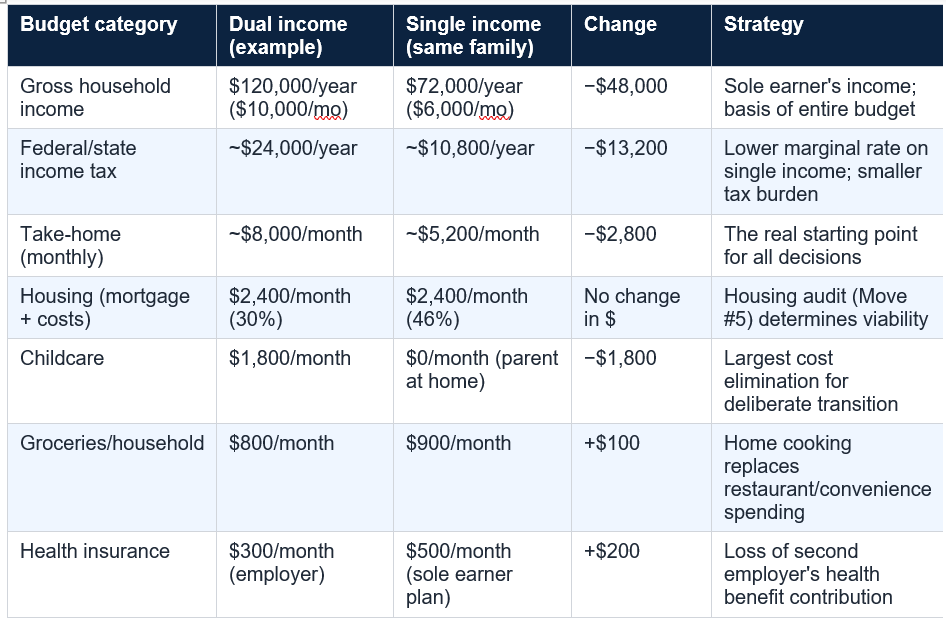
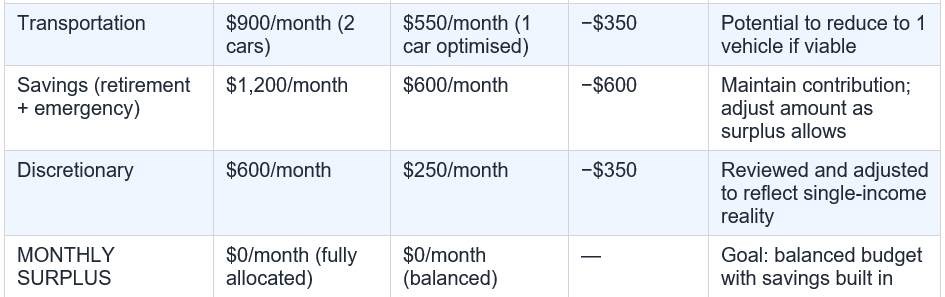
Note: This example assumes a deliberate transition where childcare costs are eliminated by the non-working parent's presence. Numbers are illustrative for a median-range US family. Tax calculation is simplified. Individual situations vary significantly by state, family size, and employer benefits. Not financial advice.
In the highest-cost states and metro areas, the single-income question becomes more about income threshold than spending discipline. When housing alone consumes 45% to 60% of net take-home on a single income, the structural gap between cost and income cannot be closed by spending adjustments alone. For families in these markets, the single-income decision may require a geographic component — whether that is a deliberate move to a lower-cost area before the transition, or a specific plan to earn a higher income that makes the local cost structure viable.
The EPI Family Budget Calculator (updated March 2026) provides the most rigorous estimate of what a modest but adequate standard of living requires for different family types in different regions. For a two-adult, one-child family in rural Mississippi, the monthly income needed is approximately $5,200. For the same family in San Jose, California, it is approximately $13,000. The gap reflects housing, childcare, healthcare, and transportation cost differences that no budgeting skill can fully bridge without a corresponding income. Geography is the variable that financial planning frameworks most often underprice.
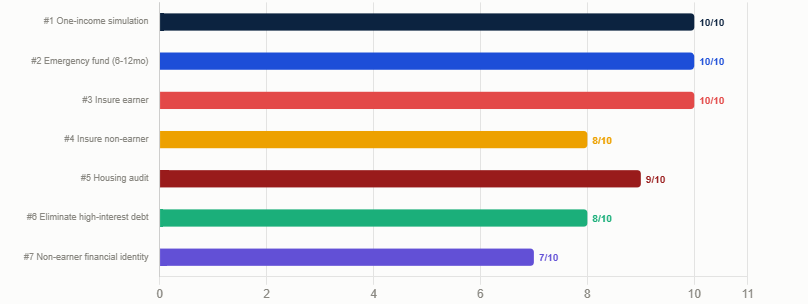
The seven money moves in this guide are not a prescription for every family's circumstances. They are the evidence-based preparation steps that address the seven most common failure points in the single-income transition: the gap between projected and actual spending (Move #1), the absence of adequate liquid reserves (Move #2), the uninsured earner (Move #3), the uninsured non-earner (Move #4), the housing cost mismatch (Move #5), the high-interest debt that consumes cash flow (Move #6), and the financial vulnerability of the non-working parent (Move #7).
Every one of these moves is best made while both incomes are still flowing. The dual-income period before the transition is the household's most financially powerful window — the one in which savings accumulate fastest, debt can be eliminated most aggressively, and major structural decisions can be made without pressure. Use it. The family that completes these moves before day one of the single-income life does not find the first year in crisis. They find it, typically, in the same place the simulation left them: tight but manageable, with a plan they already know works because they ran it for three months before it became permanent.
Yes — but the data makes clear it requires specific preparation. Approximately 25-30% of married-couple families in the US are doing it — roughly 15 to 18 million households (US Census/BLS data). The families that make it work have typically addressed the seven structural challenges: adequate emergency fund, income protection insurance, debt elimination, housing affordability, and the non-working parent's financial identity. The ones that struggle entered the transition without completing that preparation and face the structural gaps under financial pressure. Kiplinger's March 2026 analysis shows it is significantly easier in lower-cost states where housing and daily expenses are below the national median. In high-cost coastal cities and metros, the same one-income viability may require a substantially higher earner's income — or a deliberate decision about geographic flexibility. Not financial advice — individual viability depends on income, location, debt, and family structure.
How much emergency fund should a single-income family have?
More than the standard three-to-six-month guideline that applies to dual-income households. TheSmartMom's April 2026 comprehensive family financial guide recommends a minimum of six months for single-income households, and notes that three months no longer cuts it for families with children given health plan out-of-pocket maximums that regularly exceed $9,000 per family. Due.com's July 2026 financial checklist for parents recommends growing toward six months or more once a child arrives. The target should be based on the post-transition monthly essential expenses — not the current dual-income spending level. If post-transition monthly essentials are $5,800, a six-month fund is $34,800 and a twelve-month fund is $69,600. Hold it in a HYSA (top rates 4.21% APY, NerdWallet September 2026) at a separate bank from the daily checking account. Fund it aggressively during the dual-income period before the transition, using the second income as the primary contribution source.
Does a stay-at-home parent need life insurance?
Yes — and this is one of the most underappreciated financial planning gaps for single-income families. The non-working parent performs unpaid labour — childcare, household management, transportation, administration — that TheSmartMom's April 2026 guide quantifies at $40,000 to $70,000 per year to replace at market rates. If the non-working parent dies, the surviving earner must continue working full-time while simultaneously replacing all of those functions commercially. TheSmartMom recommends $250,000 to $500,000 of term life insurance for a stay-at-home parent — enough to fund professional childcare, household support, and the surviving earner's reduced work capacity during the adjustment period without requiring immediate, drastic financial changes. The premium is typically very affordable because the non-working parent has no earned income at risk, and healthy younger adults are the cheapest to insure. Always consult a licensed insurance professional for coverage sizing specific to your family situation.
What should I prioritise first: emergency fund or debt repayment?
The standard framework from most financial advisers (including the Ramsey Baby Steps) is: first build a small starter emergency fund ($1,000 to $2,000) to prevent emergencies from adding new debt, then eliminate all high-interest consumer debt aggressively, then build the full emergency fund. For single-income household preparation specifically, this sequencing is sound — but the timeline matters. If the transition to single income is 12 to 18 months away, the correct approach is to use the remaining dual-income period to both accelerate high-interest debt elimination and build the emergency fund simultaneously, since the combination of both needs to be completed before day one. A household with $15,000 in credit card debt and two incomes has the capacity to pay off the debt and build the emergency fund in parallel across 12 to 15 months if both incomes are directed aggressively toward the goal. Once on single income, the priority shifts exclusively to maintaining the emergency fund and meeting minimums on any remaining low-interest debt. Not financial advice — individual debt and income situations vary.
How does the non-working parent build retirement savings?
Through a spousal IRA — a specific provision in the US tax code that allows a non-working spouse to receive IRA contributions based on the working spouse's earned income. In 2026, the contribution limit is $7,000 per year (or $8,000 for those aged 50 and over). The spousal IRA can be a Traditional IRA (pre-tax contributions, taxable at withdrawal) or a Roth IRA (after-tax contributions, tax-free growth and withdrawal). For a non-working spouse who expects to be in a lower tax bracket in retirement than the working spouse currently is, the Roth IRA is often the more tax-advantaged choice. The Roth also has no required minimum distributions in the owner's lifetime. Beyond the spousal IRA, the non-working parent benefits from maintaining any workplace retirement accounts from prior employment rather than cashing them out, and from any part-time or freelance income that allows them to make direct IRA or SEP-IRA contributions. Not tax advice — consult a qualified tax professional for the correct IRA type and contribution strategy for your household.
What are the biggest risks of transitioning to one income unprepared?
Three risks dominate. First, the immediate liquidity crisis: an unexpected expense — medical bill, car repair, home emergency — that the household cannot absorb without high-interest borrowing, because the emergency fund was sized for dual-income risk rather than single-income risk. Second, the total income loss event: the sole earner loses their job, becomes disabled, or dies without adequate insurance coverage. In a dual-income household, either of these events is severe but survivable. In a single-income household without disability insurance, a disability eliminates all household income. Without adequate life insurance, a death leaves the surviving parent to manage both grief and financial crisis simultaneously. Third, the housing trap: a household that transitioned to single income with a mortgage sized to dual-income capacity discovers — typically in the first year — that the true cost of homeownership exceeds what one income can sustain. The Hometap August 2026 analysis identifies maintenance, taxes, insurance, and utilities as the costs that push housing from marginally affordable to genuinely unaffordable on a single income. All three risks are addressed by specific money moves in this guide, and all three are best addressed before the transition — not during it.
Table of Contents
- Why Living on One Income Is Harder Than It Used to Be
- Who Is Living on One Income in 2026 — and Why
- The True Cost Test: Can You Actually Do This?
- Money Move #1 — Run the One-Income Simulation for Three Months
- Money Move #2 — Build a Six-to-Twelve-Month Emergency Fund First
- Money Move #3 — Insure the Earner: Life and Disability Coverage
- Money Move #4 — Insure the Non-Earner: Why the Stay-at-Home Parent Needs Coverage Too
- Money Move #5 — Audit Your Housing Against One-Income Reality
- Money Move #6 — Eliminate High-Interest Debt Before the Transition
- Money Move #7 — Build the Non-Working Parent's Independent Financial Identity
- The One-Income Budget: What It Actually Looks Like
- State-by-State Reality: Where One Income Goes Furthest
- Conclusion: The Answer Is Preparation, Not Income
- Frequently Asked Questions
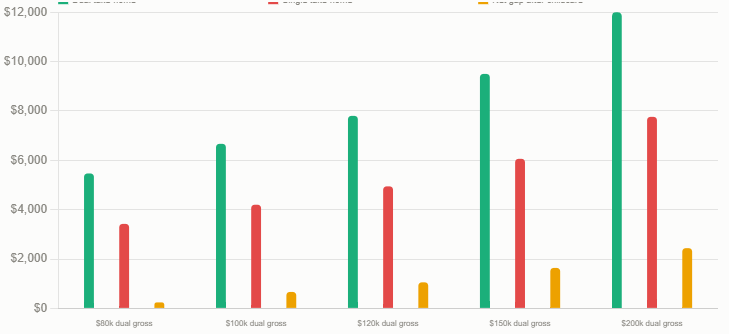
Dual vs single income: the monthly cash flow gap
The 7 money moves: priority and what each one protects
Emergency fund targets at different expense levels
Why Living on One Income Is Harder Than It Used to Be
There was a time — and it was not that long ago — when one income was the default rather than the aspiration. The post-war decades in the United States were built on a model where a single breadwinner, typically male, supported a household that included a partner managing the home, children, and the unpaid work that made the household function. That model did not disappear because families stopped wanting it. It disappeared because the economics that made it possible stopped working.Mark Hamrick, Bankrate's senior economic analyst, is direct about the scale of the shift: 'Where there was a time in the US when a married couple with children could get by with a single-wage earner in the house, those days are mostly vestiges of the past.' The data from the Bureau of Labor Statistics confirms it: about half of all married-couple families in the US now have both spouses employed. In families with children, two-thirds of all households have both parents working outside the home (CNBC December 2025). The Harris Poll found that even six-figure earners say one income feels 'nearly impossible' to live on.
And yet 15 to 18 million married-couple households are doing it. Some are doing it because of childcare costs that make work economically irrational for a lower-earning partner. Some are doing it because of a health event, a job loss, or a family member who needs full-time care. Some are doing it by deliberate choice — prioritising time over income at a specific life stage. The circumstances differ. The financial preparation required does not. These seven money moves, executed before the single-income life begins, are what separate the families who make it work from those who spend the first year in crisis.
Two-thirds of US households with children have both parents working (BLS 2024, cited CNBC December 2025). 25-30% of married-couple families live on a single income — 15-18 million households (US Census/BLS). 5 million stay-at-home parents rely on one working spouse. Even six-figure earners say one income feels 'nearly impossible' (Harris Poll). A dual-to-single income shift can happen overnight: divorce, job loss, death of a spouse, a new baby, a health crisis (Hometap/ABC17 News August 2026). US median household income 2026: approximately $83,000. Childcare in metro areas 2026: $1,500-$2,200/month (TheSmartMom April 2026). Health plan OOP maximum 2026: regularly tops $9,000 per family.
Who Is Living on One Income in 2026 — and Why
Single-income households are not a monolithic group. The 15 to 18 million married-couple households living on one income in 2026 include families across every income level and every geography, arriving at the one-income arrangement through very different paths.The deliberate choice group includes families where the childcare calculation does not work out. In metro areas, childcare runs $1,500 to $2,200 per month in 2026, according to TheSmartMom's April 2026 family financial guide. For a family where the lower-earning parent would bring home $2,800 per month after tax, the net benefit of that second income is $600 to $1,300 per month — before accounting for work-related costs (second car, professional wardrobe, convenience food, commuting). Many families discover the net gain from dual income is smaller than it appears, and opt for the arrangement where one partner manages the household full-time.
The involuntary group includes families navigating a disability, a redundancy, a family health crisis, or a bereavement. The Hometap report, published in August 2026 and cited across multiple news outlets, identifies the overnight nature of this transition: 'A change in circumstances — a divorce, the death of a spouse, a job loss, a growing family — can turn a two-income household into a one-income household overnight.' For this group, the preparation described in this guide was not completed before the transition — and the financial reality they face is substantially harder.
The hybrid group includes households that have always been single-income — solo earners supporting a family without a partner — as well as gig and freelance households where income is irregular rather than absent. The creditgenius Substack analysis of US Census and BLS data notes that gig and hybrid income has replaced stable W-2 checks for roughly a third of working parents in 2026, creating a category of household that is technically dual-income on paper but effectively single-income in cash flow predictability.
The critical distinction for financial planning purposes is not whether a household is single-income by choice or necessity — it is whether the financial preparation for single-income living was completed before the transition. The seven money moves in this guide are designed to be made in advance. They do not solve the problem once the crisis has arrived. They prevent the crisis from arriving in the first place.
The True Cost Test: Can You Actually Do This?
Before any of the seven money moves, the question of viability requires an honest answer. The answer does not come from a back-of-envelope calculation or an income percentage rule. It comes from understanding the gap between what the household actually spends and what one income actually covers — net, after tax, after the retirement contributions and health insurance premiums that are deducted before take-home.Housing is the largest variable. The Hometap August 2026 analysis notes that housing affordability is often measured against the mortgage alone — but property taxes, insurance, utilities, maintenance, and unplanned repairs can add hundreds or thousands per month. Industry guidance suggests budgeting 1% to 4% of the home's value annually for maintenance. On a $400,000 home, that is $4,000 to $16,000 per year — $333 to $1,333 per month that does not appear in the mortgage payment but must come from somewhere. A household whose mortgage payment is affordable on one income may still be unable to sustain the full cost of homeownership on one income once these costs are included.
The second largest variable, for families with young children, is childcare. At $1,500 to $2,200 per month in metro areas, childcare often rivals the mortgage payment. Families transitioning to single income because one parent is stopping work are eliminating childcare as a cost — but adding the full economic value of that parent's time to the household equation. TheSmartMom's April 2026 guide quantifies it: replacing the unpaid labour of childcare, household management, and transportation at market rates would cost $40,000 to $70,000 per year.
The true cost test is best conducted as a cash flow simulation rather than a budget exercise. Identify the sole earner's current net take-home pay. Subtract every actual monthly expenditure — not the budget, the actuals — for the last three months. The result is either a surplus (the transition is viable with adjustments) or a deficit (the transition requires structural changes to housing, debt, or spending before it becomes viable). Most households find a gap. The purpose of the seven money moves is to close it before the transition happens.
Money Move #1 — Run the One-Income Simulation for Three Months
The single most revealing preparation a household can make before transitioning to one income is to live on one income for three full months while both incomes are still flowing. This is not a budget projection — it is a real-money test of viability. The second income is diverted to a dedicated savings account untouched during the simulation.The simulation answers the questions that no spreadsheet can: not 'can we afford it in theory?' but 'what does it feel like when the month-end balance reflects one income?' It reveals which spending categories are genuinely flexible and which ones are not. It surfaces the irregular costs — car repairs, dental bills, school fees, home maintenance — that monthly budget projections systematically omit. And it generates the data needed to make honest decisions about housing, debt, and lifestyle adjustments before those decisions are made under financial pressure.
The savings accumulation from the simulation is also the beginning of the emergency fund described in Money Move #2. Three months of diverting the second income to savings while the household operates on one income produces both the trial and the financial cushion simultaneously. A household with a net take-home of $8,000 per month (dual income) and a sole earner's take-home of $5,500 per month accumulates $7,500 in diverted savings over three months — a meaningful contribution to the six-month emergency fund target.
How to run the one-income simulation. Month 1: identify the sole earner's exact net take-home pay (after all deductions). Open a separate savings account. Set up an automatic transfer on payday that sends the second earner's take-home equivalent to that savings account. Live exclusively on the sole earner's income. Month 2: track every actual expenditure against the sole earner's income. Identify where the month runs short and by how much. Month 3: evaluate without making any other changes. At the end of Month 3: the gap between what the household needs and what one income provides is the precise figure the remaining six money moves must address. The simulation savings become the seed of the emergency fund.
Money Move #2 — Build a Six-to-Twelve-Month Emergency Fund First
The emergency fund for a single-income household is not the same as the emergency fund for a dual-income household. In a dual-income household, a job loss by one partner is partially absorbed by the surviving income. In a single-income household, the same job loss eliminates all household income simultaneously. The risk profile is fundamentally different — and the emergency fund target should reflect it.The standard advice of three to six months of expenses was calibrated for dual-income households where partial income replacement provides a buffer. For single-income households, the Due.com financial checklist (July 2026) recommends six months or more. TheSmartMom's April 2026 comprehensive guide goes further: 'Three months no longer cuts it' for families with children, particularly in the context of health plan out-of-pocket maximums that 'regularly top $9,000 per family.' The ARQ Wealth February 2026 new parent financial planning guide makes the point numerically: if monthly expenses were $4,000 before children and are now $5,500, the emergency fund target based on the new post-transition budget is $33,000 to $66,000 — not the pre-child figure.
Critically, the emergency fund must be sized to the post-transition budget — not the current dual-income budget. A family whose monthly expenses are $7,500 on dual income but will be $5,800 on single income (after childcare is eliminated and other adjustments are made) has an emergency fund target of $34,800 to $69,600. This is the amount that should be in accessible, FDIC-insured savings before the transition begins.
Emergency fund sizing for single-income transition. Monthly essential expenses after transition (sole earner net take-home minus surplus): $5,800/month. 6-month target: $34,800. 9-month target: $52,200. 12-month target: $69,600. Current top HYSA rate (NerdWallet September 2026): 4.21% APY. Annual interest on $34,800 at 4.21%: approximately $1,465/year while the fund is held. The fund earns meaningful income rather than sitting idle. Hold in a dedicated HYSA at a separate bank from the daily checking account — psychological separation prevents casual spending and same-day liquidity is maintained for genuine emergencies. Not financial advice.
Emergency fund building strategy. Step 1: calculate the post-transition monthly essential expenses (sole earner budget from Money Move #1 simulation). Step 2: multiply by 6 (minimum) to 12 (recommended for single-income). Step 3: open a dedicated HYSA at a separate bank from your current accounts. Use the three-month simulation period (Money Move #1) to direct the second income to this account. Step 4: continue directing any surplus income to this fund until the target is reached before the transition date. Step 5: document what constitutes a genuine emergency — job loss, major medical expense, major home repair, car replacement — and commit that the fund is not available for discretionary use.
Money Move #3 — Insure the Earner: Life and Disability Coverage
In a single-income household, the earner is the financial system. Their income is not one of two inputs — it is the only input. The risk of its interruption, whether temporary (disability) or permanent (death), must be specifically and substantially addressed before the household transitions to single income. The combination of adequate life insurance and long-term disability insurance for the sole earner is the most important insurance decision a single-income family makes.The life insurance target for the earner is typically 10 to 15 times annual income — the rule of thumb that Flat Fee Advisors' September 2026 comprehensive checklist for families with young children cites. On a $90,000 annual income, that is $900,000 to $1,350,000 in death benefit. A 20-year term policy at these coverage levels is more affordable than most families expect: the Flat Fee Advisors analysis notes that a $1.5 million 20-year term policy for a healthy 35-year-old non-smoking male in the preferred underwriting class costs approximately $62 per month. Term life insurance is the appropriate product for most working-age families — pure protection for the income-dependent years, at the lowest cost per dollar of coverage available.
Disability insurance is the more neglected half of the income protection pair — and statistically the more likely claim. The Flat Fee Advisors 2026 guide states the probability directly: the chance of becoming disabled for at least three months before retirement is 1 in 4. For a single-income household where disability means $0 in monthly income rather than a 50% reduction, this risk is acute. Employer-provided disability coverage is typically 60% income replacement and terminates with employment. TheSmartMom's April 2026 guide warns explicitly: 'When you lose the job, the coverage disappears — right when you need it most.' The correct approach is a long-term disability policy owned independently of the employer — portable, not subject to termination of employment, covering 60 to 70% of income for the duration of the disability up to retirement age.
The single-income disability trap: a household that has transitioned from dual to single income and relies entirely on employer-provided disability insurance loses all income protection at exactly the moment it is most needed — when the sole earner loses the job or becomes too unwell to work. Employer coverage is not owned by the employee; it is a benefit that ends with employment. An independently owned long-term disability policy, purchased while the earner is healthy and employed, is portable and cannot be cancelled by an employer. The premium is the single most cost-effective risk management spend in a single-income household's budget. Not insurance advice — consult a licensed insurance professional.
Money Move #4 — Insure the Non-Earner: Why the Stay-at-Home Parent Needs Coverage Too
This is the insurance planning mistake most frequently missed by single-income families: the non-working parent believes they do not need life insurance because they do not earn income. This reasoning ignores the economic value of the unpaid work they perform — and the catastrophic cost of replacing it if they die.TheSmartMom's April 2026 family financial safety guide quantifies it clearly: 'The unpaid labor of childcare, household management, and transportation would cost $40,000 to $70,000 per year to replace at market rates.' A stay-at-home parent who manages childcare, school logistics, cooking, household administration, and parental availability for three children is performing work that, if purchased commercially in 2026, would run $40,000 to $70,000 per year. If the non-working parent dies, the surviving earner faces two simultaneous crises: grief and the immediate cost of replacing all of those functions while continuing to work full-time.
The appropriate coverage for a non-working parent is a term life insurance policy sized to cover the cost of replacing their labour for the years of dependancy — typically until the youngest child is self-sufficient. TheSmartMom's April 2026 guide recommends $250,000 to $500,000 in term coverage for a stay-at-home parent: sufficient to fund professional childcare, household management, and the surviving earner's reduced work capacity during the adjustment period, without requiring the family to make immediate, drastic lifestyle changes during the most difficult period of their lives.
Non-working parent insurance checklist. Step 1: obtain a term life insurance quote for $250,000 to $500,000 in coverage. Because the non-working parent has no earned income, the premium is typically lower than for the earner's policy. A healthy 33-year-old woman, non-smoker, in preferred health, can often obtain $500,000 of 20-year term coverage for $25 to $40/month. Step 2: own the policy independently, not through the earner's employer benefits. Step 3: review beneficiary designations — the surviving earner should be the primary beneficiary, with a trust or a named guardian arrangement for the children if both parents die simultaneously. Consult a qualified insurance professional for coverage sizing specific to your family's cost structure.
Money Move #5 — Audit Your Housing Against One-Income Reality
Housing is the largest fixed cost in most household budgets — and the one that is hardest to adjust quickly when income changes. The mortgage payment that was comfortably affordable on two incomes may be unmanageable on one, not because the mortgage itself is unaffordable, but because the true cost of homeownership includes costs that fluctuate and cannot be deferred indefinitely.The Hometap August 2026 analysis, cited across multiple news outlets, is explicit about the gap between mortgage-only thinking and true homeownership cost: 'Housing affordability is often measured against the mortgage alone, but that figure captures only part of what a home costs to own. Property taxes, insurance, utilities, maintenance, and unplanned repairs together can add hundreds or thousands of dollars to monthly obligations — expenses that may be manageable across two incomes but strain a single one.' On a $400,000 home at the industry benchmark of 1% to 4% of value in annual maintenance, the non-mortgage cost alone is $333 to $1,333 per month beyond the mortgage payment.
The housing audit for a single-income transition involves calculating the true all-in monthly cost of the current home — not just the mortgage — and comparing it against the 28% to 30% of gross monthly income guideline that most financial planners apply to housing costs for single-income households. If the true housing cost exceeds that threshold significantly on one income, the household has a pre-transition decision to make: adjust income, adjust the home, or adjust other costs to bring housing into proportion.
The housing decision is not reversible quickly. A household that transitions to single income and immediately discovers the house is unaffordable faces the worst possible version of the problem: selling under pressure, in a compressed timeline, potentially at a loss or at an inopportune point in the market. The housing audit in Money Move #5 is specifically designed to surface this situation while the dual income is still intact and the household has time to make the decision calmly — including the option of selling the current home and purchasing one sized to the single-income budget before the transition.
Money Move #6 — Eliminate High-Interest Debt Before the Transition
High-interest debt in a single-income household is not just a financial cost — it is a structural vulnerability. In a dual-income household, a credit card balance at 22% APR is a problem with two earners' capacity to solve it. In a single-income household, the same balance competes with every other monthly obligation for a single earner's take-home pay. The monthly minimum payment is a fixed cost that cannot be skipped, and the interest compounds regardless of what the household earns.The Ramsey Solutions framework for pre-transition debt management — eliminate high-interest consumer debt before the transition, not after — is not about mathematical optimisation. It is about removing fixed obligations that will constrain the household's ability to absorb the first emergency after the transition. A single-income household with no consumer debt has a meaningful amount of monthly cash flow flexibility. The same household carrying $15,000 in credit card debt at 22% APR has $400 to $500 in minimum monthly payments that consume income available for nothing else, in a month where the emergency fund may already be under pressure.
The priority debt list for pre-transition elimination, in order: credit cards and other revolving debt above 8% APR; personal loans; vehicle loans if the payment is large relative to the vehicle's value or replacement cost. Student loans at fixed low federal rates can be managed alongside single-income living rather than prioritised above the emergency fund. The mortgage is a secured debt with a specific payoff that should be evaluated against the housing audit in Money Move #5 — accelerating mortgage payoff before transition can reduce the monthly fixed cost meaningfully.
Debt elimination impact on single-income viability. Household with $15,000 in credit card debt at 22% APR: minimum monthly payment approximately $450/month. Sole earner's take-home: $5,500/month. With $15,000 debt: $5,500 - $450 = $5,050 available for all other costs. Without that debt (eliminated pre-transition): $5,500 available — a 9% increase in effective monthly cash flow, no change in income required. To eliminate $15,000 at 22% APR: accelerate payoff using both incomes before transition. At $800/month above minimum: paid off in approximately 16 months. The dual-income period before transition is the optimal time to eliminate this obligation. Not financial advice.
Money Move #7 — Build the Non-Working Parent's Independent Financial Identity
The final money move addresses a risk that is rarely discussed in single-income household planning: the financial vulnerability of the non-working parent. In a household where one partner has left paid employment to manage the home and raise children, that partner typically has no independent income, no independent retirement savings building, reduced Social Security accrual, and — in many cases — a credit profile that weakens over time as their individual credit history becomes dormant.This vulnerability matters in two specific scenarios. First, in the event of divorce: the non-working parent who left a career to raise children emerges from a divorce with reduced earning capacity, reduced retirement savings, and potentially weakened credit, having given productive years to the household rather than the labour market. Second, in the event of the earner's death or disability: the non-working parent faces both grief and the immediate challenge of re-entering the workforce after a potentially extended absence, with their financial identity potentially degraded.
The measures that protect the non-working parent's independent financial identity are specific and actionable. Spousal IRA contributions: the non-working spouse can receive IRA contributions based on the working spouse's income — $8,000 per year in 2026 (age 50+) or $7,000 (under 50) — building retirement savings independently. A joint credit card where the non-working spouse is a primary account holder (not just an authorised user) maintains their credit history. An individual emergency fund — separate from the household emergency fund — gives the non-working parent a personal financial buffer that belongs to them alone. And any professional development or part-time income the non-working parent pursues maintains their labour market connection during the years they are primarily at home.
Non-working parent financial identity checklist. 1) Spousal IRA: the working spouse contributes to a spousal IRA in the non-working partner's name. $7,000/year (2026, under 50) or $8,000 (age 50+). Open at any major brokerage (Fidelity, Vanguard, Schwab). Invest in broad index funds from day one. 2) Credit history: ensure the non-working spouse is a primary account holder on at least one joint credit card. Monitor credit reports at annualcreditreport.com annually. 3) Personal emergency fund: open a HYSA in the non-working partner's name with an initial target of $3,000 to $5,000 — funded from household budget, owned entirely by them. 4) Professional identity: maintain any professional licences, certifications, or memberships. Even 5 to 10 hours of part-time or freelance work monthly sustains skills and income history. 5) Life insurance: as discussed in Money Move #4, the non-working spouse should have their own term life policy.
The One-Income Budget: What It Actually Looks Like
A one-income budget is not simply a two-income budget with one income removed. It requires rethinking every spending category against the new income reality and identifying where the household's cost structure can flex and where it cannot.Note: This example assumes a deliberate transition where childcare costs are eliminated by the non-working parent's presence. Numbers are illustrative for a median-range US family. Tax calculation is simplified. Individual situations vary significantly by state, family size, and employer benefits. Not financial advice.
State-by-State Reality: Where One Income Goes Furthest
The viability of a single-income household is not just a budget question — it is a geography question. Kiplinger's March 2026 SmartAsset analysis identifies significant variation in how far a single income stretches by state. In lower-cost states — West Virginia, Arkansas, and much of the rural Midwest and South — home prices are well below the national median, transportation costs are lower, and a household income of $60,000 to $75,000 can support a single-income family in a way that the same income cannot in Boston, San Francisco, or Manhattan.In the highest-cost states and metro areas, the single-income question becomes more about income threshold than spending discipline. When housing alone consumes 45% to 60% of net take-home on a single income, the structural gap between cost and income cannot be closed by spending adjustments alone. For families in these markets, the single-income decision may require a geographic component — whether that is a deliberate move to a lower-cost area before the transition, or a specific plan to earn a higher income that makes the local cost structure viable.
The EPI Family Budget Calculator (updated March 2026) provides the most rigorous estimate of what a modest but adequate standard of living requires for different family types in different regions. For a two-adult, one-child family in rural Mississippi, the monthly income needed is approximately $5,200. For the same family in San Jose, California, it is approximately $13,000. The gap reflects housing, childcare, healthcare, and transportation cost differences that no budgeting skill can fully bridge without a corresponding income. Geography is the variable that financial planning frameworks most often underprice.
Conclusion
The question 'can our family afford to live on one income?' sounds like a question about income. It is actually a question about preparation. Millions of families across every income level are living on one income in 2026 — including households earning $50,000 per year and households earning $200,000. The common thread in the ones that are surviving and thriving is not how much the earner brings home. It is how much work was done before the transition to reduce the gap between what one income provides and what the household needs.The seven money moves in this guide are not a prescription for every family's circumstances. They are the evidence-based preparation steps that address the seven most common failure points in the single-income transition: the gap between projected and actual spending (Move #1), the absence of adequate liquid reserves (Move #2), the uninsured earner (Move #3), the uninsured non-earner (Move #4), the housing cost mismatch (Move #5), the high-interest debt that consumes cash flow (Move #6), and the financial vulnerability of the non-working parent (Move #7).
Every one of these moves is best made while both incomes are still flowing. The dual-income period before the transition is the household's most financially powerful window — the one in which savings accumulate fastest, debt can be eliminated most aggressively, and major structural decisions can be made without pressure. Use it. The family that completes these moves before day one of the single-income life does not find the first year in crisis. They find it, typically, in the same place the simulation left them: tight but manageable, with a plan they already know works because they ran it for three months before it became permanent.
Frequently Asked Questions
Can a family really live on one income in 2026?Yes — but the data makes clear it requires specific preparation. Approximately 25-30% of married-couple families in the US are doing it — roughly 15 to 18 million households (US Census/BLS data). The families that make it work have typically addressed the seven structural challenges: adequate emergency fund, income protection insurance, debt elimination, housing affordability, and the non-working parent's financial identity. The ones that struggle entered the transition without completing that preparation and face the structural gaps under financial pressure. Kiplinger's March 2026 analysis shows it is significantly easier in lower-cost states where housing and daily expenses are below the national median. In high-cost coastal cities and metros, the same one-income viability may require a substantially higher earner's income — or a deliberate decision about geographic flexibility. Not financial advice — individual viability depends on income, location, debt, and family structure.
How much emergency fund should a single-income family have?
More than the standard three-to-six-month guideline that applies to dual-income households. TheSmartMom's April 2026 comprehensive family financial guide recommends a minimum of six months for single-income households, and notes that three months no longer cuts it for families with children given health plan out-of-pocket maximums that regularly exceed $9,000 per family. Due.com's July 2026 financial checklist for parents recommends growing toward six months or more once a child arrives. The target should be based on the post-transition monthly essential expenses — not the current dual-income spending level. If post-transition monthly essentials are $5,800, a six-month fund is $34,800 and a twelve-month fund is $69,600. Hold it in a HYSA (top rates 4.21% APY, NerdWallet September 2026) at a separate bank from the daily checking account. Fund it aggressively during the dual-income period before the transition, using the second income as the primary contribution source.
Does a stay-at-home parent need life insurance?
Yes — and this is one of the most underappreciated financial planning gaps for single-income families. The non-working parent performs unpaid labour — childcare, household management, transportation, administration — that TheSmartMom's April 2026 guide quantifies at $40,000 to $70,000 per year to replace at market rates. If the non-working parent dies, the surviving earner must continue working full-time while simultaneously replacing all of those functions commercially. TheSmartMom recommends $250,000 to $500,000 of term life insurance for a stay-at-home parent — enough to fund professional childcare, household support, and the surviving earner's reduced work capacity during the adjustment period without requiring immediate, drastic financial changes. The premium is typically very affordable because the non-working parent has no earned income at risk, and healthy younger adults are the cheapest to insure. Always consult a licensed insurance professional for coverage sizing specific to your family situation.
What should I prioritise first: emergency fund or debt repayment?
The standard framework from most financial advisers (including the Ramsey Baby Steps) is: first build a small starter emergency fund ($1,000 to $2,000) to prevent emergencies from adding new debt, then eliminate all high-interest consumer debt aggressively, then build the full emergency fund. For single-income household preparation specifically, this sequencing is sound — but the timeline matters. If the transition to single income is 12 to 18 months away, the correct approach is to use the remaining dual-income period to both accelerate high-interest debt elimination and build the emergency fund simultaneously, since the combination of both needs to be completed before day one. A household with $15,000 in credit card debt and two incomes has the capacity to pay off the debt and build the emergency fund in parallel across 12 to 15 months if both incomes are directed aggressively toward the goal. Once on single income, the priority shifts exclusively to maintaining the emergency fund and meeting minimums on any remaining low-interest debt. Not financial advice — individual debt and income situations vary.
How does the non-working parent build retirement savings?
Through a spousal IRA — a specific provision in the US tax code that allows a non-working spouse to receive IRA contributions based on the working spouse's earned income. In 2026, the contribution limit is $7,000 per year (or $8,000 for those aged 50 and over). The spousal IRA can be a Traditional IRA (pre-tax contributions, taxable at withdrawal) or a Roth IRA (after-tax contributions, tax-free growth and withdrawal). For a non-working spouse who expects to be in a lower tax bracket in retirement than the working spouse currently is, the Roth IRA is often the more tax-advantaged choice. The Roth also has no required minimum distributions in the owner's lifetime. Beyond the spousal IRA, the non-working parent benefits from maintaining any workplace retirement accounts from prior employment rather than cashing them out, and from any part-time or freelance income that allows them to make direct IRA or SEP-IRA contributions. Not tax advice — consult a qualified tax professional for the correct IRA type and contribution strategy for your household.
What are the biggest risks of transitioning to one income unprepared?
Three risks dominate. First, the immediate liquidity crisis: an unexpected expense — medical bill, car repair, home emergency — that the household cannot absorb without high-interest borrowing, because the emergency fund was sized for dual-income risk rather than single-income risk. Second, the total income loss event: the sole earner loses their job, becomes disabled, or dies without adequate insurance coverage. In a dual-income household, either of these events is severe but survivable. In a single-income household without disability insurance, a disability eliminates all household income. Without adequate life insurance, a death leaves the surviving parent to manage both grief and financial crisis simultaneously. Third, the housing trap: a household that transitioned to single income with a mortgage sized to dual-income capacity discovers — typically in the first year — that the true cost of homeownership exceeds what one income can sustain. The Hometap August 2026 analysis identifies maintenance, taxes, insurance, and utilities as the costs that push housing from marginally affordable to genuinely unaffordable on a single income. All three risks are addressed by specific money moves in this guide, and all three are best addressed before the transition — not during it.

0 Comments Comments