

Financial Literacy
5 Hard Things You Need to Do to Get Rich
There are 24 million millionaires in the United States — roughly 1 in every 12 American adults. 74% of them are first-generation wealthy. They didn't inherit it. They built it. But the personal savings rate has fallen to 4.2%, credit card debt sits at $1.28 trillion, and most Americans spend 96 cents of every dollar they earn. The gap between knowing how to build wealth and actually doing it is not information. It's behaviour. This guide names the five hardest — and most necessary — behaviours that separate people who get rich from those who don't.

This is not an information problem. It is a behaviour problem. The things that actually build wealth are not complicated — but they are genuinely hard. They require consistent choices against immediate comfort, social pressure, and deeply ingrained psychological patterns. They require doing the opposite of what most of the people around you are doing. And they require sustaining that approach through market crashes, income shocks, and the relentless pressure of a consumer economy designed to extract every dollar before you can save it.
This guide is not a list of clever hacks or financial tricks. It is an honest account of the five behaviours that the data consistently shows separate people who build lasting wealth from those who do not — with the real statistics, the real psychological barriers, and the specific actions required to overcome them.
24 million US millionaires (1 in 12 adults; UBS 2025 Global Wealth Report). 74% first-generation wealthy; 76% attended public schools; 52% took out student loans (Money Guy, June 2026). Median age of reaching millionaire status: 50. Average time taken: 25–30 years. US personal savings rate: 4.2% (Q3 2025). Credit card debt: $1.28 trillion (Q4 2025). Top 1% hold 31.75% of all US wealth — highest since 1989 (Fed, cited The CEO Views, March 2026).
The most striking data point: 71% of Money Guy's working millionaire clients save more than 20% of their income. Not 5%. Not 10%. More than 20%. The US personal savings rate in 2025 was 4.2% — meaning the average American saves approximately one-fifth of what the average millionaire saves. That gap, sustained over 25–30 years, is the entire explanation for the wealth difference.
Fidelity's data adds a parallel story. As of mid-2025, 595,000 people held $1 million or more in a 401(k) account alone — up 27% in a single year. Their average age was 59. Their average tenure in the same retirement plan was 26 years. Their total savings rate was 14.2%. Many earned less than $150,000 per year. These are not stock-pickers or market-timers. As Steady Wealth (March 2026) observes: 'They didn't time the market. They didn't pick winning stocks. They contributed consistently for 26 years and let compounding do the rest. That's a get-rich-slowly story, and it's the only one that works reliably.'
The uncomfortable truth: The millionaire data is democratising. These are not primarily people who inherited money, went to elite schools, or made a single brilliant investment. They are people who did boring things consistently for a long time. The implication is that wealth is more accessible than most people believe — and simultaneously harder, because it requires sustained behaviour over decades rather than a single clever decision.
The US personal savings rate of 4.2% means the average American saves approximately $1 of every $24 earned. The average millionaire in the Money Guy survey saves more than 20 cents of every dollar. The compound difference over 30 years is staggering. But the day-to-day experience of that gap is simply this: the future millionaire says no to things. Consistently. Repeatedly. Without apology.
This is hard because saying no to current consumption for a future benefit requires an unusual ability to delay gratification. It is hard because consumer culture — advertising, social media, peer groups, credit availability — is designed to make spending feel natural and saving feel like sacrifice. And it is hard because the benefit is not visible. You cannot see compound interest accumulating. You cannot feel the protection that a growing investment portfolio provides. The reward is invisible; the sacrifice is immediate.
Richify AI's 2026 analysis of millionaire habits identifies the core reframe: 'Wealthy people don't save what's left after spending. They spend what's left after saving.' The mechanism: automate savings on payday. Before the money arrives in a current account where it can be spent, a predetermined percentage goes to savings and investment accounts. Vanguard and the CFPB found that automation increases long-term savings rates by over 40% (cited Steady Wealth, March 2026). The automation removes the daily decision — and therefore removes the daily temptation.
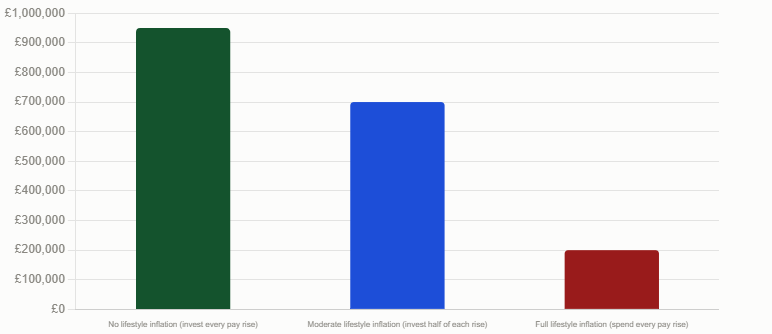
$500 saved and invested per month at 7% annual return over 30 years grows to approximately $567,000. At 20% savings rate on a $50,000 income ($833/month): approximately $946,000 over 30 years. At 4.2% savings rate on the same income ($175/month): approximately $198,000 over 30 years. The difference between the US average savings rate and the millionaire savings rate, sustained over 30 years, is approximately $748,000 on the same income. This is the mathematical expression of the behavioural gap. All figures illustrative at 7% annual return; actual returns vary. Not financial advice.
Automate savings before anything else. Set up a standing order on payday for at least 15–20% of your net income to go to a separate savings or investment account the day your salary arrives. If 20% feels impossible, start with 10% and increase by 1% every six months. The target is not perfection immediately — it is a savings rate that is genuinely higher than the consumption economy expects you to maintain.
The mechanism is well-documented. When income increases — through a promotion, a new job, a bonus — the immediate impulse is to upgrade the lifestyle to match the new income level. A better car. A larger flat. More restaurants, more holidays, better clothes. None of this feels like overspending — it feels like enjoying success. And none of it is individually ruinous. But collectively and cumulatively, it eliminates the wealth-building potential of every pay rise, permanently.
The data supports the scale of the problem. Most people underestimate their discretionary spending by 30–40% (Whye.org). When Marcus, a 32-year-old software developer profiled in the Whye.org lifestyle inflation analysis, tracked his actual spending, he discovered his discretionary category averaged $2,100 per month — not the $800 he had estimated. That $1,300 monthly gap represented his lifestyle inflation in action: invisible, habitual, and compounding in the wrong direction.
Steady Wealth (March 2026) expresses the underlying rule from Morgan Housel: 'Wealth is what you don't see. The nice cars not purchased. The diamonds not bought. The watches not worn.' The people who appear wealthy — driving expensive cars, wearing premium brands, eating at fashionable restaurants — are frequently not building wealth. The people who are building wealth are frequently invisible: ordinary cars, modest homes, conservative spending, quietly growing investment accounts.
The most dangerous moment for wealth-building is not when times are hard. It is when times are good. A pay rise, a bonus, or a promotion is simultaneously a wealth-building opportunity and a lifestyle inflation trap. The wealthy response to a pay rise: invest the majority of the increase before adjusting lifestyle at all. The standard response: immediately adjust lifestyle to the new income level, saving nothing more than before.
When your income increases, apply the '50/50 rule' or stronger: at minimum, direct 50% of any income increase to savings and investment before adjusting your lifestyle budget. Ideally, direct 80–100% of increases to wealth-building for the first year, then reassess. Set up the investment transfer on the same day the pay rise takes effect, before the higher income has been spent for even one month. Lifestyle adjustments made before savings automation is locked in almost always win.
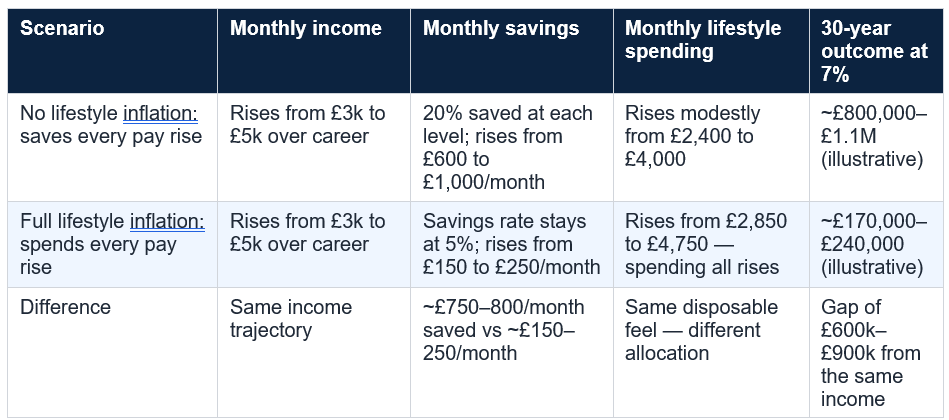
All figures illustrative over 30 years at assumed 7% annual return. Actual investment returns vary and can be negative. Not financial advice.
Warren Buffett has given the same investment advice for decades, distilled in his instructions for his wife's inheritance: 90% in a low-cost S&P 500 index fund, 10% in short-term government bonds (2013 Berkshire Hathaway shareholder letter). The S&P 500 has returned 251.61% over the past decade. His advice does not require picking stocks, timing the market, or hiring expensive advisers. It requires one thing: starting, and not stopping.
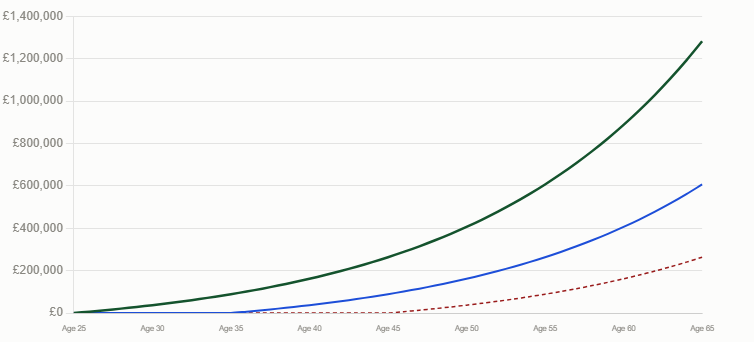
The cost of delay is concrete. At 7% annual return: £500 per month invested from age 25 grows to approximately £567,000 by age 55 (30 years). The same £500 per month starting at age 35 grows to approximately £245,000 by age 55 (20 years). The ten-year delay cost: approximately £322,000 — from the same monthly contribution. The compounding didn't require more money. It required more time. Time is the one thing that cannot be recovered.
The reason people don't start is psychological, not financial. Investing feels risky. Markets fall. Headlines are alarming. There is always a reason to wait for a better moment. But Steady Wealth's analysis of 401(k) millionaires makes the empirical point: 595,000 people with £1 million+ in their 401(k) 'didn't time the market. They didn't pick winning stocks. They contributed consistently for 26 years and let compounding do the rest.' The data does not support waiting for the right moment. It supports starting at the earliest possible moment and not stopping.
Fidelity's research shows that individuals with average incomes who consistently invest 15% of their earnings combined with long-term investment can significantly increase the likelihood of reaching millionaire status (cited New Trader U, April 2025). 15% of income. Consistently. For a long time. That is the formula — and it works regardless of market timing.
Open an investment account today if you do not have one. Set up a monthly direct debit into a globally diversified, low-cost index fund — a total world equity fund or S&P 500 tracker — for whatever amount you can currently afford. Even £50 per month is a start; the habit and the compounding engine are more important than the initial amount. Increase the amount when you can. Do not stop when markets fall. Review annually, not monthly. The goal is decades of consistent contribution, not brilliant market timing. Use a tax-advantaged account (ISA in the UK, 401(k)/IRA in the US) first — the tax saving adds to the compounding effect.
Building a second or third income stream while still working full-time is hard in every dimension. It takes time you do not feel you have. It takes energy after a working day that leaves you tired. It takes sustained attention over months or years before producing meaningful income. And it requires tolerating failure — most side ventures fail, most online businesses fail, most freelance attempts fail before one eventually succeeds. The willingness to absorb those early failures while maintaining a full-time job is one of the most demanding things on this list.
The nature of the additional income stream matters less than the existence and diversification of it. The most common among self-made millionaires: investment income (dividends, interest, capital gains — the 'passive' income that grows as the investment portfolio grows); rental property income; a second business or freelance income; royalties or intellectual property income. The point is not that all of these are available to everyone — it is that relying on a single income source keeps wealth-building limited to what one employer pays one employee for their working hours.
The good news: the first additional income stream is the hardest. An investment portfolio that generates dividend income requires no ongoing time once it is built. A rental property, once established and managed (or via a letting agent), requires relatively limited ongoing input. A freelance skill monetised gradually alongside a day job can become a significant supplementary income over three to five years. The New Trader U analysis (April 2025) makes the key point: 'Income diversification provides stability and accelerates wealth accumulation' — both qualities that a single salary cannot provide.
Identify one specific additional income stream to develop in the next 12 months. Options: increase investment contributions until dividend/interest income is measurable; investigate whether your primary skill set can be monetised as a freelance service; explore ISA or pension top-ups that generate future compounding income; research buy-to-let or REITs (real estate investment trusts) for property income without the management burden. Set a specific monthly target for this additional income stream and a 12-month review date. The goal is not to replace your day job income in year one — it is to have one income stream that is not entirely dependent on your continued employment.
The mathematics are unambiguous. An investor who stays fully invested in the S&P 500 from 1993 to 2023 would have seen roughly 10% annualised returns. An investor who missed the ten best trading days in that 30-year period — typically days that immediately follow sharp falls — would have seen their annual return fall to approximately 5.5%. Missing the twenty best days: around 3.5%. The best days in markets almost always come within weeks of the worst days. Investors who sell during crashes almost invariably miss the recovery.
What makes staying the course during a crash so hard? Three things. First: the financial pain is real and visible — watching a portfolio fall £20,000 or £50,000 triggers a genuine emotional response, regardless of whether the loss is 'only on paper.' Second: the right action (holding or buying more) feels exactly backwards to the pain — it requires acting against the survival instinct that says 'stop the bleeding.' Third: the social environment reinforces panic — friends, family, social media, financial news are all amplifying the fear. The wealthy investor who buys during a crash is not immune to the fear; they are simply better at separating their emotional response from their financial behaviour.
Steady Wealth (March 2026) identifies automation as the infrastructure that makes this possible: 'Research from Vanguard and the CFPB found that automation increases long-term savings rates by over 40%.' The implication extends beyond savings to investing. An investor who has set up automatic monthly contributions to an index fund does not have to make a decision during a market crash. The system invests automatically at the lower price — a process called pound-cost averaging — without requiring the investor to overcome their instinct to stop.
The people who got rich from the S&P 500 are not primarily the people who bought at exactly the right time. They are primarily the people who kept buying regardless of the time, for decades, without stopping when it was scary. That is the hard thing: not the intelligence of the decision, but the emotional discipline of maintaining it through fear.
Set up your investment contributions as automatic transfers that require active cancellation to stop, rather than active initiation to continue. Write down your investment rationale when you are calm — the reasons you are invested, your time horizon, the historical evidence for long-term returns — and read it during the next market downturn before making any decision. If possible, avoid checking portfolio values more than quarterly. The more frequently you check, the more frequently you experience paper losses, and the higher the temptation to react. Automation and reduced monitoring are the infrastructure of long-term investing discipline.
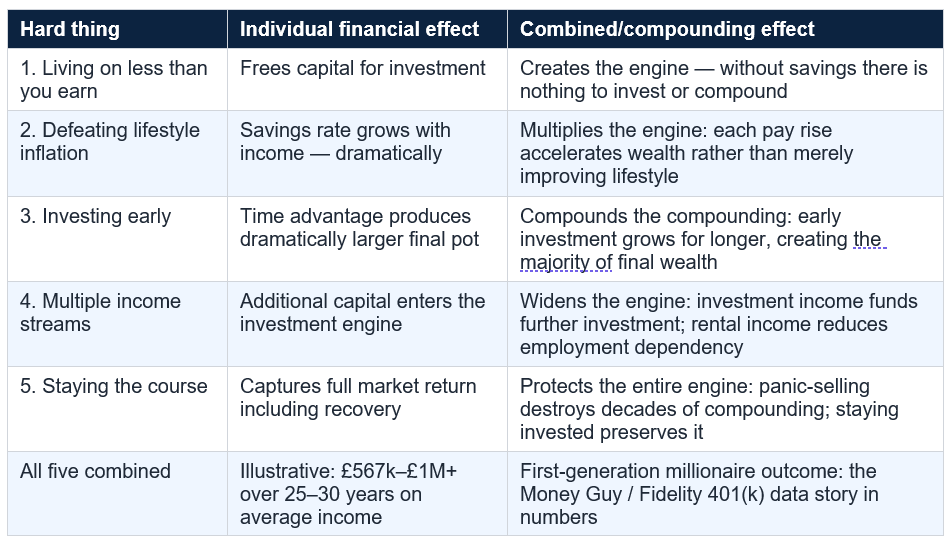
All figures illustrative. Individual outcomes depend on income, savings rate, investment returns, timing, and many other factors. Not financial advice.
Morgan Housel's insight, cited by Steady Wealth (March 2026), captures the paradox: 'Wealth is the nice cars not purchased. The diamonds not bought. The watches not worn. We judge wealth by what we can see, because that's the only information available. But the world is full of people who look modest and are quietly wealthy, and people who look rich and are barely hanging on.'
The K-shaped economy data from Deloitte Insights (June 2026) adds a societal dimension: real consumer spending has grown since 2023 for high-income households but declined for low-income and middle-income households. The Federal Reserve Bank of New York data shows this divergence clearly. The top 1% held 31.75% of all US wealth in Q3 2025 — the highest since records began in 1989. The mechanism that drives this divergence is precisely the five hard things: the wealthy consistently do them; most others do not.
The data is clear: 24 million Americans have become millionaires, 74% of them through first-generation wealth building. They did it by saving significantly more than average, resisting lifestyle inflation, investing early and consistently, building multiple income streams, and staying the course through market downturns. The median time taken: 25–30 years. The median age of achievement: 50. There is no shortcut in the data. There is only the compounding of disciplined behaviour over long periods.
The personal savings rate of 4.2% and $1.28 trillion in credit card debt tell a parallel story: for most people, the five hard things are not being done. The gap between the two outcomes — the millionaire at 50 and the person still carrying credit card debt at 60 — is not primarily an income gap. It is a behaviour gap, sustained over decades, that produces radically different financial outcomes from similar starting points. The five hard things are hard precisely because they work.
According to the UBS 2025 Global Wealth Report (cited by The Military Wallet, May 2026), the average age of US millionaires is 61, and the median age of reaching millionaire status is 50. This means most people who become millionaires take approximately 25–30 years to get there. The 595,000 Americans with $1 million or more in their 401(k) alone (as of mid-2025, per Fidelity) had an average plan tenure of 26 years and saved at an average rate of 14.2%. There is no reliable shortcut — but the data is clear that average incomes, consistently invested over sufficient time, are enough to produce millionaire-level outcomes for a significant proportion of people who start early and maintain discipline.
What savings rate do I need to become a millionaire?
The Money Guy's 2026 survey of 1,000 millionaire households found that 71% of their working clients save more than 20% of their income. Fidelity's research suggests that consistently investing 15% of income can significantly increase the likelihood of reaching millionaire status. The US average personal savings rate of 4.2% (Q3 2025) is dramatically below either of these targets. A 15–20% savings rate, maintained over 25–30 years and invested in a diversified portfolio, is the range most consistently associated with first-generation millionaire outcomes in the research literature. Starting earlier allows a lower savings rate to achieve the same outcome; starting later requires a higher rate to compensate for the lost compounding time.
What is lifestyle inflation and why is it so damaging?
Lifestyle inflation is the automatic increase in spending that follows an increase in income — buying a better car, moving to a larger house, spending more on restaurants and travel — so that the savings rate remains essentially unchanged even as income grows. It is damaging because it eliminates the wealth-building potential of every pay rise. Instead of a pay rise expanding the savings and investment rate, it expands the lifestyle cost base, leaving the person no richer relative to their income than before. Whye.org research shows that most people underestimate their discretionary spending by 30–40%. Most people who receive a pay rise spend the entire increase within six months. The effective antidote is to automate investment transfers to capture a portion of any income increase before it can be spent on lifestyle.
Should I pay off debt before investing?
This depends on the interest rate on the debt. High-interest consumer debt — credit card debt at 21% APR (the US average in Q1 2026) — almost certainly should be paid off before any investment other than capturing an employer pension match. No investment reliably returns 21% per year after tax. For lower-interest debt (student loans below 5–6%, mortgages), the calculus changes: the expected long-term return from a diversified equity portfolio may exceed the interest cost, making simultaneous investing and debt servicing a reasonable approach. The general framework: (1) always capture any employer pension match first — it is an immediate 50–100% return; (2) pay off credit cards and high-interest consumer debt aggressively; (3) invest consistently while servicing lower-interest debt.
Is it too late to start building wealth in my 40s or 50s?
It is harder, but not too late. The 595,000 people with £1 million+ in their 401(k) had an average age of 59 (Fidelity, mid-2025) — meaning they had 26 years in the plan starting at approximately age 33. Someone starting at 45 with 20 years to typical retirement age still has meaningful compounding time available. The key adjustments for a later start: increase the savings rate aggressively (a higher rate is needed to compensate for the shorter compounding window); consider working longer if possible to extend the compounding period; maximise all tax-advantaged account contributions (including catch-up contributions available from age 50 in the US); and take professional financial planning advice to build a realistic projection for your specific situation.
How do I build multiple income streams without burning out?
Tom Corley's research in Rich Habits (cited consistently through 2025–2026) shows that the average self-made millionaire has at least three income streams. But these are typically built sequentially, not simultaneously from scratch. The practical approach: start by ensuring your primary income is as high as possible through career investment and skill development. Then build one additional income stream — most commonly investment income from a growing portfolio, which requires no ongoing time once set up. Then, when that is established, consider a third: a freelance skill, a side business, a rental property, or further investment income. The goal is not to run five businesses simultaneously; it is to avoid the single-point-of-failure of one salary as your only income source.
Table of Contents
- The Gap Is Behavioural, Not Informational
- Who Actually Gets Rich? The 2026 Data on Millionaires
- Hard Thing 1: Living on Significantly Less Than You Earn
- Hard Thing 2: Defeating Lifestyle Inflation Every Time You Get a Pay Rise
- Hard Thing 3: Starting to Invest Before You Feel Ready
- Hard Thing 4: Building Multiple Income Streams While Still Working Full-Time
- Hard Thing 5: Staying the Course When Everyone Around You Is Panicking
- The Compounding Effect: What These Five Things Together Actually Produce
- What Rich Doesn't Look Like
- Conclusion: The Common Thread
- Frequently Asked Questions
Compounding Interest Difference: Start Early vs Start Late
Lifestyle Inflation: Spending Every Pay Rise vs Investing It.
The Gap Is Behavioural, Not Informational
More personal finance information is available today than at any point in human history. Podcasts, YouTube channels, financial planning apps, investment platforms with zero minimum investment — the tools have never been more accessible. Yet the personal savings rate in the United States fell to 4.2% in Q3 2025 (Yahoo Finance / Federal Reserve). Americans are spending approximately 96 cents of every dollar they earn. Total credit card debt hit $1.28 trillion at the end of 2025, with the average indebted cardholder paying approximately $1,655 per year in interest alone — money that cannot compound, cannot be invested, and cannot build wealth.This is not an information problem. It is a behaviour problem. The things that actually build wealth are not complicated — but they are genuinely hard. They require consistent choices against immediate comfort, social pressure, and deeply ingrained psychological patterns. They require doing the opposite of what most of the people around you are doing. And they require sustaining that approach through market crashes, income shocks, and the relentless pressure of a consumer economy designed to extract every dollar before you can save it.
This guide is not a list of clever hacks or financial tricks. It is an honest account of the five behaviours that the data consistently shows separate people who build lasting wealth from those who do not — with the real statistics, the real psychological barriers, and the specific actions required to overcome them.
24 million US millionaires (1 in 12 adults; UBS 2025 Global Wealth Report). 74% first-generation wealthy; 76% attended public schools; 52% took out student loans (Money Guy, June 2026). Median age of reaching millionaire status: 50. Average time taken: 25–30 years. US personal savings rate: 4.2% (Q3 2025). Credit card debt: $1.28 trillion (Q4 2025). Top 1% hold 31.75% of all US wealth — highest since 1989 (Fed, cited The CEO Views, March 2026).
Who Actually Gets Rich? The 2026 Data on Millionaires
The Money Guy Show surveyed 1,000 millionaire households from their Abound Wealth client base in 2026 — people with a median net worth of $2.5 million. The findings challenge almost every popular narrative about how people become wealthy. 74% are first-generation wealthy. 76% attended public schools. 52% took out student loans. 71% financed their first car, just like everyone else. The difference, as the Money Guy analysis concludes, was not where they started. It was the habits, rules, and mindset they built along the way.The most striking data point: 71% of Money Guy's working millionaire clients save more than 20% of their income. Not 5%. Not 10%. More than 20%. The US personal savings rate in 2025 was 4.2% — meaning the average American saves approximately one-fifth of what the average millionaire saves. That gap, sustained over 25–30 years, is the entire explanation for the wealth difference.
Fidelity's data adds a parallel story. As of mid-2025, 595,000 people held $1 million or more in a 401(k) account alone — up 27% in a single year. Their average age was 59. Their average tenure in the same retirement plan was 26 years. Their total savings rate was 14.2%. Many earned less than $150,000 per year. These are not stock-pickers or market-timers. As Steady Wealth (March 2026) observes: 'They didn't time the market. They didn't pick winning stocks. They contributed consistently for 26 years and let compounding do the rest. That's a get-rich-slowly story, and it's the only one that works reliably.'
The uncomfortable truth: The millionaire data is democratising. These are not primarily people who inherited money, went to elite schools, or made a single brilliant investment. They are people who did boring things consistently for a long time. The implication is that wealth is more accessible than most people believe — and simultaneously harder, because it requires sustained behaviour over decades rather than a single clever decision.
Hard Thing 1: Living on Significantly Less Than You Earn
HARD THING 1: Living on Significantly Less Than You Earn — Not Just a Little Less Ramsey Solutions describes it plainly: 'Wealthy people don't save what's left after spending. They spend what's left after saving.' This distinction is not semantic. It describes a completely different relationship with money — one where saving is the first act, not the residual.The US personal savings rate of 4.2% means the average American saves approximately $1 of every $24 earned. The average millionaire in the Money Guy survey saves more than 20 cents of every dollar. The compound difference over 30 years is staggering. But the day-to-day experience of that gap is simply this: the future millionaire says no to things. Consistently. Repeatedly. Without apology.
This is hard because saying no to current consumption for a future benefit requires an unusual ability to delay gratification. It is hard because consumer culture — advertising, social media, peer groups, credit availability — is designed to make spending feel natural and saving feel like sacrifice. And it is hard because the benefit is not visible. You cannot see compound interest accumulating. You cannot feel the protection that a growing investment portfolio provides. The reward is invisible; the sacrifice is immediate.
Richify AI's 2026 analysis of millionaire habits identifies the core reframe: 'Wealthy people don't save what's left after spending. They spend what's left after saving.' The mechanism: automate savings on payday. Before the money arrives in a current account where it can be spent, a predetermined percentage goes to savings and investment accounts. Vanguard and the CFPB found that automation increases long-term savings rates by over 40% (cited Steady Wealth, March 2026). The automation removes the daily decision — and therefore removes the daily temptation.
$500 saved and invested per month at 7% annual return over 30 years grows to approximately $567,000. At 20% savings rate on a $50,000 income ($833/month): approximately $946,000 over 30 years. At 4.2% savings rate on the same income ($175/month): approximately $198,000 over 30 years. The difference between the US average savings rate and the millionaire savings rate, sustained over 30 years, is approximately $748,000 on the same income. This is the mathematical expression of the behavioural gap. All figures illustrative at 7% annual return; actual returns vary. Not financial advice.
Automate savings before anything else. Set up a standing order on payday for at least 15–20% of your net income to go to a separate savings or investment account the day your salary arrives. If 20% feels impossible, start with 10% and increase by 1% every six months. The target is not perfection immediately — it is a savings rate that is genuinely higher than the consumption economy expects you to maintain.
Hard Thing 2: Defeating Lifestyle Inflation Every Time You Get a Pay Rise
HARD THING 2: Defeating Lifestyle Inflation Every Single Time You Get a Pay Rise Lifestyle inflation — the automatic upgrading of spending when income rises — is the most common and most insidious wealth killer. It is the reason that most people who earn more never become significantly richer. They simply consume more expensively.The mechanism is well-documented. When income increases — through a promotion, a new job, a bonus — the immediate impulse is to upgrade the lifestyle to match the new income level. A better car. A larger flat. More restaurants, more holidays, better clothes. None of this feels like overspending — it feels like enjoying success. And none of it is individually ruinous. But collectively and cumulatively, it eliminates the wealth-building potential of every pay rise, permanently.
The data supports the scale of the problem. Most people underestimate their discretionary spending by 30–40% (Whye.org). When Marcus, a 32-year-old software developer profiled in the Whye.org lifestyle inflation analysis, tracked his actual spending, he discovered his discretionary category averaged $2,100 per month — not the $800 he had estimated. That $1,300 monthly gap represented his lifestyle inflation in action: invisible, habitual, and compounding in the wrong direction.
Steady Wealth (March 2026) expresses the underlying rule from Morgan Housel: 'Wealth is what you don't see. The nice cars not purchased. The diamonds not bought. The watches not worn.' The people who appear wealthy — driving expensive cars, wearing premium brands, eating at fashionable restaurants — are frequently not building wealth. The people who are building wealth are frequently invisible: ordinary cars, modest homes, conservative spending, quietly growing investment accounts.
The most dangerous moment for wealth-building is not when times are hard. It is when times are good. A pay rise, a bonus, or a promotion is simultaneously a wealth-building opportunity and a lifestyle inflation trap. The wealthy response to a pay rise: invest the majority of the increase before adjusting lifestyle at all. The standard response: immediately adjust lifestyle to the new income level, saving nothing more than before.
When your income increases, apply the '50/50 rule' or stronger: at minimum, direct 50% of any income increase to savings and investment before adjusting your lifestyle budget. Ideally, direct 80–100% of increases to wealth-building for the first year, then reassess. Set up the investment transfer on the same day the pay rise takes effect, before the higher income has been spent for even one month. Lifestyle adjustments made before savings automation is locked in almost always win.
All figures illustrative over 30 years at assumed 7% annual return. Actual investment returns vary and can be negative. Not financial advice.
Hard Thing 3: Starting to Invest Before You Feel Ready
HARD THING 3: Starting to Invest Before You Feel Ready — and Not Stopping The most financially damaging phrase in personal finance is 'I'll start investing when I have more money.' The people who say this will say it again next year, and the year after. Meanwhile, the most powerful engine of wealth creation — compound interest — is ticking without them.Warren Buffett has given the same investment advice for decades, distilled in his instructions for his wife's inheritance: 90% in a low-cost S&P 500 index fund, 10% in short-term government bonds (2013 Berkshire Hathaway shareholder letter). The S&P 500 has returned 251.61% over the past decade. His advice does not require picking stocks, timing the market, or hiring expensive advisers. It requires one thing: starting, and not stopping.
The cost of delay is concrete. At 7% annual return: £500 per month invested from age 25 grows to approximately £567,000 by age 55 (30 years). The same £500 per month starting at age 35 grows to approximately £245,000 by age 55 (20 years). The ten-year delay cost: approximately £322,000 — from the same monthly contribution. The compounding didn't require more money. It required more time. Time is the one thing that cannot be recovered.
The reason people don't start is psychological, not financial. Investing feels risky. Markets fall. Headlines are alarming. There is always a reason to wait for a better moment. But Steady Wealth's analysis of 401(k) millionaires makes the empirical point: 595,000 people with £1 million+ in their 401(k) 'didn't time the market. They didn't pick winning stocks. They contributed consistently for 26 years and let compounding do the rest.' The data does not support waiting for the right moment. It supports starting at the earliest possible moment and not stopping.
Fidelity's research shows that individuals with average incomes who consistently invest 15% of their earnings combined with long-term investment can significantly increase the likelihood of reaching millionaire status (cited New Trader U, April 2025). 15% of income. Consistently. For a long time. That is the formula — and it works regardless of market timing.
Open an investment account today if you do not have one. Set up a monthly direct debit into a globally diversified, low-cost index fund — a total world equity fund or S&P 500 tracker — for whatever amount you can currently afford. Even £50 per month is a start; the habit and the compounding engine are more important than the initial amount. Increase the amount when you can. Do not stop when markets fall. Review annually, not monthly. The goal is decades of consistent contribution, not brilliant market timing. Use a tax-advantaged account (ISA in the UK, 401(k)/IRA in the US) first — the tax saving adds to the compounding effect.
Hard Thing 4: Building Multiple Income Streams While Still Working Full-Time
HARD THING 4: Building Multiple Income Streams While You Still Have a Day Job Tom Corley's Rich Habits research, cited consistently across multiple 2025–2026 sources, finds that the average self-made millionaire has at least three income streams. Some have four or five. Having only one income source — a single salary — is the financial equivalent of having a single point of failure in a system. It is also a structural ceiling on wealth accumulation: you can only work so many hours, and your salary is capped by what one employer is willing to pay for that time.Building a second or third income stream while still working full-time is hard in every dimension. It takes time you do not feel you have. It takes energy after a working day that leaves you tired. It takes sustained attention over months or years before producing meaningful income. And it requires tolerating failure — most side ventures fail, most online businesses fail, most freelance attempts fail before one eventually succeeds. The willingness to absorb those early failures while maintaining a full-time job is one of the most demanding things on this list.
The nature of the additional income stream matters less than the existence and diversification of it. The most common among self-made millionaires: investment income (dividends, interest, capital gains — the 'passive' income that grows as the investment portfolio grows); rental property income; a second business or freelance income; royalties or intellectual property income. The point is not that all of these are available to everyone — it is that relying on a single income source keeps wealth-building limited to what one employer pays one employee for their working hours.
The good news: the first additional income stream is the hardest. An investment portfolio that generates dividend income requires no ongoing time once it is built. A rental property, once established and managed (or via a letting agent), requires relatively limited ongoing input. A freelance skill monetised gradually alongside a day job can become a significant supplementary income over three to five years. The New Trader U analysis (April 2025) makes the key point: 'Income diversification provides stability and accelerates wealth accumulation' — both qualities that a single salary cannot provide.
Identify one specific additional income stream to develop in the next 12 months. Options: increase investment contributions until dividend/interest income is measurable; investigate whether your primary skill set can be monetised as a freelance service; explore ISA or pension top-ups that generate future compounding income; research buy-to-let or REITs (real estate investment trusts) for property income without the management burden. Set a specific monthly target for this additional income stream and a 12-month review date. The goal is not to replace your day job income in year one — it is to have one income stream that is not entirely dependent on your continued employment.
Hard Thing 5: Staying the Course When Everyone Around You Is Panicking
HARD THING 5: Staying Invested When Markets Fall and Everyone Around You Is Panicking The hardest moment in wealth building is not the decades of discipline. It is the specific, acute moment when markets fall 20% or 30% and every financial headline is catastrophising. In that moment, selling feels like self-protection and staying invested feels like denial. The wealthy behaviour — staying the course, or buying more — is psychologically counterintuitive and socially difficult. It is also the behaviour most strongly predictive of long-term wealth outcomes.The mathematics are unambiguous. An investor who stays fully invested in the S&P 500 from 1993 to 2023 would have seen roughly 10% annualised returns. An investor who missed the ten best trading days in that 30-year period — typically days that immediately follow sharp falls — would have seen their annual return fall to approximately 5.5%. Missing the twenty best days: around 3.5%. The best days in markets almost always come within weeks of the worst days. Investors who sell during crashes almost invariably miss the recovery.
What makes staying the course during a crash so hard? Three things. First: the financial pain is real and visible — watching a portfolio fall £20,000 or £50,000 triggers a genuine emotional response, regardless of whether the loss is 'only on paper.' Second: the right action (holding or buying more) feels exactly backwards to the pain — it requires acting against the survival instinct that says 'stop the bleeding.' Third: the social environment reinforces panic — friends, family, social media, financial news are all amplifying the fear. The wealthy investor who buys during a crash is not immune to the fear; they are simply better at separating their emotional response from their financial behaviour.
Steady Wealth (March 2026) identifies automation as the infrastructure that makes this possible: 'Research from Vanguard and the CFPB found that automation increases long-term savings rates by over 40%.' The implication extends beyond savings to investing. An investor who has set up automatic monthly contributions to an index fund does not have to make a decision during a market crash. The system invests automatically at the lower price — a process called pound-cost averaging — without requiring the investor to overcome their instinct to stop.
The people who got rich from the S&P 500 are not primarily the people who bought at exactly the right time. They are primarily the people who kept buying regardless of the time, for decades, without stopping when it was scary. That is the hard thing: not the intelligence of the decision, but the emotional discipline of maintaining it through fear.
Set up your investment contributions as automatic transfers that require active cancellation to stop, rather than active initiation to continue. Write down your investment rationale when you are calm — the reasons you are invested, your time horizon, the historical evidence for long-term returns — and read it during the next market downturn before making any decision. If possible, avoid checking portfolio values more than quarterly. The more frequently you check, the more frequently you experience paper losses, and the higher the temptation to react. Automation and reduced monitoring are the infrastructure of long-term investing discipline.
The Compounding Effect: What These Five Things Together Actually Produce
Each of the five hard things above produces results in isolation. Together, they compound — not just financially, but behaviourally. A person who saves 20% of income, resists lifestyle inflation, starts investing early, builds multiple income streams, and stays the course through market volatility does not simply produce five separate financial benefits. They build a system that becomes self-reinforcing over time.All figures illustrative. Individual outcomes depend on income, savings rate, investment returns, timing, and many other factors. Not financial advice.
What Rich Doesn't Look Like
The data from the millionaire surveys consistently challenges the cultural image of wealth. 76% of millionaires attended public schools. 52% took out student loans. 71% financed their first car. Most do not live in the largest house they can afford. Most do not drive the most expensive car their income could support. Ramsey Solutions' description of Warren Buffett's home — a $31,500 house bought in 1958 in Omaha, Nebraska, never upgraded despite becoming the world's most celebrated investor — is not an outlier. It is the archetype.Morgan Housel's insight, cited by Steady Wealth (March 2026), captures the paradox: 'Wealth is the nice cars not purchased. The diamonds not bought. The watches not worn. We judge wealth by what we can see, because that's the only information available. But the world is full of people who look modest and are quietly wealthy, and people who look rich and are barely hanging on.'
The K-shaped economy data from Deloitte Insights (June 2026) adds a societal dimension: real consumer spending has grown since 2023 for high-income households but declined for low-income and middle-income households. The Federal Reserve Bank of New York data shows this divergence clearly. The top 1% held 31.75% of all US wealth in Q3 2025 — the highest since records began in 1989. The mechanism that drives this divergence is precisely the five hard things: the wealthy consistently do them; most others do not.
Conclusion
The five hard things in this guide share a common characteristic: they require sustained action against immediate impulse, across decades, in the face of social pressure, emotional discomfort, and a consumer economy designed to defeat them. None of them is intellectually complex. All of them are behaviourally difficult.The data is clear: 24 million Americans have become millionaires, 74% of them through first-generation wealth building. They did it by saving significantly more than average, resisting lifestyle inflation, investing early and consistently, building multiple income streams, and staying the course through market downturns. The median time taken: 25–30 years. The median age of achievement: 50. There is no shortcut in the data. There is only the compounding of disciplined behaviour over long periods.
The personal savings rate of 4.2% and $1.28 trillion in credit card debt tell a parallel story: for most people, the five hard things are not being done. The gap between the two outcomes — the millionaire at 50 and the person still carrying credit card debt at 60 — is not primarily an income gap. It is a behaviour gap, sustained over decades, that produces radically different financial outcomes from similar starting points. The five hard things are hard precisely because they work.
Frequently Asked Questions
How long does it actually take to become a millionaire?According to the UBS 2025 Global Wealth Report (cited by The Military Wallet, May 2026), the average age of US millionaires is 61, and the median age of reaching millionaire status is 50. This means most people who become millionaires take approximately 25–30 years to get there. The 595,000 Americans with $1 million or more in their 401(k) alone (as of mid-2025, per Fidelity) had an average plan tenure of 26 years and saved at an average rate of 14.2%. There is no reliable shortcut — but the data is clear that average incomes, consistently invested over sufficient time, are enough to produce millionaire-level outcomes for a significant proportion of people who start early and maintain discipline.
What savings rate do I need to become a millionaire?
The Money Guy's 2026 survey of 1,000 millionaire households found that 71% of their working clients save more than 20% of their income. Fidelity's research suggests that consistently investing 15% of income can significantly increase the likelihood of reaching millionaire status. The US average personal savings rate of 4.2% (Q3 2025) is dramatically below either of these targets. A 15–20% savings rate, maintained over 25–30 years and invested in a diversified portfolio, is the range most consistently associated with first-generation millionaire outcomes in the research literature. Starting earlier allows a lower savings rate to achieve the same outcome; starting later requires a higher rate to compensate for the lost compounding time.
What is lifestyle inflation and why is it so damaging?
Lifestyle inflation is the automatic increase in spending that follows an increase in income — buying a better car, moving to a larger house, spending more on restaurants and travel — so that the savings rate remains essentially unchanged even as income grows. It is damaging because it eliminates the wealth-building potential of every pay rise. Instead of a pay rise expanding the savings and investment rate, it expands the lifestyle cost base, leaving the person no richer relative to their income than before. Whye.org research shows that most people underestimate their discretionary spending by 30–40%. Most people who receive a pay rise spend the entire increase within six months. The effective antidote is to automate investment transfers to capture a portion of any income increase before it can be spent on lifestyle.
Should I pay off debt before investing?
This depends on the interest rate on the debt. High-interest consumer debt — credit card debt at 21% APR (the US average in Q1 2026) — almost certainly should be paid off before any investment other than capturing an employer pension match. No investment reliably returns 21% per year after tax. For lower-interest debt (student loans below 5–6%, mortgages), the calculus changes: the expected long-term return from a diversified equity portfolio may exceed the interest cost, making simultaneous investing and debt servicing a reasonable approach. The general framework: (1) always capture any employer pension match first — it is an immediate 50–100% return; (2) pay off credit cards and high-interest consumer debt aggressively; (3) invest consistently while servicing lower-interest debt.
Is it too late to start building wealth in my 40s or 50s?
It is harder, but not too late. The 595,000 people with £1 million+ in their 401(k) had an average age of 59 (Fidelity, mid-2025) — meaning they had 26 years in the plan starting at approximately age 33. Someone starting at 45 with 20 years to typical retirement age still has meaningful compounding time available. The key adjustments for a later start: increase the savings rate aggressively (a higher rate is needed to compensate for the shorter compounding window); consider working longer if possible to extend the compounding period; maximise all tax-advantaged account contributions (including catch-up contributions available from age 50 in the US); and take professional financial planning advice to build a realistic projection for your specific situation.
How do I build multiple income streams without burning out?
Tom Corley's research in Rich Habits (cited consistently through 2025–2026) shows that the average self-made millionaire has at least three income streams. But these are typically built sequentially, not simultaneously from scratch. The practical approach: start by ensuring your primary income is as high as possible through career investment and skill development. Then build one additional income stream — most commonly investment income from a growing portfolio, which requires no ongoing time once set up. Then, when that is established, consider a third: a freelance skill, a side business, a rental property, or further investment income. The goal is not to run five businesses simultaneously; it is to avoid the single-point-of-failure of one salary as your only income source.

0 Comments Comments