

Financial Literacy
Signs You’re Breaking Your Parents’ Bad Money Habits

Money habits form by age seven. By then, children have already absorbed their parents’ relationship with debt, spending, saving, and financial stress — not from lessons, but from watching. Research shows 59% of people whose parents overspent do the same. 63% of those whose parents shopped impulsively also shop impulsively. But the inheritance is not irreversible. Some people do break the cycle — and there are specific, recognisable signs that you are becoming one of them.

University of Cambridge research, cited across multiple financial literacy studies, found that children’s money habits are typically formed by age seven. By that age, they have already absorbed whether money is a source of stress or security, whether debt is normal or frightening, whether saving is a habit or an afterthought — primarily from watching their parents. Research published in the Journal of Family and Economic Issues confirms that parents are the primary influence on their children’s financial attitudes and behaviours, not schools, not financial products, not media.
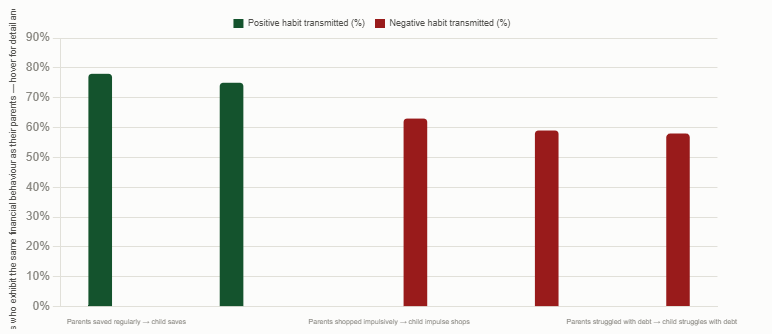
The transmission is not limited to good habits. A Money Smart Singapore survey, cited across multiple personal finance publications, found that 59% of people whose parents overspent say they tend to overspend too. 63% of those whose parents shopped impulsively also shop impulsively. 58% of those whose parents struggled with debt have also struggled with debt. The reverse is also true: 78% of those whose parents saved regularly also save regularly, and 75% of those whose parents budgeted also budget. The pattern is bidirectional and powerful.
Most people who inherited bad money habits from their parents do not recognise this. The habits feel personal, self-generated, natural — because they were absorbed before conscious memory formed the context. This is what makes them so persistent, and what makes breaking them so significant. This article documents the specific, concrete signs that you are doing it.
59% of those whose parents overspent say they do the same. 63% of impulsive parents → impulsive children. 78% of saving parents → saving children. Money habits form by age 7 (Cambridge study). 70% of Americans had financial regrets in 2024, most commonly not saving (Credit Karma / Harris Poll Jan 2025). 53% of parents and grandparents believe children today are less financially prepared than they were (Wealth Enhancement survey, May 2026).
Children observe their parents’ relationship with money across thousands of small moments over years: the anxiety in a parent’s face when a bill arrives, the casual ease with which a purchase is made on credit, the relief that follows a financial windfall, the silence that descends when money is a topic. These observations do not form knowledge in the conventional sense. They form what financial psychologists call ‘money scripts’ — unconscious beliefs about money that drive financial behaviour in adulthood, often without the person’s awareness.
Orsacu.org’s analysis of how childhood affects financial habits identifies several specific transmission pathways: avoidance of investing because a parent lost money in the stock market; overspending to compensate for childhood scarcity; hoarding money as an adult response to witnessing parental financial instability; careless spending as a response to having grown up in a household where money was never discussed. The Boston College Centre for Retirement Research notes that ‘avoiding financial conversations has a negative effect that can wreak havoc on children as they age’ and specifically links parental financial silence to both hoarding and careless spending as adult outcomes.
Understanding this transmission is not about assigning blame to parents. Most parents who passed on poor financial habits were themselves working from an inherited set of scripts. The cycle is long and largely unconscious. But recognising it is the first step toward interrupting it — and that interruption is what the signs in this article measure.
Breaking this pattern means shifting from reactive to proactive. 75% of people whose parents regularly budgeted also budget as adults (MoneySmart survey). The reverse is true with similar force. If you are now creating a plan for your money before the month begins — not reviewing the damage after — you have already shifted the underlying psychological posture from one you inherited to one you chose.
Choose a budgeting method that fits your life: the 50/30/20 rule (50% needs, 30% wants, 20% savings/debt), zero-based budgeting (every pound/dollar assigned a job), or a simple two-column income/expenses list. The method matters less than the habit. Set a recurring 15-minute monthly 'money date' with yourself — or your partner — to review and adjust.
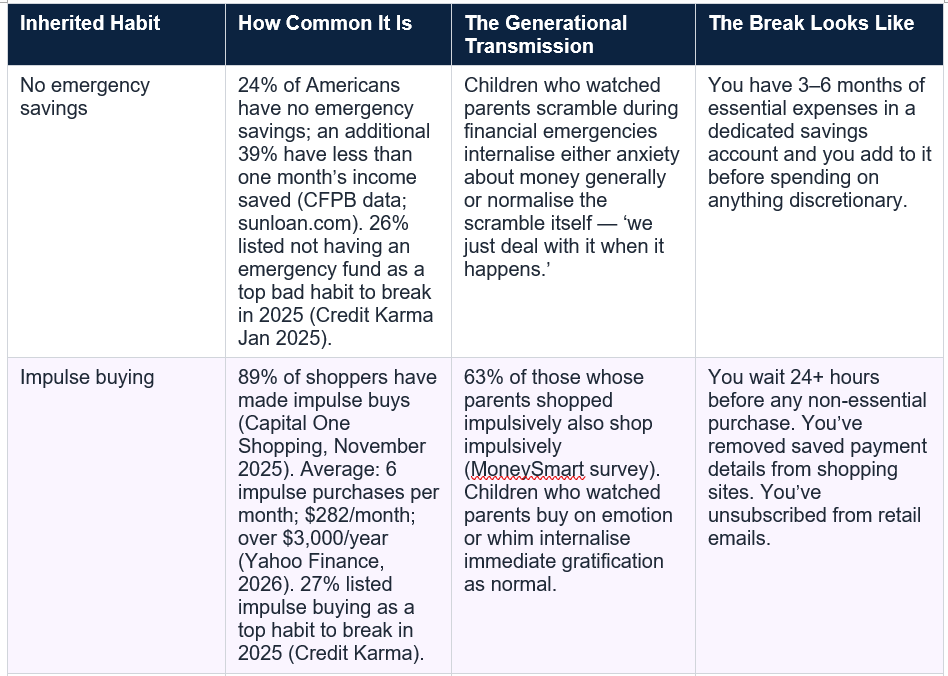
The statistics on this habit reveal how widespread the gap remains. In a 2022 CFPB survey, 24% of Americans had no emergency savings at all, and 39% had less than one month’s income saved. Only 43% said they could cover a $1,000 emergency from savings (Bankrate emergency fund report, 2023). These figures reflect a nationwide pattern, and in households where this pattern was normalised, the child’s default posture toward financial emergencies is to put them on credit — not to absorb them in cash.
Having an emergency fund is a sign you are breaking this pattern. Protecting it — not raiding it for a television, a holiday, or a lifestyle upgrade — is the sign you have internalised the distinction between an emergency and a want. That distinction is the psychological shift the inherited pattern did not include.
The goal is 3–6 months of essential living expenses in a high-yield savings account (HYSA), earning 4%+ APY rather than sitting in a low-interest current account. The practical first target is £500–$1,000 to cover the most common single emergencies — a car repair, a boiler callout, an unexpected medical copay. Start there, and build from it.
The 24-hour rule is not a new idea, but the research supporting it has become more compelling. Yahoo Finance / GOBankingRates (2026) specifically recommends the approach as a top 2026 financial habit change: ‘If you see something online that you might want to buy, just add it to your cart. After at least a day, ask yourself if it’s worth buying. You may forget about it or realise the item isn’t as appealing as you thought.’
The sign you are breaking an inherited impulse-buying pattern is that the pause is automatic — not forced. You have built enough space between stimulus and response that the purchase decision is a genuine choice, not a reaction. The Money Digest / Intuit Credit Karma December 2025 report notes that many of the Americans who are optimistic about their 2026 financial changes specifically cite impulse spending as the habit they are addressing. You are among the 45% committed to making successful changes.
Practical tactics that reduce impulse buying: remove saved payment details from all shopping platforms; introduce a 72-hour rule for purchases over £50/$75; unsubscribe from all retail email lists; delete shopping apps from your home screen; and if you notice you shop when emotionally stressed or bored, name that trigger and build a competing response (a walk, a call, a cup of tea).
Children from financially silent households arrive in adulthood without the vocabulary or emotional ease to talk about money, negotiate salaries, discuss financial stress with partners, or seek help when in difficulty. They often manage money in private, which means mistakes accumulate without correction, and help is not sought until a crisis forces it.
Breaking this pattern means doing the opposite of what you absorbed. It means speaking about money as a neutral topic — not a source of shame, secrecy, or conflict. It means asking about interest rates, comparing financial decisions with a partner, and being honest about your numbers. The Wealth Enhancement ‘First Dollar’ survey (May 2026) found that financial preparedness starts with ‘consistent conversations, intentional modelling, and understanding family values.’ If you are now having those conversations — with a partner, a friend, or yourself — you have interrupted the silence your household may have kept for a generation.
The sign you are breaking this pattern is automation. When you invest via a standing order or payroll deduction rather than a deliberate monthly decision, you have removed the psychological barrier — the need to consciously choose each time — that emotional money scripts create. Regular, automated investing is the financial habit that most powerfully separates wealth-building from wealth-stagnation over a career, and it is also the habit most likely to have been absent in households where money was a source of stress rather than a tool.
You do not need large amounts to begin. A pension contribution that captures the employer match, a monthly ISA contribution of £25, a Roth IRA contribution of $50 — the automation and the habit are the structural achievement, not the amount. The amount grows as your income grows and as compounding does its work.
Children who grew up in households where credit card balances were normal absorb the script that revolving debt is part of being an adult. They do not experience it as a problem to solve; they experience it as the baseline. Breaking this pattern means adopting a different relationship with credit entirely: using it as a tool with a defined function (rewards, credit-building, planned purchases repaid within the same month) rather than as a supplement to income.
The sign you have broken this pattern is not dramatic. It is boring: you know your credit card balance, you pay it in full each month, and you would not use credit for a restaurant meal you could not already afford from your current account balance. That ordinary discipline represents a profound shift from inherited behaviour for a significant proportion of the population.
The Buy Now Pay Later (BNPL) sector has created a new form of lifestyle-funded debt that does not always appear in credit scores or budgets until it cascades. BNPL usage has grown dramatically among younger consumers; the average BNPL user in 2025 had multiple simultaneous instalment plans, not all tracked in a single place. If you use BNPL regularly, treat it as debt — list every outstanding balance, know the payment dates, and include them in your monthly budget.
Boldin.com (June 2026) identifies this as the hardest dimension of financial behaviour to change, precisely because it is not rational: ‘The beliefs you carry about money help determine what you do with it. Your biggest financial obstacle isn’t a number.’ Orsacu.org’s analysis of how childhood affects financial habits advises applying awareness to daily decisions to notice when you are following an inherited pattern: ‘Once you’ve identified the influences and behaviors, apply your awareness to your daily decisions to notice when you’re following inherited patterns.’
Feeling calm about money is the downstream result of the other signs in this article. When you have an emergency fund, a budget, an investment standing order, and no revolving debt, the emotional landscape of money changes from scarcity and panic to manageability and agency. Calm is not complacency — it is evidence that the script has changed.
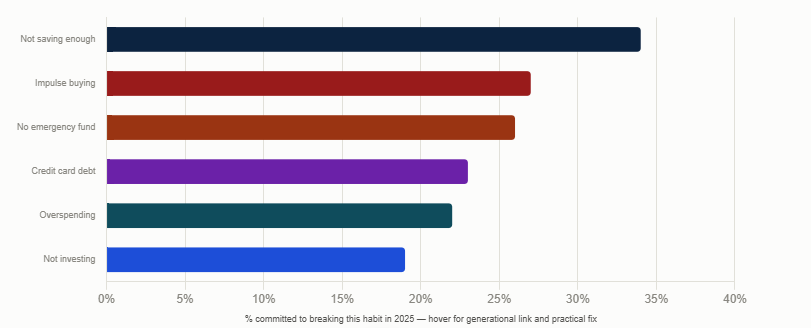
The Credit Karma / Harris Poll survey (January 2025) found that not saving money was the most common financial regret of 2024 (cited by 31%), and the top bad habit 34% of Americans were committed to breaking in 2025. The pattern of spending first and saving from the remainder is the structural cause of this regret. By the time month-end arrives, there is frequently nothing to save.
You are breaking this habit the moment saving becomes an automatic deduction that does not require willpower. Setting up a standing order or payroll deduction that moves money to a savings account or investment vehicle on payday removes the decision from your conscious control each month. The money moves before you can spend it. What remains is your budget. This is the structural opposite of the inherited pattern.
The 50/30/20 framework makes the pay-yourself-first principle concrete: 50% of net income to needs (housing, utilities, food, transport), 30% to wants (dining, entertainment, subscriptions), 20% to savings and debt repayment. If 20% is too large initially, start with 5% or 10% and automate it. The automation is the habit; the percentage can grow.
Knowing your numbers is not the same as obsessing over them. It means having a working knowledge of your financial position: approximately how much comes in each month, approximately how much goes out, what your balances are, what your debts are, and what direction each of these is trending. Orsacu.org advises: ‘Take stock of your income, expenses, debts, and savings. Knowledge is power.’ The capacity to hold these numbers without anxiety is itself a sign of the pattern changing.
Many people who reach this sign are surprised to find that the numbers — once examined directly — are not as frightening as the avoidance suggested. The gap between reality and the anxiety-driven imagination of reality is often smaller than expected. And once the numbers are known, the next steps are clear, whereas avoidance offers no such clarity.
Common inherited money scripts include: ‘There’s never enough’ (scarcity script); ‘Money is the root of all evil’ (avoidance script); ‘You have to work hard for every penny’ (work-worship script); ‘It’s selfish to want more’ (virtue script); ‘People like us don’t have investments’ (identity script). Each of these, unchallenged, constrains financial behaviour in specific ways — the scarcity script produces hoarding or chronic anxiety; the avoidance script produces aversion to wealth-building; the identity script limits aspiration.
Changing the script is the deepest level of breaking the cycle, because it changes the context in which all the other behavioural signs operate. You budget not from fear but from agency. You save not from anxiety but from a genuine belief that your future self deserves provision. You invest not as an alien activity but as something people in your category do. The sign you have made this shift is internal but unmistakable: you notice the old voice when it arises, and you have a different answer for it.
The research framing is important here. As cornerstonefcu.org (August 2025) notes: ‘Children can and do develop their own financial attitudes and habits as they grow. The goal of parental financial modelling is not to dictate a child’s every financial move but to provide a solid foundation of knowledge and habits that they can build upon.’ The generosity in this framing is worth internalising: parents were providing what they had. What you are doing is building what they did not.
If you have children or other young people in your life, the MoneySmart research indicates you now have remarkable influence. 78% of those whose parents saved regularly also save; 75% of those whose parents budgeted also budget. The most powerful thing you can do with the cycle you are breaking is to not pass it forward. Talk about money at home. Show them what a budget looks like. Normalise saving and investing. Give them the conversations that were absent in your own childhood.
The Boldin.com June 2026 guide summarises this precisely: ‘Planning proactively rather than reactively, talking openly about financial trade-offs, recovering from setbacks without panic, and making deliberate choices about spending and saving — these behaviors, demonstrated consistently over years, are the most powerful inheritance you can offer.’
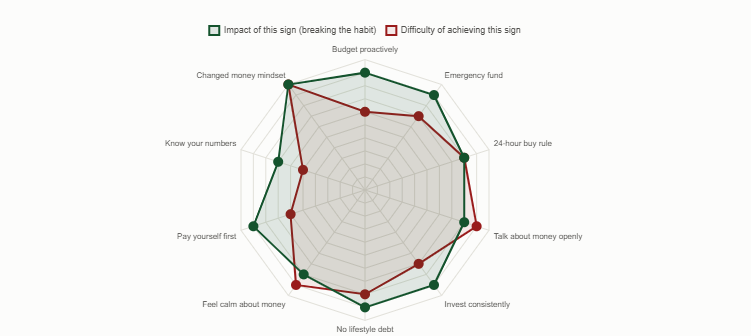
The ten signs in this article — budgeting proactively, maintaining an emergency fund, delaying gratification, talking about money openly, investing consistently, avoiding lifestyle debt, approaching finances calmly, paying yourself first, knowing your numbers, and changing your inner narrative — represent the most concrete and measurable markers of that reconstruction. You do not need all ten simultaneously. The research is clear that small, consistent, structural changes — a standing order, a 24-hour rule, a monthly money conversation — produce durable shifts in the underlying behaviour.
73% of Americans were committed to breaking bad financial habits in 2025. 45% reported optimism that they would succeed with financial changes in 2026. The statistics suggest progress is being made, even if incompletely. If you recognise yourself in three of the ten signs above, you are already breaking a cycle that took decades to form. If you recognise yourself in seven or eight, you are well on your way to building a financial identity that is entirely your own.
Yes — the research is consistent and strong across multiple studies. A MoneySmart survey found that 59% of those whose parents overspent also overspend, 63% of those whose parents shopped impulsively also shop impulsively, and 58% of those whose parents struggled with debt have also struggled with debt. The reverse is equally true: 78% of those whose parents saved regularly also save, and 75% of those whose parents budgeted also budget. University of Cambridge research confirms that money habits are typically formed by age seven, largely through observation of parental behaviour rather than formal instruction. The Journal of Family and Economic Issues identifies parents as the primary influence on children's financial attitudes. The inheritance is not genetic — it is observational and psychological, formed from the emotional baseline children absorb watching their parents handle money across thousands of daily moments.
What are the most common bad money habits people inherit from their parents?
The most commonly inherited and most commonly regretted financial habits, based on research from Credit Karma (January 2025), Capital One Shopping (November 2025), and MoneySmart, include: not saving regularly (cited by 34% of Americans as their top bad habit to break in 2025); impulse buying (27%); not having an emergency fund (26%); carrying revolving credit card debt; never talking about money openly; not investing; and living without a budget. Financial silence — growing up in a household where money was never discussed — is one of the most damaging inherited patterns, as the Boston College Center for Retirement Research documents: 'Avoiding financial conversations has a negative effect that can wreak havoc on children as they age.'
How do you know if you are breaking your parents' bad money habits?
The ten signs in this article provide specific, behavioural indicators: you budget proactively rather than reactively; you have an emergency fund and protect it; you wait before buying non-essentials; you talk about money openly; you invest consistently even in small amounts; you do not use debt to fund your lifestyle; you feel calm rather than panicked about money; you save before you spend (pay yourself first); you know your approximate financial numbers; and you have changed the inner narrative (money scripts) you carry about money. You do not need all ten simultaneously. Recognising yourself in even three or four of these signs indicates meaningful movement away from inherited patterns.
Can bad money habits from childhood be permanently changed?
Yes, though it requires both behavioural change and some degree of psychological work. The behavioural dimension — setting up automations, building an emergency fund, adopting a budget — can be implemented structurally, with results visible within months. The psychological dimension — changing the money scripts, the emotional responses, the avoidance patterns — takes longer and may benefit from conscious reflection, reading, or conversations with a financial counsellor or therapist who specialises in money psychology. Orsacu.org advises: 'Once you've identified the influences and behaviours, apply your awareness to your daily decisions to notice when you're following inherited patterns.' Boldin.com (June 2026) frames the key tasks as: planning proactively rather than reactively, talking openly about financial trade-offs, recovering from setbacks without panic, and making deliberate choices about spending and saving. All of these are learnable, practicable, and reinforcing once started.
What is the single most impactful step for breaking inherited bad money habits?
The research across multiple personal finance studies points most consistently to one structural change: automating the positive behaviour. An automatic savings transfer on payday (before you spend), an automatic pension or 401(k)/ISA contribution, an automatic investment standing order — all remove the monthly decision that money scripts can interfere with. The second most impactful step, supported by the MoneySmart and boldin.com research, is changing the conversation: talking about money with a partner, a trusted friend, or a financial counsellor. The combination of structural automation and open conversation addresses both the behavioural and psychological dimensions of inherited financial habits simultaneously.
How do I avoid passing bad money habits to my own children?
The MoneySmart research gives the most direct answer: 78% of those whose parents saved regularly also save; 75% of those whose parents budgeted also budget. Modelling the behaviour is the most powerful transmission mechanism — more powerful than formal instruction. Boldin.com (June 2026) summarises what to model: 'Planning proactively rather than reactively, talking openly about financial trade-offs, recovering from setbacks without panic, and making deliberate choices about spending and saving — these behaviours, demonstrated consistently over years, are the most powerful inheritance you can offer.' Practically: involve children in simple budget conversations at appropriate ages, let them see you checking a budget, talk openly about what you are saving for and why, give them pocket money and let them make decisions with it, and normalise investing as something ordinary people do.
Table of Contents
- The Inheritance Nobody Talks About
- The Science: How Parental Money Habits Become Your Own
- The Most Common Bad Money Habits Passed Down Through Families
- Sign #1: You Budget Before You Spend — Not After
- Sign #2: You Have an Emergency Fund and Protect It
- Sign #3: You Wait Before Buying — The 24-Hour Rule
- Sign #4: You Talk About Money Openly
- Sign #5: You Invest Regularly, Even in Small Amounts
- Sign #6: You Don’t Use Debt to Fund Your Lifestyle
- Sign #7: You Feel Calm, Not Panicked, About Money
- Sign #8: You Save Before You Spend — Pay Yourself First
- Sign #9: You Know Your Numbers
- Sign #10: You’ve Changed What You Tell Yourself About Money
- Breaking the Cycle Without Shaming Your Parents
- Conclusion: The Chain Can Stop With You
- Frequently Asked Questions
The Generational Transmission: Good & Bad Habits
10 Bad Money Habits Americans Want To Break (2025/26)
10 Signs: Am I breaking The Cycle
The Inheritance Nobody Talks About
There is a form of inheritance that skips probate, requires no solicitor, and passes from generation to generation without anyone signing a single document. It is not money itself. It is the set of beliefs, behaviours, and emotional responses that surround money — and most people carry it without knowing it came from somewhere outside themselves.University of Cambridge research, cited across multiple financial literacy studies, found that children’s money habits are typically formed by age seven. By that age, they have already absorbed whether money is a source of stress or security, whether debt is normal or frightening, whether saving is a habit or an afterthought — primarily from watching their parents. Research published in the Journal of Family and Economic Issues confirms that parents are the primary influence on their children’s financial attitudes and behaviours, not schools, not financial products, not media.
The transmission is not limited to good habits. A Money Smart Singapore survey, cited across multiple personal finance publications, found that 59% of people whose parents overspent say they tend to overspend too. 63% of those whose parents shopped impulsively also shop impulsively. 58% of those whose parents struggled with debt have also struggled with debt. The reverse is also true: 78% of those whose parents saved regularly also save regularly, and 75% of those whose parents budgeted also budget. The pattern is bidirectional and powerful.
Most people who inherited bad money habits from their parents do not recognise this. The habits feel personal, self-generated, natural — because they were absorbed before conscious memory formed the context. This is what makes them so persistent, and what makes breaking them so significant. This article documents the specific, concrete signs that you are doing it.
59% of those whose parents overspent say they do the same. 63% of impulsive parents → impulsive children. 78% of saving parents → saving children. Money habits form by age 7 (Cambridge study). 70% of Americans had financial regrets in 2024, most commonly not saving (Credit Karma / Harris Poll Jan 2025). 53% of parents and grandparents believe children today are less financially prepared than they were (Wealth Enhancement survey, May 2026).
The Science: How Parental Money Habits Become Your Own
The mechanism by which parental financial behaviour becomes a child’s own is not straightforward imitation. It is more subtle and more durable than that. Boldin.com (June 2026), in its research summary on generational financial habits, draws the critical distinction: ‘Modelling financial behavior is what happens when kids watch you make decisions, handle setbacks, and engage with your own financial future over time. Both explicit instruction and modelling matter, but modelling tends to shape kids’ financial psychology more durably — because what they observe becomes their emotional baseline, not just their technical knowledge.’Children observe their parents’ relationship with money across thousands of small moments over years: the anxiety in a parent’s face when a bill arrives, the casual ease with which a purchase is made on credit, the relief that follows a financial windfall, the silence that descends when money is a topic. These observations do not form knowledge in the conventional sense. They form what financial psychologists call ‘money scripts’ — unconscious beliefs about money that drive financial behaviour in adulthood, often without the person’s awareness.
Orsacu.org’s analysis of how childhood affects financial habits identifies several specific transmission pathways: avoidance of investing because a parent lost money in the stock market; overspending to compensate for childhood scarcity; hoarding money as an adult response to witnessing parental financial instability; careless spending as a response to having grown up in a household where money was never discussed. The Boston College Centre for Retirement Research notes that ‘avoiding financial conversations has a negative effect that can wreak havoc on children as they age’ and specifically links parental financial silence to both hoarding and careless spending as adult outcomes.
Understanding this transmission is not about assigning blame to parents. Most parents who passed on poor financial habits were themselves working from an inherited set of scripts. The cycle is long and largely unconscious. But recognising it is the first step toward interrupting it — and that interruption is what the signs in this article measure.
The Most Common Bad Money Habits Passed Down Through Families
Before examining the signs of breaking the cycle, it helps to know what the cycle most commonly looks like. Research from Credit Karma, Capital One Shopping, and multiple consumer finance studies for 2025–2026 identifies the habits most commonly inherited and most commonly regretted:
Sign #1: You Budget Before You Spend — Not After
Sign #1: You Know Where Your Money Is Going Before It Leaves You allocate your income at the start of each month or pay period — before spending happens. This might look like a 50/30/20 split, a zero-based budget, or a simple spreadsheet. The key marker is sequence: plan first, then spend.
The most visible sign of a budgeting household growing up is also the most underrated: children who never saw a budget internalise a reactive relationship with money. They find out what they can afford by running out of it. They are surprised by account balances. They make financial decisions based on how they feel rather than what they know.Breaking this pattern means shifting from reactive to proactive. 75% of people whose parents regularly budgeted also budget as adults (MoneySmart survey). The reverse is true with similar force. If you are now creating a plan for your money before the month begins — not reviewing the damage after — you have already shifted the underlying psychological posture from one you inherited to one you chose.
Choose a budgeting method that fits your life: the 50/30/20 rule (50% needs, 30% wants, 20% savings/debt), zero-based budgeting (every pound/dollar assigned a job), or a simple two-column income/expenses list. The method matters less than the habit. Set a recurring 15-minute monthly 'money date' with yourself — or your partner — to review and adjust.
Sign #2: You Have an Emergency Fund and Protect It
Sign #2: You Have Cash Set Aside That You Don’t Touch for Non-Emergencies You maintain a dedicated emergency fund — separate from your current account, separate from spending money — and your instinct when it is depleted is to rebuild it, not to accept the depletion as normal.
Among the most durable transmissions of financial anxiety is the absence of a financial cushion. Children who grew up in households where every unexpected expense became a crisis — a broken appliance, an emergency dental visit, a car repair — develop one of two responses: they either internalise the crisis-as-normal script, or they over-correct by hoarding money compulsively. Neither is the same as building a calm, deliberate emergency fund.The statistics on this habit reveal how widespread the gap remains. In a 2022 CFPB survey, 24% of Americans had no emergency savings at all, and 39% had less than one month’s income saved. Only 43% said they could cover a $1,000 emergency from savings (Bankrate emergency fund report, 2023). These figures reflect a nationwide pattern, and in households where this pattern was normalised, the child’s default posture toward financial emergencies is to put them on credit — not to absorb them in cash.
Having an emergency fund is a sign you are breaking this pattern. Protecting it — not raiding it for a television, a holiday, or a lifestyle upgrade — is the sign you have internalised the distinction between an emergency and a want. That distinction is the psychological shift the inherited pattern did not include.
The goal is 3–6 months of essential living expenses in a high-yield savings account (HYSA), earning 4%+ APY rather than sitting in a low-interest current account. The practical first target is £500–$1,000 to cover the most common single emergencies — a car repair, a boiler callout, an unexpected medical copay. Start there, and build from it.
Sign #3: You Wait Before Buying — The 24-Hour Rule
Sign #3: You Have a Cooling-Off Period Between Wanting Something and Buying It Before making any non-essential purchase above a personal threshold (say, £20–$30), you wait at least 24 hours. Many people find the desire gone entirely when they return to the decision with a clear head.
Impulse buying is one of the most reliably transmitted financial habits from parent to child. 63% of those whose parents shopped impulsively also shop impulsively (MoneySmart survey). And in the current environment, the conditions for impulse buying have never been stronger: 89% of shoppers have made impulse buys (Capital One Shopping, November 2025), the average consumer makes six per month and spends over $3,000 per year on them, and platforms like one-click purchasing, social media advertising, and buy-now-pay-later have reduced every friction point that might have produced a pause in an earlier era.The 24-hour rule is not a new idea, but the research supporting it has become more compelling. Yahoo Finance / GOBankingRates (2026) specifically recommends the approach as a top 2026 financial habit change: ‘If you see something online that you might want to buy, just add it to your cart. After at least a day, ask yourself if it’s worth buying. You may forget about it or realise the item isn’t as appealing as you thought.’
The sign you are breaking an inherited impulse-buying pattern is that the pause is automatic — not forced. You have built enough space between stimulus and response that the purchase decision is a genuine choice, not a reaction. The Money Digest / Intuit Credit Karma December 2025 report notes that many of the Americans who are optimistic about their 2026 financial changes specifically cite impulse spending as the habit they are addressing. You are among the 45% committed to making successful changes.
Practical tactics that reduce impulse buying: remove saved payment details from all shopping platforms; introduce a 72-hour rule for purchases over £50/$75; unsubscribe from all retail email lists; delete shopping apps from your home screen; and if you notice you shop when emotionally stressed or bored, name that trigger and build a competing response (a walk, a call, a cup of tea).
Sign #4: You Talk About Money Openly
Sign #4: Money Is Not a Taboo Subject in Your Household You discuss finances with your partner, adult children, or close friends without shame or anxiety. You have had at least one honest conversation about your income, your debts, your savings, or your goals in the past month.
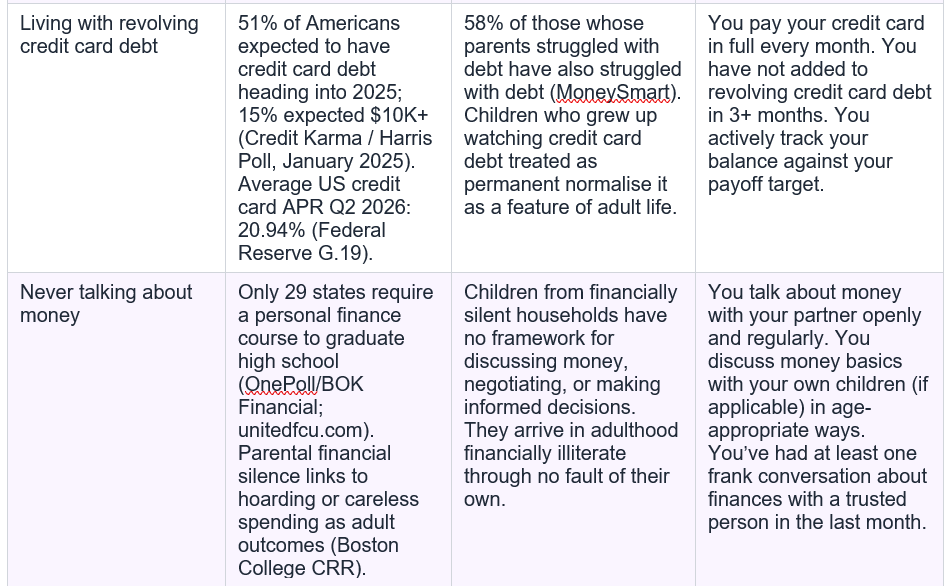
Financial silence is one of the most damaging inherited patterns — and one of the least recognised. The Boston College Centre for Retirement Research documents its consequences clearly: ‘Avoiding financial conversations has a negative effect that can wreak havoc on children as they age.’ In extreme cases, financial silence produces two opposite outcomes: hoarding as a defensive response to having witnessed uncontrolled financial instability, and careless spending as a response to having no framework at all.Children from financially silent households arrive in adulthood without the vocabulary or emotional ease to talk about money, negotiate salaries, discuss financial stress with partners, or seek help when in difficulty. They often manage money in private, which means mistakes accumulate without correction, and help is not sought until a crisis forces it.
Breaking this pattern means doing the opposite of what you absorbed. It means speaking about money as a neutral topic — not a source of shame, secrecy, or conflict. It means asking about interest rates, comparing financial decisions with a partner, and being honest about your numbers. The Wealth Enhancement ‘First Dollar’ survey (May 2026) found that financial preparedness starts with ‘consistent conversations, intentional modelling, and understanding family values.’ If you are now having those conversations — with a partner, a friend, or yourself — you have interrupted the silence your household may have kept for a generation.
Sign #5: You Invest Regularly, Even in Small Amounts
Sign #5: You Put Money into Long-Term Growth Vehicles Consistently You contribute to a workplace pension, ISA, Roth IRA, 401(k), or other investment vehicle on a regular schedule — not occasionally, not only when you feel financially confident, but as a standing instruction that does not require a monthly decision.
Parental attitudes toward investing transfer to children through either direct fear (watching a parent lose money in markets) or simple absence (no investing was modelled, so no framework was absorbed). In the 2025 Credit Karma survey, 19% of Americans listed not investing as one of their top bad habits to break. Many financial educators observe that this is disproportionately represented among people whose parents did not invest — because there was no baseline demonstration that investing was ordinary, manageable, or appropriate for someone ‘like them.’The sign you are breaking this pattern is automation. When you invest via a standing order or payroll deduction rather than a deliberate monthly decision, you have removed the psychological barrier — the need to consciously choose each time — that emotional money scripts create. Regular, automated investing is the financial habit that most powerfully separates wealth-building from wealth-stagnation over a career, and it is also the habit most likely to have been absent in households where money was a source of stress rather than a tool.
You do not need large amounts to begin. A pension contribution that captures the employer match, a monthly ISA contribution of £25, a Roth IRA contribution of $50 — the automation and the habit are the structural achievement, not the amount. The amount grows as your income grows and as compounding does its work.
Sign #6: You Don’t Use Debt to Fund Your Lifestyle
Sign #6: Credit Is a Tool You Choose, Not a Gap-Filler You Default To You use credit strategically — for large, planned purchases, to build a credit history, or to earn rewards you pay off monthly. You do not use credit cards to bridge the gap between your income and your lifestyle.
Credit card debt as a permanent feature of adult life is among the most commonly transmitted financial habits. 51% of Americans expected to carry credit card debt into 2025, with 15% expecting balances over $10,000 (Credit Karma / Harris Poll, January 2025). At the current average US credit card APR of 20.94% (Federal Reserve G.19 Q2 2026), carrying a $10,000 balance costs over $2,000 per year in interest alone — interest that funds nothing, builds nothing, and reduces the capacity for every other financial goal.Children who grew up in households where credit card balances were normal absorb the script that revolving debt is part of being an adult. They do not experience it as a problem to solve; they experience it as the baseline. Breaking this pattern means adopting a different relationship with credit entirely: using it as a tool with a defined function (rewards, credit-building, planned purchases repaid within the same month) rather than as a supplement to income.
The sign you have broken this pattern is not dramatic. It is boring: you know your credit card balance, you pay it in full each month, and you would not use credit for a restaurant meal you could not already afford from your current account balance. That ordinary discipline represents a profound shift from inherited behaviour for a significant proportion of the population.
The Buy Now Pay Later (BNPL) sector has created a new form of lifestyle-funded debt that does not always appear in credit scores or budgets until it cascades. BNPL usage has grown dramatically among younger consumers; the average BNPL user in 2025 had multiple simultaneous instalment plans, not all tracked in a single place. If you use BNPL regularly, treat it as debt — list every outstanding balance, know the payment dates, and include them in your monthly budget.
Sign #7: You Feel Calm, Not Panicked, About Money
Sign #7: Financial Stress Is Manageable; Not Overwhelming You still worry about money sometimes — most people do. But you no longer feel the physical anxiety, the avoidance, or the sense of impending crisis that characterises an inherited fear-based money script. You open your bank app without dread.
The emotional signature of an inherited negative money script is often stronger than any specific financial behaviour. Children who grew up in households where money was a chronic source of stress — arguments, avoidance, silence, visible anxiety when bills arrived — develop a physiological stress response to financial topics that persists into adulthood. This response manifests as avoiding bank statements, not opening bills, not checking balances, not planning ahead — because each of these things triggers the anxiety that was internalised in childhood.Boldin.com (June 2026) identifies this as the hardest dimension of financial behaviour to change, precisely because it is not rational: ‘The beliefs you carry about money help determine what you do with it. Your biggest financial obstacle isn’t a number.’ Orsacu.org’s analysis of how childhood affects financial habits advises applying awareness to daily decisions to notice when you are following an inherited pattern: ‘Once you’ve identified the influences and behaviors, apply your awareness to your daily decisions to notice when you’re following inherited patterns.’
Feeling calm about money is the downstream result of the other signs in this article. When you have an emergency fund, a budget, an investment standing order, and no revolving debt, the emotional landscape of money changes from scarcity and panic to manageability and agency. Calm is not complacency — it is evidence that the script has changed.
Sign #8: You Save Before You Spend — Pay Yourself First
Sign #8: Saving Is an Automatic Deduction, Not a Leftover Your savings contribution leaves your account on the day you are paid — before rent, before food, before any discretionary spending. What’s left is your spending money. You save what you intend to save, not what happens to remain at the end of the month.
The ‘pay yourself first’ principle is one of the most well-evidenced behavioural strategies in personal finance, and it is structurally opposite to how money was managed in many households where saving was inconsistent or absent. In those households, saving happened from the remainder — if there was a remainder. There often was not, because spending expanded naturally to fill available income without a prior deduction to constrain it.The Credit Karma / Harris Poll survey (January 2025) found that not saving money was the most common financial regret of 2024 (cited by 31%), and the top bad habit 34% of Americans were committed to breaking in 2025. The pattern of spending first and saving from the remainder is the structural cause of this regret. By the time month-end arrives, there is frequently nothing to save.
You are breaking this habit the moment saving becomes an automatic deduction that does not require willpower. Setting up a standing order or payroll deduction that moves money to a savings account or investment vehicle on payday removes the decision from your conscious control each month. The money moves before you can spend it. What remains is your budget. This is the structural opposite of the inherited pattern.
The 50/30/20 framework makes the pay-yourself-first principle concrete: 50% of net income to needs (housing, utilities, food, transport), 30% to wants (dining, entertainment, subscriptions), 20% to savings and debt repayment. If 20% is too large initially, start with 5% or 10% and automate it. The automation is the habit; the percentage can grow.
Sign #9: You Know Your Numbers
Sign #9: You Can State Your Net Worth, Income, and Monthly Expenses Approximately Accurately You know your approximate account balance, your monthly take-home, your total outstanding debt, and your savings balance without having to look them all up. Financial knowledge of your own situation is not something you avoid.
Financial avoidance — the active avoidance of knowing your financial situation — is a direct product of the inherited anxiety described in Sign #7. People who grew up in financially stressed households often develop a strong aversion to numbers as a self-protective mechanism: if you do not look, you cannot be confronted by what is there. The irony is that not looking always makes the situation worse.Knowing your numbers is not the same as obsessing over them. It means having a working knowledge of your financial position: approximately how much comes in each month, approximately how much goes out, what your balances are, what your debts are, and what direction each of these is trending. Orsacu.org advises: ‘Take stock of your income, expenses, debts, and savings. Knowledge is power.’ The capacity to hold these numbers without anxiety is itself a sign of the pattern changing.
Many people who reach this sign are surprised to find that the numbers — once examined directly — are not as frightening as the avoidance suggested. The gap between reality and the anxiety-driven imagination of reality is often smaller than expected. And once the numbers are known, the next steps are clear, whereas avoidance offers no such clarity.
Sign #10: You’ve Changed What You Tell Yourself About Money
Sign #10: Your Inner Narrative About Money Has Shifted You no longer describe yourself as 'bad with money,' 'not a money person,' or 'just like my mum/dad.' You have replaced inherited money scripts — 'money doesn't grow on trees,' 'rich people are greedy,' 'we can't afford that kind of thing' — with chosen beliefs that support the financial life you are building.
Financial psychologists describe ‘money scripts’ as unconscious beliefs about money that drive behaviour, typically developed in childhood and rarely examined as adults. Boldin.com (June 2026) describes these as beliefs you carry that ‘help determine what you do with money’ and identifies them as the primary psychological obstacle to financial change — ‘your biggest financial obstacle isn’t a number.’Common inherited money scripts include: ‘There’s never enough’ (scarcity script); ‘Money is the root of all evil’ (avoidance script); ‘You have to work hard for every penny’ (work-worship script); ‘It’s selfish to want more’ (virtue script); ‘People like us don’t have investments’ (identity script). Each of these, unchallenged, constrains financial behaviour in specific ways — the scarcity script produces hoarding or chronic anxiety; the avoidance script produces aversion to wealth-building; the identity script limits aspiration.
Changing the script is the deepest level of breaking the cycle, because it changes the context in which all the other behavioural signs operate. You budget not from fear but from agency. You save not from anxiety but from a genuine belief that your future self deserves provision. You invest not as an alien activity but as something people in your category do. The sign you have made this shift is internal but unmistakable: you notice the old voice when it arises, and you have a different answer for it.
Breaking the Cycle Without Shaming Your Parents
Recognising that you inherited poor financial habits from your parents carries a risk: it can become a narrative of blame that serves neither you nor your relationship with your family. Most parents who transmitted financial anxiety, avoidance, or poor habits did so from the same place: they themselves were working from an unexamined inheritance.The research framing is important here. As cornerstonefcu.org (August 2025) notes: ‘Children can and do develop their own financial attitudes and habits as they grow. The goal of parental financial modelling is not to dictate a child’s every financial move but to provide a solid foundation of knowledge and habits that they can build upon.’ The generosity in this framing is worth internalising: parents were providing what they had. What you are doing is building what they did not.
If you have children or other young people in your life, the MoneySmart research indicates you now have remarkable influence. 78% of those whose parents saved regularly also save; 75% of those whose parents budgeted also budget. The most powerful thing you can do with the cycle you are breaking is to not pass it forward. Talk about money at home. Show them what a budget looks like. Normalise saving and investing. Give them the conversations that were absent in your own childhood.
The Boldin.com June 2026 guide summarises this precisely: ‘Planning proactively rather than reactively, talking openly about financial trade-offs, recovering from setbacks without panic, and making deliberate choices about spending and saving — these behaviors, demonstrated consistently over years, are the most powerful inheritance you can offer.’
Conclusion
Money habits form by age seven. That is the research consensus, and it is both sobering and motivating. It means that the financial patterns you carry into adulthood were largely installed before you had the capacity to choose them. It also means that the work of breaking them is not a character failing remedied — it is a deliberate act of reconstruction under circumstances that made the original patterns nearly inevitable.The ten signs in this article — budgeting proactively, maintaining an emergency fund, delaying gratification, talking about money openly, investing consistently, avoiding lifestyle debt, approaching finances calmly, paying yourself first, knowing your numbers, and changing your inner narrative — represent the most concrete and measurable markers of that reconstruction. You do not need all ten simultaneously. The research is clear that small, consistent, structural changes — a standing order, a 24-hour rule, a monthly money conversation — produce durable shifts in the underlying behaviour.
73% of Americans were committed to breaking bad financial habits in 2025. 45% reported optimism that they would succeed with financial changes in 2026. The statistics suggest progress is being made, even if incompletely. If you recognise yourself in three of the ten signs above, you are already breaking a cycle that took decades to form. If you recognise yourself in seven or eight, you are well on your way to building a financial identity that is entirely your own.
Frequently Asked Questions
Do we really inherit money habits from our parents?Yes — the research is consistent and strong across multiple studies. A MoneySmart survey found that 59% of those whose parents overspent also overspend, 63% of those whose parents shopped impulsively also shop impulsively, and 58% of those whose parents struggled with debt have also struggled with debt. The reverse is equally true: 78% of those whose parents saved regularly also save, and 75% of those whose parents budgeted also budget. University of Cambridge research confirms that money habits are typically formed by age seven, largely through observation of parental behaviour rather than formal instruction. The Journal of Family and Economic Issues identifies parents as the primary influence on children's financial attitudes. The inheritance is not genetic — it is observational and psychological, formed from the emotional baseline children absorb watching their parents handle money across thousands of daily moments.
What are the most common bad money habits people inherit from their parents?
The most commonly inherited and most commonly regretted financial habits, based on research from Credit Karma (January 2025), Capital One Shopping (November 2025), and MoneySmart, include: not saving regularly (cited by 34% of Americans as their top bad habit to break in 2025); impulse buying (27%); not having an emergency fund (26%); carrying revolving credit card debt; never talking about money openly; not investing; and living without a budget. Financial silence — growing up in a household where money was never discussed — is one of the most damaging inherited patterns, as the Boston College Center for Retirement Research documents: 'Avoiding financial conversations has a negative effect that can wreak havoc on children as they age.'
How do you know if you are breaking your parents' bad money habits?
The ten signs in this article provide specific, behavioural indicators: you budget proactively rather than reactively; you have an emergency fund and protect it; you wait before buying non-essentials; you talk about money openly; you invest consistently even in small amounts; you do not use debt to fund your lifestyle; you feel calm rather than panicked about money; you save before you spend (pay yourself first); you know your approximate financial numbers; and you have changed the inner narrative (money scripts) you carry about money. You do not need all ten simultaneously. Recognising yourself in even three or four of these signs indicates meaningful movement away from inherited patterns.
Can bad money habits from childhood be permanently changed?
Yes, though it requires both behavioural change and some degree of psychological work. The behavioural dimension — setting up automations, building an emergency fund, adopting a budget — can be implemented structurally, with results visible within months. The psychological dimension — changing the money scripts, the emotional responses, the avoidance patterns — takes longer and may benefit from conscious reflection, reading, or conversations with a financial counsellor or therapist who specialises in money psychology. Orsacu.org advises: 'Once you've identified the influences and behaviours, apply your awareness to your daily decisions to notice when you're following inherited patterns.' Boldin.com (June 2026) frames the key tasks as: planning proactively rather than reactively, talking openly about financial trade-offs, recovering from setbacks without panic, and making deliberate choices about spending and saving. All of these are learnable, practicable, and reinforcing once started.
What is the single most impactful step for breaking inherited bad money habits?
The research across multiple personal finance studies points most consistently to one structural change: automating the positive behaviour. An automatic savings transfer on payday (before you spend), an automatic pension or 401(k)/ISA contribution, an automatic investment standing order — all remove the monthly decision that money scripts can interfere with. The second most impactful step, supported by the MoneySmart and boldin.com research, is changing the conversation: talking about money with a partner, a trusted friend, or a financial counsellor. The combination of structural automation and open conversation addresses both the behavioural and psychological dimensions of inherited financial habits simultaneously.
How do I avoid passing bad money habits to my own children?
The MoneySmart research gives the most direct answer: 78% of those whose parents saved regularly also save; 75% of those whose parents budgeted also budget. Modelling the behaviour is the most powerful transmission mechanism — more powerful than formal instruction. Boldin.com (June 2026) summarises what to model: 'Planning proactively rather than reactively, talking openly about financial trade-offs, recovering from setbacks without panic, and making deliberate choices about spending and saving — these behaviours, demonstrated consistently over years, are the most powerful inheritance you can offer.' Practically: involve children in simple budget conversations at appropriate ages, let them see you checking a budget, talk openly about what you are saving for and why, give them pocket money and let them make decisions with it, and normalise investing as something ordinary people do.
0 Comments
Be the first to share your thoughts on this article.