

Financial Literacy
How To Manage Your Finances When You Start a Family
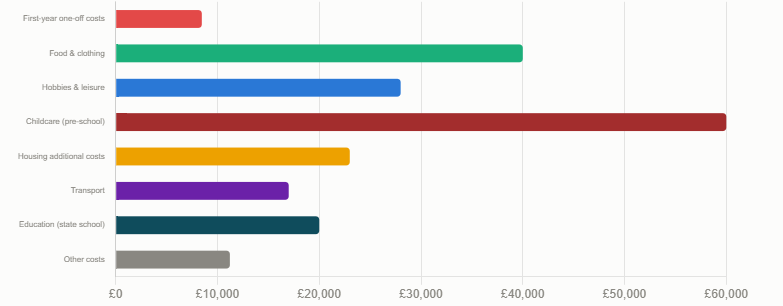
Starting a family is one of life's greatest milestones — and one of its biggest financial turning points. The basic cost of raising a child in the UK reaches £167,679 by age 18, rising to £251,018 when childcare and housing are included. In the US, the figure sits at approximately $320,000. Yet most new parents face this transformation with no financial plan in place. This guide walks through every money decision that matters — from the moment you decide to start a family to the tools that protect and grow what you build together.

The answer is not to become a financial expert overnight. It is to make a small number of important decisions before the baby arrives — and to build simple, automatic systems that hold the family's finances together when life becomes chaotic. This guide covers every one of those decisions in plain language, with specific numbers for the UK in 2026/27 and, where relevant, the United States.
UK: raising one child to 18 costs £167,679 basic (couple); £251,018 with childcare and housing (CPAG, cited Royal London April 2026). First-year costs alone: ~£8,460 (Smart Cells, cited LV= 2026). US: ~$320,000 from birth to 18 (Northwestern Mutual, adjusted from USDA 2015 data using CPI inflation, September 2025). US births 2025: 3.6 million, down 1% from 2024 (US News, June 2026).
In the United States, Northwestern Mutual estimates the cost of raising a child from birth to 18 at approximately $320,000 in 2025 — adjusted from the 2015 USDA figure of $233,610 using CPI inflation data. This does not include college, which the College Board estimates costs an additional $28,000–$58,000 per year depending on institution type.
The first year is typically the most expensive per-year period. LV='s 2026 guide, citing Smart Cells research, estimates first-year costs at approximately £8,460, driven by one-off capital items:
Sources: Child Poverty Action Group (CPAG) 2024, cited Statista December 2024; Royal London April 2026 (CPAG figure £167,679); LV= 2026 / Smart Cells (first year £8,460); Coram Family and Childcare Survey 2026 (published 17 March 2026); Northwestern Mutual September 2025 (US $320,000). All UK figures are averages; actual costs vary significantly by region, lifestyle, and family choices. Not financial advice.
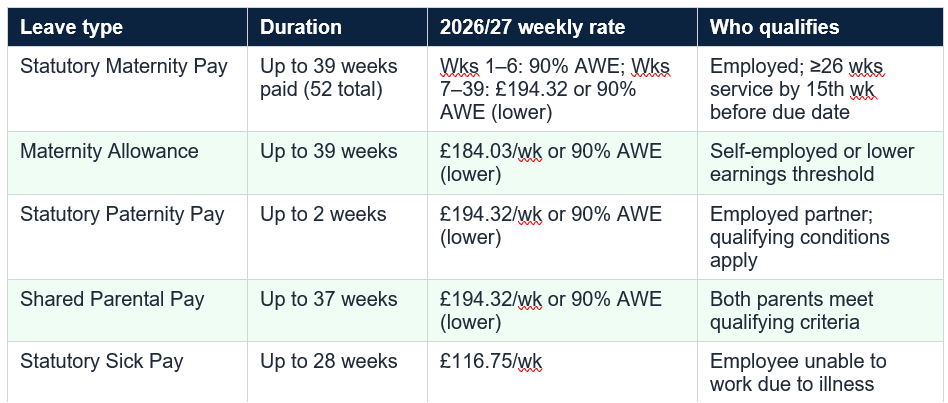
Statutory Maternity Pay (SMP) for 2026/27 works as follows: the first six weeks are paid at 90% of your average weekly earnings before tax. After that, the rate drops to £194.32 per week or 90% of average weekly earnings — whichever is lower — for up to 33 further weeks. Weeks 40 to 52 of maternity leave are unpaid (Royal London, April 2026). For someone earning £35,000 a year (approximately £673/week), the first six weeks at 90% = £605/week; weeks 7–39 = £194.32/week — a drop of approximately £479/week from full pay.
Statutory Paternity Pay (SPP) for 2026/27 is £194.32 per week or 90% of average weekly earnings (whichever is lower), for up to two weeks. Shared Parental Leave (SPL) allows qualifying parents to split up to 50 weeks of leave and up to 37 weeks of pay between them — at the same statutory rates. Some employers offer significantly enhanced parental leave; always check your contract before assuming statutory rates apply.
In the United States, there is no federal mandate for paid parental leave. Some states — including California, New York, New Jersey, Washington, Massachusetts, and Minnesota (from 2026) — have their own paid family and medical leave programmes. For federal employees and many private sector workers, the situation depends entirely on the employer's policy. US News (June 2026) recommends exploring your company's benefits, paid time off, and state leave laws in detail before the birth.
Source: Royal London (April 6, 2026); PocketWise (April 14, 2026); GOV.UK. Rates are for 2026/27 and subject to annual review. Always check gov.uk/maternity-pay-leave and gov.uk/paternity-pay-leave for current rules and calculators.
The drop from full pay to SMP can be hundreds of pounds per week. For many families it means a 40–60% income reduction for several months. If your employer only offers statutory rates and you have not saved a buffer, this is the period most likely to generate credit card debt, missed payments, or loan dependency. Start saving a buffer the moment you know you are expecting.
The most effective approach is a complete budget rebuild, not a tweak to the existing one. Start from zero: list all income during leave (SMP, SPP, any employer enhancement, any partner income), then list all essential expenses in their new form. Many pre-baby discretionary expenses — restaurants, holidays, gym memberships — will naturally reduce. New fixed costs (nappies, formula if not breastfeeding, baby clothes, nursery fees) must be added in.
A practical framework for new family budgets is a modified 50/30/20 rule, adjusted for the family stage:
The good news is that a significant portion of these costs can be reduced through government support — but only if you know what you are entitled to and apply in time. The three main mechanisms in England in 2026 are:
A critical and widely misunderstood point: even if the High Income Child Benefit Charge (HICBC) means you will have to repay the Child Benefit through Self Assessment — because the higher-earning partner earns over £60,000 — you should still claim it. Claiming earns NI credits for the lower-earning or non-working parent, which count toward their State Pension entitlement. PocketWise (April 2026) values these NI credits at approximately £1,354 per year in future State Pension income — worth far more over a lifetime than the HICBC repayment might suggest. You can claim Child Benefit and elect not to receive the payment, preserving the NI credits without incurring the charge.
Other state support worth investigating:
The challenge for new parents is timing: the period when the emergency fund is most needed (early parenthood, reduced income, higher spending) is also the period when it is hardest to build. The solution is to start before the baby arrives. Royal London (April 2026) recommends building cash savings in easy-access accounts before parental leave begins: 'It pays to have a financial buffer in place.'
Target calculation for a UK family in 2026: add up your essential monthly expenses — mortgage or rent, utilities, food, childcare, minimum debt payments, and basic transport. Multiply by six. That is your emergency fund target. For a family with £2,500/month in essential expenses, the target is £15,000. This may take time to build — start with one month's expenses and add to it regularly.
Open a dedicated easy-access savings account (separate from your current account and your other savings) labelled 'Emergency Fund.' Set up a standing order for whatever you can afford — even £50/month adds £600 a year. Do not invest the emergency fund in stocks and shares ISAs or any investment that can fall in value; it must be in cash and instantly accessible. The current best easy-access cash ISA and savings rates are available at Moneysavingexpert.com.
Life insurance: a term life insurance policy pays a lump sum if you die during the policy term. For new parents, the standard approach is a level term policy covering the mortgage (if applicable) and providing income replacement for the surviving partner and child. A 30-year-old non-smoker in good health can typically obtain £500,000 of life cover for £10–£20 per month — one of the cheapest forms of significant financial protection available. PocketWise (April 2026) notes that 'life insurance quotes are available online in minutes' and recommends comparing via comparison sites or a whole-of-market broker.
Income protection: pays a monthly income if you cannot work due to illness or injury. PocketWise (April 2026) describes this as 'particularly important for self-employed parents or anyone without a generous employer sick pay scheme' — noting that Statutory Sick Pay is just £116.75 per week for a maximum of 28 weeks. An income protection policy paying 60% of salary until recovery or retirement is significantly more valuable than most people realise, and is relatively inexpensive for those in their 20s and 30s.
Critical illness cover: pays a lump sum on diagnosis of specified serious conditions (cancer, heart attack, stroke, etc.). Useful in addition to income protection, particularly if your employer's sick pay is generous enough to cover short-term absence but not the cost of adapting your home or funding private treatment.
Many people assume that employer life insurance (death in service benefit, typically 2–4× salary) is sufficient. For a family with a mortgage, childcare costs, and a dependent child, 2× salary — even at 4× salary — may fall significantly short of what the surviving partner would need to maintain the family's standard of living. Review the adequacy of your total life cover, not just its existence.
A will for new parents should address: who inherits your assets (and in what proportions); who is appointed guardian of your child; whether you wish to create a trust for any inheritance your child receives (so it is managed until they reach an appropriate age rather than being handed over at 18); and who is appointed executor to administer the estate.
Both partners should have separate wills, updated when the family grows. A solicitor-drafted will typically costs £150–£350 per person. It is one of the highest-return financial decisions a new parent can make. Mirror wills (where both partners leave everything to each other and then to children) are a common and efficient approach for most families.
Contact a solicitor who specialises in wills and estate planning — the Law Society's Find a Solicitor tool (solicitors.lawsociety.org.uk) can help. Bring to the meeting: a list of your assets (property, pensions, savings, investments); names and contact details of proposed guardians (ask them first); names of proposed executors; any specific wishes about trusts or age-conditions on inheritance. Review and update the will when: you have an additional child; you move house; you divorce or separate; a named executor or guardian dies or becomes unsuitable.
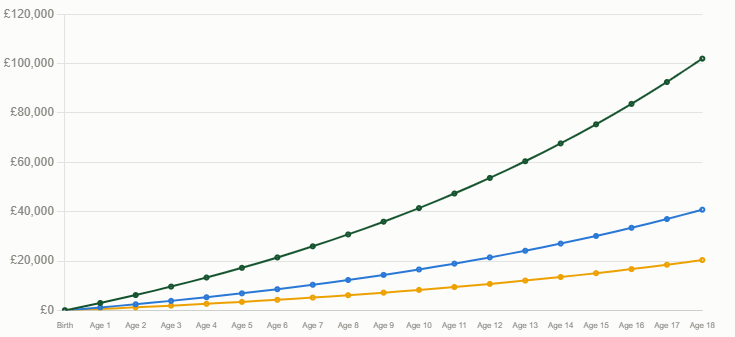
The power of starting early is significant. A stocks and shares Junior ISA invested in a globally diversified fund from birth has 18 years to grow. At a long-term average equity return of 7% per year (not guaranteed), a monthly contribution of £100 (£1,200/year) from birth would grow to approximately £38,000 by age 18. At £250/month (£3,000/year) — still well within the £9,000 annual limit — the projected value rises to approximately £95,000. These are illustrative projections; investment returns can fall as well as rise and past performance is not a guide to future performance.
Two types of Junior ISA are available: cash Junior ISA (fixed or variable interest rate; no investment risk; lower expected long-term return) and stocks and shares Junior ISA (invested in funds or shares; higher expected long-term return; subject to market fluctuation). For an 18-year investment horizon, most financial planners consider a diversified equity fund to be appropriate — but this is a personal decision and the right choice depends on individual circumstances and risk tolerance.
The Junior ISA allowance is separate from the adult ISA allowance (£20,000 for 2026/27). A family maximising both allowances could save £29,000 per year per child (£20,000 adult ISA + £9,000 JISA) in a tax-efficient wrapper. Grandparents can also contribute to a JISA — making it an efficient way for the wider family to support the child's long-term financial future. Note: JISA funds are the child's money; they cannot be reclaimed by the parent.
In the UK, if you are auto-enrolled in a workplace pension and earning above the lower earnings limit, your employer must continue making pension contributions during any period of paid leave (ordinary maternity leave and additional maternity leave, up to 52 weeks), calculated on your actual pay. During unpaid periods, employer contributions typically stop — but you can continue making contributions from your own funds if you choose.
The lower-earning parent who takes a long career break or returns part-time should also consider making additional personal pension contributions in later years when income recovers, using carry forward if applicable. The pension Annual Allowance for 2026/27 is £60,000 — most people are far below this ceiling, leaving significant room to catch up.
Critically: the NI credit from Child Benefit (see Section 7) protects State Pension entitlement during periods out of work. This is entirely separate from private pension saving — but both matter for retirement. A ten-year career break with no NI credits and no pension contributions could cost a parent tens of thousands of pounds in retirement income.
During parental leave, check: (1) Is your employer still contributing to your workplace pension? (Legally required during paid leave.) (2) Is your NI record being credited — have you claimed Child Benefit? (3) If you have paused your own contributions, calculate what it will cost in reduced pension at retirement and when you plan to restart. Even reducing contributions rather than stopping entirely preserves the habit and the employer match.
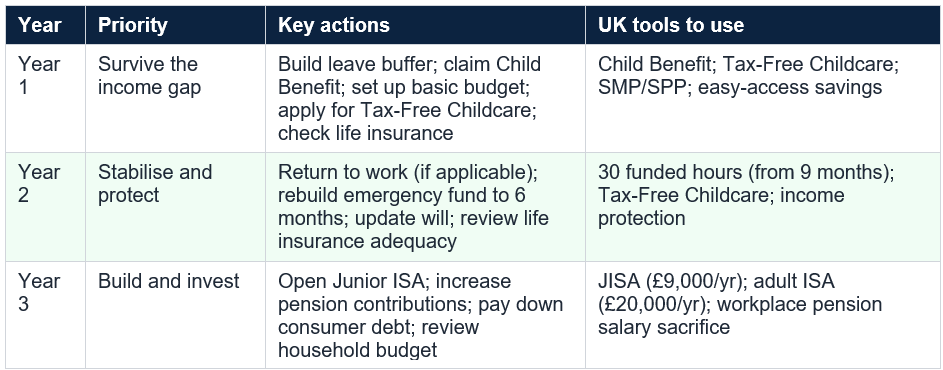
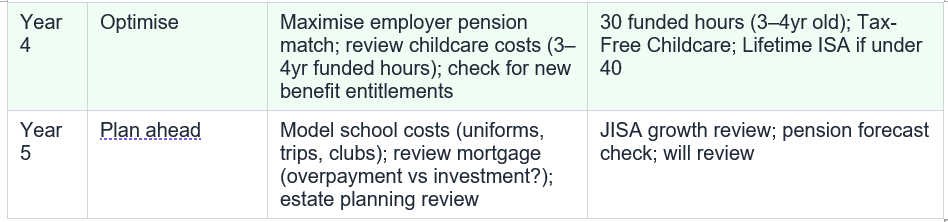
Not financial advice. Priorities will vary significantly based on income, debt levels, housing situation, and family size. This framework is a starting point — consult a qualified independent financial adviser for a plan specific to your circumstances.
The essentials are these: save a parental leave buffer before the birth; understand exactly what your statutory or enhanced pay will be during leave; rebuild your budget around the new reality; claim every state benefit and support scheme you are entitled to; protect your family with life insurance and a will; and start saving for your child's future — even £50 a month in a Junior ISA makes a meaningful difference over 18 years. Most importantly, do not pause your pension contributions any longer than you absolutely must. The compounding loss of a long pension gap is one of the most underestimated costs of parenthood.
The financial challenges of starting a family are real, but they are manageable with preparation and the right systems in place. The families who navigate this period best are not those with the highest incomes — they are those who plan early, automate their saving, claim what they are entitled to, and review their finances regularly as the family grows.
There is no single figure that works for every family, but a useful target is three to six months of your essential household expenses plus the cost of the key baby items you will need in the first year. In the UK, Smart Cells estimates first-year costs at approximately £8,460 in 2026, covering a car seat, pushchair, nappies, cot, and essentials. Add to that the income you will lose during maternity or paternity leave beyond the statutory amount you receive. If your employer only pays Statutory Maternity Pay (SMP), and your full salary is significantly higher than £194.32 per week, you could be losing several hundred pounds a week for up to 33 weeks. Save for that gap as a priority before the birth.
What is the difference between Tax-Free Childcare and 30 funded hours?
They are separate schemes that can be used together. The 30 funded hours scheme provides government-funded childcare — 30 hours per week for eligible working parents with children aged 9 months to 4 years in England (since September 2025 expansion). This reduces the number of hours you pay for. Tax-Free Childcare then provides a 20% top-up (up to £2,000 per year per child) on the childcare fees you do pay. So if you use 30 funded hours and still pay for additional hours above the funded entitlement, Tax-Free Childcare makes those additional paid hours 20% cheaper. Apply for the 30-hour code at gov.uk/apply-30-hours-free-childcare; apply for Tax-Free Childcare via gov.uk/tax-free-childcare.
Should I claim Child Benefit even if I earn over £60,000?
Yes — you should claim Child Benefit even if the High Income Child Benefit Charge (HICBC) means you have to repay some or all of it through Self Assessment. The reason is NI credits. Claiming Child Benefit earns National Insurance credits for the lower-earning or non-earning parent — protecting their future State Pension entitlement. PocketWise values these credits at approximately £1,354 per year in future State Pension income. If you do not want to receive the Child Benefit payment and avoid the HICBC admin, you can claim it and then elect not to receive the payment — preserving the NI credits at no cost.
Do I need life insurance if I already have death in service through my employer?
Death in service benefit — typically 2–4× your annual salary — is a valuable employer benefit, but it is rarely sufficient on its own for a family with a mortgage and dependent children. Consider: if you have a £300,000 mortgage and a child who will need financial support for 18 years, 4× a £35,000 salary (£140,000) leaves a significant gap. A personal term life insurance policy covers this gap, is independent of your employment (so it continues if you change jobs or are made redundant), and is inexpensive for younger parents in good health. Use a comparison site or whole-of-market broker to compare policies.
What is a Junior ISA and when should I open one?
A Junior ISA (JISA) is a tax-free savings or investment account for children under 18 resident in the UK. The 2026/27 annual subscription limit is £9,000 per child, frozen until 2030/31. The funds belong to the child and are locked until they turn 18, at which point the JISA converts to an adult ISA. You can open a cash JISA (lower risk, lower expected return) or a stocks and shares JISA (higher expected long-term return, subject to market fluctuation). The earlier you open one, the longer the money has to grow — starting from birth gives 18 years of potential compound growth. Monthly contributions of even £50 (£600/year) from birth, invested in a diversified equity fund at a long-term average return of 7% per year, would project to approximately £19,000 by age 18 (illustrative; not guaranteed).
How do I protect my pension if I take a long maternity or paternity leave?
Three actions protect your pension during leave: (1) Confirm your employer will continue contributing during paid leave — they are legally required to for employees on ordinary and additional maternity leave. (2) Claim Child Benefit to earn NI credits for your State Pension record during any unpaid period. (3) Plan to increase your pension contributions when you return to work to partially offset any gap. Most people have unused Annual Allowance well below the £60,000 cap for 2026/27 — there is typically capacity to catch up in later earning years. If you are self-employed, continue making SIPP contributions even at a reduced rate during leave to preserve the habit and any available tax relief.
Table of Contents
- The Financial Reality of Starting a Family
- What It Really Costs: Birth to 18 in the UK and US
- Preparing Before Baby Arrives: The Pre-Birth Financial Checklist
- Understanding Maternity, Paternity, and Shared Parental Leave Pay
- Rebuilding Your Budget Around a Baby
- Childcare Costs and How to Reduce Them
- Child Benefit, Tax-Free Childcare, and Other State Support
- Building an Emergency Fund for Your Family
- Life Insurance and Income Protection: The Protections Most New Parents Skip
- Wills, Guardianship, and Estate Planning
- Junior ISAs and Long-Term Savings for Your Child
- Protecting Your Pension During Parental Leave
- Family Finance Beyond the First Year: A Five-Year Plan
- Conclusion: A Financial Foundation for Your Growing Family
- Frequently Asked Questions
UK Cost Of Raising A Child: BreakDown Birth To 18
Junior ISA Growth: The Power of Starting Early
The Financial Reality of Starting a Family
Having a child change everything — including your finances. Most couples focus on the joy of the arrival and underestimate the financial transformation that accompanies it. Income drops during parental leave. Spending rises immediately and continues rising for 18 years. The budget that worked perfectly for two people no longer works at all for three. And all of this arrives at the same time as sleep deprivation, emotional intensity, and little bandwidth for spreadsheets.The answer is not to become a financial expert overnight. It is to make a small number of important decisions before the baby arrives — and to build simple, automatic systems that hold the family's finances together when life becomes chaotic. This guide covers every one of those decisions in plain language, with specific numbers for the UK in 2026/27 and, where relevant, the United States.
UK: raising one child to 18 costs £167,679 basic (couple); £251,018 with childcare and housing (CPAG, cited Royal London April 2026). First-year costs alone: ~£8,460 (Smart Cells, cited LV= 2026). US: ~$320,000 from birth to 18 (Northwestern Mutual, adjusted from USDA 2015 data using CPI inflation, September 2025). US births 2025: 3.6 million, down 1% from 2024 (US News, June 2026).
What It Really Costs: Birth to 18 in the UK and US
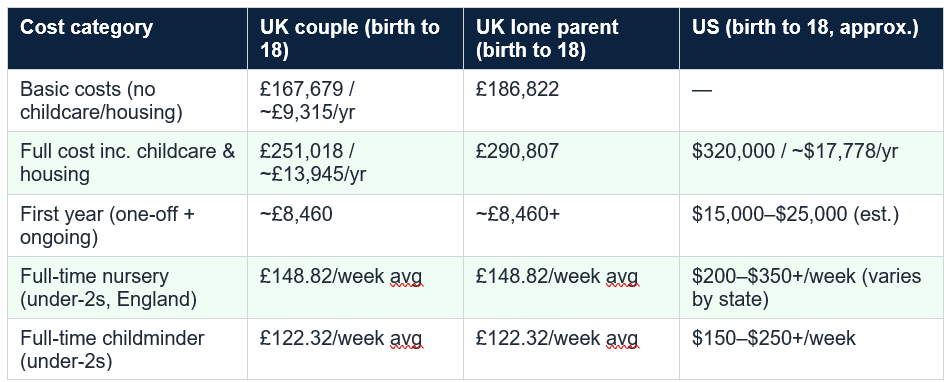
The Child Poverty Action Group's research — cited by Royal London in April 2026 — puts the basic cost of raising one child to age 18 at £167,679 for a couple, or approximately £9,315 per year. When childcare costs and additional housing costs are included, that figure more than doubles to £251,018, or over £13,945 per year. For a lone parent, the equivalent figures are £186,822 (basic) and £290,807 (full cost including childcare and housing), according to 2024 Statista data citing CPAG.In the United States, Northwestern Mutual estimates the cost of raising a child from birth to 18 at approximately $320,000 in 2025 — adjusted from the 2015 USDA figure of $233,610 using CPI inflation data. This does not include college, which the College Board estimates costs an additional $28,000–$58,000 per year depending on institution type.
The first year is typically the most expensive per-year period. LV='s 2026 guide, citing Smart Cells research, estimates first-year costs at approximately £8,460, driven by one-off capital items:
- Infant car seat: average £175 (Smart Cells 2026)
- Pushchair or travel system: approximately £525
- Nappies and wipes for the first year: approximately £260
- Cot, bedding, and nursery furniture: variable but typically £300–£700
- Feeding equipment, clothing, and miscellaneous: £500–£1,000+
Sources: Child Poverty Action Group (CPAG) 2024, cited Statista December 2024; Royal London April 2026 (CPAG figure £167,679); LV= 2026 / Smart Cells (first year £8,460); Coram Family and Childcare Survey 2026 (published 17 March 2026); Northwestern Mutual September 2025 (US $320,000). All UK figures are averages; actual costs vary significantly by region, lifestyle, and family choices. Not financial advice.
Preparing Before Baby Arrives: The Pre-Birth Financial Checklist
The months before a baby's due date are the highest-leverage financial planning window you will have. Income is still at full level, the schedule is relatively predictable, and you have time to research, compare, and set things up. The following are the actions that matter most:- Calculate your maternity/paternity leave income: work out exactly what you will earn during leave — both statutory and any enhanced employer provision. Model your monthly cash flow during leave and identify the months where income drops most sharply.
- Save a parental leave buffer: even £50 a week saved in the months before leave builds a meaningful cushion — £50/week over six months = £1,300 (PenniesToPounds). If you can save more, target three to six months of essential expenses.
- Check and update your employer benefits: life insurance through your employer (death in service), income protection, and enhanced parental leave provisions are often underused. Read your employment contract and HR documents before the birth — this is also the moment to update your expression of wishes for any workplace pension.
- Request your P60 and check your NI record: the lower-earning partner (often the one taking the longer leave) should check their National Insurance record at gov.uk. Claiming Child Benefit — even if the HICBC cancels it out — earns NI credits that protect the State Pension record.
- Compare and buy life insurance: a new baby is the clearest trigger for a life insurance review. Quotes are available in minutes online. A 30-year-old in good health can obtain £500,000 of level term life insurance for £10–£15 per month.
- Draft or update your will: without a will, the law decides who inherits your assets and who cares for your children — and it may not be who you would choose. A solicitor-drafted will costs £150–£300 and takes a few hours.
Understanding Maternity, Paternity, and Shared Parental Leave Pay
One of the most common financial shocks for new parents in the UK is the drop in income during parental leave. Most people understand that maternity pay exists — but significantly fewer understand exactly how much it is, when it changes, and how long it lasts.Statutory Maternity Pay (SMP) for 2026/27 works as follows: the first six weeks are paid at 90% of your average weekly earnings before tax. After that, the rate drops to £194.32 per week or 90% of average weekly earnings — whichever is lower — for up to 33 further weeks. Weeks 40 to 52 of maternity leave are unpaid (Royal London, April 2026). For someone earning £35,000 a year (approximately £673/week), the first six weeks at 90% = £605/week; weeks 7–39 = £194.32/week — a drop of approximately £479/week from full pay.
Statutory Paternity Pay (SPP) for 2026/27 is £194.32 per week or 90% of average weekly earnings (whichever is lower), for up to two weeks. Shared Parental Leave (SPL) allows qualifying parents to split up to 50 weeks of leave and up to 37 weeks of pay between them — at the same statutory rates. Some employers offer significantly enhanced parental leave; always check your contract before assuming statutory rates apply.
In the United States, there is no federal mandate for paid parental leave. Some states — including California, New York, New Jersey, Washington, Massachusetts, and Minnesota (from 2026) — have their own paid family and medical leave programmes. For federal employees and many private sector workers, the situation depends entirely on the employer's policy. US News (June 2026) recommends exploring your company's benefits, paid time off, and state leave laws in detail before the birth.
Source: Royal London (April 6, 2026); PocketWise (April 14, 2026); GOV.UK. Rates are for 2026/27 and subject to annual review. Always check gov.uk/maternity-pay-leave and gov.uk/paternity-pay-leave for current rules and calculators.
The drop from full pay to SMP can be hundreds of pounds per week. For many families it means a 40–60% income reduction for several months. If your employer only offers statutory rates and you have not saved a buffer, this is the period most likely to generate credit card debt, missed payments, or loan dependency. Start saving a buffer the moment you know you are expecting.
Rebuilding Your Budget Around a Baby
A baby fundamentally changes your household budget — not just because spending increases, but because income drops at the same time. Most pre-baby budgets are calibrated for two adult incomes and two adult lifestyles. Post-baby, the budget must absorb higher spending and lower income simultaneously, often with less time to manage it.The most effective approach is a complete budget rebuild, not a tweak to the existing one. Start from zero: list all income during leave (SMP, SPP, any employer enhancement, any partner income), then list all essential expenses in their new form. Many pre-baby discretionary expenses — restaurants, holidays, gym memberships — will naturally reduce. New fixed costs (nappies, formula if not breastfeeding, baby clothes, nursery fees) must be added in.
A practical framework for new family budgets is a modified 50/30/20 rule, adjusted for the family stage:
- 50% of net income to needs: rent/mortgage, utilities, food, essential transport, minimum debt payments, baby essentials (nappies, formula, clothing).
- 30% to wants: discretionary spending — though this category will naturally contract during the early years and that is normal. Resist the urge to maintain the pre-baby lifestyle on a post-baby income.
- 20% to saving and debt repayment: emergency fund top-up, pension contributions (even reduced ones), Junior ISA if possible, and any consumer debt above 0% interest.
Childcare Costs and How to Reduce Them
For most UK families with children under five, childcare is the single largest expenditure item — larger than rent or mortgage payments in many cases. The Coram Family and Childcare Survey 2026 (published 17 March 2026) found that a full-time nursery place for a child under two in England averages £148.82 per week; a full-time childminder averages £122.32 per week. A nanny in the South East costs approximately £34,500/year in gross salary, rising to around £39,000 in total employer cost once National Insurance and pension contributions are added.The good news is that a significant portion of these costs can be reduced through government support — but only if you know what you are entitled to and apply in time. The three main mechanisms in England in 2026 are:
- Funded childcare hours: since September 2025, eligible working parents in England can access up to 30 funded hours per week for children from 9 months old. For children aged 3–4, the 30-hour entitlement has been in place for longer. Scotland, Wales, and Northern Ireland have their own equivalent schemes. Apply at least 2–3 months before you need the place — popular settings fill up quickly (PocketWise, March 2026).
- Tax-Free Childcare: for every £8 you deposit into a Tax-Free Childcare account, the government adds £2 — up to a maximum government contribution of £2,000 per year per child (£4,000 for disabled children). This is available to working parents where neither partner earns over £100,000 adjusted net income. Applied to £10,000 of childcare spend, the £2,000 top-up represents a 20% saving.
- Universal Credit childcare element: for parents on Universal Credit, up to 85% of childcare costs can be covered by the UC childcare element — a significantly higher rate than Tax-Free Childcare. The two schemes cannot be used simultaneously; choose the one most beneficial for your circumstances.
Child Benefit, Tax-Free Childcare, and Other State Support
Child Benefit for 2026/27 is £27.05 per week (£1,406 per year) for the eldest child and £17.90 per week (£931 per year) for each additional child. It is paid until the child turns 16, or until 20 if they stay in approved education or training. Claiming Child Benefit is free and straightforward — you can claim online at gov.uk/child-benefit even before your baby is born if you have a due date.A critical and widely misunderstood point: even if the High Income Child Benefit Charge (HICBC) means you will have to repay the Child Benefit through Self Assessment — because the higher-earning partner earns over £60,000 — you should still claim it. Claiming earns NI credits for the lower-earning or non-working parent, which count toward their State Pension entitlement. PocketWise (April 2026) values these NI credits at approximately £1,354 per year in future State Pension income — worth far more over a lifetime than the HICBC repayment might suggest. You can claim Child Benefit and elect not to receive the payment, preserving the NI credits without incurring the charge.
Other state support worth investigating:
- Healthy Start vouchers: if you are pregnant or have a child under four and are receiving certain benefits, you may qualify for Healthy Start vouchers to spend on milk, fruit, vegetables, and vitamins.
- Sure Start Maternity Grant: a one-off payment of £500 if you are receiving certain means-tested benefits and this is your first child (or you are expecting multiple births).
- Free school meals: children in Reception through Year 2 in England receive Universal Free School Meals. From Year 3 onward, eligibility is means-tested.
- 15 hours free childcare (non-working parents): all 3–4 year olds in England are entitled to 15 hours of funded childcare per week regardless of parental employment status.
Building an Emergency Fund for Your Family
An emergency fund is the financial safety net that prevents a single unexpected cost — a broken boiler, a car repair, a period of illness — from turning into debt. Before children, a three-month emergency fund is typically recommended. With children, six months of essential expenses is the appropriate target — because the unexpected becomes much more frequent and much more expensive.The challenge for new parents is timing: the period when the emergency fund is most needed (early parenthood, reduced income, higher spending) is also the period when it is hardest to build. The solution is to start before the baby arrives. Royal London (April 2026) recommends building cash savings in easy-access accounts before parental leave begins: 'It pays to have a financial buffer in place.'
Target calculation for a UK family in 2026: add up your essential monthly expenses — mortgage or rent, utilities, food, childcare, minimum debt payments, and basic transport. Multiply by six. That is your emergency fund target. For a family with £2,500/month in essential expenses, the target is £15,000. This may take time to build — start with one month's expenses and add to it regularly.
Open a dedicated easy-access savings account (separate from your current account and your other savings) labelled 'Emergency Fund.' Set up a standing order for whatever you can afford — even £50/month adds £600 a year. Do not invest the emergency fund in stocks and shares ISAs or any investment that can fall in value; it must be in cash and instantly accessible. The current best easy-access cash ISA and savings rates are available at Moneysavingexpert.com.
Life Insurance and Income Protection: The Protections Most New Parents Skip
Of all the financial gaps new parents leave open, life insurance and income protection are the most consequential and the most commonly overlooked. The logic is straightforward: once you have a child who depends on your income, the financial consequences of your death or long-term illness extend far beyond your own situation.Life insurance: a term life insurance policy pays a lump sum if you die during the policy term. For new parents, the standard approach is a level term policy covering the mortgage (if applicable) and providing income replacement for the surviving partner and child. A 30-year-old non-smoker in good health can typically obtain £500,000 of life cover for £10–£20 per month — one of the cheapest forms of significant financial protection available. PocketWise (April 2026) notes that 'life insurance quotes are available online in minutes' and recommends comparing via comparison sites or a whole-of-market broker.
Income protection: pays a monthly income if you cannot work due to illness or injury. PocketWise (April 2026) describes this as 'particularly important for self-employed parents or anyone without a generous employer sick pay scheme' — noting that Statutory Sick Pay is just £116.75 per week for a maximum of 28 weeks. An income protection policy paying 60% of salary until recovery or retirement is significantly more valuable than most people realise, and is relatively inexpensive for those in their 20s and 30s.
Critical illness cover: pays a lump sum on diagnosis of specified serious conditions (cancer, heart attack, stroke, etc.). Useful in addition to income protection, particularly if your employer's sick pay is generous enough to cover short-term absence but not the cost of adapting your home or funding private treatment.
Many people assume that employer life insurance (death in service benefit, typically 2–4× salary) is sufficient. For a family with a mortgage, childcare costs, and a dependent child, 2× salary — even at 4× salary — may fall significantly short of what the surviving partner would need to maintain the family's standard of living. Review the adequacy of your total life cover, not just its existence.
Wills, Guardianship, and Estate Planning
Without a valid will, the law of intestacy determines what happens to your assets and — critically — who looks after your child if both parents die. In England and Wales, the intestacy rules may not reflect your wishes. More importantly, they cannot name a guardian for your child — only a will can do that.A will for new parents should address: who inherits your assets (and in what proportions); who is appointed guardian of your child; whether you wish to create a trust for any inheritance your child receives (so it is managed until they reach an appropriate age rather than being handed over at 18); and who is appointed executor to administer the estate.
Both partners should have separate wills, updated when the family grows. A solicitor-drafted will typically costs £150–£350 per person. It is one of the highest-return financial decisions a new parent can make. Mirror wills (where both partners leave everything to each other and then to children) are a common and efficient approach for most families.
Contact a solicitor who specialises in wills and estate planning — the Law Society's Find a Solicitor tool (solicitors.lawsociety.org.uk) can help. Bring to the meeting: a list of your assets (property, pensions, savings, investments); names and contact details of proposed guardians (ask them first); names of proposed executors; any specific wishes about trusts or age-conditions on inheritance. Review and update the will when: you have an additional child; you move house; you divorce or separate; a named executor or guardian dies or becomes unsuitable.
Junior ISAs and Long-Term Savings for Your Child
A Junior ISA (JISA) is a tax-free savings or investment account for children under 18 who live in the UK. The annual subscription limit for 2026/27 is £9,000 per child, frozen until 2030/31 (PKF Francis Clark, March 2026; HMRC). The funds are locked until the child turns 18, at which point the JISA automatically converts to an adult ISA in the child's name. The child can take control of the account from age 16 but cannot withdraw funds until 18.The power of starting early is significant. A stocks and shares Junior ISA invested in a globally diversified fund from birth has 18 years to grow. At a long-term average equity return of 7% per year (not guaranteed), a monthly contribution of £100 (£1,200/year) from birth would grow to approximately £38,000 by age 18. At £250/month (£3,000/year) — still well within the £9,000 annual limit — the projected value rises to approximately £95,000. These are illustrative projections; investment returns can fall as well as rise and past performance is not a guide to future performance.
Two types of Junior ISA are available: cash Junior ISA (fixed or variable interest rate; no investment risk; lower expected long-term return) and stocks and shares Junior ISA (invested in funds or shares; higher expected long-term return; subject to market fluctuation). For an 18-year investment horizon, most financial planners consider a diversified equity fund to be appropriate — but this is a personal decision and the right choice depends on individual circumstances and risk tolerance.
The Junior ISA allowance is separate from the adult ISA allowance (£20,000 for 2026/27). A family maximising both allowances could save £29,000 per year per child (£20,000 adult ISA + £9,000 JISA) in a tax-efficient wrapper. Grandparents can also contribute to a JISA — making it an efficient way for the wider family to support the child's long-term financial future. Note: JISA funds are the child's money; they cannot be reclaimed by the parent.
Protecting Your Pension During Parental Leave
Parental leave — especially a long stretch on reduced statutory pay — is one of the most common causes of gaps in pension saving. The parent taking leave typically reduces or stops pension contributions during the low-income period. Over a working lifetime, the compound effect of even a short gap can be material.In the UK, if you are auto-enrolled in a workplace pension and earning above the lower earnings limit, your employer must continue making pension contributions during any period of paid leave (ordinary maternity leave and additional maternity leave, up to 52 weeks), calculated on your actual pay. During unpaid periods, employer contributions typically stop — but you can continue making contributions from your own funds if you choose.
The lower-earning parent who takes a long career break or returns part-time should also consider making additional personal pension contributions in later years when income recovers, using carry forward if applicable. The pension Annual Allowance for 2026/27 is £60,000 — most people are far below this ceiling, leaving significant room to catch up.
Critically: the NI credit from Child Benefit (see Section 7) protects State Pension entitlement during periods out of work. This is entirely separate from private pension saving — but both matter for retirement. A ten-year career break with no NI credits and no pension contributions could cost a parent tens of thousands of pounds in retirement income.
During parental leave, check: (1) Is your employer still contributing to your workplace pension? (Legally required during paid leave.) (2) Is your NI record being credited — have you claimed Child Benefit? (3) If you have paused your own contributions, calculate what it will cost in reduced pension at retirement and when you plan to restart. Even reducing contributions rather than stopping entirely preserves the habit and the employer match.
Family Finance Beyond the First Year: A Five-Year Plan
The first year of parenthood is financial survival mode. The aim is to bridge the income gap, manage the new costs, and avoid taking on consumer debt. From year two onward — once childcare is understood, parental leave is over, and routines are established — a more active financial strategy becomes possible. A five-year plan for family finances:Not financial advice. Priorities will vary significantly based on income, debt levels, housing situation, and family size. This framework is a starting point — consult a qualified independent financial adviser for a plan specific to your circumstances.
Conclusion
Starting a family is the most significant financial event in most people's lives — larger in its long-term impact than buying a house or changing jobs. The cost of raising a child in the UK can reach £251,018 over 18 years; in the US, approximately $320,000. Those are not numbers to be alarmed by — they are numbers to plan around. And the planning itself is straightforward when broken into manageable steps.The essentials are these: save a parental leave buffer before the birth; understand exactly what your statutory or enhanced pay will be during leave; rebuild your budget around the new reality; claim every state benefit and support scheme you are entitled to; protect your family with life insurance and a will; and start saving for your child's future — even £50 a month in a Junior ISA makes a meaningful difference over 18 years. Most importantly, do not pause your pension contributions any longer than you absolutely must. The compounding loss of a long pension gap is one of the most underestimated costs of parenthood.
The financial challenges of starting a family are real, but they are manageable with preparation and the right systems in place. The families who navigate this period best are not those with the highest incomes — they are those who plan early, automate their saving, claim what they are entitled to, and review their finances regularly as the family grows.
Frequently Asked Questions
How much should I save before having a baby?There is no single figure that works for every family, but a useful target is three to six months of your essential household expenses plus the cost of the key baby items you will need in the first year. In the UK, Smart Cells estimates first-year costs at approximately £8,460 in 2026, covering a car seat, pushchair, nappies, cot, and essentials. Add to that the income you will lose during maternity or paternity leave beyond the statutory amount you receive. If your employer only pays Statutory Maternity Pay (SMP), and your full salary is significantly higher than £194.32 per week, you could be losing several hundred pounds a week for up to 33 weeks. Save for that gap as a priority before the birth.
What is the difference between Tax-Free Childcare and 30 funded hours?
They are separate schemes that can be used together. The 30 funded hours scheme provides government-funded childcare — 30 hours per week for eligible working parents with children aged 9 months to 4 years in England (since September 2025 expansion). This reduces the number of hours you pay for. Tax-Free Childcare then provides a 20% top-up (up to £2,000 per year per child) on the childcare fees you do pay. So if you use 30 funded hours and still pay for additional hours above the funded entitlement, Tax-Free Childcare makes those additional paid hours 20% cheaper. Apply for the 30-hour code at gov.uk/apply-30-hours-free-childcare; apply for Tax-Free Childcare via gov.uk/tax-free-childcare.
Should I claim Child Benefit even if I earn over £60,000?
Yes — you should claim Child Benefit even if the High Income Child Benefit Charge (HICBC) means you have to repay some or all of it through Self Assessment. The reason is NI credits. Claiming Child Benefit earns National Insurance credits for the lower-earning or non-earning parent — protecting their future State Pension entitlement. PocketWise values these credits at approximately £1,354 per year in future State Pension income. If you do not want to receive the Child Benefit payment and avoid the HICBC admin, you can claim it and then elect not to receive the payment — preserving the NI credits at no cost.
Do I need life insurance if I already have death in service through my employer?
Death in service benefit — typically 2–4× your annual salary — is a valuable employer benefit, but it is rarely sufficient on its own for a family with a mortgage and dependent children. Consider: if you have a £300,000 mortgage and a child who will need financial support for 18 years, 4× a £35,000 salary (£140,000) leaves a significant gap. A personal term life insurance policy covers this gap, is independent of your employment (so it continues if you change jobs or are made redundant), and is inexpensive for younger parents in good health. Use a comparison site or whole-of-market broker to compare policies.
What is a Junior ISA and when should I open one?
A Junior ISA (JISA) is a tax-free savings or investment account for children under 18 resident in the UK. The 2026/27 annual subscription limit is £9,000 per child, frozen until 2030/31. The funds belong to the child and are locked until they turn 18, at which point the JISA converts to an adult ISA. You can open a cash JISA (lower risk, lower expected return) or a stocks and shares JISA (higher expected long-term return, subject to market fluctuation). The earlier you open one, the longer the money has to grow — starting from birth gives 18 years of potential compound growth. Monthly contributions of even £50 (£600/year) from birth, invested in a diversified equity fund at a long-term average return of 7% per year, would project to approximately £19,000 by age 18 (illustrative; not guaranteed).
How do I protect my pension if I take a long maternity or paternity leave?
Three actions protect your pension during leave: (1) Confirm your employer will continue contributing during paid leave — they are legally required to for employees on ordinary and additional maternity leave. (2) Claim Child Benefit to earn NI credits for your State Pension record during any unpaid period. (3) Plan to increase your pension contributions when you return to work to partially offset any gap. Most people have unused Annual Allowance well below the £60,000 cap for 2026/27 — there is typically capacity to catch up in later earning years. If you are self-employed, continue making SIPP contributions even at a reduced rate during leave to preserve the habit and any available tax relief.

0 Comments Comments