

Financial Literacy
3 Money Habits That Turn Middle-Class Earners Into Millionaires
You do not need a high salary to become a millionaire. Approximately 24.5 million Americans — 8.8% of adults — have crossed the seven-figure threshold, and 80% built their wealth without inheriting it. The typical millionaire earned between $60,000 and $150,000 for most of their career: solidly middle class. What separated them from the majority was not their income. It was three specific, repeatable money habits that Erneroy identified. This guide examines each habit in full detail — with the actual numbers behind how middle-class incomes become millionaire outcomes.

There are approximately 24.5 million millionaires in the United States, representing 8.8% of all American adults (Wealthvieu, April 2026). Eighty per cent of them built their wealth themselves, without inheriting it. The typical millionaire reached $1 million around age 49 and earned between $60,000 and $150,000 for the bulk of their career — well within what Pew Research defines as the US middle class (CompoundLadder May 2026 puts the 2026 middle-class income range at $54,700–$163,200 for a 3-person household).
Identifying three habits that ordinary earners use to quietly build seven-figure wealth. The Rich Habits Study — conducted by Tom Corley, cited by SavingAdvice.com on August 30, 2026 — independently arrived at the same three habits: frugal spending, saving 20% or more of income, and a structured approach to allocating savings. These are not secret strategies. They are behaviours that most people know about but consistently fail to implement.
This guide provides the full picture: what the habits actually are, why they work mathematically, how the data shows they produce millionaire outcomes on ordinary incomes, and what specific actions the research shows make the difference between those who follow the habits and those who intend to.
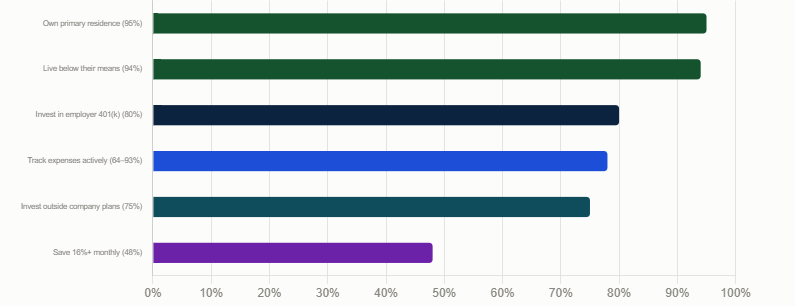
24.5 million US millionaires (8.8% of adults; Wealthvieu April 2026). 80% self-made — not inherited (The World Data Feb 2026). Typical millionaire reached $1M at age 49; earned $60k–$150k for most of career (Ramsey Solutions survey of 10,000; Wealthvieu April 2026). Middle-class income 2026: $54,700–$163,200 for 3-person household (Pew/CompoundLadder May 2026). Median household income: $83,000 (Financial Samurai May 2026). 94% of millionaires live below their means. 80% invested aggressively in 401(k)s (The World Data Feb 2026).
Ramsey Solutions surveyed 10,000 millionaires and found that nearly half save at least 16% of monthly income, and their median household income was nowhere near the top 1%. Steady Wealth (March 2026) summarises the Fidelity 401(k) millionaire data: 595,000 people hold $1 million or more in a 401(k) alone, up 27% in a single year. Their average tenure: 26 years. Their average savings rate: 14.2% (9.5% employee contribution + 4.8% employer match). Many earned less than $150,000 per year.
Wealthvieu's April 2026 analysis distils the behavioural pattern to its essence: 'Living below your means is the defining behavioral trait — 94% do this.' And the Rich Habits Study from Tom Corley, cited by SavingAdvice.com on August 30, 2026, reports that the Saver-Investor millionaires in the study accumulated an average of $3,260,000 — through frugal spending, saving 20% or more, and a structured bucket system for allocating savings. These were not high-income earners. They were systematic savers.
The demographic portrait that emerges is of wealth built through occupational consistency, not spectacle: teachers who invested in 403(b) plans for 30 years; engineers who maxed their 401(k) and invested bonuses; government workers who built pensions alongside TSP contributions; accountants who started side businesses while compounding retirement savings. As LA Weekly Magazine (May 2026) observes: 'Engineers and teachers are more represented than bankers or entertainers.'
The middle-class millionaire is primarily a story of three interacting forces: time (decades of consistent contribution), rate (a high enough savings rate — 14–20% — to generate meaningful investment volume), and behaviour (the consistent choices that prevent savings from being consumed by lifestyle inflation). None of these three forces requires a high income. All three require sustained behaviour over a long period — which is precisely why they are within reach for middle-class earners and simultaneously difficult to maintain in a consumer economy designed to extract every available dollar before it can be invested.
Compounding is the mechanism by which consistent, moderate investing on a middle-class income produces millionaire outcomes over time. The principle is simple: investment returns generate their own returns. In the early years, the effect is modest. In the later years, it becomes overwhelming — the majority of a long-term portfolio's value is typically generated by growth on prior growth, not by the original contributions.
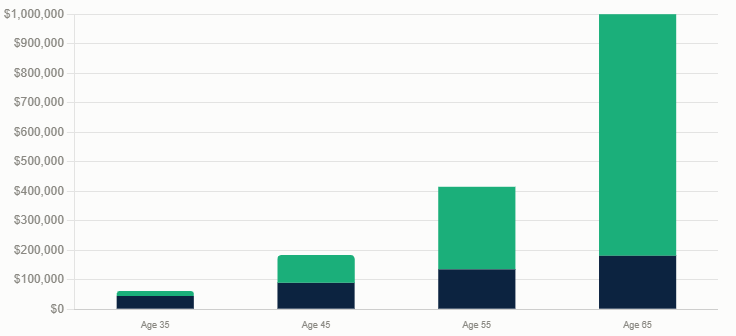
Kiplinger's worked example from their September 2026 article is instructive: starting with $1,000 at age 25 and investing approximately $375 per month could accumulate roughly $1 million by age 65, assuming a hypothetical 7% average annual return. The total contributions over 40 years: approximately $181,000. The compounding-generated growth: approximately $819,000. More than 80% of the final million-dollar portfolio comes from compound growth, not from the investor's own deposits.
Wealthvieu (April 2026) provides a complementary figure: $500 per month invested consistently can reach $1 million in 31 years at a 7% average return. This means a middle-class earner on the 2026 median household income of $83,000 — investing roughly 7.2% of gross income consistently — could reach millionaire status before traditional retirement age.
The critical word in all of these projections is 'consistently.' The power of compounding is destroyed by interruptions. An investor who stops contributing for two years in their 30s — to cover a lifestyle upgrade, pay for an unplanned expense, or simply because the market fell and they lost confidence — does not simply lose two years of contributions. They lose two years of compounding on all future contributions, the compounding that would have been earned on those two years' contributions, and the psychological momentum that makes consistent investing feel automatic.
The maths: $375/month invested from age 25 at 7%/year = approximately $1,000,000 by age 65. Total personal contributions: ~$181,000. Compound growth: ~$819,000 (82% of the total). Same $375/month starting at age 35: approximately $450,000 by age 65. The 10-year delay cost: approximately $550,000 — from the same monthly contribution. $500/month from age 25 at 7%/year: approximately $1.4 million by age 65. At 6% return: approximately $940,000. At 8% return: approximately $1.75 million. All figures illustrative; actual returns vary. Not financial advice. Use Investor.gov compound interest calculator for personalised projections.
Open a tax-advantaged investment account today if you do not have one: a 401(k) through your employer (especially if an employer match is available — the match is an immediate 50–100% return on contributions), or a Roth IRA ($7,500 annual contribution limit in 2026; Upworthy notes the Roth's unique advantage — contributions can be withdrawn penalty-free, giving liquidity that most people do not realise they have). Set up automatic monthly contributions for a specific amount. Review annually to increase contributions in line with any income growth. The specific fund matters less than the habit of consistent contribution — a low-cost, globally diversified index fund is the starting point most financial educators recommend. In the UK: ISA or pension (SIPP); verify tax-advantaged limits at gov.uk/individual-savings-accounts.
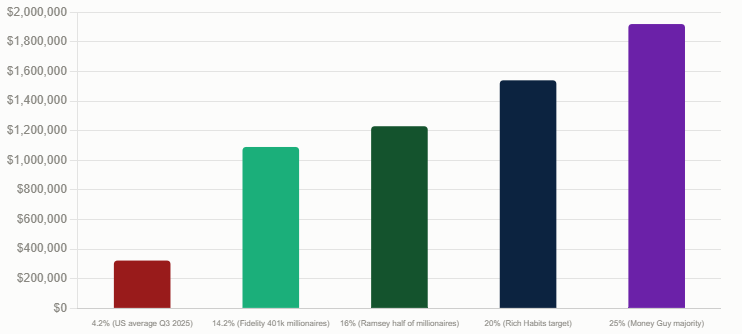
The savings rate is the most directly controllable variable in wealth building. Income can be increased — but it is uncertain, requires external validation (an employer, clients, or customers), and takes time. Investment returns cannot be controlled at all. But the percentage of income saved is entirely within the individual's control every month, regardless of what the market does. Yet the US personal savings rate in Q3 2025 stood at 4.2% — roughly one-fifth of what the millionaire data consistently identifies as the target.
The difference in outcome between a 4.2% savings rate and a 20% savings rate on the same income over 30 years is not a matter of small adjustments at the margins. On a $83,000 gross income, 4.2% represents approximately $3,486 per year invested. Twenty per cent represents approximately $16,600 per year invested. At 7% annual return over 30 years: 4.2% savings produces approximately $323,000. Twenty per cent savings produces approximately $1.54 million. The difference is the entire journey to millionaire status — from the same income — achieved entirely through the savings rate decision.
The mechanism that makes a 20% savings rate sustainable is automation. Steady Wealth's March 2026 analysis of modern millionaire behaviour identifies the system that transforms an aspirational savings rate into a reliable one: '401(k) maxed before the money ever appears in checking; bills auto-paid, so the remaining balance is the actual discretionary amount; raises auto-routed — 50% to investments, 50% to lifestyle.' Vanguard and the CFPB research, cited by Steady Wealth, found that automation increases long-term savings rates by over 40%.
The Upworthy/Austin Williams analysis (August 6, 2026) frames the psychology of saving-first simply: 'Middle-class millionaires know that saving comes before spending. How you handle the money you do have makes a big difference in how much wealth you are able to build.' Brian Feroldi, writing on August 4, 2026, distils it to a single sentence: 'The most important financial decision you will ever make is to always live below your means.'
All projections illustrative at 7% hypothetical annual return. Actual investment returns vary and can be negative. Based on $83,000 gross income (2026 US median household income; Financial Samurai May 2026). Not financial advice.
Identify your current savings rate: divide what you actually save and invest each month (not what you intend to) by your net monthly income. If it is below 15%, set a specific target of 1% increase per month for the next 6 months until you reach 15–20%. Implement automation: set a standing order on payday for the savings amount to transfer immediately to a separate investment or savings account — before any discretionary spending occurs. When you receive a pay rise, commit in advance to directing at minimum 50% of the after-tax increase to savings/investment before adjusting your lifestyle budget. The Steady Wealth system: treat the investment transfer as a fixed bill with the same non-negotiable status as rent.
Living below your means is the hardest of the three habits to maintain precisely because it is the one that faces the most continuous external pressure. Consumer culture — advertising, social media, peer consumption, credit availability — is engineered to narrow the gap between income and spending to zero. Every upgrade in lifestyle feels like earned reward. Every peer purchase that is not matched feels like deprivation. And the credit system makes it trivially easy to spend money you do not yet have, eliminating the natural friction that would otherwise limit overspending.
Financial Samurai (May 2026) observes the scale of the opportunity: 'In 2026, the median household income is around $83,000. What gets overlooked is the tremendous wealth built over the past few decades — thanks to saving, investing, and riding the greatest bull market in history. There is more wealth out there than you think.' The insight is that middle-class incomes, in an era of accessible index funds and tax-advantaged accounts, are entirely sufficient to build millionaire-level wealth — but only for those who maintain the gap between income and spending that makes investment possible.
Steady Wealth's analysis of the automation system that supports this habit is precise: 'The shift from how can I be more disciplined? to how can I design systems that make good decisions automatic? is the single most impactful mindset change in modern wealth building.' Living below your means is not sustained by willpower alone — it is sustained by systems that make the default behaviour the wealth-building behaviour. Automatic transfers, bill automation, pre-committed savings rates, and deferred lifestyle upgrades are the infrastructure of below-means living.
The enemy of this habit is lifestyle inflation: the automatic expansion of spending to match income growth. As LA Weekly Magazine (May 2026) identifies, the number-one wealth-building habit of millionaires is 'automating investments (especially 401(k)s) and avoiding lifestyle inflation.' Every time income rises and spending rises with it, the wealth-building gap remains static even as the income number grows. The gap is everything. No gap, no wealth, regardless of how large the paycheck.
Living below your means is often described as if it is about sacrifice — driving older cars, eating at home, avoiding luxury goods. This framing is both true and misleading. The millionaire who drives a 2019 car instead of a 2026 model is not experiencing deprivation. They are choosing a $30,000 gap between their income and their spending that compounds into $60,000 or $80,000 in portfolio value over the next five years. The sacrifice framing makes the habit feel negative; the compounding framing makes it feel like an investment in a future that compounds while you sleep.
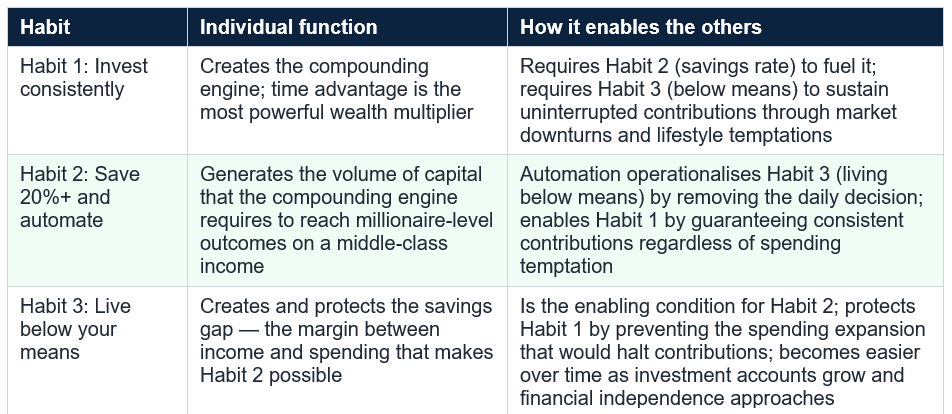
Habit 1 (consistent investing) creates the engine. But the engine can only run on fuel — the fuel is the money that is available to invest. Without Habit 2 (a high savings rate), the engine is starved. Without Habit 3 (living below means), Habit 2 is impossible to sustain because lifestyle inflation continuously reclaims any savings margin that income growth creates.
The system is self-reinforcing once it is running. A high savings rate, automated on payday, means the investment account grows every month without a decision. Growing investment accounts generate returns that further grow the account. As the portfolio reaches meaningful size — $100,000, then $200,000, then $500,000 — the compound growth begins to exceed the monthly contribution in absolute dollar terms. At $500,000 in a portfolio earning 7%, the annual growth is $35,000 — more than the $16,600 that a 20% saver on the median income contributes annually. The portfolio begins to grow faster than the saver can contribute. This is the mathematical tipping point from which the journey to $1 million becomes almost inevitable, given time.
Sources: savings rate benchmarks from Ramsey Solutions (cited Steady Wealth March 2026); Fidelity 401(k) data (Steady Wealth March 2026); Money Guy (September 2025); Rich Habits Study (SavingAdvice.com August 30, 2026). All projections illustrative at 7% hypothetical annual return; actual returns vary and can be negative. Based on $83,000 gross household income (2026 median; Financial Samurai May 2026). Not financial advice.
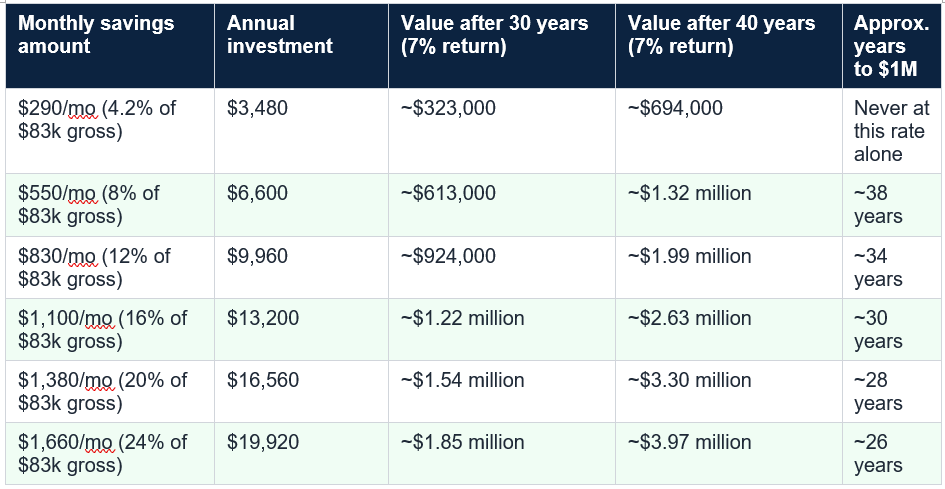
The table tells a clear story: the US average savings rate of 4.2% does not produce a millionaire outcome on a middle-class income. The 14.2% rate that characterises Fidelity's 401(k) millionaire cohort reaches $1 million in approximately 31 years — consistent with the 26-year average tenure data and starting investment in early career. The 20% target from the Rich Habits Study reaches $1 million in approximately 28 years from a single household's earnings. The 25% rate that the majority of Money Guy's millionaire clients achieve reaches $1 million in approximately 25 years.
The practical translation: a 35-year-old middle-class earner who shifts from the US average savings rate (4.2%) to 20% — and sustains it — reaches millionaire status around age 63: before traditional retirement, from a median income, through habits alone.
What the evidence also shows is that the habits are hard — not because they are intellectually complex, but because they require sustained behaviour against the natural tendencies of a consumer economy and the deeply human preference for immediate reward over future benefit. The 80% of millionaires who built their own wealth did not find these habits easy. They built systems that made the habits automatic: automated contributions, automated bill payment, pre-committed savings rates, and a fundamental orientation toward their future financial self rather than their present consumer self.
The middle-class millionaire is not a myth. They exist in the millions, on ordinary incomes, built over ordinary careers, through these three ordinary but consistently practised habits. As Kiplinger's September 2026 article concludes: 'You don't need a massive salary or a flashy lifestyle to build a seven-figure net worth. These three habits can help ordinary earners steadily accumulate wealth over time.' The data agrees. The only question is whether the habits will be implemented — or merely acknowledged.
Yes — and the data confirms it at scale. Approximately 80% of US millionaires built their wealth themselves rather than inheriting it (The World Data, February 2026; Wealthvieu, April 2026). The typical millionaire earned $60,000–$150,000 for the bulk of their career — within the Pew Research definition of middle class (CompoundLadder puts the 2026 US middle-class income range at $54,700–$163,200 for a 3-person household). The key variable is not income but savings rate: at 20% savings on the 2026 median household income of $83,000, investing for 28 years at a 7% average return produces approximately $1.54 million. The mechanism is compound interest sustained over time — accessible to any earner who maintains the three habits.
What savings rate is needed to become a millionaire on a middle-class income?
The research converges on 14–20% as the effective range. Fidelity's 401(k) millionaire cohort (595,000 people with $1M+ in their 401(k)) averaged a 14.2% total savings rate (9.5% employee + 4.8% employer match; Steady Wealth March 2026). Ramsey Solutions' survey of 10,000 millionaires found that nearly half save at least 16% monthly. The Rich Habits Study recommends 20% or more as the target for the Saver-Investor millionaire path. The US average savings rate in Q3 2025 was 4.2% — approximately one-third of the minimum needed for a millionaire outcome on a middle-class income within a working career. The practical starting point: identify your current savings rate, then increase it by 1–2% every six months until reaching 15–20%.
How important is it to start early? What if I'm in my 40s?
Starting early is mathematically the most powerful decision available — Kiplinger's September 2026 example shows that starting at 25 with $375/month produces approximately $1 million by 65, while starting at 35 with the same contribution produces approximately $450,000 by 65. The 10-year delay cost is approximately $550,000. However, starting later is dramatically better than not starting at all. A 40-year-old who shifts to a 20% savings rate still has 25+ years of compounding ahead. For those starting later, two adjustments help close the gap: increasing the savings rate above 20% (catch-up contributions in 401(k) and IRA are available from age 50 in the US); and extending the working timeline if possible to allow more compounding years. Professional financial planning advice is especially valuable for those starting wealth-building later in their career.
Is it better to pay off debt or invest?
For most middle-class earners, the framework is: (1) always capture the employer 401(k) match first — it is an immediate 50–100% return on contributions that beats almost any debt payoff rate; (2) pay off high-interest consumer debt (credit cards at 21% APR in Q1 2026, personal loans) aggressively — no investment reliably returns 21%+ after tax; (3) once high-interest debt is eliminated, redirect that cash flow to investment; (4) lower-interest debt (student loans below 5–6%, mortgages) can be serviced while simultaneously investing, since the expected long-term investment return may exceed the interest cost. The critical mistake is waiting until all debt is eliminated before beginning to invest — this delays compounding and can cost decades of growth.
What is the role of homeownership in becoming a middle-class millionaire?
Homeownership features prominently in the data: 95% of US millionaires own their primary residence, with an average home equity of $743,000 (The World Data, February 2026). However, 43% of millionaires own just one property — multiple properties are not required. The wealth-building case for homeownership rests on: leverage (a mortgage allows control of a large asset with a fraction of its value in cash); forced saving (mortgage payments build equity automatically); and long-term appreciation. The counterargument: home equity is illiquid, housing is geographically concentrated, maintenance costs are significant, and in some markets and periods, renting and investing the difference has outperformed buying. The research supports homeownership as a component of the middle-class millionaire path — not as a replacement for the three habits, but as a complementary wealth-building vehicle alongside them.
What does 'living below your means' actually require in daily life?
Wealthvieu (April 2026) identifies this as the defining behavioural trait of 94% of millionaires — but the Rich Habits Study clarifies that it does not mean extreme deprivation. It means frugal spending: 'spending your money on the lowest price, highest quality product or service available.' In practice: driving cars for longer (7+ years is common among millionaires, not the 3-year upgrade cycle of lifestyle-inflators); meal planning to reduce restaurant spending; avoiding consumer debt for discretionary purchases; maintaining a budget that tracks where money actually goes (64–93% of millionaires actively track expenses, per LA Weekly Magazine May 2026); and pre-committing to direct income increases to investment before adjusting lifestyle. The core requirement is a permanent positive gap between income and spending — not a specific dollar figure or lifestyle level, but the consistent discipline to spend less than you earn, month after month, year after year.
Table of Contents
- The Middle-Class Millionaire Is Not a Myth
- Who Actually Becomes a Millionaire? The 2026 Data
- Habit 1: Invest Consistently — and Let Compounding Do the Work
- Habit 2: Save 20% or More — and Automate It Before You Can Spend It
- Habit 3: Live Persistently Below Your Means — Playing Financial Defence
- How the Three Habits Work Together: The Compounding System
- The Vehicles That Middle-Class Millionaires Use
- The Habits That Undermine Wealth — and What to Replace Them With
- A Realistic Timeline: What Middle-Class Incomes Can Accumulate
- Conclusion: Wealth Is a Behaviour, Not an Income
- Frequently Asked Questions
Saving Rate vs Wealth Outcome: The $83k Income Comparison
Compound Interest: $375/ month From Age 25 to 65 years.
The 3 Habits: Which Millionaires Use Each One
The Middle-Class Millionaire Is Not a Myth
The phrase 'middle-class millionaire' sounds contradictory. The middle class, by definition, is the layer between working-class struggle and upper-class comfort. Millionaires, in popular imagination, are the people who drove there from above — through inheritance, executive salaries, business exits, or lottery luck. The data for 2026 challenges every part of this assumption.There are approximately 24.5 million millionaires in the United States, representing 8.8% of all American adults (Wealthvieu, April 2026). Eighty per cent of them built their wealth themselves, without inheriting it. The typical millionaire reached $1 million around age 49 and earned between $60,000 and $150,000 for the bulk of their career — well within what Pew Research defines as the US middle class (CompoundLadder May 2026 puts the 2026 middle-class income range at $54,700–$163,200 for a 3-person household).
Identifying three habits that ordinary earners use to quietly build seven-figure wealth. The Rich Habits Study — conducted by Tom Corley, cited by SavingAdvice.com on August 30, 2026 — independently arrived at the same three habits: frugal spending, saving 20% or more of income, and a structured approach to allocating savings. These are not secret strategies. They are behaviours that most people know about but consistently fail to implement.
This guide provides the full picture: what the habits actually are, why they work mathematically, how the data shows they produce millionaire outcomes on ordinary incomes, and what specific actions the research shows make the difference between those who follow the habits and those who intend to.
24.5 million US millionaires (8.8% of adults; Wealthvieu April 2026). 80% self-made — not inherited (The World Data Feb 2026). Typical millionaire reached $1M at age 49; earned $60k–$150k for most of career (Ramsey Solutions survey of 10,000; Wealthvieu April 2026). Middle-class income 2026: $54,700–$163,200 for 3-person household (Pew/CompoundLadder May 2026). Median household income: $83,000 (Financial Samurai May 2026). 94% of millionaires live below their means. 80% invested aggressively in 401(k)s (The World Data Feb 2026).
Who Actually Becomes a Millionaire? The 2026 Data
The 2026 data on millionaires is more demographically accessible than the popular image of wealth suggests. The World Data's February 2026 analysis of US millionaire statistics identifies the primary common factors: 80% aggressively invested in employer-sponsored 401(k) plans; 75% invested outside their company plans in taxable brokerage accounts, IRAs, or other vehicles; and 95% own their primary residence.Ramsey Solutions surveyed 10,000 millionaires and found that nearly half save at least 16% of monthly income, and their median household income was nowhere near the top 1%. Steady Wealth (March 2026) summarises the Fidelity 401(k) millionaire data: 595,000 people hold $1 million or more in a 401(k) alone, up 27% in a single year. Their average tenure: 26 years. Their average savings rate: 14.2% (9.5% employee contribution + 4.8% employer match). Many earned less than $150,000 per year.
Wealthvieu's April 2026 analysis distils the behavioural pattern to its essence: 'Living below your means is the defining behavioral trait — 94% do this.' And the Rich Habits Study from Tom Corley, cited by SavingAdvice.com on August 30, 2026, reports that the Saver-Investor millionaires in the study accumulated an average of $3,260,000 — through frugal spending, saving 20% or more, and a structured bucket system for allocating savings. These were not high-income earners. They were systematic savers.
The demographic portrait that emerges is of wealth built through occupational consistency, not spectacle: teachers who invested in 403(b) plans for 30 years; engineers who maxed their 401(k) and invested bonuses; government workers who built pensions alongside TSP contributions; accountants who started side businesses while compounding retirement savings. As LA Weekly Magazine (May 2026) observes: 'Engineers and teachers are more represented than bankers or entertainers.'
The middle-class millionaire is primarily a story of three interacting forces: time (decades of consistent contribution), rate (a high enough savings rate — 14–20% — to generate meaningful investment volume), and behaviour (the consistent choices that prevent savings from being consumed by lifestyle inflation). None of these three forces requires a high income. All three require sustained behaviour over a long period — which is precisely why they are within reach for middle-class earners and simultaneously difficult to maintain in a consumer economy designed to extract every available dollar before it can be invested.
Habit 1: Invest Consistently — and Let Compounding Do the Work
HABIT 1: Invest Consistently — Every Month, Without Exception The single most powerful wealth-building action available to a middle-class earner Kiplinger's September 2026 analysis identifies consistent investing as the first of three habits: 'One of the biggest advantages you can give yourself when building wealth isn't finding the perfect stock. It's time. Consistently investing every month allows you to benefit from compounding, meaning you can potentially earn returns not only on the money you've contributed but also on previous investment gains.'Compounding is the mechanism by which consistent, moderate investing on a middle-class income produces millionaire outcomes over time. The principle is simple: investment returns generate their own returns. In the early years, the effect is modest. In the later years, it becomes overwhelming — the majority of a long-term portfolio's value is typically generated by growth on prior growth, not by the original contributions.
Kiplinger's worked example from their September 2026 article is instructive: starting with $1,000 at age 25 and investing approximately $375 per month could accumulate roughly $1 million by age 65, assuming a hypothetical 7% average annual return. The total contributions over 40 years: approximately $181,000. The compounding-generated growth: approximately $819,000. More than 80% of the final million-dollar portfolio comes from compound growth, not from the investor's own deposits.
Wealthvieu (April 2026) provides a complementary figure: $500 per month invested consistently can reach $1 million in 31 years at a 7% average return. This means a middle-class earner on the 2026 median household income of $83,000 — investing roughly 7.2% of gross income consistently — could reach millionaire status before traditional retirement age.
The critical word in all of these projections is 'consistently.' The power of compounding is destroyed by interruptions. An investor who stops contributing for two years in their 30s — to cover a lifestyle upgrade, pay for an unplanned expense, or simply because the market fell and they lost confidence — does not simply lose two years of contributions. They lose two years of compounding on all future contributions, the compounding that would have been earned on those two years' contributions, and the psychological momentum that makes consistent investing feel automatic.
The maths: $375/month invested from age 25 at 7%/year = approximately $1,000,000 by age 65. Total personal contributions: ~$181,000. Compound growth: ~$819,000 (82% of the total). Same $375/month starting at age 35: approximately $450,000 by age 65. The 10-year delay cost: approximately $550,000 — from the same monthly contribution. $500/month from age 25 at 7%/year: approximately $1.4 million by age 65. At 6% return: approximately $940,000. At 8% return: approximately $1.75 million. All figures illustrative; actual returns vary. Not financial advice. Use Investor.gov compound interest calculator for personalised projections.
Open a tax-advantaged investment account today if you do not have one: a 401(k) through your employer (especially if an employer match is available — the match is an immediate 50–100% return on contributions), or a Roth IRA ($7,500 annual contribution limit in 2026; Upworthy notes the Roth's unique advantage — contributions can be withdrawn penalty-free, giving liquidity that most people do not realise they have). Set up automatic monthly contributions for a specific amount. Review annually to increase contributions in line with any income growth. The specific fund matters less than the habit of consistent contribution — a low-cost, globally diversified index fund is the starting point most financial educators recommend. In the UK: ISA or pension (SIPP); verify tax-advantaged limits at gov.uk/individual-savings-accounts.
Habit 2: Save 20% or More — and Automate It Before You Can Spend It
HABIT 2: Save 20% or More of Your Income — and Automate Before Spending The savings rate gap is the wealth gap The Rich Habits Study, cited by SavingAdvice.com (August 30, 2026), states clearly: 'Saving 20% or more of your income requires that you maintain a standard of living that allows you to live off of 80% of net pay.' For would-be Saver-Investor millionaires, the study finds that 'accumulating wealth requires that you make a habit of making saving the first bill you pay with every paycheck and then learning to live off of what's left.'The savings rate is the most directly controllable variable in wealth building. Income can be increased — but it is uncertain, requires external validation (an employer, clients, or customers), and takes time. Investment returns cannot be controlled at all. But the percentage of income saved is entirely within the individual's control every month, regardless of what the market does. Yet the US personal savings rate in Q3 2025 stood at 4.2% — roughly one-fifth of what the millionaire data consistently identifies as the target.
The difference in outcome between a 4.2% savings rate and a 20% savings rate on the same income over 30 years is not a matter of small adjustments at the margins. On a $83,000 gross income, 4.2% represents approximately $3,486 per year invested. Twenty per cent represents approximately $16,600 per year invested. At 7% annual return over 30 years: 4.2% savings produces approximately $323,000. Twenty per cent savings produces approximately $1.54 million. The difference is the entire journey to millionaire status — from the same income — achieved entirely through the savings rate decision.
The mechanism that makes a 20% savings rate sustainable is automation. Steady Wealth's March 2026 analysis of modern millionaire behaviour identifies the system that transforms an aspirational savings rate into a reliable one: '401(k) maxed before the money ever appears in checking; bills auto-paid, so the remaining balance is the actual discretionary amount; raises auto-routed — 50% to investments, 50% to lifestyle.' Vanguard and the CFPB research, cited by Steady Wealth, found that automation increases long-term savings rates by over 40%.
The Upworthy/Austin Williams analysis (August 6, 2026) frames the psychology of saving-first simply: 'Middle-class millionaires know that saving comes before spending. How you handle the money you do have makes a big difference in how much wealth you are able to build.' Brian Feroldi, writing on August 4, 2026, distils it to a single sentence: 'The most important financial decision you will ever make is to always live below your means.'
All projections illustrative at 7% hypothetical annual return. Actual investment returns vary and can be negative. Based on $83,000 gross income (2026 US median household income; Financial Samurai May 2026). Not financial advice.
Identify your current savings rate: divide what you actually save and invest each month (not what you intend to) by your net monthly income. If it is below 15%, set a specific target of 1% increase per month for the next 6 months until you reach 15–20%. Implement automation: set a standing order on payday for the savings amount to transfer immediately to a separate investment or savings account — before any discretionary spending occurs. When you receive a pay rise, commit in advance to directing at minimum 50% of the after-tax increase to savings/investment before adjusting your lifestyle budget. The Steady Wealth system: treat the investment transfer as a fixed bill with the same non-negotiable status as rent.
Habit 3: Live Persistently Below Your Means — Playing Financial Defence
HABIT 3: Live Persistently Below Your Means — The Defining Behavioural Trait 94% of millionaires do this consistently — and it is the hardest habit to maintain Wealthvieu's April 2026 analysis identifies living below your means as 'the defining behavioral trait' of millionaires, practised by 94% of them. This is not a temporary sacrifice or a starting condition — it is a permanent orientation toward spending less than you earn, regardless of what you earn or what your peers appear to be spending. The Rich Habits Study describes it as 'frugal spending' — and clarifies an important distinction: frugal does not mean cheap. It means 'spending your money on the lowest price, highest quality product or service available.'Living below your means is the hardest of the three habits to maintain precisely because it is the one that faces the most continuous external pressure. Consumer culture — advertising, social media, peer consumption, credit availability — is engineered to narrow the gap between income and spending to zero. Every upgrade in lifestyle feels like earned reward. Every peer purchase that is not matched feels like deprivation. And the credit system makes it trivially easy to spend money you do not yet have, eliminating the natural friction that would otherwise limit overspending.
Financial Samurai (May 2026) observes the scale of the opportunity: 'In 2026, the median household income is around $83,000. What gets overlooked is the tremendous wealth built over the past few decades — thanks to saving, investing, and riding the greatest bull market in history. There is more wealth out there than you think.' The insight is that middle-class incomes, in an era of accessible index funds and tax-advantaged accounts, are entirely sufficient to build millionaire-level wealth — but only for those who maintain the gap between income and spending that makes investment possible.
Steady Wealth's analysis of the automation system that supports this habit is precise: 'The shift from how can I be more disciplined? to how can I design systems that make good decisions automatic? is the single most impactful mindset change in modern wealth building.' Living below your means is not sustained by willpower alone — it is sustained by systems that make the default behaviour the wealth-building behaviour. Automatic transfers, bill automation, pre-committed savings rates, and deferred lifestyle upgrades are the infrastructure of below-means living.
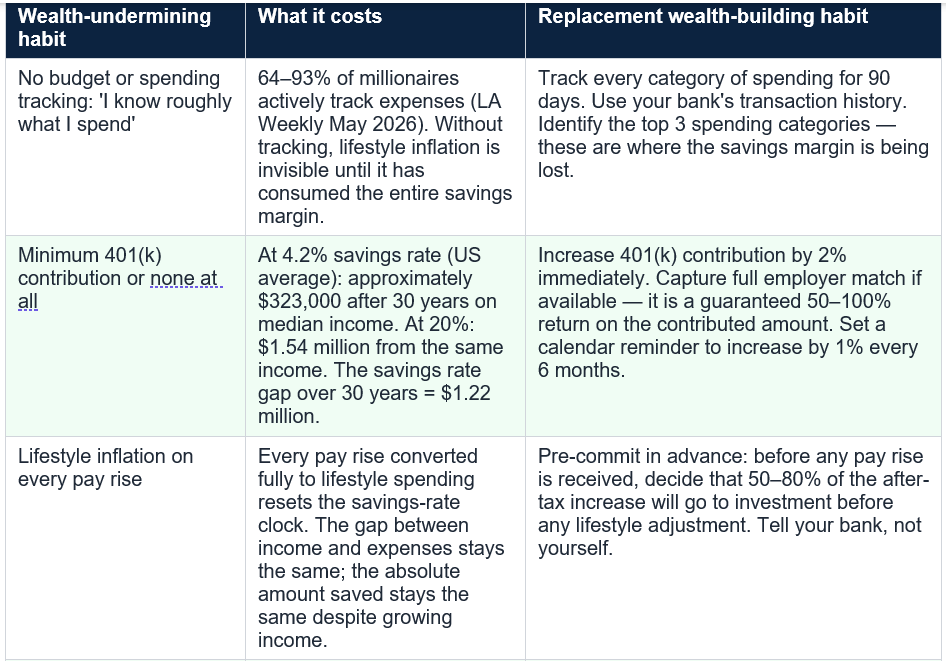
The enemy of this habit is lifestyle inflation: the automatic expansion of spending to match income growth. As LA Weekly Magazine (May 2026) identifies, the number-one wealth-building habit of millionaires is 'automating investments (especially 401(k)s) and avoiding lifestyle inflation.' Every time income rises and spending rises with it, the wealth-building gap remains static even as the income number grows. The gap is everything. No gap, no wealth, regardless of how large the paycheck.
Living below your means is often described as if it is about sacrifice — driving older cars, eating at home, avoiding luxury goods. This framing is both true and misleading. The millionaire who drives a 2019 car instead of a 2026 model is not experiencing deprivation. They are choosing a $30,000 gap between their income and their spending that compounds into $60,000 or $80,000 in portfolio value over the next five years. The sacrifice framing makes the habit feel negative; the compounding framing makes it feel like an investment in a future that compounds while you sleep.
How the Three Habits Work Together: The Compounding System
Each of the three habits has independent value. But they interact as a system in a way that is greater than the sum of the parts.Habit 1 (consistent investing) creates the engine. But the engine can only run on fuel — the fuel is the money that is available to invest. Without Habit 2 (a high savings rate), the engine is starved. Without Habit 3 (living below means), Habit 2 is impossible to sustain because lifestyle inflation continuously reclaims any savings margin that income growth creates.
The system is self-reinforcing once it is running. A high savings rate, automated on payday, means the investment account grows every month without a decision. Growing investment accounts generate returns that further grow the account. As the portfolio reaches meaningful size — $100,000, then $200,000, then $500,000 — the compound growth begins to exceed the monthly contribution in absolute dollar terms. At $500,000 in a portfolio earning 7%, the annual growth is $35,000 — more than the $16,600 that a 20% saver on the median income contributes annually. The portfolio begins to grow faster than the saver can contribute. This is the mathematical tipping point from which the journey to $1 million becomes almost inevitable, given time.
The Vehicles That Middle-Class Millionaires Use
The three habits describe what to do. The investment vehicles describe where to do it. Middle-class millionaires do not typically access exotic investment products unavailable to ordinary earners. They use the same tax-advantaged and accessible investment vehicles available to anyone with a regular income:- 401(k) or 403(b) employer plans: 80% of US millionaires aggressively invested in employer-sponsored plans (The World Data Feb 2026). The average millionaire has $810,000 across retirement accounts. The key mechanics: pre-tax contributions reduce current taxable income; employer matching is an immediate guaranteed return; compound growth is tax-deferred until withdrawal. 2026 contribution limit: $23,500 for those under 50; $31,000 for those 50 and over (catch-up provision).
- Roth IRA: Upworthy (August 2026) highlights the Roth's travel-relevant features for middle-class savers: contributions grow tax-free; qualified distributions in retirement are completely tax-free; and contributions (not earnings) can be withdrawn penalty-free at any time, providing liquidity that makes the account less intimidating for those who fear locking money away. 2026 contribution limit: $7,500 per year ($8,500 if age 50 or over); income phase-out begins at $168,000 (single) / $236,000 (married). For higher earners: backdoor Roth IRA conversion is available.
- Taxable brokerage accounts: 75% of millionaires invested outside their company retirement plans (The World Data Feb 2026). Once tax-advantaged accounts are maximised, a low-cost index fund in a taxable brokerage account continues the compounding process without annual contribution limits. Long-term capital gains rates (0%, 15%, or 20% depending on income) are typically lower than ordinary income rates, making long-held equity investments tax-efficient.
- Home ownership: 95% of millionaires own their primary residence, with an average home equity of $743,000 (The World Data Feb 2026). While home equity is not a liquid asset and housing-as-investment has important caveats (maintenance costs, illiquidity, geographic concentration), the combination of leverage (a mortgage allows control of a large asset with a fraction of its value in down payment), forced saving (monthly mortgage payments build equity), and long-term appreciation has contributed meaningfully to middle-class wealth accumulation. Note: 43% of millionaires own just one property, challenging the idea that multiple properties are required.
- ISA and pension (UK-specific): for UK readers, the ISA (Individual Savings Account) provides a £20,000 annual tax-free investment allowance, and personal pensions (SIPPs) attract income tax relief at the contributor's marginal rate. These are the UK equivalents of Roth IRA / 401(k) respectively — and operate on the same principle of tax-advantaged compounding.
The Habits That Undermine Wealth — and What to Replace Them With
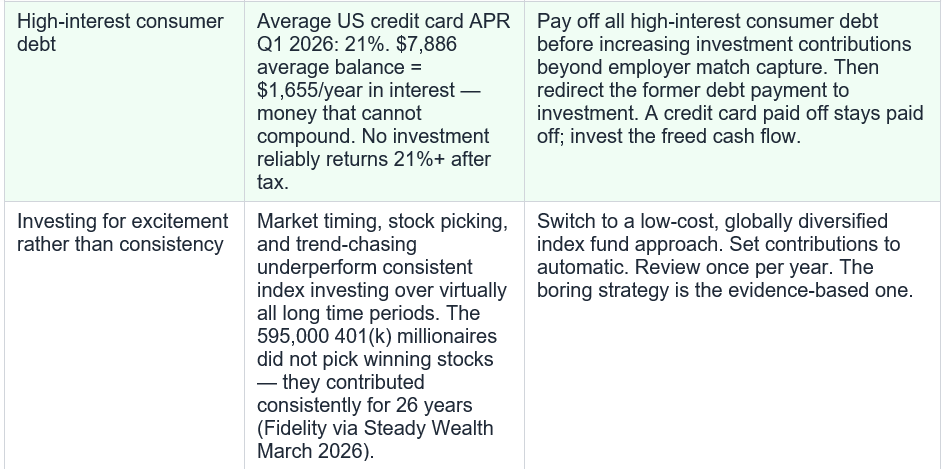
Understanding the three wealth-building habits is also an opportunity to identify their mirror opposites — the common financial behaviours that prevent middle-class incomes from producing middle-class millionaires.
A Realistic Timeline: What Middle-Class Incomes Can Accumulate
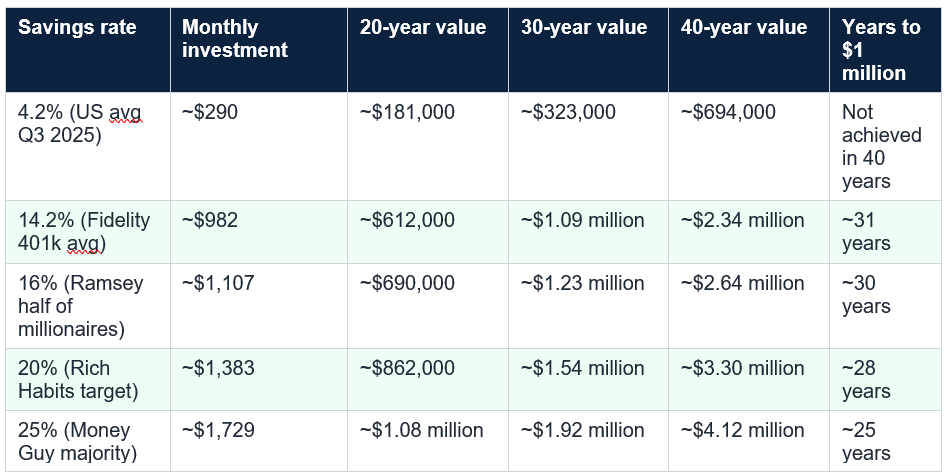
One of the most useful reframings for middle-class earners is to look at what consistent habit application over realistic career timelines actually produces. The following projections are based on the 2026 US median household income of $83,000, a 7% assumed annual return, and savings rates drawn from the millionaire research:Sources: savings rate benchmarks from Ramsey Solutions (cited Steady Wealth March 2026); Fidelity 401(k) data (Steady Wealth March 2026); Money Guy (September 2025); Rich Habits Study (SavingAdvice.com August 30, 2026). All projections illustrative at 7% hypothetical annual return; actual returns vary and can be negative. Based on $83,000 gross household income (2026 median; Financial Samurai May 2026). Not financial advice.
The table tells a clear story: the US average savings rate of 4.2% does not produce a millionaire outcome on a middle-class income. The 14.2% rate that characterises Fidelity's 401(k) millionaire cohort reaches $1 million in approximately 31 years — consistent with the 26-year average tenure data and starting investment in early career. The 20% target from the Rich Habits Study reaches $1 million in approximately 28 years from a single household's earnings. The 25% rate that the majority of Money Guy's millionaire clients achieve reaches $1 million in approximately 25 years.
The practical translation: a 35-year-old middle-class earner who shifts from the US average savings rate (4.2%) to 20% — and sustains it — reaches millionaire status around age 63: before traditional retirement, from a median income, through habits alone.
Conclusion
The three money habits that can turn middle-class earners into millionaires — consistent investing, a 20%+ savings rate, and persistent below-means living — are not secrets. They appear in every serious study of wealth accumulation, from the Rich Habits Study (SavingAdvice.com, August 30, 2026) to Ramsey's survey of 10,000 millionaires to Fidelity's 401(k) cohort data. The evidence is consistent, extensive, and unambiguous.What the evidence also shows is that the habits are hard — not because they are intellectually complex, but because they require sustained behaviour against the natural tendencies of a consumer economy and the deeply human preference for immediate reward over future benefit. The 80% of millionaires who built their own wealth did not find these habits easy. They built systems that made the habits automatic: automated contributions, automated bill payment, pre-committed savings rates, and a fundamental orientation toward their future financial self rather than their present consumer self.
The middle-class millionaire is not a myth. They exist in the millions, on ordinary incomes, built over ordinary careers, through these three ordinary but consistently practised habits. As Kiplinger's September 2026 article concludes: 'You don't need a massive salary or a flashy lifestyle to build a seven-figure net worth. These three habits can help ordinary earners steadily accumulate wealth over time.' The data agrees. The only question is whether the habits will be implemented — or merely acknowledged.
Frequently Asked Questions
Can someone genuinely become a millionaire on a middle-class income?Yes — and the data confirms it at scale. Approximately 80% of US millionaires built their wealth themselves rather than inheriting it (The World Data, February 2026; Wealthvieu, April 2026). The typical millionaire earned $60,000–$150,000 for the bulk of their career — within the Pew Research definition of middle class (CompoundLadder puts the 2026 US middle-class income range at $54,700–$163,200 for a 3-person household). The key variable is not income but savings rate: at 20% savings on the 2026 median household income of $83,000, investing for 28 years at a 7% average return produces approximately $1.54 million. The mechanism is compound interest sustained over time — accessible to any earner who maintains the three habits.
What savings rate is needed to become a millionaire on a middle-class income?
The research converges on 14–20% as the effective range. Fidelity's 401(k) millionaire cohort (595,000 people with $1M+ in their 401(k)) averaged a 14.2% total savings rate (9.5% employee + 4.8% employer match; Steady Wealth March 2026). Ramsey Solutions' survey of 10,000 millionaires found that nearly half save at least 16% monthly. The Rich Habits Study recommends 20% or more as the target for the Saver-Investor millionaire path. The US average savings rate in Q3 2025 was 4.2% — approximately one-third of the minimum needed for a millionaire outcome on a middle-class income within a working career. The practical starting point: identify your current savings rate, then increase it by 1–2% every six months until reaching 15–20%.
How important is it to start early? What if I'm in my 40s?
Starting early is mathematically the most powerful decision available — Kiplinger's September 2026 example shows that starting at 25 with $375/month produces approximately $1 million by 65, while starting at 35 with the same contribution produces approximately $450,000 by 65. The 10-year delay cost is approximately $550,000. However, starting later is dramatically better than not starting at all. A 40-year-old who shifts to a 20% savings rate still has 25+ years of compounding ahead. For those starting later, two adjustments help close the gap: increasing the savings rate above 20% (catch-up contributions in 401(k) and IRA are available from age 50 in the US); and extending the working timeline if possible to allow more compounding years. Professional financial planning advice is especially valuable for those starting wealth-building later in their career.
Is it better to pay off debt or invest?
For most middle-class earners, the framework is: (1) always capture the employer 401(k) match first — it is an immediate 50–100% return on contributions that beats almost any debt payoff rate; (2) pay off high-interest consumer debt (credit cards at 21% APR in Q1 2026, personal loans) aggressively — no investment reliably returns 21%+ after tax; (3) once high-interest debt is eliminated, redirect that cash flow to investment; (4) lower-interest debt (student loans below 5–6%, mortgages) can be serviced while simultaneously investing, since the expected long-term investment return may exceed the interest cost. The critical mistake is waiting until all debt is eliminated before beginning to invest — this delays compounding and can cost decades of growth.
What is the role of homeownership in becoming a middle-class millionaire?
Homeownership features prominently in the data: 95% of US millionaires own their primary residence, with an average home equity of $743,000 (The World Data, February 2026). However, 43% of millionaires own just one property — multiple properties are not required. The wealth-building case for homeownership rests on: leverage (a mortgage allows control of a large asset with a fraction of its value in cash); forced saving (mortgage payments build equity automatically); and long-term appreciation. The counterargument: home equity is illiquid, housing is geographically concentrated, maintenance costs are significant, and in some markets and periods, renting and investing the difference has outperformed buying. The research supports homeownership as a component of the middle-class millionaire path — not as a replacement for the three habits, but as a complementary wealth-building vehicle alongside them.
What does 'living below your means' actually require in daily life?
Wealthvieu (April 2026) identifies this as the defining behavioural trait of 94% of millionaires — but the Rich Habits Study clarifies that it does not mean extreme deprivation. It means frugal spending: 'spending your money on the lowest price, highest quality product or service available.' In practice: driving cars for longer (7+ years is common among millionaires, not the 3-year upgrade cycle of lifestyle-inflators); meal planning to reduce restaurant spending; avoiding consumer debt for discretionary purchases; maintaining a budget that tracks where money actually goes (64–93% of millionaires actively track expenses, per LA Weekly Magazine May 2026); and pre-committing to direct income increases to investment before adjusting lifestyle. The core requirement is a permanent positive gap between income and spending — not a specific dollar figure or lifestyle level, but the consistent discipline to spend less than you earn, month after month, year after year.

0 Comments Comments