

Financial Literacy
Millennial Money Milestones: Which Ones Actually Matter
56% of millennials have delayed at least one major financial milestone due to financial pressure. 60% believe they may never afford at least one of life’s goals. And yet 53% feel financially secure in 2026 — up from 43% the year before. The tension is real: a generation shaped by two recessions, record student debt, and pandemic-era housing prices is now in its peak earning years, reassessing which milestones were always worth chasing and which were someone else’s idea of what a life should look like.

The generation that graduated into the Great Recession, accumulated more student debt than any before it, and watched home prices surge to historic levels precisely during its peak homebuying years is now in its 30s and 40s, reassessing the financial checklist it inherited. Some of those checklist items were always worth pursuing: they build genuine wealth, reduce risk, and create the conditions for a stable financial life. Others were internalised from a different era, a different economy, or someone else’s life circumstances entirely.
This guide does two things. First, it documents the milestones that millennials consistently feel they should hit — and where the data shows they actually stand. Second, and more usefully, it separates the milestones that genuinely matter from those that are primarily sources of comparison-driven anxiety. CFP Brittney Castro, cited in fa-mag.com (August 2026), frames the distinction precisely: ‘I do believe most financial anxiety and stress comes from comparing ourselves to some made-up timeline.’ That made-up timeline is worth examining, item by item.
56% of millennials delayed at least one major financial milestone due to financial challenges (Northwestern Mutual 2026). 60% believe they may never afford at least one life goal (NWM 2026). 53% feel financially secure in 2026 — up from 43% in 2025 (NWM 2026). Millennial homeownership: 55% in 2025 (Redfin). Average millennial retirement savings: $62,600. 78% are saving for retirement. Millennials own $4.94 trillion in stocks as of Q1 2026 — more than doubled since 2021 (Federal Reserve).
Each of those events hit at precisely the wrong life-stage moments. The Great Recession reduced millennial starting salaries and prevented wealth accumulation during the earliest years of compound growth. Student debt — averaging approximately $33,000 per US millennial borrower (matthewsheppardbrown.com, November 2025) — consumed the cash that might otherwise have gone to down payments and retirement accounts. Rising home prices during 2020–2023 moved the goal post just as millennials were accumulating the income and savings to reach it.
The Financial Finesse 2026 Financial Wellness in America report (based on 8.2 million employee interactions) found that middle-income millennial workers (aged 30–44 with household income between $60,000 and $100,000) saw financial stress rise by 3.2 points in 2025 — moving in the opposite direction from lower-income Gen Z workers, who saw stress improve (Financial Finesse, April 2026). This is the core millennial tension: sufficient income to feel the gap between aspirations and reality, not quite sufficient to close it on the timeline that previous generations followed.
And yet the direction of travel is positive. Millennial homeownership reached 55% in 2025 (Redfin), up from lower rates in prior years. The share of non-homeowner millennials who believe homeownership is achievable rose from 33% to 42% in a single year (Northwestern Mutual 2026). Stock wealth more than doubled since 2021. 75% now save in a retirement plan. The structural headwinds were real. The structural momentum is also real.
The emotional weight millennials attach to homeownership reflects a genuine wealth-building case for it — real estate has historically been the primary source of wealth accumulation for American middle-class households. But the ‘by 30’ qualifier is where the pressure becomes comparison-driven rather than financially grounded. A 35-year-old who buys a house they can maintain, with a sustainable mortgage-to-income ratio and an emergency fund intact, is in a fundamentally better position than a 28-year-old who buys at the limits of their qualification with no savings buffer.
The Northwestern Mutual 2026 data reflects a notable shift in millennial optimism: the share of non-homeowner millennials who believe homeownership is achievable rose from 33% to 42% in a single year. Mortgage rate anxiety has softened (down from 48% calling rates prohibitively high to 40%), and competition concern has also eased. The structural headwinds are easing, slowly, and the age at which the milestone is achieved is becoming less culturally stigmatised.
The milestone that actually matters: a debt-to-income ratio below 36%, a 10–20% down payment that does not exhaust your emergency fund, and a monthly mortgage payment below 28–30% of gross income. Those conditions define affordability far more meaningfully than the year of your birth relative to the date of purchase.
The emergency fund is also the milestone most likely to be deprioritised in favour of more visible ones. Paying off student debt feels more concrete. Contributing to a retirement account produces a visible growing balance. Buying a home is a publicly legible achievement. An emergency fund sits in a savings account, earns modest interest, and produces no social signal. But it is the foundation on which all other financial milestones are safely built.
The practical target for millennials is specific rather than aspirational: calculate your essential monthly expenses (rent/mortgage, utilities, food, transport, minimum debt payments, insurance), multiply by three to six, and deposit that amount in a dedicated high-yield savings account (HYSA) earning 4%+ APY. Once built, it requires maintenance but not growth — unlike retirement savings, it has a completion point.
The milestone that actually matters is not ‘zero student debt balance’ but rather ‘no high-interest debt’ — a category that typically means credit card debt and personal loans above 7–10%, not subsidised student loans at 4–5%. A millennial who pays off a 4.5% student loan while forgoing an employer 401(k) match that effectively returns 50–100% on the contribution has made a mathematically poor trade-off, even if the zero balance feels like a milestone.
For those with high-rate student debt (private loans above 7–8%), aggressive payoff does make sense. The avalanche method — directing extra payments to the highest-rate debt first — minimises total interest. Refinancing high-rate private loans to lower rates may reduce the urgency further. The point is that ‘all student debt’ as a category masks enormous variation in the actual financial impact of different loans.
The urgency of retirement saving is real but does not require the maximum contribution to be financially meaningful. David Lerner Associates (October 2025) frames the priority: ‘For many Millennials, a Roth IRA is often the best place to start, with a general contribution limit of $7,000 as of 2025 [$7,500 in 2026 for those under 50].’ The Roth IRA specifically is advantageous for millennials currently in lower brackets who expect higher tax rates in retirement — contributions are post-tax, growth and withdrawals are tax-free.
The more important milestone than ‘maxing out’ is ‘automating’: a standing order or payroll deduction that increases the retirement contribution rate by one percentage point per year. The behavioural economics research on retirement savings consistently finds that automation and escalation — not willpower and one-time decisions — produce the most durable savings outcomes. A millennial who contributes 8% consistently and increases by 1% per year will, over 20 years, accumulate substantially more than one who contributes sporadically at maximum rates.
A more useful framework for millennials assessing their wealth-building trajectory: are you increasing your net worth year over year? Is your savings rate trending upward? Is your debt-to-asset ratio declining? These directional questions are more meaningful than hitting a fixed formula that was derived from an earlier economic context.
The context also matters: millennials who have invested consistently since 2021 have seen stock wealth more than double. Those who purchased homes in 2019–2021 before the price surge have seen significant equity growth. The net worth picture for millennials is more heterogeneous than any single formula captures.
The distinction between ‘no credit card debt’ as a milestone and ‘no credit card balance’ as a habit matters. The milestone is the one-time achievement of clearing outstanding debt. The habit is paying the full statement balance every month so no revolving balance accumulates. The habit is more important than the milestone — because a cleared balance that refills with revolving debt produces no lasting benefit.
For millennials carrying both student debt and credit card debt, the avalanche method — directing extra payments to the highest-rate debt first — almost always points to credit card debt as the first target. A 22% credit card is more financially damaging than a 5% student loan by a factor of 4.4. Sequencing matters.
The research reflects a cautious optimism that was absent in earlier millennial surveys. The CFP Board’s 2024 survey found that most millennials remain optimistic about achieving life aspirations, including family-related ones. And as housing cost pressure has eased slightly and millennial incomes have grown, the calculus has shifted. The milestone that matters is not perfection — it is a sustainable plan, not a perfect financial balance sheet.
The fa-mag.com August 2026 analysis captures the improving picture: millennials’ stock wealth has more than doubled since 2021, driven by both new contributions and market growth. Those who maintained consistent contributions through the 2022 market downturn and subsequent recovery are now well positioned. The anxiety about retirement readiness — while justified by the genuine structural challenges millennials faced — is somewhat countered by the wealth accumulation that has occurred.
And notably: millennials are starting to save for retirement earlier than their parents and grandparents, according to Northwestern Mutual 2026. That early start — even if at modest amounts — is the most powerful long-term wealth-building behaviour available to any generation. Starting 5–10 years earlier than the previous generation, even at lower initial rates, can produce comparable or superior retirement outcomes because of compound growth.

But the research also shows something important: the direction has changed. Homeownership is at 55% and rising. Millennial stock wealth has more than doubled since 2021. 53% feel financially secure — the highest rate in years. 75% are saving for retirement. The structural headwinds were real and their effects on the timeline were real. So is the momentum of a generation now in its peak earning years, actively tackling debt (26% list it as their top 2026 goal), and increasingly pragmatic about which milestones are worth pursuing and on what terms.
The milestones that actually matter — an emergency fund, no high-interest revolving debt, capturing the employer match, buying a home when it is genuinely affordable — are achievable on any income, in any order that fits your specific circumstances. The milestones that mainly produce anxiety — owning a home by a specific age, achieving a formula net worth, having every debt cleared before starting a life — are less about financial health than about the comparison to a previous generation’s experience in a different economy. Progress over perfection. Your timeline, not a spreadsheet’s.
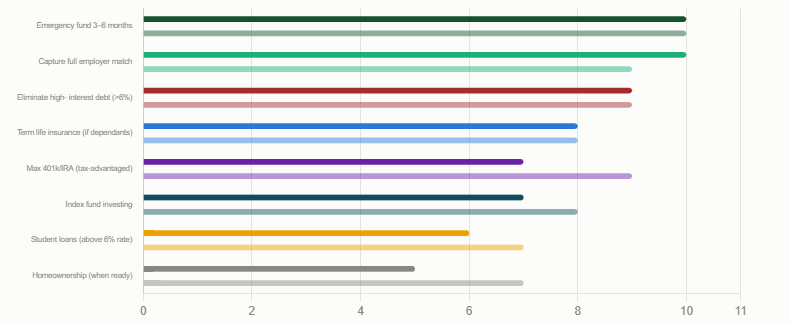
Research and financial planning consensus point to a clear priority sequence: (1) Build an emergency fund of 3–6 months of essential expenses in a high-yield savings account (HYSA) — this is the financial foundation that prevents all other goals from being derailed; (2) Capture 100% of your employer 401(k) match — this is effectively a 50–100% guaranteed return on the contribution; (3) Eliminate revolving credit card debt at 20%+ APR — this is the highest guaranteed return available in retail finance; (4) Increase retirement contributions beyond the match, ideally into a Roth IRA or 401(k); (5) Address student debt at high rates (above 7–8%) aggressively; and (6) pursue homeownership when it is affordable by the standard measures (debt-to-income below 36%, down payment that preserves emergency savings, monthly payment below 28–30% of gross income). The age at which each is achieved matters far less than achieving them in an order that makes financial sense for your specific situation.
Are millennials behind on financial milestones compared to previous generations?
Yes, on traditional timelines — but the gap is narrowing and the comparison is complicated. Only 33% of millennials owned a home by age 30, compared with 42% of Gen X and 48% of Baby Boomers at the same age (Apartment List/Census Bureau analysis, Motley Fool July 2026). Average millennial retirement savings are approximately $62,600, compared with $120,300 for Baby Boomers (though Baby Boomers have had longer to save). However, millennial stock wealth has more than doubled since 2021 (Federal Reserve data, fa-mag.com August 2026), homeownership has now reached 55%, and the generation is saving for retirement at high rates — 75% participate in a plan (David Lerner Associates, October 2025). The context matters: millennials entered the workforce during the Great Recession, accumulated more student debt than any prior generation, and faced historic home price surges during their peak buying years. The timeline delays were structural, not motivational.
Does homeownership still matter as a financial milestone for millennials?
Yes, but the timing pressure is overstated. Homeownership builds equity, provides housing stability, and has historically been the primary wealth-building mechanism for the American middle class. Millennial homeownership reached 55% in 2025 — up meaningfully from prior years — and the share of non-homeowner millennials who believe ownership is achievable rose from 33% to 42% in a single year (Northwestern Mutual 2026). The meaningful milestone is not 'own a home by 30' but 'own a home on affordable terms' — specifically a debt-to-income ratio below 36%, a down payment that does not exhaust savings, and a monthly payment below 28–30% of gross income. A 37-year-old who buys affordably is in a far better financial position than a 28-year-old who overextends. David Lerner Associates (October 2025): 'Focus on building wealth first; homeownership can follow when it makes sense for your specific situation.'
How much should a millennial have saved for retirement by 40?
A common financial planning guideline (Fidelity) suggests having 3× your annual salary saved by age 40. On a $75,000 salary, that would be $225,000 by 40 — a benchmark that most millennials are below, given that the average millennial retirement savings is approximately $62,600 (National Debt Relief, April 2025). However, this guideline is a directional benchmark, not a hard target. It assumes a specific retirement age, withdrawal rate, and Social Security contribution that may not apply to every individual. More important than the point-in-time balance is the trajectory: are you increasing your savings rate? Are you capturing the employer match? Is the balance growing year over year? A millennial who starts saving consistently at 30 and increases contributions by 1% annually will accumulate significantly more than the average by retirement — regardless of where they stand at 40. Millennials are also starting to save earlier than previous generations (Northwestern Mutual 2026), which partially compensates for current balance gaps.
Why do millennials feel behind financially even when they're doing well?
The primary driver is social comparison — comparing personal financial progress to a timeline derived from different economic circumstances, and to highly visible peers and media representations. CFP Brittney Castro (cited fa-mag.com, August 2026): 'I do believe most financial anxiety and stress comes from comparing ourselves to some made-up timeline.' Financial Finesse's 2026 Financial Wellness in America report (8.2 million employee interactions) found that middle-income millennial workers (household income $60K–$100K) saw financial stress rise 3.2 points in 2025 — having enough income to perceive the gap between aspirations and reality without (yet) having enough to close it. Social media amplifies this by making others' financial milestones (home purchases, investment wins, career milestones) highly visible while keeping their debts, setbacks, and struggles private. The gap between felt experience and actual progress is real: 53% of millennials now feel financially secure — up from 43% in 2025 — even as 56% have delayed at least one major milestone. Both can be true simultaneously.
What is the most important financial milestone for millennials to focus on right now?
The emergency fund. Not because it is the most exciting, visible, or socially legible milestone — it is none of those things. But because an emergency fund is the financial mechanism that prevents all other financial goals from being derailed by the unexpected. Without 3–6 months of essential expenses in a dedicated savings account, any financial disruption — a job loss, a medical event, a car repair — immediately becomes debt. And debt at 22%+ credit card APR is the most expensive disruption to financial progress available in retail finance. The emergency fund is also the milestone most likely to be deprioritised in favour of more visible goals like homeownership or retirement contributions. But every other milestone is more safely and efficiently pursued once the emergency fund is in place. Start there, automate a monthly contribution, and build everything else on top of that foundation.
Table of Contents
- The Millennial Milestone Paradox
- Why Millennials Feel Behind: The Structural Context
- The Milestones Millennials Feel They Should Hit
- Milestone #1: Owning a Home by 30
- Milestone #2: Having a Six-Month Emergency Fund
- Milestone #3: Paying Off All Student Debt
- Milestone #4: Maxing Out a Retirement Account
- Milestone #5: Having a Net Worth Equal to Your Age Times Your Salary
- Milestone #6: No Credit Card Debt
- Milestone #7: Starting a Family on Solid Financial Footing
- Milestone #8: Having ‘Enough’ Saved by 40
- Which Milestones Actually Matter Most: A Framework
- Rewriting the Timeline: What Wealthy Millennials Actually Do
- Conclusion: Progress Over Perfection, on Your Own Timeline
- Frequently Asked Questions
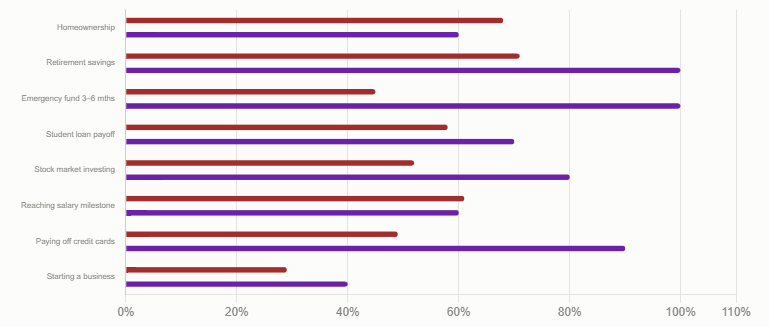
Which Milestone Matter vs Which Millennial Feel Behind On It
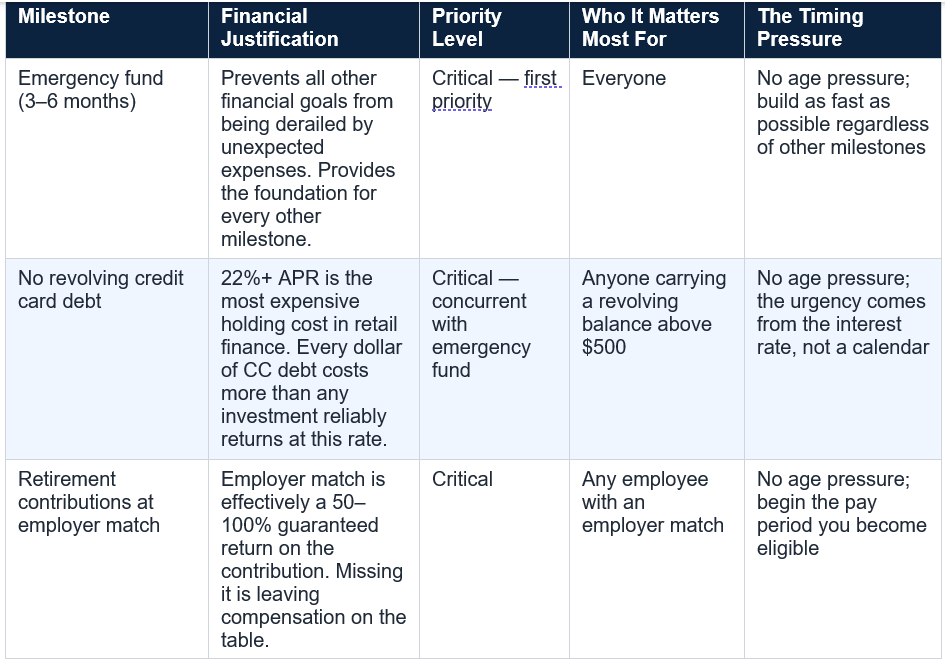
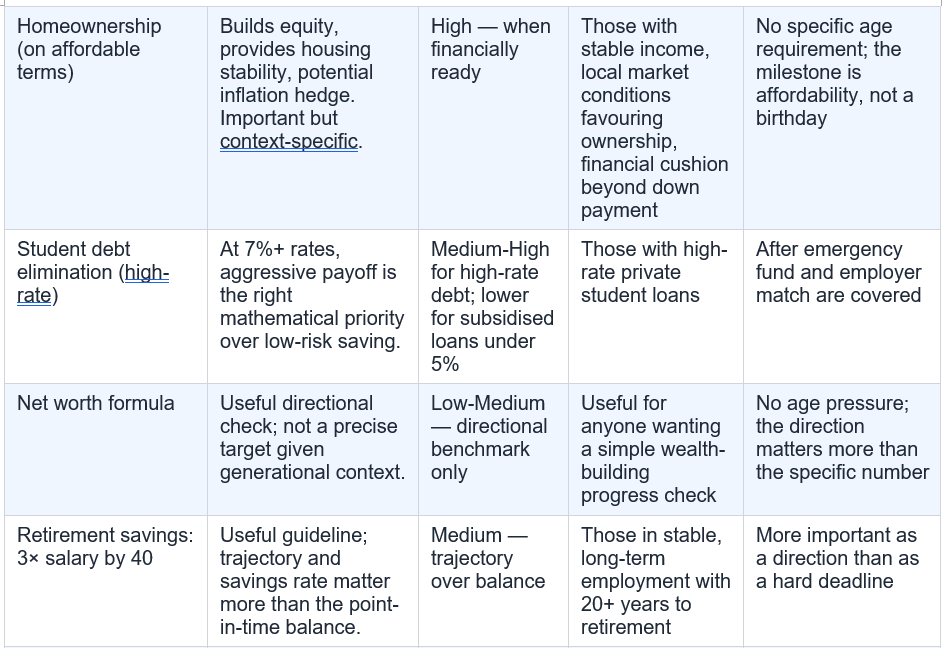
Milestone Prirority Framework: What To Tackle First
The Millennial Milestone Paradox
There is a paradox at the centre of how millennials experience money in 2026. On one side: 56% say financial challenges have caused them to postpone at least one major life milestone, and 60% believe they may never be able to afford at least one of the goals they have set for themselves (Northwestern Mutual Planning & Progress Study 2026, Harris Poll, 4,375 US adults). On the other: 53% of millennials feel financially secure — up from 43% just one year earlier — and they now own approximately $4.94 trillion in stocks, with those holdings more than doubling since 2021 (Federal Reserve data, cited fa-mag.com, August 2026).The generation that graduated into the Great Recession, accumulated more student debt than any before it, and watched home prices surge to historic levels precisely during its peak homebuying years is now in its 30s and 40s, reassessing the financial checklist it inherited. Some of those checklist items were always worth pursuing: they build genuine wealth, reduce risk, and create the conditions for a stable financial life. Others were internalised from a different era, a different economy, or someone else’s life circumstances entirely.
This guide does two things. First, it documents the milestones that millennials consistently feel they should hit — and where the data shows they actually stand. Second, and more usefully, it separates the milestones that genuinely matter from those that are primarily sources of comparison-driven anxiety. CFP Brittney Castro, cited in fa-mag.com (August 2026), frames the distinction precisely: ‘I do believe most financial anxiety and stress comes from comparing ourselves to some made-up timeline.’ That made-up timeline is worth examining, item by item.
56% of millennials delayed at least one major financial milestone due to financial challenges (Northwestern Mutual 2026). 60% believe they may never afford at least one life goal (NWM 2026). 53% feel financially secure in 2026 — up from 43% in 2025 (NWM 2026). Millennial homeownership: 55% in 2025 (Redfin). Average millennial retirement savings: $62,600. 78% are saving for retirement. Millennials own $4.94 trillion in stocks as of Q1 2026 — more than doubled since 2021 (Federal Reserve).
Why Millennials Feel Behind: The Structural Context
The feeling of falling behind a financial timeline is not irrational for millennials. It reflects a genuine structural reality that has been documented consistently across research. Theworlddata.com’s May 2026 millennial statistics report describes the generational sequence: ‘No other generation in American history has experienced quite the same sequence of formative economic events: they entered young adulthood during the dot-com bust of 2000–2001, graduated into the workforce during or after the Great Recession of 2008–2009, accumulated more student debt than any preceding generation, and then watched home prices surge to historic heights during the pandemic of 2020–2023 just as they were finally approaching their peak homebuying years.’Each of those events hit at precisely the wrong life-stage moments. The Great Recession reduced millennial starting salaries and prevented wealth accumulation during the earliest years of compound growth. Student debt — averaging approximately $33,000 per US millennial borrower (matthewsheppardbrown.com, November 2025) — consumed the cash that might otherwise have gone to down payments and retirement accounts. Rising home prices during 2020–2023 moved the goal post just as millennials were accumulating the income and savings to reach it.
The Financial Finesse 2026 Financial Wellness in America report (based on 8.2 million employee interactions) found that middle-income millennial workers (aged 30–44 with household income between $60,000 and $100,000) saw financial stress rise by 3.2 points in 2025 — moving in the opposite direction from lower-income Gen Z workers, who saw stress improve (Financial Finesse, April 2026). This is the core millennial tension: sufficient income to feel the gap between aspirations and reality, not quite sufficient to close it on the timeline that previous generations followed.
And yet the direction of travel is positive. Millennial homeownership reached 55% in 2025 (Redfin), up from lower rates in prior years. The share of non-homeowner millennials who believe homeownership is achievable rose from 33% to 42% in a single year (Northwestern Mutual 2026). Stock wealth more than doubled since 2021. 75% now save in a retirement plan. The structural headwinds were real. The structural momentum is also real.
The Milestones Millennials Feel They Should Hit
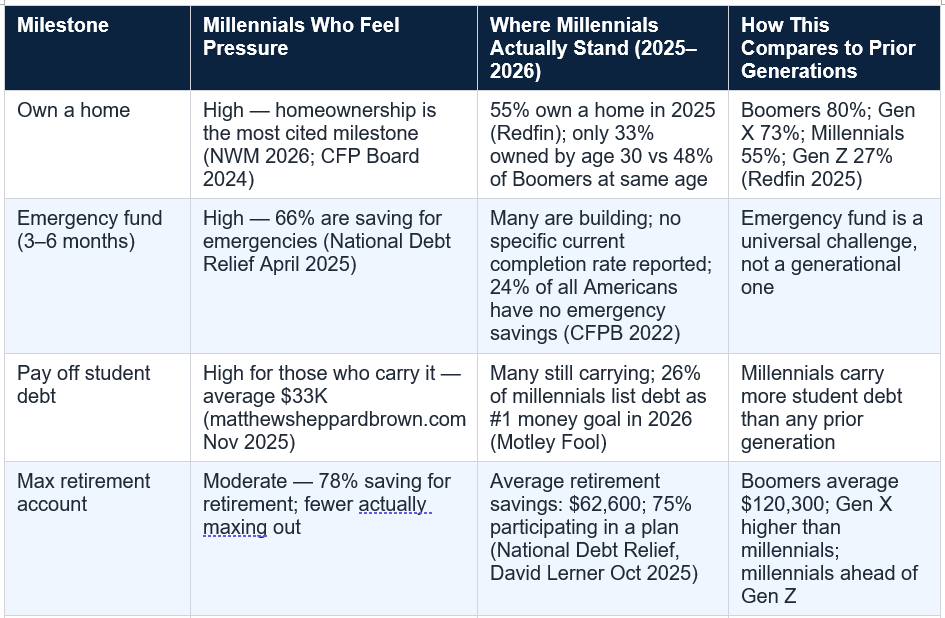
Survey research across CFP Board, Northwestern Mutual, Motley Fool, and National Debt Relief consistently finds a cluster of financial milestones that millennials feel social and cultural pressure to achieve. Before examining each one, the baseline picture of where millennials actually stand:
Milestone #1: Owning a Home by 30
Own a Home by 30 55% of millennials now own a home (2025, Redfin) — but only 33% did so by age 30, compared with 42% of Gen X and 48% of Baby Boomers at the same age (Apartment List / Census Bureau analysis, Motley Fool July 2026). 40% of under-50 non-homebuyers cite high home prices as the primary barrier (WalletHub Q4 2025). Down payment anxiety has eased — 53% of non-homeowners cite it as a barrier in 2026, down from 64% in 2025 (Northwestern Mutual 2026). Does it actually matter? Age-independent: Yes, but the timing is not critical. Homeownership builds equity and provides housing stability — but buying before you are financially ready creates more risk than it removes. The research from David Lerner Associates (October 2025) makes the counterpoint directly: 'Focus on building wealth first; homeownership can follow when it makes sense for your specific situation.' The meaningful milestone is owning a home you can afford to maintain — not owning one by a specific age.The emotional weight millennials attach to homeownership reflects a genuine wealth-building case for it — real estate has historically been the primary source of wealth accumulation for American middle-class households. But the ‘by 30’ qualifier is where the pressure becomes comparison-driven rather than financially grounded. A 35-year-old who buys a house they can maintain, with a sustainable mortgage-to-income ratio and an emergency fund intact, is in a fundamentally better position than a 28-year-old who buys at the limits of their qualification with no savings buffer.
The Northwestern Mutual 2026 data reflects a notable shift in millennial optimism: the share of non-homeowner millennials who believe homeownership is achievable rose from 33% to 42% in a single year. Mortgage rate anxiety has softened (down from 48% calling rates prohibitively high to 40%), and competition concern has also eased. The structural headwinds are easing, slowly, and the age at which the milestone is achieved is becoming less culturally stigmatised.
The milestone that actually matters: a debt-to-income ratio below 36%, a 10–20% down payment that does not exhaust your emergency fund, and a monthly mortgage payment below 28–30% of gross income. Those conditions define affordability far more meaningfully than the year of your birth relative to the date of purchase.
Milestone #2: Having a Six-Month Emergency Fund
Full Six-Month Emergency Fund 66% of millennials are actively saving for emergencies (National Debt Relief, April 2025). A 2022 CFPB report found 24% of all Americans have no emergency savings, and 39% have less than one month's income — but millennial saving behaviour has improved meaningfully since then. The benchmark most financial planners recommend: 3–6 months of essential living expenses. Does it actually matter? Absolutely — this is the one milestone with the clearest, most evidence-based justification. An emergency fund is the financial mechanism that prevents every unexpected expense from becoming a debt event. Without it, a car repair, a medical bill, or a temporary income reduction immediately becomes credit card debt at 20%+ APR. The six-month figure is not arbitrary social pressure — it is the empirical minimum that provides meaningful protection against the most common financial disruptions.The emergency fund is also the milestone most likely to be deprioritised in favour of more visible ones. Paying off student debt feels more concrete. Contributing to a retirement account produces a visible growing balance. Buying a home is a publicly legible achievement. An emergency fund sits in a savings account, earns modest interest, and produces no social signal. But it is the foundation on which all other financial milestones are safely built.
The practical target for millennials is specific rather than aspirational: calculate your essential monthly expenses (rent/mortgage, utilities, food, transport, minimum debt payments, insurance), multiply by three to six, and deposit that amount in a dedicated high-yield savings account (HYSA) earning 4%+ APY. Once built, it requires maintenance but not growth — unlike retirement savings, it has a completion point.
Milestone #3: Paying Off All Student Debt
Eliminate All Student Debt Average millennial US student debt is approximately $33,000 (matthewsheppardbrown.com, November 2025). 26% of millennials list tackling debt as their top money goal in 2026 — the largest single category (Motley Fool 2026 generation goals survey). Debt repayment was the top financial priority across all age groups. Does it actually matter? Nuanced — context matters more than speed. Total elimination of student debt is genuinely valuable, but prioritising full payoff at the expense of retirement contributions or emergency savings is often the wrong trade-off. The David Lerner Associates (October 2025) analysis documents the specific arbitrage: 'Make minimum payments on low-interest student loans (typically under 5% interest) while maximising contributions to employer 401(k) matches. The guaranteed return from an employer match can often exceed the interest rate on student loans.'The milestone that actually matters is not ‘zero student debt balance’ but rather ‘no high-interest debt’ — a category that typically means credit card debt and personal loans above 7–10%, not subsidised student loans at 4–5%. A millennial who pays off a 4.5% student loan while forgoing an employer 401(k) match that effectively returns 50–100% on the contribution has made a mathematically poor trade-off, even if the zero balance feels like a milestone.
For those with high-rate student debt (private loans above 7–8%), aggressive payoff does make sense. The avalanche method — directing extra payments to the highest-rate debt first — minimises total interest. Refinancing high-rate private loans to lower rates may reduce the urgency further. The point is that ‘all student debt’ as a category masks enormous variation in the actual financial impact of different loans.
Milestone #4: Maxing Out a Retirement Account
Max Out a Retirement Account 75% of American millennials save in a retirement plan (401(k) or 403(b)), vs 47% of Gen Zers (David Lerner Associates, October 2025). Average millennial retirement savings: approximately $62,600 (National Debt Relief, April 2025). 2026 401(k) contribution limit: $24,500 (under 50). Most millennials contribute less than the maximum — but they are participating at high rates. Millennial stock wealth has more than doubled since 2021 (Federal Reserve data, fa-mag.com August 2026). Does it actually matter? Critically important — time is the most powerful variable. Millennials in their 30s and early 40s have 20–30 years until typical retirement age. The compounding effect on even modest, consistent contributions over that time frame is substantial. The CFP Board 2024 survey found 3 in 5 millennials optimistic about building retirement savings. But 'maxing out' is not the threshold that matters — what matters is consistent participation, capturing the employer match, and increasing the contribution rate as income grows.The urgency of retirement saving is real but does not require the maximum contribution to be financially meaningful. David Lerner Associates (October 2025) frames the priority: ‘For many Millennials, a Roth IRA is often the best place to start, with a general contribution limit of $7,000 as of 2025 [$7,500 in 2026 for those under 50].’ The Roth IRA specifically is advantageous for millennials currently in lower brackets who expect higher tax rates in retirement — contributions are post-tax, growth and withdrawals are tax-free.
The more important milestone than ‘maxing out’ is ‘automating’: a standing order or payroll deduction that increases the retirement contribution rate by one percentage point per year. The behavioural economics research on retirement savings consistently finds that automation and escalation — not willpower and one-time decisions — produce the most durable savings outcomes. A millennial who contributes 8% consistently and increases by 1% per year will, over 20 years, accumulate substantially more than one who contributes sporadically at maximum rates.
Milestone #5: Having a Net Worth Equal to Your Age Times Your Salary
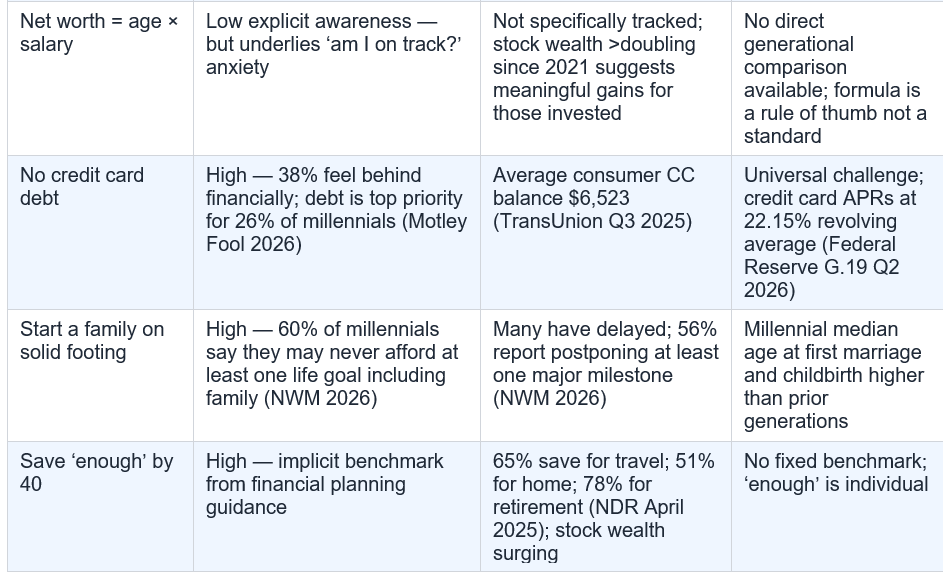
Net Worth = Age × Annual Salary ÷ 10 (The ‘Millionaire Next Door’ Formula) The formula from The Millionaire Next Door: your net worth should equal your age multiplied by your annual pre-tax household income, divided by 10. At 35 on a $75,000 salary: target net worth = 35 × $75,000 ÷ 10 = $262,500. At 40 on $90,000: target = 40 × $90,000 ÷ 10 = $360,000. Few millennials hit this benchmark — and that is partly because it was designed for a different era. Does it actually matter? Useful directional indicator — but not a source of distress. The formula predates the student debt era, the two-recession sequence, and the pandemic-era housing surge. It also ignores the fact that a 35-year-old with $33,000 in student debt that was used to earn a $90,000 salary is structurally different from a 35-year-old with zero debt and a $60,000 salary. The formula is a benchmark, not a standard. The underlying question it asks — 'am I building net worth in proportion to my income and age?' — is valuable. The specific number is not.A more useful framework for millennials assessing their wealth-building trajectory: are you increasing your net worth year over year? Is your savings rate trending upward? Is your debt-to-asset ratio declining? These directional questions are more meaningful than hitting a fixed formula that was derived from an earlier economic context.
The context also matters: millennials who have invested consistently since 2021 have seen stock wealth more than double. Those who purchased homes in 2019–2021 before the price surge have seen significant equity growth. The net worth picture for millennials is more heterogeneous than any single formula captures.
Milestone #6: No Credit Card Debt
Zero Credit Card Balance Average consumer credit card balance: $6,523 (TransUnion Q3 2025). Credit card APR Q2 2026: 22.15% revolving average (Federal Reserve G.19). 26% of millennials list debt as their top 2026 money goal (Motley Fool). Total US credit card debt: $1.21 trillion (WalletHub Q4 2025, cited theworlddata.com May 2026). Does it actually matter? The most financially urgent of the common milestones — more urgent than homeownership or retirement contributions for anyone carrying revolving credit card debt at 20%+ APR. At 22.15% APR, every dollar of revolving credit card balance costs 22 cents per year to hold. No savings account, CD, or low-risk investment reliably returns 22%+ — meaning paying off credit card debt is the highest guaranteed return available to any consumer.The distinction between ‘no credit card debt’ as a milestone and ‘no credit card balance’ as a habit matters. The milestone is the one-time achievement of clearing outstanding debt. The habit is paying the full statement balance every month so no revolving balance accumulates. The habit is more important than the milestone — because a cleared balance that refills with revolving debt produces no lasting benefit.
For millennials carrying both student debt and credit card debt, the avalanche method — directing extra payments to the highest-rate debt first — almost always points to credit card debt as the first target. A 22% credit card is more financially damaging than a 5% student loan by a factor of 4.4. Sequencing matters.
Milestone #7: Starting a Family on Solid Financial Footing
Starting a Family With Financial Stability 60% of millennials believe they may never be able to afford at least one life milestone (Northwestern Mutual 2026); for many, family is among them. 56% have already delayed at least one major milestone. Millennials are marrying and having children later than prior generations — partly by choice, partly by financial circumstance. Does it actually matter? Important but individually defined. The financial 'solid footing' required before starting a family is genuinely subjective and context-dependent. A household with two stable incomes, health insurance, an emergency fund, and affordable housing has adequate financial footing for a family — regardless of whether every debt is eliminated or every retirement account is maxed. The cultural pressure to achieve every other financial milestone before starting a family has caused many millennials to defer the decision indefinitely, which carries its own costs.The research reflects a cautious optimism that was absent in earlier millennial surveys. The CFP Board’s 2024 survey found that most millennials remain optimistic about achieving life aspirations, including family-related ones. And as housing cost pressure has eased slightly and millennial incomes have grown, the calculus has shifted. The milestone that matters is not perfection — it is a sustainable plan, not a perfect financial balance sheet.
Milestone #8: Having ‘Enough’ Saved by 40
Having 'Enough' Saved by Age 40 Average millennial retirement savings: $62,600 (National Debt Relief, April 2025). The common financial planning benchmark: 3× salary saved by age 40 (Fidelity rule of thumb). On a $75,000 salary: $225,000 by 40. Most millennials are well below this benchmark. 78% are saving for retirement, but average balances lag the target. Does it actually matter? Directional, not absolute. The Fidelity 3× rule is a guideline derived from assumptions about retirement age, withdrawal rate, and Social Security income that may not apply to every millennial's situation. The more important question at 40 is not 'do I have 3× salary saved?' but 'is my savings rate sufficient to reach my retirement income target given my time horizon and expected contributions?' At 40 with 25+ years to retirement, the trajectory matters more than the current balance.The fa-mag.com August 2026 analysis captures the improving picture: millennials’ stock wealth has more than doubled since 2021, driven by both new contributions and market growth. Those who maintained consistent contributions through the 2022 market downturn and subsequent recovery are now well positioned. The anxiety about retirement readiness — while justified by the genuine structural challenges millennials faced — is somewhat countered by the wealth accumulation that has occurred.
And notably: millennials are starting to save for retirement earlier than their parents and grandparents, according to Northwestern Mutual 2026. That early start — even if at modest amounts — is the most powerful long-term wealth-building behaviour available to any generation. Starting 5–10 years earlier than the previous generation, even at lower initial rates, can produce comparable or superior retirement outcomes because of compound growth.
Which Milestones Actually Matter Most: A Framework
Having examined each milestone individually, a framework emerges for deciding which deserve prioritisation, which are contextual, and which are primarily social pressure without a strong financial case:
Rewriting the Timeline: What Wealthy Millennials Actually Do
Rather than following a prescribed sequence of milestones, the millennials making the most financial progress in 2026 tend to share a set of behaviours that are less visible than the milestones themselves but more financially decisive:- They automate savings before they budget spending. A standing order to retirement, emergency fund, or investment account on payday removes the monthly decision. Behaviourally, automation consistently outperforms intention.
- They treat the employer 401(k) match as non-negotiable. David Lerner Associates (October 2025): the guaranteed return from an employer match can often exceed the interest rate on student loans. Those who do not capture the match lose compensation that is already budgeted for them.
- They use a Roth IRA in their 30s. The Roth’s tax-free growth is most valuable when current-bracket rates are lower than expected future rates — which describes most millennials in mid-career. $7,500 per year invested from 35 to 60 at a hypothetical 7% average annual return grows to approximately $487,000 in after-tax wealth (illustrative; past performance does not predict future results).
- They build equity in their careers as aggressively as in their homes. Salary negotiation, professional development, and income growth are the most powerful levers on millennial wealth accumulation in the medium term — more impactful than optimising any specific financial product.
- They reject the comparison trap. The Motley Fool 2026 Financial Firsts Survey finds that younger Americans are reaching major milestones at lower rates than prior generations — but that the milestones themselves are worth questioning. A millennial who rents intentionally, invests the difference, and achieves a higher net worth than a homeowner neighbour has not failed a milestone; they have succeeded at wealth-building through a different path.
Conclusion
The millennial milestone checklist — own a home by 30, zero debt, maxed retirement accounts, emergency fund complete, family started on solid footing, net worth on target — was designed for a different economic context. It does not fully account for the two-recession sequence that delayed millennial wealth accumulation, the student debt burden, the pandemic-era housing surge, or the reality that 60% of the generation still believes they may never afford at least one of those goals.But the research also shows something important: the direction has changed. Homeownership is at 55% and rising. Millennial stock wealth has more than doubled since 2021. 53% feel financially secure — the highest rate in years. 75% are saving for retirement. The structural headwinds were real and their effects on the timeline were real. So is the momentum of a generation now in its peak earning years, actively tackling debt (26% list it as their top 2026 goal), and increasingly pragmatic about which milestones are worth pursuing and on what terms.
The milestones that actually matter — an emergency fund, no high-interest revolving debt, capturing the employer match, buying a home when it is genuinely affordable — are achievable on any income, in any order that fits your specific circumstances. The milestones that mainly produce anxiety — owning a home by a specific age, achieving a formula net worth, having every debt cleared before starting a life — are less about financial health than about the comparison to a previous generation’s experience in a different economy. Progress over perfection. Your timeline, not a spreadsheet’s.
Frequently Asked Questions
What financial milestones should millennials prioritise in 2026?Research and financial planning consensus point to a clear priority sequence: (1) Build an emergency fund of 3–6 months of essential expenses in a high-yield savings account (HYSA) — this is the financial foundation that prevents all other goals from being derailed; (2) Capture 100% of your employer 401(k) match — this is effectively a 50–100% guaranteed return on the contribution; (3) Eliminate revolving credit card debt at 20%+ APR — this is the highest guaranteed return available in retail finance; (4) Increase retirement contributions beyond the match, ideally into a Roth IRA or 401(k); (5) Address student debt at high rates (above 7–8%) aggressively; and (6) pursue homeownership when it is affordable by the standard measures (debt-to-income below 36%, down payment that preserves emergency savings, monthly payment below 28–30% of gross income). The age at which each is achieved matters far less than achieving them in an order that makes financial sense for your specific situation.
Are millennials behind on financial milestones compared to previous generations?
Yes, on traditional timelines — but the gap is narrowing and the comparison is complicated. Only 33% of millennials owned a home by age 30, compared with 42% of Gen X and 48% of Baby Boomers at the same age (Apartment List/Census Bureau analysis, Motley Fool July 2026). Average millennial retirement savings are approximately $62,600, compared with $120,300 for Baby Boomers (though Baby Boomers have had longer to save). However, millennial stock wealth has more than doubled since 2021 (Federal Reserve data, fa-mag.com August 2026), homeownership has now reached 55%, and the generation is saving for retirement at high rates — 75% participate in a plan (David Lerner Associates, October 2025). The context matters: millennials entered the workforce during the Great Recession, accumulated more student debt than any prior generation, and faced historic home price surges during their peak buying years. The timeline delays were structural, not motivational.
Does homeownership still matter as a financial milestone for millennials?
Yes, but the timing pressure is overstated. Homeownership builds equity, provides housing stability, and has historically been the primary wealth-building mechanism for the American middle class. Millennial homeownership reached 55% in 2025 — up meaningfully from prior years — and the share of non-homeowner millennials who believe ownership is achievable rose from 33% to 42% in a single year (Northwestern Mutual 2026). The meaningful milestone is not 'own a home by 30' but 'own a home on affordable terms' — specifically a debt-to-income ratio below 36%, a down payment that does not exhaust savings, and a monthly payment below 28–30% of gross income. A 37-year-old who buys affordably is in a far better financial position than a 28-year-old who overextends. David Lerner Associates (October 2025): 'Focus on building wealth first; homeownership can follow when it makes sense for your specific situation.'
How much should a millennial have saved for retirement by 40?
A common financial planning guideline (Fidelity) suggests having 3× your annual salary saved by age 40. On a $75,000 salary, that would be $225,000 by 40 — a benchmark that most millennials are below, given that the average millennial retirement savings is approximately $62,600 (National Debt Relief, April 2025). However, this guideline is a directional benchmark, not a hard target. It assumes a specific retirement age, withdrawal rate, and Social Security contribution that may not apply to every individual. More important than the point-in-time balance is the trajectory: are you increasing your savings rate? Are you capturing the employer match? Is the balance growing year over year? A millennial who starts saving consistently at 30 and increases contributions by 1% annually will accumulate significantly more than the average by retirement — regardless of where they stand at 40. Millennials are also starting to save earlier than previous generations (Northwestern Mutual 2026), which partially compensates for current balance gaps.
Why do millennials feel behind financially even when they're doing well?
The primary driver is social comparison — comparing personal financial progress to a timeline derived from different economic circumstances, and to highly visible peers and media representations. CFP Brittney Castro (cited fa-mag.com, August 2026): 'I do believe most financial anxiety and stress comes from comparing ourselves to some made-up timeline.' Financial Finesse's 2026 Financial Wellness in America report (8.2 million employee interactions) found that middle-income millennial workers (household income $60K–$100K) saw financial stress rise 3.2 points in 2025 — having enough income to perceive the gap between aspirations and reality without (yet) having enough to close it. Social media amplifies this by making others' financial milestones (home purchases, investment wins, career milestones) highly visible while keeping their debts, setbacks, and struggles private. The gap between felt experience and actual progress is real: 53% of millennials now feel financially secure — up from 43% in 2025 — even as 56% have delayed at least one major milestone. Both can be true simultaneously.
What is the most important financial milestone for millennials to focus on right now?
The emergency fund. Not because it is the most exciting, visible, or socially legible milestone — it is none of those things. But because an emergency fund is the financial mechanism that prevents all other financial goals from being derailed by the unexpected. Without 3–6 months of essential expenses in a dedicated savings account, any financial disruption — a job loss, a medical event, a car repair — immediately becomes debt. And debt at 22%+ credit card APR is the most expensive disruption to financial progress available in retail finance. The emergency fund is also the milestone most likely to be deprioritised in favour of more visible goals like homeownership or retirement contributions. But every other milestone is more safely and efficiently pursued once the emergency fund is in place. Start there, automate a monthly contribution, and build everything else on top of that foundation.

0 Comments Comments