

Financial Literacy
You’re Not Behind: Why Everyone Seems Richer Than You
About 3 in 5 young Americans are anxious about their finances — despite being richer than any previous generation at the same age. A quarter of Americans earning over $100,000 say they live paycheck to paycheck. The median net worth for the under-35s is approximately $40,000. And the person on your Instagram feed who just posted their Amalfi Coast holiday? The luxury is probably on a credit card. This article is about the gap between what wealth looks like and what wealth actually is — and why the feeling that you’re behind is almost certainly wrong.
The term gained significant traction in 2025, appearing across personal finance media from Verywell Mind to NPR’s The Indicator. According to reporting cited by YourStory.com (August 2025), people across all income levels — even those earning six figures — say they ‘feel broke.’ The experience cuts across age groups, income brackets, and net worth levels. It is not primarily a poverty issue; it is a perception issue, shaped by specific environmental conditions that have become more extreme in the social media era.
This article takes the feeling seriously without validating the distortion. The experience of financial anxiety is real and has genuine psychological consequences. But the trigger for that anxiety — the belief that everyone else is doing better — is, in most cases, factually wrong and systematically distorted by the information environment in which most people now live. Understanding the specific mechanisms of the distortion is the first step toward correcting it. Not financial advice.
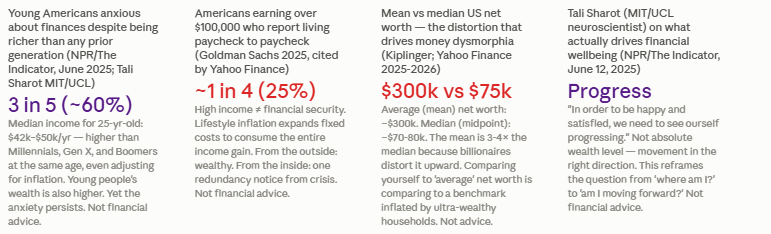
~60% (3 in 5) young Americans are anxious about their finances despite being richer than any previous generation at the same age (NPR/The Indicator, June 2025; Tali Sharot, MIT/UCL). ~25% of Americans earning over $100,000 say they live paycheck to paycheck (Goldman Sachs 2025, cited by Yahoo Finance). Median US net worth under 35: ~$40,000. Median age 35-44: ~$135,000. Median age 45-54: ~$250,000 (Kiplinger, cited by Yahoo Finance). Mean (average) US net worth: ~$300,000. Median: ~$70,000-$80,000. The average is 3-4× the median because of ultra-wealthy households. Not financial advice.
And yet approximately 3 in 5 young Americans are anxious about their finances. There are legitimate structural factors — student debt, high housing prices, and income inequality — that Sharot and the NPR team acknowledge. But they are explicit: ‘they don’t fully explain this mismatch.’ Something else is producing the anxiety gap. That something else is comparison: the experience of measuring oneself against a reference group that is not representative, not complete, and not even real in the way that the comparison feels real.
The paradox matters because it means the solution to financial anxiety is not simply more money. Someone experiencing money dysmorphia who earns more tomorrow will feel better briefly — and then recalibrate their social reference group upward and feel comparably anxious again. The relief requires not a higher income but a different relationship with financial comparison itself. Not financial advice.
Tali Sharot, neuroscientist at MIT and University College London (NPR/The Indicator, June 12, 2025): 'In order to be happy and satisfied, we need to see ourself progressing. They are the generation where social media is a huge thing that they kind of grew up with. Everyone's posting their travels or their whatever, and half of it is not really an accurate representation of what's true. So now you're comparing yourself to what appears to be your peers. That will definitely have a negative effect.' Source: NPR/The Indicator (KRWG, BTPM, NPR Illinois, June 12, 2025).
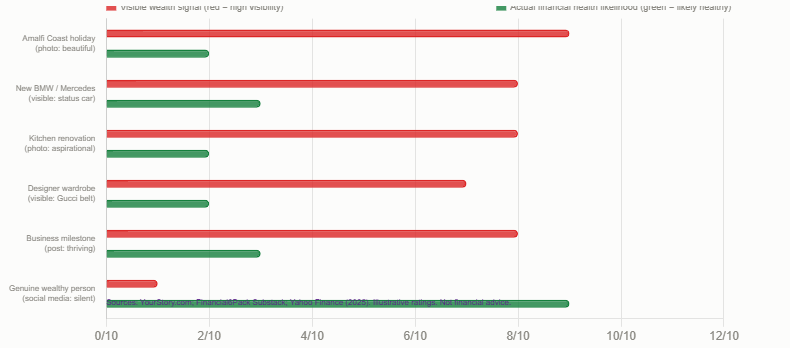
What they see on social media, in the financial domain, is systematically skewed toward wealth display. The Amalfi Coast holiday appears in the feed; the credit card statement from the Amalfi Coast holiday does not. The new car appears; the loan agreement does not. The kitchen renovation appears; the home equity loan that paid for it does not. The business milestone post appears; the anxiety about making payroll that preceded it does not. YourStory.com (August 2025) notes the key asymmetry: ‘Research shows true wealth often hides in humility. Meanwhile, many luxury goods on feeds are financed through EMIs and credit cards.’
A 2018 Pew Research study found that 26% of teens feel worse about their lives because of social media. The same comparative dynamic applies to adults around wealth perception. And the problem is not static: as social media algorithms optimise for engagement, they preferentially serve content that generates emotional reactions — which aspirational wealth display does, reliably. The result is an information environment that systematically overrepresents the upper tail of the wealth distribution, making that tail appear to be the median. Not financial advice.
The social media wealth display is not randomly distributed. It overrepresents: (1) people who derive social status from financial display (not the wealthiest group); (2) people who are leveraging visible spending on credit (the most financially precarious group); (3) aspirational content creators whose income depends on appearing successful; (4) genuine high-earners in visible professions (lawyers, doctors, finance) whose income is high but may be heavily committed to mortgage, school fees, and lifestyle; and (5) people in unusually affluent social circles who post to a network that is not representative of the general population. The genuinely wealthy -- those with high net worth and genuine financial security -- are typically underrepresented in financial display. Source: YourStory.com (August 2025). Not financial advice.
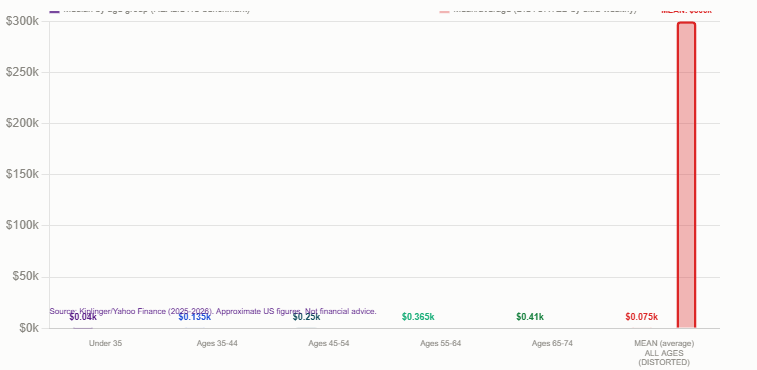
In the United States, the mean (average) net worth is approximately $300,000. The median net worth is approximately $70,000–$80,000. These numbers refer to the same population at the same time. The reason they are so different is that a relatively small number of ultra-wealthy households — the billionaires and centimillionaires — pull the mean dramatically upward. Jeff Bezos, Elon Musk, and a few thousand other extreme-wealth individuals contribute so much to the total wealth pool that they make the mean meaningless as a benchmark for the typical person.
When someone reads a headline about ‘average net worth’ and compares themselves to it, they are almost certainly comparing themselves to a number that is significantly inflated by the presence of people with 100 or 1,000 times more wealth than any typical household. Yahoo Finance (2025, citing Kiplinger) makes this point explicitly: ‘One of the most common sources of money dysmorphia is relying on misleading benchmarks. When you see headlines about average net worth, remember that averages are skewed by ultra-wealthy households... The median tells a different story.’ Not financial advice.
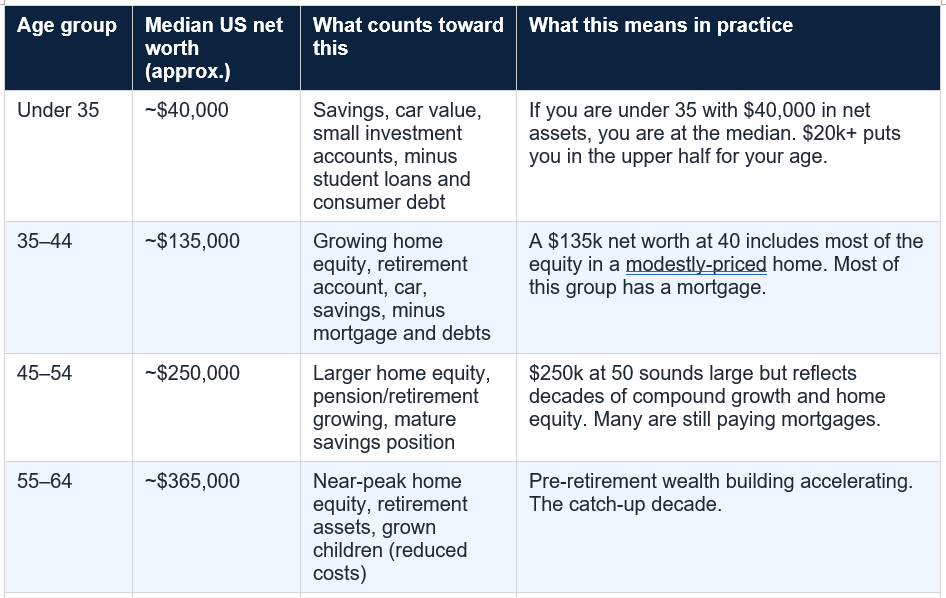
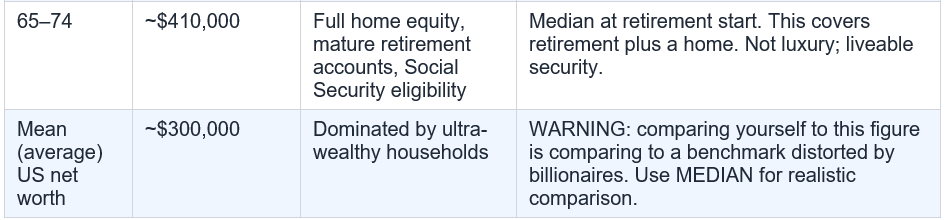
The benchmark reality: if you are 28 with $35,000 in net assets (savings minus debts), you are not behind. You are at approximately the median for your age group. If you are 35 with $100,000 in equity (home and savings combined), you are above median. The person on social media with the Porsche and the beach house is either (a) in the top 5% of wealth for their age, (b) carrying enormous debt to maintain that appearance, or (c) both. The median is the realistic comparison point. The Instagram highlight reel is not. Not financial advice.
The people who are quietly accumulating real wealth — through consistent saving, index fund investing, paid-off mortgages, and compounding returns — are not posting about it. There is no Instagram moment in transferring £500 to a stocks and shares ISA. There is no viral content in maintaining a 20% savings rate for fifteen years. There is no engagement on a post about having a three-month emergency fund. The behaviours that actually build wealth are boring, unglamorous, and completely invisible on social media.
What is visible on social media are the consumption decisions that tend to correlate negatively with wealth accumulation: the new car that should have been invested; the holidays booked on a credit card; the restaurant meals that make great content but drain the savings buffer. The correlation between social media wealth display and actual net worth is likely negative for the majority of people displaying wealth — not because all wealthy displays are fake, but because the incentive to display wealth is strongest among those for whom it provides the most social status relative to their actual position.
The $100,000 paycheck-to-paycheck household illustrates the mechanism of lifestyle inflation. As income rises, housing costs rise (bigger apartment, nicer neighbourhood); car costs rise (upgrade from Honda to BMW); social costs rise (restaurants, holidays, gifts appropriate to the new peer group); childcare costs rise (private school, premium extracurriculars); and fixed monthly commitments expand to consume the entire income gain. The lifestyle ratchet turns, and the household finds itself financially stretched at $100,000 in the same structural way it was stretched at $60,000.
From the outside, the $100,000 lifestyle looks wealthy. A nice apartment, a German car, good clothes, European holidays. From the inside, it is financially precarious: no emergency fund, high fixed costs, sensitivity to any income disruption, and a retirement savings balance that has not kept pace with the lifestyle. The appearance of wealth and the reality of wealth are, for this group, opposite. Not financial advice.
The Psychology: The paycheck-to-paycheck paradox: earning more does not automatically produce more wealth. The psychological mechanism is called the hedonic treadmill or lifestyle inflation -- as income rises, reference points for 'normal' spending rise too, so satisfaction stays roughly constant. A household that earns more and spends more is not financially ahead of where it was; it is running faster to stay in the same place. The financially secure household is the one that earns more and does NOT spend more -- or at least delays lifestyle upgrades until investment accounts are growing. Not financial advice. Consult a qualified financial adviser.
The signal that social media sends is almost entirely about consumption: where people go, what they wear, what they drive, where they eat. None of this is a reliable signal of financial wealth. The person with the Gucci belt — to use YourStory.com’s example — may have financed it on a credit card at 29% APR. The person with the European holiday may have put it on a 0% balance transfer that will revert to 24% in six months. The person with the gym membership, the meal prep delivery, the designer coffee maker, and the latest iPhone may be one redundancy notice away from financial crisis.
Meanwhile, the financially secure person lives in a modest house in a good school catchment area, drives a seven-year-old car, takes a UK holiday, and has a boring investment account growing silently in the background. They do not post about it. They are not aspirational content. They are financially free in a way that the person with the Amalfi Coast photo and the credit card debt is not.
Esquire India (2026) captures this dynamic of contemporary comparison fatigue: ‘An entire generation has learned to treat their own downtime as content to be optimised, and their own financial anxiety as something to be quietly managed off-camera while the performance continues on it.’ The performance is the problem. Not financial advice.
The implication of the first mechanism is that the same absolute wealth level produces very different levels of financial wellbeing depending on the social reference group. A person with $200,000 in savings who compares themselves to friends with $50,000 in savings feels good. The same person who compares themselves to friends with $500,000 in savings feels bad. The absolute number is identical; the felt experience is opposite. Social media, by exposing people to a reference group that is systematically skewed toward wealth display, shifts the comparison point upward in a way that produces permanent relative deprivation for most users.
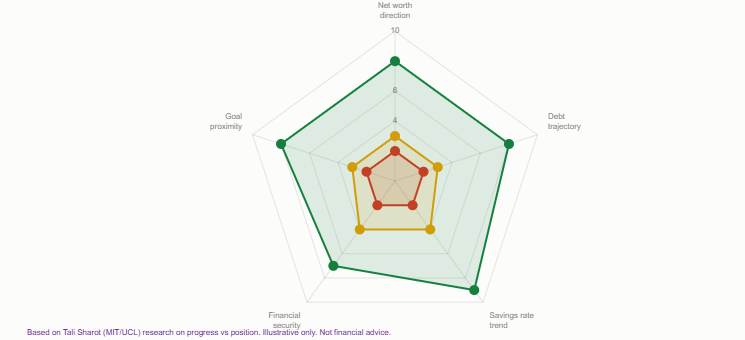
The implication of the second mechanism — the need for progress rather than position — is that the question ‘am I doing well?’ is less important than ‘am I improving?’ A person at $15,000 in net assets who was at $0 six months ago has progressed. A person at $200,000 who was at $250,000 six months ago has regressed. The first person has more reason to feel financially good, despite the lower absolute number. This is counterintuitive but is supported by the research Sharot cites. Not financial advice.
The study found that visual wealth exposure on social media increases relative deprivation through a chain mediation effect: seeing others’ wealth triggers the perception of falling behind (relative deprivation), which produces hostility toward the wealthy, which produces aggressive responses. The mechanism is not merely about feeling sad; it actively distorts perception of fairness and social relationships. The study concluded that ‘specific activities on social media’ — specifically the passive consumption of visual wealth displays — are the trigger, not social media use per se.
This has a practical implication that Tali Sharot also articulated in the NPR broadcast: the specific behaviour of following wealth-displaying accounts on social media is the modifiable variable. Not all social media use produces the same effect; it is the specific exposure to visual wealth display that activates the relative deprivation mechanism. Curating the social media feed — specifically reducing exposure to accounts that primarily display aspirational wealth — is a direct intervention with evidence of likely benefit. Not financial advice.
If the answer to all five is yes, you are not behind. You are making progress. Progress, not position, is the evidence-backed predictor of financial wellbeing. The person who answers yes to all five at a $40,000 net worth is in a psychologically and financially better position than the person who answers no to all five at a $200,000 net worth but declining trajectory.
The progress test also has the practical advantage of being completely within individual control. The wealth distribution is not within your control; where you rank in it at any given moment depends partly on factors (inheritance, housing markets, career sector) that are not entirely chosen. The trajectory of your own financial life — the direction and rate of change — is much more within your influence, and is the more meaningful measure of financial health.
The five-question progress test (apply to your own financial situation right now, not relative to anyone else): (1) Is my net worth higher than 12 months ago? (2) Is my total debt lower than 12 months ago? (3) Is my monthly savings rate the same or higher than 12 months ago? (4) Do I have more financial security (emergency fund size, protection) than 12 months ago? (5) Am I closer to at least one specific named financial goal than I was 12 months ago? If yes to 3 or more: you are not behind. You are progressing. If no to 3 or more: the issue is the trajectory, not the position -- and trajectory is fixable. Not financial advice.
Genuinely being behind financially means: net worth declining consistently year-over-year; carrying high-interest consumer debt (credit cards at 20%+ APR) with no clear repayment plan; no emergency fund while living with significant income volatility; pension or retirement savings not started by the mid-30s; spending consistently exceeding income; or financial obligations that cannot be met without borrowing. These are structural financial problems that require attention.
By contrast, being at the median net worth for your age, or slightly below, with a stable income, no high-interest debt, growing savings, and a trajectory of improvement is not being behind. It is being exactly where most people are, with the direction of travel that matters. The social media-induced feeling of being behind is not calibrated to either definition — it is calibrated to the highlight reel, which bears no relationship to either. Not financial advice.
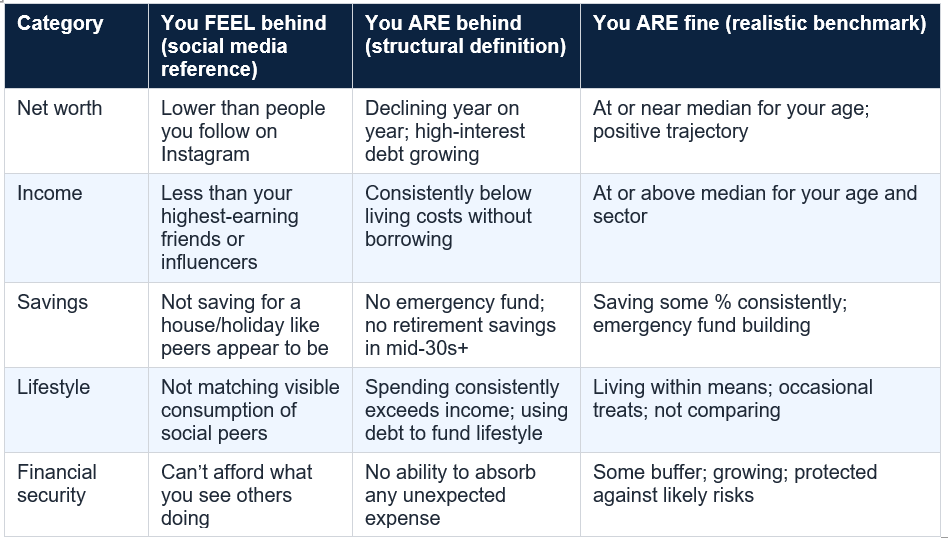
Not financial advice. These are general descriptive categories to aid recalibration, not clinical or professional financial assessment. If you are genuinely concerned about your financial position, consult a qualified independent financial adviser.
The world IS set up, in important respects, to make you feel behind. Social media platforms’ business models depend on engagement, and aspirational wealth display produces engagement because it activates the comparison mechanism. Advertising depends on the feeling of inadequacy — the belief that you are missing something you should have, which the advertised product can supply. Consumer culture broadly benefits from the conviction that your current situation is insufficient relative to what you could have. The money dysmorphia feeling is not accidental; it is produced, maintained, and amplified by commercial systems with a financial interest in your sense of inadequacy.
The question that changes everything is: measured against objective benchmarks — median net worth for your age, realistic trajectory, genuine financial security metrics — are you actually behind? For most people who feel acutely behind, the honest answer is: no. Not by the only measures that are not commercially motivated to make you feel otherwise. Not financial advice.
The race that social media shows you is not the race you are in. It is a curated, filtered, commercially motivated, selection-biased display that systematically overrepresents the upper tail of financial display while completely hiding the debt, anxiety, and financial fragility that often sit behind it. The silent rich — the people who have actually accumulated meaningful wealth through consistent saving and investing over decades — are not in your Instagram feed. They are in the boring index funds, the paid-off mortgage, the pension account that nobody posts about.
You are not behind. You are probably much closer to where most people are than the comparison environment tells you. The most financially productive thing you can do is to stop comparing against a distorted reference group and start tracking your own progress against your own trajectory. That is the only race worth running, and it is the only one you have any meaningful ability to influence. Not financial, psychological, or clinical advice. If financial anxiety significantly affects your mental health or daily life, please consult a qualified professional.
Money dysmorphia is not a clinical diagnosis — it does not appear in the DSM-5 or any official diagnostic manual. The term has been used in personal finance media and psychology journalism (including Verywell Mind and NPR) to describe a distorted perception of one's own financial situation: believing you are doing significantly worse than you actually are, typically driven by social comparison, social media wealth display, and misleading statistical benchmarks like average (mean) net worth instead of median. It is characterised by people across all income levels — including six-figure earners — reporting that they 'feel broke' despite objective financial data suggesting they are doing adequately. Sources: Verywell Mind (cited by YourStory.com, August 2025); NPR/The Indicator (June 12, 2025); Yahoo Finance (2025-2026). Not a clinical term — not financial or psychological advice.
Why does everyone seem richer than me on social media?
Because of systematic selection bias in what gets posted and what the algorithm amplifies. People post their highlights — holidays, new cars, home upgrades, restaurants — and do not post the credit card statements, loan agreements, and financial anxiety that may accompany those highlights. YourStory.com (August 2025) notes: 'Research shows true wealth often hides in humility. Meanwhile, many luxury goods on feeds are financed through EMIs and credit cards.' The genuine wealthy are typically underrepresented in financial display content; the people most loudly displaying wealth are often among the most financially precarious. Additionally, neuroscience research (Tali Sharot, MIT/UCL, NPR June 2025) shows that comparison against social media peers 'will definitely have a negative effect' because the peer group shown is not a representative sample. A 2025 peer-reviewed study (Yan et al., Cyberpsychology) confirmed that visual wealth exposure on social media increases relative deprivation.
What is the median net worth by age in the US?
According to Kiplinger (cited by Yahoo Finance, 2025-2026): Under 35: approximately $40,000. Ages 35-44: approximately $135,000. Ages 45-54: approximately $250,000. Ages 55-64: approximately $365,000. Ages 65-74: approximately $410,000. CRITICAL CAVEAT: these are MEDIAN figures (midpoints), not averages (means). The average (mean) US net worth is approximately $300,000, but this figure is dramatically inflated by ultra-wealthy households. The median is the realistic benchmark — it represents the person in the middle of the distribution, which is far more meaningful for comparison purposes than the mean, which is distorted by billionaires. Source: Kiplinger (cited by Yahoo Finance, 2025-2026). US figures only — UK figures are different but follow a similar trajectory. Not financial advice.
Am I actually behind financially?
The honest assessment: compare yourself to the MEDIAN net worth for your age group (see Section 5), not to social media highlight reels, not to the mean (average) net worth which is inflated by the ultra-wealthy. Then apply the progress test: is your net worth higher than 12 months ago? Is your debt lower? Is your savings rate the same or higher? Are you closer to your financial goals? If yes to most of these, you are not behind — you are progressing, which is the evidence-backed predictor of financial wellbeing (Tali Sharot, MIT/UCL, NPR June 2025). Genuinely being behind has a specific structural definition (see Section 12): net worth declining year-on-year, high-interest consumer debt without a repayment plan, no emergency fund, no retirement savings by mid-30s, spending exceeding income. The feeling of being behind, driven by social comparison, is not the same as the structural reality. Not financial advice. Consult a qualified independent financial adviser for a personalised assessment.
Does more money actually make you happier?
Research suggests a complicated answer. Neuroscientist Tali Sharot (MIT/UCL, NPR/The Indicator June 2025) found that 'people will care more and are happier if they get more rewards — in this case, money — relative to others.' Relative position, not absolute wealth, drives much of financial wellbeing. This means someone earning £40,000 in a peer group where everyone earns £30,000 may feel more financially satisfied than someone earning £80,000 in a peer group where everyone earns £120,000 — even though the second person has twice the absolute income. The research also shows that progress matters more than position: 'In order to be happy and satisfied, we need to see ourself progressing.' A growing financial situation at any absolute level tends to produce more wellbeing than a stagnant or declining one at a higher level. The implication: managing your social comparison reference group and focusing on your personal trajectory is not just good advice — it is evidence-backed neuroscience. Not financial or psychological advice.
Table of Contents
- The Feeling Has a Name: Money Dysmorphia
- The Paradox: Richer Than Ever, More Anxious Than Ever
- The Social Media Wealth Theatre
- The Average vs Median Trap: Why the Numbers Lie
- What the Real Benchmarks Actually Look Like
- The Silent Rich: Why True Wealth Is Invisible
- The $100k Paycheck-to-Paycheck Problem
- Lifestyle Inflation: The Loudest Fake Wealth Signal
- The Comparison Mechanism: What Neuroscience Says
- Relative Deprivation: When Seeing Others’ Wealth Hurts
- The Progress Test: Are You Moving, Not Just Positioned?
- What ‘Being Behind’ Would Actually Look Like
- How to Recalibrate: Five Practical Resets
- The Question That Changes Everything
- Conclusion: The Race You’re Watching Isn’t Real
- Frequently Asked Questions
Real benchmarks — median net worth by age
The wealth illusion — what social media shows vs reality
The progress test — are you moving forward?
The Feeling Has a Name: Money Dysmorphia
Money dysmorphia is not a clinical diagnosis. It does not appear in the DSM-5 and it is not something a psychiatrist would formally code on a patient’s chart. But as a description of an increasingly widespread psychological phenomenon, it has become one of the most accurate and resonant phrases in contemporary personal finance discourse. Money dysmorphia describes a distorted perception of one’s own financial situation — the experience of believing you are doing significantly worse than you actually are, typically in comparison to a social reference group that is itself distorted by selection bias and performative display.The term gained significant traction in 2025, appearing across personal finance media from Verywell Mind to NPR’s The Indicator. According to reporting cited by YourStory.com (August 2025), people across all income levels — even those earning six figures — say they ‘feel broke.’ The experience cuts across age groups, income brackets, and net worth levels. It is not primarily a poverty issue; it is a perception issue, shaped by specific environmental conditions that have become more extreme in the social media era.
This article takes the feeling seriously without validating the distortion. The experience of financial anxiety is real and has genuine psychological consequences. But the trigger for that anxiety — the belief that everyone else is doing better — is, in most cases, factually wrong and systematically distorted by the information environment in which most people now live. Understanding the specific mechanisms of the distortion is the first step toward correcting it. Not financial advice.
~60% (3 in 5) young Americans are anxious about their finances despite being richer than any previous generation at the same age (NPR/The Indicator, June 2025; Tali Sharot, MIT/UCL). ~25% of Americans earning over $100,000 say they live paycheck to paycheck (Goldman Sachs 2025, cited by Yahoo Finance). Median US net worth under 35: ~$40,000. Median age 35-44: ~$135,000. Median age 45-54: ~$250,000 (Kiplinger, cited by Yahoo Finance). Mean (average) US net worth: ~$300,000. Median: ~$70,000-$80,000. The average is 3-4× the median because of ultra-wealthy households. Not financial advice.
The Paradox: Richer Than Ever, More Anxious Than Ever
The central paradox of contemporary financial psychology is not that people are poor and feel poor — it is that people are, by most objective measures, significantly richer than their parents were at the same age, yet feel significantly worse about their financial situation. NPR’s The Indicator (June 12, 2025), featuring neuroscientist Tali Sharot of MIT and University College London, laid out the statistical reality: the median income for a 25-year-old in the US is somewhere between $42,000 and $50,000 per year. Millennials, Gen Xers, and baby boomers all earned significantly less at that age, even after adjusting for inflation. Young people’s wealth is also higher than it was for comparable age groups in previous generations.And yet approximately 3 in 5 young Americans are anxious about their finances. There are legitimate structural factors — student debt, high housing prices, and income inequality — that Sharot and the NPR team acknowledge. But they are explicit: ‘they don’t fully explain this mismatch.’ Something else is producing the anxiety gap. That something else is comparison: the experience of measuring oneself against a reference group that is not representative, not complete, and not even real in the way that the comparison feels real.
The paradox matters because it means the solution to financial anxiety is not simply more money. Someone experiencing money dysmorphia who earns more tomorrow will feel better briefly — and then recalibrate their social reference group upward and feel comparably anxious again. The relief requires not a higher income but a different relationship with financial comparison itself. Not financial advice.
Tali Sharot, neuroscientist at MIT and University College London (NPR/The Indicator, June 12, 2025): 'In order to be happy and satisfied, we need to see ourself progressing. They are the generation where social media is a huge thing that they kind of grew up with. Everyone's posting their travels or their whatever, and half of it is not really an accurate representation of what's true. So now you're comparing yourself to what appears to be your peers. That will definitely have a negative effect.' Source: NPR/The Indicator (KRWG, BTPM, NPR Illinois, June 12, 2025).
The Social Media Wealth Theatre
Social media is not a mirror of reality. It is a curated highlight reel — a selection of moments chosen specifically because they are impressive, enviable, or aspirational, and filtered, edited, and captioned to maximise the impression they create. This is not a controversial observation; almost everyone agrees with it in the abstract. The problem is that agreement in the abstract does not prevent comparison in practice. The emotional centres of the brain do not distinguish between ‘curated highlight reel’ and ‘representative sample.’ They react to what they see.What they see on social media, in the financial domain, is systematically skewed toward wealth display. The Amalfi Coast holiday appears in the feed; the credit card statement from the Amalfi Coast holiday does not. The new car appears; the loan agreement does not. The kitchen renovation appears; the home equity loan that paid for it does not. The business milestone post appears; the anxiety about making payroll that preceded it does not. YourStory.com (August 2025) notes the key asymmetry: ‘Research shows true wealth often hides in humility. Meanwhile, many luxury goods on feeds are financed through EMIs and credit cards.’
A 2018 Pew Research study found that 26% of teens feel worse about their lives because of social media. The same comparative dynamic applies to adults around wealth perception. And the problem is not static: as social media algorithms optimise for engagement, they preferentially serve content that generates emotional reactions — which aspirational wealth display does, reliably. The result is an information environment that systematically overrepresents the upper tail of the wealth distribution, making that tail appear to be the median. Not financial advice.
The social media wealth display is not randomly distributed. It overrepresents: (1) people who derive social status from financial display (not the wealthiest group); (2) people who are leveraging visible spending on credit (the most financially precarious group); (3) aspirational content creators whose income depends on appearing successful; (4) genuine high-earners in visible professions (lawyers, doctors, finance) whose income is high but may be heavily committed to mortgage, school fees, and lifestyle; and (5) people in unusually affluent social circles who post to a network that is not representative of the general population. The genuinely wealthy -- those with high net worth and genuine financial security -- are typically underrepresented in financial display. Source: YourStory.com (August 2025). Not financial advice.
The Average vs Median Trap: Why the Numbers Lie
The second major source of the ‘everyone is richer than me’ feeling is a statistical misunderstanding so common that it has its own name in economics: the mean-median gap. Almost every media report about ‘average’ wealth, income, or savings uses the mean (the mathematical average of all values), not the median (the midpoint value where half of people are above and half are below). For wealth data specifically, these two numbers are radically different.In the United States, the mean (average) net worth is approximately $300,000. The median net worth is approximately $70,000–$80,000. These numbers refer to the same population at the same time. The reason they are so different is that a relatively small number of ultra-wealthy households — the billionaires and centimillionaires — pull the mean dramatically upward. Jeff Bezos, Elon Musk, and a few thousand other extreme-wealth individuals contribute so much to the total wealth pool that they make the mean meaningless as a benchmark for the typical person.
When someone reads a headline about ‘average net worth’ and compares themselves to it, they are almost certainly comparing themselves to a number that is significantly inflated by the presence of people with 100 or 1,000 times more wealth than any typical household. Yahoo Finance (2025, citing Kiplinger) makes this point explicitly: ‘One of the most common sources of money dysmorphia is relying on misleading benchmarks. When you see headlines about average net worth, remember that averages are skewed by ultra-wealthy households... The median tells a different story.’ Not financial advice.
What the Real Benchmarks Actually Look Like
Using median net worth by age group — the most realistic benchmark for where you stand relative to your peers — the picture is substantially different from the one that social media and average-net-worth headlines project. These figures are drawn from Kiplinger as cited by Yahoo Finance (2025–2026). All figures are approximate and US-based; UK figures will differ.The benchmark reality: if you are 28 with $35,000 in net assets (savings minus debts), you are not behind. You are at approximately the median for your age group. If you are 35 with $100,000 in equity (home and savings combined), you are above median. The person on social media with the Porsche and the beach house is either (a) in the top 5% of wealth for their age, (b) carrying enormous debt to maintain that appearance, or (c) both. The median is the realistic comparison point. The Instagram highlight reel is not. Not financial advice.
The Silent Rich: Why True Wealth Is Invisible
One of the most consequential insights about wealth perception is that genuine financial wealth tends to be invisible, while financial precariousness tends to look wealthy. This inversion is counterintuitive but well-documented. YourStory.com (August 2025) articulates it precisely: ‘A nine-figure entrepreneur can walk into lunch wearing shorts and a polo, looking like an average uncle. A wealthy family may post their Rome vacation selfies but not the fact they flew private and stayed in villas.’The people who are quietly accumulating real wealth — through consistent saving, index fund investing, paid-off mortgages, and compounding returns — are not posting about it. There is no Instagram moment in transferring £500 to a stocks and shares ISA. There is no viral content in maintaining a 20% savings rate for fifteen years. There is no engagement on a post about having a three-month emergency fund. The behaviours that actually build wealth are boring, unglamorous, and completely invisible on social media.
What is visible on social media are the consumption decisions that tend to correlate negatively with wealth accumulation: the new car that should have been invested; the holidays booked on a credit card; the restaurant meals that make great content but drain the savings buffer. The correlation between social media wealth display and actual net worth is likely negative for the majority of people displaying wealth — not because all wealthy displays are fake, but because the incentive to display wealth is strongest among those for whom it provides the most social status relative to their actual position.
The $100k Paycheck-to-Paycheck Problem
One of the most revelatory statistics in contemporary personal finance is the Goldman Sachs finding (2025), cited by Yahoo Finance, that approximately a quarter of Americans earning over $100,000 per year report living paycheck to paycheck. Income and wealth are not the same thing. Income is what flows in each month. Wealth is what accumulates. A high income spent in full each month produces no wealth; a moderate income saved and invested consistently produces substantial wealth over time.The $100,000 paycheck-to-paycheck household illustrates the mechanism of lifestyle inflation. As income rises, housing costs rise (bigger apartment, nicer neighbourhood); car costs rise (upgrade from Honda to BMW); social costs rise (restaurants, holidays, gifts appropriate to the new peer group); childcare costs rise (private school, premium extracurriculars); and fixed monthly commitments expand to consume the entire income gain. The lifestyle ratchet turns, and the household finds itself financially stretched at $100,000 in the same structural way it was stretched at $60,000.
From the outside, the $100,000 lifestyle looks wealthy. A nice apartment, a German car, good clothes, European holidays. From the inside, it is financially precarious: no emergency fund, high fixed costs, sensitivity to any income disruption, and a retirement savings balance that has not kept pace with the lifestyle. The appearance of wealth and the reality of wealth are, for this group, opposite. Not financial advice.
The Psychology: The paycheck-to-paycheck paradox: earning more does not automatically produce more wealth. The psychological mechanism is called the hedonic treadmill or lifestyle inflation -- as income rises, reference points for 'normal' spending rise too, so satisfaction stays roughly constant. A household that earns more and spends more is not financially ahead of where it was; it is running faster to stay in the same place. The financially secure household is the one that earns more and does NOT spend more -- or at least delays lifestyle upgrades until investment accounts are growing. Not financial advice. Consult a qualified financial adviser.
Lifestyle Inflation: The Loudest Fake Wealth Signal
Lifestyle inflation is the mechanism by which visible spending outpaces actual wealth accumulation, producing the social media wealth illusion that drives money dysmorphia. It operates in two directions simultaneously: the person experiencing lifestyle inflation looks wealthier to observers (because their consumption is higher and more visible), while actually becoming less financially secure (because the gap between income and saving is growing, not shrinking).The signal that social media sends is almost entirely about consumption: where people go, what they wear, what they drive, where they eat. None of this is a reliable signal of financial wealth. The person with the Gucci belt — to use YourStory.com’s example — may have financed it on a credit card at 29% APR. The person with the European holiday may have put it on a 0% balance transfer that will revert to 24% in six months. The person with the gym membership, the meal prep delivery, the designer coffee maker, and the latest iPhone may be one redundancy notice away from financial crisis.
Meanwhile, the financially secure person lives in a modest house in a good school catchment area, drives a seven-year-old car, takes a UK holiday, and has a boring investment account growing silently in the background. They do not post about it. They are not aspirational content. They are financially free in a way that the person with the Amalfi Coast photo and the credit card debt is not.
Esquire India (2026) captures this dynamic of contemporary comparison fatigue: ‘An entire generation has learned to treat their own downtime as content to be optimised, and their own financial anxiety as something to be quietly managed off-camera while the performance continues on it.’ The performance is the problem. Not financial advice.
The Comparison Mechanism: What Neuroscience Says
Neuroscience provides perhaps the most important explanatory framework for why financial comparison produces such intense and persistent anxiety. Tali Sharot’s research at MIT and UCL, discussed in the NPR/The Indicator broadcast (June 2025), identifies two key mechanisms. The first is that human wellbeing is not primarily determined by absolute outcomes but by relative outcomes: how one is doing compared to others. The second is that people specifically need to see themselves progressing to feel satisfied — not simply to be at a certain level, but to be moving upward.The implication of the first mechanism is that the same absolute wealth level produces very different levels of financial wellbeing depending on the social reference group. A person with $200,000 in savings who compares themselves to friends with $50,000 in savings feels good. The same person who compares themselves to friends with $500,000 in savings feels bad. The absolute number is identical; the felt experience is opposite. Social media, by exposing people to a reference group that is systematically skewed toward wealth display, shifts the comparison point upward in a way that produces permanent relative deprivation for most users.
The implication of the second mechanism — the need for progress rather than position — is that the question ‘am I doing well?’ is less important than ‘am I improving?’ A person at $15,000 in net assets who was at $0 six months ago has progressed. A person at $200,000 who was at $250,000 six months ago has regressed. The first person has more reason to feel financially good, despite the lower absolute number. This is counterintuitive but is supported by the research Sharot cites. Not financial advice.
Relative Deprivation: When Seeing Others’ Wealth Hurts
The academic literature has formalised the social comparison mechanism as relative deprivation theory: the experience of perceiving oneself as having less than a relevant reference group, producing feelings of injustice, resentment, and dissatisfaction regardless of absolute welfare. A landmark 2025 study published in Cyberpsychology: Journal of Psychosocial Research on Cyberspace — ‘They Shouldn’t Be Richer Than Me: How Visual Wealth Exposure on Social Media Increases Relative Deprivation’ by Yan, Fu, Yang, and Han — documented this mechanism specifically in the context of social media.The study found that visual wealth exposure on social media increases relative deprivation through a chain mediation effect: seeing others’ wealth triggers the perception of falling behind (relative deprivation), which produces hostility toward the wealthy, which produces aggressive responses. The mechanism is not merely about feeling sad; it actively distorts perception of fairness and social relationships. The study concluded that ‘specific activities on social media’ — specifically the passive consumption of visual wealth displays — are the trigger, not social media use per se.
This has a practical implication that Tali Sharot also articulated in the NPR broadcast: the specific behaviour of following wealth-displaying accounts on social media is the modifiable variable. Not all social media use produces the same effect; it is the specific exposure to visual wealth display that activates the relative deprivation mechanism. Curating the social media feed — specifically reducing exposure to accounts that primarily display aspirational wealth — is a direct intervention with evidence of likely benefit. Not financial advice.
The Progress Test: Are You Moving, Not Just Positioned?
If Tali Sharot’s research is correct that progress matters more than position, then the right question for financial wellbeing is not ‘where am I in the wealth distribution?’ but ‘am I moving in the right direction?’ The progress test asks five questions, not one. Is my net worth higher than it was 12 months ago? Is my debt lower than it was 12 months ago? Is my savings rate higher than it was 12 months ago? Is my financial security greater (emergency fund, insurance, protection) than it was 12 months ago? Am I moving toward my specific, named financial goals, even slowly?If the answer to all five is yes, you are not behind. You are making progress. Progress, not position, is the evidence-backed predictor of financial wellbeing. The person who answers yes to all five at a $40,000 net worth is in a psychologically and financially better position than the person who answers no to all five at a $200,000 net worth but declining trajectory.
The progress test also has the practical advantage of being completely within individual control. The wealth distribution is not within your control; where you rank in it at any given moment depends partly on factors (inheritance, housing markets, career sector) that are not entirely chosen. The trajectory of your own financial life — the direction and rate of change — is much more within your influence, and is the more meaningful measure of financial health.
The five-question progress test (apply to your own financial situation right now, not relative to anyone else): (1) Is my net worth higher than 12 months ago? (2) Is my total debt lower than 12 months ago? (3) Is my monthly savings rate the same or higher than 12 months ago? (4) Do I have more financial security (emergency fund size, protection) than 12 months ago? (5) Am I closer to at least one specific named financial goal than I was 12 months ago? If yes to 3 or more: you are not behind. You are progressing. If no to 3 or more: the issue is the trajectory, not the position -- and trajectory is fixable. Not financial advice.
What ‘Being Behind’ Would Actually Look Like
Part of the antidote to money dysmorphia is being specific about what genuinely being behind would look like — so that the feeling of being behind can be calibrated against an actual definition. The feeling that everyone is richer than you is not the same as genuinely being behind. They require different responses.Genuinely being behind financially means: net worth declining consistently year-over-year; carrying high-interest consumer debt (credit cards at 20%+ APR) with no clear repayment plan; no emergency fund while living with significant income volatility; pension or retirement savings not started by the mid-30s; spending consistently exceeding income; or financial obligations that cannot be met without borrowing. These are structural financial problems that require attention.
By contrast, being at the median net worth for your age, or slightly below, with a stable income, no high-interest debt, growing savings, and a trajectory of improvement is not being behind. It is being exactly where most people are, with the direction of travel that matters. The social media-induced feeling of being behind is not calibrated to either definition — it is calibrated to the highlight reel, which bears no relationship to either. Not financial advice.
Not financial advice. These are general descriptive categories to aid recalibration, not clinical or professional financial assessment. If you are genuinely concerned about your financial position, consult a qualified independent financial adviser.
How to Recalibrate: Five Practical Resets
Understanding that the feeling of being behind is driven by distorted information is useful but not sufficient. The emotional response to social comparison is not eliminated by intellectual understanding of its mechanism. The following five practical resets address the distorted information environment directly.- Audit your social media follow list with a single question: does this account make me feel worse about my financial situation? If yes, unfollow or mute. Not because the content is false (though some of it is), but because the reference group it creates is not representative and is producing measurable psychological harm. Tali Sharot (NPR, June 2025): ‘If the reason you are anxious and sad could be potentially lessened by simply not following certain people on social media, maybe having a break from social media — try to make a change in your habits.’ Not financial advice.
- Switch from average to median. Every time you see a headline about ‘average’ net worth, savings, income, or wealth, add a mental correction: the median is typically 40–60% lower than the average for wealth data, because ultra-wealthy households distort the mean. Compare yourself to the median for your age group, not the mean. Use the Kiplinger/Federal Reserve median net worth tables as your benchmark. Not financial advice.
- Calculate your own net worth today — assets minus liabilities. Write it down. Do it again in six months. The question is not the number; it is the direction. If the number is higher in six months, you are winning the only race that matters — your own. Not financial advice.
- Name one person whose financial life you know completely: income, debts, savings, pension, mortgage, credit card balances, financial anxiety levels. You almost certainly cannot. The people who appear wealthy on social media are showing you one variable (visible consumption) of a ten-variable equation. Not financial advice.
- Reframe the benchmark from ‘where am I vs others?’ to ‘where am I vs where I was?’ Use the progress test from Section 11. Run it quarterly. This is the only comparison that produces useful information about your specific financial situation and does not import the distortions of social reference. Not financial advice.
The Question That Changes Everything
Financial6Pack Substack (August 2025) poses the question that cuts through the comparison illusion most effectively: ‘What if the wealth you’re seeing is an illusion? What if you’re not actually behind, but the world is set up to make you believe you are?’ These are not rhetorical questions. They are empirically accurate descriptions of the information environment that most people now inhabit.The world IS set up, in important respects, to make you feel behind. Social media platforms’ business models depend on engagement, and aspirational wealth display produces engagement because it activates the comparison mechanism. Advertising depends on the feeling of inadequacy — the belief that you are missing something you should have, which the advertised product can supply. Consumer culture broadly benefits from the conviction that your current situation is insufficient relative to what you could have. The money dysmorphia feeling is not accidental; it is produced, maintained, and amplified by commercial systems with a financial interest in your sense of inadequacy.
The question that changes everything is: measured against objective benchmarks — median net worth for your age, realistic trajectory, genuine financial security metrics — are you actually behind? For most people who feel acutely behind, the honest answer is: no. Not by the only measures that are not commercially motivated to make you feel otherwise. Not financial advice.
Conclusion
About 3 in 5 young Americans feel financially anxious despite being richer than any previous generation at the same age. A quarter of six-figure earners live paycheck to paycheck, while looking prosperous from the outside. The median net worth for the under-35s is approximately $40,000 — not the glamorous Instagram highlight reel figure, but a real and achievable benchmark that most people who feel behind are actually near or above. And the neuroscience is clear: what produces financial wellbeing is not wealth level but progress, not position but trajectory.The race that social media shows you is not the race you are in. It is a curated, filtered, commercially motivated, selection-biased display that systematically overrepresents the upper tail of financial display while completely hiding the debt, anxiety, and financial fragility that often sit behind it. The silent rich — the people who have actually accumulated meaningful wealth through consistent saving and investing over decades — are not in your Instagram feed. They are in the boring index funds, the paid-off mortgage, the pension account that nobody posts about.
You are not behind. You are probably much closer to where most people are than the comparison environment tells you. The most financially productive thing you can do is to stop comparing against a distorted reference group and start tracking your own progress against your own trajectory. That is the only race worth running, and it is the only one you have any meaningful ability to influence. Not financial, psychological, or clinical advice. If financial anxiety significantly affects your mental health or daily life, please consult a qualified professional.
Frequently Asked Questions
What is money dysmorphia?Money dysmorphia is not a clinical diagnosis — it does not appear in the DSM-5 or any official diagnostic manual. The term has been used in personal finance media and psychology journalism (including Verywell Mind and NPR) to describe a distorted perception of one's own financial situation: believing you are doing significantly worse than you actually are, typically driven by social comparison, social media wealth display, and misleading statistical benchmarks like average (mean) net worth instead of median. It is characterised by people across all income levels — including six-figure earners — reporting that they 'feel broke' despite objective financial data suggesting they are doing adequately. Sources: Verywell Mind (cited by YourStory.com, August 2025); NPR/The Indicator (June 12, 2025); Yahoo Finance (2025-2026). Not a clinical term — not financial or psychological advice.
Why does everyone seem richer than me on social media?
Because of systematic selection bias in what gets posted and what the algorithm amplifies. People post their highlights — holidays, new cars, home upgrades, restaurants — and do not post the credit card statements, loan agreements, and financial anxiety that may accompany those highlights. YourStory.com (August 2025) notes: 'Research shows true wealth often hides in humility. Meanwhile, many luxury goods on feeds are financed through EMIs and credit cards.' The genuine wealthy are typically underrepresented in financial display content; the people most loudly displaying wealth are often among the most financially precarious. Additionally, neuroscience research (Tali Sharot, MIT/UCL, NPR June 2025) shows that comparison against social media peers 'will definitely have a negative effect' because the peer group shown is not a representative sample. A 2025 peer-reviewed study (Yan et al., Cyberpsychology) confirmed that visual wealth exposure on social media increases relative deprivation.
What is the median net worth by age in the US?
According to Kiplinger (cited by Yahoo Finance, 2025-2026): Under 35: approximately $40,000. Ages 35-44: approximately $135,000. Ages 45-54: approximately $250,000. Ages 55-64: approximately $365,000. Ages 65-74: approximately $410,000. CRITICAL CAVEAT: these are MEDIAN figures (midpoints), not averages (means). The average (mean) US net worth is approximately $300,000, but this figure is dramatically inflated by ultra-wealthy households. The median is the realistic benchmark — it represents the person in the middle of the distribution, which is far more meaningful for comparison purposes than the mean, which is distorted by billionaires. Source: Kiplinger (cited by Yahoo Finance, 2025-2026). US figures only — UK figures are different but follow a similar trajectory. Not financial advice.
Am I actually behind financially?
The honest assessment: compare yourself to the MEDIAN net worth for your age group (see Section 5), not to social media highlight reels, not to the mean (average) net worth which is inflated by the ultra-wealthy. Then apply the progress test: is your net worth higher than 12 months ago? Is your debt lower? Is your savings rate the same or higher? Are you closer to your financial goals? If yes to most of these, you are not behind — you are progressing, which is the evidence-backed predictor of financial wellbeing (Tali Sharot, MIT/UCL, NPR June 2025). Genuinely being behind has a specific structural definition (see Section 12): net worth declining year-on-year, high-interest consumer debt without a repayment plan, no emergency fund, no retirement savings by mid-30s, spending exceeding income. The feeling of being behind, driven by social comparison, is not the same as the structural reality. Not financial advice. Consult a qualified independent financial adviser for a personalised assessment.
Does more money actually make you happier?
Research suggests a complicated answer. Neuroscientist Tali Sharot (MIT/UCL, NPR/The Indicator June 2025) found that 'people will care more and are happier if they get more rewards — in this case, money — relative to others.' Relative position, not absolute wealth, drives much of financial wellbeing. This means someone earning £40,000 in a peer group where everyone earns £30,000 may feel more financially satisfied than someone earning £80,000 in a peer group where everyone earns £120,000 — even though the second person has twice the absolute income. The research also shows that progress matters more than position: 'In order to be happy and satisfied, we need to see ourself progressing.' A growing financial situation at any absolute level tends to produce more wellbeing than a stagnant or declining one at a higher level. The implication: managing your social comparison reference group and focusing on your personal trajectory is not just good advice — it is evidence-backed neuroscience. Not financial or psychological advice.

0 Comments Comments