

Financial Literacy
Women’s Financial Literacy: How to Close the Gap
Women answer an average of 45% of personal finance questions correctly, versus 55% for men. The median woman retires with $50,000 in savings versus $157,000 for the median man. Yet when women invest, they outperform men by 0.4 to 1.8% annually — and women’s wealth is projected to reach $34 trillion by 2030. The gap is real. So is the potential. This guide maps both.
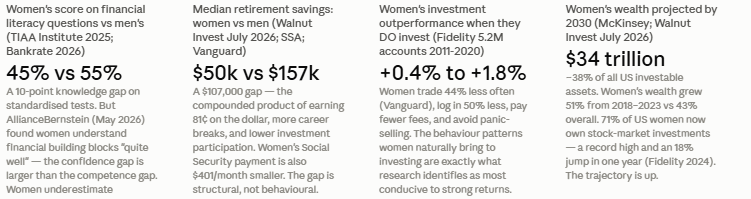
The second fact: when women invest, they outperform men. Fidelity’s analysis of 5.2 million accounts from 2011 to 2020 found women’s portfolios outperformed men’s by 0.4% annually. Academic studies put the advantage between 0.4% and 1.8% depending on the study (Walnut Invest July 2026; Experian). Women trade 44% less often than men, log into their investment accounts roughly 50% less, pay fewer transaction fees, and avoid the performance-destroying pattern of panic-selling and market-timing that characterises more active trading (Vanguard data). Women’s wealth grew 51% between 2018 and 2023, versus 43% overall, and women are projected to control approximately $34 trillion — around 38% of US investable assets — by 2030 (McKinsey; Walnut Invest July 2026).
The gap, in other words, is not a gap in financial capability. The research is remarkably consistent on this: when women engage with their finances, they perform well. The gap is in engagement, confidence, participation, and the structural conditions — the pay gap, the caregiving burden, the career break penalty — that reduce the resources available to invest in the first place. Closing it requires addressing both dimensions: the structural conditions that reduce financial resources, and the confidence and literacy barriers that reduce financial engagement.
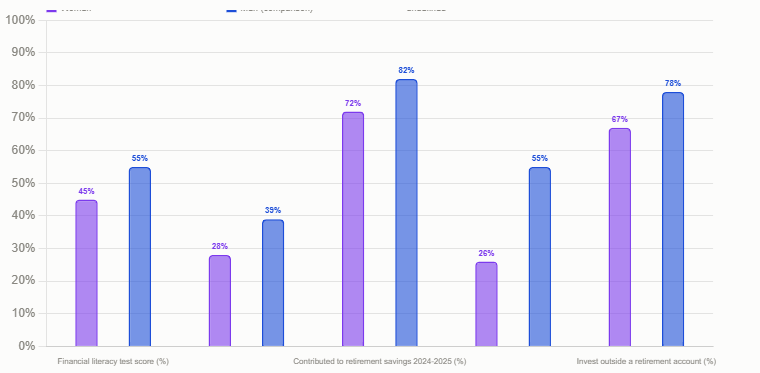
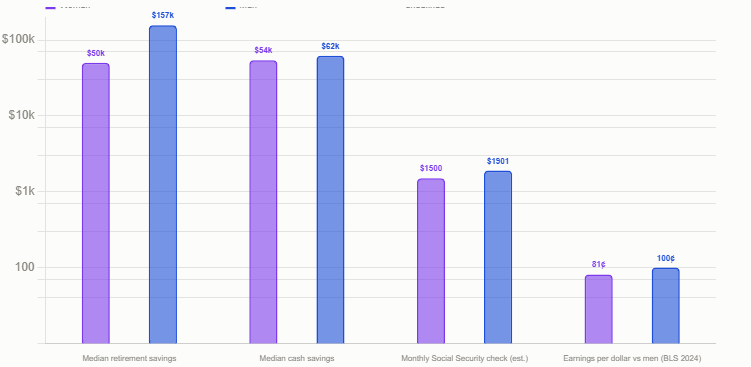
Women answer 45% of personal finance questions correctly vs 55% for men (TIAA Institute 2025; Bankrate 2026). Median retirement savings: women ~$50,000 vs men ~$157,000 (Walnut Invest July 2026). Women's Social Security monthly payment: $401 smaller than men's (SSA; Walnut Invest July 2026). 81% of women say finances keep them up at night (Fidelity 2025; Bankrate 2026). BUT: women outperform men in investing by 0.4-1.8% annually (Fidelity; multiple academic studies; Walnut Invest July 2026). 71% of US women now own stock-market investments -- an 18% jump in one year (Fidelity 2024; Walnut Invest July 2026). Women projected to control $34 trillion (38% of US investable assets) by 2030 (McKinsey). Women's wealth grew 51% from 2018-2023 vs 43% overall (McKinsey; Walnut Invest July 2026).
In Australia, AMP’s Retirement Confidence Pulse (January 2026) found that only 34% of women understand the concept of compounding returns before the age of 40, 71% fear they won’t be able to afford their retirement, and only 26% have ever sought professional financial advice. AMP’s deputy chief economist Diana Mousina stated: ‘The retirement confidence gap we’re seeing among women is the predictable result of a long-running financial literacy gap.’
In the UK, Legal & General’s research found that women are 33% more likely than men to say they do not understand how their pension works. By age 27, UK women are already earning £10,000 less per year than men of the same age — a gap that compounds through pension contributions, investment capacity, and lifetime savings.
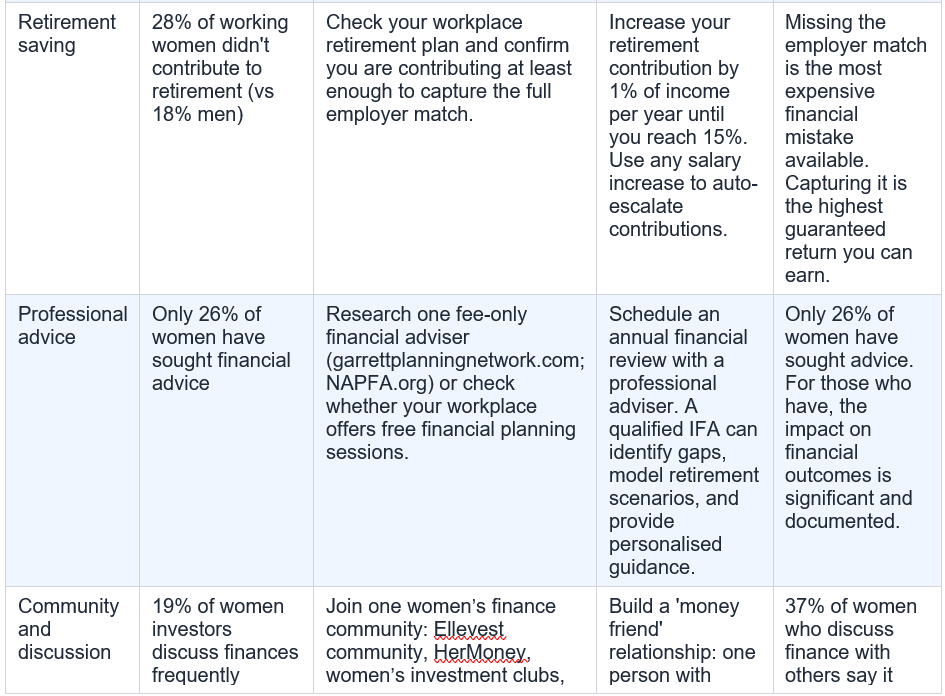
In the US, 28% of working women or those seeking employment did not contribute to their retirement savings between 2024 and 2025, compared to 18% of working men (Bankrate 2026). Among those who did save, 51% of women said they were unlikely to save enough to retire comfortably, versus 44% of men. These numbers reflect not just lower income but lower financial engagement across the board.
AllianceBernstein’s 2026 research (‘Inside the Minds of Plan Participants,’ May 2026) found that women perform comparably to men on concrete financial knowledge questions — about inflation, compounding, and diversification — even while expressing significantly lower confidence in their financial decision-making. The AB research summary states directly: ‘Women worry over retirement but understand its financial building blocks quite well compared to men.’
Only 28% of women feel comfortable making investment decisions, versus 39% of men (Walnut Invest July 2026). But 72% of women rate their investment knowledge as ‘beginner or nonexistent’ even when their actual performance data (when they do invest) shows they outperform male investors. This is a classic manifestation of what psychologists call the Dunning-Kruger effect in reverse — a tendency to underestimate one’s own competence relative to the actual evidence.
The practical consequence is significant. Research consistently links financial confidence to financial participation. If a woman believes she does not know enough about investing to start, she does not start — even if her actual financial knowledge is comparable to her peers who are already participating. The confidence gap produces a participation gap, and the participation gap produces a wealth gap. Closing the literacy gap is not only about teaching women more facts. It is also about correcting a systematic underestimation of existing knowledge.
The AllianceBernstein finding deserves particular attention: women's low retirement confidence does not reflect low capability. It reflects a specific set of structural and social factors that suppress confidence below its warranted level. Women who receive specific, concrete financial education consistently show faster confidence gains than the knowledge gains themselves would predict -- because the education corrects the underestimation of existing competence, not just adding new information. Not financial advice.
The Good News: When women invest, they outperform men by 0.4% to 1.8% annually (Fidelity; multiple academic studies). The outperformance mechanism: women trade 44% less often (Vanguard), pay fewer transaction fees, and avoid market-timing mistakes more reliably. The irony of the gender investing gap is that the behaviour patterns women naturally bring to investing -- patience, long-term focus, lower trading frequency -- are exactly the behaviours that investment research identifies as most conducive to strong portfolio returns. Not investment advice.
The gender pay gap is the foundation of all the others. US female workers earn 81 cents for every dollar earned by male workers based on median weekly earnings in 2024 (US Bureau of Labor Statistics; Bankrate 2026). This is not a small gap to be managed at the margins. Every dollar not earned is a dollar not saved, not invested, and not compounding over decades. At 81 cents per dollar, over a 40-year career at median US female earnings, the cumulative uncollected income runs to hundreds of thousands of dollars in direct lost earnings before any investment or compounding calculation.
Caregiving disproportionately falls to women. The BSI’s 2025 Lifting the Second Glass Ceiling found that 31% of women expect to retire earlier than planned, and 23% cite caring for family — particularly elderly parents — as a barrier to remaining in the workforce (IFA Australia January 2026). These are not choices made in a vacuum: they are responses to a care infrastructure that leaves women as the default caregivers, with the financial consequences falling exclusively on the individual rather than being shared socially.
Financial education itself has a history of gender bias that has been only partially corrected. Research on financial content, advertising, and advisory culture has documented that women are more likely to be treated as novices in financial contexts, less likely to be actively engaged by financial advisers, and more likely to encounter financial products and education materials calibrated to male financial circumstances — single incomes, continuous career trajectories, and high risk tolerance — that do not reflect the actual circumstances of most women’s financial lives.
The Gap: The structural causes of the gender financial gap require structural responses — pay equity legislation, affordable childcare, pension contribution protection during maternity leave, and equal representation in financial services. Individual financial literacy, while necessary and impactful, is not a substitute for these structural changes. This guide focuses on what individuals can do within the current structure while advocating for its improvement. Not financial or policy advice.
Consider a woman earning $50,000 per year and a man earning $61,728 per year (the equivalent at the 81-cent earnings ratio). Both contribute 10% of their income to a retirement account. Both earn 7% annual returns over 30 years. The woman contributes $5,000 per year; the man contributes $6,173 per year. After 30 years, the woman’s account contains approximately $472,000. The man’s contains approximately $583,000 — a gap of $111,000, generated entirely by the pay gap, not by any difference in financial behaviour or decisions. This is the invisible compounding of structural inequality.
The Social Security dimension adds a further permanent consequence. Social Security benefits are calculated based on lifetime earnings. Thirty-five years of lower earnings produces a lower average indexed monthly earnings (AIME) figure, which produces a lower Primary Insurance Amount (PIA), which produces a permanently lower monthly benefit — an average of $401 per month less than men’s average benefit (SSA data; Walnut Invest July 2026). Over a 20-year retirement, that monthly gap compounds to approximately $96,240 in lost income, again with no individual action capable of reversing it after the fact.
The practical implication for financial planning is that women need to save and invest a higher percentage of their current income than men to achieve equivalent retirement outcomes — not because they are less disciplined or less capable, but because their structural starting position requires a higher savings rate to compensate for the pay gap’s compounding effects. This is a planning reality that financial advisers and financial literacy education frequently fail to make explicit.
In the UK, Legal & General’s research confirms that young women are forecast to accumulate significantly less in workplace pensions than men at the same age, with the gap widened by career breaks, part-time work during child-rearing years, and lower rates of senior leadership attainment. By the 2060s, the projected average workplace pension pot for young women at state pension age — adjusted for inflation — will be equivalent to approximately £12,873 per year, a figure that understates the actual gap because it does not account for career-break effects, lower seniority, and part-time working patterns (The Intermediary 2026; Legal & General).
The specific pension planning implications for women who anticipate career breaks include: maximising contributions before the break to build a larger base for compound growth to work on; using any paid maternity leave period to continue some pension contributions if cash flow permits; reviewing and boosting contributions aggressively on return to work; and using any lump sums (tax refunds, inheritances, bonuses) to make catch-up pension contributions that partially offset the break period.
But the confidence gap remains. Even as participation increases, only 28% of women feel comfortable making investment decisions (versus 39% of men), and 72% rate their investment knowledge as beginner or nonexistent — despite the performance data showing their investment outcomes are superior to men’s when they do participate (Walnut Invest July 2026). This creates a specific dynamic: women who invest do well; women who do not invest cite lack of confidence as a primary barrier; and the lack of confidence is systematically larger than the lack of competence.
The mechanism by which women outperform when they do invest is well-documented. Fidelity’s analysis of 5.2 million accounts found women trade 44% less often than men (Vanguard data confirms similar patterns). Lower trading frequency means fewer transaction costs, fewer tax events from realised gains, and reduced exposure to the single most damaging pattern in retail investing: buying high and selling low in response to market volatility. Women also log into their investment accounts roughly 50% less than men — which prevents the emotional reactivity that frequent account-checking produces (Walnut Invest July 2026). Patience, long-term focus, and lower trading frequency are the behaviours that decades of investment research identify as most conducive to strong long-term portfolio returns. Women exhibit them more consistently than men.
The investing gender gap may be largely a confidence and engagement gap rather than a knowledge or skill gap. The implications are significant: targeted interventions that specifically address confidence (rather than just knowledge) may produce faster results than traditional financial education alone. Research on 'positive financial identity' programmes -- which emphasise women's actual investment performance data rather than solely teaching concepts -- has shown promise in confidence-building contexts. Not financial advice.
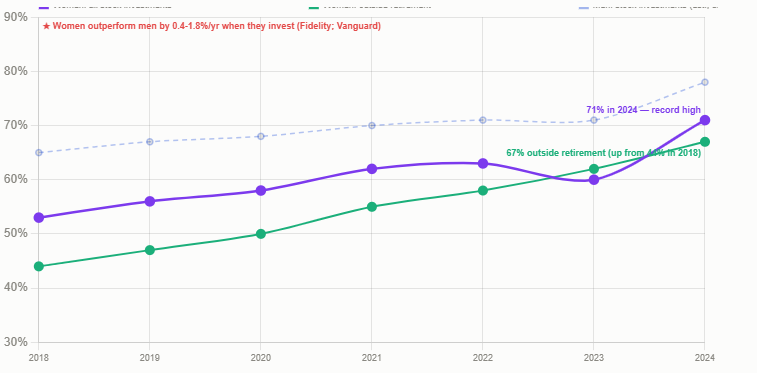
Investment participation is at record levels. The 18% single-year jump in women’s stock-market ownership (from approximately 60% to 71% in one year, 2023 to 2024) is the largest recorded annual increase in female investment participation (Fidelity 2024). The number of women investing outside retirement accounts reached 67% in 2024, compared to 44% in 2018 — a 52% increase in six years. These are structural shifts, not marginal movements.
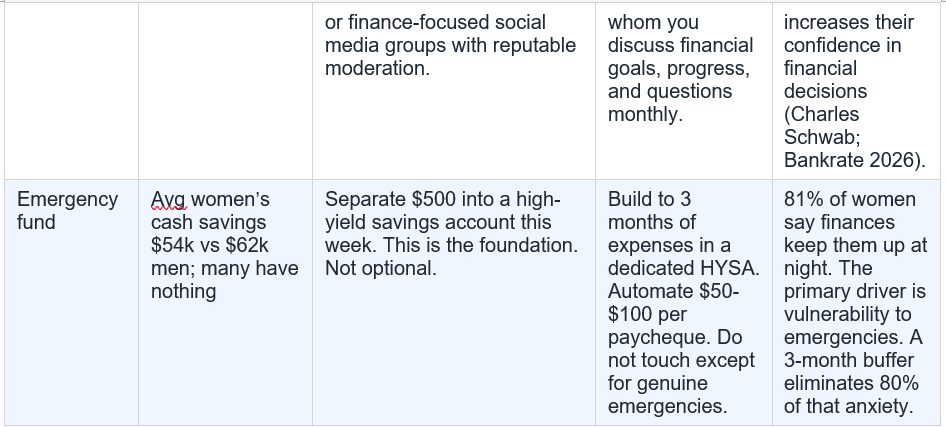
Around 1 in 5 (19%) of women investors now frequently discuss financial information with others, and among this group, 37% do so specifically to feel more confident in their financial decisions (Bankrate 2026 citing Charles Schwab Women Investors Survey). The emerging culture of women discussing money with each other — through financial communities, peer networks, and social platforms — is producing confidence gains that traditional top-down financial education has struggled to generate.
The generational trajectory is also positive. Younger women are entering the workforce with higher educational attainment than their male peers in many developed countries, higher rates of financial engagement than their mothers’ generation, and greater willingness to seek financial information and professional advice. The structural barriers remain, but the direction of travel has shifted.
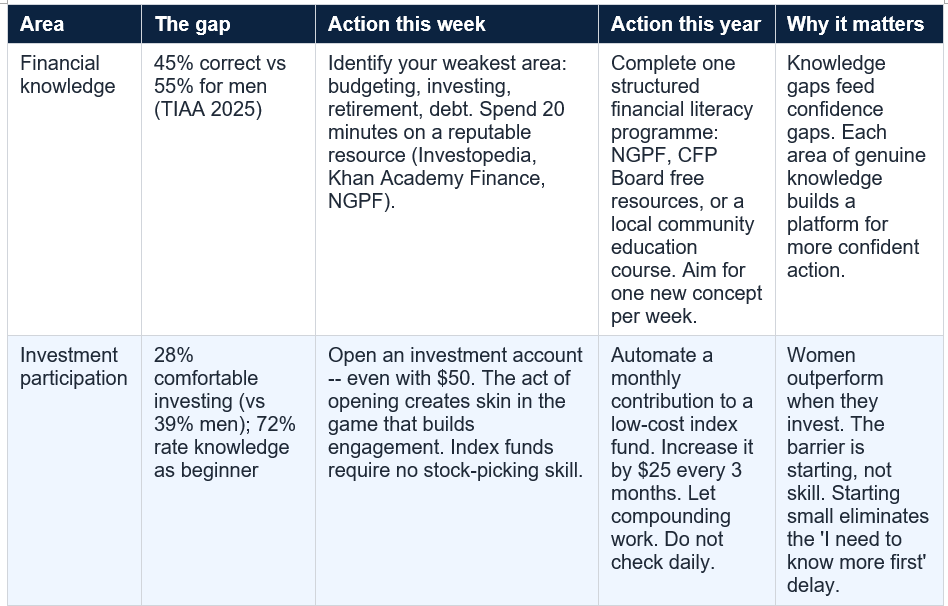
The specific recommendation for someone starting from a position of low confidence is not to study extensively before acting but to start small and act immediately. Open a brokerage account with a low-cost provider (Vanguard, Fidelity, Schwab, or a target-date fund in a 401(k)). Invest in a single diversified index fund — a total market index fund or an S&P 500 index fund — in an amount you can afford to leave untouched. Automate a monthly contribution. And then do not check it daily.
The ‘do not check daily’ instruction is not advice to be ignorant about your investments. It is a practical recognition that frequent account-checking produces emotional reactivity to short-term market movements that is demonstrably harmful to investment performance (the research on this is extensive). The women who outperform men by 0.4–1.8% annually are largely those who invest, automate, and leave it alone. This is not a passive strategy. It is a deliberate one, grounded in the research on what produces strong investment outcomes.
Specific investment starting steps: (1) Open a Roth IRA or contribute to your workplace 401(k) up to the employer match (guaranteed 50-100% instant return). (2) Choose one fund: a total market index fund (e.g. Vanguard Total Stock Market Index, Fidelity ZERO Total Market Index) or a target-date fund appropriate for your expected retirement year. (3) Set up automatic contributions of whatever you can afford: $25, $50, $100/month. (4) Set a calendar reminder to increase by $25 every 6 months. (5) Check quarterly, not daily. That is the entire investment plan. Not financial advice. Consult a qualified financial adviser for personalised guidance.
The resources available for women-specific financial community and education have expanded significantly in recent years. Ellevest (ellevest.com) offers a digital investing platform built specifically around women’s financial circumstances, including a pay-gap-adjusted investment model. HerMoney (hermoney.com) provides financial education, podcasts, and community specifically for women. Investment clubs — groups of individuals who pool research and make collective investment decisions — have historically been a significant vehicle for women’s financial education and are being revived in digital formats.
For professional advice, the Garrett Planning Network (garrettplanningnetwork.com) lists fee-only financial advisers who offer hourly advice — accessible without requiring a minimum asset level that would exclude many women at earlier stages of wealth-building. NAPFA (napfa.org) lists fee-only advisers who are fiduciaries — legally required to act in the client’s best interest rather than earning commissions. Both are better choices for women seeking advice than commission-based advisers whose incentives may not align with clients’ needs.
The NGPF (Next Gen Personal Finance) offers free online financial literacy resources. Khan Academy’s finance section provides structured, jargon-free financial education. For UK-based readers, the Money and Pensions Service (moneyandpensionsservice.org.uk) offers free financial guidance and links to regulated advisers.
But the gap is not fixed. Women who invest outperform men. Women’s wealth is growing faster than average. Investment participation is at record levels. The community of women discussing money and building financial knowledge is expanding. And the structural barriers — the pay gap, the caregiving burden, the pension contribution interruptions — are at least being named, measured, and in some jurisdictions, legislatively addressed.
The most powerful individual action available to any woman reading this guide is the first financial action she has been postponing. Open the retirement account. Make the first contribution. Check one salary comparison for her job title. Ask the first question of a financial adviser. The research on financial confidence is clear: confidence follows action, not the reverse. The women who feel most confident about their finances are not the ones who studied longest before acting. They are the ones who started — imperfectly, with incomplete information, and with genuine uncertainty about the outcome — and let the experience build the knowledge and confidence that produces the next action.
Women projected to control $34 trillion in investable assets by 2030 are not a different species from women currently earning 81 cents on the dollar. They are the same women, making the first move. Not financial advice — always consult a qualified financial adviser for guidance specific to your circumstances.
The gender financial literacy gap refers to the documented difference in financial knowledge and financial confidence between women and men. On standardised financial literacy assessments, women consistently score lower than men: the 2025 TIAA Institute financial literacy survey found women answering an average of 45% of questions correctly versus 55% for men (Bankrate 2026). Women also report lower confidence in financial decision-making: only 28% of women feel comfortable making investment decisions compared to 39% of men, and 72% rate their investment knowledge as beginner or nonexistent (Walnut Invest July 2026). The gap exists across multiple countries — the US, UK, Australia, and other developed nations all show similar patterns in their national financial literacy surveys. Critically, the gap is larger in confidence than in actual competence: AllianceBernstein's 2026 research found that women understand core financial concepts comparably to men even while expressing significantly lower confidence. The gap is not primarily about ability. It is about engagement, confidence, structural barriers, and historically less inclusive financial education environments. Not financial advice.
Why do women have less money saved for retirement than men?
The retirement savings gap between women (median ~$50,000) and men (median ~$157,000) has multiple structural causes that compound over a career. The gender pay gap (women earn 81 cents per dollar at the median, BLS 2024) means women have less income available to save and invest. Career breaks for childcare and elder care — which disproportionately fall to women — interrupt pension contributions and employer matching contributions. Women are less likely to hold senior leadership positions, reducing lifetime earnings. Women are more likely to work part-time during child-rearing years, further reducing contribution capacity. Additionally, 28% of working women did not contribute to retirement savings in 2024-2025, versus 18% of working men (Bankrate 2026). Social Security benefits, calculated on lifetime earnings, are on average $401 per month lower for women than men (SSA data). The retirement gap is not primarily a financial literacy or behaviour gap — it is largely the compound product of structural inequality in pay, career progression, and caregiving responsibilities. Not financial advice. Sources: Walnut Invest July 2026; Bankrate 2026; SSA; BLS.
Do women invest as well as men?
When women invest, they outperform men. Fidelity's analysis of 5.2 million accounts from 2011 to 2020 found women's portfolios outperformed men's by 0.4% annually. Academic studies of the same question range from 0.4% to 1.8% annual outperformance. The mechanism is behavioural: women trade approximately 44% less often than men (Vanguard data), log into investment accounts roughly 50% less, pay fewer transaction fees, and avoid the performance-destroying pattern of panic-selling and market-timing that characterises more active trading (Walnut Invest July 2026). Women tend to make fewer emotional investment decisions in response to short-term market movements, which the research consistently shows as the primary source of poor individual investor returns. As of 2024, 71% of US women own stock-market investments, a record high and an 18% jump from 2023 (Fidelity 2024). The challenge is not performance — it is participation and confidence. Only 28% of women feel comfortable making investment decisions, despite the evidence that they perform well when they do. Not investment advice. Sources: Walnut Invest July 2026; Fidelity; Vanguard; Bankrate 2026.
How can women start improving their financial literacy?
The most effective approach combines knowledge-building with immediate action, because financial confidence is built through doing rather than exclusively through studying. Practical steps: (1) Identify your specific knowledge gap (budgeting, investing, retirement, debt management) and focus there first rather than trying to learn everything at once. (2) Use free reputable resources: Investopedia, Khan Academy Finance, Next Gen Personal Finance (NGPF), and the CFP Board's financial planning resources. (3) Open a retirement account if you don't have one, or confirm you are contributing at least enough to capture your full employer match — this is the highest guaranteed return available. (4) Open an investment account with a small amount you can afford to invest in a single diversified index fund. (5) Join a women’s financial community (Ellevest, HerMoney, women’s investment clubs) where peer discussion builds confidence alongside knowledge. (6) Consult a fee-only financial adviser (NAPFA.org; garrettplanningnetwork.com) for personalised guidance. The AllianceBernstein 2026 research found that women's low financial confidence does not reflect low capability — they understand financial concepts comparably to men. The most valuable step is often the first action, not more preparation. Not financial advice.
How much more should women save for retirement compared to men?
Because of the pay gap, career interruptions, and longer average lifespan (women live approximately 5.3 years longer than men on average, SSA), women typically need to save a higher percentage of their income than men to achieve equivalent retirement outcomes. The standard financial planning guideline of saving 10-15% of gross income is a starting point, but for women specifically, a 15-20% savings rate is a more conservative and more appropriate target to account for the structural disadvantages. Women also benefit from planning retirement income for a longer period: a woman who retires at 65 should plan for 25-30 years of retirement income rather than 20, given average life expectancy data. The Social Security claiming strategy is particularly valuable for women: delaying from age 62 to 70 increases the monthly benefit by approximately 76%, and women's longer average lifespan means the break-even age (where cumulative delayed benefits exceed cumulative early benefits) is reached at a younger effective age for women than for men. These are general guidelines; individual circumstances vary significantly. Not financial advice. Consult a qualified financial adviser for personalised retirement planning.
Table of Contents
- The Gap Is Real — and So Is the Potential
- What the Numbers Actually Show
- The Confidence Gap vs the Competence Gap
- Why the Gap Exists: Structural Causes
- The Pay Gap’s Long Tail: How $0.81 Becomes $107,000
- Career Breaks, Caregiving, and the Pension Penalty
- The Investing Gap: Less Participation, Better Performance
- The Good News: Women’s Wealth Trajectory
- How to Close the Gap: A Practical Action Framework
- Building Investment Confidence: Starting From Zero
- The Retirement Gap: Specific Strategies for Women
- Finding Community and Professional Support
- Conclusion: The Most Powerful Investment Is the First One
- Frequently Asked Questions
The knowledge and confidence gap — what the data shows
The retirement and wealth gap — causes and scale
The good news--- women's investing performance
The Gap Is Real — and So Is the Potential
Two facts about women and money sit in uncomfortable tension, and the tension is the point. The first: women answer an average of 45% of personal finance questions correctly on standardised literacy surveys, versus 55% for men — a 10-percentage-point gap documented by the TIAA Institute in 2025 (Bankrate 2026). The median woman retires with approximately $50,000 in savings, versus $157,000 for the median man. Women’s average Social Security cheque is $401 per month smaller. Eighty-one percent of women say their finances keep them up at night (Fidelity 2025 Women and Money Study). These are the gap.The second fact: when women invest, they outperform men. Fidelity’s analysis of 5.2 million accounts from 2011 to 2020 found women’s portfolios outperformed men’s by 0.4% annually. Academic studies put the advantage between 0.4% and 1.8% depending on the study (Walnut Invest July 2026; Experian). Women trade 44% less often than men, log into their investment accounts roughly 50% less, pay fewer transaction fees, and avoid the performance-destroying pattern of panic-selling and market-timing that characterises more active trading (Vanguard data). Women’s wealth grew 51% between 2018 and 2023, versus 43% overall, and women are projected to control approximately $34 trillion — around 38% of US investable assets — by 2030 (McKinsey; Walnut Invest July 2026).
The gap, in other words, is not a gap in financial capability. The research is remarkably consistent on this: when women engage with their finances, they perform well. The gap is in engagement, confidence, participation, and the structural conditions — the pay gap, the caregiving burden, the career break penalty — that reduce the resources available to invest in the first place. Closing it requires addressing both dimensions: the structural conditions that reduce financial resources, and the confidence and literacy barriers that reduce financial engagement.
Women answer 45% of personal finance questions correctly vs 55% for men (TIAA Institute 2025; Bankrate 2026). Median retirement savings: women ~$50,000 vs men ~$157,000 (Walnut Invest July 2026). Women's Social Security monthly payment: $401 smaller than men's (SSA; Walnut Invest July 2026). 81% of women say finances keep them up at night (Fidelity 2025; Bankrate 2026). BUT: women outperform men in investing by 0.4-1.8% annually (Fidelity; multiple academic studies; Walnut Invest July 2026). 71% of US women now own stock-market investments -- an 18% jump in one year (Fidelity 2024; Walnut Invest July 2026). Women projected to control $34 trillion (38% of US investable assets) by 2030 (McKinsey). Women's wealth grew 51% from 2018-2023 vs 43% overall (McKinsey; Walnut Invest July 2026).
What the Numbers Actually Show
The financial literacy gender gap shows up across multiple measurement approaches and multiple countries, suggesting it is not an artefact of any single survey methodology. The 2025 TIAA Institute financial literacy survey — one of the most rigorous annual assessments of US adult financial literacy — found women answering 45% of questions correctly versus 55% for men (Bankrate 2026). This 10-percentage-point gap is not trivial: it represents meaningful differences in knowledge about compounding, inflation, risk diversification, and debt management — the building blocks of effective financial decision-making.In Australia, AMP’s Retirement Confidence Pulse (January 2026) found that only 34% of women understand the concept of compounding returns before the age of 40, 71% fear they won’t be able to afford their retirement, and only 26% have ever sought professional financial advice. AMP’s deputy chief economist Diana Mousina stated: ‘The retirement confidence gap we’re seeing among women is the predictable result of a long-running financial literacy gap.’
In the UK, Legal & General’s research found that women are 33% more likely than men to say they do not understand how their pension works. By age 27, UK women are already earning £10,000 less per year than men of the same age — a gap that compounds through pension contributions, investment capacity, and lifetime savings.
In the US, 28% of working women or those seeking employment did not contribute to their retirement savings between 2024 and 2025, compared to 18% of working men (Bankrate 2026). Among those who did save, 51% of women said they were unlikely to save enough to retire comfortably, versus 44% of men. These numbers reflect not just lower income but lower financial engagement across the board.
The Confidence Gap vs the Competence Gap
One of the most important findings in recent women’s financial research is the distinction between confidence and competence. The two do not always track together — and for women, the research consistently finds that the confidence gap is significantly larger than the competence gap.AllianceBernstein’s 2026 research (‘Inside the Minds of Plan Participants,’ May 2026) found that women perform comparably to men on concrete financial knowledge questions — about inflation, compounding, and diversification — even while expressing significantly lower confidence in their financial decision-making. The AB research summary states directly: ‘Women worry over retirement but understand its financial building blocks quite well compared to men.’
Only 28% of women feel comfortable making investment decisions, versus 39% of men (Walnut Invest July 2026). But 72% of women rate their investment knowledge as ‘beginner or nonexistent’ even when their actual performance data (when they do invest) shows they outperform male investors. This is a classic manifestation of what psychologists call the Dunning-Kruger effect in reverse — a tendency to underestimate one’s own competence relative to the actual evidence.
The practical consequence is significant. Research consistently links financial confidence to financial participation. If a woman believes she does not know enough about investing to start, she does not start — even if her actual financial knowledge is comparable to her peers who are already participating. The confidence gap produces a participation gap, and the participation gap produces a wealth gap. Closing the literacy gap is not only about teaching women more facts. It is also about correcting a systematic underestimation of existing knowledge.
The AllianceBernstein finding deserves particular attention: women's low retirement confidence does not reflect low capability. It reflects a specific set of structural and social factors that suppress confidence below its warranted level. Women who receive specific, concrete financial education consistently show faster confidence gains than the knowledge gains themselves would predict -- because the education corrects the underestimation of existing competence, not just adding new information. Not financial advice.
The Good News: When women invest, they outperform men by 0.4% to 1.8% annually (Fidelity; multiple academic studies). The outperformance mechanism: women trade 44% less often (Vanguard), pay fewer transaction fees, and avoid market-timing mistakes more reliably. The irony of the gender investing gap is that the behaviour patterns women naturally bring to investing -- patience, long-term focus, lower trading frequency -- are exactly the behaviours that investment research identifies as most conducive to strong portfolio returns. Not investment advice.
Why the Gap Exists: Structural Causes
The financial literacy and wealth gap between women and men is not primarily a function of aptitude, interest, or personal finance choices. It is the product of structural conditions that systematically disadvantage women’s financial position across the lifecycle: the gender pay gap, the caregiving burden, career interruptions, lower rates of senior leadership representation, and financial education environments that have historically been less inclusive of women’s specific circumstances.The gender pay gap is the foundation of all the others. US female workers earn 81 cents for every dollar earned by male workers based on median weekly earnings in 2024 (US Bureau of Labor Statistics; Bankrate 2026). This is not a small gap to be managed at the margins. Every dollar not earned is a dollar not saved, not invested, and not compounding over decades. At 81 cents per dollar, over a 40-year career at median US female earnings, the cumulative uncollected income runs to hundreds of thousands of dollars in direct lost earnings before any investment or compounding calculation.
Caregiving disproportionately falls to women. The BSI’s 2025 Lifting the Second Glass Ceiling found that 31% of women expect to retire earlier than planned, and 23% cite caring for family — particularly elderly parents — as a barrier to remaining in the workforce (IFA Australia January 2026). These are not choices made in a vacuum: they are responses to a care infrastructure that leaves women as the default caregivers, with the financial consequences falling exclusively on the individual rather than being shared socially.
Financial education itself has a history of gender bias that has been only partially corrected. Research on financial content, advertising, and advisory culture has documented that women are more likely to be treated as novices in financial contexts, less likely to be actively engaged by financial advisers, and more likely to encounter financial products and education materials calibrated to male financial circumstances — single incomes, continuous career trajectories, and high risk tolerance — that do not reflect the actual circumstances of most women’s financial lives.
The Gap: The structural causes of the gender financial gap require structural responses — pay equity legislation, affordable childcare, pension contribution protection during maternity leave, and equal representation in financial services. Individual financial literacy, while necessary and impactful, is not a substitute for these structural changes. This guide focuses on what individuals can do within the current structure while advocating for its improvement. Not financial or policy advice.
The Pay Gap’s Long Tail: How $0.81 Becomes $107,000
The $107,000 retirement savings gap between the median woman ($50,000) and the median man ($157,000) is the compound product of 40 years of earning less, investing less, and accumulating less (Walnut Invest July 2026; SSA; Vanguard). Understanding the compounding arithmetic of the pay gap is among the most important pieces of financial education available to women precisely because it makes the stakes visible.Consider a woman earning $50,000 per year and a man earning $61,728 per year (the equivalent at the 81-cent earnings ratio). Both contribute 10% of their income to a retirement account. Both earn 7% annual returns over 30 years. The woman contributes $5,000 per year; the man contributes $6,173 per year. After 30 years, the woman’s account contains approximately $472,000. The man’s contains approximately $583,000 — a gap of $111,000, generated entirely by the pay gap, not by any difference in financial behaviour or decisions. This is the invisible compounding of structural inequality.
The Social Security dimension adds a further permanent consequence. Social Security benefits are calculated based on lifetime earnings. Thirty-five years of lower earnings produces a lower average indexed monthly earnings (AIME) figure, which produces a lower Primary Insurance Amount (PIA), which produces a permanently lower monthly benefit — an average of $401 per month less than men’s average benefit (SSA data; Walnut Invest July 2026). Over a 20-year retirement, that monthly gap compounds to approximately $96,240 in lost income, again with no individual action capable of reversing it after the fact.
The practical implication for financial planning is that women need to save and invest a higher percentage of their current income than men to achieve equivalent retirement outcomes — not because they are less disciplined or less capable, but because their structural starting position requires a higher savings rate to compensate for the pay gap’s compounding effects. This is a planning reality that financial advisers and financial literacy education frequently fail to make explicit.
Career Breaks, Caregiving, and the Pension Penalty
Career breaks for childcare, elder care, or family support reduce pension contributions during the break period. But the financial impact extends well beyond the missed contributions. A woman who takes two years out of the workforce at age 32 for childcare does not simply miss two years of pension contributions. She misses two years of employer matching contributions; she misses two years of compound growth on the contributions she would have made; she may return to the workforce at a lower salary than if she had stayed (research documents a ‘motherhood penalty’ in earnings); and she may return to a reduced role with reduced contribution capacity for years after the break ends.In the UK, Legal & General’s research confirms that young women are forecast to accumulate significantly less in workplace pensions than men at the same age, with the gap widened by career breaks, part-time work during child-rearing years, and lower rates of senior leadership attainment. By the 2060s, the projected average workplace pension pot for young women at state pension age — adjusted for inflation — will be equivalent to approximately £12,873 per year, a figure that understates the actual gap because it does not account for career-break effects, lower seniority, and part-time working patterns (The Intermediary 2026; Legal & General).
The specific pension planning implications for women who anticipate career breaks include: maximising contributions before the break to build a larger base for compound growth to work on; using any paid maternity leave period to continue some pension contributions if cash flow permits; reviewing and boosting contributions aggressively on return to work; and using any lump sums (tax refunds, inheritances, bonuses) to make catch-up pension contributions that partially offset the break period.
The Investing Gap: Less Participation, Better Performance
The gender investing gap — the difference in investment participation rates between men and women — has been narrowing significantly. In 2024, approximately 71% of US women owned stock-market investments, up 18% from 2023 and a record high (Fidelity 2024; Walnut Invest July 2026). The number of women investing outside of a retirement account has risen from 44% in 2018 to 67% in 2024 (Fidelity data; Experian). These are meaningful improvements in a short time period.But the confidence gap remains. Even as participation increases, only 28% of women feel comfortable making investment decisions (versus 39% of men), and 72% rate their investment knowledge as beginner or nonexistent — despite the performance data showing their investment outcomes are superior to men’s when they do participate (Walnut Invest July 2026). This creates a specific dynamic: women who invest do well; women who do not invest cite lack of confidence as a primary barrier; and the lack of confidence is systematically larger than the lack of competence.
The mechanism by which women outperform when they do invest is well-documented. Fidelity’s analysis of 5.2 million accounts found women trade 44% less often than men (Vanguard data confirms similar patterns). Lower trading frequency means fewer transaction costs, fewer tax events from realised gains, and reduced exposure to the single most damaging pattern in retail investing: buying high and selling low in response to market volatility. Women also log into their investment accounts roughly 50% less than men — which prevents the emotional reactivity that frequent account-checking produces (Walnut Invest July 2026). Patience, long-term focus, and lower trading frequency are the behaviours that decades of investment research identify as most conducive to strong long-term portfolio returns. Women exhibit them more consistently than men.
The investing gender gap may be largely a confidence and engagement gap rather than a knowledge or skill gap. The implications are significant: targeted interventions that specifically address confidence (rather than just knowledge) may produce faster results than traditional financial education alone. Research on 'positive financial identity' programmes -- which emphasise women's actual investment performance data rather than solely teaching concepts -- has shown promise in confidence-building contexts. Not financial advice.
The Good News: Women’s Wealth Trajectory
The trajectory of women’s financial position is improving in ways that are genuinely significant, even against the backdrop of a persistent gap. The headline number is the projected $34 trillion in US investable assets that women are expected to control by 2030 — approximately 38% of the total (McKinsey; Walnut Invest July 2026). Women’s wealth grew 51% between 2018 and 2023, compared to 43% overall growth in US investable assets. Women are accumulating wealth faster than the average.Investment participation is at record levels. The 18% single-year jump in women’s stock-market ownership (from approximately 60% to 71% in one year, 2023 to 2024) is the largest recorded annual increase in female investment participation (Fidelity 2024). The number of women investing outside retirement accounts reached 67% in 2024, compared to 44% in 2018 — a 52% increase in six years. These are structural shifts, not marginal movements.
Around 1 in 5 (19%) of women investors now frequently discuss financial information with others, and among this group, 37% do so specifically to feel more confident in their financial decisions (Bankrate 2026 citing Charles Schwab Women Investors Survey). The emerging culture of women discussing money with each other — through financial communities, peer networks, and social platforms — is producing confidence gains that traditional top-down financial education has struggled to generate.
The generational trajectory is also positive. Younger women are entering the workforce with higher educational attainment than their male peers in many developed countries, higher rates of financial engagement than their mothers’ generation, and greater willingness to seek financial information and professional advice. The structural barriers remain, but the direction of travel has shifted.
How to Close the Gap: A Practical Action Framework
Closing the women’s financial literacy gap requires action at the individual level (building knowledge and confidence through deliberate engagement), the community level (creating social environments where women discuss and share financial information), and the structural level (advocating for and benefiting from pay equity, pension protections, and accessible financial advice). This section focuses on the individual and community actions that are available immediately.
Building Investment Confidence: Starting From Zero
Investment confidence for women is not built primarily through courses, articles, or expert advice — although all of these help. It is built through action. The research on self-efficacy (Bandura) is clear: the most powerful source of confidence is mastery experience — actually doing the thing, in real stakes, and experiencing a positive result. In the investing context, this means opening an account, making an investment, and watching how it performs.The specific recommendation for someone starting from a position of low confidence is not to study extensively before acting but to start small and act immediately. Open a brokerage account with a low-cost provider (Vanguard, Fidelity, Schwab, or a target-date fund in a 401(k)). Invest in a single diversified index fund — a total market index fund or an S&P 500 index fund — in an amount you can afford to leave untouched. Automate a monthly contribution. And then do not check it daily.
The ‘do not check daily’ instruction is not advice to be ignorant about your investments. It is a practical recognition that frequent account-checking produces emotional reactivity to short-term market movements that is demonstrably harmful to investment performance (the research on this is extensive). The women who outperform men by 0.4–1.8% annually are largely those who invest, automate, and leave it alone. This is not a passive strategy. It is a deliberate one, grounded in the research on what produces strong investment outcomes.
Specific investment starting steps: (1) Open a Roth IRA or contribute to your workplace 401(k) up to the employer match (guaranteed 50-100% instant return). (2) Choose one fund: a total market index fund (e.g. Vanguard Total Stock Market Index, Fidelity ZERO Total Market Index) or a target-date fund appropriate for your expected retirement year. (3) Set up automatic contributions of whatever you can afford: $25, $50, $100/month. (4) Set a calendar reminder to increase by $25 every 6 months. (5) Check quarterly, not daily. That is the entire investment plan. Not financial advice. Consult a qualified financial adviser for personalised guidance.
The Retirement Gap: Specific Strategies for Women
The $107,000 retirement savings gap between women and men does not close automatically. It closes through deliberate action over time, beginning as early as possible to maximise the compounding that women who invest have already demonstrated they benefit from when they participate. Several strategies are specifically relevant to women’s financial circumstances.- Max the workplace match first: 28% of working women not contributing to retirement (versus 18% of men) are forfeiting free employer match money — a guaranteed 50-100% immediate return on every matched dollar. This is the first financial action, before any other saving or investing priority.
- Understand Social Security claiming strategy: women’s longer life expectancy (approximately 5.3 years longer than men on average, SSA) means that delayed Social Security claiming is typically more valuable for women than for men. Delaying from age 62 to 70 increases the monthly benefit by approximately 76%. Combined with the monthly gap of $401 compared to men, the lifetime value of an optimised Social Security claiming strategy is among the highest-value financial decisions available to women nearing retirement.
- Plan for a longer retirement: women’s longer average lifespan means retirement savings need to last longer. A woman who retires at 65 with an average life expectancy of 87 needs 22 years of retirement income — not 17 years. Financial plans that use a 20-year retirement duration will be inadequate for many women. Using a 25–30 year planning horizon is more conservative and more appropriate.
- Specifically address the career break gap: if you have taken or anticipate taking a career break, model the specific pension contribution shortfall it will create and set a concrete plan to address it. Catching up pension contributions on return to work is possible and valuable, but requires a deliberate plan rather than hoping salary growth will fill the gap automatically.
- Seek a financial adviser who understands women’s specific circumstances: only 26% of women have ever sought professional financial advice (AMP 2026). The combination of the pay gap, the caregiving penalty, the longer lifespan, and Social Security optimisation creates a planning environment where generic advice calibrated to male career trajectories is likely to produce inadequate results. A fee-only financial adviser who works with women’s specific financial circumstances is worth the cost.
Finding Community and Professional Support
The 19% of women investors who frequently discuss financial information with others and the 37% who say it builds their confidence (Charles Schwab Women Investors Survey; Bankrate 2026) point to something research on behaviour change consistently confirms: social support and peer accountability are among the most powerful drivers of sustained behaviour change. Women who talk about money with other women make different financial decisions than those who process financial questions in isolation.The resources available for women-specific financial community and education have expanded significantly in recent years. Ellevest (ellevest.com) offers a digital investing platform built specifically around women’s financial circumstances, including a pay-gap-adjusted investment model. HerMoney (hermoney.com) provides financial education, podcasts, and community specifically for women. Investment clubs — groups of individuals who pool research and make collective investment decisions — have historically been a significant vehicle for women’s financial education and are being revived in digital formats.
For professional advice, the Garrett Planning Network (garrettplanningnetwork.com) lists fee-only financial advisers who offer hourly advice — accessible without requiring a minimum asset level that would exclude many women at earlier stages of wealth-building. NAPFA (napfa.org) lists fee-only advisers who are fiduciaries — legally required to act in the client’s best interest rather than earning commissions. Both are better choices for women seeking advice than commission-based advisers whose incentives may not align with clients’ needs.
The NGPF (Next Gen Personal Finance) offers free online financial literacy resources. Khan Academy’s finance section provides structured, jargon-free financial education. For UK-based readers, the Money and Pensions Service (moneyandpensionsservice.org.uk) offers free financial guidance and links to regulated advisers.
Conclusion
The gender financial literacy gap is real, documented, and consequential. Women answer fewer personal finance questions correctly. Women retire with less money. Women’s Social Security payments are smaller. Women’s confidence in financial matters is systematically lower than their demonstrated competence warrants. These are the facts.But the gap is not fixed. Women who invest outperform men. Women’s wealth is growing faster than average. Investment participation is at record levels. The community of women discussing money and building financial knowledge is expanding. And the structural barriers — the pay gap, the caregiving burden, the pension contribution interruptions — are at least being named, measured, and in some jurisdictions, legislatively addressed.
The most powerful individual action available to any woman reading this guide is the first financial action she has been postponing. Open the retirement account. Make the first contribution. Check one salary comparison for her job title. Ask the first question of a financial adviser. The research on financial confidence is clear: confidence follows action, not the reverse. The women who feel most confident about their finances are not the ones who studied longest before acting. They are the ones who started — imperfectly, with incomplete information, and with genuine uncertainty about the outcome — and let the experience build the knowledge and confidence that produces the next action.
Women projected to control $34 trillion in investable assets by 2030 are not a different species from women currently earning 81 cents on the dollar. They are the same women, making the first move. Not financial advice — always consult a qualified financial adviser for guidance specific to your circumstances.
Frequently Asked Questions
What is the gender financial literacy gap?The gender financial literacy gap refers to the documented difference in financial knowledge and financial confidence between women and men. On standardised financial literacy assessments, women consistently score lower than men: the 2025 TIAA Institute financial literacy survey found women answering an average of 45% of questions correctly versus 55% for men (Bankrate 2026). Women also report lower confidence in financial decision-making: only 28% of women feel comfortable making investment decisions compared to 39% of men, and 72% rate their investment knowledge as beginner or nonexistent (Walnut Invest July 2026). The gap exists across multiple countries — the US, UK, Australia, and other developed nations all show similar patterns in their national financial literacy surveys. Critically, the gap is larger in confidence than in actual competence: AllianceBernstein's 2026 research found that women understand core financial concepts comparably to men even while expressing significantly lower confidence. The gap is not primarily about ability. It is about engagement, confidence, structural barriers, and historically less inclusive financial education environments. Not financial advice.
Why do women have less money saved for retirement than men?
The retirement savings gap between women (median ~$50,000) and men (median ~$157,000) has multiple structural causes that compound over a career. The gender pay gap (women earn 81 cents per dollar at the median, BLS 2024) means women have less income available to save and invest. Career breaks for childcare and elder care — which disproportionately fall to women — interrupt pension contributions and employer matching contributions. Women are less likely to hold senior leadership positions, reducing lifetime earnings. Women are more likely to work part-time during child-rearing years, further reducing contribution capacity. Additionally, 28% of working women did not contribute to retirement savings in 2024-2025, versus 18% of working men (Bankrate 2026). Social Security benefits, calculated on lifetime earnings, are on average $401 per month lower for women than men (SSA data). The retirement gap is not primarily a financial literacy or behaviour gap — it is largely the compound product of structural inequality in pay, career progression, and caregiving responsibilities. Not financial advice. Sources: Walnut Invest July 2026; Bankrate 2026; SSA; BLS.
Do women invest as well as men?
When women invest, they outperform men. Fidelity's analysis of 5.2 million accounts from 2011 to 2020 found women's portfolios outperformed men's by 0.4% annually. Academic studies of the same question range from 0.4% to 1.8% annual outperformance. The mechanism is behavioural: women trade approximately 44% less often than men (Vanguard data), log into investment accounts roughly 50% less, pay fewer transaction fees, and avoid the performance-destroying pattern of panic-selling and market-timing that characterises more active trading (Walnut Invest July 2026). Women tend to make fewer emotional investment decisions in response to short-term market movements, which the research consistently shows as the primary source of poor individual investor returns. As of 2024, 71% of US women own stock-market investments, a record high and an 18% jump from 2023 (Fidelity 2024). The challenge is not performance — it is participation and confidence. Only 28% of women feel comfortable making investment decisions, despite the evidence that they perform well when they do. Not investment advice. Sources: Walnut Invest July 2026; Fidelity; Vanguard; Bankrate 2026.
How can women start improving their financial literacy?
The most effective approach combines knowledge-building with immediate action, because financial confidence is built through doing rather than exclusively through studying. Practical steps: (1) Identify your specific knowledge gap (budgeting, investing, retirement, debt management) and focus there first rather than trying to learn everything at once. (2) Use free reputable resources: Investopedia, Khan Academy Finance, Next Gen Personal Finance (NGPF), and the CFP Board's financial planning resources. (3) Open a retirement account if you don't have one, or confirm you are contributing at least enough to capture your full employer match — this is the highest guaranteed return available. (4) Open an investment account with a small amount you can afford to invest in a single diversified index fund. (5) Join a women’s financial community (Ellevest, HerMoney, women’s investment clubs) where peer discussion builds confidence alongside knowledge. (6) Consult a fee-only financial adviser (NAPFA.org; garrettplanningnetwork.com) for personalised guidance. The AllianceBernstein 2026 research found that women's low financial confidence does not reflect low capability — they understand financial concepts comparably to men. The most valuable step is often the first action, not more preparation. Not financial advice.
How much more should women save for retirement compared to men?
Because of the pay gap, career interruptions, and longer average lifespan (women live approximately 5.3 years longer than men on average, SSA), women typically need to save a higher percentage of their income than men to achieve equivalent retirement outcomes. The standard financial planning guideline of saving 10-15% of gross income is a starting point, but for women specifically, a 15-20% savings rate is a more conservative and more appropriate target to account for the structural disadvantages. Women also benefit from planning retirement income for a longer period: a woman who retires at 65 should plan for 25-30 years of retirement income rather than 20, given average life expectancy data. The Social Security claiming strategy is particularly valuable for women: delaying from age 62 to 70 increases the monthly benefit by approximately 76%, and women's longer average lifespan means the break-even age (where cumulative delayed benefits exceed cumulative early benefits) is reached at a younger effective age for women than for men. These are general guidelines; individual circumstances vary significantly. Not financial advice. Consult a qualified financial adviser for personalised retirement planning.

0 Comments Comments