

Financial Literacy
Gen Z Thinks They Need $10M to Succeed: Real Habits
An Empower survey found that Gen Z believes it takes $10 million in net worth — and $587,800 a year in income — to feel financially successful. Baby Boomers put the income figure under $100,000. The $10 million target is roughly 300 times what the typical young adult has. At the same time, 66% of Gen Z are saving (up from 60% last year), 42% practice loud budgeting, and 60% now discuss money openly with friends. One picture shows a generation paralysed by impossibly high benchmarks. The other shows a generation quietly building better money habits than any that came before. Both are true. This guide is about closing the gap between the aspiration and the action.
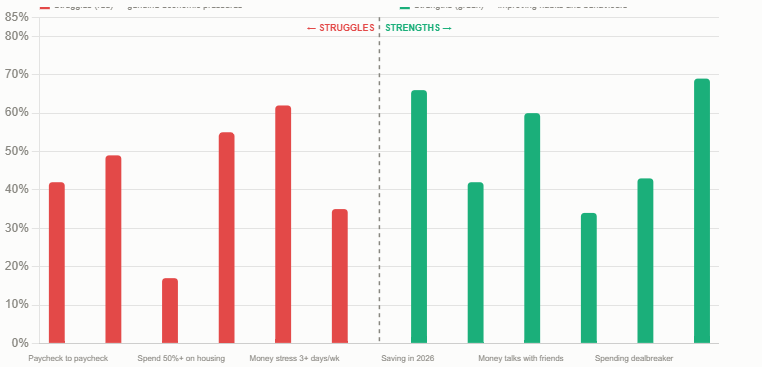
These pictures are not contradictions. They are the same generation navigating genuinely difficult economic conditions — 49% cite the high cost of living as a top barrier to financial success, and 17% spend more than half their paycheck on housing — while simultaneously developing money habits and financial transparency that outpace earlier generations at the same age. Understanding both pictures is necessary for understanding what healthy money habits actually look like for Gen Z in 2026.
Kiplinger's Seth Miller, CFP, CEPA, published a piece today framing the core tension: 'Different generations have wildly different opinions about what it takes to feel successful. But real financial freedom comes from a healthy relationship with money, however old you are.' This guide takes that framing seriously. It examines what the $10 million benchmark actually reflects, where it breaks down as a goal, and what the specific habits look like that build genuine financial health — regardless of whether the balance ever reaches eight figures.
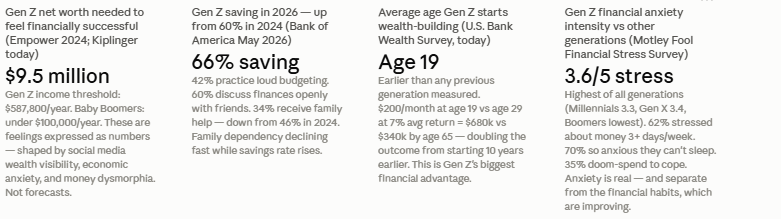
Gen Z: $10 million net worth needed to feel financially successful; $587,800/year income (Empower 2024; Kiplinger today). Boomers: under $100,000/year. 42% Gen Z living paycheck to paycheck (BofA 2026). 49% cite high cost of living as top barrier. 66% saving (up from 60% 2024). 42% practice loud budgeting (BofA 2026). 60% discuss finances openly with friends (BofA 2026). 55% delaying major life decisions due to finances (Deloitte 2026 Gen Z Survey, 22,595 respondents). Financial anxiety: 3.6/5 intensity (highest of all generations, Motley Fool survey). 34% receive family financial help — down from 46% in 2024 (BofA 2026).
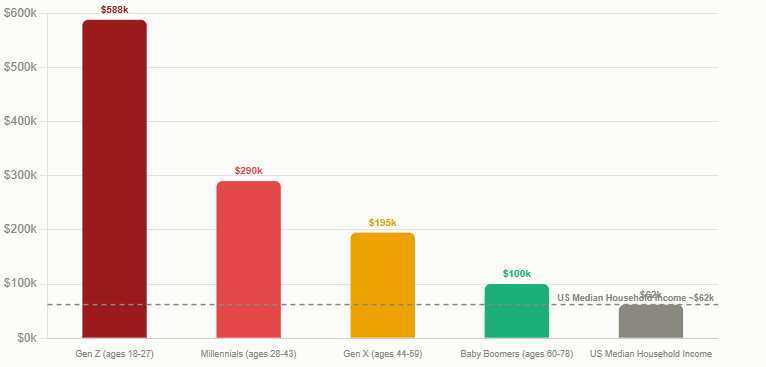
To put these numbers in context: the 2026 US median household income is approximately $60,000-$65,000 per year. The $587,800 Gen Z income threshold is approximately ten times the median. The $10 million net worth threshold is approximately 300 to 475 times the typical starting net worth of a young adult. These are not forecasts — they are feelings, expressed as numbers. They reflect what Gen Z believes would make them feel financially secure, not what they expect to earn.
Several structural forces converge to produce numbers this high. Social media creates a visibility problem: the wealthy are dramatically overrepresented in the financial content that Gen Z consumes daily. An algorithm that rewards aspirational content means that the financial reference points young adults see — the influencer's apartment, the content creator's investment returns, the entrepreneur's exit — are disproportionately from the top of the income distribution. When the benchmark is set by what is visible, and what is visible skews extremely wealthy, the threshold for feeling successful calibrates accordingly.
Money dysmorphia is a concept coined to describe the phenomenon of feeling financially behind regardless of objective circumstances — a distorted perception of one's own financial situation, often driven by social comparison. Research on social comparison and financial wellbeing consistently finds that perceived relative wealth (how you compare to your reference group) predicts financial satisfaction more strongly than absolute wealth level. When Gen Z's reference group is defined by social media, the comparison is permanently unflattering — the algorithm always has a wealthier person for you to discover. The $10 million figure may be less about what Gen Z actually needs and more about what chronic social comparison feels like as a number.
Kiplinger's Seth Miller addresses this directly: 'That gap, between what money looks like and what money is, came to mind when I saw the popular Empower Survey making the rounds again.' The gap between the appearance of wealth (the number $10 million, the influencer's lifestyle) and the reality of financial health (consistent savings rate, no high-interest debt, three to six months of emergency fund, retirement contributions from the first paycheck) is the space in which financial anxiety lives. When appearance is the benchmark, reality always falls short.
The benchmark also has a measurable emotional cost. Financial anxiety at intensity 3.6 out of 5 — higher than every other generation — is not solely a product of economic conditions, though those conditions are genuinely difficult. It is also a product of the distance between where young adults are and where they believe they need to be. Closing that gap requires either reaching $10 million (which most people will not do) or revising the benchmark to reflect what financial health actually requires, which is accessible to far more people.
The comparison trap in specific terms: if 60% of Gen Z are discussing money openly with friends (BofA 2026), the quality of those conversations matters. Talking about financial stress is healthy. Talking about other people's investment gains from content you saw on social media, and comparing your own situation to them, is the loop that sustains money dysmorphia. The Cornell University research cited by SheKnows June 2026 found that discussing finances with others reduces financial anxiety over time — but the research refers to honest conversations about one's actual situation, not social comparison loops. Not financial advice.
The constraints are real. Bank of America's 2026 Better Money Habits Gen Z study — conducted by Ipsos in February 2026 across more than 1,133 Gen Z adults ages 18-29 — found that 42% are living paycheck to paycheck, 49% cite the high cost of living as a top barrier to financial success, and 17% spend more than half their paycheck on housing — up from 13% in 2025 and 10% in 2024. This last figure is described by Bank of America as 'one of the most worrying data points in the study.' Deloitte's 2026 Gen Z and Millennial Survey, the largest of its kind with 22,595 respondents across 44 countries, found that 55% of Gen Z are delaying major life decisions including marriage, starting a family, or further education due to their financial situation.
The labour market has added pressure. Youth unemployment reached 10.8% in July 2025 — approximately 2.5 times the 4.3% national rate — and entry-level job postings declined 29 percentage points from January 2024, according to Randstad's analysis of 126 million global job postings cited by Axis Intelligence's July 2026 Gen Z Statistics report. 76% of employers reported hiring the same number or fewer entry-level workers in 2025 than in 2024, citing AI adoption and market caution.
Against these constraints, the behavioural data is genuinely encouraging. Family financial dependency is declining at a meaningful pace: 34% of Gen Z received family financial assistance in 2026, down from 39% in 2025 and 46% in 2024 (BofA 2026). The decline is sharpest among older Gen Z (ages 26-29) where only 18% now receive family help. As Fox Business reported May 19, 2026 quoting Bank of America's Will Smayda: 'We view that as extremely positive — more saving, less reliance on family members to get by.'
By 2026, 42% of Gen Z practice loud budgeting (Bank of America 2026). It has moved from a social media trend to a documented behavioural shift with measurable financial implications. Personal finance experts quoted in Axios describe the practice as a 'no shame' approach they expect to last, citing the empowering message it sends about setting financial boundaries and being in control of spending decisions rather than reactive to social pressure.
The practical application of loud budgeting extends well beyond simply saying no to restaurant dinners. AOL's July 2026 analysis of BofA data found that 75% of Gen Z look for ways to save when going out with friends: 39% suggest free or low-cost activities, 38% order cheaper menu items, 31% eat at home or bring food before going out, 29% host gatherings at home, and 20% reduce transportation costs by walking, taking public transit, or carpooling. This is a comprehensive social spending optimisation framework — and it is being adopted at scale by a generation that has made financial transparency a cultural norm rather than a source of shame.
The loud budgeting habit in practice: before each social situation, decide in advance what you are willing to spend and communicate it clearly rather than deciding in the moment under social pressure. 'I'm doing a low-spend month — can we do a walk instead of the restaurant?' is loud budgeting. The habit builds two things simultaneously: the actual financial discipline of not overspending, and the social normalisation of having financial limits — which benefits everyone in the social group who faces the same constraints but has not yet felt comfortable naming them. Not financial advice.
Gen Z is dismantling this taboo systematically. Bank of America's 2026 study found that 60% of Gen Z discuss finances openly with friends — covering salaries (27%), monthly expenses, budgeting strategies, and financial stress (24%). SheKnows' June 2026 analysis of the trend cites Cornell University research finding that people who regularly discuss their finances with others experience lower financial anxiety over time, noting that 'money conversations themselves may help reduce stress rather than create it.'
The same analysis identifies several additional documented benefits of financial transparency: more intentional spending and budgeting habits, better salary negotiation outcomes, the ability to identify pay inequities, and a reduction in the isolation that makes financial anxiety worse. When you know what your friends actually earn and actually owe, the social comparison problem becomes more tractable — you are comparing against real people with real constraints rather than against the curated highlight reel of financial success that dominates online financial content.
The financial transparency norm: the single most counter-cultural money habit Gen Z is building is also, according to research, one of the most beneficial. The shift from private money management to transparent money conversation reduces anxiety, improves decision-making, and creates the social conditions in which getting help with financial challenges no longer requires admitting a secret. This habit is worth deliberately cultivating — and deliberately protecting from comparison loops that substitute social media wealth displays for honest peer conversations. Not financial advice.
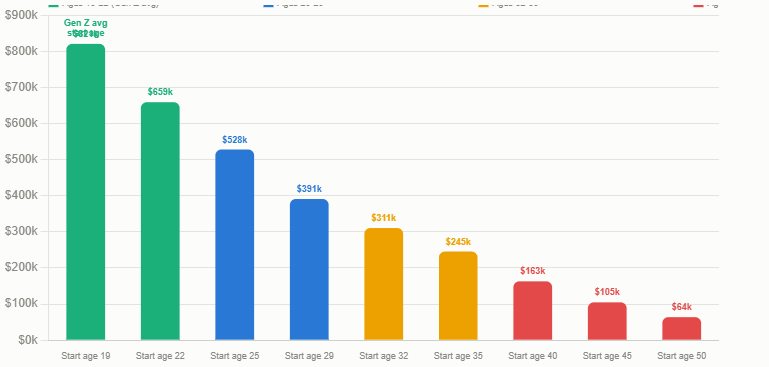
The mathematics of starting early are worth stating concretely. An investor who contributes $200 per month from age 22, earning a 7% average annual return, accumulates approximately $525,000 by age 65. An investor who waits until age 32 to start the same monthly contribution and return rate accumulates approximately $243,000 by age 65. Starting ten years earlier, on the same monthly contribution, generates more than twice the ending balance. The $10 million target feels impossibly distant; $200 per month into a Roth IRA starting at 22 is achievable right now, and it sets in motion compounding that will outperform almost any other financial decision made in the same decade.
Starting early — the compound interest reality. $200/month starting at age 22 at 7% average return: $525,000 by age 65. $200/month starting at age 32 at 7%: $243,000 by age 65. $200/month starting at age 42 at 7%: $107,000 by age 65. The difference between starting at 22 vs 32: $282,000 more — from the same monthly contribution. The difference between starting at 22 vs 42: $418,000 more — from the same $200/month. Gen Z's habit of starting at average age 19 (U.S. Bank Wealth Survey, today) is the single highest-return financial behaviour available to them. Not a specific investment recommendation — illustrative only. Past performance not indicative of future results. Not financial advice.
What does a healthy financial relationship look like in concrete terms? The research and expert consensus converge on a framework that has nothing to do with hitting a specific number. It involves spending less than you earn and directing the difference toward building security and the future. It involves not using debt to fund a lifestyle — the distinction between debt that builds assets (a mortgage, a business loan) and debt that funds consumption (a credit card balance carried month to month). It involves an emergency fund that covers three to six months of essential expenses, which removes the anxiety of a single unexpected event derailing financial stability. It involves retirement contributions that begin early, even if they begin small. And it involves a clear, honest picture of your actual financial situation — income, expenses, assets, liabilities — rather than an avoidance that allows anxiety to fill the space that information would otherwise occupy.
Deloitte's 2026 Gen Z and Millennial Survey found something that complicates the doom narrative: despite the financial pressures that are causing 55% to delay major life decisions, many are optimistic that their financial situation will improve over the next year. Just 25% of Gen Z prefer fast-paced career progression marked by rapid promotions; most favour gradual growth and lateral moves that build long-term experience. This is not failure orientation — it is a generational recalibration toward sustainability over spectacle. That recalibration, applied to financial goals, looks like defining success as consistent progress rather than a distant, fixed number.
Fortune's September 2025 reporting on Gen Z financial anxiety noted that 70% are so anxious about money they cannot sleep, and that rather than turning to practical measures like budgeting or building an emergency fund, many are opting for passive comfort through screens — doom-scrolling or 'bed rotting.' Fortune's analysis quotes avoidance experts directly: 'Avoidance tactics can make you feel more in control when the world feels uncertain. But in reality, avoiding confronting your finances head-on and seeking a quick boost of dopamine instead only delays facing your anxiety.'
The healthy alternative to doom spending is not willpower — it is structure. A budget is not a punishment; it is the document that makes spending feel intentional rather than reactive. When every dollar has a designated purpose before it is spent, the decision to buy something within the plan feels like an authorised choice, not an act of financial self-sabotage. When spending happens outside the plan, the budget makes that visible immediately — which is what makes it uncomfortable, which is also what makes it useful.
A practical doom-spending management system. First: label the urge. Before any unplanned purchase, name what is driving it — boredom, anxiety, FOMO, genuine need? Naming it creates a gap between the impulse and the action. Second: a 24-hour rule for any unplanned purchase above a personally meaningful threshold (many people use $50; adjust to what is meaningful for your situation). If you still want it tomorrow, and it fits within your budget, it is no longer an impulse — it is a decision. Third: build a small, guilt-free 'fun money' category into your budget every month. The goal is not zero enjoyment spending — it is enjoyment spending that is planned rather than reactive. Not financial advice.
But Kiplinger's Seth Miller, CFP, published today's most important observation about this data: 'Real financial freedom comes from a healthy relationship with money, however old you are.' A healthy relationship with money does not begin at $10 million. It begins with a savings rate higher than zero. It begins with a budget that makes spending intentional rather than reactive. It begins with the willingness to say 'I can't afford that right now' without shame — which 42% of Gen Z are already doing. It begins with talking about money honestly with people you trust — which 60% of Gen Z are already doing. It begins with the first contribution to a retirement account, however small, which earns decades of compound interest that cannot be purchased at any price later in life.
The $10 million aspiration is not the enemy of healthy financial behaviour. The enemy is letting it function as the only benchmark — the frame in which no achievable progress counts. What the data on Gen Z's actual money habits shows is a generation that is, in many important ways, building financial habits that earlier generations did not build at the same age. The anxiety is real. The structural constraints are real. And the habits — loudly declining what cannot be afforded, talking openly about money, starting early, saving more — are also real. Not financial advice. Work with a qualified financial adviser to apply these frameworks to your specific situation.
Yes, according to Empower's 2024 personal wealth survey, which asked Americans across generations what level of net worth it would take to feel financially successful. Gen Z's answer was approximately $10 million. The same survey found Gen Z believes it takes about $587,800 per year in income to feel financially successful — approximately ten times the 2026 US median household income. Baby Boomers put the income threshold for financial success at just under $100,000 per year. The gap between generations is dramatic. Kiplinger's Seth Miller, CFP, CEPA, explored the figure in an article published today: 'Different generations have wildly different opinions about what it takes to feel successful. But real financial freedom comes from a healthy relationship with money, however old you are.' The $10 million is best understood as what Gen Z believes it would take to feel secure — a feeling shaped by social media wealth imagery, money dysmorphia, and genuine economic anxiety — rather than a literal financial target they are pursuing as a plan. Not financial advice.
What is 'loud budgeting' and is it actually a good financial habit?
Loud budgeting is the practice of openly declining social spending you cannot afford — saying clearly and without shame that you cannot or will not spend on a particular thing. Popularised in late 2023 by comedian Lukas Battle's viral TikTok, the practice had become mainstream enough by 2026 that Bank of America's Better Money Habits study (February 2026, 1,133 Gen Z adults, Ipsos) found 42% of Gen Z practice it. Personal finance experts quoted by Axios describe it as a 'no shame' approach they expect to last, citing the empowering message about setting financial boundaries and being in control. The financial benefits are concrete: loud budgeting reduces social spending pressure, makes budget adherence a positive social norm rather than a source of shame, and creates the space for honest financial conversations with peers. AOL's July 2026 analysis of BofA data found 75% of Gen Z look for ways to save when going out with friends, including suggesting free activities, ordering cheaper menu items, and hosting gatherings at home. Not financial advice.
What percentage of Gen Z are saving money in 2026?
66% of Gen Z report that they are saving in 2026, up from 60% in 2024, according to Bank of America's Better Money Habits 2026 Gen Z study conducted by Ipsos in February 2026 across more than 1,133 Gen Z adults ages 18-29. Of those saving, 36% put any leftover money into savings when possible. This represents a meaningful improvement over two years and occurs despite genuine financial pressures: 42% are living paycheck to paycheck, 49% cite the high cost of living as a top barrier to financial success, and 17% spend more than half their paycheck on housing. The family dependency trend also shows financial independence increasing: family financial assistance fell from 46% in 2024 to 34% in 2026, with the sharpest decline among older Gen Z (ages 26-29) where only 18% now receive family help, compared to 51% of those ages 18-22. Bank of America's Will Smayda told Fox Business: 'We view that as extremely positive — more saving, less reliance on family members to get by.' Not financial advice.
What is 'doom spending' and how does Gen Z manage it?
Doom spending is the practice of buying things to cope with stress, economic anxiety, or broader existential uncertainty — what Contentworks described as 'retail therapy with an apocalyptic twist.' Intuit Credit Karma's survey found that 35% of Gen Z report doom spending to cope with stress about the economy or current events. McKinsey data shows Gen Z and Millennials are more likely than older generations to engage in this behaviour despite earning and saving less on average. The behaviour provides genuine short-term emotional relief but counteracts savings goals and can worsen underlying financial anxiety. Fortune's September 2025 reporting noted that 70% of Gen Z are so anxious about money they cannot sleep, with some coping through avoidance (doom-scrolling, 'bed rotting') rather than constructive engagement. The healthy alternative is structure: a budget that makes every spending category intentional, a small guilt-free 'fun money' category that authorises some enjoyment spending, and a naming practice that creates a gap between the impulse and the action. Not financial advice.
What does a healthy financial relationship actually look like for Gen Z?
Kiplinger's Seth Miller, CFP, CEPA — writing today about the $10 million Gen Z benchmark — identifies the key reframe: 'Real financial freedom comes from a healthy relationship with money, however old you are.' The research on financial wellbeing identifies several specific habits that predict long-term financial health regardless of income level: spending less than you earn (which creates the surplus that funds everything else); building an emergency fund of three to six months of essential expenses; starting retirement contributions as early as possible even in small amounts (the U.S. Bank Wealth Survey published today found Gen Z starts wealth-building at average age 19, earlier than previous generations); avoiding high-interest consumer debt; talking about money openly with trusted peers (which Cornell research finds reduces financial anxiety over time); and defining financial success by process metrics — savings rate, debt trajectory, contribution consistency — rather than by net worth relative to a specific benchmark. The Bank of America 2026 Gen Z study found 42% already practice loud budgeting, 60% discuss finances openly with friends, and 66% are saving. These are the behaviours of a generation with a healthier relationship with money than many headlines suggest. Not financial advice.
Table of Contents
- Two Pictures of the Same Generation
- Where the $10 Million Number Comes From
- Why the Benchmark Is Broken — and Why It Matters
- The Real Financial Picture for Gen Z in 2026
- The Strengths Nobody Is Talking About
- Healthy Habit #1 — Loud Budgeting: Making 'No' a Financial Statement
- Healthy Habit #2 — Talking About Money Openly
- Healthy Habit #3 — Starting Early, Even Small
- Healthy Habit #4 — Defining Your Own Version of Financial Success
- Healthy Habit #5 — Managing Doom Spending and Financial Anxiety
- What Healthy Money Habits Actually Look Like: A Framework
- Conclusion: The Number Is Not the Point
- Frequently Asked Questions
The aspiration gap: $9.5M vs reality across generations
Gen Z financial picture: struggles and surprising strengths
5 healthy money habits that actually build wealth
Two Pictures of the Same Generation
There are two ways to look at Gen Z and money, and both are accurate. The first picture: a generation that says it needs $10 million in net worth and $587,800 per year in income to feel financially successful (Empower 2024 survey, republished and discussed today in Kiplinger), while 42% are living paycheck to paycheck (Bank of America 2026 Gen Z study, May 2026), 62% are stressed about money more than three days a week (Motley Fool Financial Stress Survey), and 70% are so anxious about money they cannot sleep (Fortune, September 2025). The second picture: a generation in which 66% are saving — up from 60% last year — 42% practice 'loud budgeting,' 60% discuss finances openly with friends on topics that previous generations considered taboo, and 75% look for ways to save when going out with friends (Bank of America 2026 Gen Z study).These pictures are not contradictions. They are the same generation navigating genuinely difficult economic conditions — 49% cite the high cost of living as a top barrier to financial success, and 17% spend more than half their paycheck on housing — while simultaneously developing money habits and financial transparency that outpace earlier generations at the same age. Understanding both pictures is necessary for understanding what healthy money habits actually look like for Gen Z in 2026.
Kiplinger's Seth Miller, CFP, CEPA, published a piece today framing the core tension: 'Different generations have wildly different opinions about what it takes to feel successful. But real financial freedom comes from a healthy relationship with money, however old you are.' This guide takes that framing seriously. It examines what the $10 million benchmark actually reflects, where it breaks down as a goal, and what the specific habits look like that build genuine financial health — regardless of whether the balance ever reaches eight figures.
Gen Z: $10 million net worth needed to feel financially successful; $587,800/year income (Empower 2024; Kiplinger today). Boomers: under $100,000/year. 42% Gen Z living paycheck to paycheck (BofA 2026). 49% cite high cost of living as top barrier. 66% saving (up from 60% 2024). 42% practice loud budgeting (BofA 2026). 60% discuss finances openly with friends (BofA 2026). 55% delaying major life decisions due to finances (Deloitte 2026 Gen Z Survey, 22,595 respondents). Financial anxiety: 3.6/5 intensity (highest of all generations, Motley Fool survey). 34% receive family financial help — down from 46% in 2024 (BofA 2026).
Where the $10 Million Number Comes From
The $10 million figure originated in Empower's 2024 personal wealth survey, which asked Americans across generations what level of net worth it would take to feel financially successful. Generation Z's answer — approximately $10 million — was dramatically higher than every other generation, and the gap was not marginal. Baby Boomers put the income threshold for financial success at just under $100,000 per year; Gen Z put it at $587,800. Kiplinger's Seth Miller, CFP, explored the figure this morning, noting that it has been 'making the rounds' as a reference point for generational financial attitudes.To put these numbers in context: the 2026 US median household income is approximately $60,000-$65,000 per year. The $587,800 Gen Z income threshold is approximately ten times the median. The $10 million net worth threshold is approximately 300 to 475 times the typical starting net worth of a young adult. These are not forecasts — they are feelings, expressed as numbers. They reflect what Gen Z believes would make them feel financially secure, not what they expect to earn.
Several structural forces converge to produce numbers this high. Social media creates a visibility problem: the wealthy are dramatically overrepresented in the financial content that Gen Z consumes daily. An algorithm that rewards aspirational content means that the financial reference points young adults see — the influencer's apartment, the content creator's investment returns, the entrepreneur's exit — are disproportionately from the top of the income distribution. When the benchmark is set by what is visible, and what is visible skews extremely wealthy, the threshold for feeling successful calibrates accordingly.
Money dysmorphia is a concept coined to describe the phenomenon of feeling financially behind regardless of objective circumstances — a distorted perception of one's own financial situation, often driven by social comparison. Research on social comparison and financial wellbeing consistently finds that perceived relative wealth (how you compare to your reference group) predicts financial satisfaction more strongly than absolute wealth level. When Gen Z's reference group is defined by social media, the comparison is permanently unflattering — the algorithm always has a wealthier person for you to discover. The $10 million figure may be less about what Gen Z actually needs and more about what chronic social comparison feels like as a number.
Why the Benchmark Is Broken — and Why It Matters
The problem with the $10 million benchmark is not that it represents unachievable ambition. Ambition is fine. The problem is that it functions as a frame that makes ordinary financial progress invisible. If financial success only begins at $10 million, then paying off $5,000 in credit card debt is not a win. Saving three months of emergency fund is not a milestone. Opening a Roth IRA at 22 is not meaningful progress. Reaching $100,000 in total savings is barely a rounding error. Every achievable, compound-interest-building, financially stabilising action that a 22 or 25 year old can realistically take registers as trivially small against a $10 million backdrop.Kiplinger's Seth Miller addresses this directly: 'That gap, between what money looks like and what money is, came to mind when I saw the popular Empower Survey making the rounds again.' The gap between the appearance of wealth (the number $10 million, the influencer's lifestyle) and the reality of financial health (consistent savings rate, no high-interest debt, three to six months of emergency fund, retirement contributions from the first paycheck) is the space in which financial anxiety lives. When appearance is the benchmark, reality always falls short.
The benchmark also has a measurable emotional cost. Financial anxiety at intensity 3.6 out of 5 — higher than every other generation — is not solely a product of economic conditions, though those conditions are genuinely difficult. It is also a product of the distance between where young adults are and where they believe they need to be. Closing that gap requires either reaching $10 million (which most people will not do) or revising the benchmark to reflect what financial health actually requires, which is accessible to far more people.
The comparison trap in specific terms: if 60% of Gen Z are discussing money openly with friends (BofA 2026), the quality of those conversations matters. Talking about financial stress is healthy. Talking about other people's investment gains from content you saw on social media, and comparing your own situation to them, is the loop that sustains money dysmorphia. The Cornell University research cited by SheKnows June 2026 found that discussing finances with others reduces financial anxiety over time — but the research refers to honest conversations about one's actual situation, not social comparison loops. Not financial advice.
The Real Financial Picture for Gen Z in 2026
Behind the aspiration gap, the real financial picture for Gen Z in 2026 is one of genuinely difficult structural constraints operating alongside positive behavioural trends. Understanding both honestly is necessary for building financial habits that are grounded in reality rather than either catastrophising or toxic positivity.The constraints are real. Bank of America's 2026 Better Money Habits Gen Z study — conducted by Ipsos in February 2026 across more than 1,133 Gen Z adults ages 18-29 — found that 42% are living paycheck to paycheck, 49% cite the high cost of living as a top barrier to financial success, and 17% spend more than half their paycheck on housing — up from 13% in 2025 and 10% in 2024. This last figure is described by Bank of America as 'one of the most worrying data points in the study.' Deloitte's 2026 Gen Z and Millennial Survey, the largest of its kind with 22,595 respondents across 44 countries, found that 55% of Gen Z are delaying major life decisions including marriage, starting a family, or further education due to their financial situation.
The labour market has added pressure. Youth unemployment reached 10.8% in July 2025 — approximately 2.5 times the 4.3% national rate — and entry-level job postings declined 29 percentage points from January 2024, according to Randstad's analysis of 126 million global job postings cited by Axis Intelligence's July 2026 Gen Z Statistics report. 76% of employers reported hiring the same number or fewer entry-level workers in 2025 than in 2024, citing AI adoption and market caution.
Against these constraints, the behavioural data is genuinely encouraging. Family financial dependency is declining at a meaningful pace: 34% of Gen Z received family financial assistance in 2026, down from 39% in 2025 and 46% in 2024 (BofA 2026). The decline is sharpest among older Gen Z (ages 26-29) where only 18% now receive family help. As Fox Business reported May 19, 2026 quoting Bank of America's Will Smayda: 'We view that as extremely positive — more saving, less reliance on family members to get by.'
The Strengths Nobody Is Talking About
The headline narratives about Gen Z and money consistently focus on what they cannot afford, what they aspire to beyond reach, and what they are anxious about. What they receive significantly less coverage is what Gen Z is doing well — and the list is substantial.- Starting earlier: U.S. Bank's Wealth Survey (conducted June-July 2026, 5,000 US adults), published today, found that Gen Z and Millennials start building wealth at an average age of 19 — earlier than previous generations. The power of compound interest means that the investor who starts at 19 versus 25 accumulates dramatically more wealth over a lifetime, even with identical investment returns.
- Saving more: 66% of Gen Z are saving in 2026, up from 60% in 2024 (BofA 2026). This is a meaningful improvement over two years, occurring during a period of genuine economic pressure, and suggests that the generation's financial behaviours are trending in the right direction even as structural conditions remain difficult.
- Transparent about money: 60% discuss finances openly with friends, including salaries (27%), monthly expenses, and financial stress (24%). This is a cultural shift from the silence that characterised previous generations' money conversations — and research supports it as a genuinely beneficial habit. Cornell University's research, cited by SheKnows June 2026, found that people who regularly discuss their finances with others experience lower financial anxiety over time.
- Setting financial compatibility standards in relationships: 43% of Gen Z cite irresponsible spending habits as a romantic dealbreaker (BofA 2026). This represents a generation that is taking financial values seriously as a compatibility criterion — a habit that consistently appears in research on long-term financial wellbeing and relationship stability.
- Entrepreneurially oriented: 69% of Gen Z say owning a business is part of the American Dream, and 74% of Gen Z adults who do not yet own a business want to own one someday (Wells Fargo 2026 Money Study, 3,773 US adults). This is higher than any previous generation measured in the same study.
Healthy Habit #1 — Loud Budgeting: Making 'No' a Financial Statement
Loud budgeting is the practice of openly declining social spending you cannot afford — saying 'I can't afford that' or 'I'm not spending on that right now' in social contexts rather than quietly going into debt or stress-spending to keep up with social expectations. The practice was popularised in late 2023 by comedian Lukas Battle's viral TikTok video, which described the concept with characteristic cultural precision: 'If you know any rich people, you know that they hate spending money. So it's almost more chic, more stylish, more of a flex. It's not I don't have enough — it's I don't want to spend.'By 2026, 42% of Gen Z practice loud budgeting (Bank of America 2026). It has moved from a social media trend to a documented behavioural shift with measurable financial implications. Personal finance experts quoted in Axios describe the practice as a 'no shame' approach they expect to last, citing the empowering message it sends about setting financial boundaries and being in control of spending decisions rather than reactive to social pressure.
The practical application of loud budgeting extends well beyond simply saying no to restaurant dinners. AOL's July 2026 analysis of BofA data found that 75% of Gen Z look for ways to save when going out with friends: 39% suggest free or low-cost activities, 38% order cheaper menu items, 31% eat at home or bring food before going out, 29% host gatherings at home, and 20% reduce transportation costs by walking, taking public transit, or carpooling. This is a comprehensive social spending optimisation framework — and it is being adopted at scale by a generation that has made financial transparency a cultural norm rather than a source of shame.
The loud budgeting habit in practice: before each social situation, decide in advance what you are willing to spend and communicate it clearly rather than deciding in the moment under social pressure. 'I'm doing a low-spend month — can we do a walk instead of the restaurant?' is loud budgeting. The habit builds two things simultaneously: the actual financial discipline of not overspending, and the social normalisation of having financial limits — which benefits everyone in the social group who faces the same constraints but has not yet felt comfortable naming them. Not financial advice.
Healthy Habit #2 — Talking About Money Openly
Money was the last taboo for most of the 20th century in American culture. Salaries were private. Debt was shameful. Financial struggles were concealed. The result was a culture in which people made financial decisions in isolation, without accurate information about what their peers actually earned, owed, or managed — which meant comparisons were made against unrealistic reference points, and financial shame prevented people from getting help when they needed it.Gen Z is dismantling this taboo systematically. Bank of America's 2026 study found that 60% of Gen Z discuss finances openly with friends — covering salaries (27%), monthly expenses, budgeting strategies, and financial stress (24%). SheKnows' June 2026 analysis of the trend cites Cornell University research finding that people who regularly discuss their finances with others experience lower financial anxiety over time, noting that 'money conversations themselves may help reduce stress rather than create it.'
The same analysis identifies several additional documented benefits of financial transparency: more intentional spending and budgeting habits, better salary negotiation outcomes, the ability to identify pay inequities, and a reduction in the isolation that makes financial anxiety worse. When you know what your friends actually earn and actually owe, the social comparison problem becomes more tractable — you are comparing against real people with real constraints rather than against the curated highlight reel of financial success that dominates online financial content.
The financial transparency norm: the single most counter-cultural money habit Gen Z is building is also, according to research, one of the most beneficial. The shift from private money management to transparent money conversation reduces anxiety, improves decision-making, and creates the social conditions in which getting help with financial challenges no longer requires admitting a secret. This habit is worth deliberately cultivating — and deliberately protecting from comparison loops that substitute social media wealth displays for honest peer conversations. Not financial advice.
Healthy Habit #3 — Starting Early, Even Small
The compound interest argument for starting young is among the most well-documented in personal finance, and Gen Z is acting on it. U.S. Bank's Wealth Survey, published today, found that Gen Z and Millennials start their wealth-building journey at an average age of 19 — earlier than previous generations. Combined with the data showing 66% saving in 2026 (up from 60% in 2024), the picture is one of a generation that is beginning the right habits at the right time, even if individual contribution amounts are constrained by real economic pressures.The mathematics of starting early are worth stating concretely. An investor who contributes $200 per month from age 22, earning a 7% average annual return, accumulates approximately $525,000 by age 65. An investor who waits until age 32 to start the same monthly contribution and return rate accumulates approximately $243,000 by age 65. Starting ten years earlier, on the same monthly contribution, generates more than twice the ending balance. The $10 million target feels impossibly distant; $200 per month into a Roth IRA starting at 22 is achievable right now, and it sets in motion compounding that will outperform almost any other financial decision made in the same decade.
Starting early — the compound interest reality. $200/month starting at age 22 at 7% average return: $525,000 by age 65. $200/month starting at age 32 at 7%: $243,000 by age 65. $200/month starting at age 42 at 7%: $107,000 by age 65. The difference between starting at 22 vs 32: $282,000 more — from the same monthly contribution. The difference between starting at 22 vs 42: $418,000 more — from the same $200/month. Gen Z's habit of starting at average age 19 (U.S. Bank Wealth Survey, today) is the single highest-return financial behaviour available to them. Not a specific investment recommendation — illustrative only. Past performance not indicative of future results. Not financial advice.
Healthy Habit #4 — Defining Your Own Version of Financial Success
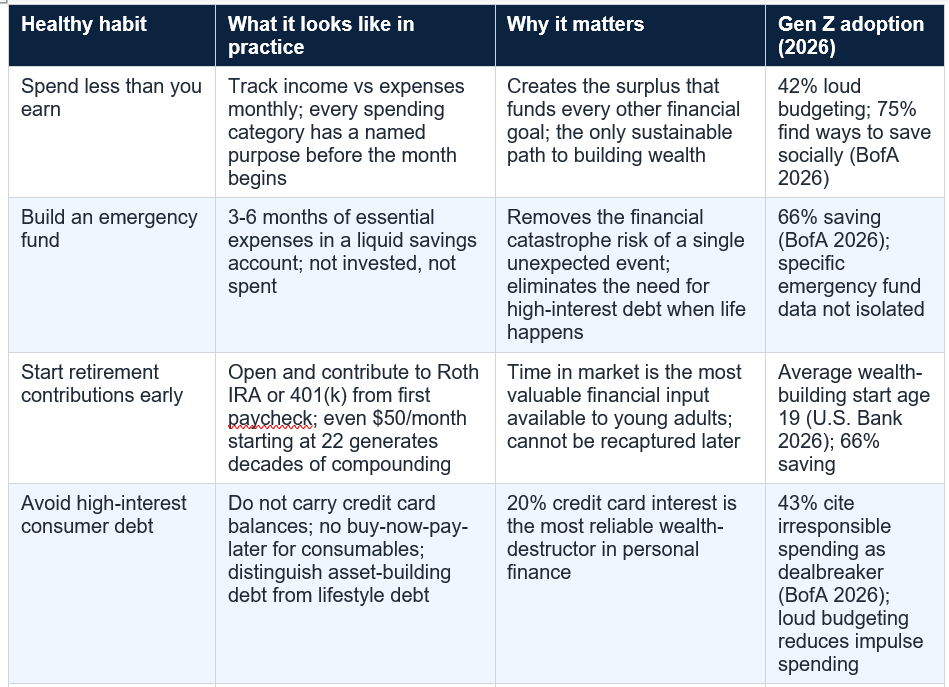
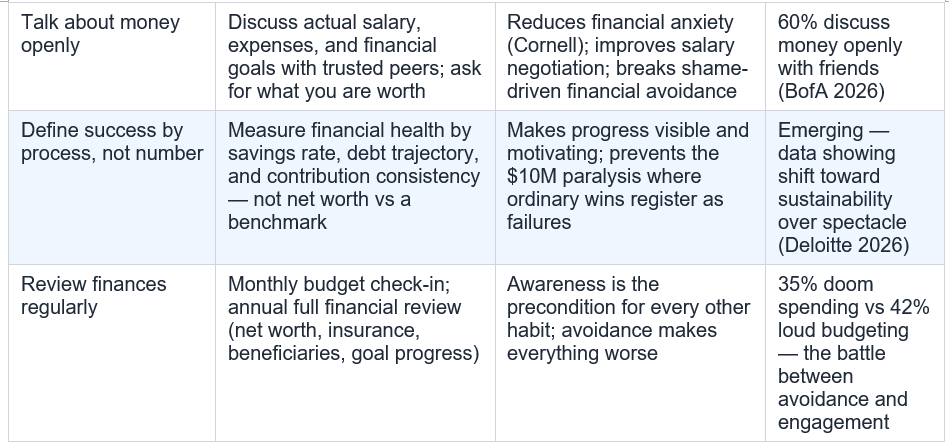
The most direct response to the $10 million benchmark problem is the one Kiplinger's Seth Miller, CFP, makes at the core of today's piece: real financial freedom comes from a healthy relationship with money, not from reaching a specific dollar figure. A healthy relationship with money is available to people at every income and wealth level. A $10 million net worth is not.What does a healthy financial relationship look like in concrete terms? The research and expert consensus converge on a framework that has nothing to do with hitting a specific number. It involves spending less than you earn and directing the difference toward building security and the future. It involves not using debt to fund a lifestyle — the distinction between debt that builds assets (a mortgage, a business loan) and debt that funds consumption (a credit card balance carried month to month). It involves an emergency fund that covers three to six months of essential expenses, which removes the anxiety of a single unexpected event derailing financial stability. It involves retirement contributions that begin early, even if they begin small. And it involves a clear, honest picture of your actual financial situation — income, expenses, assets, liabilities — rather than an avoidance that allows anxiety to fill the space that information would otherwise occupy.
Deloitte's 2026 Gen Z and Millennial Survey found something that complicates the doom narrative: despite the financial pressures that are causing 55% to delay major life decisions, many are optimistic that their financial situation will improve over the next year. Just 25% of Gen Z prefer fast-paced career progression marked by rapid promotions; most favour gradual growth and lateral moves that build long-term experience. This is not failure orientation — it is a generational recalibration toward sustainability over spectacle. That recalibration, applied to financial goals, looks like defining success as consistent progress rather than a distant, fixed number.
Healthy Habit #5 — Managing Doom Spending and Financial Anxiety
Doom spending — buying things to cope with financial stress, economic anxiety, or broader existential uncertainty — is a distinct and recognised behavioural pattern. Intuit Credit Karma's survey found that 35% of Gen Z report doom spending to cope with stress about the economy or current events. Contentworks' analysis describes it as 'retail therapy with an apocalyptic twist: the world feels like it's falling apart, so I might as well buy the concert tickets, the new sneakers, or that extra latte.' The behaviour is rational in the immediate moment — it provides a genuine, if temporary, emotional lift — and counterproductive over time, since it increases the debt or depletes the savings that would reduce the underlying anxiety.Fortune's September 2025 reporting on Gen Z financial anxiety noted that 70% are so anxious about money they cannot sleep, and that rather than turning to practical measures like budgeting or building an emergency fund, many are opting for passive comfort through screens — doom-scrolling or 'bed rotting.' Fortune's analysis quotes avoidance experts directly: 'Avoidance tactics can make you feel more in control when the world feels uncertain. But in reality, avoiding confronting your finances head-on and seeking a quick boost of dopamine instead only delays facing your anxiety.'
The healthy alternative to doom spending is not willpower — it is structure. A budget is not a punishment; it is the document that makes spending feel intentional rather than reactive. When every dollar has a designated purpose before it is spent, the decision to buy something within the plan feels like an authorised choice, not an act of financial self-sabotage. When spending happens outside the plan, the budget makes that visible immediately — which is what makes it uncomfortable, which is also what makes it useful.
A practical doom-spending management system. First: label the urge. Before any unplanned purchase, name what is driving it — boredom, anxiety, FOMO, genuine need? Naming it creates a gap between the impulse and the action. Second: a 24-hour rule for any unplanned purchase above a personally meaningful threshold (many people use $50; adjust to what is meaningful for your situation). If you still want it tomorrow, and it fits within your budget, it is no longer an impulse — it is a decision. Third: build a small, guilt-free 'fun money' category into your budget every month. The goal is not zero enjoyment spending — it is enjoyment spending that is planned rather than reactive. Not financial advice.
What Healthy Money Habits Actually Look Like: A Framework
The research on financial wellbeing consistently identifies a small number of high-impact habits that predict long-term financial health more reliably than income level, wealth level, or career trajectory. These habits are accessible to Gen Z at current income levels, do not require $10 million to begin, and build the financial foundation from which genuine security is actually constructed.
Conclusion
The Empower survey's finding — that Gen Z believes it needs $10 million in net worth to feel financially successful — is a data point about aspiration, not about what financial health actually requires. It is shaped by social media wealth visibility, genuine economic anxiety, and the reasonable conclusion of a generation that has grown up watching wealth inequality widen that the financial safety net begins at a very high number.But Kiplinger's Seth Miller, CFP, published today's most important observation about this data: 'Real financial freedom comes from a healthy relationship with money, however old you are.' A healthy relationship with money does not begin at $10 million. It begins with a savings rate higher than zero. It begins with a budget that makes spending intentional rather than reactive. It begins with the willingness to say 'I can't afford that right now' without shame — which 42% of Gen Z are already doing. It begins with talking about money honestly with people you trust — which 60% of Gen Z are already doing. It begins with the first contribution to a retirement account, however small, which earns decades of compound interest that cannot be purchased at any price later in life.
The $10 million aspiration is not the enemy of healthy financial behaviour. The enemy is letting it function as the only benchmark — the frame in which no achievable progress counts. What the data on Gen Z's actual money habits shows is a generation that is, in many important ways, building financial habits that earlier generations did not build at the same age. The anxiety is real. The structural constraints are real. And the habits — loudly declining what cannot be afforded, talking openly about money, starting early, saving more — are also real. Not financial advice. Work with a qualified financial adviser to apply these frameworks to your specific situation.
Frequently Asked Questions
Did Gen Z really say they need $10 million to be financially successful?Yes, according to Empower's 2024 personal wealth survey, which asked Americans across generations what level of net worth it would take to feel financially successful. Gen Z's answer was approximately $10 million. The same survey found Gen Z believes it takes about $587,800 per year in income to feel financially successful — approximately ten times the 2026 US median household income. Baby Boomers put the income threshold for financial success at just under $100,000 per year. The gap between generations is dramatic. Kiplinger's Seth Miller, CFP, CEPA, explored the figure in an article published today: 'Different generations have wildly different opinions about what it takes to feel successful. But real financial freedom comes from a healthy relationship with money, however old you are.' The $10 million is best understood as what Gen Z believes it would take to feel secure — a feeling shaped by social media wealth imagery, money dysmorphia, and genuine economic anxiety — rather than a literal financial target they are pursuing as a plan. Not financial advice.
What is 'loud budgeting' and is it actually a good financial habit?
Loud budgeting is the practice of openly declining social spending you cannot afford — saying clearly and without shame that you cannot or will not spend on a particular thing. Popularised in late 2023 by comedian Lukas Battle's viral TikTok, the practice had become mainstream enough by 2026 that Bank of America's Better Money Habits study (February 2026, 1,133 Gen Z adults, Ipsos) found 42% of Gen Z practice it. Personal finance experts quoted by Axios describe it as a 'no shame' approach they expect to last, citing the empowering message about setting financial boundaries and being in control. The financial benefits are concrete: loud budgeting reduces social spending pressure, makes budget adherence a positive social norm rather than a source of shame, and creates the space for honest financial conversations with peers. AOL's July 2026 analysis of BofA data found 75% of Gen Z look for ways to save when going out with friends, including suggesting free activities, ordering cheaper menu items, and hosting gatherings at home. Not financial advice.
What percentage of Gen Z are saving money in 2026?
66% of Gen Z report that they are saving in 2026, up from 60% in 2024, according to Bank of America's Better Money Habits 2026 Gen Z study conducted by Ipsos in February 2026 across more than 1,133 Gen Z adults ages 18-29. Of those saving, 36% put any leftover money into savings when possible. This represents a meaningful improvement over two years and occurs despite genuine financial pressures: 42% are living paycheck to paycheck, 49% cite the high cost of living as a top barrier to financial success, and 17% spend more than half their paycheck on housing. The family dependency trend also shows financial independence increasing: family financial assistance fell from 46% in 2024 to 34% in 2026, with the sharpest decline among older Gen Z (ages 26-29) where only 18% now receive family help, compared to 51% of those ages 18-22. Bank of America's Will Smayda told Fox Business: 'We view that as extremely positive — more saving, less reliance on family members to get by.' Not financial advice.
What is 'doom spending' and how does Gen Z manage it?
Doom spending is the practice of buying things to cope with stress, economic anxiety, or broader existential uncertainty — what Contentworks described as 'retail therapy with an apocalyptic twist.' Intuit Credit Karma's survey found that 35% of Gen Z report doom spending to cope with stress about the economy or current events. McKinsey data shows Gen Z and Millennials are more likely than older generations to engage in this behaviour despite earning and saving less on average. The behaviour provides genuine short-term emotional relief but counteracts savings goals and can worsen underlying financial anxiety. Fortune's September 2025 reporting noted that 70% of Gen Z are so anxious about money they cannot sleep, with some coping through avoidance (doom-scrolling, 'bed rotting') rather than constructive engagement. The healthy alternative is structure: a budget that makes every spending category intentional, a small guilt-free 'fun money' category that authorises some enjoyment spending, and a naming practice that creates a gap between the impulse and the action. Not financial advice.
What does a healthy financial relationship actually look like for Gen Z?
Kiplinger's Seth Miller, CFP, CEPA — writing today about the $10 million Gen Z benchmark — identifies the key reframe: 'Real financial freedom comes from a healthy relationship with money, however old you are.' The research on financial wellbeing identifies several specific habits that predict long-term financial health regardless of income level: spending less than you earn (which creates the surplus that funds everything else); building an emergency fund of three to six months of essential expenses; starting retirement contributions as early as possible even in small amounts (the U.S. Bank Wealth Survey published today found Gen Z starts wealth-building at average age 19, earlier than previous generations); avoiding high-interest consumer debt; talking about money openly with trusted peers (which Cornell research finds reduces financial anxiety over time); and defining financial success by process metrics — savings rate, debt trajectory, contribution consistency — rather than by net worth relative to a specific benchmark. The Bank of America 2026 Gen Z study found 42% already practice loud budgeting, 60% discuss finances openly with friends, and 66% are saving. These are the behaviours of a generation with a healthier relationship with money than many headlines suggest. Not financial advice.

0 Comments Comments