

Financial Literacy
Where Would You Put $5,000 Heading Into 2027?
Six days ago, the Federal Reserve raised interest rates to 3.75%-4.00% and signalled more hikes may follow. Inflation is running at 3.60%. A traditional savings account is paying 0.38%. The S&P 500 has returned approximately 27% over the last two years combined. Whether $5,000 is your emergency buffer, a tax-refund windfall, or a year of disciplined saving, where it goes next depends on one question that most financial content skips entirely: what is it for? This guide answers that question first — then maps every realistic option to the answer.
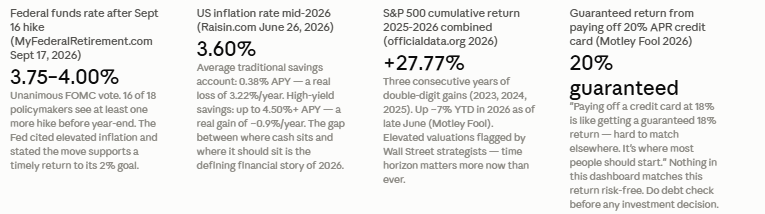
The economic context heading into the fourth quarter of 2026 adds specific nuance to every option. The Federal Reserve raised rates by 25 basis points on September 16, 2026 — six days ago — bringing the federal funds rate to 3.75%-4.00% and signalling that more increases may follow. Inflation is running at 3.60%, above the Fed's 2% target. High-yield savings accounts and short-term CDs are paying rates that have not been available since the mid-2000s, making cash a meaningfully competitive option in a way that was not true for most of the 2010s. Simultaneously, the S&P 500 has delivered approximately 27.77% cumulative returns over the combined 2025-2026 period, meaning anyone sitting entirely in cash has left significant growth on the table.
These facts do not produce a single correct answer for everyone. A 28-year-old with no emergency fund, a 55-year-old who has maxed their 401(k) and is looking for additional retirement investing, and a 40-year-old carrying high-interest credit card debt are all holding $5,000 in different contexts that call for different decisions. This guide maps each option to the specific situation where it is most appropriate — not to a generic reader.
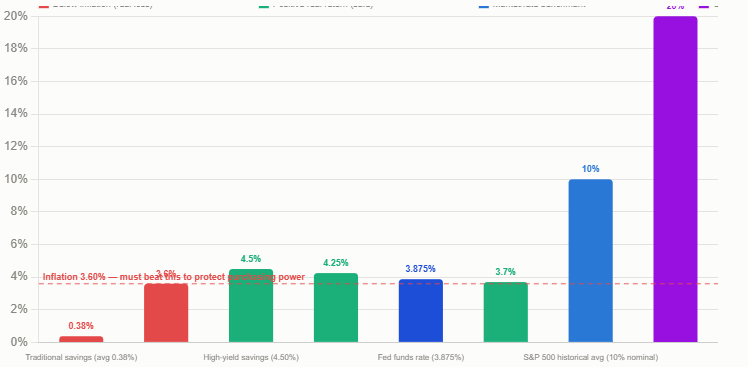
Fed funds rate as of September 16, 2026: 3.75%-4.00% (25 bps hike; unanimous FOMC vote; MyFederalRetirement.com September 17, 2026). Inflation September 2026: 3.60% (Raisin.com June 26, 2026). S&P 500 YTD 2026: approximately +7% as of late June (Motley Fool June 29, 2026). S&P 500 cumulative 2025-2026: approximately +27.77% (officialdata.org). Average traditional savings account: 0.38% APY (Raisin.com June 2026). High-yield savings: up to 4.50%+ APY. Top 1-year CDs: 4.00-4.50%+ APY. IRA contribution limit 2026: $7,500. Average credit card rate: 20-22% APR. Historical S&P 500 average annual return: approximately 7% real / 10% nominal.
The Federal Reserve's September 16 rate increase — unanimously voted and signalled as potentially not the last — means that high-yield savings accounts, money market accounts, certificates of deposit, and Treasury securities are all paying meaningfully positive real rates in a way that was not true during the near-zero rate environment of 2009-2022. A high-yield savings account paying 4.50% APY against 3.60% inflation produces a real return of approximately 0.9% — modest, but positive, and available with full FDIC insurance up to $250,000. This is not exciting, but it is genuine preservation of purchasing power.
The equities market context is more complicated. Three consecutive years of double-digit returns in the S&P 500 (2023, 2024, 2025) and continued gains in 2026 have pushed valuations to levels that multiple Wall Street strategists describe as 'elevated.' Wealth Enhancement's portfolio consulting director Ayako Yoshioka noted in late 2025 that while 7% average annual returns remain a reasonable long-term expectation, 'elevated valuations remain a concern.' This does not mean equities are wrong for long-term money — history is emphatic that time in market beats timing the market — but it does mean that investors with short time horizons are taking more valuation risk than they would be in a cheaper market.
The debt environment matters too. Credit card interest rates averaging 20-22% APR in 2026 mean that a dollar used to pay off a credit card balance generates a guaranteed, risk-free return equal to the card's interest rate — which nothing else in this guide can match. This is the context in which every $5,000 decision should be evaluated: not just what the money could earn, but what it is currently costing to not pay off existing high-interest obligations first.
The September 16, 2026 Fed rate hike has a two-sided effect on this decision. It makes safe cash-equivalent options (HYSA, CDs, T-bills) more attractive than they have been in two decades. But it also creates a short-term headwind for bond prices (when rates rise, existing bond prices fall) and adds uncertainty about whether equities, already at elevated valuations, will absorb the higher rate environment smoothly. The right response is not to avoid equities for long-term goals — the academic consensus on long-term equity returns remains robust — but to be precise about time horizon before committing long-term-investment dollars. Not financial advice.
An emergency fund in a high-yield savings account paying 4.50% APY in September 2026 is not 'uninvested.' It is performing its function — providing liquidity and security against the events (job loss, medical bill, car breakdown, appliance failure) that without a buffer would force the use of high-interest credit or the premature liquidation of investments at potentially disadvantageous times. The cost of not having an emergency fund is not the modest return foregone on the buffer itself — it is the 20% APR credit card debt incurred when the first unexpected expense exceeds the available cash.
Financial planning expert Michael Solari, CFP, quoted by MyBankTracker, frames the sequencing directly: 'Before you can start building a mountain of wealth, it is important to protect yourself from falling into a ditch.' The ditch is the absence of liquidity when life produces an unexpected cost. For someone without an emergency fund, $5,000 goes to a high-yield savings account. Full stop. Not because it earns the most — it does not — but because liquidity protection is the foundational financial requirement from which everything else follows.
Emergency fund first. Three to six months of essential expenses (housing, food, utilities, transportation, minimum debt payments) in a high-yield savings account accessible within 1-3 business days. For most Americans, essential monthly expenses run $2,500-$5,000. A $5,000 emergency fund covers one to two months for most households — a start, but worth building further. In September 2026, a HYSA paying 4.50% APY means the emergency fund is also generating meaningful interest while it waits. Not financial advice — emergency fund sizing depends on individual income stability, job market, and dependents.
Paying off a credit card charging 20% APR is not metaphorically like getting a 20% return — it is mathematically equivalent to one. Every $1,000 applied to a balance charging 20% annual interest eliminates $200 per year in interest expense, permanently, with zero risk, zero tax consequence, and guaranteed execution. No investment available in September 2026 offers a 20% risk-free annual return. The S&P 500's long-term historical nominal average is approximately 10% per year, and that average comes with significant short-term volatility and the possibility of multi-year drawdowns. A 20% guaranteed return by paying off credit card debt is one of the few unambiguous, context-independent financial recommendations.
Motley Fool's 2026 smart money guide is explicit: 'If you're carrying high-interest debt, paying it off is an investment in yourself. Let's say you have a credit card with a $15,000 balance and interest rate of 18%. Paying that balance off is like getting a guaranteed 18% return on your money — hard to match elsewhere. It's where most people should start if they're looking for places to put excess cash.'
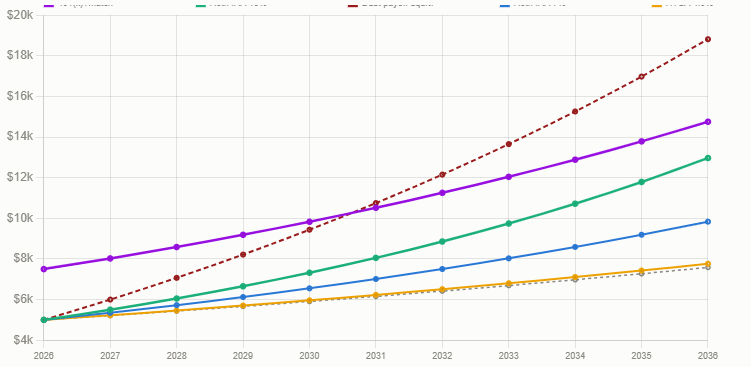
Debt vs investing: the 20% card. $5,000 applied to credit card at 20% APR with $10,000 remaining balance. Interest eliminated: $5,000 × 20% = $1,000/year immediately. That $1,000/year of eliminated interest, if invested at 7% per year for 10 more years, becomes approximately $1,967 in additional compounding value. Total 10-year benefit of paying the card first: $5,000 + $1,000 immediate interest elimination + compounding of saved interest = substantially more than investing the $5,000 directly at 7%. Contrast: $5,000 invested at 7% in the S&P 500 for 10 years = approximately $9,836. But the simultaneous $10,000 credit card balance accruing 20% interest costs $2,000/year — far exceeding the $350/year investment return in the first year. Pay the debt first. This is a simplified illustration. Not financial advice.
Online banks in September 2026 are offering HYSAs paying as much as 4.50%+ APY, against a traditional bank savings account average of 0.38% APY (Raisin.com, June 26, 2026). The Experian best savings places guide noted select accounts offering as high as 5% as of May 2026. At 4.50% APY against 3.60% inflation, the HYSA is generating a real (inflation-adjusted) return of approximately 0.9% — modest, but positive. $5,000 in a HYSA at 4.50% generates approximately $225 in interest in the first year with full FDIC insurance up to $250,000 per institution per depositor category.
The HYSA is liquid — money can typically be accessed within one to three business days with no penalty. The rate is variable, which means it will decline if and when the Fed begins cutting rates. The September 16 rate hike suggests that decline is not imminent, but rate cuts are widely expected at some point in 2027 or beyond. The HYSA is the right destination for: the final top-off of an emergency fund, money needed for a specific goal within one to three years (a down payment, a vehicle purchase, a home renovation), or cash that has not yet been allocated and needs a holding pen while a decision is made.
The best online bank CD rates in September 2026 are in the 4.00-4.50%+ range for 12-month terms. The FDIC reports that the average 1-year CD rate was 1.55% APY in May 2026, but this average is pulled down by low-paying traditional bank CDs. Online banks, credit unions, and neobanks are consistently offering 3.50-4.50%+ for short-term CDs. The average 5-year CD is lower (1.34% per FDIC as of May 2026 for the national average), reflecting the market's expectation that rates will be lower in future years — which is exactly why the CD ladder strategy makes sense.
A CD ladder divides $5,000 across CDs of different maturities to balance the rate-lock benefit with the liquidity need. A simple $5,000 ladder might divide $1,667 each into a 6-month CD, a 12-month CD, and an 18-month CD. As each matures, the principal rolls into a new longer-term CD if rates remain attractive or into a HYSA if rates have fallen. This creates a rotating structure where some money is always maturing soon (providing liquidity) while the rest is locked into higher rates.
Building a simple $5,000 CD ladder heading into 2027. Tier 1 ($1,667): 6-month CD at best available rate (target 4.00%+ at online banks). Matures in March 2027. Tier 2 ($1,667): 12-month CD at best available rate (target 4.25%+). Matures in September 2027. Tier 3 ($1,666): 18-month CD at best available rate (target 4.00%+). Matures in March 2028. As each CD matures: if rates remain elevated, roll into a new 18-month CD. If rates have fallen significantly, consider redirecting to a HYSA or toward investment accounts. Compare CD rates at Bankrate.com, NerdWallet.com, or directly at online banks (Ally, Marcus, Discover, Synchrony, Bread Financial). Not financial advice — specific rates change daily.
Inside a Roth IRA, contributions are made with after-tax dollars — no upfront tax deduction — but all growth and all qualified withdrawals are completely tax-free. A $5,000 contribution at age 30 that grows at 7% average annual return for 35 years becomes approximately $53,000 at age 65. In a Roth IRA, every dollar of that $53,000 is withdrawn tax-free. In a taxable brokerage account, the same investment would be subject to long-term capital gains tax on the $48,000 of gain. At the current 15% long-term capital gains rate, that is $7,200 in additional tax owed — just on this one $5,000 contribution.
The investment choice inside the Roth IRA matters, and for most investors, a low-cost S&P 500 index fund or a total stock market index fund is the most defensible choice. The 10% nominal historical annual average return of the S&P 500 over long periods is not guaranteed to repeat, but the case for owning the broad US equity market in a tax-advantaged wrapper is well supported by decades of data. An S&P 500 index fund in a Roth IRA is the combination of tax-free compounding and diversified equity exposure — two of the most powerful wealth-building tools available to individual investors — operating simultaneously.
Roth IRA vs taxable: the tax difference on $5,000. $5,000 invested at 7% annual average return. Age at investment: 30. Age at withdrawal: 65. Years of compounding: 35. Final balance: $5,000 × (1.07)^35 = approximately $53,200. ROTH IRA: total gain ($48,200) is tax-free at withdrawal. Tax owed: $0. TAXABLE ACCOUNT: $48,200 gain subject to long-term capital gains tax. At 15% LTCG rate: $7,230 in tax. After-tax value: $53,200 − $7,230 = $45,970. THE ROTH ADVANTAGE: approximately $7,230 more from the same $5,000 investment, purely from the tax structure. At 20% LTCG rate (for higher earners): $9,640 advantage. This example assumes no interim distributions and simplified tax treatment. Not tax advice — actual outcomes depend on tax rates at time of withdrawal, which are unknown.
The taxable brokerage account has no contribution limits, no income restrictions, and no withdrawal restrictions. Money can be added and withdrawn at any time. Gains are taxed differently based on how long the position is held: securities held more than one year qualify for long-term capital gains treatment (0%, 15%, or 20% depending on income), while those held one year or less are taxed at ordinary income rates. The tax efficiency of low-turnover index funds makes them well-suited to taxable accounts: an S&P 500 index fund like those from Vanguard, Fidelity, or Schwab generates minimal taxable distributions compared to actively managed funds, allowing most of the compound growth to accumulate without annual tax drag.
The investment choice in a taxable account should be even more tax-conscious than in a retirement account. Municipal bond funds, which generate federally tax-exempt interest, become more attractive in taxable accounts for higher-income investors. Tax-loss harvesting — selling positions at a loss to offset capital gains elsewhere — is available in taxable accounts in a way that is not available in retirement accounts. And broad index funds from major providers now charge expense ratios below 0.05%, meaning the investment cost itself is nearly negligible.
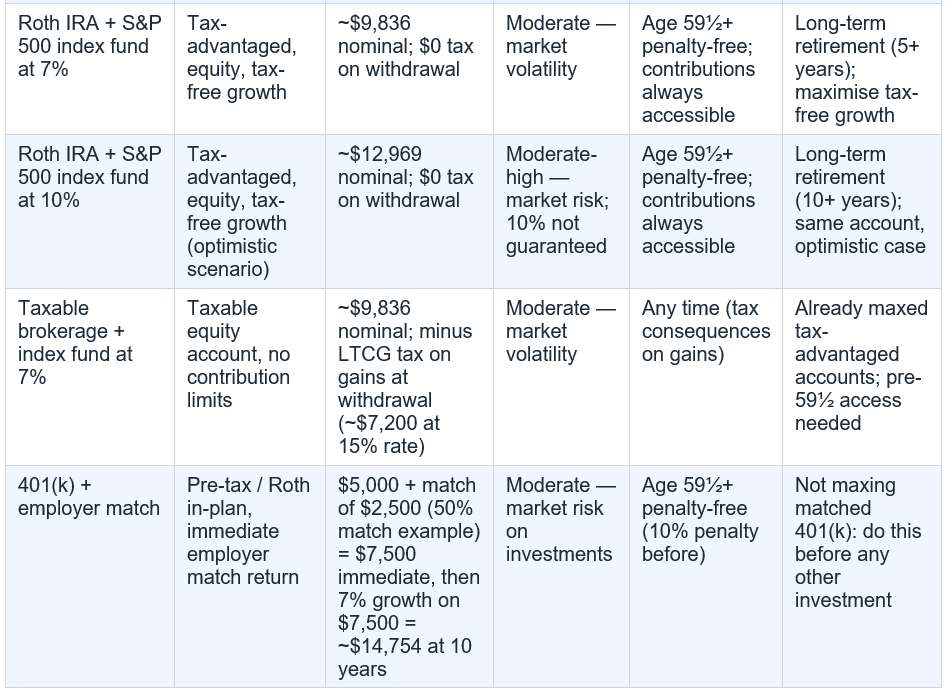
Employer matching on a 401(k) is the only genuinely guaranteed immediate 100% return available in investing. A 50% match on contributions up to 6% of salary, on a $70,000 salary, means the first $4,200 in annual contributions generates $2,100 in employer matching — a 50% immediate return before the money is invested at all. If $5,000 in available cash enables you to contribute an additional $5,000 to a matched 401(k) between now and year-end, the after-match value of that contribution could be $7,500 or more in the account immediately.
The Health Savings Account (HSA) is another tax-advantaged destination worth considering if you have an HSA-eligible high-deductible health plan. HSA contributions in 2026 are deductible from income (or pre-tax through payroll), grow tax-free, and are withdrawn tax-free for qualified medical expenses. The HSA triple tax benefit — deductible contribution, tax-free growth, tax-free withdrawal for medical costs — makes it one of the most tax-efficient accounts available. The 2026 HSA contribution limits are $4,400 for self-only coverage and $8,750 for family coverage. A $5,000 contribution covers the full self-only limit with $600 remaining.
The 2026 Roth IRA income limits mean that some higher earners cannot contribute directly. Single filers with MAGI above $168,000 and married filers above $252,000 are ineligible for direct Roth IRA contributions in 2026. However, the backdoor Roth IRA conversion strategy — making a non-deductible traditional IRA contribution and then converting it to Roth — remains available to most taxpayers regardless of income. This strategy has nuances (the pro-rata rule can affect its effectiveness for those with existing pre-tax IRA balances) and should be discussed with a CPA before implementing. Not tax advice.
I Bonds carry important constraints that limit their use as an investment vehicle. The annual purchase limit is $10,000 per Social Security number ($5,000 additional via tax refund). They cannot be redeemed in the first year of ownership — money is completely illiquid for 12 months. Early redemption between 12 months and 5 years forfeits the most recent three months of interest. After 5 years, I Bonds are fully redeemable with no penalty. Interest is subject to federal income tax but exempt from state and local tax, and tax can be deferred until redemption.
For a $5,000 allocation, I Bonds represent a compelling inflation hedge for money with a medium-term horizon — specifically, money that can be locked away for at least 12 months but potentially for 5 or more years. The current I Bond composite rate (the combination of fixed and inflation components) depends on when the bond is purchased — rates reset on May 1 and November 1. With inflation at 3.60%, the I Bond rate for new purchases in late September 2026 will reflect the most recent inflation data. I Bonds are purchased directly at TreasuryDirect.gov; there are no brokerage fees or intermediary costs.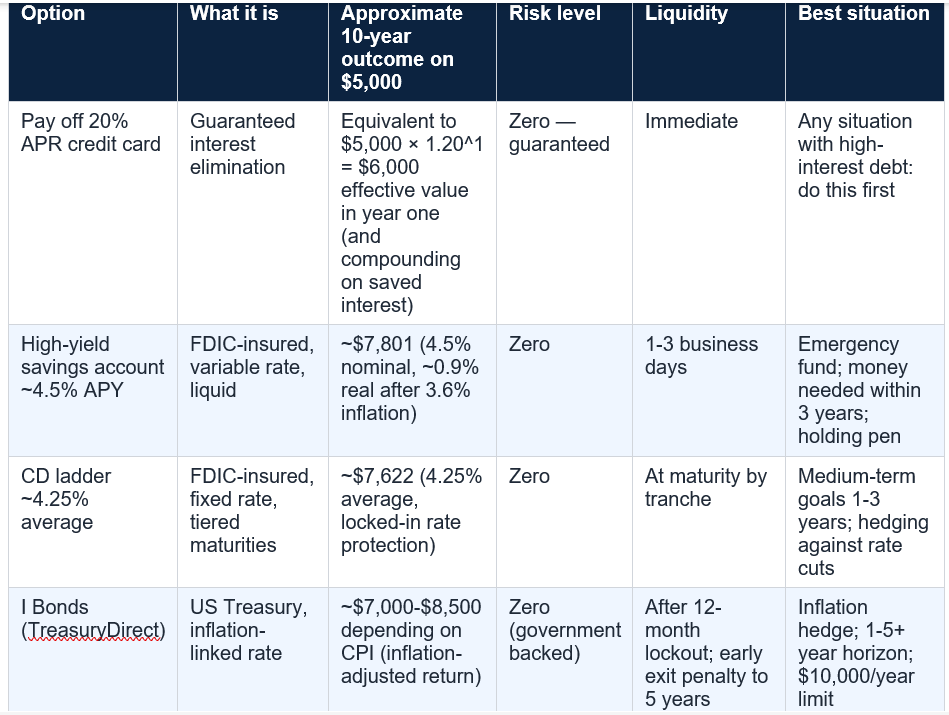
None of these are universally correct. All of them are correct in the right context. The first decision is not which account — it is what the $5,000 is for, what it would cost you to need it back in a year, and what obligations you are currently paying interest on that render every investment return comparatively marginal. A $5,000 Roth IRA contribution is one of the most powerful financial moves available to an eligible earner with no high-interest debt, a complete emergency fund, and a ten-year time horizon. The same $5,000 in a Roth IRA while a credit card balance accrues 20% annually is a mathematically suboptimal sequence.
Get the sequence right. Clear the prerequisite steps. Then put the money in the highest-return vehicle that matches the correct time horizon and risk tolerance. In September 2026, that vehicle is almost certainly either a high-yield savings account for near-term money, or a Roth IRA plus index fund for long-term money — with debt payoff and employer matching as the non-negotiable first stops if either condition applies. Not financial advice — consult a qualified financial adviser for guidance specific to your situation.
It depends entirely on your time horizon and whether you have high-interest debt. For money you might need within one to three years, a high-yield savings account paying 4.50%+ APY in September 2026 is the more appropriate choice — it is FDIC-insured, liquid, and currently generating a positive real return above the 3.60% inflation rate. For money you will not need for five or more years, a diversified equity index fund — particularly in a tax-advantaged Roth IRA — has historically delivered superior returns over long periods. The S&P 500's long-term historical average is approximately 7% real and 10% nominal annually. But that average comes with significant short-term volatility and the possibility of multi-year drawdowns. The key question: if the stock market fell 30% in 2027, would you need to sell? If yes, the HYSA is the right call. If no, the index fund wins over a 10+ year horizon. Never invest money in equities that you might need to access within two to three years. Not financial advice.
Should I pay off debt or invest $5,000 in 2026?
The mathematically correct answer depends on the interest rate on your debt compared to the after-tax return you can reliably earn on the investment. For high-interest consumer debt (credit cards at 20%+ APR, personal loans at 15%+), paying off the debt is almost always superior — it is a guaranteed, risk-free return equal to the interest rate eliminated. Motley Fool's 2026 guide states: 'Paying off a credit card at 18% is like getting a guaranteed 18% return on your money — hard to match elsewhere.' For lower-interest debt (mortgages at 6-7%, student loans at 4-5%), the comparison is less clear and depends on whether the investment can reliably exceed the after-tax cost of the debt. A mortgage at 6.5% that generates a tax deduction has an effective after-tax cost below 6%, which a diversified equity portfolio has historically exceeded over long periods — though with risk. For any debt above 8-10% APR, pay it off before investing. Not financial advice.
What is a CD ladder and should I use one for $5,000 heading into 2027?
A CD ladder divides a lump sum across certificates of deposit with different maturity dates, creating a rotating structure where some money is always maturing soon (providing liquidity) while the rest is locked into fixed rates. For $5,000 heading into 2027, a simple ladder might divide the money into a 6-month CD, a 12-month CD, and an 18-month CD at roughly equal portions. As each matures, the holder can decide whether to roll into a new CD (if rates remain attractive) or redirect the funds. The primary advantage heading into 2027 is rate-lock: if the Fed eventually begins cutting rates (which most economists expect at some point in 2027 or 2028), CD holders who locked in 2026 rates continue earning those rates for the full term, while high-yield savings account rates decline. The primary limitation is reduced liquidity: early withdrawal from a CD typically incurs a penalty (often 3-6 months of interest). A CD ladder is appropriate for money with a defined 1-3 year need that does not require immediate access. Not financial advice.
How does a Roth IRA contribution of $5,000 work in 2026?
A Roth IRA is a tax-advantaged individual retirement account that accepts after-tax contributions and provides tax-free growth and withdrawals. The 2026 IRA contribution limit is $7,500 per person ($8,600 for those aged 50 or over, including the $1,100 catch-up). Contributions must come from earned income and cannot exceed your earned income for the year. Eligibility phases out between $153,000-$168,000 MAGI for single filers and $242,000-$252,000 for married filing jointly in 2026. A $5,000 contribution is within the annual limit. Inside the Roth IRA, the money can be invested in any available security — most investors in a Roth IRA for retirement choose a low-cost, diversified index fund tracking the S&P 500 or the total stock market. Roth IRA contributions (not gains) can be withdrawn at any time without penalty or tax, making the account more flexible than a traditional IRA. Earnings can be withdrawn penalty-free and tax-free after age 59½ and after the account has been open at least 5 years. The deadline for 2026 Roth IRA contributions is the 2026 tax filing deadline (typically April 15, 2027). Not financial advice.
What is the best way to invest $5,000 if I already have an emergency fund and no debt?
With the emergency fund complete and no high-interest debt, the optimal sequence for $5,000 in September 2026 is: first, capture any uncaptured employer 401(k) match (this is an immediate guaranteed return that nothing else matches); second, contribute to a Roth IRA if eligible (2026 limit $7,500; income phase-out $153,000-$168,000 single/$242,000-$252,000 MFJ) and invest in a low-cost broad index fund; third, contribute to an HSA if you have an HSA-eligible health plan (triple tax advantage); fourth, if all tax-advantaged options are maxed, open a taxable brokerage account and invest in low-cost, tax-efficient index funds. For $5,000 with a 10+ year horizon, the Roth IRA with a low-cost S&P 500 index fund is the most tax-efficient destination for most eligible investors. At a 7% average annual return over 35 years, $5,000 grows to approximately $53,200 — all tax-free in a Roth IRA. At the same return in a taxable account, the gain would be subject to capital gains tax at withdrawal. The tax difference alone on a single $5,000 contribution can be worth thousands of dollars. Not financial advice — consult a qualified financial adviser and CPA.
Table of Contents
- The Question to Answer Before the Money Question
- The Economic Backdrop Heading Into 2027
- Step One: Do You Have an Emergency Fund? (The Answer Changes Everything)
- Step Two: Do You Have High-Interest Debt? (The Guaranteed 20% Return)
- Option A — High-Yield Savings Account: Liquid, Safe, and Beating Inflation
- Option B — CD Ladder: Locking In Today's Rates Before They Fall
- Option C — Roth IRA With an Index Fund: The Long Game at Its Best
- Option D — Taxable Brokerage Account With Index Funds: No Limit, No Lock-In
- Option E — Max Out a Tax-Advantaged Account: The 401(k) and HSA Case
- Option F — I Bonds: Inflation Protection From the US Treasury
- What $5,000 Grows Into: A 10-Year Projection Across All Options
- Which Option Is Right for You: A Decision Framework
- Conclusion: The First Decision Is Not Which Account — It's What It's For
- Frequently Asked Questions
The rate environment: why September 2026 changes the math
$5,000 over 10 years: every option projected and compared
The decision framework: which option for which situation
The Question to Answer Before the Money Question
Most investment guides begin with the options. This one begins with the question that determines which options are relevant: what is this $5,000 for? The answer changes everything. $5,000 earmarked for an emergency fund belongs somewhere entirely different from $5,000 that represents savings above and beyond three months of expenses. $5,000 you might need in six months has a different optimal destination than $5,000 you would not touch for ten years. And $5,000 sitting in a savings account while you are carrying $8,000 in credit card debt at 20% APR is not an investment decision yet — it is a debt-management decision with an obvious answer that most investment content carefully avoids stating.The economic context heading into the fourth quarter of 2026 adds specific nuance to every option. The Federal Reserve raised rates by 25 basis points on September 16, 2026 — six days ago — bringing the federal funds rate to 3.75%-4.00% and signalling that more increases may follow. Inflation is running at 3.60%, above the Fed's 2% target. High-yield savings accounts and short-term CDs are paying rates that have not been available since the mid-2000s, making cash a meaningfully competitive option in a way that was not true for most of the 2010s. Simultaneously, the S&P 500 has delivered approximately 27.77% cumulative returns over the combined 2025-2026 period, meaning anyone sitting entirely in cash has left significant growth on the table.
These facts do not produce a single correct answer for everyone. A 28-year-old with no emergency fund, a 55-year-old who has maxed their 401(k) and is looking for additional retirement investing, and a 40-year-old carrying high-interest credit card debt are all holding $5,000 in different contexts that call for different decisions. This guide maps each option to the specific situation where it is most appropriate — not to a generic reader.
Fed funds rate as of September 16, 2026: 3.75%-4.00% (25 bps hike; unanimous FOMC vote; MyFederalRetirement.com September 17, 2026). Inflation September 2026: 3.60% (Raisin.com June 26, 2026). S&P 500 YTD 2026: approximately +7% as of late June (Motley Fool June 29, 2026). S&P 500 cumulative 2025-2026: approximately +27.77% (officialdata.org). Average traditional savings account: 0.38% APY (Raisin.com June 2026). High-yield savings: up to 4.50%+ APY. Top 1-year CDs: 4.00-4.50%+ APY. IRA contribution limit 2026: $7,500. Average credit card rate: 20-22% APR. Historical S&P 500 average annual return: approximately 7% real / 10% nominal.
The Economic Backdrop Heading Into 2027
Understanding where to put money requires understanding what kind of financial environment you are putting it into. September 2026 offers a specific set of conditions that make some options better than they were two years ago and some worse.The Federal Reserve's September 16 rate increase — unanimously voted and signalled as potentially not the last — means that high-yield savings accounts, money market accounts, certificates of deposit, and Treasury securities are all paying meaningfully positive real rates in a way that was not true during the near-zero rate environment of 2009-2022. A high-yield savings account paying 4.50% APY against 3.60% inflation produces a real return of approximately 0.9% — modest, but positive, and available with full FDIC insurance up to $250,000. This is not exciting, but it is genuine preservation of purchasing power.
The equities market context is more complicated. Three consecutive years of double-digit returns in the S&P 500 (2023, 2024, 2025) and continued gains in 2026 have pushed valuations to levels that multiple Wall Street strategists describe as 'elevated.' Wealth Enhancement's portfolio consulting director Ayako Yoshioka noted in late 2025 that while 7% average annual returns remain a reasonable long-term expectation, 'elevated valuations remain a concern.' This does not mean equities are wrong for long-term money — history is emphatic that time in market beats timing the market — but it does mean that investors with short time horizons are taking more valuation risk than they would be in a cheaper market.
The debt environment matters too. Credit card interest rates averaging 20-22% APR in 2026 mean that a dollar used to pay off a credit card balance generates a guaranteed, risk-free return equal to the card's interest rate — which nothing else in this guide can match. This is the context in which every $5,000 decision should be evaluated: not just what the money could earn, but what it is currently costing to not pay off existing high-interest obligations first.
The September 16, 2026 Fed rate hike has a two-sided effect on this decision. It makes safe cash-equivalent options (HYSA, CDs, T-bills) more attractive than they have been in two decades. But it also creates a short-term headwind for bond prices (when rates rise, existing bond prices fall) and adds uncertainty about whether equities, already at elevated valuations, will absorb the higher rate environment smoothly. The right response is not to avoid equities for long-term goals — the academic consensus on long-term equity returns remains robust — but to be precise about time horizon before committing long-term-investment dollars. Not financial advice.
Step One: Do You Have an Emergency Fund? (The Answer Changes Everything)
Before any $5,000 gets directed to an investment, a critical prerequisite check: do you have three to six months of essential expenses in liquid, accessible savings? If the answer is no, or if $5,000 represents part of that incomplete buffer, the question of where to invest it is premature. The first job of this money is not to grow — it is to protect.An emergency fund in a high-yield savings account paying 4.50% APY in September 2026 is not 'uninvested.' It is performing its function — providing liquidity and security against the events (job loss, medical bill, car breakdown, appliance failure) that without a buffer would force the use of high-interest credit or the premature liquidation of investments at potentially disadvantageous times. The cost of not having an emergency fund is not the modest return foregone on the buffer itself — it is the 20% APR credit card debt incurred when the first unexpected expense exceeds the available cash.
Financial planning expert Michael Solari, CFP, quoted by MyBankTracker, frames the sequencing directly: 'Before you can start building a mountain of wealth, it is important to protect yourself from falling into a ditch.' The ditch is the absence of liquidity when life produces an unexpected cost. For someone without an emergency fund, $5,000 goes to a high-yield savings account. Full stop. Not because it earns the most — it does not — but because liquidity protection is the foundational financial requirement from which everything else follows.
Emergency fund first. Three to six months of essential expenses (housing, food, utilities, transportation, minimum debt payments) in a high-yield savings account accessible within 1-3 business days. For most Americans, essential monthly expenses run $2,500-$5,000. A $5,000 emergency fund covers one to two months for most households — a start, but worth building further. In September 2026, a HYSA paying 4.50% APY means the emergency fund is also generating meaningful interest while it waits. Not financial advice — emergency fund sizing depends on individual income stability, job market, and dependents.
Step Two: Do You Have High-Interest Debt? (The Guaranteed 20% Return)
If the emergency fund box is checked, the next question before any investment discussion is: are you carrying high-interest consumer debt? Specifically, credit card balances, personal loans above 7-8%, and buy-now-pay-later balances charging double-digit rates.Paying off a credit card charging 20% APR is not metaphorically like getting a 20% return — it is mathematically equivalent to one. Every $1,000 applied to a balance charging 20% annual interest eliminates $200 per year in interest expense, permanently, with zero risk, zero tax consequence, and guaranteed execution. No investment available in September 2026 offers a 20% risk-free annual return. The S&P 500's long-term historical nominal average is approximately 10% per year, and that average comes with significant short-term volatility and the possibility of multi-year drawdowns. A 20% guaranteed return by paying off credit card debt is one of the few unambiguous, context-independent financial recommendations.
Motley Fool's 2026 smart money guide is explicit: 'If you're carrying high-interest debt, paying it off is an investment in yourself. Let's say you have a credit card with a $15,000 balance and interest rate of 18%. Paying that balance off is like getting a guaranteed 18% return on your money — hard to match elsewhere. It's where most people should start if they're looking for places to put excess cash.'
Debt vs investing: the 20% card. $5,000 applied to credit card at 20% APR with $10,000 remaining balance. Interest eliminated: $5,000 × 20% = $1,000/year immediately. That $1,000/year of eliminated interest, if invested at 7% per year for 10 more years, becomes approximately $1,967 in additional compounding value. Total 10-year benefit of paying the card first: $5,000 + $1,000 immediate interest elimination + compounding of saved interest = substantially more than investing the $5,000 directly at 7%. Contrast: $5,000 invested at 7% in the S&P 500 for 10 years = approximately $9,836. But the simultaneous $10,000 credit card balance accruing 20% interest costs $2,000/year — far exceeding the $350/year investment return in the first year. Pay the debt first. This is a simplified illustration. Not financial advice.
Option A — High-Yield Savings Account: Liquid, Safe, and Beating Inflation
With the emergency fund and high-interest debt checks complete, the investment options begin. For money that has a near-term purpose — needed within one to three years — or for money that must remain accessible without penalty, the high-yield savings account (HYSA) is the most rational destination in September 2026.Online banks in September 2026 are offering HYSAs paying as much as 4.50%+ APY, against a traditional bank savings account average of 0.38% APY (Raisin.com, June 26, 2026). The Experian best savings places guide noted select accounts offering as high as 5% as of May 2026. At 4.50% APY against 3.60% inflation, the HYSA is generating a real (inflation-adjusted) return of approximately 0.9% — modest, but positive. $5,000 in a HYSA at 4.50% generates approximately $225 in interest in the first year with full FDIC insurance up to $250,000 per institution per depositor category.
The HYSA is liquid — money can typically be accessed within one to three business days with no penalty. The rate is variable, which means it will decline if and when the Fed begins cutting rates. The September 16 rate hike suggests that decline is not imminent, but rate cuts are widely expected at some point in 2027 or beyond. The HYSA is the right destination for: the final top-off of an emergency fund, money needed for a specific goal within one to three years (a down payment, a vehicle purchase, a home renovation), or cash that has not yet been allocated and needs a holding pen while a decision is made.
Option B — CD Ladder: Locking In Today's Rates Before They Fall
Certificates of deposit differ from high-yield savings accounts in one critical way: the rate is fixed for the term. When you open a 12-month CD paying 4.25% APY, you receive that rate for the full twelve months regardless of what the Fed does after. When rates eventually fall — as they inevitably do — the CD holder who locked in today's rate benefits while the HYSA holder sees their rate decline.The best online bank CD rates in September 2026 are in the 4.00-4.50%+ range for 12-month terms. The FDIC reports that the average 1-year CD rate was 1.55% APY in May 2026, but this average is pulled down by low-paying traditional bank CDs. Online banks, credit unions, and neobanks are consistently offering 3.50-4.50%+ for short-term CDs. The average 5-year CD is lower (1.34% per FDIC as of May 2026 for the national average), reflecting the market's expectation that rates will be lower in future years — which is exactly why the CD ladder strategy makes sense.
A CD ladder divides $5,000 across CDs of different maturities to balance the rate-lock benefit with the liquidity need. A simple $5,000 ladder might divide $1,667 each into a 6-month CD, a 12-month CD, and an 18-month CD. As each matures, the principal rolls into a new longer-term CD if rates remain attractive or into a HYSA if rates have fallen. This creates a rotating structure where some money is always maturing soon (providing liquidity) while the rest is locked into higher rates.
Building a simple $5,000 CD ladder heading into 2027. Tier 1 ($1,667): 6-month CD at best available rate (target 4.00%+ at online banks). Matures in March 2027. Tier 2 ($1,667): 12-month CD at best available rate (target 4.25%+). Matures in September 2027. Tier 3 ($1,666): 18-month CD at best available rate (target 4.00%+). Matures in March 2028. As each CD matures: if rates remain elevated, roll into a new 18-month CD. If rates have fallen significantly, consider redirecting to a HYSA or toward investment accounts. Compare CD rates at Bankrate.com, NerdWallet.com, or directly at online banks (Ally, Marcus, Discover, Synchrony, Bread Financial). Not financial advice — specific rates change daily.
Option C — Roth IRA With an Index Fund: The Long Game at Its Best
For money that will not be needed for at least five to ten years, contributing $5,000 to a Roth IRA is, for most eligible earners, one of the best uses of the funds available in 2026. The 2026 IRA contribution limit is $7,500 ($8,600 for those aged 50 and over), meaning $5,000 is well within the annual limit. The Roth IRA contribution must come from earned income and is subject to income phase-out: for single filers, contributions begin phasing out at $153,000 in MAGI and are eliminated at $168,000; for married filing jointly, the phase-out runs from $242,000 to $252,000 (AdamsBrownCPA 2026 tax update).Inside a Roth IRA, contributions are made with after-tax dollars — no upfront tax deduction — but all growth and all qualified withdrawals are completely tax-free. A $5,000 contribution at age 30 that grows at 7% average annual return for 35 years becomes approximately $53,000 at age 65. In a Roth IRA, every dollar of that $53,000 is withdrawn tax-free. In a taxable brokerage account, the same investment would be subject to long-term capital gains tax on the $48,000 of gain. At the current 15% long-term capital gains rate, that is $7,200 in additional tax owed — just on this one $5,000 contribution.
The investment choice inside the Roth IRA matters, and for most investors, a low-cost S&P 500 index fund or a total stock market index fund is the most defensible choice. The 10% nominal historical annual average return of the S&P 500 over long periods is not guaranteed to repeat, but the case for owning the broad US equity market in a tax-advantaged wrapper is well supported by decades of data. An S&P 500 index fund in a Roth IRA is the combination of tax-free compounding and diversified equity exposure — two of the most powerful wealth-building tools available to individual investors — operating simultaneously.
Roth IRA vs taxable: the tax difference on $5,000. $5,000 invested at 7% annual average return. Age at investment: 30. Age at withdrawal: 65. Years of compounding: 35. Final balance: $5,000 × (1.07)^35 = approximately $53,200. ROTH IRA: total gain ($48,200) is tax-free at withdrawal. Tax owed: $0. TAXABLE ACCOUNT: $48,200 gain subject to long-term capital gains tax. At 15% LTCG rate: $7,230 in tax. After-tax value: $53,200 − $7,230 = $45,970. THE ROTH ADVANTAGE: approximately $7,230 more from the same $5,000 investment, purely from the tax structure. At 20% LTCG rate (for higher earners): $9,640 advantage. This example assumes no interim distributions and simplified tax treatment. Not tax advice — actual outcomes depend on tax rates at time of withdrawal, which are unknown.
Option D — Taxable Brokerage Account With Index Funds: No Limit, No Lock-In
For those who have already maxed their tax-advantaged accounts, who do not qualify for a Roth IRA due to income limits, or who have long-term investment goals that require access before age 59½ (when penalty-free retirement account withdrawals become available), a taxable brokerage account with a low-cost index fund is the next logical destination for long-term $5,000.The taxable brokerage account has no contribution limits, no income restrictions, and no withdrawal restrictions. Money can be added and withdrawn at any time. Gains are taxed differently based on how long the position is held: securities held more than one year qualify for long-term capital gains treatment (0%, 15%, or 20% depending on income), while those held one year or less are taxed at ordinary income rates. The tax efficiency of low-turnover index funds makes them well-suited to taxable accounts: an S&P 500 index fund like those from Vanguard, Fidelity, or Schwab generates minimal taxable distributions compared to actively managed funds, allowing most of the compound growth to accumulate without annual tax drag.
The investment choice in a taxable account should be even more tax-conscious than in a retirement account. Municipal bond funds, which generate federally tax-exempt interest, become more attractive in taxable accounts for higher-income investors. Tax-loss harvesting — selling positions at a loss to offset capital gains elsewhere — is available in taxable accounts in a way that is not available in retirement accounts. And broad index funds from major providers now charge expense ratios below 0.05%, meaning the investment cost itself is nearly negligible.
Option E — Max Out a Tax-Advantaged Account: The 401(k) and HSA Case
If you have not yet maxed your 401(k) for 2026 — and $5,000 represents the difference between your current contributions and the $24,500 annual limit — increasing your 401(k) contribution rate now and using the $5,000 as a bridge for living expenses while the higher paycheck deduction takes effect is a powerful move, particularly if your employer offers any matching.Employer matching on a 401(k) is the only genuinely guaranteed immediate 100% return available in investing. A 50% match on contributions up to 6% of salary, on a $70,000 salary, means the first $4,200 in annual contributions generates $2,100 in employer matching — a 50% immediate return before the money is invested at all. If $5,000 in available cash enables you to contribute an additional $5,000 to a matched 401(k) between now and year-end, the after-match value of that contribution could be $7,500 or more in the account immediately.
The Health Savings Account (HSA) is another tax-advantaged destination worth considering if you have an HSA-eligible high-deductible health plan. HSA contributions in 2026 are deductible from income (or pre-tax through payroll), grow tax-free, and are withdrawn tax-free for qualified medical expenses. The HSA triple tax benefit — deductible contribution, tax-free growth, tax-free withdrawal for medical costs — makes it one of the most tax-efficient accounts available. The 2026 HSA contribution limits are $4,400 for self-only coverage and $8,750 for family coverage. A $5,000 contribution covers the full self-only limit with $600 remaining.
The 2026 Roth IRA income limits mean that some higher earners cannot contribute directly. Single filers with MAGI above $168,000 and married filers above $252,000 are ineligible for direct Roth IRA contributions in 2026. However, the backdoor Roth IRA conversion strategy — making a non-deductible traditional IRA contribution and then converting it to Roth — remains available to most taxpayers regardless of income. This strategy has nuances (the pro-rata rule can affect its effectiveness for those with existing pre-tax IRA balances) and should be discussed with a CPA before implementing. Not tax advice.
Option F — I Bonds: Inflation Protection From the US Treasury
Series I US Savings Bonds (I Bonds) are a unique Treasury instrument that combines a fixed rate component with an inflation adjustment component, resetting every six months based on CPI. The inflation-linked rate makes I Bonds particularly relevant in periods of elevated inflation — which September 2026, with inflation at 3.60%, qualifies as.I Bonds carry important constraints that limit their use as an investment vehicle. The annual purchase limit is $10,000 per Social Security number ($5,000 additional via tax refund). They cannot be redeemed in the first year of ownership — money is completely illiquid for 12 months. Early redemption between 12 months and 5 years forfeits the most recent three months of interest. After 5 years, I Bonds are fully redeemable with no penalty. Interest is subject to federal income tax but exempt from state and local tax, and tax can be deferred until redemption.
For a $5,000 allocation, I Bonds represent a compelling inflation hedge for money with a medium-term horizon — specifically, money that can be locked away for at least 12 months but potentially for 5 or more years. The current I Bond composite rate (the combination of fixed and inflation components) depends on when the bond is purchased — rates reset on May 1 and November 1. With inflation at 3.60%, the I Bond rate for new purchases in late September 2026 will reflect the most recent inflation data. I Bonds are purchased directly at TreasuryDirect.gov; there are no brokerage fees or intermediary costs.
What $5,000 Grows Into: A 10-Year Projection Across All Options
Which Option Is Right for You: A Decision Framework
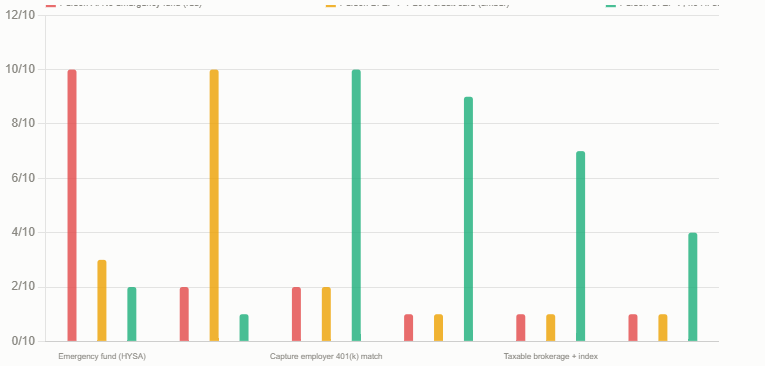
Rather than recommending a single answer for every reader, the following decision sequence maps the right option to the right situation. Move through the steps in order — do not skip ahead to investment options until the prerequisites are addressed.- Step 1 — Emergency fund check: Do you have three to six months of essential expenses in liquid savings? If no, or if this $5,000 brings you to that threshold: HYSA. Full stop.
- Step 2 — High-interest debt check: Do you carry any debt at 8% APR or higher? If yes, and the interest rate exceeds what you could reasonably earn after tax: pay the debt first. A 20% APR credit card is a 20% guaranteed return on every dollar applied.
- Step 3 — Employer 401(k) match: Does your employer offer a 401(k) match that you are not fully capturing? If yes: the matched amount should be captured before any other investment. Employer matching is a guaranteed immediate return that no market instrument can replicate.
- Step 4 — Roth IRA eligibility: Are you eligible to contribute to a Roth IRA (income under $168,000 single / $252,000 MFJ in 2026), and is this money you will not need for at least five years? If yes: contribute to a Roth IRA and invest in a low-cost broad index fund.
- Step 5 — HSA eligibility: Do you have an HSA-eligible high-deductible health plan and an unused HSA contribution capacity for 2026? If yes: HSA contributions offer triple tax benefits that are extremely difficult to match elsewhere.
- Step 6 — Short-to-medium term money (1-3 years): HYSA or CD ladder. Lock in current rates with a CD if the timeframe is 12+ months and you can tolerate the reduced liquidity.
- Step 7 — Long-term money, already maxed tax-advantaged accounts: taxable brokerage account with low-cost index funds. No contribution limits, no income restrictions, full liquidity at the cost of annual tax on dividends and capital gains tax on eventual sale.
Conclusion
On September 16, 2026, six days ago, the Federal Reserve raised the federal funds rate to 3.75%-4.00% and signalled that more increases may follow. Inflation is running at 3.60%. High-yield savings accounts are paying 4.50%+ APY. The S&P 500 has returned approximately 27% over the last two years combined. I Bonds protect against further inflation erosion. A Roth IRA with an S&P 500 index fund combines tax-free compounding with a century-long track record of equity returns. And paying off a 20% APR credit card generates a guaranteed return that none of the above can match.None of these are universally correct. All of them are correct in the right context. The first decision is not which account — it is what the $5,000 is for, what it would cost you to need it back in a year, and what obligations you are currently paying interest on that render every investment return comparatively marginal. A $5,000 Roth IRA contribution is one of the most powerful financial moves available to an eligible earner with no high-interest debt, a complete emergency fund, and a ten-year time horizon. The same $5,000 in a Roth IRA while a credit card balance accrues 20% annually is a mathematically suboptimal sequence.
Get the sequence right. Clear the prerequisite steps. Then put the money in the highest-return vehicle that matches the correct time horizon and risk tolerance. In September 2026, that vehicle is almost certainly either a high-yield savings account for near-term money, or a Roth IRA plus index fund for long-term money — with debt payoff and employer matching as the non-negotiable first stops if either condition applies. Not financial advice — consult a qualified financial adviser for guidance specific to your situation.
Frequently Asked Questions
Is a high-yield savings account better than investing in the stock market in 2026?It depends entirely on your time horizon and whether you have high-interest debt. For money you might need within one to three years, a high-yield savings account paying 4.50%+ APY in September 2026 is the more appropriate choice — it is FDIC-insured, liquid, and currently generating a positive real return above the 3.60% inflation rate. For money you will not need for five or more years, a diversified equity index fund — particularly in a tax-advantaged Roth IRA — has historically delivered superior returns over long periods. The S&P 500's long-term historical average is approximately 7% real and 10% nominal annually. But that average comes with significant short-term volatility and the possibility of multi-year drawdowns. The key question: if the stock market fell 30% in 2027, would you need to sell? If yes, the HYSA is the right call. If no, the index fund wins over a 10+ year horizon. Never invest money in equities that you might need to access within two to three years. Not financial advice.
Should I pay off debt or invest $5,000 in 2026?
The mathematically correct answer depends on the interest rate on your debt compared to the after-tax return you can reliably earn on the investment. For high-interest consumer debt (credit cards at 20%+ APR, personal loans at 15%+), paying off the debt is almost always superior — it is a guaranteed, risk-free return equal to the interest rate eliminated. Motley Fool's 2026 guide states: 'Paying off a credit card at 18% is like getting a guaranteed 18% return on your money — hard to match elsewhere.' For lower-interest debt (mortgages at 6-7%, student loans at 4-5%), the comparison is less clear and depends on whether the investment can reliably exceed the after-tax cost of the debt. A mortgage at 6.5% that generates a tax deduction has an effective after-tax cost below 6%, which a diversified equity portfolio has historically exceeded over long periods — though with risk. For any debt above 8-10% APR, pay it off before investing. Not financial advice.
What is a CD ladder and should I use one for $5,000 heading into 2027?
A CD ladder divides a lump sum across certificates of deposit with different maturity dates, creating a rotating structure where some money is always maturing soon (providing liquidity) while the rest is locked into fixed rates. For $5,000 heading into 2027, a simple ladder might divide the money into a 6-month CD, a 12-month CD, and an 18-month CD at roughly equal portions. As each matures, the holder can decide whether to roll into a new CD (if rates remain attractive) or redirect the funds. The primary advantage heading into 2027 is rate-lock: if the Fed eventually begins cutting rates (which most economists expect at some point in 2027 or 2028), CD holders who locked in 2026 rates continue earning those rates for the full term, while high-yield savings account rates decline. The primary limitation is reduced liquidity: early withdrawal from a CD typically incurs a penalty (often 3-6 months of interest). A CD ladder is appropriate for money with a defined 1-3 year need that does not require immediate access. Not financial advice.
How does a Roth IRA contribution of $5,000 work in 2026?
A Roth IRA is a tax-advantaged individual retirement account that accepts after-tax contributions and provides tax-free growth and withdrawals. The 2026 IRA contribution limit is $7,500 per person ($8,600 for those aged 50 or over, including the $1,100 catch-up). Contributions must come from earned income and cannot exceed your earned income for the year. Eligibility phases out between $153,000-$168,000 MAGI for single filers and $242,000-$252,000 for married filing jointly in 2026. A $5,000 contribution is within the annual limit. Inside the Roth IRA, the money can be invested in any available security — most investors in a Roth IRA for retirement choose a low-cost, diversified index fund tracking the S&P 500 or the total stock market. Roth IRA contributions (not gains) can be withdrawn at any time without penalty or tax, making the account more flexible than a traditional IRA. Earnings can be withdrawn penalty-free and tax-free after age 59½ and after the account has been open at least 5 years. The deadline for 2026 Roth IRA contributions is the 2026 tax filing deadline (typically April 15, 2027). Not financial advice.
What is the best way to invest $5,000 if I already have an emergency fund and no debt?
With the emergency fund complete and no high-interest debt, the optimal sequence for $5,000 in September 2026 is: first, capture any uncaptured employer 401(k) match (this is an immediate guaranteed return that nothing else matches); second, contribute to a Roth IRA if eligible (2026 limit $7,500; income phase-out $153,000-$168,000 single/$242,000-$252,000 MFJ) and invest in a low-cost broad index fund; third, contribute to an HSA if you have an HSA-eligible health plan (triple tax advantage); fourth, if all tax-advantaged options are maxed, open a taxable brokerage account and invest in low-cost, tax-efficient index funds. For $5,000 with a 10+ year horizon, the Roth IRA with a low-cost S&P 500 index fund is the most tax-efficient destination for most eligible investors. At a 7% average annual return over 35 years, $5,000 grows to approximately $53,200 — all tax-free in a Roth IRA. At the same return in a taxable account, the gain would be subject to capital gains tax at withdrawal. The tax difference alone on a single $5,000 contribution can be worth thousands of dollars. Not financial advice — consult a qualified financial adviser and CPA.

0 Comments Comments