

Financial Literacy
12 Things You Should Do With Your Money

Only 30% of Americans have a long-term financial plan. 70% have less than $1,000 in emergency savings. Nearly 40% of UK adults are not confident managing money. 11.5 million Brits have less than £100 in savings. The financial gap between what most people know they should do and what they have actually done is one of the most expensive gaps in modern personal finance. These 12 things — in priority order — are the ones that close it. Not financial advice.
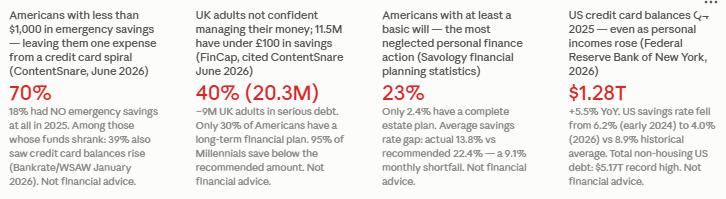
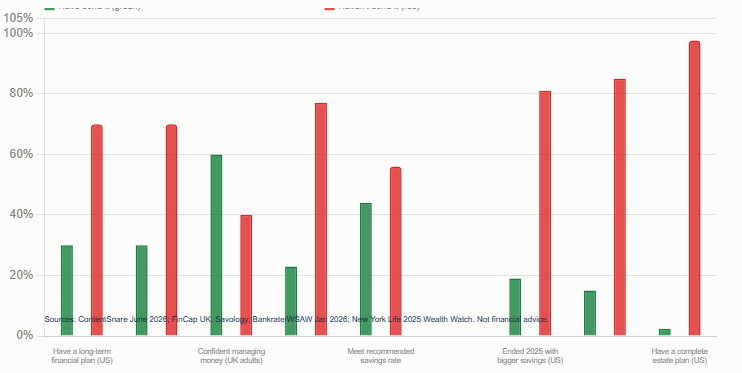
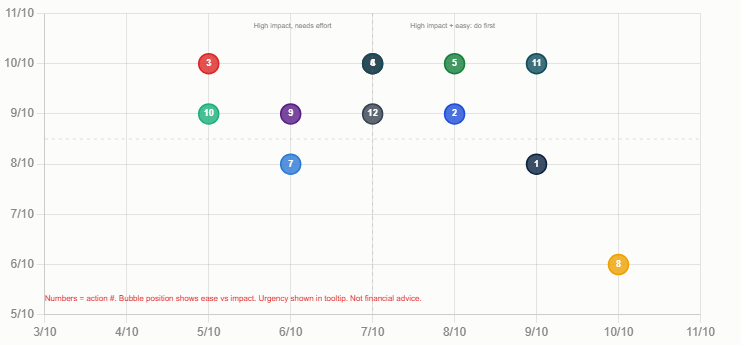
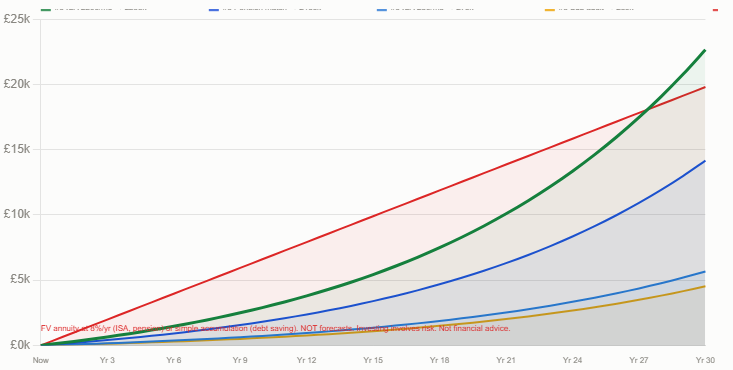
The financial planning gap is real and wide. Only 30% of Americans have a long-term financial plan (ContentSnare, June 2026). 70% have less than $1,000 in emergency savings. In the UK, nearly 40% of adults (20.3 million people) are not confident managing money; 11.5 million have less than £100 in savings; almost 9 million are in serious debt (FinCap, cited by ContentSnare June 2026). The US credit card balance reached $1.28 trillion in Q4 2025, a 5.5% annual increase, at a time when personal incomes also rose. People are earning more and saving less — turning to credit to manage the gap.
These 12 things are the ordered response to that gap. They are not comprehensive financial planning — that requires a qualified adviser with knowledge of your specific situation. They are the twelve most impactful, most universally applicable actions in personal finance, sequenced from the most urgent to the most forward-looking. Not financial advice. Always consult a qualified independent financial adviser for guidance specific to your circumstances.
Only 30% of Americans have a long-term financial plan. 70% have less than $1,000 emergency savings. 95% of Millennials save below the recommended amount (ContentSnare, June 2026). 40% of UK adults (20.3M) not confident managing money; 11.5M have <£100 in savings; ~9M in serious debt (FinCap, cited by ContentSnare June 2026). US credit card balances: $1.28 trillion Q4 2025 (+5.5% YoY) even as incomes rose. US personal savings rate fell from 6.2% (early 2024) to 4.0% (2026) vs historical average 8.9% (Federal Reserve; Caithness Business Index 2026). Just 19% of Americans ended 2025 with bigger emergency savings than they started (Bankrate via WSAW, January 2026). Not financial advice.
The calculation: list every financial asset (bank accounts, savings, ISAs, pension estimated value, property equity, investments, premium bonds) and every liability (mortgage, credit cards, loans, overdraft, BNPL, student loan if affecting cash flow). Subtract liabilities from assets. If the number is negative — write it down anyway. That is the starting line. The purpose is not a comfortable number; it is an accurate one.
This week: calculate your net worth using a spreadsheet, a notes app, or a free app (Money Dashboard UK; Copilot US). Write the date and the number down. Set a reminder to repeat in 3 months. The baseline is the most important output — not how big the number is, but that you have one to track. Not financial advice.
The most accessible starting framework is the 50/30/20 rule: 50% of take-home income to needs (housing, bills, transport, food), 30% to wants (dining, entertainment, subscriptions), and 20% to savings and debt. Hargreaves Lansdown’s 10-step 2025 guide suggests 50–60% needs, 20–30% wants, and 20% for ‘future you.’ If debt is significant, the 20% savings allocation temporarily becomes 30% or more by compressing the wants allocation. Not financial advice.
73% of US adults adjusted or revised their budgets for 2025 (New York Life Wealth Watch 2025), yet only 26% felt confident in their financial plans. The gap between having a budget and having a budget that works is almost always execution frequency: the monthly review. A budget reviewed once and never again is simply a document. A budget reviewed monthly is a financial system. Free tools: Money Helper budget planner (moneyhelper.org.uk, UK); YNAB or EveryDollar (US). Not financial advice.
The scale of the problem: US credit card balances reached $1.28 trillion in Q4 2025, a 5.5% annual increase even as personal incomes rose (Federal Reserve Bank of New York, cited by Caithness Business Index 2026). The average US credit card balance is $8,295, with Gen Xers averaging $10,141 (New York Life 2025 Wealth Watch). 67% of US adults carry debt. US total non-housing debt reached a record $5.17 trillion at end of 2025, including $1.67 trillion in auto loans and $1.28 trillion in credit card debt (Federal Reserve Bank of New York, cited by Yahoo Finance 2026). UK credit card APRs: typically 20–29% for standard cards.
Two strategies: Debt Avalanche (mathematically optimal — pay minimum on all debts, direct all extra cash to the highest interest rate first, saving the most in total interest); Debt Snowball (behaviourally effective — pay minimum on all, direct extra cash to the smallest balance first, generating quick wins that sustain motivation). Both strategies work; the best one is the one you actually stick to. Not financial advice.
The minimum payment trap: credit card minimum payments are specifically designed to maximise lifetime interest paid. On £3,000 at 22% APR: minimum payments keep the debt alive for approximately 25-30 years with £3,000-£4,500 in total interest. Paying £200/month clears it in approximately 18 months with approximately £500 in total interest. The minimum payment is not the minimum path out of debt — it is the maximum path to prolonged debt. Not financial advice.
The standard target: three to six months of essential living expenses (housing, food, utilities, transport, essential bills — not discretionary spending) held in a separate, instantly accessible, high-interest savings account. Three months for people with stable employment, no dependants, and a supportive network. Six months for the self-employed, those with variable income, single-income households, homeowners with expensive maintenance risks, or people with dependants.
Sequence: if no emergency fund exists, build the starter fund (£500–£1,000 / $500–$1,000) before attacking debt beyond minimum payments. The starter fund prevents the debt-repayment progress from being erased by the first unexpected expense. Full emergency fund: build after high-interest debt is cleared. Not financial advice.
The Maths: Emergency fund vs credit card trap: £1,000 emergency on credit card at 22% APR with minimum payments = paid off in approximately 25+ years with ~£1,000-£1,500 interest. Same £1,000 emergency covered from savings account at 4.5% = zero interest cost. Savings account opportunity cost: approximately £45/year foregone interest on the £1,000. Net saving vs credit card: approximately £1,000+ per emergency event. Build the fund once; it pays for itself every time you need it. Not financial advice.
In the UK, auto-enrolment requires a minimum total contribution of 8% (5% employee, 3% employer) of qualifying earnings. Many employers offer enhanced matching — some will match up to 7%, 8%, or 10% of salary for employees who contribute at a higher rate. The first action of any employed UK worker should be to confirm their current contribution rate and their employer’s matching policy, and ensure they are contributing at least enough to receive the full match. On top of the match: basic-rate pension tax relief means a £100 pension contribution costs only £80 net of take-home pay for a basic-rate taxpayer. Higher-rate taxpayers receive proportionally more.
The compound maths of the employer match alone: £1,500/year (employer match on £30,000 salary, 5% match) invested at 8%/yr for 30 years = approximately £169,000 from the match alone, before the employee’s own contributions. Not a forecast. FV of annuity formula; illustrative. Not financial advice.
What to hold: a low-cost, broadly diversified index fund tracking a global or total-market index (Vanguard FTSE All-World, iShares MSCI World, or equivalent). The evidence for passive index investing over active fund selection is robust and consistent: the majority of actively managed funds underperform their benchmark index over any 10-year period, primarily because management fees erode returns. A 0.22% annual charge (Vanguard Lifestrategy) vs a 1.5% annual charge (typical actively managed fund) on £100,000 over 30 years at 8% base return: the difference is approximately £245,000 in foregone compound growth. Fees are the most controllable variable in long-term investment outcomes. Not financial advice. Investment involves risk.
£200/month in a Stocks and Shares ISA at 8%/yr for 30 years: approximately £298,000. Same £200/month in a cash ISA at 4.5%/yr for 30 years: approximately £165,000. Difference: approximately £133,000 — the equity risk premium over three decades. ISA allowance 2026/27: £20,000/year (UK). Roth IRA limit 2026: $7,000/year (US, under 50). Not a forecast. FV of annuity. Investment involves risk. Not financial advice. Past performance does not predict future results.
In 2026, UK mortgage rates for remortgagers are approximately 4.5–5.5% (two-year fixed) and 4.2–5.0% (five-year fixed). At these rates, the case for overpaying is stronger than it was at 2019–2021 lows. Most fixed-rate mortgages allow overpayments of up to 10% of the outstanding balance per year without penalty. For people with 5–6% mortgage rates, overpaying (within the 10% annual limit) is a guaranteed, risk-free return equal to the mortgage rate — competitive with many savings accounts and without the investment uncertainty of equities. Not financial advice. Consult a qualified mortgage adviser.
The priority order: (1) capture full employer pension match (100% guaranteed return); (2) clear high-interest debt (guaranteed return at the debt’s APR); (3) then compare mortgage rate vs expected investment return vs available savings rate. At 5%+ mortgage rates: overpaying is often rational. At below 4%: investing is often superior in expected value terms. Not financial advice. Individual circumstances vary.
The process: review the last three months of bank statements and identify every recurring charge. Check the phone settings (iPhone: Settings → Apple ID → Subscriptions; Android: Play Store → Profile → Subscriptions). For each subscription: has it been used in the past month? If no: cancel today. If occasionally: evaluate against alternatives (free equivalents or cheaper tiers). The cancelled subscriptions free up cash that can be redirected to the debt, emergency fund, or investment priorities above.
Annual subscription audit: 30-45 minutes, once a year, saves an estimated £20-£60/month for the typical UK household. Step 1: bank statements (3 months). Step 2: phone subscription menu. Step 3: email inbox search for 'subscription' and 'renewal'. Step 4: cancel everything unused. Step 5: add the monthly saving to your spending plan's savings/debt allocation. Not consumer advice.
The annual insurance review should also cover: life insurance (if dependants exist), critical illness cover, buildings and contents insurance (re-shopped annually — loyalty premiums are real; comparison sites take 15 minutes and typically save £50–£200), and any packaged bank account benefits (verified as still relevant and accessible for your circumstances). Not financial, insurance, or legal advice. Consult a qualified protection adviser or independent financial adviser.
The annual salary review process: research the market rate for your role using salary comparison sites (Glassdoor, LinkedIn Salary, Totaljobs UK, Payscale); quantify the specific value you have added in the past twelve months (projects delivered, revenue generated, costs saved, skills acquired); schedule a specific meeting with your manager rather than raising it informally; present the case calmly and with evidence rather than as a personal request. If a direct salary increase is not available: negotiate non-salary compensation (additional pension contribution, flexible working, additional holiday, professional development budget, or performance-linked bonus). Every component has compounding career value. Not financial advice.
28% of UK adults regret not educating themselves more about money earlier in life (SWNS survey of 4,000 UK adults, featured in this series). Only 15% of Americans planned to consult a financial professional in 2025 — which makes self-education the primary financial literacy tool for the majority. High-return learning areas in roughly 30 minutes each: compound interest and the time value of money; pension mechanics (tax relief, employer matching, lifetime allowance); ISA types and the difference between cash and stocks and shares; the difference between index funds and active management; how credit scores work and the fastest legal ways to improve them; the basics of life insurance, income protection, and critical illness. Free sources: Money Helper (moneyhelper.org.uk), Martin Lewis / MoneySavingExpert, Investopedia (US), Khan Academy Personal Finance. Not financial advice.
The immediate actions: (1) Write a basic will. In the UK, simple wills can be prepared for £90–£250 through a solicitor, or free through Will Aid (November each year, when participating solicitors waive fees for a donation to charity). (2) Check the beneficiary designations on every pension, life insurance policy, and workplace death-in-service scheme. These assets pass outside the will directly to the named beneficiary — if the beneficiary designation is incorrect, out of date, or blank, the asset may not go where you intend. (3) If you have dependant children: name a guardian in the will. (4) Consider a Lasting Power of Attorney (UK) or Durable Power of Attorney (US) to name someone to manage your affairs if you become incapacitated. Not legal advice. Consult a qualified solicitor or estate planning attorney.
The will checklist: (1) Write a will, or update one written before 2020. (2) Check beneficiary designations on: pension (workplace and private), life insurance, and death-in-service. (3) Name a guardian for any dependent children in the will. (4) Consider a Lasting Power of Attorney (UK: Property and Financial Affairs; Health and Welfare). UK resources: GOV.UK wills guidance; Unbiased.co.uk for a local solicitor; Will Aid (willaid.org.uk, November each year). Not legal advice.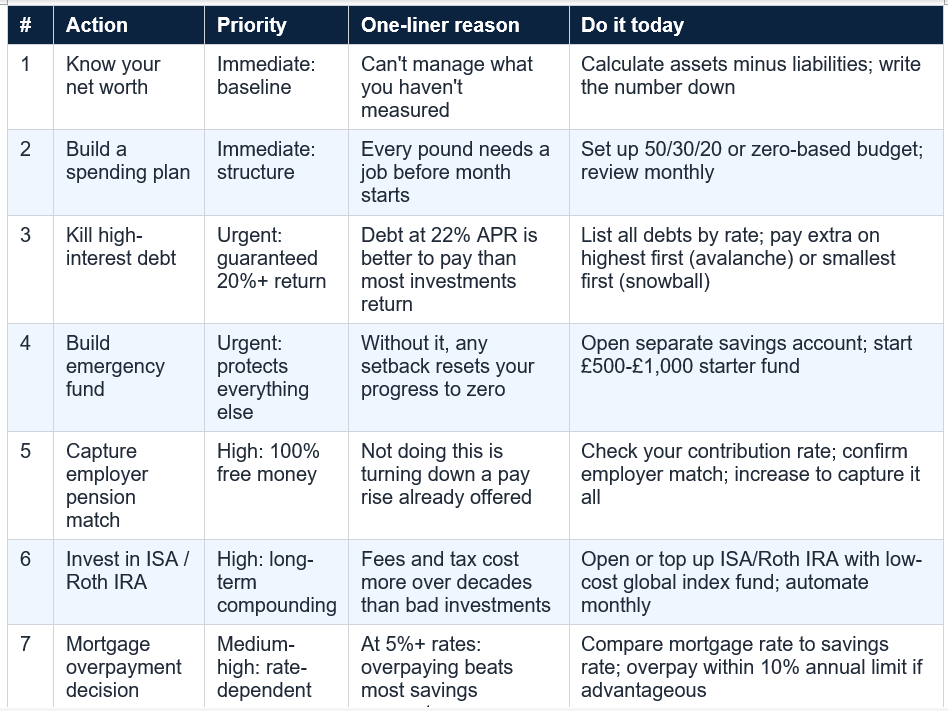
Not financial, investment, tax, or legal advice. The priority order is a general framework and may not apply to all individual situations. Always consult qualified professionals for advice specific to your circumstances. UK figures (ISA, pension, SDLT) are for 2026/27; verify current allowances and rules from official sources (HMRC, FCA, GOV.UK). US figures (401(k), IRA, Roth) are for 2026; verify from IRS.gov.
The gap between knowing and doing is the most expensive gap in personal finance. Only 30% of Americans have a long-term plan. 70% have under $1,000 saved. 23% have a will. These are not knowledge gaps — most people know they should save, invest, and protect their income. They are execution gaps, and they are paid for in compound interest working against rather than for, in opportunities declined rather than accepted, and in consequences that materialise at the worst moments.
Pick one thing from this list that you have not done. Do it this week. Not all twelve. Not the hardest one. The most urgent one that you have been postponing. Build the next one on top of it. The compound effect applies to habits as well as money. Not financial, investment, tax, or legal advice. For guidance specific to your circumstances, consult a qualified independent financial adviser.
The correct order depends on the type of debt. The generally accepted sequence: (1) Make minimum payments on all debts (to avoid late fees and credit damage). (2) Build a starter emergency fund (£500-£1,000 / $500-$1,000) to prevent any setback sending you back to credit. (3) Capture the full employer pension match — this is a 100% guaranteed immediate return that outperforms even the highest-rate debt. (4) Pay off high-interest debt (credit cards at 20-29% APR) as aggressively as possible — this is a guaranteed return at the debt's interest rate. (5) Build the full emergency fund to 3-6 months of expenses. (6) Invest the rest in an ISA (UK) or Roth IRA / 401(k) (US). The logic: certainty outranks expectation. A guaranteed 22% return (debt elimination) beats an expected 8% return (investing), so eliminate high-interest debt first. But always capture the employer match before either, because 100% beats 22%. Not financial advice.
How much emergency fund do I need?
The standard target is three to six months of essential living expenses — housing, food, utilities, transport, minimum debt payments, and essential bills. Not three to six months of total income, and not three to six months of current spending (which includes discretionary items). Three months is appropriate for people with stable employment in a sector with readily available equivalent roles, no dependants, and a strong support network. Six months is appropriate for the self-employed or contractors with variable income, single-income households, people with dependants, homeowners with potentially expensive maintenance liabilities, or workers in industries with longer job-search timelines. 70% of Americans have less than $1,000 in emergency savings (ContentSnare, June 2026) — far below the recommended target. The fund is held in an instantly accessible, high-interest savings account (separate from the current account to reduce temptation to spend). Not financial advice.
What is the best thing to do with money in the UK in 2026?
In priority order for most UK households in 2026: (1) Know your net worth. (2) Build a spending plan. (3) Pay off high-interest debt (credit cards at 20-29% APR, overdrafts). (4) Build a starter emergency fund (£500-£1,000). (5) Capture the full employer pension match — the 3% employer minimum is the floor; many employers match more if you contribute more. (6) Fill the Stocks and Shares ISA (up to £20,000/year, 2026/27 allowance) with a low-cost global index fund. (7) Consider mortgage overpayment (if rate is above approximately 4.5% and within the 10% annual overpayment limit). (8) Annual subscription audit. (9) Income protection insurance review. (10) Annual salary negotiation. (11) Financial education (moneyhelper.org.uk). (12) Write a will and check pension/insurance beneficiary designations. Not financial advice. Individual circumstances vary significantly — for tailored advice, consult a qualified IFA (check the FCA register at register.fca.org.uk).
When should I start investing?
As soon as the conditions above are met: high-interest debt cleared, starter emergency fund established, and employer pension match captured. The research consistently shows that the single most valuable variable in long-term investment outcomes is time, not timing. Ramit Sethi (June 2026, MoneyLion): 'There is never a perfect time to invest and not investing is usually driven by fear. Start now. Start small — even $50 a month will still make a difference. Time in the market, not timing the market.' The compound difference between starting to invest £200/month at age 22 vs age 32 is approximately £404,000 at age 62 (at 8%/yr; illustrative; not a forecast). That gap is entirely composed of time. If you are debt-free and have a starter emergency fund: the right time to invest is now. If you still have high-interest debt: clear the debt first — the guaranteed return beats the expected investment return. Investment involves risk. Not financial advice.
Do I really need a will?
Yes, especially if you have: any assets at all (property, savings, pension, investments); a partner you are not married to (a cohabiting partner has NO automatic inheritance rights under English law — they must be named in the will); dependent children (a will is the only place you can name a legal guardian); specific preferences about who receives what; a desire to minimise Inheritance Tax (legal estate planning can reduce IHT liability significantly). Only 23% of Americans have even a basic will (Savology statistics). In England and Wales, dying intestate (without a will) means assets are distributed under the Intestacy Rules, which may not reflect your wishes. A basic will through a solicitor: approximately £90-£250. Will Aid (willaid.org.uk): every November, participating solicitors write basic wills in exchange for a donation to charity. Also essential alongside the will: check the beneficiary designations on all pension plans, life insurance policies, and workplace death-in-service schemes. These assets pass OUTSIDE the will directly to the named beneficiary — if the designation is out of date, the wrong person may inherit. Not legal advice. Consult a qualified solicitor.
Table of Contents
- Why the Order Matters as Much as the Actions
- #1 Know Your Net Worth
- #2 Build a Spending Plan (Not a Budget)
- #3 Kill High-Interest Debt First
- #4 Build Your Emergency Fund
- #5 Capture Every Penny of Employer Pension Match
- #6 Invest in a Low-Cost Index Fund ISA or Roth IRA
- #7 Understand Whether to Overpay Your Mortgage
- #8 Do the Annual Subscription Audit
- #9 Protect Your Income (Insurance Review)
- #10 Negotiate Your Salary — Every Year
- #11 Invest in Financial Education
- #12 Write a Will and Name Beneficiaries
- The 12 Things: Quick-Reference Summary Table
- Conclusion: Done Is Better Than Perfect
- Frequently Asked Questions
The financial planning gap — where most people are
Priority return matrix — what each action gives you
The compound payoff — what each action builds over time
Why the Order Matters as Much as the Actions
The 12 things in this article are not equally urgent, and they are not interchangeable. The sequence in which they are done matters as much as whether they are done at all. Paying into an investment ISA before eliminating credit card debt at 22% APR is mathematically irrational: the 8% expected return on the investment is overwhelmed by the 22% guaranteed cost of the debt. Building a six-month emergency fund before capturing the employer pension match — a 100% guaranteed instant return — is leaving money on the table. Order produces efficiency. Random action produces a better-than-average outcome; ordered action produces the best one.The financial planning gap is real and wide. Only 30% of Americans have a long-term financial plan (ContentSnare, June 2026). 70% have less than $1,000 in emergency savings. In the UK, nearly 40% of adults (20.3 million people) are not confident managing money; 11.5 million have less than £100 in savings; almost 9 million are in serious debt (FinCap, cited by ContentSnare June 2026). The US credit card balance reached $1.28 trillion in Q4 2025, a 5.5% annual increase, at a time when personal incomes also rose. People are earning more and saving less — turning to credit to manage the gap.
These 12 things are the ordered response to that gap. They are not comprehensive financial planning — that requires a qualified adviser with knowledge of your specific situation. They are the twelve most impactful, most universally applicable actions in personal finance, sequenced from the most urgent to the most forward-looking. Not financial advice. Always consult a qualified independent financial adviser for guidance specific to your circumstances.
Only 30% of Americans have a long-term financial plan. 70% have less than $1,000 emergency savings. 95% of Millennials save below the recommended amount (ContentSnare, June 2026). 40% of UK adults (20.3M) not confident managing money; 11.5M have <£100 in savings; ~9M in serious debt (FinCap, cited by ContentSnare June 2026). US credit card balances: $1.28 trillion Q4 2025 (+5.5% YoY) even as incomes rose. US personal savings rate fell from 6.2% (early 2024) to 4.0% (2026) vs historical average 8.9% (Federal Reserve; Caithness Business Index 2026). Just 19% of Americans ended 2025 with bigger emergency savings than they started (Bankrate via WSAW, January 2026). Not financial advice.
#1 Know Your Net Worth
You cannot manage what you have not measured. Net worth — total assets minus total liabilities — is the single most informative number in personal finance, and the one most consistently unknown. It converts vague financial anxiety into a specific, trackable figure. It is also the number against which every subsequent action on this list can be measured: after 12 months, is the number higher or lower? If higher: progress. If lower: something in the plan needs adjustment.The calculation: list every financial asset (bank accounts, savings, ISAs, pension estimated value, property equity, investments, premium bonds) and every liability (mortgage, credit cards, loans, overdraft, BNPL, student loan if affecting cash flow). Subtract liabilities from assets. If the number is negative — write it down anyway. That is the starting line. The purpose is not a comfortable number; it is an accurate one.
This week: calculate your net worth using a spreadsheet, a notes app, or a free app (Money Dashboard UK; Copilot US). Write the date and the number down. Set a reminder to repeat in 3 months. The baseline is the most important output — not how big the number is, but that you have one to track. Not financial advice.
#2 Build a Spending Plan (Not a Budget)
The word ‘budget’ creates psychological resistance. A spending plan is identical in structure and enormously different in psychological framing. Dr Bruce Ross (University of Kentucky, January 2025) is explicit: ‘Redefine a budget as a spending plan to reduce stress and remove negative connotations around budgeting. Let values inform your spending and saving habits.’ The spending plan allocates every pound or dollar of income to a specific category before the month begins — including a savings category, a debt category, and a ‘discretionary’ category that allows genuine spending without guilt.The most accessible starting framework is the 50/30/20 rule: 50% of take-home income to needs (housing, bills, transport, food), 30% to wants (dining, entertainment, subscriptions), and 20% to savings and debt. Hargreaves Lansdown’s 10-step 2025 guide suggests 50–60% needs, 20–30% wants, and 20% for ‘future you.’ If debt is significant, the 20% savings allocation temporarily becomes 30% or more by compressing the wants allocation. Not financial advice.
73% of US adults adjusted or revised their budgets for 2025 (New York Life Wealth Watch 2025), yet only 26% felt confident in their financial plans. The gap between having a budget and having a budget that works is almost always execution frequency: the monthly review. A budget reviewed once and never again is simply a document. A budget reviewed monthly is a financial system. Free tools: Money Helper budget planner (moneyhelper.org.uk, UK); YNAB or EveryDollar (US). Not financial advice.
#3 Kill High-Interest Debt First
High-interest debt — credit cards at 20–29% APR, overdrafts, payday loans, BNPL balances that have reverted to interest — is the highest guaranteed financial return available to anyone who carries it. Paying off £1,000 of credit card debt at 22% APR saves £220 per year in guaranteed interest. No investment reliably returns 22% per year; the effective return of debt elimination is the interest rate, risk-free. This is why eliminating high-interest debt before investing is mathematically correct, not just morally satisfying.The scale of the problem: US credit card balances reached $1.28 trillion in Q4 2025, a 5.5% annual increase even as personal incomes rose (Federal Reserve Bank of New York, cited by Caithness Business Index 2026). The average US credit card balance is $8,295, with Gen Xers averaging $10,141 (New York Life 2025 Wealth Watch). 67% of US adults carry debt. US total non-housing debt reached a record $5.17 trillion at end of 2025, including $1.67 trillion in auto loans and $1.28 trillion in credit card debt (Federal Reserve Bank of New York, cited by Yahoo Finance 2026). UK credit card APRs: typically 20–29% for standard cards.
Two strategies: Debt Avalanche (mathematically optimal — pay minimum on all debts, direct all extra cash to the highest interest rate first, saving the most in total interest); Debt Snowball (behaviourally effective — pay minimum on all, direct extra cash to the smallest balance first, generating quick wins that sustain motivation). Both strategies work; the best one is the one you actually stick to. Not financial advice.
The minimum payment trap: credit card minimum payments are specifically designed to maximise lifetime interest paid. On £3,000 at 22% APR: minimum payments keep the debt alive for approximately 25-30 years with £3,000-£4,500 in total interest. Paying £200/month clears it in approximately 18 months with approximately £500 in total interest. The minimum payment is not the minimum path out of debt — it is the maximum path to prolonged debt. Not financial advice.
#4 Build Your Emergency Fund
The emergency fund is the financial structure that stands between a temporary setback and a spiral into debt. 18% of Americans had no emergency savings at all in 2025; among those whose emergency funds shrank, 39% also saw their credit card balances increase (Bankrate, cited by WSAW/InvestigateTV, January 2026). The mechanism is direct: without savings, any unexpected expense — boiler breakdown, car repair, dental bill, job loss — goes onto a credit card at 20–29% APR, converting a one-off cost into a compounding debt.The standard target: three to six months of essential living expenses (housing, food, utilities, transport, essential bills — not discretionary spending) held in a separate, instantly accessible, high-interest savings account. Three months for people with stable employment, no dependants, and a supportive network. Six months for the self-employed, those with variable income, single-income households, homeowners with expensive maintenance risks, or people with dependants.
Sequence: if no emergency fund exists, build the starter fund (£500–£1,000 / $500–$1,000) before attacking debt beyond minimum payments. The starter fund prevents the debt-repayment progress from being erased by the first unexpected expense. Full emergency fund: build after high-interest debt is cleared. Not financial advice.
The Maths: Emergency fund vs credit card trap: £1,000 emergency on credit card at 22% APR with minimum payments = paid off in approximately 25+ years with ~£1,000-£1,500 interest. Same £1,000 emergency covered from savings account at 4.5% = zero interest cost. Savings account opportunity cost: approximately £45/year foregone interest on the £1,000. Net saving vs credit card: approximately £1,000+ per emergency event. Build the fund once; it pays for itself every time you need it. Not financial advice.
#5 Capture Every Penny of Employer Pension Match
The employer pension match is the only financial product in existence that provides a guaranteed, immediate 100% return. An employer who matches 5% of salary is contributing £1,500 per year in free money to a £30,000 salary employee. Not contributing enough to capture the full employer match is declining a pay rise that has already been offered. It is the most universally overlooked financial mistake in the UK employment market.In the UK, auto-enrolment requires a minimum total contribution of 8% (5% employee, 3% employer) of qualifying earnings. Many employers offer enhanced matching — some will match up to 7%, 8%, or 10% of salary for employees who contribute at a higher rate. The first action of any employed UK worker should be to confirm their current contribution rate and their employer’s matching policy, and ensure they are contributing at least enough to receive the full match. On top of the match: basic-rate pension tax relief means a £100 pension contribution costs only £80 net of take-home pay for a basic-rate taxpayer. Higher-rate taxpayers receive proportionally more.
The compound maths of the employer match alone: £1,500/year (employer match on £30,000 salary, 5% match) invested at 8%/yr for 30 years = approximately £169,000 from the match alone, before the employee’s own contributions. Not a forecast. FV of annuity formula; illustrative. Not financial advice.
#6 Invest in a Low-Cost Index Fund ISA or Roth IRA
After high-interest debt is cleared, the emergency fund is established, and the employer pension match is captured, the next priority is long-term investing in a tax-efficient wrapper. In the UK: the Stocks and Shares ISA (up to £20,000 per year in 2026/27; all interest, dividends, and capital gains permanently tax-free). In the US: the Roth IRA (up to $7,000 per year in 2026 for under-50s; permanent tax-free growth on qualified withdrawals).What to hold: a low-cost, broadly diversified index fund tracking a global or total-market index (Vanguard FTSE All-World, iShares MSCI World, or equivalent). The evidence for passive index investing over active fund selection is robust and consistent: the majority of actively managed funds underperform their benchmark index over any 10-year period, primarily because management fees erode returns. A 0.22% annual charge (Vanguard Lifestrategy) vs a 1.5% annual charge (typical actively managed fund) on £100,000 over 30 years at 8% base return: the difference is approximately £245,000 in foregone compound growth. Fees are the most controllable variable in long-term investment outcomes. Not financial advice. Investment involves risk.
£200/month in a Stocks and Shares ISA at 8%/yr for 30 years: approximately £298,000. Same £200/month in a cash ISA at 4.5%/yr for 30 years: approximately £165,000. Difference: approximately £133,000 — the equity risk premium over three decades. ISA allowance 2026/27: £20,000/year (UK). Roth IRA limit 2026: $7,000/year (US, under 50). Not a forecast. FV of annuity. Investment involves risk. Not financial advice. Past performance does not predict future results.
#7 Understand Whether to Overpay Your Mortgage
Mortgage overpayment is one of the most context-dependent actions on this list. Whether it is the right thing to do with spare money depends entirely on your mortgage rate relative to the after-tax return available from alternative investments. At a 5% mortgage rate: overpaying generates a guaranteed 5% return (reduced interest). Investing in equities expected to return 7–8% generates a higher expected return but with uncertainty. At a 2% mortgage rate (historical low rates): the calculus shifts decisively toward investing, where expected returns comfortably exceed the guaranteed mortgage saving.In 2026, UK mortgage rates for remortgagers are approximately 4.5–5.5% (two-year fixed) and 4.2–5.0% (five-year fixed). At these rates, the case for overpaying is stronger than it was at 2019–2021 lows. Most fixed-rate mortgages allow overpayments of up to 10% of the outstanding balance per year without penalty. For people with 5–6% mortgage rates, overpaying (within the 10% annual limit) is a guaranteed, risk-free return equal to the mortgage rate — competitive with many savings accounts and without the investment uncertainty of equities. Not financial advice. Consult a qualified mortgage adviser.
The priority order: (1) capture full employer pension match (100% guaranteed return); (2) clear high-interest debt (guaranteed return at the debt’s APR); (3) then compare mortgage rate vs expected investment return vs available savings rate. At 5%+ mortgage rates: overpaying is often rational. At below 4%: investing is often superior in expected value terms. Not financial advice. Individual circumstances vary.
#8 Do the Annual Subscription Audit
The subscription audit is the highest-return 30-minute task in personal finance. Most UK households have approximately seven active subscriptions (market research estimates). A thorough audit typically uncovers £20–£60 per month in unused or forgotten recurring charges — streaming services barely watched, gym apps never opened, magazine subscriptions from 2023, software licences for work done differently now. According to the Self Financial 2025 data featured in this series, 58.9% of Caviar subscribers and 54.1% of Grubhub subscribers had not used their service in the past month.The process: review the last three months of bank statements and identify every recurring charge. Check the phone settings (iPhone: Settings → Apple ID → Subscriptions; Android: Play Store → Profile → Subscriptions). For each subscription: has it been used in the past month? If no: cancel today. If occasionally: evaluate against alternatives (free equivalents or cheaper tiers). The cancelled subscriptions free up cash that can be redirected to the debt, emergency fund, or investment priorities above.
Annual subscription audit: 30-45 minutes, once a year, saves an estimated £20-£60/month for the typical UK household. Step 1: bank statements (3 months). Step 2: phone subscription menu. Step 3: email inbox search for 'subscription' and 'renewal'. Step 4: cancel everything unused. Step 5: add the monthly saving to your spending plan's savings/debt allocation. Not consumer advice.
#9 Protect Your Income (Insurance Review)
Financial resilience is not only about accumulating assets; it is also about protecting the income stream that funds all the other items on this list. Income protection insurance — which pays a percentage of salary (typically 50–60%) if you are unable to work due to illness or injury — is the most underused and most important financial protection product for working-age adults. The statistical reality: a 30-year-old worker is significantly more likely to be unable to work for three or more months due to illness or injury during their career than to die before retirement, yet life insurance uptake in the UK substantially exceeds income protection uptake.The annual insurance review should also cover: life insurance (if dependants exist), critical illness cover, buildings and contents insurance (re-shopped annually — loyalty premiums are real; comparison sites take 15 minutes and typically save £50–£200), and any packaged bank account benefits (verified as still relevant and accessible for your circumstances). Not financial, insurance, or legal advice. Consult a qualified protection adviser or independent financial adviser.
#10 Negotiate Your Salary — Every Year
Salary negotiation is the financial action with the highest single-event return and the lowest uptake. The evidence from this blog series: 3% of Americans’ biggest 2025 financial regret was not negotiating a higher salary (Omni Calculator 2026). A £2,000 salary increase achieved in a single conversation — compounded through every future pay review and every pension contribution calculated as a percentage of salary over a 40-year career — is worth approximately £424,000 in additional compound career wealth (at 7%/yr, FV of investment income stream; illustrative). The conversation that achieves it takes perhaps ten minutes.The annual salary review process: research the market rate for your role using salary comparison sites (Glassdoor, LinkedIn Salary, Totaljobs UK, Payscale); quantify the specific value you have added in the past twelve months (projects delivered, revenue generated, costs saved, skills acquired); schedule a specific meeting with your manager rather than raising it informally; present the case calmly and with evidence rather than as a personal request. If a direct salary increase is not available: negotiate non-salary compensation (additional pension contribution, flexible working, additional holiday, professional development budget, or performance-linked bonus). Every component has compounding career value. Not financial advice.
#11 Invest in Financial Education
One piece of financial knowledge applied for a lifetime produces returns that dwarf its time cost. Understanding pension tax relief (20–45% of every pension contribution returns immediately as tax benefit) applied to a 30-year contribution history changes the retirement outcome by hundreds of thousands of pounds. Understanding the difference between index funds and actively managed funds — saving 1–2% per year in fees — changes the terminal ISA value by approximately £245,000 on £100,000 over 30 years. Understanding the employer match mechanism identifies ‘free money’ being declined by millions of UK workers who contribute below the matching threshold.28% of UK adults regret not educating themselves more about money earlier in life (SWNS survey of 4,000 UK adults, featured in this series). Only 15% of Americans planned to consult a financial professional in 2025 — which makes self-education the primary financial literacy tool for the majority. High-return learning areas in roughly 30 minutes each: compound interest and the time value of money; pension mechanics (tax relief, employer matching, lifetime allowance); ISA types and the difference between cash and stocks and shares; the difference between index funds and active management; how credit scores work and the fastest legal ways to improve them; the basics of life insurance, income protection, and critical illness. Free sources: Money Helper (moneyhelper.org.uk), Martin Lewis / MoneySavingExpert, Investopedia (US), Khan Academy Personal Finance. Not financial advice.
#12 Write a Will and Name Your Beneficiaries
Only 23% of Americans have at least a basic will; only 2.4% have a complete estate plan (Savology financial planning statistics). In the UK, the figure is similarly low despite HMRC data consistently showing that intestacy — dying without a will — causes significant unintended asset distribution, family disputes, and avoidable Inheritance Tax liability. A will does not require significant wealth to be worthwhile; it requires only that you have preferences about who should receive what, or who should care for dependant children.The immediate actions: (1) Write a basic will. In the UK, simple wills can be prepared for £90–£250 through a solicitor, or free through Will Aid (November each year, when participating solicitors waive fees for a donation to charity). (2) Check the beneficiary designations on every pension, life insurance policy, and workplace death-in-service scheme. These assets pass outside the will directly to the named beneficiary — if the beneficiary designation is incorrect, out of date, or blank, the asset may not go where you intend. (3) If you have dependant children: name a guardian in the will. (4) Consider a Lasting Power of Attorney (UK) or Durable Power of Attorney (US) to name someone to manage your affairs if you become incapacitated. Not legal advice. Consult a qualified solicitor or estate planning attorney.
The will checklist: (1) Write a will, or update one written before 2020. (2) Check beneficiary designations on: pension (workplace and private), life insurance, and death-in-service. (3) Name a guardian for any dependent children in the will. (4) Consider a Lasting Power of Attorney (UK: Property and Financial Affairs; Health and Welfare). UK resources: GOV.UK wills guidance; Unbiased.co.uk for a local solicitor; Will Aid (willaid.org.uk, November each year). Not legal advice.
The 12 Things: Quick-Reference Summary Table
Not financial, investment, tax, or legal advice. The priority order is a general framework and may not apply to all individual situations. Always consult qualified professionals for advice specific to your circumstances. UK figures (ISA, pension, SDLT) are for 2026/27; verify current allowances and rules from official sources (HMRC, FCA, GOV.UK). US figures (401(k), IRA, Roth) are for 2026; verify from IRS.gov.
Conclusion
The 12 things on this list are not theoretical. They are the concrete, ordered, measurable actions that convert financial anxiety into financial progress. Not all of them require large sums of money. Not all of them require sophistication. Calculating your net worth (#1) costs nothing and takes twenty minutes. Doing the subscription audit (#8) returns more than its time cost in the first month. Writing a will (#12) costs under £250 and protects assets that may be worth far more. The emergency fund (#4) may start at £500.The gap between knowing and doing is the most expensive gap in personal finance. Only 30% of Americans have a long-term plan. 70% have under $1,000 saved. 23% have a will. These are not knowledge gaps — most people know they should save, invest, and protect their income. They are execution gaps, and they are paid for in compound interest working against rather than for, in opportunities declined rather than accepted, and in consequences that materialise at the worst moments.
Pick one thing from this list that you have not done. Do it this week. Not all twelve. Not the hardest one. The most urgent one that you have been postponing. Build the next one on top of it. The compound effect applies to habits as well as money. Not financial, investment, tax, or legal advice. For guidance specific to your circumstances, consult a qualified independent financial adviser.
Frequently Asked Questions
What should I do with my money first — save or pay off debt?The correct order depends on the type of debt. The generally accepted sequence: (1) Make minimum payments on all debts (to avoid late fees and credit damage). (2) Build a starter emergency fund (£500-£1,000 / $500-$1,000) to prevent any setback sending you back to credit. (3) Capture the full employer pension match — this is a 100% guaranteed immediate return that outperforms even the highest-rate debt. (4) Pay off high-interest debt (credit cards at 20-29% APR) as aggressively as possible — this is a guaranteed return at the debt's interest rate. (5) Build the full emergency fund to 3-6 months of expenses. (6) Invest the rest in an ISA (UK) or Roth IRA / 401(k) (US). The logic: certainty outranks expectation. A guaranteed 22% return (debt elimination) beats an expected 8% return (investing), so eliminate high-interest debt first. But always capture the employer match before either, because 100% beats 22%. Not financial advice.
How much emergency fund do I need?
The standard target is three to six months of essential living expenses — housing, food, utilities, transport, minimum debt payments, and essential bills. Not three to six months of total income, and not three to six months of current spending (which includes discretionary items). Three months is appropriate for people with stable employment in a sector with readily available equivalent roles, no dependants, and a strong support network. Six months is appropriate for the self-employed or contractors with variable income, single-income households, people with dependants, homeowners with potentially expensive maintenance liabilities, or workers in industries with longer job-search timelines. 70% of Americans have less than $1,000 in emergency savings (ContentSnare, June 2026) — far below the recommended target. The fund is held in an instantly accessible, high-interest savings account (separate from the current account to reduce temptation to spend). Not financial advice.
What is the best thing to do with money in the UK in 2026?
In priority order for most UK households in 2026: (1) Know your net worth. (2) Build a spending plan. (3) Pay off high-interest debt (credit cards at 20-29% APR, overdrafts). (4) Build a starter emergency fund (£500-£1,000). (5) Capture the full employer pension match — the 3% employer minimum is the floor; many employers match more if you contribute more. (6) Fill the Stocks and Shares ISA (up to £20,000/year, 2026/27 allowance) with a low-cost global index fund. (7) Consider mortgage overpayment (if rate is above approximately 4.5% and within the 10% annual overpayment limit). (8) Annual subscription audit. (9) Income protection insurance review. (10) Annual salary negotiation. (11) Financial education (moneyhelper.org.uk). (12) Write a will and check pension/insurance beneficiary designations. Not financial advice. Individual circumstances vary significantly — for tailored advice, consult a qualified IFA (check the FCA register at register.fca.org.uk).
When should I start investing?
As soon as the conditions above are met: high-interest debt cleared, starter emergency fund established, and employer pension match captured. The research consistently shows that the single most valuable variable in long-term investment outcomes is time, not timing. Ramit Sethi (June 2026, MoneyLion): 'There is never a perfect time to invest and not investing is usually driven by fear. Start now. Start small — even $50 a month will still make a difference. Time in the market, not timing the market.' The compound difference between starting to invest £200/month at age 22 vs age 32 is approximately £404,000 at age 62 (at 8%/yr; illustrative; not a forecast). That gap is entirely composed of time. If you are debt-free and have a starter emergency fund: the right time to invest is now. If you still have high-interest debt: clear the debt first — the guaranteed return beats the expected investment return. Investment involves risk. Not financial advice.
Do I really need a will?
Yes, especially if you have: any assets at all (property, savings, pension, investments); a partner you are not married to (a cohabiting partner has NO automatic inheritance rights under English law — they must be named in the will); dependent children (a will is the only place you can name a legal guardian); specific preferences about who receives what; a desire to minimise Inheritance Tax (legal estate planning can reduce IHT liability significantly). Only 23% of Americans have even a basic will (Savology statistics). In England and Wales, dying intestate (without a will) means assets are distributed under the Intestacy Rules, which may not reflect your wishes. A basic will through a solicitor: approximately £90-£250. Will Aid (willaid.org.uk): every November, participating solicitors write basic wills in exchange for a donation to charity. Also essential alongside the will: check the beneficiary designations on all pension plans, life insurance policies, and workplace death-in-service schemes. These assets pass OUTSIDE the will directly to the named beneficiary — if the designation is out of date, the wrong person may inherit. Not legal advice. Consult a qualified solicitor.
0 Comments
Be the first to share your thoughts on this article.