

Financial Literacy
Where to Store $25,000 Right Now: Best Options Explained

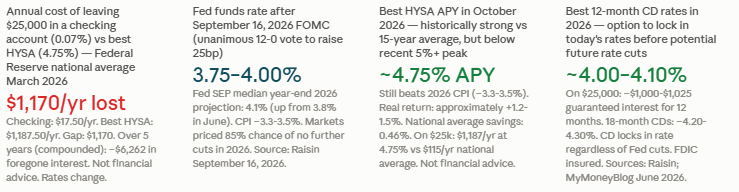
The Fed raised rates to 3.75–4.00% on September 16, 2026. US inflation is approximately 3.3–3.5%. The national average checking account pays 0.07%. The best high-yield savings accounts pay up to 4.75% APY. On $25,000, that gap is worth $1,170 per year. If you have $25,000 sitting in a standard account, you are effectively paying that much in foregone interest every twelve months. This article covers every serious option for storing $25,000 in the current rate environment — with the real numbers, the real trade-offs, and the recommended structure. Not financial advice.
Why this matters for where you store $25,000: in a higher-for-longer rate environment, savers have genuine and meaningful choices among savings products that all offer competitive real returns. High-yield savings accounts at 4.35–4.75% APY, CDs at 3.90–4.20%, T-bills at approximately 3.60%, and money market funds at approximately 3.55% are all producing real returns above inflation for the first time in years. The era of 5%+ savings rates has passed, but as WealthVieu noted in May 2026: ‘The current 4.35–4.75% HYSA environment... is still historically excellent — and it still beats 2026 inflation of ~3%.’
This window will not last indefinitely. If the Fed cuts rates in late 2026 or 2027 as inflation returns to target, savings and CD rates will fall. The most time-sensitive decision for a $25,000 saver in October 2026 is whether to lock in a fixed CD rate now or maintain the flexibility of a variable-rate HYSA. Both choices are defensible; the right answer depends on the individual’s timeline and liquidity needs. Not financial advice.
Fed funds rate (September 16, 2026): 3.75%–4.00% (raised 25bp, 12-0 vote). Fed year-end 2026 SEP median projection: 4.1% (up from 3.8% June). US CPI: 4.2% (May 2026 peak); 3.5% (June); ~3.3–3.5% (October estimate). National average checking account: 0.07% (Federal Reserve, March 2026). National average MMA: 0.57% (FDIC, May 2026). National average 12-month CD: 1.65% (FDIC, June 2026). Best HYSA: ~4.35–4.75% APY. Best CDs: ~3.90–4.20% APY. T-bills (3-6 month): ~3.60%. Sources: Raisin September 2026; Cambridge Currencies; WealthVieu May 2026; FDIC; Walnutinvest.com. Not financial advice. Rates change; verify directly.
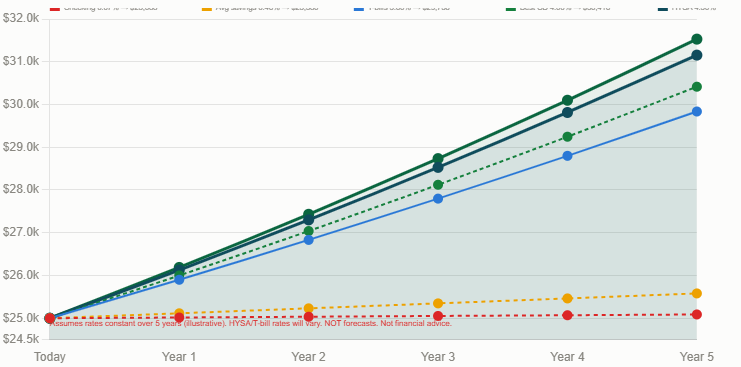
Over three years, the compounding effect is significant. $25,000 in a checking account at 0.07% for three years: approximately $25,052.63 (compound interest). The same $25,000 in a best HYSA at 4.50% APY for three years: approximately $28,429.45. Difference: $3,376.82 for three years of having the money in the right place. Over five years at 4.50% vs 0.07%: approximately $31,070 vs $25,088. Difference: $5,982. That is nearly $6,000 in foregone interest over five years on $25,000 — money that required no additional risk, no investment expertise, and no market exposure. Not financial advice.
AOL Finance / Moneywise (March 2026) is explicit on the $25,000 case specifically: ‘A cash hoard of $25,000 or more is likely to be long-term savings’ requiring a more strategic approach than simply leaving it in a checking account. The account that is right for an emergency fund (‘instant access’) is usually not the right account for $25,000 that is not needed immediately. Not financial advice.
The cost of lazy money on $25,000: Checking account at 0.07%: $17.50/year. Best HYSA at 4.75%: $1,187.50/year. Annual gap: $1,170. Over 3 years (compounded): checking gives ~$52; best HYSA gives ~$3,745. Difference: ~$3,693. Over 5 years: checking ~$88; HYSA ~$6,350. Difference: ~$6,262. Source: Federal Reserve national average (0.07% March 2026); WealthVieu/aggregator data (4.75% best HYSA). Not financial advice. Rates change; always verify.
WealthVieu (May–June 2026) describes HYSAs as the ideal vehicle for an emergency fund or any savings with uncertain timing: ‘full liquidity... your money works while you wait.’ Experian (May 2026) confirms that select accounts may offer up to 5% APY for promotional periods, though the realistic best sustainable rate in October 2026 is approximately 4.35–4.75%. The Motley Fool (January 2026) highlighted SoFi Checking and Savings as a strong option for its high APY, no monthly fees, and integrated app experience.
One important caveat: HYSA rates are variable. They will fall when the Fed cuts rates, which prediction markets estimate has a significant probability of occurring in 2027 or late 2026. If you need certainty about the return on your $25,000 for a specific time horizon, a CD (Option 2) is the better fit. If you need liquidity and are comfortable with a rate that may drift lower: the HYSA is the right default. Not financial advice.
Current Rate: Best HYSA rates (October 2026): approximately 4.35%–4.75% APY. On $25,000: approximately $1,087–$1,187 annual interest. FDIC insured to $250,000. Fully liquid (1-3 business day transfers). Variable rate: will fall with Fed cuts. Sources: WealthVieu May-June 2026; Experian May 2026; Motley Fool Jan 2026. Always verify current rates directly with institutions before opening an account. Not financial advice.
The best CD rates in June 2026 ranged from approximately 3.90% to 4.20% APY depending on term. MyMoneyBlog (May 2026) found a 12-month CD at 4.00% APY from Farmer’s Insurance FCU (new money required). WealthVieu (May 2026) quoted 18-month CDs at 4.20–4.50% and 24-month CDs at 4.00–4.25%. The 5-year CD rate was approximately 4.1% APY (MyMoneyBlog). Following the September 2026 rate rise to 3.75–4.00%, CD rates will likely adjust upward slightly.
The case for a CD right now: if the Fed begins cutting rates in 2027, a CD locked in today preserves the current rate for its full term. A 12-month CD at 4.00% opened in October 2026 will still pay 4.00% in September 2027 even if HYSA rates have fallen to 3.00%. For money you will not need for 12–24 months, a CD is a more reliable vehicle than a variable HYSA in a potentially declining rate environment. Not financial advice.
$25,000 in a 12-month CD at 4.00% APY: approximately $1,000 in interest (before tax), for a total of $26,000 at maturity. Same in an 18-month CD at 4.30% APY: approximately $1,612.50, total $26,612.50 at maturity. Same in a 24-month CD at 4.10% APY: approximately $2,087, total $27,087 at maturity. These are fixed returns, locked in at today's rate, regardless of future Fed moves. Source: Raisin June 2026; MyMoneyBlog May 2026; WealthVieu May 2026. All figures approximate; verify current rates before opening. Not financial advice.
How to build a $25,000 CD ladder in October 2026: divide the $25,000 into four or five portions and open CDs with maturity dates of three months, six months, twelve months, and twenty-four months respectively. Each time a CD matures, you have three choices: reinvest at whatever the current rate is, extend the ladder by opening a new longer-term CD, or withdraw the cash if needed. The ladder provides regular access to a portion of the money (eliminating the all-or-nothing illiquidity of a single CD) while locking in today’s rates on the longer-term tranches.
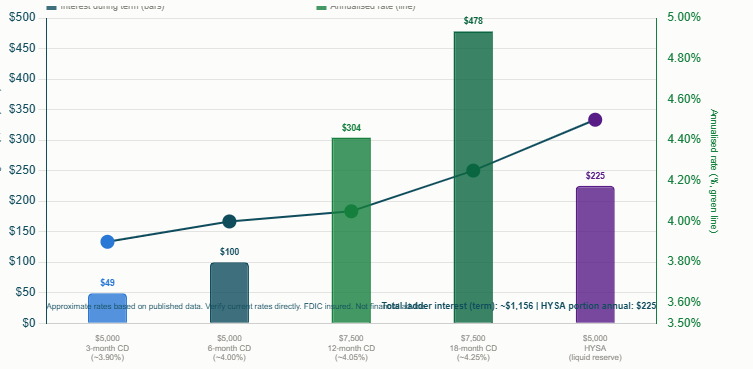
A practical $25,000 CD ladder example for October 2026: $5,000 in a 3-month CD at approximately 3.90%; $5,000 in a 6-month CD at approximately 4.00%; $7,500 in a 12-month CD at approximately 4.00–4.10%; $7,500 in an 18-month CD at approximately 4.20–4.30%. Total first-year interest: approximately $1,050–1,100. Liquidity events: every 3, 6, 12, and 18 months. Not financial advice.
The CD ladder advantage: (1) Locks in higher rates on longer tranches before potential rate cuts. (2) Provides liquidity at regular intervals (no single maturity event). (3) If rates rise further: short tranches reinvest at higher rates when they mature. (4) If rates fall: long tranches continue earning today's locked-in rate. Sources: Raisin June 2026; MyMoneyBlog May 2026 ('ladder the remaining across CDs'). Not financial advice. Verify current rates before opening.
The key advantage of T-bills over HYSAs and CDs: the interest is exempt from state and local income taxes. For a saver in New York (12.7% top state rate), California (13.3%), New Jersey (10.75%), or any other high-tax state, the after-tax return on T-bills is meaningfully higher than their headline rate would suggest. The Clark.com comparison (April 2026) notes that the stated yield on T-bills may be ‘slightly below the best high-yield savings and CD rates’ but the tax efficiency makes them ‘most sense if tax efficiency or capital safety is your top priority.’
T-bills also provide liquidity through the secondary market: while they mature at a fixed date, they can be sold before maturity through a brokerage account (though at a market price that may reflect a gain or loss). For $25,000, buying T-bills directly through TreasuryDirect or through a brokerage account is straightforward. Alternatively, ultra-short Treasury ETFs (such as BIL or SGOV) provide daily liquidity with T-bill-like yields minus a small management fee. Not financial advice.
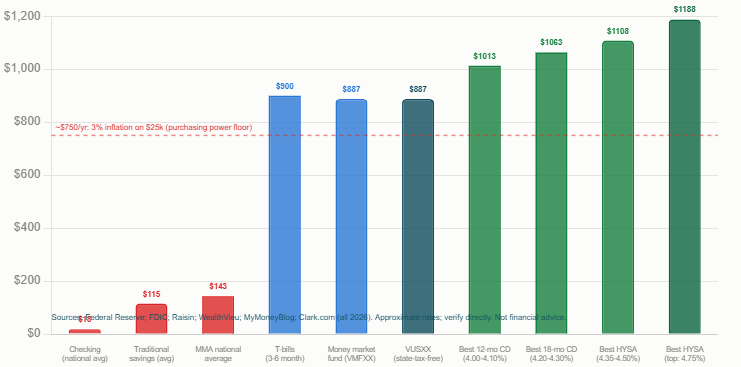
T-bill rates (approximate, October 2026): 3-month: ~3.60%. 6-month: ~3.65%. 12-month (1-year): ~3.75–3.80%. Key advantage: interest exempt from state and local taxes. On $25,000 at 3.60% for one year: ~$900 in interest before federal tax. In California (13.3% state rate) vs HYSA at 4.00%: HYSA after-tax in CA = ~$870 vs T-bill after-tax = ~$900 (T-bill wins after state tax exemption). Sources: Motley Fool/AOL Finance Jan 2026; Clark.com April 2026; MyMoneyBlog May 2026. Not tax or financial advice. Consult a tax professional.
The best online MMAs pay rates competitive with HYSAs — approximately 3.0–4.0% APY for the best offerings. The Clark.com cash management guide (April 2026) is direct about the caveat: ‘Big banks have money market accounts, but they frequently pay horrible rates just like their savings accounts.’ The value of an MMA over a HYSA is primarily the check-writing and debit card flexibility, which some savers prefer for larger emergency funds or bridge cash. For a straightforward rate-maximising strategy, the best HYSA typically equals or exceeds the best MMA. Not financial advice.
VUSXX has a specific tax advantage: in 2025, 100% of its dividends came from qualifying US government obligations, making them fully exempt from state and local income taxes (MyMoneyBlog, May 2026). For high-income savers in high-tax states, the after-tax yield of VUSXX can match or exceed the after-tax yield of HYSAs with higher stated rates. Clark.com (April 2026) also highlights that municipal money market funds can provide tax-free yield for very high earners in high-tax states, though they typically carry lower stated rates.
MMFs are best suited to savers who already have brokerage accounts and prefer to keep their cash working within that account structure rather than opening separate bank accounts. They are slightly less accessible than a HYSA for emergency withdrawals (brokerage transfer times) but are generally excellent for money earmarked for investment within 6–12 months. Not financial advice.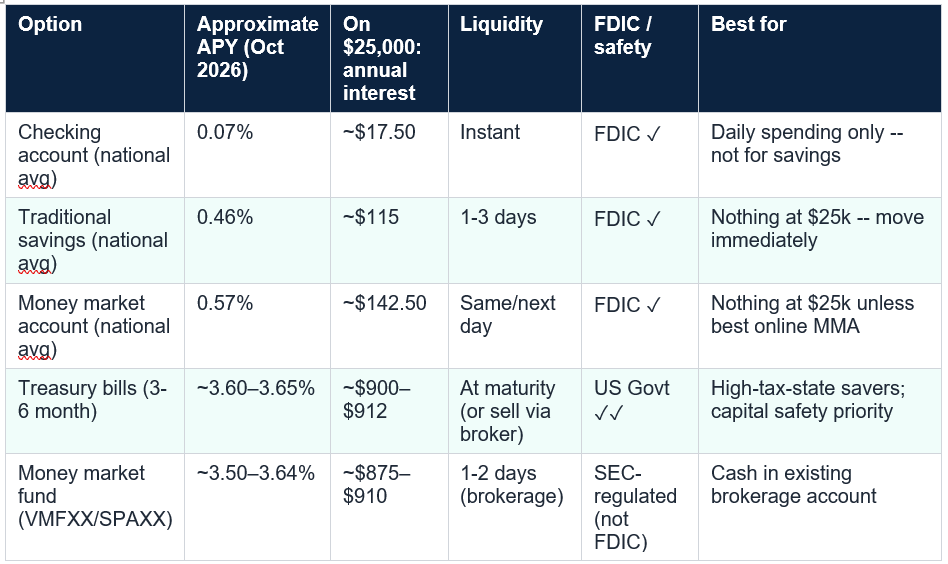
For money market funds (not bank accounts): these are not FDIC insured. However, they are regulated by the SEC under Rule 2a-7 of the Investment Company Act, which imposes strict liquidity, credit quality, and maturity limits. Government money market funds (like VMFXX and VUSXX) invest exclusively in Treasury securities and government agency securities, making them among the safest financial instruments available despite the absence of FDIC insurance. During the 2008 financial crisis, only one major retail money market fund ‘broke the buck’ (NAV fell below $1), and it was a fund with commercial paper exposure, not a government MMF.
Treasury bills require no insurance: they are direct obligations of the US government and backed by its full faith and credit, which is considered the highest-quality credit in the world. Not financial advice.
The outlook for HYSA and CD rates: if the Fed holds at 4.00–4.10% through year-end 2026 and begins cutting in 2027, HYSA rates will follow rates down with a lag of 1–2 weeks per Raisin’s September 2026 guide. CD rates, being fixed at opening, will not change for existing term holders. WealthVieu (May 2026): ‘If the Fed cuts rates 2–3 more times by end of 2026, HYSA rates will fall to ~3.75–4.25%. If inflation re-accelerates, the Fed may pause — keeping current rates longer.’
The implication for $25,000 savers in October 2026: the window of 4%+ savings rates may narrow in 2027. A CD opened now locks in today’s rate for the term regardless of future cuts. An HYSA captures today’s rate but will fall with the market if cuts arrive. Both are the right choice for different portions of $25,000, depending on the timeline. Not financial advice.
Note: This structure is an example for general informational purposes only. The right allocation for any individual depends on: (1) whether a separate emergency fund already exists (if yes, a smaller liquid tranche is needed); (2) whether the $25,000 has a specific planned use (e.g., home down payment in 18 months: different structure from an indefinite savings reserve); (3) state tax situation (high-tax-state residents may benefit from T-bills or VUSXX in place of some HYSA); (4) brokerage vs bank preference; (5) risk tolerance and comfort with illiquidity. Not financial advice. Consult an FCA/SEC-registered adviser for personalised guidance.
Opening a money market account at a large traditional bank without checking the rate first: as Clark.com notes, ‘Big banks have money market accounts, but they frequently pay horrible rates just like their savings accounts.’ The label ‘money market account’ does not guarantee a competitive rate; always check the specific APY.
Putting the entire $25,000 into a single long-term CD without an emergency fund: CDs impose early withdrawal penalties. If the $25,000 is the only savings and an unexpected expense arises, breaking a 24-month CD could cost one to three months of interest. Always maintain a liquid emergency fund before locking money into a fixed-term product. Not financial advice.
In a rate environment where the Fed is at 3.75–4.00% with projections pointing to 4.1% at year-end, CDs offer the additional option of locking in today’s rates before potential future cuts. The CD ladder — splitting $25,000 across multiple maturities — is the most robust strategy: preserving liquidity at regular intervals while locking in rate certainty on the portions not needed immediately. T-bills add a tax efficiency dimension for residents of high-tax states.
The rate environment described in this article will not last indefinitely. WealthVieu is direct: ‘The current 4.35–4.75% HYSA environment will not last indefinitely.’ Freenance concludes: ‘Current rates are historically attractive — don’t wait for perfection.’ The perfect allocation may require a financial adviser’s input. But the best move is clearly not nothing. Not financial, investment, or tax advice.
It depends on your timeline and liquidity needs. In October 2026, the best HYSAs offer slightly higher rates (approximately 4.35-4.75% APY) than the best CDs (approximately 3.90-4.20% APY) while offering full liquidity. However, HYSA rates are variable and will fall when the Fed cuts rates. A CD locks in today's fixed rate for the full term regardless of future rate changes. For money you might need unexpectedly: HYSA. For money you definitely won't need for 12-24 months: CD. For the best of both: use a CD ladder (some in a HYSA for liquidity, rest in CDs of various terms). Source: Raisin June 2026; WealthVieu May 2026. Not financial advice.
How much interest does $25,000 earn at 4.50% APY?
At 4.50% APY, $25,000 earns approximately $1,125 in the first year. After two years (compound interest at 4.50%): approximately $2,301. After five years: approximately $6,130. This compares to the national average checking account at 0.07%, which earns approximately $17.50 per year. The annual gap between the two (at 4.50% vs 0.07%) is approximately $1,107. Rates change; always verify the current APY with the specific institution before opening. Not financial advice.
Are high-yield savings accounts safe?
Yes, if the account is with an FDIC-insured bank or NCUA-insured credit union. FDIC insurance covers up to $250,000 per depositor, per insured institution, per ownership category. $25,000 is well within this limit. Money market funds (an alternative option) are not FDIC insured but are SEC-regulated; government money market funds (like Vanguard's VMFXX or VUSXX) invest exclusively in US Treasury and government agency securities and are considered extremely safe. Treasury bills are backed by the US government. Not financial advice.
What is a CD ladder and should I use one for $25,000?
A CD ladder splits a lump sum across multiple CDs with different maturity dates (e.g., 3 months, 6 months, 12 months, 18 months) so that a portion of the money becomes accessible at regular intervals. For $25,000, a typical ladder might be: $5,000 in a 3-month CD, $5,000 in a 6-month CD, $7,500 in a 12-month CD, $7,500 in an 18-month CD. As each CD matures, you can reinvest at current rates, extend the ladder, or withdraw the cash. The advantage: you lock in today's rates on longer tranches (protection against rate cuts) while maintaining regular liquidity events. Raisin (June 2026) specifically recommends CD laddering alongside an HYSA as the optimal 2026 savings strategy. Not financial advice.
Should I put my $25,000 in Treasury bills instead of a HYSA?
T-bills are worth considering for $25,000, particularly if you live in a high-tax state. T-bill interest is exempt from state and local income taxes, which can make their after-tax return competitive with or better than a HYSA at a higher stated rate. Example: T-bill at 3.60% in California (13.3% state rate) vs HYSA at 4.50% in California: T-bill after-tax ≈ $900 federal tax only; HYSA after-tax in CA ≈ approximately $876 after combined federal + state. The T-bill wins after state taxes. For residents of states with no income tax (Florida, Texas, etc.), the HYSA at a higher rate is usually preferable. T-bills can be purchased at TreasuryDirect.gov or through most brokerage accounts. Source: Clark.com April 2026; MyMoneyBlog May 2026. Not tax or financial advice. Consult a tax professional.
Table of Contents
- The Rate Environment Right Now: Why This Matters
- The Cost of Lazy Money: What Sitting in Checking Is Costing You
- Option 1: High-Yield Savings Account (HYSA) — The Default Answer
- Option 2: Certificates of Deposit (CDs) — Lock In Before Rates Fall
- Option 3: CD Ladder — The Best of Both Worlds
- Option 4: Treasury Bills (T-Bills) — Government-Backed and Tax-Smart
- Option 5: Money Market Accounts (MMAs) — The Flexible Hybrid
- Option 6: Money Market Funds (MMFs) — The Brokerage Option
- The Full Comparison: All Options Side by Side
- The FDIC Question: Is Your $25,000 Protected?
- The Rate Environment Outlook: What Happens Next?
- The Recommended Structure: How to Split $25,000
- What NOT to Do With $25,000 Right Now
- Conclusion: $1,170 a Year Is Real Money
- Frequently Asked Questions
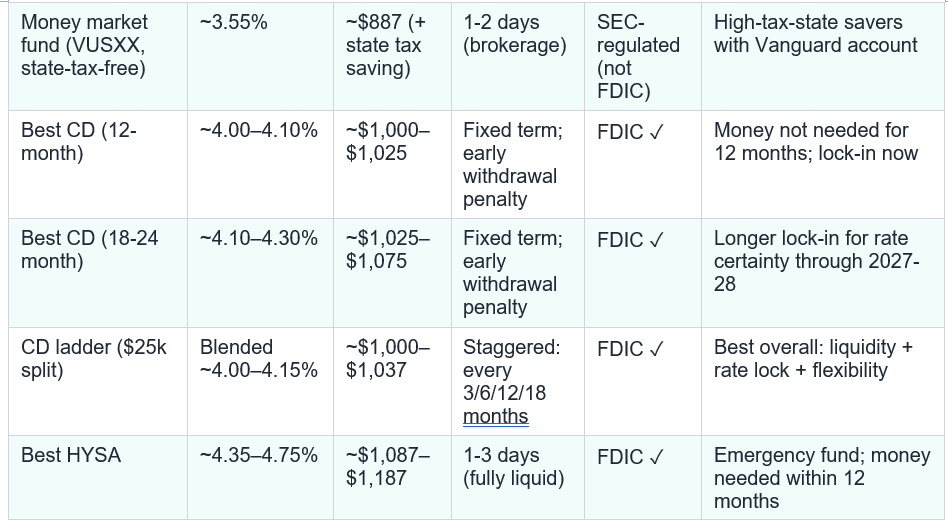
Rate comparison — every option side by side on $25,000
The cost of doing nothing — lazy money over 5 years
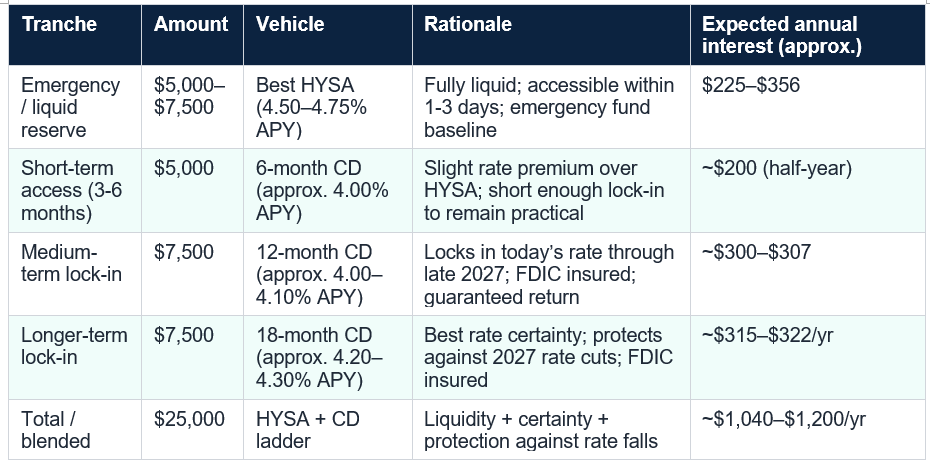
CD ladder — how to split $25,000 for best outcome
The Rate Environment Right Now: Why This Matters
On September 16, 2026, the Federal Open Market Committee voted unanimously to raise the federal funds rate by 25 basis points to a target range of 3.75%–4.00%. The Fed’s September 2026 Summary of Economic Projections revised the median projected year-end rate to 4.1%, up from 3.8% in June. US CPI inflation reached 4.2% in May 2026 (the highest since April 2023) before easing to 3.5% in June and approximately 3.3–3.5% in subsequent months. The Fed’s path is now trending higher again after a series of cuts that began in late 2024.Why this matters for where you store $25,000: in a higher-for-longer rate environment, savers have genuine and meaningful choices among savings products that all offer competitive real returns. High-yield savings accounts at 4.35–4.75% APY, CDs at 3.90–4.20%, T-bills at approximately 3.60%, and money market funds at approximately 3.55% are all producing real returns above inflation for the first time in years. The era of 5%+ savings rates has passed, but as WealthVieu noted in May 2026: ‘The current 4.35–4.75% HYSA environment... is still historically excellent — and it still beats 2026 inflation of ~3%.’
This window will not last indefinitely. If the Fed cuts rates in late 2026 or 2027 as inflation returns to target, savings and CD rates will fall. The most time-sensitive decision for a $25,000 saver in October 2026 is whether to lock in a fixed CD rate now or maintain the flexibility of a variable-rate HYSA. Both choices are defensible; the right answer depends on the individual’s timeline and liquidity needs. Not financial advice.
Fed funds rate (September 16, 2026): 3.75%–4.00% (raised 25bp, 12-0 vote). Fed year-end 2026 SEP median projection: 4.1% (up from 3.8% June). US CPI: 4.2% (May 2026 peak); 3.5% (June); ~3.3–3.5% (October estimate). National average checking account: 0.07% (Federal Reserve, March 2026). National average MMA: 0.57% (FDIC, May 2026). National average 12-month CD: 1.65% (FDIC, June 2026). Best HYSA: ~4.35–4.75% APY. Best CDs: ~3.90–4.20% APY. T-bills (3-6 month): ~3.60%. Sources: Raisin September 2026; Cambridge Currencies; WealthVieu May 2026; FDIC; Walnutinvest.com. Not financial advice. Rates change; verify directly.
The Cost of Lazy Money: What Sitting in Checking Is Costing You
The national average interest rate on a checking account was 0.07% as of March 2026 (Federal Reserve data, cited by AOL Finance/Moneywise). On $25,000, that is $17.50 per year in interest. The best high-yield savings accounts in October 2026 are paying approximately 4.75% APY — $1,187.50 per year on the same $25,000. The gap between the two: $1,170 per year, or approximately $97.50 per month, simply from moving money between accounts. This is the cost of financial inertia: not a bad investment decision, not a market loss, not a risk taken and punished. Just money sitting in the wrong place.Over three years, the compounding effect is significant. $25,000 in a checking account at 0.07% for three years: approximately $25,052.63 (compound interest). The same $25,000 in a best HYSA at 4.50% APY for three years: approximately $28,429.45. Difference: $3,376.82 for three years of having the money in the right place. Over five years at 4.50% vs 0.07%: approximately $31,070 vs $25,088. Difference: $5,982. That is nearly $6,000 in foregone interest over five years on $25,000 — money that required no additional risk, no investment expertise, and no market exposure. Not financial advice.
AOL Finance / Moneywise (March 2026) is explicit on the $25,000 case specifically: ‘A cash hoard of $25,000 or more is likely to be long-term savings’ requiring a more strategic approach than simply leaving it in a checking account. The account that is right for an emergency fund (‘instant access’) is usually not the right account for $25,000 that is not needed immediately. Not financial advice.
The cost of lazy money on $25,000: Checking account at 0.07%: $17.50/year. Best HYSA at 4.75%: $1,187.50/year. Annual gap: $1,170. Over 3 years (compounded): checking gives ~$52; best HYSA gives ~$3,745. Difference: ~$3,693. Over 5 years: checking ~$88; HYSA ~$6,350. Difference: ~$6,262. Source: Federal Reserve national average (0.07% March 2026); WealthVieu/aggregator data (4.75% best HYSA). Not financial advice. Rates change; always verify.
Option 1: High-Yield Savings Account (HYSA) — The Default Answer
A high-yield savings account is the most straightforward and most recommended place to store $25,000 in the current rate environment. HYSAs are offered primarily by online banks and credit unions (rather than traditional high-street banks, which almost universally pay rates close to the national average). They are FDIC insured up to $250,000, meaning your $25,000 is fully protected. They are fully liquid: money can typically be transferred out within one to three business days. And they currently pay rates ranging from approximately 4.35% to 4.75% APY — far above inflation and far above any traditional savings or checking product.WealthVieu (May–June 2026) describes HYSAs as the ideal vehicle for an emergency fund or any savings with uncertain timing: ‘full liquidity... your money works while you wait.’ Experian (May 2026) confirms that select accounts may offer up to 5% APY for promotional periods, though the realistic best sustainable rate in October 2026 is approximately 4.35–4.75%. The Motley Fool (January 2026) highlighted SoFi Checking and Savings as a strong option for its high APY, no monthly fees, and integrated app experience.
One important caveat: HYSA rates are variable. They will fall when the Fed cuts rates, which prediction markets estimate has a significant probability of occurring in 2027 or late 2026. If you need certainty about the return on your $25,000 for a specific time horizon, a CD (Option 2) is the better fit. If you need liquidity and are comfortable with a rate that may drift lower: the HYSA is the right default. Not financial advice.
Current Rate: Best HYSA rates (October 2026): approximately 4.35%–4.75% APY. On $25,000: approximately $1,087–$1,187 annual interest. FDIC insured to $250,000. Fully liquid (1-3 business day transfers). Variable rate: will fall with Fed cuts. Sources: WealthVieu May-June 2026; Experian May 2026; Motley Fool Jan 2026. Always verify current rates directly with institutions before opening an account. Not financial advice.
Option 2: Certificates of Deposit (CDs) — Lock In Before Rates Fall
A certificate of deposit is a time-locked savings product: you deposit a fixed amount for a fixed term (commonly 3, 6, 12, 18, or 24 months) and receive a fixed interest rate for that term regardless of what happens to rates in the broader market. CDs are FDIC insured. The trade-off is illiquidity: accessing your money before the term ends typically triggers an early withdrawal penalty, usually equal to one to three months of interest on shorter-term CDs.The best CD rates in June 2026 ranged from approximately 3.90% to 4.20% APY depending on term. MyMoneyBlog (May 2026) found a 12-month CD at 4.00% APY from Farmer’s Insurance FCU (new money required). WealthVieu (May 2026) quoted 18-month CDs at 4.20–4.50% and 24-month CDs at 4.00–4.25%. The 5-year CD rate was approximately 4.1% APY (MyMoneyBlog). Following the September 2026 rate rise to 3.75–4.00%, CD rates will likely adjust upward slightly.
The case for a CD right now: if the Fed begins cutting rates in 2027, a CD locked in today preserves the current rate for its full term. A 12-month CD at 4.00% opened in October 2026 will still pay 4.00% in September 2027 even if HYSA rates have fallen to 3.00%. For money you will not need for 12–24 months, a CD is a more reliable vehicle than a variable HYSA in a potentially declining rate environment. Not financial advice.
$25,000 in a 12-month CD at 4.00% APY: approximately $1,000 in interest (before tax), for a total of $26,000 at maturity. Same in an 18-month CD at 4.30% APY: approximately $1,612.50, total $26,612.50 at maturity. Same in a 24-month CD at 4.10% APY: approximately $2,087, total $27,087 at maturity. These are fixed returns, locked in at today's rate, regardless of future Fed moves. Source: Raisin June 2026; MyMoneyBlog May 2026; WealthVieu May 2026. All figures approximate; verify current rates before opening. Not financial advice.
Option 3: CD Ladder — The Best of Both Worlds
A CD ladder is the strategy of splitting a lump sum across multiple CDs with staggered maturity dates, so that a portion of the money becomes available at regular intervals rather than all at once or none at all until a single maturity date. It is the most frequently recommended strategy for $25,000 by the sources reviewed for this article. Raisin (June 2026): ‘A 2026 savings strategy that works: combining multiple savings vehicles — including a CD ladder alongside a high-yield savings account — can help you balance growth, liquidity, and protection against rate changes.’How to build a $25,000 CD ladder in October 2026: divide the $25,000 into four or five portions and open CDs with maturity dates of three months, six months, twelve months, and twenty-four months respectively. Each time a CD matures, you have three choices: reinvest at whatever the current rate is, extend the ladder by opening a new longer-term CD, or withdraw the cash if needed. The ladder provides regular access to a portion of the money (eliminating the all-or-nothing illiquidity of a single CD) while locking in today’s rates on the longer-term tranches.
A practical $25,000 CD ladder example for October 2026: $5,000 in a 3-month CD at approximately 3.90%; $5,000 in a 6-month CD at approximately 4.00%; $7,500 in a 12-month CD at approximately 4.00–4.10%; $7,500 in an 18-month CD at approximately 4.20–4.30%. Total first-year interest: approximately $1,050–1,100. Liquidity events: every 3, 6, 12, and 18 months. Not financial advice.
The CD ladder advantage: (1) Locks in higher rates on longer tranches before potential rate cuts. (2) Provides liquidity at regular intervals (no single maturity event). (3) If rates rise further: short tranches reinvest at higher rates when they mature. (4) If rates fall: long tranches continue earning today's locked-in rate. Sources: Raisin June 2026; MyMoneyBlog May 2026 ('ladder the remaining across CDs'). Not financial advice. Verify current rates before opening.
Option 4: Treasury Bills (T-Bills) — Government-Backed and Tax-Smart
Treasury bills are short-term US government debt securities issued at a discount and maturing at face value, with terms of 4, 8, 13, 17, 26, or 52 weeks. They are purchased directly from the US Treasury at TreasuryDirect.gov or through a brokerage account. They are backed by the full faith and credit of the United States government — the safest possible credit backing for any financial instrument in the world. Current 3–6 month T-bill yields are approximately 3.60% (Motley Fool, January 2026 citing current rates).The key advantage of T-bills over HYSAs and CDs: the interest is exempt from state and local income taxes. For a saver in New York (12.7% top state rate), California (13.3%), New Jersey (10.75%), or any other high-tax state, the after-tax return on T-bills is meaningfully higher than their headline rate would suggest. The Clark.com comparison (April 2026) notes that the stated yield on T-bills may be ‘slightly below the best high-yield savings and CD rates’ but the tax efficiency makes them ‘most sense if tax efficiency or capital safety is your top priority.’
T-bills also provide liquidity through the secondary market: while they mature at a fixed date, they can be sold before maturity through a brokerage account (though at a market price that may reflect a gain or loss). For $25,000, buying T-bills directly through TreasuryDirect or through a brokerage account is straightforward. Alternatively, ultra-short Treasury ETFs (such as BIL or SGOV) provide daily liquidity with T-bill-like yields minus a small management fee. Not financial advice.
T-bill rates (approximate, October 2026): 3-month: ~3.60%. 6-month: ~3.65%. 12-month (1-year): ~3.75–3.80%. Key advantage: interest exempt from state and local taxes. On $25,000 at 3.60% for one year: ~$900 in interest before federal tax. In California (13.3% state rate) vs HYSA at 4.00%: HYSA after-tax in CA = ~$870 vs T-bill after-tax = ~$900 (T-bill wins after state tax exemption). Sources: Motley Fool/AOL Finance Jan 2026; Clark.com April 2026; MyMoneyBlog May 2026. Not tax or financial advice. Consult a tax professional.
Option 5: Money Market Accounts (MMAs) — The Flexible Hybrid
A money market account is a type of savings account offered by banks and credit unions that typically combines features of savings and checking accounts: higher interest rates than standard savings, plus check-writing privileges and sometimes a debit card. Like HYSAs, MMAs are FDIC insured up to $250,000. The national average MMA rate was 0.57% as of May 2026 (FDIC), reflecting the fact that most MMAs at large traditional banks pay near-zero rates.The best online MMAs pay rates competitive with HYSAs — approximately 3.0–4.0% APY for the best offerings. The Clark.com cash management guide (April 2026) is direct about the caveat: ‘Big banks have money market accounts, but they frequently pay horrible rates just like their savings accounts.’ The value of an MMA over a HYSA is primarily the check-writing and debit card flexibility, which some savers prefer for larger emergency funds or bridge cash. For a straightforward rate-maximising strategy, the best HYSA typically equals or exceeds the best MMA. Not financial advice.
Option 6: Money Market Funds (MMFs) — The Brokerage Option
Money market funds are mutual funds that invest in short-term, high-quality debt instruments — typically Treasury bills, commercial paper, and agency securities. They are held in brokerage accounts rather than bank accounts and are therefore not FDIC insured, but they are regulated by the SEC and have historically maintained a stable $1 net asset value (NAV). The current best MMF yields in May–June 2026: Vanguard Federal Money Market Fund (VMFXX) 7-day SEC yield approximately 3.55–3.64%; Vanguard Treasury Money Market Fund (VUSXX) approximately 3.55%; Fidelity Government Money Market Fund (SPAXX) approximately 3.40–3.50%.VUSXX has a specific tax advantage: in 2025, 100% of its dividends came from qualifying US government obligations, making them fully exempt from state and local income taxes (MyMoneyBlog, May 2026). For high-income savers in high-tax states, the after-tax yield of VUSXX can match or exceed the after-tax yield of HYSAs with higher stated rates. Clark.com (April 2026) also highlights that municipal money market funds can provide tax-free yield for very high earners in high-tax states, though they typically carry lower stated rates.
MMFs are best suited to savers who already have brokerage accounts and prefer to keep their cash working within that account structure rather than opening separate bank accounts. They are slightly less accessible than a HYSA for emergency withdrawals (brokerage transfer times) but are generally excellent for money earmarked for investment within 6–12 months. Not financial advice.
The Full Comparison: All Options Side by Side
The FDIC Question: Is Your $25,000 Protected?
FDIC (Federal Deposit Insurance Corporation) insurance covers up to $250,000 per depositor, per FDIC-insured bank, per account ownership category. At $25,000, your money is fully covered at any single FDIC-insured institution. HYSAs, CDs, MMAs, and standard savings accounts at FDIC-insured banks are all covered. $25,000 is 10% of the $250,000 limit, leaving significant room if you hold additional deposits at the same institution.For money market funds (not bank accounts): these are not FDIC insured. However, they are regulated by the SEC under Rule 2a-7 of the Investment Company Act, which imposes strict liquidity, credit quality, and maturity limits. Government money market funds (like VMFXX and VUSXX) invest exclusively in Treasury securities and government agency securities, making them among the safest financial instruments available despite the absence of FDIC insurance. During the 2008 financial crisis, only one major retail money market fund ‘broke the buck’ (NAV fell below $1), and it was a fund with commercial paper exposure, not a government MMF.
Treasury bills require no insurance: they are direct obligations of the US government and backed by its full faith and credit, which is considered the highest-quality credit in the world. Not financial advice.
The Rate Environment Outlook: What Happens Next?
The Fed raised to 3.75–4.00% in September 2026 with a projected year-end 2026 rate of 4.1%. Markets as of the September FOMC had priced in an 85% probability of zero cuts for the remainder of 2026 and a 72% probability of a hold at the September meeting (SimpleFunctions prediction market). The next FOMC meetings are October 27–28 and December 8–9, 2026. Freenance.io concludes: ‘Current rates are historically attractive — well above the 15-year average... Recommendation: current rates are historically attractive — don’t wait for perfection.’The outlook for HYSA and CD rates: if the Fed holds at 4.00–4.10% through year-end 2026 and begins cutting in 2027, HYSA rates will follow rates down with a lag of 1–2 weeks per Raisin’s September 2026 guide. CD rates, being fixed at opening, will not change for existing term holders. WealthVieu (May 2026): ‘If the Fed cuts rates 2–3 more times by end of 2026, HYSA rates will fall to ~3.75–4.25%. If inflation re-accelerates, the Fed may pause — keeping current rates longer.’
The implication for $25,000 savers in October 2026: the window of 4%+ savings rates may narrow in 2027. A CD opened now locks in today’s rate for the term regardless of future cuts. An HYSA captures today’s rate but will fall with the market if cuts arrive. Both are the right choice for different portions of $25,000, depending on the timeline. Not financial advice.
The Recommended Structure: How to Split $25,000
Most sources agree that the optimal strategy for $25,000 in October 2026 is not to pick one option but to split the money across two or three vehicles, balancing liquidity, rate certainty, and tax efficiency. Here is a general structure, for general informational purposes only — not personalised financial advice. Individual circumstances vary significantly.Note: This structure is an example for general informational purposes only. The right allocation for any individual depends on: (1) whether a separate emergency fund already exists (if yes, a smaller liquid tranche is needed); (2) whether the $25,000 has a specific planned use (e.g., home down payment in 18 months: different structure from an indefinite savings reserve); (3) state tax situation (high-tax-state residents may benefit from T-bills or VUSXX in place of some HYSA); (4) brokerage vs bank preference; (5) risk tolerance and comfort with illiquidity. Not financial advice. Consult an FCA/SEC-registered adviser for personalised guidance.
What NOT to Do With $25,000 Right Now
Several common mistakes specifically harm the $25,000 saver in the current environment. Leaving it in a standard checking or savings account at a large traditional bank: the national average checking rate is 0.07% and the typical large-bank savings rate is similar. On $25,000 this costs approximately $1,170 per year in foregone interest versus the best available HYSA. This is the single most common and most expensive mistake.Opening a money market account at a large traditional bank without checking the rate first: as Clark.com notes, ‘Big banks have money market accounts, but they frequently pay horrible rates just like their savings accounts.’ The label ‘money market account’ does not guarantee a competitive rate; always check the specific APY.
Putting the entire $25,000 into a single long-term CD without an emergency fund: CDs impose early withdrawal penalties. If the $25,000 is the only savings and an unexpected expense arises, breaking a 24-month CD could cost one to three months of interest. Always maintain a liquid emergency fund before locking money into a fixed-term product. Not financial advice.
- Do NOT leave in a checking account (0.07% — $17.50/year interest lost vs $1,187/year at 4.75% HYSA).
- Do NOT open a traditional bank savings account without checking the current APY first.
- Do NOT put all $25,000 into a single long-term CD if you have no other liquid reserves.
- Do NOT assume your bank’s money market account is competitive — most at large banks pay near-zero.
- Do NOT assume you’ll ‘do it later’ — at 4.50% APY vs 0.07%, every month in the wrong account costs approximately $93 in foregone interest.
Conclusion
The decision of where to store $25,000 in October 2026 is one of the few personal finance choices that has a clear, quantifiable, and immediate answer. The national average checking account pays 0.07%. The best high-yield savings accounts pay up to 4.75% APY. The gap on $25,000 is $1,170 per year. That is not a return on investment, not a market gain, not a risk-adjusted premium. It is free money that requires moving funds from one account to another. The only cost is the fifteen minutes it takes to open a HYSA.In a rate environment where the Fed is at 3.75–4.00% with projections pointing to 4.1% at year-end, CDs offer the additional option of locking in today’s rates before potential future cuts. The CD ladder — splitting $25,000 across multiple maturities — is the most robust strategy: preserving liquidity at regular intervals while locking in rate certainty on the portions not needed immediately. T-bills add a tax efficiency dimension for residents of high-tax states.
The rate environment described in this article will not last indefinitely. WealthVieu is direct: ‘The current 4.35–4.75% HYSA environment will not last indefinitely.’ Freenance concludes: ‘Current rates are historically attractive — don’t wait for perfection.’ The perfect allocation may require a financial adviser’s input. But the best move is clearly not nothing. Not financial, investment, or tax advice.
Frequently Asked Questions
Is a high-yield savings account better than a CD for $25,000?It depends on your timeline and liquidity needs. In October 2026, the best HYSAs offer slightly higher rates (approximately 4.35-4.75% APY) than the best CDs (approximately 3.90-4.20% APY) while offering full liquidity. However, HYSA rates are variable and will fall when the Fed cuts rates. A CD locks in today's fixed rate for the full term regardless of future rate changes. For money you might need unexpectedly: HYSA. For money you definitely won't need for 12-24 months: CD. For the best of both: use a CD ladder (some in a HYSA for liquidity, rest in CDs of various terms). Source: Raisin June 2026; WealthVieu May 2026. Not financial advice.
How much interest does $25,000 earn at 4.50% APY?
At 4.50% APY, $25,000 earns approximately $1,125 in the first year. After two years (compound interest at 4.50%): approximately $2,301. After five years: approximately $6,130. This compares to the national average checking account at 0.07%, which earns approximately $17.50 per year. The annual gap between the two (at 4.50% vs 0.07%) is approximately $1,107. Rates change; always verify the current APY with the specific institution before opening. Not financial advice.
Are high-yield savings accounts safe?
Yes, if the account is with an FDIC-insured bank or NCUA-insured credit union. FDIC insurance covers up to $250,000 per depositor, per insured institution, per ownership category. $25,000 is well within this limit. Money market funds (an alternative option) are not FDIC insured but are SEC-regulated; government money market funds (like Vanguard's VMFXX or VUSXX) invest exclusively in US Treasury and government agency securities and are considered extremely safe. Treasury bills are backed by the US government. Not financial advice.
What is a CD ladder and should I use one for $25,000?
A CD ladder splits a lump sum across multiple CDs with different maturity dates (e.g., 3 months, 6 months, 12 months, 18 months) so that a portion of the money becomes accessible at regular intervals. For $25,000, a typical ladder might be: $5,000 in a 3-month CD, $5,000 in a 6-month CD, $7,500 in a 12-month CD, $7,500 in an 18-month CD. As each CD matures, you can reinvest at current rates, extend the ladder, or withdraw the cash. The advantage: you lock in today's rates on longer tranches (protection against rate cuts) while maintaining regular liquidity events. Raisin (June 2026) specifically recommends CD laddering alongside an HYSA as the optimal 2026 savings strategy. Not financial advice.
Should I put my $25,000 in Treasury bills instead of a HYSA?
T-bills are worth considering for $25,000, particularly if you live in a high-tax state. T-bill interest is exempt from state and local income taxes, which can make their after-tax return competitive with or better than a HYSA at a higher stated rate. Example: T-bill at 3.60% in California (13.3% state rate) vs HYSA at 4.50% in California: T-bill after-tax ≈ $900 federal tax only; HYSA after-tax in CA ≈ approximately $876 after combined federal + state. The T-bill wins after state taxes. For residents of states with no income tax (Florida, Texas, etc.), the HYSA at a higher rate is usually preferable. T-bills can be purchased at TreasuryDirect.gov or through most brokerage accounts. Source: Clark.com April 2026; MyMoneyBlog May 2026. Not tax or financial advice. Consult a tax professional.
0 Comments
Be the first to share your thoughts on this article.