

Financial Literacy
France Riots: Impact on Your Personal Finance

France’s 2026 civil unrest is not a replay of 2023. It has a new trigger, a new political context, and new personal finance consequences. The government’s proposed €44 billion austerity package brought more than one million people onto the streets in September 2025. The 2026 protests saw 309 detained, 26 officers injured, and 260 demonstrations across France in a single day. Prime Minister Bayrou fell on a no-confidence vote over the budget; Lecornu took over. Transport, schools, hospitals, and shops were brought to a halt. For anyone planning a French holiday, holding French stocks, or simply watching what happens when a €2.8 trillion economy tries to cut €44 billion from its spending, this article explains the personal finance consequences — with the numbers. Not financial advice.
That distinction matters for personal finance analysis. Austerity-driven unrest is broader, more organised, and more sustained than riot-driven unrest. When the CGT trade union (France’s largest and most militant) calls a national strike, transport shuts down. When a million people march, airports empty. When trade unions call a ‘Block Everything’ day, shops, schools, hospitals, and public transport are simultaneously affected. The disruption footprint of 2026-style organised labour action is wider and more predictable than the spontaneous violence of the 2023 Nahel riots — and therefore more plannable from a personal finance perspective. Not financial advice.
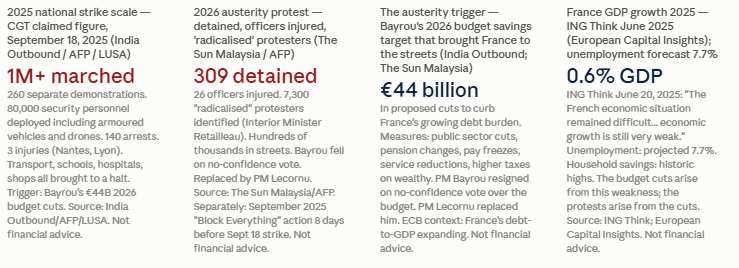
2026 France austerity protest key data: Budget trigger: Bayrou's €44 billion savings package for 2026 budget, aimed at curbing France's high debt. PM Bayrou: resigned after no-confidence vote over the budget. Replaced by PM Sébastien Lecornu. (India Outbound; The Sun Malaysia.) Sept 18, 2025 national strike: CGT claimed 1M+ in demonstrations; 260 protests; 140 arrests; 80,000 security personnel deployed including armoured vehicles and drones; transport, schools, hospitals, shops all impacted. (India Outbound/AFP/LUSA.) 2026 protest: 309 detained; 7,300 'radicalised' protesters (Interior Minister); 26 officers injured; hundreds of thousands in streets. (The Sun Malaysia/AFP.) Not financial advice.
These are not abstract numbers. For French households, the proposed cuts represent real risks to everyday personal finance. Public sector workers face potential job losses and pay freezes. The pension system — already contested through the 2023 pension reform crisis — faces further pressure. Hospital capacity reductions affect healthcare access. School staffing cuts affect childcare costs for working parents. And the proposed higher taxes on wealthy individuals have implications for investment planning by higher-income residents. The trade unions (CGT, led by Sophie Binet; CFDT and others) have specifically framed their opposition around protecting wages, pensions, and public services. Sophie Larchet, a 60-year-old Paris civil servant who joined the protests, captured the general sentiment: ‘We’ve had enough, he’s tormenting France.’ Bruno Cavalier, 64, in Lyon: ‘Every day the richest get richer and the poor get poorer.’ (The Sun Malaysia, 2026.)
For non-French residents and tourists, the €44 billion cuts are less directly personal but still financially relevant: cuts to tourism infrastructure, transport subsidies, and public amenities directly affect the quality and cost of visiting France. Not financial advice.
The 2026 protest cycle continued this scale. The Sun Malaysia (citing AFP) reported hundreds of thousands in the streets in a ‘nationwide day of anger against Macron.’ 309 people detained. 26 officers injured. Interior Minister Bruno Retailleau identified 7,300 ‘radicalised’ protesters among the demonstrators. The previous mobilisation — the ‘Block Everything’ day of September 10, 2025 — preceded the September 18 strike by just eight days, demonstrating the frequency and velocity of the protest cycle.
For anyone with a France holiday, business trip, or connecting flight scheduled during this cycle, the disruption is not hypothetical. On September 18, 2025, India Outbound reported that ‘services of local as well as national public transport, including buses, metros, regional and national rail services have been severely impacted.’ Airports can be affected by transport strikes even if air traffic control is not directly involved. Not financial advice.
On Record: India Outbound / AFP / LUSA (September 18, 2025): 'Large-scale demonstrations across France, in protest against the economic policies of the government and especially the budget for the year 2026, have brought the country to a grinding halt as transport services as well as schools, hospitals and even shops are severely impacted by the strike... This is said to be one of the largest [strikes] in recent years.' CGT leader Sophie Binet: 'We have recorded 260 demonstrations across France.' (The Sun Malaysia, 2026.)
Sébastien Lecornu, Bayrou’s replacement, has committed to dialogue with trade unions and indicated the budget proposals are under review. But the structural fiscal pressures that generated the €44 billion savings requirement have not disappeared — they arise from France’s debt levels and its obligations within the EU Stability and Growth Pact. Any incoming PM faces the same arithmetic: France needs to reduce its deficit, and there is no politically painless way to do that. The difference between governments is the sequencing and composition of cuts, not their existence.
For investors, the political instability premium matters. A government that is uncertain about its own survival spends less time on growth-enabling reform and more time managing political crises. France’s CAC 40 contains companies that depend on domestic policy stability for their business environment. Lecornu’s mandate, and the direction of the budget, remains a live political variable that will continue to affect market sentiment into 2027. Not financial advice.
These are not separate from the protest cycle — they cause it. France’s economic weakness fuels the social frustration that drives the protests. The protests then damage confidence, tourism, and investment, which weakens the economy further. This feedback loop — weak growth → austerity cuts → protests → disruption → weaker growth → more austerity — is France’s central economic policy challenge of 2025–26.
For investors in European equities, this backdrop means France is not currently a growth driver within the eurozone. Germany’s own difficulties plus France’s structural problems create a drag on European equity performance relative to the US market. The CAC 40 contains world-class companies (LVMH, Hermès, TotalEnergies, BNP Paribas, Sanofi) that operate globally and whose share prices are not solely determined by French domestic conditions. But the macro environment matters for sentiment and for domestically-focused businesses. Not financial advice.
The September 18, 2025 strike took out ‘local as well as national public transport, including buses, metros, regional and national rail services’ (India Outbound). For a family arriving at Charles de Gaulle airport on a strike day, getting to central Paris becomes a taxi or private hire cost of €80–€150 rather than the €11 RER-B fare. Multiply that by four people and two journeys (arrival and departure) and a “small disruption” costs approximately €320–€600 extra on a family holiday that had budgeted for public transport.
Additionally, school closures during strike days affect families with children travelling during French school holiday periods. Museum and attraction openings can be reduced. Some French businesses and restaurants close or operate with skeleton staff. The disruption is real and it costs money even when it does not make the front page. Not financial or travel advice.
Travel planning for 2026 France visits: (1) Check CGT and major union strike calendars before booking travel dates. Strikes are typically announced 5-10 days in advance at www.cgt.fr and reported by SNCF and RATP. (2) Book flexible rail tickets (SNCF Flexi fare) rather than non-refundable promo fares if a strike period is possible. Price difference is typically €15-30 per person but worth it. (3) Budget €100-200 per person per trip for transport contingency (taxis, private hire, car hire) in case of strike-day arrival/departure. (4) Stay accommodation with good walkability to central Paris reduces dependency on public transport. (5) For long-haul and international connections via CDG: allow an extra day's buffer if arriving during a known strike period. French air traffic control strikes have grounded significant proportions of flights historically. Not travel advice. Check FCDO/State Dept advisory.
Standard travel insurance covers industrial action only if the policy specifically includes it and the disruption was ‘not foreseeable’ at the time of booking. In 2026, with France’s strike cycle generating news coverage and government notices, a strike that is clearly foreseeable — which the austerity-driven trade union actions of 2025–26 certainly are, in general if not specifically — may be excluded from standard ‘disruption’ cover. This is the critical difference from the 2023 riots: riots are typically unforeseeable and may be covered under some policies; a trade union strike during a documented austerity protest cycle is foreseeable, which weakens the insurance coverage argument.
The solution is the same: a Cancel For Any Reason (CFAR) add-on provides genuine flexibility regardless of the cause of disruption. Premium annual travel insurance policies from comprehensive providers may include industrial action cover. The key is to check the specific wording before booking non-refundable travel to France. Not financial or insurance advice.
2026 France insurance gap: two distinct coverage exclusion categories: (1) CIVIL UNREST/RIOT: most standard policies exclude. Allianz note (CNN July 2023) confirmed this for the business context. (2) INDUSTRIAL ACTION (STRIKES): most standard policies exclude disruption caused by strikes, especially 'foreseeable' ones. In 2026, France's austerity protest cycle is highly foreseeable — CGT has been calling national strikes since September 2025. A 'foreseeable' strike almost certainly falls outside standard travel disruption cover. TO BE COVERED: (a) Cancel For Any Reason (CFAR) add-on. (b) Premium comprehensive policy with explicit industrial action clause. (c) Check Section 75 (UK credit card) for bookings over £100 — provides additional protection. Not insurance advice. Always read your policy.
The fall of PM Bayrou on a no-confidence vote is the kind of political event that adds a risk premium to French sovereign bonds (the ‘OAT-Bund spread’ — the gap between French and German government bond yields) and creates uncertainty for businesses that depend on stable government policy. A wider OAT-Bund spread means France’s borrowing costs rise, reducing fiscal flexibility, which can pressure the euro and create a drag on French equity valuations. This is a slower-burning dynamic than a stock crash on riot day, but it compounds over months.
For UK and US investors in European equity funds or CAC 40 ETFs, the practical exposure is modest in most diversified portfolios (France is approximately 3–4% of a global tracker). But investors with specific French stock positions or heavily Europe-weighted funds should be aware that the combination of weak GDP growth (0.6%), rising unemployment (7.7%), sustained protest disruption, and political instability creates a structurally unfavourable environment for French domestic equities through 2026–2027. Not financial advice.
Investment Angle: 2026 France investment context: (1) OAT-Bund spread: France's 10-year government bond yield vs Germany's. Bayrou no-confidence vote and austerity protest cycle widen this spread — watch for it as a market stress indicator. (2) Sector exposure: tourism/hospitality (Accor), airlines (Air France-KLM), retail, and French domestic financials (BNP Paribas) carry the highest direct unrest and austerity risk. (3) Global French companies: LVMH, Hermès, TotalEnergies, Sanofi — derive most revenue internationally. Less exposed to domestic disruption, though Champs-Élysées flagship stores are in riot-risk zones. (4) CAC 40 overall: NOT a reliable proxy for domestic unrest impact in short episodes. (5) MACRO: France GDP 0.6% (2025), unemployment 7.7% (ING Think) -- a sustained drag that affects long-term CAC 40 return relative to S&P 500. Not investment advice.
For 2026, the combination of the Bayrou no-confidence vote, the austerity protest cycle, GDP growth of 0.6%, and the ECB’s evolving rate trajectory creates a specific EUR/GBP dynamic. If the ECB is cutting rates faster than the Bank of England (BoE) — to support a weaker eurozone economy — EUR/GBP declines, making France cheaper for UK travellers but reducing the sterling value of euro-denominated assets. In 2026, UK travellers are spending more sterling value per euro than in 2021–22 when the euro was weaker; if the ECB cuts further, that dynamic could partially reverse.
For personal holiday budgeting: use a low-fee travel card (Wise, Revolut, Starling) rather than airport bureau de change. In October 2026, airport exchange margins are typically 5–6% above the mid-market rate. On €800 in holiday spending, that is £40–48 in pure margin costs — approximately the cost of two Paris restaurant meals. Not financial or currency advice.
For UK and US tourists visiting France in 2026, the practical effect is a modest increase in the cost of a France holiday relative to pre-austerity baselines. Paris was already Europe’s most expensive city for tourists by many measures; the squeeze on public services adds friction without adding value. Visitors who budgeted for a France holiday based on 2023 or 2024 prices should build in 5–10% additional contingency for 2026, reflecting both the inflationary trend and the disruption premium of the current political and social environment. Not financial advice.
The personal finance consequences are real and specific: transport strikes disrupt arrivals and departures at significant cost; standard travel insurance increasingly fails to cover foreseeable strikes; non-refundable bookings become losses; stocks in French tourism, retail, and transport bear episodic sector damage; and France’s GDP growth of 0.6% (ING Think 2025) means the macro environment for French equities is genuinely unfavourable. None of this is catastrophic for a well-prepared traveller or investor. All of it is financially costly for someone who has not accounted for it.
The good news: unlike the spontaneous Nahel riots, the 2026 austerity protest cycle is structured, announced, and navigable. Strike dates are known in advance. Flexible bookings are available. Insurance solutions exist. Currency management is accessible through low-fee apps. The €44 billion in budget cuts has a personal finance footnote — and it is legible for anyone who takes the time to read it. Not financial, travel, or insurance advice. Consult qualified professionals for decisions specific to your situation.
The 2025-2026 French protest cycle was triggered by the Bayrou government's proposed 2026 budget, which included approximately €44 billion in savings to address France's growing debt burden. The measures proposed included public sector cuts, pension changes, pay freezes, and reductions in public services. Prime Minister François Bayrou resigned after a vote of no-confidence in the French parliament over the budget and was replaced by Sébastien Lecornu. (India Outbound; The Sun Malaysia.) Scale: the CGT trade union reported more than one million people in demonstrations on September 18, 2025 alone — 260 separate demonstrations across France (India Outbound/AFP/LUSA). The 2026 protest cycle saw 309 detained, 26 officers injured, and hundreds of thousands in the streets in a single day of nationwide action (The Sun Malaysia/AFP). Not financial advice.
How do France’s 2026 protests affect travel insurance differently from the 2023 riots?
There is a critical distinction: the 2023 Nahel riots were largely spontaneous and unforeseeable. Most travel insurance policies exclude civil unrest but the unforeseeable nature of a spontaneous riot created some ambiguity in some policies. The 2025-26 austerity protest cycle is organised, announced in advance, and clearly foreseeable. In 2026, standard travel insurance policies exclude two relevant events: (1) civil unrest/riots (as in 2023); and (2) industrial action — typically excluded when strikes are 'foreseeable.' Because France's strike cycle is well-publicised and ongoing, any disruption from a CGT national strike is likely to be considered 'foreseeable' by most insurers, making standard disruption cover harder to claim. The solution: Cancel For Any Reason (CFAR) add-on; a premium policy with explicit industrial action cover; Section 75 credit card protection for UK bookings over £100. Not insurance advice. Always read your policy terms.
Is it safe to travel to France in 2026?
This article does not provide travel safety advice. For current guidance, consult the official UK FCDO travel advisory at www.gov.uk/foreign-travel-advice/france or the US State Department at travel.state.gov. These are updated in real time. What can be stated from a financial preparation perspective: France's 2026 protest cycle is centred on organised labour action (strikes) rather than spontaneous riots. The transport disruption risk is high on announced strike days; the physical safety risk of organised marches is generally lower than riot situations. However, some 2026 demonstrations have included violence (7,300 'radicalised' protesters identified by Interior Minister Retailleau; The Sun Malaysia). The practical personal finance preparation — flexible bookings, CFAR insurance, transport contingency budget, accessible emergency funds — is the same regardless of safety level. Check current advisories before travel.
What is the OAT-Bund spread and why does it matter for investors?
The OAT-Bund spread is the difference between French government 10-year bond yields (OAT = Obligations Assimilables du Trésor) and German government 10-year bond yields (Bunds). Germany's bonds are considered the eurozone's risk-free benchmark; France's spread over Germany reflects the market's assessment of France's additional fiscal and political risk. When political instability increases (as in the Bayrou no-confidence vote), or when fiscal risk rises (as with the €44B austerity debate), the OAT-Bund spread widens — meaning France pays higher interest rates to borrow money. A wider spread: (1) increases France's borrowing costs, reducing fiscal flexibility; (2) signals investor concern about French assets generally; (3) can create modest EUR pressure; (4) adds a risk premium to French equity valuations. For most retail investors with a diversified global tracker, this is a background variable. For investors with significant France-specific equity or bond exposure, it is a key monitoring indicator. Not investment advice.
What is the personal finance impact of France’s austerity cuts on French residents?
For French residents (as opposed to visitors), the €44 billion austerity package proposed by the Bayrou government affects personal finances across multiple dimensions: (1) Public sector workers face potential job losses, pay freezes, or reduced terms and conditions. (2) Pension system: further pressure on the already-contested retirement system, potentially affecting when workers can retire and at what income level. (3) Healthcare: hospital capacity reductions affect accessibility and potentially out-of-pocket costs for care. (4) Education: school staffing cuts affect childcare and educational support for families. (5) Social benefits: potential reductions in housing benefit, child support, or other welfare transfers. (6) Tax changes: proposed higher taxes on wealthy individuals affect capital gains, wealth holdings, and investment planning. These are the grievances that have mobilised the trade unions and millions of marchers. For financial planning by French residents, the uncertainty about the final budget composition — still under Lecornu's review as of October 2026 — makes specific planning difficult. Not financial or tax advice.
Table of Contents
- What’s Different About 2026: The Austerity Trigger
- The €44 Billion Budget: What Macron’s Government Is Cutting
- The Protests: How Big Are They and How Disruptive?
- The Political Earthquake: Bayrou Falls, Lecornu Takes Over
- France’s Economic Backdrop: A Fragile Foundation
- Impact 1: Your Holiday and Travel Plans in 2026
- Impact 2: Travel Insurance — Still the Gap Nobody Fixes
- Impact 3: French Stocks and European Investments
- Impact 4: The Euro and Your Holiday Money
- The Cost-of-Living Dimension: What Austerity Does to Prices
- Comparing 2026 to Prior Episodes: What’s New, What’s the Same
- What You Can Do: Seven Personal Finance Steps for 2026
- Conclusion: €44 Billion in Cuts Has a Personal Finance Footnote
- Frequently Asked Questions
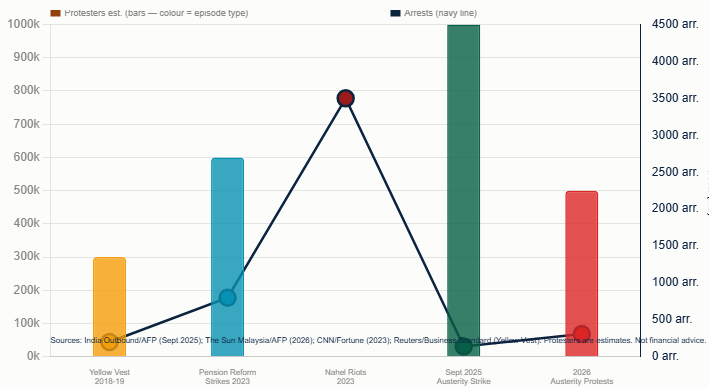
2026 vs history — protest scale and economic damage
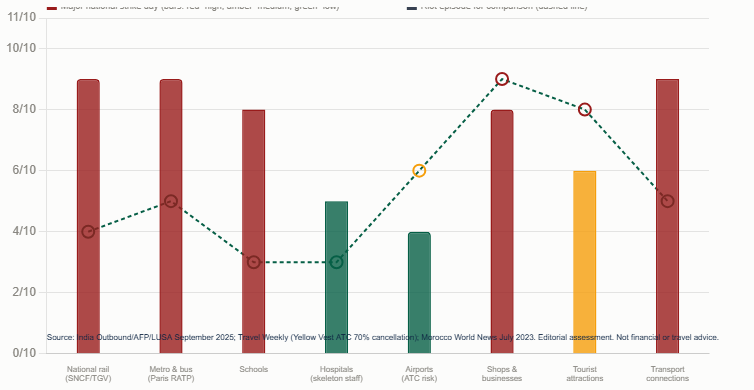
Travel disruption map — what strikes actually close
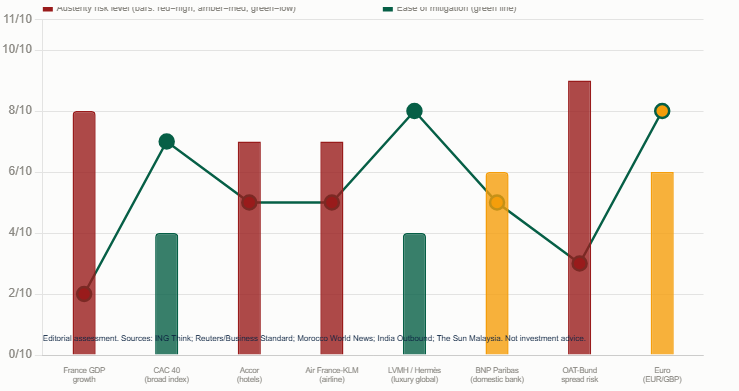
Investor risk matrix — French assets in the austerity cycle
What’s Different About 2026: The Austerity Trigger
The civil unrest in France in 2025–2026 is qualitatively different from prior episodes in one important respect: it is driven by austerity. The Yellow Vest movement (2018–19) was triggered by a fuel tax hike on working-class drivers. The 2023 Nahel riots were triggered by a police shooting. The 2025–26 wave of protests and strikes is driven by a government budget — François Bayrou’s proposed 2026 budget package — that proposed approximately €44 billion in savings to address France’s growing debt burden. Teachers, nurses, train drivers, pharmacists, students, and trade unionists are all on the same side of this argument: the €44 billion must not be cut from public services, pensions, and wages.That distinction matters for personal finance analysis. Austerity-driven unrest is broader, more organised, and more sustained than riot-driven unrest. When the CGT trade union (France’s largest and most militant) calls a national strike, transport shuts down. When a million people march, airports empty. When trade unions call a ‘Block Everything’ day, shops, schools, hospitals, and public transport are simultaneously affected. The disruption footprint of 2026-style organised labour action is wider and more predictable than the spontaneous violence of the 2023 Nahel riots — and therefore more plannable from a personal finance perspective. Not financial advice.
2026 France austerity protest key data: Budget trigger: Bayrou's €44 billion savings package for 2026 budget, aimed at curbing France's high debt. PM Bayrou: resigned after no-confidence vote over the budget. Replaced by PM Sébastien Lecornu. (India Outbound; The Sun Malaysia.) Sept 18, 2025 national strike: CGT claimed 1M+ in demonstrations; 260 protests; 140 arrests; 80,000 security personnel deployed including armoured vehicles and drones; transport, schools, hospitals, shops all impacted. (India Outbound/AFP/LUSA.) 2026 protest: 309 detained; 7,300 'radicalised' protesters (Interior Minister); 26 officers injured; hundreds of thousands in streets. (The Sun Malaysia/AFP.) Not financial advice.
The €44 Billion Budget: What Macron’s Government Is Cutting
The Bayrou government’s 2026 budget proposed €44 billion in savings — one of the largest fiscal consolidation efforts France has attempted in the modern era. The specific measures, as outlined by India Outbound (September 2025) and The Sun Malaysia (2026 coverage), include public sector cuts, pay freezes, pension changes, higher taxes on the wealthy, and reductions in public service spending across schools, hospitals, and social services.These are not abstract numbers. For French households, the proposed cuts represent real risks to everyday personal finance. Public sector workers face potential job losses and pay freezes. The pension system — already contested through the 2023 pension reform crisis — faces further pressure. Hospital capacity reductions affect healthcare access. School staffing cuts affect childcare costs for working parents. And the proposed higher taxes on wealthy individuals have implications for investment planning by higher-income residents. The trade unions (CGT, led by Sophie Binet; CFDT and others) have specifically framed their opposition around protecting wages, pensions, and public services. Sophie Larchet, a 60-year-old Paris civil servant who joined the protests, captured the general sentiment: ‘We’ve had enough, he’s tormenting France.’ Bruno Cavalier, 64, in Lyon: ‘Every day the richest get richer and the poor get poorer.’ (The Sun Malaysia, 2026.)
For non-French residents and tourists, the €44 billion cuts are less directly personal but still financially relevant: cuts to tourism infrastructure, transport subsidies, and public amenities directly affect the quality and cost of visiting France. Not financial advice.
The Protests: How Big Are They and How Disruptive?
The scale of the 2025–26 French protests is significant by any historical benchmark. On September 18, 2025, India Outbound (citing AFP and LUSA) reported that the CGT trade union claimed ‘more than one million people’ participated in demonstrations across France — 260 separate protests. The French government deployed 80,000 police officers and gendarmes, including riot police, drones, and armoured vehicles. At least 140 people were arrested. At least three people were injured in Nantes and Lyon. The disruption was comprehensive: buses and metros cancelled, regional rail suspended, national rail severely impacted, schools closed, hospitals on skeleton staff.The 2026 protest cycle continued this scale. The Sun Malaysia (citing AFP) reported hundreds of thousands in the streets in a ‘nationwide day of anger against Macron.’ 309 people detained. 26 officers injured. Interior Minister Bruno Retailleau identified 7,300 ‘radicalised’ protesters among the demonstrators. The previous mobilisation — the ‘Block Everything’ day of September 10, 2025 — preceded the September 18 strike by just eight days, demonstrating the frequency and velocity of the protest cycle.
For anyone with a France holiday, business trip, or connecting flight scheduled during this cycle, the disruption is not hypothetical. On September 18, 2025, India Outbound reported that ‘services of local as well as national public transport, including buses, metros, regional and national rail services have been severely impacted.’ Airports can be affected by transport strikes even if air traffic control is not directly involved. Not financial advice.
On Record: India Outbound / AFP / LUSA (September 18, 2025): 'Large-scale demonstrations across France, in protest against the economic policies of the government and especially the budget for the year 2026, have brought the country to a grinding halt as transport services as well as schools, hospitals and even shops are severely impacted by the strike... This is said to be one of the largest [strikes] in recent years.' CGT leader Sophie Binet: 'We have recorded 260 demonstrations across France.' (The Sun Malaysia, 2026.)
The Political Earthquake: Bayrou Falls, Lecornu Takes Over
Prime Minister François Bayrou’s resignation following a vote of no-confidence in the French parliament over his 2026 budget represents the most politically significant disruption in this cycle. No-confidence votes bringing down a French government are rare — this was only the second time since the Fifth Republic was established in 1958 that a PM had been removed on a no-confidence vote. The political instability this creates has direct economic and financial market consequences.Sébastien Lecornu, Bayrou’s replacement, has committed to dialogue with trade unions and indicated the budget proposals are under review. But the structural fiscal pressures that generated the €44 billion savings requirement have not disappeared — they arise from France’s debt levels and its obligations within the EU Stability and Growth Pact. Any incoming PM faces the same arithmetic: France needs to reduce its deficit, and there is no politically painless way to do that. The difference between governments is the sequencing and composition of cuts, not their existence.
For investors, the political instability premium matters. A government that is uncertain about its own survival spends less time on growth-enabling reform and more time managing political crises. France’s CAC 40 contains companies that depend on domestic policy stability for their business environment. Lecornu’s mandate, and the direction of the budget, remains a live political variable that will continue to affect market sentiment into 2027. Not financial advice.
France’s Economic Backdrop: A Fragile Foundation
The austerity protests and political instability are occurring against a weak economic backdrop that amplifies their personal finance consequences. ING Think’s June 2025 analysis projects GDP growth of just 0.6% for France in 2025 — barely above stagnation. Unemployment is projected to rise to 7.7% (ING Think). The June 20 ING Think report stated directly: ‘The French economic situation remained difficult at the end of the second quarter, and economic growth is still very weak.’These are not separate from the protest cycle — they cause it. France’s economic weakness fuels the social frustration that drives the protests. The protests then damage confidence, tourism, and investment, which weakens the economy further. This feedback loop — weak growth → austerity cuts → protests → disruption → weaker growth → more austerity — is France’s central economic policy challenge of 2025–26.
For investors in European equities, this backdrop means France is not currently a growth driver within the eurozone. Germany’s own difficulties plus France’s structural problems create a drag on European equity performance relative to the US market. The CAC 40 contains world-class companies (LVMH, Hermès, TotalEnergies, BNP Paribas, Sanofi) that operate globally and whose share prices are not solely determined by French domestic conditions. But the macro environment matters for sentiment and for domestically-focused businesses. Not financial advice.
Impact 1: Your Holiday and Travel Plans in 2026
For UK and international travellers, the 2026 austerity protest cycle creates a distinct and in some ways more predictable travel disruption risk than the spontaneous 2023 Nahel riots. Trade union strikes are typically announced in advance — often a week or more ahead of the action. This gives travellers warning. The practical disruption is concentrated in transport: trains, metros, buses, and sometimes airports (if aviation workers join the action) are shut down or severely reduced on strike days.The September 18, 2025 strike took out ‘local as well as national public transport, including buses, metros, regional and national rail services’ (India Outbound). For a family arriving at Charles de Gaulle airport on a strike day, getting to central Paris becomes a taxi or private hire cost of €80–€150 rather than the €11 RER-B fare. Multiply that by four people and two journeys (arrival and departure) and a “small disruption” costs approximately €320–€600 extra on a family holiday that had budgeted for public transport.
Additionally, school closures during strike days affect families with children travelling during French school holiday periods. Museum and attraction openings can be reduced. Some French businesses and restaurants close or operate with skeleton staff. The disruption is real and it costs money even when it does not make the front page. Not financial or travel advice.
Travel planning for 2026 France visits: (1) Check CGT and major union strike calendars before booking travel dates. Strikes are typically announced 5-10 days in advance at www.cgt.fr and reported by SNCF and RATP. (2) Book flexible rail tickets (SNCF Flexi fare) rather than non-refundable promo fares if a strike period is possible. Price difference is typically €15-30 per person but worth it. (3) Budget €100-200 per person per trip for transport contingency (taxis, private hire, car hire) in case of strike-day arrival/departure. (4) Stay accommodation with good walkability to central Paris reduces dependency on public transport. (5) For long-haul and international connections via CDG: allow an extra day's buffer if arriving during a known strike period. French air traffic control strikes have grounded significant proportions of flights historically. Not travel advice. Check FCDO/State Dept advisory.
Impact 2: Travel Insurance — Still the Gap Nobody Fixes
The same insurance gap documented during the 2023 Nahel riots applies equally in 2026 — and in some ways more acutely, because organised strikes introduce a different category of disruption to the spontaneous riot scenario. Allianz Global Corporate & Specialty warned during the 2023 riots that ‘business interruption losses from vandalism, looting and potential curfews are unlikely to be covered by the French state’ (CNN July 2023). But organised strikes introduce a new layer: flight cancellations, train cancellations, and accommodation costs caused by industrial action are excluded from most standard travel insurance policies under a separate ‘industrial action’ exclusion clause.Standard travel insurance covers industrial action only if the policy specifically includes it and the disruption was ‘not foreseeable’ at the time of booking. In 2026, with France’s strike cycle generating news coverage and government notices, a strike that is clearly foreseeable — which the austerity-driven trade union actions of 2025–26 certainly are, in general if not specifically — may be excluded from standard ‘disruption’ cover. This is the critical difference from the 2023 riots: riots are typically unforeseeable and may be covered under some policies; a trade union strike during a documented austerity protest cycle is foreseeable, which weakens the insurance coverage argument.
The solution is the same: a Cancel For Any Reason (CFAR) add-on provides genuine flexibility regardless of the cause of disruption. Premium annual travel insurance policies from comprehensive providers may include industrial action cover. The key is to check the specific wording before booking non-refundable travel to France. Not financial or insurance advice.
2026 France insurance gap: two distinct coverage exclusion categories: (1) CIVIL UNREST/RIOT: most standard policies exclude. Allianz note (CNN July 2023) confirmed this for the business context. (2) INDUSTRIAL ACTION (STRIKES): most standard policies exclude disruption caused by strikes, especially 'foreseeable' ones. In 2026, France's austerity protest cycle is highly foreseeable — CGT has been calling national strikes since September 2025. A 'foreseeable' strike almost certainly falls outside standard travel disruption cover. TO BE COVERED: (a) Cancel For Any Reason (CFAR) add-on. (b) Premium comprehensive policy with explicit industrial action clause. (c) Check Section 75 (UK credit card) for bookings over £100 — provides additional protection. Not insurance advice. Always read your policy.
Impact 3: French Stocks and European Investments
The stock market dynamics of austerity-driven unrest differ from riot-driven unrest. The 2023 Nahel riots produced sharp, short-duration sector-specific falls (Accor −1.6%, Air France −2.7% in a day — Reuters December 2018 during Yellow Vest; similar patterns in 2023). Austerity protests and political instability produce a different pattern: sustained pressure on domestically-exposed businesses, uncertainty about the fiscal policy environment, and a political risk premium that weighs on French assets over a longer period.The fall of PM Bayrou on a no-confidence vote is the kind of political event that adds a risk premium to French sovereign bonds (the ‘OAT-Bund spread’ — the gap between French and German government bond yields) and creates uncertainty for businesses that depend on stable government policy. A wider OAT-Bund spread means France’s borrowing costs rise, reducing fiscal flexibility, which can pressure the euro and create a drag on French equity valuations. This is a slower-burning dynamic than a stock crash on riot day, but it compounds over months.
For UK and US investors in European equity funds or CAC 40 ETFs, the practical exposure is modest in most diversified portfolios (France is approximately 3–4% of a global tracker). But investors with specific French stock positions or heavily Europe-weighted funds should be aware that the combination of weak GDP growth (0.6%), rising unemployment (7.7%), sustained protest disruption, and political instability creates a structurally unfavourable environment for French domestic equities through 2026–2027. Not financial advice.
Investment Angle: 2026 France investment context: (1) OAT-Bund spread: France's 10-year government bond yield vs Germany's. Bayrou no-confidence vote and austerity protest cycle widen this spread — watch for it as a market stress indicator. (2) Sector exposure: tourism/hospitality (Accor), airlines (Air France-KLM), retail, and French domestic financials (BNP Paribas) carry the highest direct unrest and austerity risk. (3) Global French companies: LVMH, Hermès, TotalEnergies, Sanofi — derive most revenue internationally. Less exposed to domestic disruption, though Champs-Élysées flagship stores are in riot-risk zones. (4) CAC 40 overall: NOT a reliable proxy for domestic unrest impact in short episodes. (5) MACRO: France GDP 0.6% (2025), unemployment 7.7% (ING Think) -- a sustained drag that affects long-term CAC 40 return relative to S&P 500. Not investment advice.
Impact 4: The Euro and Your Holiday Money
Political instability and sustained fiscal uncertainty weaken the euro, primarily through the OAT-Bund spread mechanism and reduced investor confidence in French assets. The Yellow Vest movement created sustained EUR/GBP and EUR/USD pressure through late 2018. Finance Minister Le Maire noted it ‘knocked 0.1 percentage points off France’s GDP this quarter’ (Euronews December 2018) — a figure that signals macro drag, which in turn feeds into currency weakness.For 2026, the combination of the Bayrou no-confidence vote, the austerity protest cycle, GDP growth of 0.6%, and the ECB’s evolving rate trajectory creates a specific EUR/GBP dynamic. If the ECB is cutting rates faster than the Bank of England (BoE) — to support a weaker eurozone economy — EUR/GBP declines, making France cheaper for UK travellers but reducing the sterling value of euro-denominated assets. In 2026, UK travellers are spending more sterling value per euro than in 2021–22 when the euro was weaker; if the ECB cuts further, that dynamic could partially reverse.
For personal holiday budgeting: use a low-fee travel card (Wise, Revolut, Starling) rather than airport bureau de change. In October 2026, airport exchange margins are typically 5–6% above the mid-market rate. On €800 in holiday spending, that is £40–48 in pure margin costs — approximately the cost of two Paris restaurant meals. Not financial or currency advice.
The Cost-of-Living Dimension: What Austerity Does to Prices
The €44 billion austerity package has a direct cost-of-living dimension that affects both French residents and visitors. Public transport subsidies, when cut, raise fares. VAT changes on food and services, if implemented, raise restaurant and shop prices. Reductions in tourism promotion budgets reduce the quality of the visitor experience. Energy price subsidies that France has used since the 2022 energy crisis may be reduced, pushing utility costs higher for hotels and restaurants — who pass those costs to customers.For UK and US tourists visiting France in 2026, the practical effect is a modest increase in the cost of a France holiday relative to pre-austerity baselines. Paris was already Europe’s most expensive city for tourists by many measures; the squeeze on public services adds friction without adding value. Visitors who budgeted for a France holiday based on 2023 or 2024 prices should build in 5–10% additional contingency for 2026, reflecting both the inflationary trend and the disruption premium of the current political and social environment. Not financial advice.
Comparing 2026 to Prior Episodes: What’s New, What’s the Same
| Episode | Trigger | Scale | Duration | Tourism impact | Stock impact | Key economic figure | Personal finance risk |
| Yellow Vest 2018-19 | Fuel tax hike on working-class motorists | Nationwide; up to 10,000+ in Paris each weekend | 4+ months of weekly protests | Hotels -15-25%; restaurants -20-50% | Accor -1.6%; Air France -2.7%; CAC 40 +1.7% | GDP: -0.1pp this quarter (Le Maire); retailer losses ~€1B pre-Xmas | Long-duration travel risk; sustained currency pressure |
| 2023 Pension Reform Protests | Retirement age increase from 62 to 64 | Largest strikes in a decade; millions on streets | Months of industrial action | Tourism disruption; Paris visits impacted | CAC 40 moderately affected; sector stocks weaker | Widespread business interruption across multiple sectors | Strike disruption to France visits; non-refundable booking risk |
| 2023 Nahel Riots | Fatal police shooting of Nahel Merzouk, 17 | Nationwide; worst Paris riots in decades | ~1 week acute; then declining | 20-25% Paris trip cancellations (MEDEF) | Sector-specific falls; Accor/Air France type pattern | €1B+ in business damage; 200 shops looted; 300 bank branches destroyed (MEDEF; Morocco World News) | One-week acute risk; insurance gap critical; non-refundable losses |
| 2025-26 Austerity Protests | €44B budget cuts; pension/wage/service reductions | 1M+ on streets (CGT Sept 2025); 260 demonstrations | Ongoing through 2026+ | Transport strikes = disrupted arrivals/departures | OAT-Bund spread pressure; political risk premium | GDP 0.6% (ING Think 2025); PM fell on no-confidence vote; 309 detained 2026 | Transport strike disruption; foreseeable = worse insurance coverage; holiday budget cost-of-living impact |
What You Can Do: Seven Personal Finance Steps for 2026
The recurring nature of French civil unrest in 2025–26, combined with its structural economic roots, means that this is not a situation to ‘wait out’ and then reassess. The personal finance steps that protect you from this environment are straightforward and most of them cost relatively little to implement. Not financial advice.- Check strike dates before booking travel. French trade unions announce major strike actions on their websites (CGT: cgt.fr; SNCF and RATP publish disruption notices). If you are booking France travel for 2026–27, check whether there is an active industrial action period. Booking on a known strike date is avoidable with basic research.
- Choose flexible fares and refundable bookings. SNCF TGV Lyria, Eurostar, and Air France all offer flexible or exchangeable fares at modest premium. On a £600-per-person trip, spending £20–30 extra on a refundable fare is a cheap hedge against a strike-day disruption.
- Review your travel insurance specifically for industrial action and civil unrest. Standard policies often exclude both. In 2026, with France’s protest cycle clearly ongoing, any disruption from strikes is arguably ‘foreseeable’ and therefore excluded from standard disruption cover. A Cancel For Any Reason (CFAR) add-on is the most reliable solution.
- Budget a transport contingency. On a family Paris holiday, budget €150–€250 per person trip for strike-day alternative transport (taxis, Uber, private hire). If you need it, you have it. If you don’t, it stays in your pocket.
- For investments: review your European equity exposure. France-specific sector stocks (Accor, Air France-KLM, domestic French retail) carry unrest and austerity risk. For most diversified index fund investors, this is a small-percentage exposure that requires no action. For concentrated European fund holders, the ING Think GDP 0.6% / 7.7% unemployment backdrop is a structural underperformance argument.
- Currency planning: use Wise, Revolut, or Starling for euro conversion. Do not buy holiday euros at the airport or at high-street bureau de change, especially during protest periods when the euro may be under modest pressure. Convert in smaller tranches using the app to get market-rate exchange.
- Keep your emergency fund accessible from abroad. One credit card with no foreign transaction fees and one travel card ensures that if disruption creates unexpected costs (extended hotel stay, rebooking flight, emergency transport), you are not restricted to the cash in your wallet. Not financial advice.
Conclusion
France’s 2025–26 austerity protest cycle is different from what came before it. It is driven by a specific, documented fiscal trigger: €44 billion in proposed budget savings that the French public, its trade unions, and ultimately its parliament — which removed Prime Minister Bayrou on a no-confidence vote — have rejected. More than one million people marched in September 2025 (CGT). Hundreds of thousands in 2026. Schools, hospitals, transport, and shops brought to a halt on multiple national strike days.The personal finance consequences are real and specific: transport strikes disrupt arrivals and departures at significant cost; standard travel insurance increasingly fails to cover foreseeable strikes; non-refundable bookings become losses; stocks in French tourism, retail, and transport bear episodic sector damage; and France’s GDP growth of 0.6% (ING Think 2025) means the macro environment for French equities is genuinely unfavourable. None of this is catastrophic for a well-prepared traveller or investor. All of it is financially costly for someone who has not accounted for it.
The good news: unlike the spontaneous Nahel riots, the 2026 austerity protest cycle is structured, announced, and navigable. Strike dates are known in advance. Flexible bookings are available. Insurance solutions exist. Currency management is accessible through low-fee apps. The €44 billion in budget cuts has a personal finance footnote — and it is legible for anyone who takes the time to read it. Not financial, travel, or insurance advice. Consult qualified professionals for decisions specific to your situation.
Frequently Asked Questions
What triggered France’s 2026 protests and how big are they?The 2025-2026 French protest cycle was triggered by the Bayrou government's proposed 2026 budget, which included approximately €44 billion in savings to address France's growing debt burden. The measures proposed included public sector cuts, pension changes, pay freezes, and reductions in public services. Prime Minister François Bayrou resigned after a vote of no-confidence in the French parliament over the budget and was replaced by Sébastien Lecornu. (India Outbound; The Sun Malaysia.) Scale: the CGT trade union reported more than one million people in demonstrations on September 18, 2025 alone — 260 separate demonstrations across France (India Outbound/AFP/LUSA). The 2026 protest cycle saw 309 detained, 26 officers injured, and hundreds of thousands in the streets in a single day of nationwide action (The Sun Malaysia/AFP). Not financial advice.
How do France’s 2026 protests affect travel insurance differently from the 2023 riots?
There is a critical distinction: the 2023 Nahel riots were largely spontaneous and unforeseeable. Most travel insurance policies exclude civil unrest but the unforeseeable nature of a spontaneous riot created some ambiguity in some policies. The 2025-26 austerity protest cycle is organised, announced in advance, and clearly foreseeable. In 2026, standard travel insurance policies exclude two relevant events: (1) civil unrest/riots (as in 2023); and (2) industrial action — typically excluded when strikes are 'foreseeable.' Because France's strike cycle is well-publicised and ongoing, any disruption from a CGT national strike is likely to be considered 'foreseeable' by most insurers, making standard disruption cover harder to claim. The solution: Cancel For Any Reason (CFAR) add-on; a premium policy with explicit industrial action cover; Section 75 credit card protection for UK bookings over £100. Not insurance advice. Always read your policy terms.
Is it safe to travel to France in 2026?
This article does not provide travel safety advice. For current guidance, consult the official UK FCDO travel advisory at www.gov.uk/foreign-travel-advice/france or the US State Department at travel.state.gov. These are updated in real time. What can be stated from a financial preparation perspective: France's 2026 protest cycle is centred on organised labour action (strikes) rather than spontaneous riots. The transport disruption risk is high on announced strike days; the physical safety risk of organised marches is generally lower than riot situations. However, some 2026 demonstrations have included violence (7,300 'radicalised' protesters identified by Interior Minister Retailleau; The Sun Malaysia). The practical personal finance preparation — flexible bookings, CFAR insurance, transport contingency budget, accessible emergency funds — is the same regardless of safety level. Check current advisories before travel.
What is the OAT-Bund spread and why does it matter for investors?
The OAT-Bund spread is the difference between French government 10-year bond yields (OAT = Obligations Assimilables du Trésor) and German government 10-year bond yields (Bunds). Germany's bonds are considered the eurozone's risk-free benchmark; France's spread over Germany reflects the market's assessment of France's additional fiscal and political risk. When political instability increases (as in the Bayrou no-confidence vote), or when fiscal risk rises (as with the €44B austerity debate), the OAT-Bund spread widens — meaning France pays higher interest rates to borrow money. A wider spread: (1) increases France's borrowing costs, reducing fiscal flexibility; (2) signals investor concern about French assets generally; (3) can create modest EUR pressure; (4) adds a risk premium to French equity valuations. For most retail investors with a diversified global tracker, this is a background variable. For investors with significant France-specific equity or bond exposure, it is a key monitoring indicator. Not investment advice.
What is the personal finance impact of France’s austerity cuts on French residents?
For French residents (as opposed to visitors), the €44 billion austerity package proposed by the Bayrou government affects personal finances across multiple dimensions: (1) Public sector workers face potential job losses, pay freezes, or reduced terms and conditions. (2) Pension system: further pressure on the already-contested retirement system, potentially affecting when workers can retire and at what income level. (3) Healthcare: hospital capacity reductions affect accessibility and potentially out-of-pocket costs for care. (4) Education: school staffing cuts affect childcare and educational support for families. (5) Social benefits: potential reductions in housing benefit, child support, or other welfare transfers. (6) Tax changes: proposed higher taxes on wealthy individuals affect capital gains, wealth holdings, and investment planning. These are the grievances that have mobilised the trade unions and millions of marchers. For financial planning by French residents, the uncertainty about the final budget composition — still under Lecornu's review as of October 2026 — makes specific planning difficult. Not financial or tax advice.
0 Comments
Be the first to share your thoughts on this article.