

Financial Literacy
10 Top Personal Finance Questions I Always Receive

These are the ten questions I hear constantly — at family dinners, in DMs, on comment threads, from colleagues, from strangers who learn what I write about. Not once, not occasionally. Constantly. And every time I answer one, I think: this question deserves a proper answer, not a fifteen-second response that skims the surface. So this is that proper answer — for all ten, in one place. These are not the sexiest financial topics. There are no stock tips here, no get-rich-quick frameworks, no viral hacks. Just the practical, evidence-backed answers to the questions that genuinely affect most people’s financial lives. The data from Bankrate’s August 2025 survey tells you why these questions matter: 74% of Americans have a financial regret this year. The top two are not saving for retirement early enough (22%) and accumulating too much credit card debt (15%). Those two regrets appear in questions three and five below. The goal of this article is that after reading it, you have one fewer financial regret next year.
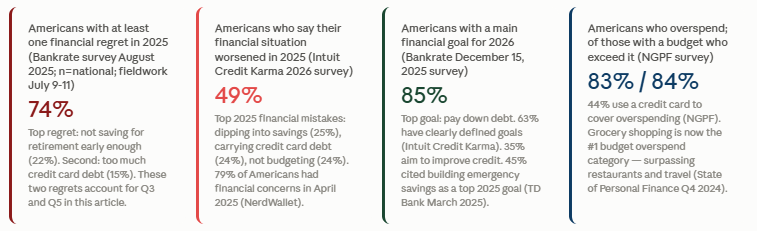
Personal finance content is everywhere, but most of it chases novelty. New apps, new investment trends, new hacks. The questions people actually have — the ones they repeat, the ones that sit in the back of their minds for years — are far more fundamental. And the survey data from 2025 and 2026 confirms which ones those are. Bankrate’s August 2025 study found that 74% of Americans carry at least one financial regret. The top two: not saving for retirement early enough (22%) and accumulating too much credit card debt (15%). Those appear in this article as Questions 3 and 5. NerdWallet’s April 2025 survey of the financial concerns of 79% of Americans revealed retirement savings (39%), credit card debt (23%), and insufficient emergency savings as the leading worries. Intuit Credit Karma’s 2026 survey found that not budgeting (24%), carrying credit card debt (24%), and dipping into savings (25%) were the three most common self-identified financial mistakes of 2025. The ten questions below map directly to these documented concerns. They cover the full span of personal finance: where your money goes (budgeting), what you keep (savings), what you build toward (retirement), what protects you (insurance), what traps you (credit card debt), where you want to go (travel), what you owe the government (taxes), where you keep your savings (savings accounts), how creditors see you (credit score), and how you grow what you have (investing). Not financial advice.
The financial stress backdrop: 74% of Americans have a financial regret in 2025 (Bankrate August 2025). 79% have financial concerns (NerdWallet April 2025). 49% say their financial situation worsened in 2025 (Intuit Credit Karma). 85% have a main financial goal for 2026 (Bankrate December 2025). Sources cited. Not financial advice.
83% of Americans say they overspend; 84% of those with a budget exceed it (NGPF). 24% of Americans cited 'not budgeting or tracking expenses' as a 2025 financial mistake (Intuit Credit Karma 2026). Top 2026 goal: budget better (Bankrate December 2025). Sources cited.
The answer: Build around your real priorities, not an idealised version. Automate savings transfers on payday — before spending. Use 50/30/20 as a starting framework. Review monthly for 3 months and adjust. Not financial advice.
45% of Americans cite building emergency savings as a top 2025 goal (TD Bank March 2025). 48% want to prioritise emergency savings (NGPF). 25% dipped into savings inappropriately in 2025 (Intuit Credit Karma). Sources cited.
The answer: Target 3-6 months of essential expenses. Keep in a high-yield savings account — not invested. Single income or self-employed: aim for 6-12 months. Automate a monthly deposit until the target is reached. Not financial advice.
#1 financial regret of 2025: not saving for retirement early enough (22%, Bankrate August 2025). Average family retirement savings: ~$87,000 (Federal Reserve 2022). 2026 401(k) limit: $23,500 (under 50); catch-up 50+: $7,500; super catch-up 60-63: $11,250 (SECURE 2.0; IRS Notice 2025-67). Sources cited.
The answer: Start immediately, regardless of amount. Capture the full employer match first. Target 10-15% of gross income. Max Roth IRA ($7,000 2026), then increase 401(k). Benchmark: 1x salary by 30, 3x by 40, 6x by 50. Not financial advice.
27% without life insurance say it's too pricey (NerdWallet April 2026 Harris Poll, n=2,070). 79% of Americans have financial concerns — NerdWallet April 2025 cites insurance as a core preparedness category. TD Bank 2025: unexpected emergencies/illnesses are top financial stress moments. Sources cited.
The answer: Non-negotiables: health, car, renters/homeowners. With dependants: term life. For working adults: disability insurance. What to review: extended warranties (likely covered by credit card), whole life vs term. Not financial or insurance advice.
15% of Americans cite credit card debt as #1 financial regret (Bankrate August 2025). $10,000+ average CC debt among debt holders (NerdWallet 2024). APR avg 23%+ (Fed Reserve). 24% 'carrying credit card debt' was a 2025 financial mistake (Intuit Credit Karma). Sources cited.
The answer: Choose debt avalanche (highest rate first — mathematically best) or snowball (smallest balance first — motivationally best). Stop accumulating: pay in full monthly or freeze the card. Consider a 0% APR balance transfer if eligible. Not financial advice.
Adults plan to use tax refunds for travel (RAM/State of Personal Finance Q4 2024). Travel surpassed by grocery spending as top overspend category (RAM Q4 2024). Over 50% of Americans plan to slash subscriptions in 2026 (NerdWallet) — a source of travel savings. Sources cited.
The answer: Open a dedicated travel savings account. Automate a monthly transfer = trip cost ÷ months until departure. Use travel credit cards only if paying full balance monthly. Book mid-week, direct, in shoulder season. Not financial advice.
Top 2026 tax fears: no refund (28%), smaller refund (27%), owing money (26%) — Intuit Credit Karma 2026. 2026 standard deduction: $15,000 single, $30,000 MFJ (IRS). 2026 401(k) limit $23,500. 8% plan to save/invest their tax refund (RAM Q4 2024). Sources cited.
The answer: Maximise pre-tax 401(k) and IRA contributions — reduces taxable income. Use an HSA if eligible. Self-employed: track all deductible expenses. Update W-4 after life changes. Large refund = reduce withholding and invest the difference monthly. Not financial or tax advice.
Most Americans hold savings and checking accounts (TD Bank 2025). High-yield savings account rates 4-5% APY available (2026 environment). Bank accounts most frequently reviewed financial instrument (TD Bank 2025: 75% review bank balances). Sources cited.
The answer: Move emergency fund and savings goals to a high-yield savings account (4%+ APY in 2026). For money not needed for 12+ months: consider a CD for a locked rate. Check your current APY and compare at bankrate.com or NerdWallet. Not financial advice.
35% of Americans aim to improve their credit in 2026 (Intuit Credit Karma). Credit card debt concern: 23% of Americans (NerdWallet April 2025). Americans with CC debt owed $10,000+ on avg in 2024 (NerdWallet). Sources cited.
The answer: Pay on time, every time — 35% of your score. Keep utilisation below 30% (ideally below 10%). Don't close old accounts. A secured credit card rebuilds credit fastest if starting from scratch. Check score free at Credit Karma or your bank app. Not financial advice.
36% of Americans list 'investments' as a financial priority (NGPF). 8% cite investing more as their main 2026 goal (Bankrate December 2025). 34% believe their finances will improve in 2026 (Bankrate December 2025). Sources cited. Capital at risk.
The answer: Sequence: (1) 401(k) match, (2) emergency fund, (3) pay high-interest debt, (4) max Roth IRA ($7,000 in 2026), (5) increase 401(k). Start with low-cost total market index fund. Time in market beats timing the market. Not financial, investment, or tax advice.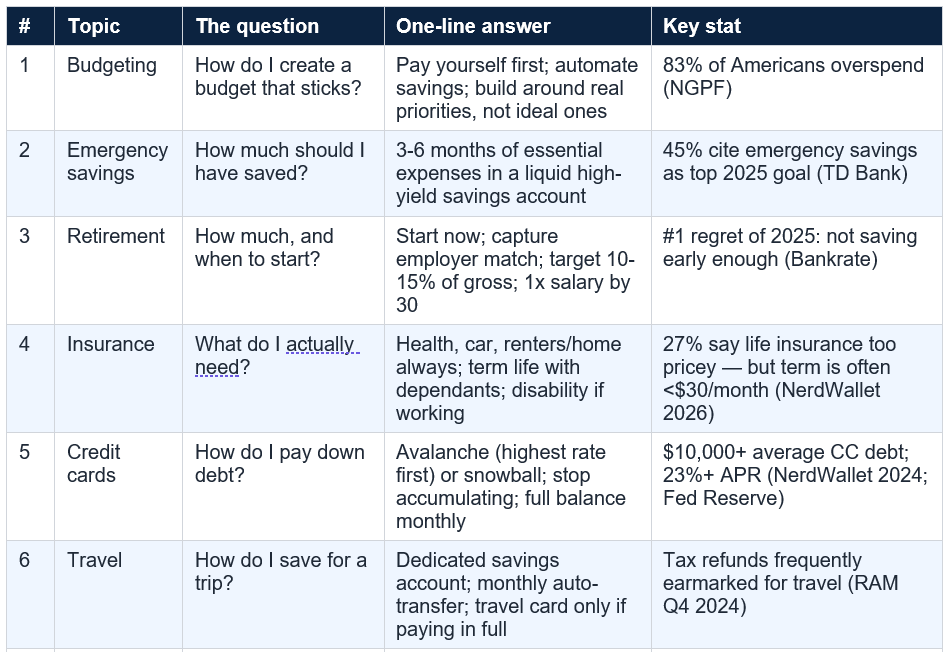
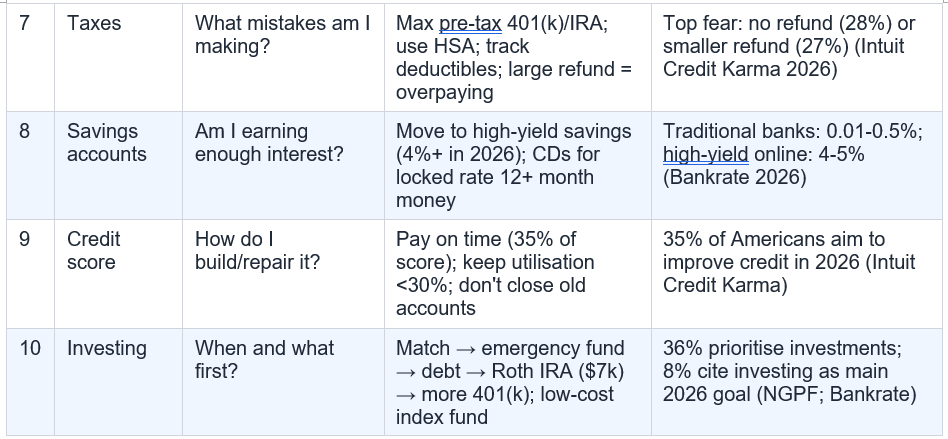
None of the answers here require special knowledge, significant capital, or perfect financial circumstances. They require clarity, consistency, and a willingness to ask the question and act on the answer. That willingness is the differentiator. The regrets in the Bankrate survey — not saving early enough, too much credit card debt — are almost always regrets about delay and inaction, not about wrong decisions. The best time to answer these questions was years ago. The second best time is today. Not financial advice. Consult a qualified financial adviser for guidance specific to your situation.
Not saving for retirement early enough — cited by 22% of Americans as their top financial regret in 2025, according to Bankrate's survey of August 20, 2025 (fieldwork July 9-11, 2025). Accumulating too much credit card debt was the second most common regret at 15%. Combined, these two regrets affect nearly 40% of survey respondents and represent the two most consistently recurring personal finance mistakes across demographic groups. The Bankrate data also shows this pattern is persistent: not saving enough for retirement was the top regret in previous years' surveys as well. Source: Bankrate August 2025. Not financial advice.
How many Americans have a financial goal for 2026?
85% of Americans have a main financial goal for 2026, according to Bankrate's December 15, 2025 survey (fieldwork November 3-5, 2025). Separately, Intuit Credit Karma's 2026 survey found that 63% have clearly defined personal finance goals for the year. The most common goals include paying down debt (the top priority, largely driven by credit card debt), building emergency savings, and improving credit. 8% cited saving for retirement and 8% cited investing more as their primary goal (Bankrate December 2025). Sources: Bankrate December 2025; Intuit Credit Karma 2026. Not financial advice.
What are the 2026 retirement contribution limits?
For 2026, the IRS has set the following limits (per IRS Notice 2025-67): employee elective deferral limit for 401(k), 403(b), and most 457 plans: $23,500 for those under age 50. Standard catch-up contribution for age 50 and over: $7,500 (total $31,000). Super catch-up contribution for age 60-63 (introduced by the SECURE 2.0 Act): $11,250 instead of $7,500 (total $34,750). IRA contribution limit: $7,000 for those under 50; $8,000 for those age 50 and over. Combined employee plus employer 401(k) limit: $72,000. Always verify current limits at IRS.gov before making contribution decisions. Not financial or tax advice. Consult a CPA.
What is the biggest credit card debt mistake people make?
Making only the minimum payment — the most expensive habit in personal finance that feels harmless. On a $10,000 balance at 23% APR, making only the minimum payment (typically 2-3% of the balance) can take over 15 years to pay off and cost more than $10,000 in interest alone — doubling the original debt. The second biggest mistake is using a credit card to bridge a budget gap (44% of people who exceed their budget use a credit card to cover the overspend, per NGPF data), which turns a budgeting problem into a compound interest problem. The most direct solution: pay more than the minimum every month; ideally, pay the full balance to avoid interest entirely. For existing debt: debt avalanche (attack the highest-rate balance first) saves the most money. Sources: NerdWallet 2024 (CC debt data); NGPF; Fed Reserve. Not financial advice.
What should I do with my tax refund?
A tax refund is not a bonus — it is the return of money you overpaid to the government, interest-free, during the year. The most financially optimal response: if you have high-interest debt (above 7-8% APR), use the refund to reduce it. If you have no emergency fund or an inadequate one, build that first. If debt is manageable and emergency fund is in place, invest the refund in a Roth IRA or increase retirement savings. Bankrate's December 2025 survey found that paying down debt is the top financial goal for 2026. Adults in the Q4 2024 State of Personal Finance report planned to use refunds for travel, dining, and clothing — which is fine if the above financial foundations are already in place, but a missed opportunity if they are not. Adjust your W-4 withholding if you consistently receive a large refund: a smaller refund means more money in your paycheck each month to invest or allocate. Sources: RAM Q4 2024; Intuit Credit Karma 2026; Bankrate. Not financial or tax advice.
Table of Contents
- Why These 10 Questions? The Data Behind the Questions Most People Ask
- Q1 [BUDGETING]: How Do I Create a Budget That Actually Sticks?
- Q2 [SAVINGS]: How Much Should I Have in an Emergency Fund?
- Q3 [RETIREMENT]: How Much Do I Need to Save for Retirement — and When Should I Start?
- Q4 [INSURANCE]: What Insurance Do I Actually Need — and What Is Overkill?
- Q5 [CREDIT CARD]: How Do I Pay Down Credit Card Debt — and Stop Accumulating More?
- Q6 [TRAVEL]: How Do I Save for a Trip Without Derailing My Budget?
- Q7 [TAXES]: What Tax Mistakes Am I Probably Making Without Realising?
- Q8 [SAVINGS (INTEREST)]: Are My Savings in the Right Account — and Am I Earning Enough Interest?
- Q9 [CREDIT SCORE]: How Do I Build or Repair My Credit Score?
- Q10 [INVESTING]: When Should I Start Investing — and What Should I Invest In First?
- At a Glance: The Ten Answers in One Table
- Conclusion: The Questions You Ask Determine the Life You Build
- Frequently Asked Questions
Why These 10 Questions? The Data Behind the Questions Most People Ask
Personal finance content is everywhere, but most of it chases novelty. New apps, new investment trends, new hacks. The questions people actually have — the ones they repeat, the ones that sit in the back of their minds for years — are far more fundamental. And the survey data from 2025 and 2026 confirms which ones those are. Bankrate’s August 2025 study found that 74% of Americans carry at least one financial regret. The top two: not saving for retirement early enough (22%) and accumulating too much credit card debt (15%). Those appear in this article as Questions 3 and 5. NerdWallet’s April 2025 survey of the financial concerns of 79% of Americans revealed retirement savings (39%), credit card debt (23%), and insufficient emergency savings as the leading worries. Intuit Credit Karma’s 2026 survey found that not budgeting (24%), carrying credit card debt (24%), and dipping into savings (25%) were the three most common self-identified financial mistakes of 2025. The ten questions below map directly to these documented concerns. They cover the full span of personal finance: where your money goes (budgeting), what you keep (savings), what you build toward (retirement), what protects you (insurance), what traps you (credit card debt), where you want to go (travel), what you owe the government (taxes), where you keep your savings (savings accounts), how creditors see you (credit score), and how you grow what you have (investing). Not financial advice.The financial stress backdrop: 74% of Americans have a financial regret in 2025 (Bankrate August 2025). 79% have financial concerns (NerdWallet April 2025). 49% say their financial situation worsened in 2025 (Intuit Credit Karma). 85% have a main financial goal for 2026 (Bankrate December 2025). Sources cited. Not financial advice.
Q1 [BUDGETING]: How Do I Create a Budget That Actually Sticks?
This is the question I hear at every dinner party, every family gathering, every time someone finds out what I do for a living. The honest answer is that most budgets fail not because people are bad at maths but because they are built around restriction instead of intention. A budget that says 'no' to everything you enjoy is a budget you will abandon by the third week of January. A budget that says 'here is how much you have deliberately chosen to spend on the things that matter to you' is one you might actually follow for a year. Start with your after-tax income. List your fixed non-negotiables: rent or mortgage, utilities, insurance, minimum debt payments. What is left is your discretionary budget — for food, entertainment, travel, clothing, savings, and everything else. The 50/30/20 framework is the most commonly cited starting structure: 50% to needs, 30% to wants, 20% to savings and debt repayment. The key is that the 20% savings contribution comes out first, automatically, before you spend anything discretionary. Pay yourself first is not a slogan. It is a mechanism that removes the decision entirely. 83% of Americans say they overspend; 84% of those with a monthly budget exceed it (NGPF survey). The solution is not a stricter budget. It is a more honest one, combined with automatic transfers that remove the willpower requirement.83% of Americans say they overspend; 84% of those with a budget exceed it (NGPF). 24% of Americans cited 'not budgeting or tracking expenses' as a 2025 financial mistake (Intuit Credit Karma 2026). Top 2026 goal: budget better (Bankrate December 2025). Sources cited.
The answer: Build around your real priorities, not an idealised version. Automate savings transfers on payday — before spending. Use 50/30/20 as a starting framework. Review monthly for 3 months and adjust. Not financial advice.
Q2 [SAVINGS]: How Much Should I Have in an Emergency Fund?
The conventional wisdom is three to six months of living expenses. The real answer depends on your specific circumstances. If you have a stable government job, a working partner, and low fixed monthly expenses, three months may be adequate. If you are self-employed, have a single household income, work in a volatile industry, or have dependants who rely entirely on you, six months is a minimum and some advisers recommend twelve. The emergency fund lives in a high-yield savings account or similar liquid, accessible vehicle — not invested in the stock market (which can fall 30% precisely when you need the money most), and not in a Certificate of Deposit with a penalty for early withdrawal. The goal is boring stability: cash that is there immediately, in full, when the emergency arrives. Emergency fund is the highest personal finance priority: 45% of Americans listed building emergency savings as a top goal for 2025 (TD Bank Financial Preparedness Survey March 2025). And 25% admitted dipping into savings as a 2025 financial mistake (Intuit Credit Karma), which is often what happens when no dedicated emergency buffer exists.45% of Americans cite building emergency savings as a top 2025 goal (TD Bank March 2025). 48% want to prioritise emergency savings (NGPF). 25% dipped into savings inappropriately in 2025 (Intuit Credit Karma). Sources cited.
The answer: Target 3-6 months of essential expenses. Keep in a high-yield savings account — not invested. Single income or self-employed: aim for 6-12 months. Automate a monthly deposit until the target is reached. Not financial advice.
Q3 [RETIREMENT]: How Much Do I Need to Save for Retirement — and When Should I Start?
The two most common financial regrets in America both point to the same answer: start earlier than you think you need to. Not saving for retirement early enough is the number-one financial regret of 2025, cited by 22% of Americans in Bankrate's August 2025 survey. The standard guidance is to aim for 10-15% of gross income directed toward retirement savings. For most people with access to a 401(k) match, the immediate first priority is contributing at least enough to capture the full employer match — that is an immediate guaranteed return of 50-100% on the matched contribution that no other investment can beat. Beyond the match, maximize a Roth IRA if eligible ($7,000/year in 2026; $8,000 if age 50+), then return to the 401(k) to increase contributions toward the $23,500 annual limit. The rough rule of thumb is to have 1x your salary saved by 30, 3x by 40, 6x by 50, 8x by 60, and 10x by retirement. These are benchmarks, not mandates — they tell you where you stand relative to a path that most commonly leads to financial security in retirement. The average family has approximately $87,000 in retirement savings (Federal Reserve 2022, cited NerdWallet) against the Fidelity benchmark suggesting multiples of annual salary. The gap is real, and earlier action is the only reliable solution.#1 financial regret of 2025: not saving for retirement early enough (22%, Bankrate August 2025). Average family retirement savings: ~$87,000 (Federal Reserve 2022). 2026 401(k) limit: $23,500 (under 50); catch-up 50+: $7,500; super catch-up 60-63: $11,250 (SECURE 2.0; IRS Notice 2025-67). Sources cited.
The answer: Start immediately, regardless of amount. Capture the full employer match first. Target 10-15% of gross income. Max Roth IRA ($7,000 2026), then increase 401(k). Benchmark: 1x salary by 30, 3x by 40, 6x by 50. Not financial advice.
Q4 [INSURANCE]: What Insurance Do I Actually Need — and What Is Overkill?
Insurance is one of the most misunderstood categories in personal finance because the answer varies so dramatically by life stage, income, and circumstances. The non-negotiables for most adults: health insurance (medical bills are the leading cause of personal bankruptcy in the United States), car insurance if you drive (legally required in most states), and renters or homeowners insurance to protect your physical possessions and yourself from liability. Beyond those three, the decisions become more circumstance-specific. If anyone is financially dependent on you — a partner, children, ageing parents you support — term life insurance is essential: it is cheaper than most people think and the consequence of not having it (your dependants losing their primary income) is catastrophic. Disability insurance covers your income if illness or injury prevents you from working. It is less commonly carried but arguably more important than life insurance for working-age adults — you are far more likely to become temporarily or permanently disabled than to die during your working years. What is often overkill: extended warranties on appliances and electronics (most credit cards provide this free), whole life insurance for people without complex estate planning needs (term is almost always cheaper for the same death benefit), and supplemental insurance products that duplicate existing coverage. NerdWallet's April 2026 survey of 2,070 US adults found that 27% of those without life insurance say it is too expensive — but term life for a healthy 35-year-old can cost less than $30/month for significant coverage.27% without life insurance say it's too pricey (NerdWallet April 2026 Harris Poll, n=2,070). 79% of Americans have financial concerns — NerdWallet April 2025 cites insurance as a core preparedness category. TD Bank 2025: unexpected emergencies/illnesses are top financial stress moments. Sources cited.
The answer: Non-negotiables: health, car, renters/homeowners. With dependants: term life. For working adults: disability insurance. What to review: extended warranties (likely covered by credit card), whole life vs term. Not financial or insurance advice.
Q5 [CREDIT CARD]: How Do I Pay Down Credit Card Debt — and Stop Accumulating More?
Credit card debt is the second most common financial regret in 2025 (Bankrate) and one of the most expensive financial problems most people carry. With average APRs above 23% (Federal Reserve data), a $10,000 credit card balance costs approximately $2,300 per year in interest alone — money that buys nothing, builds nothing, and goes entirely to the card issuer. The two most commonly cited payoff strategies are the debt avalanche (pay minimum on all cards, throw every extra dollar at the highest-interest balance first — mathematically optimal, saves the most money) and the debt snowball (pay off the smallest balance first regardless of rate — psychologically powerful, generates momentum through quick wins). The research from NerdWallet shows Americans with credit card debt owed over $10,000 on average in 2024 — which at 23% APR means paying roughly $200/month in interest before touching the principal. Stopping the accumulation is as important as paying down the balance: that means understanding what is driving the overspending (44% of budget-exceeding Americans use credit cards to cover the excess, per NGPF), addressing the underlying budget gap, and either freezing credit card use until the debt is clear or using only one card with a hard rule of paying the full balance monthly.15% of Americans cite credit card debt as #1 financial regret (Bankrate August 2025). $10,000+ average CC debt among debt holders (NerdWallet 2024). APR avg 23%+ (Fed Reserve). 24% 'carrying credit card debt' was a 2025 financial mistake (Intuit Credit Karma). Sources cited.
The answer: Choose debt avalanche (highest rate first — mathematically best) or snowball (smallest balance first — motivationally best). Stop accumulating: pay in full monthly or freeze the card. Consider a 0% APR balance transfer if eligible. Not financial advice.
Q6 [TRAVEL]: How Do I Save for a Trip Without Derailing My Budget?
Travel is one of the most common financial aspirations and one of the most consistently underplanned budget items. Most people book trips on impulse and absorb the cost via credit card, which explains why travel appears repeatedly in the data on overspending categories. The straightforward approach that actually works: decide on the trip's approximate cost, divide it by the number of months until departure, and set up a dedicated automatic transfer of that amount monthly into a separate savings account labelled with the trip. A $3,000 holiday twelve months away requires $250 per month. That is a manageable number if you know it exists; it is a financial crisis if you only realise it the week before departure. Travel credit cards and points are a legitimate addition to the strategy for frequent travellers — but the value of travel points is only realised if you are paying the full balance monthly. Carrying a balance on a travel rewards card costs 23%+ APR in interest, which far exceeds any points value earned. The single most effective travel money hack: book flights on Tuesday or Wednesday, book accommodation directly with the hotel (often cheaper than third-party platforms and more flexible for changes), and travel in shoulder season when prices are 20-40% below peak.Adults plan to use tax refunds for travel (RAM/State of Personal Finance Q4 2024). Travel surpassed by grocery spending as top overspend category (RAM Q4 2024). Over 50% of Americans plan to slash subscriptions in 2026 (NerdWallet) — a source of travel savings. Sources cited.
The answer: Open a dedicated travel savings account. Automate a monthly transfer = trip cost ÷ months until departure. Use travel credit cards only if paying full balance monthly. Book mid-week, direct, in shoulder season. Not financial advice.
Q7 [TAXES]: What Tax Mistakes Am I Probably Making Without Realising?
Tax anxiety is widespread: Intuit Credit Karma's 2026 survey found that the top tax worries among Americans are not receiving a refund at all (28%), getting a smaller refund than expected (27%), and owing money (26%). But the most consequential tax mistakes are not about refund size — they are about leaving money on the table year after year through under-utilised deductions and tax-advantaged accounts. The most common mistakes: not maxing out a 401(k) or IRA (every dollar you contribute pre-tax reduces your taxable income dollar-for-dollar, at your marginal rate — a 22% bracket taxpayer who contributes $1,000 saves $220 in current taxes); not using a Health Savings Account (HSA) if enrolled in a high-deductible health plan (HSA contributions are triple tax-advantaged: pre-tax going in, tax-free growth, tax-free withdrawal for qualifying medical expenses); not tracking deductible expenses for freelancers and self-employed people; and not adjusting W-4 withholding after a major life change (marriage, new child, second job). A large refund is not a win — it is an interest-free loan to the government. The 2026 standard deduction is $15,000 for single filers and $30,000 for married filing jointly (IRS). If your itemisable deductions do not exceed those figures, the standard deduction is better — but many people itemise out of habit without checking.Top 2026 tax fears: no refund (28%), smaller refund (27%), owing money (26%) — Intuit Credit Karma 2026. 2026 standard deduction: $15,000 single, $30,000 MFJ (IRS). 2026 401(k) limit $23,500. 8% plan to save/invest their tax refund (RAM Q4 2024). Sources cited.
The answer: Maximise pre-tax 401(k) and IRA contributions — reduces taxable income. Use an HSA if eligible. Self-employed: track all deductible expenses. Update W-4 after life changes. Large refund = reduce withholding and invest the difference monthly. Not financial or tax advice.
Q8 [SAVINGS (INTEREST)]: Are My Savings in the Right Account — and Am I Earning Enough Interest?
This question has become far more important in 2025 and 2026 than it was for most of the 2010s, when interest rates were near zero and it barely mattered where you kept your savings. With high-yield savings accounts offering 4-5% APY at online banks versus 0.01-0.5% at traditional branch banks, the difference on a $10,000 emergency fund is approximately $400-$490 per year that you either earn or leave behind. The three main savings account types to know: a standard savings account at a traditional bank (low rate, convenient access); a high-yield savings account at an online bank (higher rate, slightly less friction to move money); and a money market account (similar to high-yield savings, sometimes with check-writing). For money you will not need for at least 6-12 months, CDs (certificates of deposit) can lock in a specific rate for a set term. The priority order: emergency fund in a high-yield savings account (immediate access, good rate); savings goals (house deposit, holiday, car) also in high-yield savings; money you will not touch for 1+ year potentially in a CD for a guaranteed rate. Check your current savings account APY today. If it is below 3.5%, your savings are probably in the wrong account.Most Americans hold savings and checking accounts (TD Bank 2025). High-yield savings account rates 4-5% APY available (2026 environment). Bank accounts most frequently reviewed financial instrument (TD Bank 2025: 75% review bank balances). Sources cited.
The answer: Move emergency fund and savings goals to a high-yield savings account (4%+ APY in 2026). For money not needed for 12+ months: consider a CD for a locked rate. Check your current APY and compare at bankrate.com or NerdWallet. Not financial advice.
Q9 [CREDIT SCORE]: How Do I Build or Repair My Credit Score?
Your credit score affects your mortgage rate, car loan interest, apartment application, and sometimes even your job application. The FICO score — the most widely used version — runs from 300 to 850, with anything above 670 considered 'good,' above 740 considered 'very good,' and above 800 considered 'exceptional.' The five factors that determine it, in order of weight: payment history (35%) — pay on time, every time; amounts owed / credit utilisation (30%) — keep balances below 30% of your credit limit, ideally below 10% for the best scores; length of credit history (15%) — older accounts help; credit mix (10%) — a mix of credit cards, instalment loans and mortgages; new credit (10%) — hard inquiries temporarily lower your score. The fastest actions to improve a score: pay all bills on time starting immediately; reduce credit card balances (this can show up in 30 days); ask for a credit limit increase on existing cards (raises your utilisation ratio without spending more); and do not close old accounts (reduces total available credit, raising utilisation). For people with no credit history or damaged credit: a secured credit card (you deposit cash as collateral) is the most reliable building tool. Credit Karma cited improving credit as a 2026 goal for 35% of Americans (Intuit Credit Karma).35% of Americans aim to improve their credit in 2026 (Intuit Credit Karma). Credit card debt concern: 23% of Americans (NerdWallet April 2025). Americans with CC debt owed $10,000+ on avg in 2024 (NerdWallet). Sources cited.
The answer: Pay on time, every time — 35% of your score. Keep utilisation below 30% (ideally below 10%). Don't close old accounts. A secured credit card rebuilds credit fastest if starting from scratch. Check score free at Credit Karma or your bank app. Not financial advice.
Q10 [INVESTING]: When Should I Start Investing — and What Should I Invest In First?
The question I hear most often from people in their 20s and 30s is some version of: 'I want to invest but I do not know where to start.' The honest answer has a specific sequence. Before you invest in anything beyond your employer's 401(k) match: eliminate high-interest debt (anything above 7-8% APR, which is more expensive than most realistic investment returns); have your emergency fund in place; and understand the accounts you are using (taxable brokerage vs tax-advantaged IRA vs 401(k) each has different rules and benefits). Once those conditions are met: the most evidence-backed starting point for most people is a low-cost, globally diversified index fund held in a tax-advantaged account (Roth IRA if eligible, or 401(k) above the match). A total world market index fund with an expense ratio below 0.1% gives you exposure to thousands of companies across dozens of countries for a fraction of the management cost of an active fund. The Roth IRA is particularly powerful: contributions are after-tax, but all growth and qualified withdrawals are completely tax-free — which means a 25-year-old who contributes $7,000/year to a Roth IRA for 40 years could have over $1 million in completely tax-free wealth. The only way to start investing is to start. Time in the market consistently outperforms timing the market.36% of Americans list 'investments' as a financial priority (NGPF). 8% cite investing more as their main 2026 goal (Bankrate December 2025). 34% believe their finances will improve in 2026 (Bankrate December 2025). Sources cited. Capital at risk.
The answer: Sequence: (1) 401(k) match, (2) emergency fund, (3) pay high-interest debt, (4) max Roth IRA ($7,000 in 2026), (5) increase 401(k). Start with low-cost total market index fund. Time in market beats timing the market. Not financial, investment, or tax advice.
At a Glance: The Ten Answers in One Table
Conclusion
The ten questions in this article are not complicated. They are consistent. They come up again and again because the answers to them genuinely shape financial outcomes over years and decades. The person who builds a budget that reflects their real priorities and automates savings will accumulate more wealth over a lifetime than someone with a higher income who never addresses either. The person who starts investing at 25 in a low-cost index fund will retire more comfortably than someone who starts at 45 in a complex actively managed portfolio. The person who captures their full employer match every year will have hundreds of thousands of dollars more at retirement than someone with the same salary who does not.None of the answers here require special knowledge, significant capital, or perfect financial circumstances. They require clarity, consistency, and a willingness to ask the question and act on the answer. That willingness is the differentiator. The regrets in the Bankrate survey — not saving early enough, too much credit card debt — are almost always regrets about delay and inaction, not about wrong decisions. The best time to answer these questions was years ago. The second best time is today. Not financial advice. Consult a qualified financial adviser for guidance specific to your situation.
Frequently Asked Questions
What is the number one financial regret Americans have in 2025?Not saving for retirement early enough — cited by 22% of Americans as their top financial regret in 2025, according to Bankrate's survey of August 20, 2025 (fieldwork July 9-11, 2025). Accumulating too much credit card debt was the second most common regret at 15%. Combined, these two regrets affect nearly 40% of survey respondents and represent the two most consistently recurring personal finance mistakes across demographic groups. The Bankrate data also shows this pattern is persistent: not saving enough for retirement was the top regret in previous years' surveys as well. Source: Bankrate August 2025. Not financial advice.
How many Americans have a financial goal for 2026?
85% of Americans have a main financial goal for 2026, according to Bankrate's December 15, 2025 survey (fieldwork November 3-5, 2025). Separately, Intuit Credit Karma's 2026 survey found that 63% have clearly defined personal finance goals for the year. The most common goals include paying down debt (the top priority, largely driven by credit card debt), building emergency savings, and improving credit. 8% cited saving for retirement and 8% cited investing more as their primary goal (Bankrate December 2025). Sources: Bankrate December 2025; Intuit Credit Karma 2026. Not financial advice.
What are the 2026 retirement contribution limits?
For 2026, the IRS has set the following limits (per IRS Notice 2025-67): employee elective deferral limit for 401(k), 403(b), and most 457 plans: $23,500 for those under age 50. Standard catch-up contribution for age 50 and over: $7,500 (total $31,000). Super catch-up contribution for age 60-63 (introduced by the SECURE 2.0 Act): $11,250 instead of $7,500 (total $34,750). IRA contribution limit: $7,000 for those under 50; $8,000 for those age 50 and over. Combined employee plus employer 401(k) limit: $72,000. Always verify current limits at IRS.gov before making contribution decisions. Not financial or tax advice. Consult a CPA.
What is the biggest credit card debt mistake people make?
Making only the minimum payment — the most expensive habit in personal finance that feels harmless. On a $10,000 balance at 23% APR, making only the minimum payment (typically 2-3% of the balance) can take over 15 years to pay off and cost more than $10,000 in interest alone — doubling the original debt. The second biggest mistake is using a credit card to bridge a budget gap (44% of people who exceed their budget use a credit card to cover the overspend, per NGPF data), which turns a budgeting problem into a compound interest problem. The most direct solution: pay more than the minimum every month; ideally, pay the full balance to avoid interest entirely. For existing debt: debt avalanche (attack the highest-rate balance first) saves the most money. Sources: NerdWallet 2024 (CC debt data); NGPF; Fed Reserve. Not financial advice.
What should I do with my tax refund?
A tax refund is not a bonus — it is the return of money you overpaid to the government, interest-free, during the year. The most financially optimal response: if you have high-interest debt (above 7-8% APR), use the refund to reduce it. If you have no emergency fund or an inadequate one, build that first. If debt is manageable and emergency fund is in place, invest the refund in a Roth IRA or increase retirement savings. Bankrate's December 2025 survey found that paying down debt is the top financial goal for 2026. Adults in the Q4 2024 State of Personal Finance report planned to use refunds for travel, dining, and clothing — which is fine if the above financial foundations are already in place, but a missed opportunity if they are not. Adjust your W-4 withholding if you consistently receive a large refund: a smaller refund means more money in your paycheck each month to invest or allocate. Sources: RAM Q4 2024; Intuit Credit Karma 2026; Bankrate. Not financial or tax advice.
0 Comments
Be the first to share your thoughts on this article.