

Financial Literacy
How the Rich Make Money Work for Them: 6 Habits You Can Copy

Federal Reserve (Q1 2026): top 10% hold 87.4% of corporate equities and mutual fund shares; top 1% 50.2%; top 0.1% 24.2%; next 40% about 11.6%; bottom 50% about 1.1%. Top 1% share of net worth hit a record 32.5% in Q2 2026 (low of 22.4% in 1990). Fidelity (Q2 2026): record 654,000 401(k) millionaires; they save 17.3% of pay (25.8% with employer) vs 14.4% for the average saver; Gen X is 62% of them; 19.5% of savers have a 401(k) loan. Tax rules (2026): top long-term capital gains rate 20% above $545,500 (single) / $613,700 (joint), plus a 3.8% surcharge; estate and gift exemption $15 million per person; stepped-up basis at death remains; IRAs and 401(k)s get no step-up. My arithmetic: on a constant $100,000 salary for 30 years at 7%, saving 4.6% builds about $434,500; 14.4% about $1.36 million; 25.8% about $2.44 million.
That is the heart of how the wealthy make money work for them: income is the raw material and assets are the machine. This guide looks at who owns what, walks through six habits behind the numbers, including tax strategies that are often misunderstood, and finishes with what you can realistically copy.
That ownership shows up in total wealth. The top 1% held a record 32.5% of household net worth in the second quarter of 2026, up 0.8 points in one quarter, the largest jump in data going back to 1989, as the S&P 500 rose about 15%. The low was 22.4% in 1990. The lesson is that wealth follows asset ownership, and when assets rise, owners gain most.
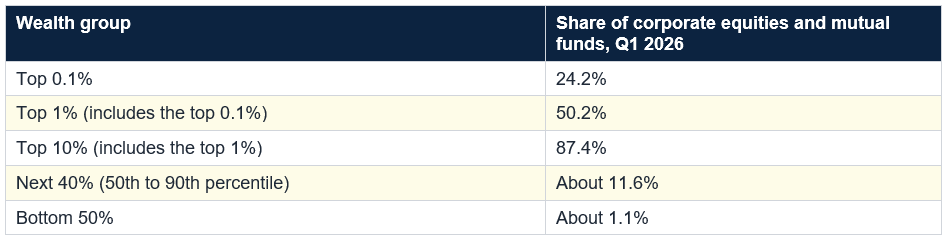
Federal Reserve DFA, Q1 2026: top 10% hold 87.4% of corporate equities and mutual fund shares; top 1% 50.2%; top 0.1% 24.2%. Top 1% share of net worth: record 32.5% in Q2 2026, up from a low of 22.4% in 1990.
For ordinary households, the entry ticket is low. A broad index fund gives you a slice of hundreds of companies, fractional shares start from $1 at several brokers and workplace plans make it automatic. The wealth gap above partly reflects who participates in markets at all. Owning a slice matters more than its size on day one.
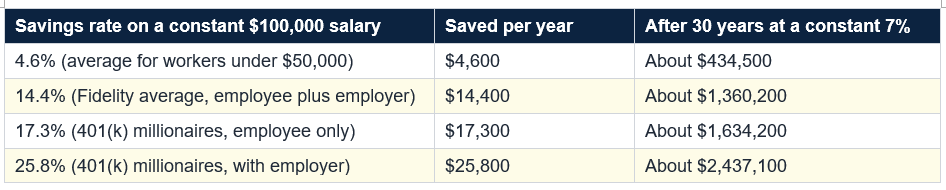
Income plays a role in who can save a lot. EBRI data, cited by MFS, show workers earning over $150,000 had an average savings rate of 12.3% and 94.5% participation, while those earning under $50,000 saved 4.6% and only 52.9% participated. In my illustration, a constant $100,000 salary saved at 4.6% for 30 years at 7% builds about $434,500; at 14.4%, about $1.36 million; at 25.8%, about $2.44 million. The savings rate is the lever you control.
Interruptions are where ordinary savers lose ground. Fidelity reported that 19.5% of retirement savers had an outstanding 401(k) loan and 3% took a hardship withdrawal in the second quarter. Research cited by MyETFJourney found that over 30 years the average investor earned about 6.8% a year against 10.2% for the S&P 500, largely because of badly timed buying and selling. Patience is underrated. At a constant 7%: $100,000 grows to about $197,000 in 10 years, $387,000 in 20 and $761,000 in 30. $1,000 a month for 30 years reaches about $1.13 million. Illustrations only.
At the top, the wealthy also use rules ordinary savers rarely meet. The federal estate and gift tax exemption is $15 million per person in 2026, permanent under the 2025 tax law, so most estates owe no federal estate tax. And heirs generally receive a stepped-up cost basis at death, so unrealized gains can disappear for income-tax purposes. One 2026 explainer notes that selling stock with a $4 million gain would trigger roughly $952,000 of federal tax at 23.8%, which a step-up can eliminate for heirs. IRAs and 401(k)s get no step-up.
It is not free money. Interest accrues, lenders can demand repayment or sell assets if prices fall, the loan must be handled in the estate plan and the step-up rule is politically contested, as 247 Wall St. points out. Nor does it help with estate tax above $15 million, which is levied at 40%. For ordinary households, credit cards near 21% and a 30-year mortgage at 7.40% make leverage expensive and risky. The wealthy borrow against big cushions of assets. Most people should pay off costly debt first. Borrowing against investments magnifies losses as well as gains. A falling market can force sales at the worst time. Do not copy a strategy designed for multimillion-dollar portfolios without understanding the risks and getting professional advice.
Costs compound against you. Top S&P 500 index funds charge as little as 0.015% to 0.04% a year. The rich pay for advice but negotiate fees, and the habit worth copying is to pay only for value. Ask what every fund and adviser charges, in dollars a year, before signing.
Still, a lot of the gap is about behavior that does not need a fortune. MFS’s summary reports that 79% of millionaires describe themselves as self-made, though that is a self-reported figure from a secondary source. Fidelity’s millionaires built balances through consistent saving over decades. Those habits cost discipline, not money.
Sixth, think about tax location: hold the investments that generate heavy taxable income in tax-advantaged accounts, and the long-term growth holdings in taxable accounts, where the lower long-term gains rates apply. Seventh, when your wealth grows, get professional advice on estate planning and borrowing before using advanced strategies. Do the boring things early, and the sophisticated ones become options instead of necessities. Choose one habit this week: raise your 401(k) contribution by 1%, set up an automatic transfer into an index fund or check the fees on your current funds. Three myths get in the way. First, that the rich are simply high earners: wealth comes from saving and owning, and many high earners spend nearly everything. Second, that the rich gamble: durable wealth relies on diversification and time. Third, that tax advantages are only for the wealthy: the 401(k), IRA, Roth and long-term gains rates are open to everyone who qualifies.
You do not need a fortune to start. You need an account, a savings rate you can raise, a low-cost fund and patience. Use the advanced tools only when your situation calls for them, and never copy a strategy you do not understand. This is general education, not personalized advice, and a qualified adviser can help you apply it.
Mainly by owning appreciating assets such as stocks, businesses and real estate, saving a large share of income, letting investments compound for decades and using tax rules and borrowing to keep more of the growth. Federal Reserve data show the top 10% of households hold 87.4% of corporate equities and mutual fund shares, so ownership, not salary alone, drives their wealth.
What is “buy, borrow, die”?
It is a strategy in which wealthy investors buy appreciating assets, borrow against them instead of selling, and hold until death, when heirs generally receive a stepped-up cost basis that can erase unrealized capital gains tax. It has real risks, including interest costs and margin calls, it does not apply to IRAs or 401(k)s and the step-up rule could change.
Can ordinary people copy what the wealthy do?
Many of the habits, yes: a high savings rate, broad investing, patience, low costs and tax-advantaged accounts. Fidelity found that 401(k) millionaires save an average of 17.3% of pay, or 25.8% with employer contributions, versus 14.4% for the average saver. Access to private markets and the ability to borrow large sums against assets are harder to replicate.
How much of the wealth gap comes from stock ownership?
A lot. The top 1% held 50.2% of corporate equities and mutual fund shares in early 2026, according to the Federal Reserve’s Distributional Financial Accounts, and a record 32.5% of household net worth in the second quarter. The bottom 50% held about 1.1% of the equity measure.
Is borrowing to invest a good idea for everyone?
No. Leverage magnifies losses as well as gains. With the average credit card rate near 21% and mortgage rates at 7.40%, borrowing is costly for most households. The wealthy typically borrow against large, diversified portfolios at lower rates, with buffers, and can survive a downturn. Most people should focus on saving, diversification and paying off expensive debt first.
Table of Contents
- Income Is Not Wealth
- The Short Answer
- The Scoreboard: Who Owns What
- Habit 1: Own Assets, Not Just a Paycheck
- Habit 2: Save a Big Share and Keep It Invested
- Habit 3: Give Money Decades to Compound
- Habit 4: Use the Tax Rules
- Habit 5: Borrow Against Assets, Carefully
- Habit 6: Diversify and Keep Costs Low
- What You Cannot Easily Copy
- A Plan at Ordinary Scale
- Myths to Drop
- Conclusion
- Frequently Asked Questions
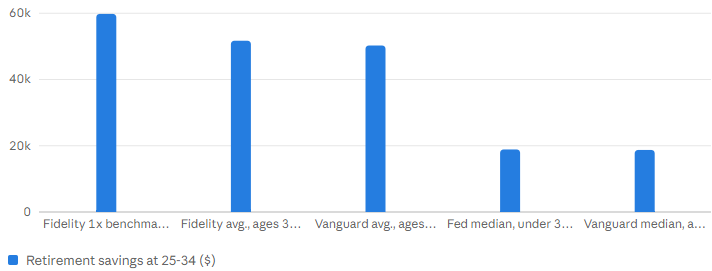
Retirement savings at about 30: the 1x benchmark vs. what people have ($)
Savings ($) by Sources: Fidelity, Vanguard How America Saves 2026, Federal Reserve SCF 2022; salary is median for ages 25-34
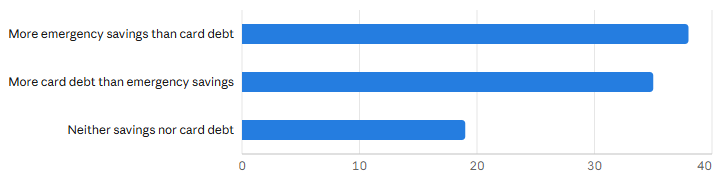
Emergency savings vs. card debt among millennials (%)
% of millennials by Source: Bankrate survey, February 2026
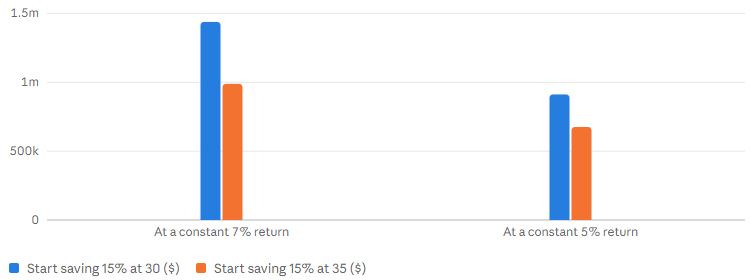
The cost of waiting 5 years: $59,800 earner saving 15% to age 67 ($)
Savings at 67 ($) by Author's illustration: no raises, contributions at year end; not a forecast
Income Is Not Wealth
Two people can earn exactly the same salary and end up in completely different places. One finishes each year with a bigger car and an emptier account. The other quietly owns a growing pile of assets that earns money while they sleep. The difference is not intelligence or luck. It is what each person does with the money after it arrives.That is the heart of how the wealthy make money work for them: income is the raw material and assets are the machine. This guide looks at who owns what, walks through six habits behind the numbers, including tax strategies that are often misunderstood, and finishes with what you can realistically copy.
The Short Answer
The rich make money work for them by owning appreciating assets, saving a large share of income, giving investments decades to compound, using tax rules to keep more of the growth, borrowing against assets rather than selling them and spreading holdings widely at low cost. The first three are open to almost everyone; the last three need more care, capital or professional help. None requires picking the next hot stock.The Scoreboard: Who Owns What
Start with where the assets sit. According to the Federal Reserve’s Distributional Financial Accounts, the wealthiest 10% of US households held 87.4% of corporate equities and mutual fund shares in the first quarter of 2026. The top 1% held 50.2%, up from 42.8% in 1989, and the top 0.1% alone held 24.2%, worth about $13.3 trillion. The 50th to 90th percentiles held about 11.6%, and the bottom half of households about 1.1%.That ownership shows up in total wealth. The top 1% held a record 32.5% of household net worth in the second quarter of 2026, up 0.8 points in one quarter, the largest jump in data going back to 1989, as the S&P 500 rose about 15%. The low was 22.4% in 1990. The lesson is that wealth follows asset ownership, and when assets rise, owners gain most.
Federal Reserve DFA, Q1 2026: top 10% hold 87.4% of corporate equities and mutual fund shares; top 1% 50.2%; top 0.1% 24.2%. Top 1% share of net worth: record 32.5% in Q2 2026, up from a low of 22.4% in 1990.
Habit 1: Own Assets, Not Just a Paycheck
The first habit is the simplest and the most often missed. Wages are taxed, spent and gone. Assets such as shares in businesses, rental property or a company you own can grow and pay you without more hours of work. The wealthy move earnings into assets as early and as consistently as they can.For ordinary households, the entry ticket is low. A broad index fund gives you a slice of hundreds of companies, fractional shares start from $1 at several brokers and workplace plans make it automatic. The wealth gap above partly reflects who participates in markets at all. Owning a slice matters more than its size on day one.
Habit 2: Save a Big Share and Keep It Invested
Fidelity’s second-quarter 2026 data offers a window into this. The number of 401(k) millionaires hit a record 654,000. The average employee contribution rate was a record 9.6% and employers added 4.8%, a combined 14.4%. But 401(k) millionaires saved far more: 17.3% of pay on average, or 25.8% including employer contributions. Gen X made up 62% of them, which fits decades of steady saving.Income plays a role in who can save a lot. EBRI data, cited by MFS, show workers earning over $150,000 had an average savings rate of 12.3% and 94.5% participation, while those earning under $50,000 saved 4.6% and only 52.9% participated. In my illustration, a constant $100,000 salary saved at 4.6% for 30 years at 7% builds about $434,500; at 14.4%, about $1.36 million; at 25.8%, about $2.44 million. The savings rate is the lever you control.
Habit 3: Give Money Decades to Compound
Time does the heavy lifting. At a constant 7%, money doubles roughly every ten years: $100,000 becomes about $197,000 in ten years, $387,000 in twenty and $761,000 in thirty, with no further effort. Add $1,000 a month for thirty years and you reach about $1.13 million. These are illustrations, not promises, but the pattern is why the wealthy start early and avoid interrupting the process.Interruptions are where ordinary savers lose ground. Fidelity reported that 19.5% of retirement savers had an outstanding 401(k) loan and 3% took a hardship withdrawal in the second quarter. Research cited by MyETFJourney found that over 30 years the average investor earned about 6.8% a year against 10.2% for the S&P 500, largely because of badly timed buying and selling. Patience is underrated. At a constant 7%: $100,000 grows to about $197,000 in 10 years, $387,000 in 20 and $761,000 in 30. $1,000 a month for 30 years reaches about $1.13 million. Illustrations only.
Habit 4: Use the Tax Rules
The tax code rewards ownership and patience. Long-term capital gains are taxed at lower rates than wages: 0% for lower incomes, generally 15% for most investors and 20% above $545,500 (single) or $613,700 (joint) in 2026, plus a 3.8% net investment income tax for higher earners. Selling later defers the tax, and tax-advantaged accounts shelter growth altogether. For 2026, the 401(k) limit is $24,500 and the IRA limit $7,500, and Roth accounts allow qualified withdrawals tax-free.At the top, the wealthy also use rules ordinary savers rarely meet. The federal estate and gift tax exemption is $15 million per person in 2026, permanent under the 2025 tax law, so most estates owe no federal estate tax. And heirs generally receive a stepped-up cost basis at death, so unrealized gains can disappear for income-tax purposes. One 2026 explainer notes that selling stock with a $4 million gain would trigger roughly $952,000 of federal tax at 23.8%, which a step-up can eliminate for heirs. IRAs and 401(k)s get no step-up.
Habit 5: Borrow Against Assets, Carefully
Then comes the strategy that gets the most attention. “Buy, borrow, die” works like this: buy appreciating assets, borrow against them with a securities-backed line of credit instead of selling and paying capital gains tax, and hold until death, when heirs may get a stepped-up basis. J.P. Morgan describes the borrowing step as a way to access liquidity while avoiding realizing gains. It is a tool for people with large portfolios and estate plans.It is not free money. Interest accrues, lenders can demand repayment or sell assets if prices fall, the loan must be handled in the estate plan and the step-up rule is politically contested, as 247 Wall St. points out. Nor does it help with estate tax above $15 million, which is levied at 40%. For ordinary households, credit cards near 21% and a 30-year mortgage at 7.40% make leverage expensive and risky. The wealthy borrow against big cushions of assets. Most people should pay off costly debt first. Borrowing against investments magnifies losses as well as gains. A falling market can force sales at the worst time. Do not copy a strategy designed for multimillion-dollar portfolios without understanding the risks and getting professional advice.
Habit 6: Diversify and Keep Costs Low
Contrary to the stereotype of the daring stock-picker, lasting fortunes tend to be spread widely. S&P Dow Jones Indices found that 79% of active large-cap funds trailed the S&P 500 in 2025, and Hendrik Bessembinder found that the best 4.3% of US stocks created all of the market’s net gains since 1926. Owning the whole market guarantees you hold the winners. Many wealthy families also own businesses, property and private holdings, but avoiding single big bets runs through them.Costs compound against you. Top S&P 500 index funds charge as little as 0.015% to 0.04% a year. The rich pay for advice but negotiate fees, and the habit worth copying is to pay only for value. Ask what every fund and adviser charges, in dollars a year, before signing.
What You Cannot Easily Copy
It would be dishonest to pretend everything is available to everyone. Large inheritances, access to private equity and venture deals, the capital to borrow big sums against assets and teams of lawyers and accountants are real advantages. Starting capital matters too, and strategies such as buy, borrow, die only matter at scales few households reach.Still, a lot of the gap is about behavior that does not need a fortune. MFS’s summary reports that 79% of millionaires describe themselves as self-made, though that is a self-reported figure from a secondary source. Fidelity’s millionaires built balances through consistent saving over decades. Those habits cost discipline, not money.
A Plan at Ordinary Scale
Here is how to apply the habits at any income. First, build a small emergency fund and pay off high-interest debt, since a 21% card beats any investment return. Second, capture your full employer match and raise your savings rate toward 15% or more. Third, buy broad, low-cost index funds in tax-advantaged accounts. Fourth, automate contributions and leave them alone. Fifth, keep costs low and review once a year.Sixth, think about tax location: hold the investments that generate heavy taxable income in tax-advantaged accounts, and the long-term growth holdings in taxable accounts, where the lower long-term gains rates apply. Seventh, when your wealth grows, get professional advice on estate planning and borrowing before using advanced strategies. Do the boring things early, and the sophisticated ones become options instead of necessities. Choose one habit this week: raise your 401(k) contribution by 1%, set up an automatic transfer into an index fund or check the fees on your current funds. Three myths get in the way. First, that the rich are simply high earners: wealth comes from saving and owning, and many high earners spend nearly everything. Second, that the rich gamble: durable wealth relies on diversification and time. Third, that tax advantages are only for the wealthy: the 401(k), IRA, Roth and long-term gains rates are open to everyone who qualifies.
Conclusion
How do the rich make money work for them? They own assets: the top 10% hold 87.4% of corporate equities and mutual fund shares, and the top 1% reached a record 32.5% of household net worth in 2026. They save a lot: 401(k) millionaires put away 17.3% of pay, 25.8% with employer contributions. They give time to compound, use tax rules, borrow against assets with care and stay diversified. Each habit is simple. Together, over decades, they are powerful.You do not need a fortune to start. You need an account, a savings rate you can raise, a low-cost fund and patience. Use the advanced tools only when your situation calls for them, and never copy a strategy you do not understand. This is general education, not personalized advice, and a qualified adviser can help you apply it.
Frequently Asked Questions
How do rich people make money work for them?Mainly by owning appreciating assets such as stocks, businesses and real estate, saving a large share of income, letting investments compound for decades and using tax rules and borrowing to keep more of the growth. Federal Reserve data show the top 10% of households hold 87.4% of corporate equities and mutual fund shares, so ownership, not salary alone, drives their wealth.
What is “buy, borrow, die”?
It is a strategy in which wealthy investors buy appreciating assets, borrow against them instead of selling, and hold until death, when heirs generally receive a stepped-up cost basis that can erase unrealized capital gains tax. It has real risks, including interest costs and margin calls, it does not apply to IRAs or 401(k)s and the step-up rule could change.
Can ordinary people copy what the wealthy do?
Many of the habits, yes: a high savings rate, broad investing, patience, low costs and tax-advantaged accounts. Fidelity found that 401(k) millionaires save an average of 17.3% of pay, or 25.8% with employer contributions, versus 14.4% for the average saver. Access to private markets and the ability to borrow large sums against assets are harder to replicate.
How much of the wealth gap comes from stock ownership?
A lot. The top 1% held 50.2% of corporate equities and mutual fund shares in early 2026, according to the Federal Reserve’s Distributional Financial Accounts, and a record 32.5% of household net worth in the second quarter. The bottom 50% held about 1.1% of the equity measure.
Is borrowing to invest a good idea for everyone?
No. Leverage magnifies losses as well as gains. With the average credit card rate near 21% and mortgage rates at 7.40%, borrowing is costly for most households. The wealthy typically borrow against large, diversified portfolios at lower rates, with buffers, and can survive a downturn. Most people should focus on saving, diversification and paying off expensive debt first.
0 Comments
Be the first to share your thoughts on this article.