

Hustle
7 Ways To Earn Extra Income From Your Existing Work Skills

73% of Americans now have a side hustle driven by financial necessity. The professionals earning the most are monetising their day-job expertise — not reinventing themselves. Here are seven ways to turn what you already know into extra income.
The fastest growing approach to side income in 2026 is not finding a new skill and learning it from scratch. It is looking at what you already do every day at work and asking whether someone outside your employer would pay for it. The answer, in a remarkable proportion of cases, is yes. Feedbagel.com’s Forbes-adjacent analysis of the 2026 side hustle economy confirmed what many professionals have been discovering through experience: workers are increasingly monetising the same expertise they use in their full-time jobs rather than relying solely on traditional gig work. The Bankrate 2025 Side Hustle Survey found the average monthly side hustle income at $885. LendingTree’s data puts it higher at $1,215 per month. Whatever the exact average, the more meaningful finding is the 61% of side hustlers who told LendingTree that their life would be unaffordable without the extra income. This is not a hobby economy. It is a skills economy. And the professionals who earn the most in it are not the ones who found the cleverest gig. They are the ones who recognised the market value of expertise they had already built. The seven methods that follow are structured around that principle: each is a direct translation of a professional skill that most workers use at work every day into an income stream that works outside it.
The more important point is the one that feedbagel.com’s Forbes-adjacent 2026 analysis made: workers are now monetising the same expertise they use in their full-time jobs rather than relying solely on traditional gig work. The workers who earn the most from side income are not generally those who trained in a new skill to sell it. They are the ones who recognised that the skills they used every day at work were already worth money to a different set of buyers. Lacey Kaelani, co-founder and CEO of Metaintro, said it plainly to GOBankingRates in 2026: ‘Skill-based work will become the primary side hustle for people who lose job stability.
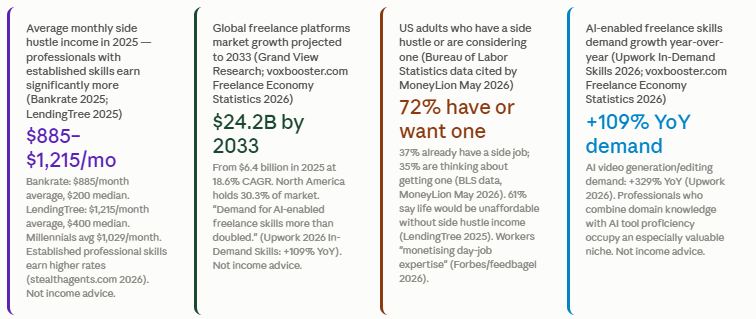
Global freelance platforms market: $6.4B in 2025, projected $24.2B by 2033 at 18.6% CAGR (Grand View Research; voxbooster.com). AI-enabled skills demand: +109% YoY (Upwork 2026). Average side hustle income: $885/month (Bankrate 2025), $1,215/month (LendingTree 2025). 61% of side hustlers say life would be unaffordable without the extra income (LendingTree 2025). Sources cited.
Feedbagel.com’s 2026 analysis, citing Forbes research, found that 73% of Americans in 2026 have side hustles driven by financial necessity rather than passion. MoneyLion’s June 2026 research confirmed that 80% of those with side hustles started for financial reasons. The generation breakdown from Bankrate’s 2025 survey is instructive: millennials earn an average of $1,029 per month, Gen Z $968, boomers $918, and Gen X $512. The millennials’ higher income is consistent with the stealthagents.com 2026 finding that established professional skills command higher freelance rates than those still being built. Experience is a genuine asset.
Writing is the workplace skill that the largest proportion of professionals use daily without recognising it as a marketable commodity. If you write client-facing emails that get responses, proposals that win business, reports that influence decisions, or marketing copy that converts — you are already a writer. The question is only whether you are being paid for it outside the context of your employment. MoneyLion’s May 2026 guide to high-earning side gigs is direct: the real money in freelance writing comes from specialisation. A freelance writer who can write generally earns one rate. A freelance writer who can write specifically — for a particular industry, with a particular technical vocabulary, for a particular audience — earns significantly more. A financial services professional who writes about financial products for financial clients, a healthcare professional who writes health content for medical publications, a technology professional who writes technical documentation: these are all skill combinations worth considerably more in the freelance market than general writing ability. Pwskills.com’s 2026 analysis of top-earning side hustles identifies copywriting as one of the five best-paying options, noting that workers can earn extra income using writing skills on popular freelance platforms that support remote work. The global freelance platforms market is projected to reach $24.2 billion by 2033 (Grand View Research, voxbooster.com) — and writing is consistently among the most in-demand skills within it.
Freelance copywriting: £/$25-£/$150+ per hour depending on specialism and experience. Content writing: £/$0.05-£/$1+ per word. Average individual freelance earnings nationally approximately $52,000/year (Fiverr 2025, GOBankingRates). Not guaranteed. Individual results vary.
Identify two or three industry topics you write about confidently at work. Create two or three sample pieces on those topics (even unpublished internal-style documents work as initial portfolio pieces). Create a profile on Upwork, Fiverr, or Contently. Apply for five roles at rates 20% below your target to build initial reviews. Raise rates after first five satisfied clients.
The consulting side hustle is the most direct transfer of professional skills to additional income: you already know things that other people would pay to learn. The difficulty is not the skill. The difficulty is recognising that expertise accumulated over years of professional experience is not universally available — it is specifically held by you. Lacey Kaelani, co-founder and CEO of Metaintro, told GOBankingRates in 2026: ‘Skill-based work will become the primary side hustle for people who lose job stability.’ Annie Rosencrans, director of people and culture at HiBob, added: ‘Side gigs have become part of how people think about work.’ Consulting takes many forms at the side-income level: fractional consulting (a set number of hours per month for a specific client), one-off advisory calls (platforms like Clarity.fm and Expert360 match consultants with businesses that need a specific conversation), project-based consulting (a defined scope, a defined deliverable, a defined fee), and ongoing retainer arrangements. MoneyLion’s May 2026 guide identified communication, business, and project management skills as essential to any would-be freelancer — all three of which experienced professionals have in abundance. The feedbagel.com Forbes-adjacent 2026 piece confirmed the broader trend: workers are increasingly monetising the same expertise they use in their full-time jobs rather than relying on traditional gig work.
Fractional consulting: $50-$500+/hour depending on seniority and specialism. Advisory calls: $150-$500 per hour on platforms like Clarity.fm. Project-based consulting: varies widely. Millennials with established professional skills charge higher freelance rates than younger workers (stealthagents.com 2026). Not guaranteed.
Start: List your top three professional expertise areas. Search those topics on Clarity.fm and Expert360 to see what demand looks like and what other consultants charge. Create a simple one-page PDF describing your background and what you help with. Offer initial calls at a discounted rate to build initial reviews and case studies.
The tutoring and coaching economy has expanded far beyond academic subjects. Professionals now monetise expertise in: interview preparation (career coaches), productivity and workflow systems (productivity coaches), Excel and data tools (spreadsheet tutors), professional writing (communication coaches), public speaking and presentation (presentation coaches), negotiation (negotiation coaches), and any subject area where there is a learner and a gap between where they are and where a professional’s expertise sits. Pwskills.com’s 2026 analysis identifies online tutoring as one of the top side hustles, with workers earning extra income using teaching skills on platforms that support remote online services. Stealthagents.com’s 2026 research confirms that millennials with established professional skills — writing, design, finance, software development — can charge higher rates precisely because of their professional credibility. Jason O’Brien of TollFreeFowarding.com, quoted by MoneyLion in May 2026, captured the potential precisely: ‘With the right skills, dedication and flexibility, individuals can not only earn extra money but actually generate a second full-time income on the side.’ The tutoring and coaching version of this is particularly accessible because the startup cost is near zero: a laptop, a video call platform, and a booking system (Calendly has a free tier). Not income or career advice.
Online tutoring rates: £/$20-£/$120+/hour depending on subject and level. Executive and professional coaching: $100-$500+/hour for established coaches. Academic tutoring through platforms like Tutorful or Wyzant: $25-$75/hour. Bankrate 2025: average side hustle income $885/month. Not guaranteed.
Identify what colleagues or juniors most often ask you to explain or help with. That is your tutoring topic. Create a profile on Tutorful (UK), Wyzant (US), or Coach.me for coaching. Offer initial sessions at a lower rate to collect testimonials. Document your session structure so it can be repeated consistently.
Design is one of the most consistently under-estimated skills available in the professional workforce. Alyssa Ostroff, founder of Self-Care Shirts, told MoneyLion in June 2026: ‘One of the most overlooked skills I feel people can monetise is design, and you don’t need a degree or any type of expensive software in order to start.’ The reason design is underestimated as a transferable income skill is that most professionals have been using it for years without calling it design: the PowerPoint deck that made an idea look credible, the Excel dashboard that turned data into a story, the Canva social post that got engagement, the document template that made a proposal look professional. These are all design outputs. Upwork’s 2026 In-Demand Skills report found that AI-enabled skills demand rose 109% year-over-year, and AI video generation and editing demand rose 329% year-over-year — both of which are design-adjacent. The tools for professional-quality design have become dramatically more accessible: Canva Pro costs approximately $13/month and produces agency-quality outputs. Figma has a generous free tier. AI image and video tools have dramatically lowered the skill floor for visual content creation. Professionals who combine domain knowledge with visual communication ability have a particularly valuable offering: a healthcare professional who can design patient-facing materials, a financial professional who can create investment presentation decks, a marketer who can create brand content.
Presentation design: $50-$200+/slide deck or per hour. Social media content creation: $25-$100+/hour. Brand design: $500-$5,000+ per project. AI-enabled design demand +109% YoY (Upwork 2026). Not guaranteed. Income varies significantly by niche and skill level.
Build three portfolio pieces using Canva or Figma — demonstrate what you can create. Create profiles on 99designs (competition entry is free to start), Fiverr, or LinkedIn services. Identify one niche (e.g. pitch decks for startups, social media content for local businesses). Target that niche specifically rather than generalising.
Project management and operational skills are among the most directly transferable from employment to freelance income, and among the most under-exploited by the professionals who hold them. The feedbagel.com Forbes-adjacent 2026 analysis confirmed the trend directly: office workers are increasingly monetising day-job skills through side hustles, and project management is one of the primary examples. MoneyLion’s May 2026 guide to high-earning side gigs identified communication, business, and project management skills as essential to any would-be freelancer — and noted that professionals already have these from years of employment. Fractional project management — providing project management as a service for a set number of hours per week to a specific client — is a growing model. Small and medium businesses frequently need more project management capacity than their budget can support in a full-time hire. A skilled freelance project manager who can integrate quickly, communicate clearly, and manage a scope and timeline is a high-value resource. Operations and process improvement consulting sits in a similar space: a professional who has built processes, identified bottlenecks, and improved workflows in a corporate environment has exactly the skills that growing smaller businesses need. Platforms like Toptal, Upwork, and LinkedIn ProFinder all have active markets for freelance project management expertise.
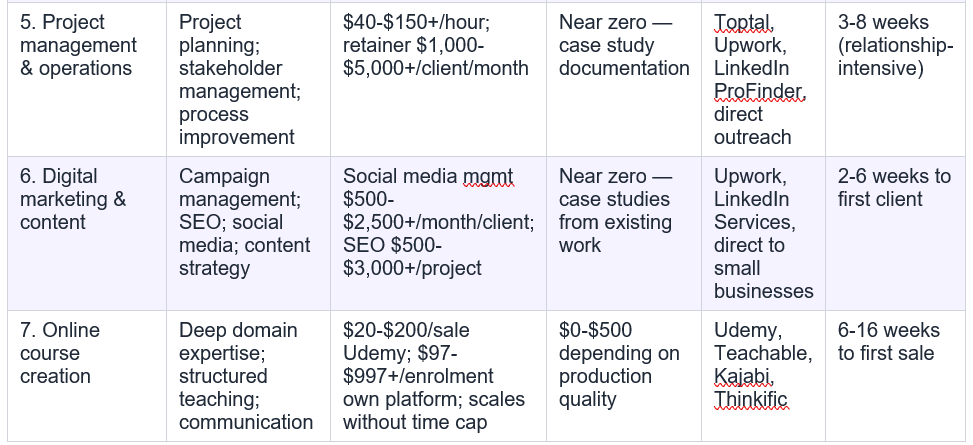
Freelance project management: $40-$150+/hour depending on experience and industry. Fractional operations roles: often arranged as monthly retainers of $1,000-$5,000+ per client. LendingTree 2025: average monthly side hustle income $1,215. Not guaranteed.
Document two or three specific projects you managed successfully — scope, approach, outcome. Create a LinkedIn 'Services' profile highlighting project management. Look at Toptal and Upwork for project management roles. Join the PMI freelance network (US) or APM (UK) for referrals and resources.
Digital marketing is one of the most accessible skill-to-income conversions available in 2026 because the demand for it substantially exceeds the supply of qualified practitioners — particularly at the small and medium business level, where companies need marketing capability but cannot afford a full-time hire. Pwskills.com’s 2026 analysis identified the growing demand for freelance digital skills as one of the primary drivers of side hustle growth, noting that workers can earn extra income using writing, AI-related, and marketing skills on platforms that support remote freelance work. Upwork’s 2026 In-Demand Skills data adds a specific quantification: AI-enabled skills demand rose 109% year-over-year, and AI video generation and editing demand rose 329% year-over-year. Professionals who can combine traditional marketing skills — strategy, copywriting, campaign management — with AI tool proficiency occupy an increasingly valuable niche. The most in-demand digital marketing side hustle services include: social media management for small businesses; email marketing strategy and implementation; SEO auditing and content optimisation; Google Ads and paid social management; and content strategy and creation. All of these are skills that professionals in marketing, communications, PR, or even roles adjacent to marketing (product management, sales, customer success) have developed over years of practice.
Social media management: $500-$2,500+/month per client (retainer basis). Email marketing: $50-$150/hour or per-project rates. SEO and content: $500-$3,000+ per project. AI-enabled skills demand +109% YoY (Upwork 2026). Freelance platforms market growing to $24.2B by 2033. Not guaranteed.
Build a two-page case study on a successful marketing project from your professional experience (anonymised where necessary). Identify three to five local small businesses in your area whose digital marketing you could improve. Offer the first month at a reduced rate in exchange for a testimonial. List services on Upwork, LinkedIn Services, and local business directories.
The online course economy is one of the few ways to monetise professional expertise that scales beyond time. Consulting, tutoring, and project management all trade hours for money. A course creates once and can sell repeatedly, making it the closest thing to genuinely passive income in this category. Stealthagents.com’s 2026 research on remote work side hustles confirms that millennials with established professional skills — writing, design, finance, software development — can charge higher rates, and the course creation model extends this: established professional credibility is the strongest possible marketing asset for an online course. The MoneyLion June 2026 guide notes that research and analytical skills are among the most overlooked side income opportunities — and the course creation model applies these directly: you research what your target learner needs, you structure the knowledge you hold, and you present it in a format that produces a clear outcome for the buyer. Pwskills.com’s 2026 analysis identifies scalable freelance income — the kind that does not require proportionally more time to earn more money — as one of the primary reasons side hustles are growing in 2026. A course built on deep professional expertise is the primary vehicle for that scalability. Platforms including Teachable, Kajabi, Udemy, and Thinkific all provide the infrastructure. The startup cost is a recording setup (a reasonable microphone and good lighting) and the time to create the curriculum.
Udemy self-paced course: $20-$200 per sale (platform takes 50-63% but provides traffic). Own platform course: full price retention, $97-$997+ per enrolment typical. Average side hustler earning $885/month (Bankrate 2025). Scalable: unlike hourly work, course income is not capped by available hours. Not guaranteed.
Identify one professional process, skill, or knowledge area you have deep expertise in and that you have already explained to others (formally or informally). Validate demand by searching Udemy and Teachable for similar courses — if they exist and sell, demand is confirmed. Outline a 5-7 module curriculum. Create a minimum viable version (screen recordings + slides) before investing in expensive production. Launch on Udemy first for traffic before building an independent platform.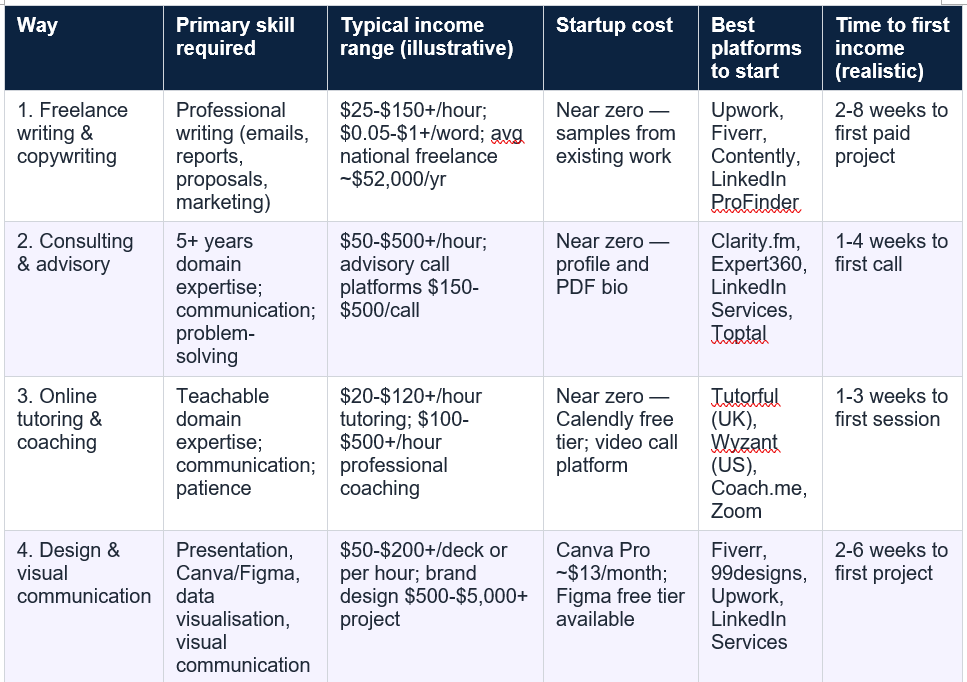
The seven ways in this article are all built on that principle. Each translates something a professional already does at work — writing, advising, teaching, designing, managing, marketing, or creating structured knowledge — into an income stream that operates outside the employer relationship. The startup cost for six of the seven is near zero. The timeline to first income for most of them is measured in weeks, not months. The constraint is not skill. It is the step of recognising that the skill is already there and deciding to point it outward. Not income, financial, or career advice. Check your employment contract for restrictions on outside work, and consult a tax professional about the implications of additional income in your jurisdiction.
The research range is wide because the outcomes are genuinely wide. Bankrate's 2025 Side Hustle Survey found an average monthly income of $885 and a median of $200. LendingTree's parallel survey found $1,215 average and $400 median. The gap between average and median reflects a real distribution: a significant proportion of side hustlers earn under $500 per month, while a smaller group earns substantially more. Stealthagents.com's 2026 research found that millennials with established professional skills earn higher rates than younger workers still building credibility — which is an argument for starting sooner: the side income rate you can command improves as your professional reputation grows. The Fiverr 2025 data cited by GOBankingRates puts average annual freelance income at approximately $52,000 nationally. 51% of side hustlers earned $500 or less monthly, but 76% were satisfied with what they earned (MoneyLion June 2026 citing Omnisend research). Individual results vary significantly.
Should I check my employment contract before starting a side hustle?
Yes — this is important. Many employment contracts include clauses about outside work, non-compete restrictions, non-solicitation of clients, or intellectual property ownership that could affect your ability to offer similar services to clients outside your employer. Feedbagel.com's 2026 analysis specifically noted that employers are revisiting moonlighting policies as workers leverage their professional skills for side income. Before starting any income-generating activity that uses similar skills to your employment, read your contract's relevant clauses. Where the situation is ambiguous, legal advice specific to your jurisdiction and contract is worth the investment. The risk is not just legal — it is reputational and professional. This article cannot provide legal or employment advice. Consult a qualified employment lawyer or HR professional if uncertain about your contract.
Do I need to register as self-employed or report side income for tax purposes?
In almost every jurisdiction: yes to both. In the UK, income above the trading allowance (£1,000 per year as of 2025-2026) from self-employed work must be reported via self-assessment. In the US, freelance income of $400 or more per year from any single source must be reported, and typically attracts self-employment tax as well as income tax. ChooseFI community members repeatedly note that state tax implications also apply in the US. Tax obligations vary by country, state or province, and individual circumstances. This article cannot provide tax advice. Consult a qualified tax professional before starting any income-generating activity outside employment. The tax implications of additional income can be significant and should be planned for before the income arrives.
What is the easiest and fastest way to start earning from existing work skills?
Based on the research and the seven methods in this article, the fastest path to first income is typically consulting or advisory work (way 2) or online tutoring (way 3) because they require near-zero setup: a profile on Clarity.fm, Coach.me, or a tutoring platform, and one initial client or session. Freelance writing (way 1) is also fast because samples from existing professional work can serve as an initial portfolio. The slower but potentially more scalable option is online course creation (way 7) — typically 6-16 weeks to first sale, but income that does not require proportionally more time as it grows. Jason O'Brien (MoneyLion May 2026): 'The rise of high-earning side hustles is redefining how people think about work and income.' Bankrate found average side hustle income at $885/month. Individual results vary significantly.
Are these methods sustainable alongside a full-time job?
Yes — all seven of the methods in this article are specifically designed for part-time operation alongside full-time employment. Feedbagel.com's 2026 analysis noted that side hustles 'offer strong income potential even with part-time work.' GoF BankingRates' 2026 expert roundup noted that side gigs offer flexible hours and the ability to choose your own projects — the primary reasons they are compatible with full employment. The practical constraints are time (2-10 hours per week is a realistic starting range for most of these methods) and energy (the work uses similar cognitive skills to the day job, so managing fatigue is real). The methods with the best part-time compatibility are consulting and advisory calls (time-bounded, high value per hour), tutoring (schedulable sessions), and online course creation once built (ongoing income with minimal time).Individual circumstances vary.
The fastest growing approach to side income in 2026 is not finding a new skill and learning it from scratch. It is looking at what you already do every day at work and asking whether someone outside your employer would pay for it. The answer, in a remarkable proportion of cases, is yes. Feedbagel.com’s Forbes-adjacent analysis of the 2026 side hustle economy confirmed what many professionals have been discovering through experience: workers are increasingly monetising the same expertise they use in their full-time jobs rather than relying solely on traditional gig work. The Bankrate 2025 Side Hustle Survey found the average monthly side hustle income at $885. LendingTree’s data puts it higher at $1,215 per month. Whatever the exact average, the more meaningful finding is the 61% of side hustlers who told LendingTree that their life would be unaffordable without the extra income. This is not a hobby economy. It is a skills economy. And the professionals who earn the most in it are not the ones who found the cleverest gig. They are the ones who recognised the market value of expertise they had already built. The seven methods that follow are structured around that principle: each is a direct translation of a professional skill that most workers use at work every day into an income stream that works outside it.
Table of Contents
- Why Your Day Job Skills Are Worth More Than You Think
- The Side Hustle Economy in 2026: Where the Money Is
- Way 1 Freelance Writing and Copywriting
- Way 2 Consulting and Advisory Work
- Way 3 Online Tutoring and Coaching
- Way 4 Freelance Design and Visual Communication
- Way 5 Freelance Project Management and Operations
- Way 6 Digital Marketing and Content Creation
- Way 7 Online Course and Training Creation
- The Skills-to-Income Quick Reference
- Conclusion: The Best Side Hustle Is Built From What You Already Know
- Frequently Asked Questions
Why Your Day Job Skills Are Worth More Than You Think
The gap between what a professional knows and what they believe they could earn from that knowledge outside their employment is almost always larger than they expect. Professional skills that were acquired through years of experience, practice, and formal or informal training are not freely available in the market. They are specifically held by the people who developed them. The market for those skills outside employment — in freelance work, consulting, coaching, and online education — has grown substantially. The global freelance platforms market was valued at $6.4 billion in 2025 and is projected to reach $24.2 billion by 2033, an 18.6% compound annual growth rate (Grand View Research, cited by voxbooster.com). Upwork’s 2026 In-Demand Skills report found that AI-enabled freelance skills demand rose 109% year-over-year.The more important point is the one that feedbagel.com’s Forbes-adjacent 2026 analysis made: workers are now monetising the same expertise they use in their full-time jobs rather than relying solely on traditional gig work. The workers who earn the most from side income are not generally those who trained in a new skill to sell it. They are the ones who recognised that the skills they used every day at work were already worth money to a different set of buyers. Lacey Kaelani, co-founder and CEO of Metaintro, said it plainly to GOBankingRates in 2026: ‘Skill-based work will become the primary side hustle for people who lose job stability.
Global freelance platforms market: $6.4B in 2025, projected $24.2B by 2033 at 18.6% CAGR (Grand View Research; voxbooster.com). AI-enabled skills demand: +109% YoY (Upwork 2026). Average side hustle income: $885/month (Bankrate 2025), $1,215/month (LendingTree 2025). 61% of side hustlers say life would be unaffordable without the extra income (LendingTree 2025). Sources cited.
The Side Hustle Economy in 2026: Where the Money Is
The scale of the side hustle economy in 2026 is significant. LendingTree’s 2025 Side Hustle Survey found that 38% of Americans have a side hustle, with an average monthly income of $1,215 and a median of $400. Bankrate’s parallel survey put the average at $885 per month, with a median of $200. The difference between average and median matters: a relatively small number of high-earning professionals pull the average up, while the majority of side hustlers earn in the $200-$500 monthly range. Both figures are meaningful additional income against a backdrop where 61% of side hustlers told LendingTree that their life would be unaffordable without the extra income.Feedbagel.com’s 2026 analysis, citing Forbes research, found that 73% of Americans in 2026 have side hustles driven by financial necessity rather than passion. MoneyLion’s June 2026 research confirmed that 80% of those with side hustles started for financial reasons. The generation breakdown from Bankrate’s 2025 survey is instructive: millennials earn an average of $1,029 per month, Gen Z $968, boomers $918, and Gen X $512. The millennials’ higher income is consistent with the stealthagents.com 2026 finding that established professional skills command higher freelance rates than those still being built. Experience is a genuine asset.
Way 1 Freelance Writing and Copywriting
The skill transfer: The skill transfer: Any professional who writes at work — emails, reports, proposals, internal communications, project briefs, marketing content — already has the foundational skill.Writing is the workplace skill that the largest proportion of professionals use daily without recognising it as a marketable commodity. If you write client-facing emails that get responses, proposals that win business, reports that influence decisions, or marketing copy that converts — you are already a writer. The question is only whether you are being paid for it outside the context of your employment. MoneyLion’s May 2026 guide to high-earning side gigs is direct: the real money in freelance writing comes from specialisation. A freelance writer who can write generally earns one rate. A freelance writer who can write specifically — for a particular industry, with a particular technical vocabulary, for a particular audience — earns significantly more. A financial services professional who writes about financial products for financial clients, a healthcare professional who writes health content for medical publications, a technology professional who writes technical documentation: these are all skill combinations worth considerably more in the freelance market than general writing ability. Pwskills.com’s 2026 analysis of top-earning side hustles identifies copywriting as one of the five best-paying options, noting that workers can earn extra income using writing skills on popular freelance platforms that support remote work. The global freelance platforms market is projected to reach $24.2 billion by 2033 (Grand View Research, voxbooster.com) — and writing is consistently among the most in-demand skills within it.
Freelance copywriting: £/$25-£/$150+ per hour depending on specialism and experience. Content writing: £/$0.05-£/$1+ per word. Average individual freelance earnings nationally approximately $52,000/year (Fiverr 2025, GOBankingRates). Not guaranteed. Individual results vary.
Identify two or three industry topics you write about confidently at work. Create two or three sample pieces on those topics (even unpublished internal-style documents work as initial portfolio pieces). Create a profile on Upwork, Fiverr, or Contently. Apply for five roles at rates 20% below your target to build initial reviews. Raise rates after first five satisfied clients.
Way 2 Consulting and Advisory Work
The skill transfer: The skill transfer: Any professional with five or more years of industry experience has accumulated knowledge that is genuinely scarce and genuinely valuable to those earlier in their careers or in adjacent industries.The consulting side hustle is the most direct transfer of professional skills to additional income: you already know things that other people would pay to learn. The difficulty is not the skill. The difficulty is recognising that expertise accumulated over years of professional experience is not universally available — it is specifically held by you. Lacey Kaelani, co-founder and CEO of Metaintro, told GOBankingRates in 2026: ‘Skill-based work will become the primary side hustle for people who lose job stability.’ Annie Rosencrans, director of people and culture at HiBob, added: ‘Side gigs have become part of how people think about work.’ Consulting takes many forms at the side-income level: fractional consulting (a set number of hours per month for a specific client), one-off advisory calls (platforms like Clarity.fm and Expert360 match consultants with businesses that need a specific conversation), project-based consulting (a defined scope, a defined deliverable, a defined fee), and ongoing retainer arrangements. MoneyLion’s May 2026 guide identified communication, business, and project management skills as essential to any would-be freelancer — all three of which experienced professionals have in abundance. The feedbagel.com Forbes-adjacent 2026 piece confirmed the broader trend: workers are increasingly monetising the same expertise they use in their full-time jobs rather than relying on traditional gig work.
Fractional consulting: $50-$500+/hour depending on seniority and specialism. Advisory calls: $150-$500 per hour on platforms like Clarity.fm. Project-based consulting: varies widely. Millennials with established professional skills charge higher freelance rates than younger workers (stealthagents.com 2026). Not guaranteed.
Start: List your top three professional expertise areas. Search those topics on Clarity.fm and Expert360 to see what demand looks like and what other consultants charge. Create a simple one-page PDF describing your background and what you help with. Offer initial calls at a discounted rate to build initial reviews and case studies.
Way 3 Online Tutoring and Coaching
The skill transfer: The skill transfer: Any professional with deep expertise in a subject, a process, or a skill that others want to learn is a potential tutor or coach. The teaching happened informally at work already — mentoring colleagues, training new starters, explaining processes.The tutoring and coaching economy has expanded far beyond academic subjects. Professionals now monetise expertise in: interview preparation (career coaches), productivity and workflow systems (productivity coaches), Excel and data tools (spreadsheet tutors), professional writing (communication coaches), public speaking and presentation (presentation coaches), negotiation (negotiation coaches), and any subject area where there is a learner and a gap between where they are and where a professional’s expertise sits. Pwskills.com’s 2026 analysis identifies online tutoring as one of the top side hustles, with workers earning extra income using teaching skills on platforms that support remote online services. Stealthagents.com’s 2026 research confirms that millennials with established professional skills — writing, design, finance, software development — can charge higher rates precisely because of their professional credibility. Jason O’Brien of TollFreeFowarding.com, quoted by MoneyLion in May 2026, captured the potential precisely: ‘With the right skills, dedication and flexibility, individuals can not only earn extra money but actually generate a second full-time income on the side.’ The tutoring and coaching version of this is particularly accessible because the startup cost is near zero: a laptop, a video call platform, and a booking system (Calendly has a free tier). Not income or career advice.
Online tutoring rates: £/$20-£/$120+/hour depending on subject and level. Executive and professional coaching: $100-$500+/hour for established coaches. Academic tutoring through platforms like Tutorful or Wyzant: $25-$75/hour. Bankrate 2025: average side hustle income $885/month. Not guaranteed.
Identify what colleagues or juniors most often ask you to explain or help with. That is your tutoring topic. Create a profile on Tutorful (UK), Wyzant (US), or Coach.me for coaching. Offer initial sessions at a lower rate to collect testimonials. Document your session structure so it can be repeated consistently.
Way 4 Freelance Design and Visual Communication
The skill transfer: The skill transfer: Any professional who creates presentations, designs documents, builds dashboards, or makes visual materials at work already uses design skills. These are not always recognised as 'design' but they are.Design is one of the most consistently under-estimated skills available in the professional workforce. Alyssa Ostroff, founder of Self-Care Shirts, told MoneyLion in June 2026: ‘One of the most overlooked skills I feel people can monetise is design, and you don’t need a degree or any type of expensive software in order to start.’ The reason design is underestimated as a transferable income skill is that most professionals have been using it for years without calling it design: the PowerPoint deck that made an idea look credible, the Excel dashboard that turned data into a story, the Canva social post that got engagement, the document template that made a proposal look professional. These are all design outputs. Upwork’s 2026 In-Demand Skills report found that AI-enabled skills demand rose 109% year-over-year, and AI video generation and editing demand rose 329% year-over-year — both of which are design-adjacent. The tools for professional-quality design have become dramatically more accessible: Canva Pro costs approximately $13/month and produces agency-quality outputs. Figma has a generous free tier. AI image and video tools have dramatically lowered the skill floor for visual content creation. Professionals who combine domain knowledge with visual communication ability have a particularly valuable offering: a healthcare professional who can design patient-facing materials, a financial professional who can create investment presentation decks, a marketer who can create brand content.
Presentation design: $50-$200+/slide deck or per hour. Social media content creation: $25-$100+/hour. Brand design: $500-$5,000+ per project. AI-enabled design demand +109% YoY (Upwork 2026). Not guaranteed. Income varies significantly by niche and skill level.
Build three portfolio pieces using Canva or Figma — demonstrate what you can create. Create profiles on 99designs (competition entry is free to start), Fiverr, or LinkedIn services. Identify one niche (e.g. pitch decks for startups, social media content for local businesses). Target that niche specifically rather than generalising.
Way 5 Freelance Project Management and Operations
The skill transfer: The skill transfer: Any professional who has managed projects, coordinated teams, run meetings, built processes, or kept stakeholders aligned already has a highly transferable operational skill set.Project management and operational skills are among the most directly transferable from employment to freelance income, and among the most under-exploited by the professionals who hold them. The feedbagel.com Forbes-adjacent 2026 analysis confirmed the trend directly: office workers are increasingly monetising day-job skills through side hustles, and project management is one of the primary examples. MoneyLion’s May 2026 guide to high-earning side gigs identified communication, business, and project management skills as essential to any would-be freelancer — and noted that professionals already have these from years of employment. Fractional project management — providing project management as a service for a set number of hours per week to a specific client — is a growing model. Small and medium businesses frequently need more project management capacity than their budget can support in a full-time hire. A skilled freelance project manager who can integrate quickly, communicate clearly, and manage a scope and timeline is a high-value resource. Operations and process improvement consulting sits in a similar space: a professional who has built processes, identified bottlenecks, and improved workflows in a corporate environment has exactly the skills that growing smaller businesses need. Platforms like Toptal, Upwork, and LinkedIn ProFinder all have active markets for freelance project management expertise.
Freelance project management: $40-$150+/hour depending on experience and industry. Fractional operations roles: often arranged as monthly retainers of $1,000-$5,000+ per client. LendingTree 2025: average monthly side hustle income $1,215. Not guaranteed.
Document two or three specific projects you managed successfully — scope, approach, outcome. Create a LinkedIn 'Services' profile highlighting project management. Look at Toptal and Upwork for project management roles. Join the PMI freelance network (US) or APM (UK) for referrals and resources.
Way 6 Digital Marketing and Content Creation
The skill transfer: The skill transfer: Any professional who has run campaigns, managed social media, analysed marketing data, created content, or contributed to marketing strategy has directly transferable digital marketing skills.Digital marketing is one of the most accessible skill-to-income conversions available in 2026 because the demand for it substantially exceeds the supply of qualified practitioners — particularly at the small and medium business level, where companies need marketing capability but cannot afford a full-time hire. Pwskills.com’s 2026 analysis identified the growing demand for freelance digital skills as one of the primary drivers of side hustle growth, noting that workers can earn extra income using writing, AI-related, and marketing skills on platforms that support remote freelance work. Upwork’s 2026 In-Demand Skills data adds a specific quantification: AI-enabled skills demand rose 109% year-over-year, and AI video generation and editing demand rose 329% year-over-year. Professionals who can combine traditional marketing skills — strategy, copywriting, campaign management — with AI tool proficiency occupy an increasingly valuable niche. The most in-demand digital marketing side hustle services include: social media management for small businesses; email marketing strategy and implementation; SEO auditing and content optimisation; Google Ads and paid social management; and content strategy and creation. All of these are skills that professionals in marketing, communications, PR, or even roles adjacent to marketing (product management, sales, customer success) have developed over years of practice.
Social media management: $500-$2,500+/month per client (retainer basis). Email marketing: $50-$150/hour or per-project rates. SEO and content: $500-$3,000+ per project. AI-enabled skills demand +109% YoY (Upwork 2026). Freelance platforms market growing to $24.2B by 2033. Not guaranteed.
Build a two-page case study on a successful marketing project from your professional experience (anonymised where necessary). Identify three to five local small businesses in your area whose digital marketing you could improve. Offer the first month at a reduced rate in exchange for a testimonial. List services on Upwork, LinkedIn Services, and local business directories.
Way 7 Online Course and Training Creation
The skill transfer: The skill transfer: Any professional who has trained colleagues, onboarded new starters, delivered presentations, or created educational content for internal use already has both the expertise and the communication skills to create a sellable course.The online course economy is one of the few ways to monetise professional expertise that scales beyond time. Consulting, tutoring, and project management all trade hours for money. A course creates once and can sell repeatedly, making it the closest thing to genuinely passive income in this category. Stealthagents.com’s 2026 research on remote work side hustles confirms that millennials with established professional skills — writing, design, finance, software development — can charge higher rates, and the course creation model extends this: established professional credibility is the strongest possible marketing asset for an online course. The MoneyLion June 2026 guide notes that research and analytical skills are among the most overlooked side income opportunities — and the course creation model applies these directly: you research what your target learner needs, you structure the knowledge you hold, and you present it in a format that produces a clear outcome for the buyer. Pwskills.com’s 2026 analysis identifies scalable freelance income — the kind that does not require proportionally more time to earn more money — as one of the primary reasons side hustles are growing in 2026. A course built on deep professional expertise is the primary vehicle for that scalability. Platforms including Teachable, Kajabi, Udemy, and Thinkific all provide the infrastructure. The startup cost is a recording setup (a reasonable microphone and good lighting) and the time to create the curriculum.
Udemy self-paced course: $20-$200 per sale (platform takes 50-63% but provides traffic). Own platform course: full price retention, $97-$997+ per enrolment typical. Average side hustler earning $885/month (Bankrate 2025). Scalable: unlike hourly work, course income is not capped by available hours. Not guaranteed.
Identify one professional process, skill, or knowledge area you have deep expertise in and that you have already explained to others (formally or informally). Validate demand by searching Udemy and Teachable for similar courses — if they exist and sell, demand is confirmed. Outline a 5-7 module curriculum. Create a minimum viable version (screen recordings + slides) before investing in expensive production. Launch on Udemy first for traffic before building an independent platform.
The Skills-to-Income Quick Reference
Conclusion
The consistent finding across the 2025-2026 research on side hustles and freelance income is that skill-based work outperforms generic gig work. Bankrate found average monthly side hustle income at $885; LendingTree found it at $1,215. The professionals at the top end of those distributions are not generally doing the most time-intensive gig work. They are the ones who recognised that what they already know is worth money to a different set of buyers. Jason O’Brien of TollFreeFowarding.com articulated the potential: ‘With the right skills, dedication and flexibility, individuals can not only earn extra money but actually generate a second full-time income on the side.’The seven ways in this article are all built on that principle. Each translates something a professional already does at work — writing, advising, teaching, designing, managing, marketing, or creating structured knowledge — into an income stream that operates outside the employer relationship. The startup cost for six of the seven is near zero. The timeline to first income for most of them is measured in weeks, not months. The constraint is not skill. It is the step of recognising that the skill is already there and deciding to point it outward. Not income, financial, or career advice. Check your employment contract for restrictions on outside work, and consult a tax professional about the implications of additional income in your jurisdiction.
Frequently Asked Questions
How much can I realistically earn from a skills-based side hustle?The research range is wide because the outcomes are genuinely wide. Bankrate's 2025 Side Hustle Survey found an average monthly income of $885 and a median of $200. LendingTree's parallel survey found $1,215 average and $400 median. The gap between average and median reflects a real distribution: a significant proportion of side hustlers earn under $500 per month, while a smaller group earns substantially more. Stealthagents.com's 2026 research found that millennials with established professional skills earn higher rates than younger workers still building credibility — which is an argument for starting sooner: the side income rate you can command improves as your professional reputation grows. The Fiverr 2025 data cited by GOBankingRates puts average annual freelance income at approximately $52,000 nationally. 51% of side hustlers earned $500 or less monthly, but 76% were satisfied with what they earned (MoneyLion June 2026 citing Omnisend research). Individual results vary significantly.
Should I check my employment contract before starting a side hustle?
Yes — this is important. Many employment contracts include clauses about outside work, non-compete restrictions, non-solicitation of clients, or intellectual property ownership that could affect your ability to offer similar services to clients outside your employer. Feedbagel.com's 2026 analysis specifically noted that employers are revisiting moonlighting policies as workers leverage their professional skills for side income. Before starting any income-generating activity that uses similar skills to your employment, read your contract's relevant clauses. Where the situation is ambiguous, legal advice specific to your jurisdiction and contract is worth the investment. The risk is not just legal — it is reputational and professional. This article cannot provide legal or employment advice. Consult a qualified employment lawyer or HR professional if uncertain about your contract.
Do I need to register as self-employed or report side income for tax purposes?
In almost every jurisdiction: yes to both. In the UK, income above the trading allowance (£1,000 per year as of 2025-2026) from self-employed work must be reported via self-assessment. In the US, freelance income of $400 or more per year from any single source must be reported, and typically attracts self-employment tax as well as income tax. ChooseFI community members repeatedly note that state tax implications also apply in the US. Tax obligations vary by country, state or province, and individual circumstances. This article cannot provide tax advice. Consult a qualified tax professional before starting any income-generating activity outside employment. The tax implications of additional income can be significant and should be planned for before the income arrives.
What is the easiest and fastest way to start earning from existing work skills?
Based on the research and the seven methods in this article, the fastest path to first income is typically consulting or advisory work (way 2) or online tutoring (way 3) because they require near-zero setup: a profile on Clarity.fm, Coach.me, or a tutoring platform, and one initial client or session. Freelance writing (way 1) is also fast because samples from existing professional work can serve as an initial portfolio. The slower but potentially more scalable option is online course creation (way 7) — typically 6-16 weeks to first sale, but income that does not require proportionally more time as it grows. Jason O'Brien (MoneyLion May 2026): 'The rise of high-earning side hustles is redefining how people think about work and income.' Bankrate found average side hustle income at $885/month. Individual results vary significantly.
Are these methods sustainable alongside a full-time job?
Yes — all seven of the methods in this article are specifically designed for part-time operation alongside full-time employment. Feedbagel.com's 2026 analysis noted that side hustles 'offer strong income potential even with part-time work.' GoF BankingRates' 2026 expert roundup noted that side gigs offer flexible hours and the ability to choose your own projects — the primary reasons they are compatible with full employment. The practical constraints are time (2-10 hours per week is a realistic starting range for most of these methods) and energy (the work uses similar cognitive skills to the day job, so managing fatigue is real). The methods with the best part-time compatibility are consulting and advisory calls (time-bounded, high value per hour), tutoring (schedulable sessions), and online course creation once built (ongoing income with minimal time).Individual circumstances vary.
0 Comments
Be the first to share your thoughts on this article.